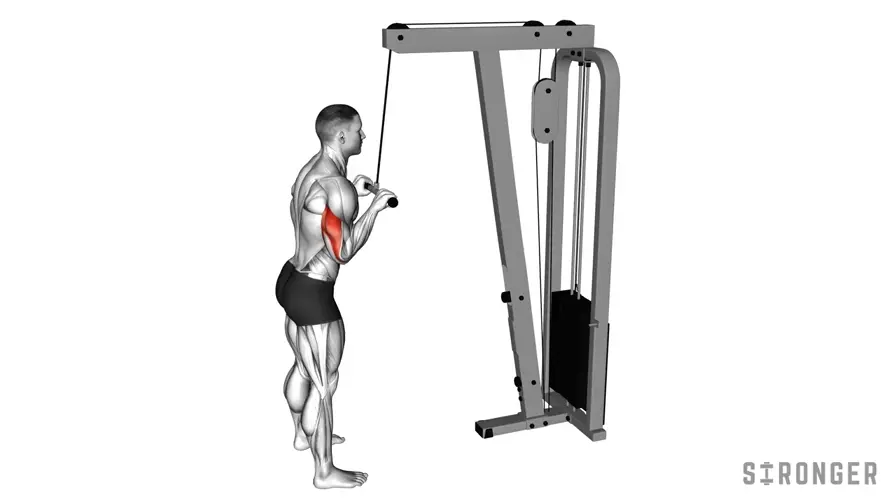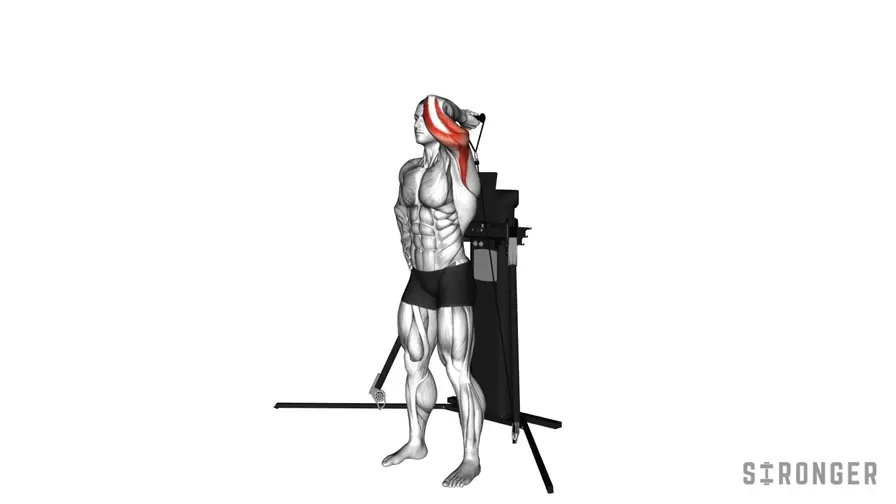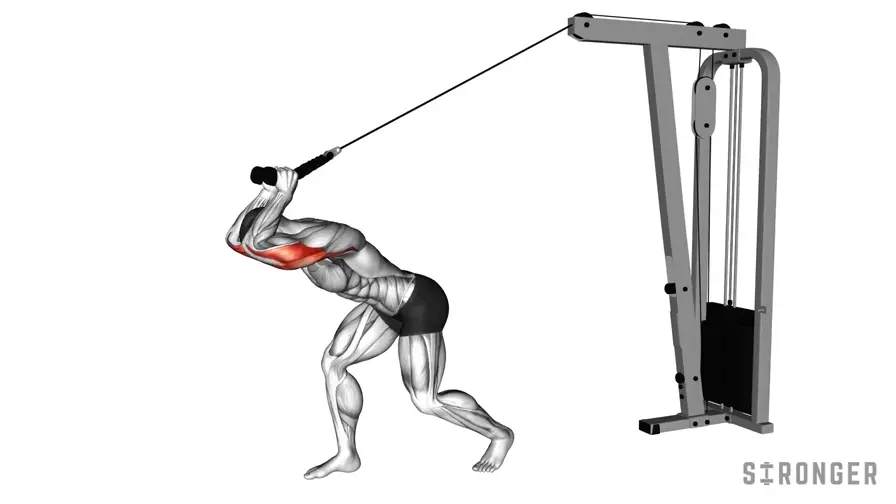

Cable Kickback
Category
isolationDifficulty
beginner
Equipment
cable
Force Type
push
How to Perform the Cable Kickback
- Set the cable pulley to a low or mid-low position and attach a single D-handle.
- Grasp the handle with one hand and step back from the machine.
- Hinge forward at the hips until your torso is roughly parallel to the floor, supporting yourself with your free hand on your knee or the machine.
- Raise your upper arm so it is parallel to the floor and pin it in place, with your elbow bent at 90 degrees.
- Extend your forearm backward by straightening your elbow, squeezing the tricep hard at full extension.
- Hold the fully extended position for a brief pause.
- Slowly bend your elbow to return to the starting position without dropping your upper arm.
- Complete all repetitions on one arm before switching to the other side.
Common Mistakes to Avoid
Dropping the upper arm below parallel to the floor
Keep your upper arm locked in position parallel to the ground throughout the entire set.
Using momentum to swing the forearm back
Move only at the elbow joint with controlled, deliberate movement on both the concentric and eccentric phases.
Not fully extending the arm at the top
Completely straighten the elbow at the top of each rep to achieve full tricep contraction.
Muscles Worked
Benefits
- ✓Constant cable tension eliminates the dead zone at the bottom that exists with dumbbell kickbacks.
- ✓Excellent isolation of the triceps, particularly the lateral head.
- ✓Unilateral training allows you to address strength imbalances between arms.
Pro Tips
- ●Focus on the squeeze at the top of the movement where the tricep is fully contracted.
- ●Keep your core tight and your back flat while hinged forward.
- ●The cable version is superior to dumbbells because tension is maintained throughout the full range of motion.
Recommended Sets & Reps
Strength
4-5 sets of 3-5 reps at 80-90% 1RM
Hypertrophy
3-4 sets of 8-12 reps at 65-75% 1RM
Endurance
2-3 sets of 15-20 reps at 50-60% 1RM
Track Your Cable Kickback in Stronger
Log your sets, watch your cable kickback progress over time, and see how it feeds your Strength Score. Join 2,000,000+ lifters on iOS and Android.
Start tracking freeTraining Guides
Articles featuring the cable kickback in workout programs and training advice.