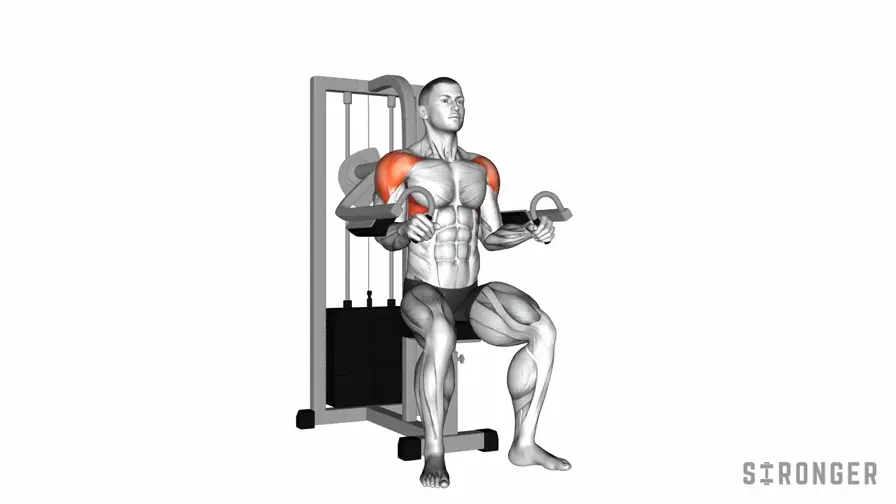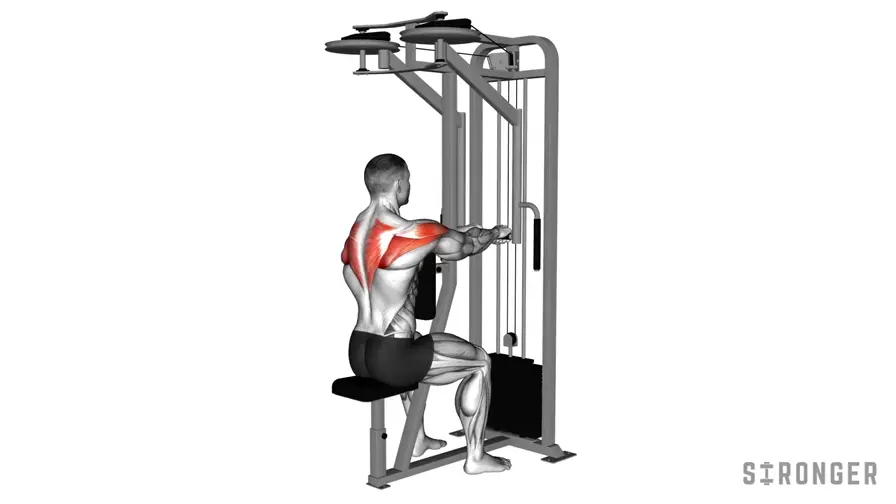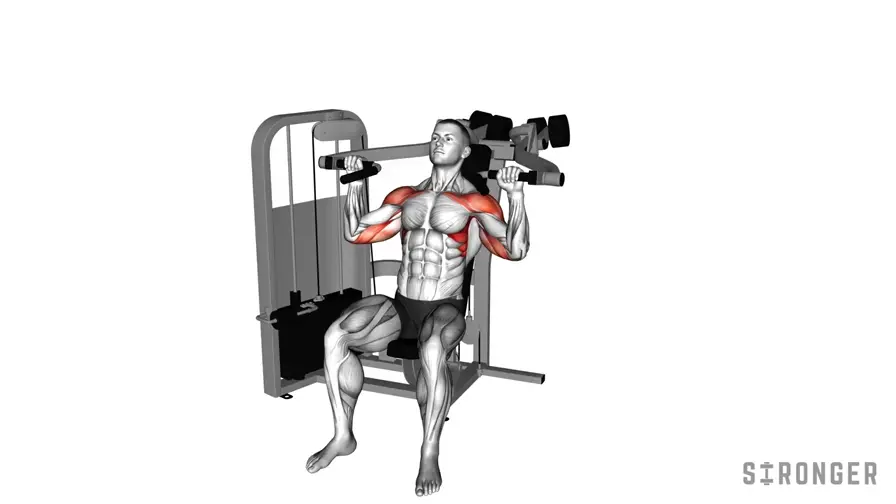

Lateral Raise Machine
Category
isolationDifficulty
beginner
Equipment
machine
Force Type
push
How to Perform the Lateral Raise Machine
- Adjust the seat height so the pivot point of the machine aligns with your shoulder joints.
- Sit down and position your upper arms against the pads, gripping the handles lightly.
- Start with your arms at your sides, elbows slightly bent.
- Raise your arms out to the sides by pushing against the pads until your upper arms are roughly parallel to the floor.
- Pause briefly at the top of the movement, squeezing the lateral deltoids.
- Lower the weight slowly and under control back to the starting position.
- Avoid letting the weight stack touch down between reps to maintain continuous tension.
Common Mistakes to Avoid
Using too much weight and relying on momentum
Select a weight that allows controlled movement through the full range of motion with a clear pause at the top.
Shrugging the traps to lift the weight
Keep your shoulders depressed and focus on initiating the movement from the lateral deltoids, not the traps.
Raising the arms too high above parallel
Stop when your upper arms reach parallel to avoid excessive trap involvement and potential impingement.
Muscles Worked
Benefits
- ✓Isolates the lateral deltoids effectively for building wider, broader shoulders.
- ✓Machine path eliminates the need for stabilization, allowing full focus on the target muscle.
- ✓Provides consistent resistance throughout the range of motion, unlike free-weight lateral raises which lose tension at the bottom.
Pro Tips
- ●Focus on a slow eccentric (lowering) phase of 2-3 seconds to maximize time under tension.
- ●Think about pushing your elbows out and up rather than lifting your hands to better engage the lateral delts.
- ●This machine is ideal for drop sets due to easy weight changes.
Variations
Recommended Sets & Reps
Strength
4-5 sets of 3-5 reps at 80-90% 1RM
Hypertrophy
3-4 sets of 8-12 reps at 65-75% 1RM
Endurance
2-3 sets of 15-20 reps at 50-60% 1RM
Track Your Lateral Raise Machine in Stronger
Log your sets, watch your lateral raise machine progress over time, and see how it feeds your Strength Score. Join 2,000,000+ lifters on iOS and Android.
Start tracking free