

5x5 Workout Program: The Complete Guide to Building Strength
What Is the 5x5 Workout Program?
The 5x5 workout program is a strength training method built on one simple principle: perform 5 sets of 5 reps on heavy compound lifts, add weight every session, and get progressively stronger over time.
The concept dates back decades — legendary bodybuilder Reg Park popularised the 5x5 method in the 1960s, and it has been refined into several modern programmes. The two most well-known versions are StrongLifts 5x5 and Madcow 5x5, each designed for different experience levels.
What makes 5x5 so effective is its simplicity. You focus on a small number of big lifts, train with moderate-to-heavy loads, and add weight in small increments. There are no complicated periodisation schemes, no exercise variety for the sake of variety — just consistent progressive overload on the movements that matter most [1].
Who Is the 5x5 Program For?
The 5x5 method is ideal for:
- Beginners (0–12 months of training) who want to build a foundation of strength
- Intermediate lifters returning to structured training after a break
- Anyone prioritising strength over bodybuilding-style hypertrophy
- Lifters who prefer minimal, efficient workouts over high-volume sessions
If you are an advanced lifter who has been training for several years, a standard linear 5x5 will stop working relatively quickly. In that case, Madcow 5x5 (which uses weekly rather than session-to-session progression) is more appropriate.
StrongLifts 5x5 vs Madcow 5x5
These are the two most popular 5x5 programmes. Here is how they compare:
| Feature | StrongLifts 5x5 | Madcow 5x5 |
|---|---|---|
| Experience level | Beginner | Intermediate |
| Progression | Every session (+2.5 kg) | Weekly (ramping sets) |
| Frequency | 3 days/week | 3 days/week |
| Structure | Alternating A/B workouts | Volume/Light/Intensity |
| Deadlift volume | 1×5 | 4×5 (ramping) |
| Duration | 12–16 weeks typical | 12+ weeks |
StrongLifts 5x5 — The Beginner Programme
StrongLifts uses two alternating workouts (A and B) performed three times per week on non-consecutive days.
Workout A:
| Exercise | Sets × Reps |
|---|---|
| Barbell Back Squat | 5 × 5 |
| Barbell Bench Press | 5 × 5 |
| Barbell Row | 5 × 5 |
Workout B:
| Exercise | Sets × Reps |
|---|---|
| Barbell Back Squat | 5 × 5 |
| Overhead Press | 5 × 5 |
| Deadlift | 1 × 5 |
You alternate A and B each training day. A typical week looks like this:
| Week | Monday | Wednesday | Friday |
|---|---|---|---|
| 1 | Workout A | Workout B | Workout A |
| 2 | Workout B | Workout A | Workout B |
Notice that you squat every session. This high frequency is what drives rapid strength gains in beginners — you practise the movement pattern three times per week while adding weight each time.
Madcow 5x5 — The Intermediate Programme
When StrongLifts stalls (typically after 3–6 months), Madcow 5x5 extends progress by using weekly rather than per-session progression. Instead of straight 5×5, you ramp up to a heavy top set.
Monday (Volume):
| Exercise | Sets × Reps |
|---|---|
| Squat | 5 × 5 (ramping to top set) |
| Bench Press | 5 × 5 (ramping) |
| Barbell Row | 5 × 5 (ramping) |
Wednesday (Light):
| Exercise | Sets × Reps |
|---|---|
| Squat | 4 × 5 (sets 1–3 as Monday, set 4 repeats set 3) |
| Overhead Press | 4 × 5 |
| Deadlift | 4 × 5 (ramping) |
Friday (Heavy):
| Exercise | Sets × Reps |
|---|---|
| Squat | 4 × 5 + 1 × 3 + 1 × 8 (back-off) |
| Bench Press | 4 × 5 + 1 × 3 + 1 × 8 |
| Barbell Row | 4 × 5 + 1 × 3 + 1 × 8 |
The ramping sets mean your first sets are lighter warm-ups that build to a heavy working set. This manages fatigue while still providing the overload stimulus for strength gains.
Ready to Get Stronger?
Join 2,000,000+ lifters tracking their workouts with Stronger. Available on iOS and Android.
Start tracking freeThe Five Core Exercises
Every 5x5 programme revolves around five barbell lifts. These are chosen because they recruit the most muscle mass, allow for the heaviest loads, and develop functional, whole-body strength.
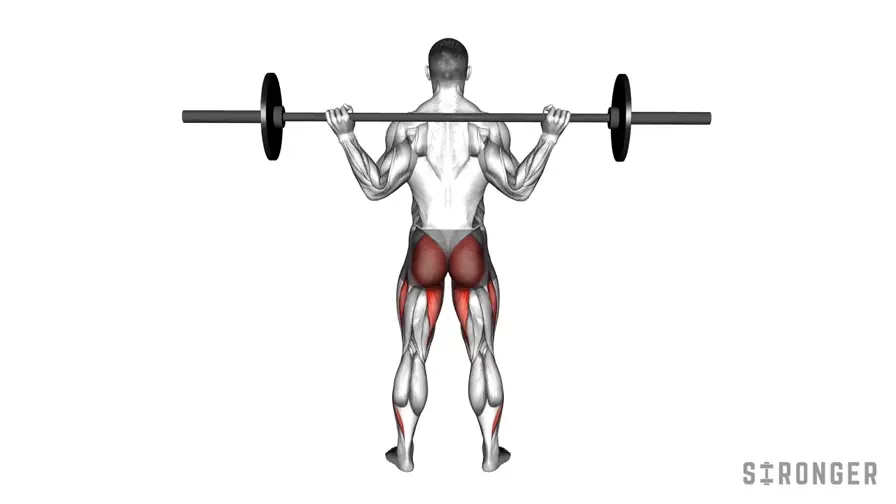
1. Barbell Back Squat
The foundation of 5x5. Squats train your quads, hamstrings, glutes, and core. You squat in every session on StrongLifts — this is the single most important lift in the programme.
Key points: Squat to at least parallel (hip crease below knee), keep your chest up, and drive through your full foot.
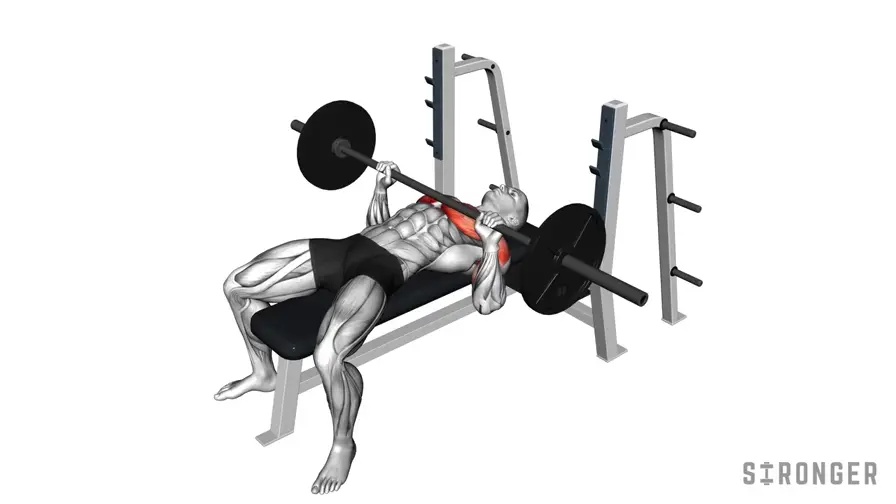
2. Barbell Bench Press
The primary upper-body pressing movement. Bench press develops your chest, front delts, and triceps. It alternates with overhead press across sessions.
Key points: Retract your shoulder blades, touch the bar to your mid-chest, and press in a slight arc back toward your face.
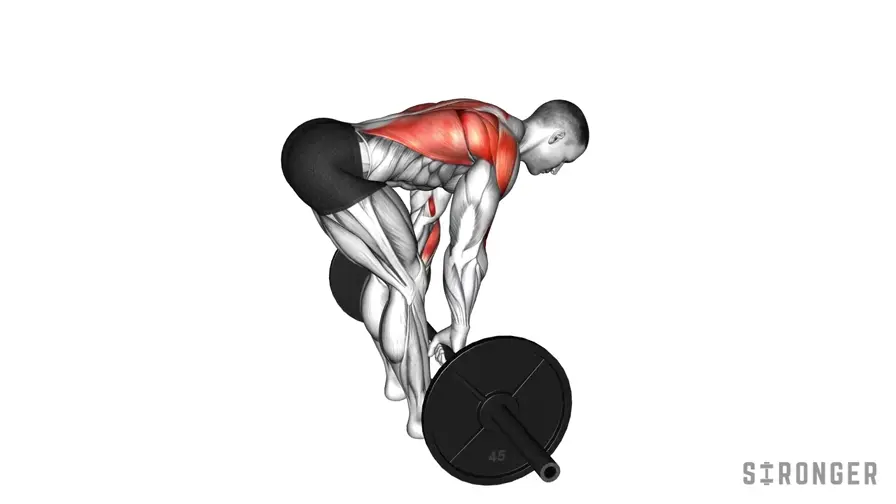
3. Barbell Row
The primary pulling movement to balance all the pressing. Barbell rows develop your entire back — lats, rhomboids, traps — plus your biceps.
Key points: Hinge at the hips with a flat back, pull the bar to your lower chest/upper abdomen, and control the descent.
4. Overhead Press
Overhead press builds your shoulders and triceps while demanding significant core stability. It is the hardest lift to progress on due to the smaller muscles involved.
Key points: Press the bar from your front delts to directly overhead (not in front), lock out fully, and avoid excessive back lean.
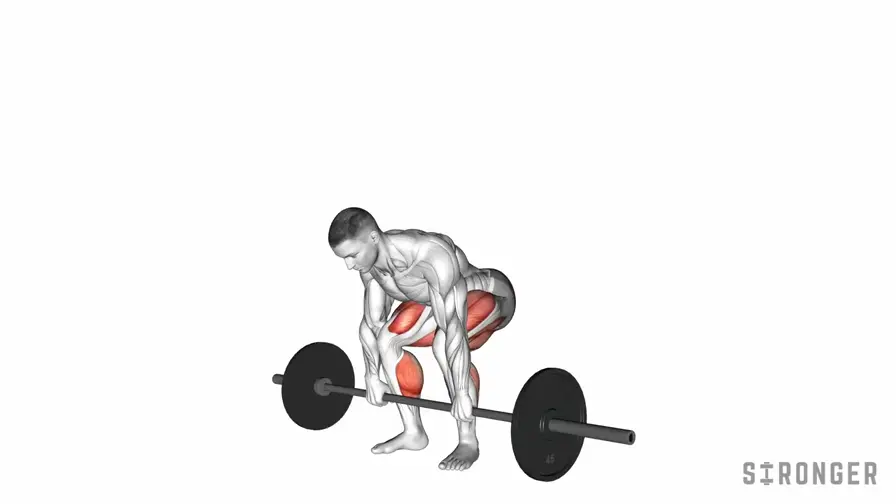
5. Deadlift
The heaviest lift in the programme. Deadlifts train your entire posterior chain — hamstrings, glutes, lower back, traps, and grip. On StrongLifts you only perform 1×5 because the deadlift is extremely fatiguing and your back already gets significant work from squats and rows.
Key points: Keep the bar close to your body, push the floor away with your legs, and lock out with your glutes — do not hyperextend your back.
5x5 Progression Scheme
The progression model is what makes 5x5 so effective for building strength quickly.
StrongLifts Progression
- Start light — begin with an empty bar (or 50% of your known max) on all lifts except deadlift (start at 40 kg / 95 lb)
- Add weight every session — increase by 2.5 kg (5 lb) on the squat, bench press, overhead press, and barbell row, and 5 kg (10 lb) on the deadlift
- Complete all reps before adding weight — you must hit 5×5 with good form before progressing
- If you fail — retry the same weight next session. Three consecutive failures = deload
Example 4-Week Squat Progression
| Week | Mon | Wed | Fri |
|---|---|---|---|
| 1 | 60 kg 5×5 | 62.5 kg 5×5 | 65 kg 5×5 |
| 2 | 67.5 kg 5×5 | 70 kg 5×5 | 72.5 kg 5×5 |
| 3 | 75 kg 5×5 | 77.5 kg 5×5 | 80 kg 5×5 |
| 4 | 82.5 kg 5×5 | 85 kg 5×5 | 87.5 kg 5×5 |
That is a 27.5 kg squat increase in just 4 weeks. While this rate slows as you get stronger, beginners routinely add 50–100 kg to their squat within the first 3–4 months on 5x5.
When and How to Deload
Deloading is a planned reduction in training intensity to manage accumulated fatigue. On a 5x5 programme, you deload when you fail to complete 5×5 at a given weight three sessions in a row.
Standard Deload Protocol
- Reduce the weight by 10% on the stalled lift
- Resume normal progression from the lower weight
- You should break through your previous plateau within 2–3 weeks
Example
- Session 1: 100 kg squat 5×5 — fail on set 4 (got 4 reps)
- Session 2: 100 kg squat — fail again
- Session 3: 100 kg squat — fail again
- Deload: drop to 90 kg
- Resume: 90 → 92.5 → 95 → 97.5 → 100 → 102.5 (break through)
If you stall again at a similar weight after deloading, it may be time to transition to an intermediate programme like Madcow or switch to a different training approach like push pull legs or an upper lower split.
Tips for Success on 5x5
Never Skip a Workout
Consistency is the single biggest predictor of success. Three sessions per week, every week. If you miss a session, pick up exactly where you left off — do not try to make up for lost time by adding extra weight.
Eat Enough
You cannot build strength in a significant calorie deficit. Beginners on 5x5 should eat at maintenance or a slight surplus, with protein intake of 1.6–2.2 g per kg bodyweight [2]. If your lifts are stalling and you weigh the same as you did 4 weeks ago, you probably need to eat more.
Film Your Lifts
Record your working sets from the side and review your form. Common issues like squat depth, bench press bar path, and deadlift back position are much easier to spot on video than they are to feel in real time.
Track Everything
Log every session — weights, reps, whether you completed all sets. This data tells you when to progress, when to deload, and whether the programme is working. Using a workout tracker app like Stronger removes the guesswork and shows your strength progression over time.
Do Not Add Exercises
The temptation to add curls, lateral raises, and ab work is strong. Resist it for the first 8–12 weeks. The five core lifts provide comprehensive full-body stimulation, and extra exercises add fatigue that can slow your progress on the main lifts at this stage.
Frequently Asked Questions
How long should a 5x5 workout take?
A typical session takes 45–60 minutes including warm-up sets. StrongLifts recommends 90 seconds rest between sets for lighter weights, increasing to 3–5 minutes for heavy sets. Do not rush rest periods — full recovery between sets is critical for maintaining performance.
Can I do 5x5 for fat loss?
Yes, but the strength gains will be slower. 5x5 in a caloric deficit preserves muscle mass and maintains strength better than high-rep programmes. Keep protein high and accept that progression will stall sooner than it would at maintenance calories.
What if I cannot squat three times per week?
If mobility or recovery is a limitation, you can substitute front squats or leg press on one of the three days. However, the programme is designed around frequent squatting. If squatting three times per week causes joint pain, consult a physiotherapist before continuing.
When should I move on from 5x5?
Move to an intermediate programme when you have deloaded 2–3 times on the same lift and can no longer make session-to-session progress. This typically happens after 3–6 months for most lifters. Good next steps include Madcow 5x5, a push pull legs split, or an upper lower programme with weekly progression.
Can women do 5x5?
Absolutely. The 5x5 method works identically for women. The only difference is starting weights — begin with whatever load allows you to perform 5×5 with good form. Research shows women make similar relative gains in strength and muscle to men, and may even gain upper-body strength faster in relative terms, so the progression model is the same [4].
Summary
The 5x5 workout programme is the most proven method for building foundational strength. Its simplicity — five exercises, three sessions per week, linear progression — is exactly what makes it work.
Key takeaways:
- 5x5 uses five barbell lifts: squat, bench press, row, overhead press, and deadlift
- StrongLifts 5x5 is for beginners (session-to-session progression); Madcow 5x5 is for intermediates (weekly progression)
- Add weight every session until you stall, then deload by 10% and work back up
- Train three days per week and eat enough protein to support muscle growth
- Track every workout to ensure you are progressing — a training log is essential
Start logging your 5x5 sessions and watch your strength numbers climb with Stronger.
Ready to Get Stronger?
Join 2,000,000+ lifters tracking their workouts with Stronger. Available on iOS and Android.
Start tracking freeSources
- Rippetoe, M. (2011). Starting Strength: Basic Barbell Training (3rd ed.). The Aasgaard Company.
- Morton, R. W., et al. (2018). A systematic review, meta-analysis and meta-regression of the effect of protein supplementation on resistance training-induced gains in muscle mass and strength in healthy adults. British Journal of Sports Medicine, 52(6), 376–384.
- Ralston, G. W., et al. (2017). The Effect of Weekly Set Volume on Strength Gain: A Meta-Analysis. Sports Medicine, 47(12), 2585–2601.
- Roberts, B. M., Nuckols, G., & Krieger, J. W. (2020). Sex Differences in Resistance Training: A Systematic Review and Meta-Analysis. Journal of Strength and Conditioning Research, 34(5), 1448–1460.
Exercises in this guide
Stronger Editorial Team
Certified strength & conditioning specialists with 10+ years of coaching experience
The Stronger editorial team produces evidence-based training content for lifters of all levels.
Ready to Get Stronger?
Join 2,000,000+ lifters tracking their workouts with Stronger. Available on iOS and Android.
Start tracking free