

Strava shows your friends that you trained.
Stronger tells you how strong you're getting.
In May 2026 Strava added real strength logs, muscle maps, and share cards — so "Strava can't track lifting" is dead. But displaying a lift and building a lifter are different jobs. Strava is the social-proof layer for an active life. Stronger is built for the gym floor: sets, reps, PRs, a Strength Score, and competition that actually compares strength.
Use Strava for the road. Use Stronger for the rack. If that line already sounds right, you're in the right place.
The 90-second verdict.
No suspense. Most lifters who search "Strava alternative" already like Strava. Here's which app you actually want — including the answer most comparison pages hide.
If the road is your main sport.
Running, cycling, hiking, or routes are the event — or lifting is just cross-training. Segments, route planning, clubs, the device ecosystem, and a 195M-strong network are best-in-class, and no gym app fakes that. A couple of gym sessions a week will look fine in your feed.
If the gym is the main event.
Squats, presses, pulls, machines, dumbbells — and the question that matters is "did the bar go up?" Stronger is built closer to how you train: sets, reps, weight, PRs, estimated 1RM, volume by muscle group, weak-point analysis, adaptive routines, and a Strength Score you can chase and compare with friends.
If you lift and run or ride.
The most honest answer for a lot of people. Log lifts in Stronger, keep Strava for cardio and your public feed. One caveat we'll be straight about below: Stronger isn't a Strava sync partner today, so this is a two-app setup, not a one-tap pipe.
If most of your training is endurance, stop reading and keep Strava. That's not us being modest — it's us being right.
Strava is the social-proof layer.
That's a feature, not a flaw.
Strava calls itself "the social network for those who strive," and that's exactly the product. The center of gravity isn't logging the most accurate workout — it's turning an activity into a feed post, attaching social meaning to it, and letting the network react with kudos, comments, and segment rankings. For a runner or cyclist that's close to perfect, because the data is naturally GPS-shaped: distance, pace, elevation, a route that reconstructs itself from a watch.
Lifting is a different animal. A squat session can't be rebuilt from wrist movement and heart rate — the app has to know the exercise, the load, the reps, the rest, the intent. That's why dedicated strength apps exist, and it's why, even after the 2026 overhaul, Strava's strength experience is mostly an import-display-share layer rather than a gym-floor training system. So no, Stronger isn't trying to be "a better Strava" for cyclists. We'd lose, and you'd know it.
A screenshot of a workout isn't a strength history.
When lifters route a session from Hevy or a watch into Strava, the parts that matter often get flattened. The new muscle map is shareable; it isn't always usable. One lifter called it "a front/back body image generator" because it doesn't separate primary from secondary muscles. Strava can show the work. It often doesn't understand it.
Strava's strength data is also only as good as the app feeding it — connect a partner that sends exercise detail, or you get time, calories, and a body outline.
// "basically just a social share." it has no idea you squatted 120kg×5.
Where Strava genuinely wins
A comparison page that admits nothing is an ad. Here's where Strava beats us, plainly — and where you should keep it on your phone.
The social graph is the moat
195 million users across 185+ countries. If your running club, your cycling friends, and your segment rivals are already there, that gravity is impossible to replicate with copywriting. Stronger is a smaller, lifting-focused community. We won't pretend otherwise.
The outdoors, all of it
Running, cycling, hiking, rowing, skiing, triathlon, HYROX — dozens of GPS sport types with routes, maps, and elevation. Stronger has no answer to that, and isn't trying to build one.
Segments are best-in-class
The same hill, road, or trail is a shared arena, so segment leaderboards are a clean comparison. Lifting has no natural equivalent — more on how we solve that below — but for the outdoors, segments win hard.
Wearables and devices
Garmin, Apple Watch, Wear OS, WHOOP, COROS, Wahoo, Zwift — Strava connects to nearly everything, and the 2026 update added 14 more partners piping gym data in. We'll be honest: Stronger does not have an Apple Watch app, and Strava's coverage is broader and clearer.
It's now credible for strength
The May 2026 update is real. Strava says strength was one of its fastest-growing sport types, with 500M+ strength activities uploaded in 2025. Workout logs, muscle maps, total volume and sets on the feed card, share cards — that closes the old "Strava only shows gym duration" gap. Give it the credit.
A bigger ecosystem
A public API, bulk export, and a new MCP connector for subscribers. Stronger has no public API today — if automation is your deal-breaker, factor that in. Worth knowing: Strava's 2026 API policy is tightening, gating standard access behind a subscription and restricting competing apps. But it's still more ecosystem than we offer.
Two honest losses there: Strava has the wearable ecosystem and the public API, and we don't match either today. If watch-first logging and automation are non-negotiable, that's your answer right there.
Strava made endurance legible.
Stronger does it for strength.
Strava solved comparison with the segment — outdoor movement has a shared arena, so a run is instantly legible to other people. Lifting doesn't work that way. A 315 lb squat means completely different things for a 60 kg novice woman, a 95 kg intermediate man, and a 120 kg powerlifter. Raw "who benched most" leaderboards are noise.
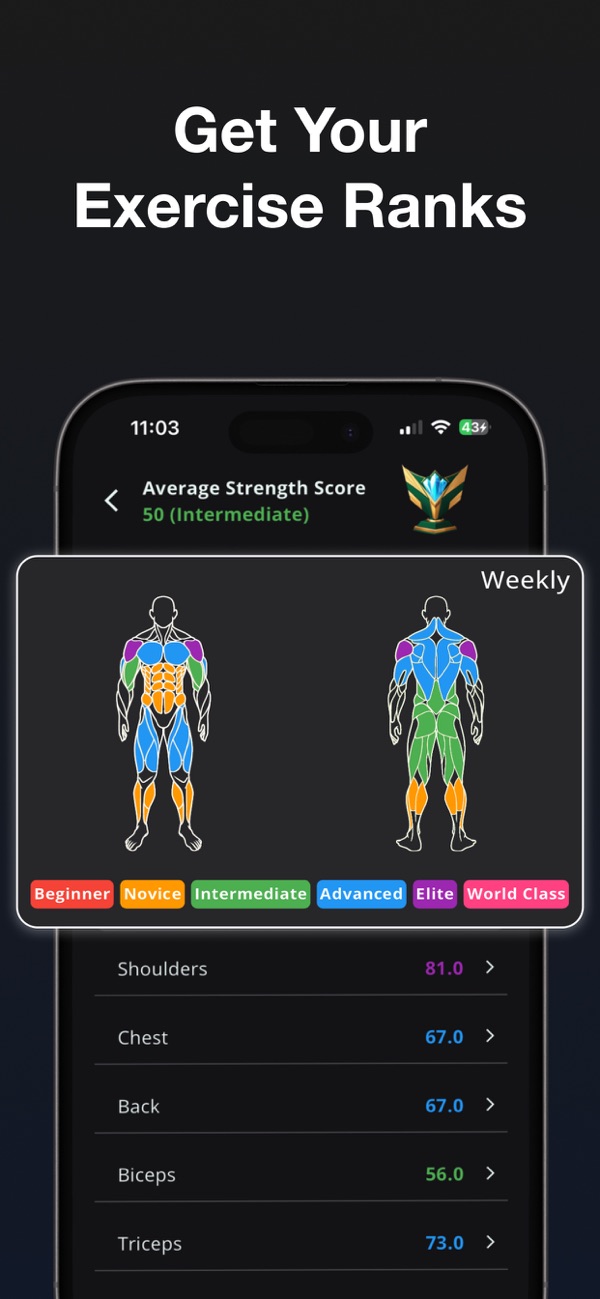
Strength Score is Stronger's answer to the gym's version of the segment problem. It captures your overall strength across the major compound lifts, then adjusts for bodyweight and gender, and ranks you against global standards — so the comparison is fair. A messy pile of numbers becomes one motivating signal you can track over time and stack against friends.
We're honest about the limit: a Strength Score is a benchmark, not a powerlifting meet total. It's not a Wilks, a DOTS, or a federation result — it's a simple way to see your trend, compare with friends, and spot weak areas. It'll feel more credible precisely because we're not claiming it's the final authority on how strong you are. See where you'd land in our strength standards guide.
This is exactly what Strava lifters keep asking for: "My friends and I could form a group and see lifts / PRs compared to one another." Strength Score, friend groups, ranked challenges, and leaderboards are the direct answer.
Choose Strava, or choose Stronger.
An honest winner called on each row. Strava takes the road, the network, the devices. Stronger takes the rows about whether the bar is going up. The split isn't close — it's just clean.
 Strava
 Stronger
- Running, cycling, hiking, GPS routes
- Best-in-class WIN
- Not the job
- Segments & outdoor competition
- Best-in-class WIN
- Not the job
- Huge existing social network
- 195M+ users WIN
- Smaller, lifting-focused
- Wearable / device ecosystem
- Broad & clear WIN
- No Apple Watch app
- Public API for power users
- Yes, tightening WIN
- None currently
- Log sets, reps, weight
- Via partners or manual
- Core workflow, built for speed
- Fast mid-set logging & rest timer
- "Edit activity / add details"
- Quick-add + smart defaults WIN
- Automatic PR detection
- Activity / segment oriented
- Per exercise, per rep range WIN
- Progressive overload tracking
- Limited
- Core feature WIN
- Estimated 1RM & strength curves
- Not the core mechanic
- Yes, per exercise
- Training volume by muscle group
- Total volume on feed card
- Volume + weak-point view WIN
- Strength benchmark (bodyweight-adjusted)
- No true equivalent
- Strength Score WIN
- Compete with friends on strength
- Not native to the feed
- Groups, ranked challenges WIN
- AI / adaptive programming
- Endurance-oriented
- Routines, adaptive loading WIN
- Syncs lifting into Strava's feed
- Via Hevy, Fitbod, Garmin WIN
- Not a partner today
Read the split. Strava owns routes, the network, the devices, the feed. Stronger owns sets, reps, PRs, progression, and a fair strength comparison. One of those is why you go to the gym.
Nobody's saying Strava is bad.
We pulled these from public Reddit threads so you get the unfiltered version. Notice the pattern: none of them hate Strava. They love the Strava feeling — they just want it built around lifting.
"I love Strava but it's not super user friendly when trying to track strength training."
"My friends and I could form a group and see lifts / PRs compared to one another."
"It has no idea that I squatted 120kg for 5 sets."
"Hevy is a great app for tracking but not for leaderboards and comparing lifts."
"Strava is my movement hub where I review all my workout and fitness stats."
"I just mute people who spam me with their boring gym and trainer workouts."
The pain isn't "I hate Strava." It's "I love the Strava feeling, but my real training is lifting." That's the gap Stronger fills — and the reason "Strava for weightlifting" is a search people actually type.
The workflow starts before the workout, not after it.
What program am I running? What's today's target load? What did I do last week at this rep range? Then during: was that a PR, should I add weight, how long do I rest? Then after: did volume go up, which muscles are lagging? Strava's strength layer mostly enters at the very end — make the session visible. Stronger owns the before, during, and after.
Neither is free for the good stuff.
Here's the real math, not the sticker price. The cleaner way to think about it: don't pay for data you don't use. For a runner that's segments and routes. For a lifter it's strength analytics, progression, and benchmarks.
Strava
endurance-first- ›Full segment leaderboards
- ›Route planning & Training Log
- ›Create / join Group Challenges
- ›Mostly endurance analytics
Monthly is a flexibility tax: $11.99 × 12 = $143.88, about $64 more than annual. If you subscribe, annual is the only sane choice.
Stronger
7-DAY FREE TRIAL- ✦Strength Score & fair friend ranks
- ✦Weak-point analysis by muscle
- ✦Adaptive routines & deloads
- ✦Ranked challenges & leaderboards
Our annual price isn't perfectly consistent across our listings yet — you may see $39.99 or $59.99. That's a known gap on our end, not a trick. Our monthly undercuts Strava's.
Can I run Stronger and Strava?
Yes — and for hybrid athletes, you probably should. But here's the thing we refuse to bury, because burying it would be the exact dishonest move we set out not to make.
Stronger does not currently sync to Strava. Strava's official strength-partner list includes Hevy, Fitbod, JEFIT, Garmin, WHOOP, and Runna — not Stronger. There's no one-tap pipe pushing your Stronger lifts into the Strava feed today.
Use Stronger as the source of truth for strength training, keep Strava for cardio, routes, and your public feed. Two apps, two jobs — a real setup plenty of athletes run.
Know this before switching. An app that does sync — Hevy, for instance — may fit that specific need better, and we'd rather tell you that than lose your trust on day two.
We're telling you this because the whole point of the page is to be the version a Strava user finishes feeling they were told the truth — about Strava and about us. A real export or a Strava-style share card is a fair thing to want from us, and it'd close this gap.
Questions a Strava user asks
Can Strava track weightlifting now?
Yes. Since its May 2026 strength overhaul, Strava supports exercise-level workout logs — sets, reps, weight, duration — plus auto-generated muscle maps, total volume and sets on the feed card, and share cards. The catch: full detail depends on connecting a partner app that sends exercise-level data. On its own, or with a basic device, Strava may only show time, calories, and heart rate.
Is Stronger better than Strava for lifting?
For lifting specifically, yes — that's the whole design. Stronger is built around sets, reps, weight, PRs, estimated 1RM, volume by muscle group, and a bodyweight-adjusted Strength Score. Strava is best-in-class for endurance and now displays strength workouts. Stronger is built to improve them.
Should I use Strava or Stronger?
If running or cycling is your main sport, Strava. If the gym is the main event and your goal is a bigger squat or a better physique, Stronger. If you do both, run both — Stronger for the lifting, Strava for cardio and the feed.
Does Stronger sync to Strava?
Not currently. Stronger isn't on Strava's strength-partner list. If posting every gym session to Strava is essential, factor that in before switching — an app like Hevy that does sync may suit that specific need better.
What's the best app to compete with friends in the gym?
This is Stronger's sweet spot. Strava's leaderboards are brilliant for routes and segments but don't translate cleanly to the weight room, because raw lift numbers aren't comparable across bodyweights. Stronger's Strength Score normalizes for bodyweight and gender, so friend groups, challenges, and leaderboards are based on strength, fairly compared.
Does Stronger work on Apple Watch?
No. Stronger does not have an Apple Watch app. Use Stronger on iPhone or Android to log your workouts.
How much does Stronger cost vs Strava?
Stronger is $9.99/mo with a 7-day trial; annual lands at $39.99–$59.99 depending on the listing. Strava is $11.99/mo or $79.99/yr (US) with a 30-day trial. For lifters the better question is what you're paying for: Strava's paid tier is mostly endurance analytics and routes; Stronger's is strength analytics, programming, and benchmarking.
What's the best Strava alternative for the gym?
Depends on what you want. If you want a pure logger that also syncs to Strava, Hevy is the common pick. If you want a gym-first app built around strength progression, benchmarking, and lifting-specific competition, Stronger is built for exactly that. Our honest workout-tracker comparison lays out the field.
Keep Strava for the road.
Track strength for the rack.
If miles are your main metric, keep Strava — genuinely. If kilos, reps, PRs, and progression are, give Stronger a week. Worst case, you keep both. Browse the feature set, the 400+ exercise library, or our free lifting calculators.


Stronger vs everything else
- vs HevySocial tracker→
- vs StrongMinimalist logger→
- vs FitbodAI auto-programming→
- vs JEFITExercise database→
- vs BoostcampProgram library→
- vs CaliberCoaching app→
- vs StrengthLogFree-tier logger→
- vs RepCountNo-bloat logger→
- vs LiftoffGamified ranking→