
Strength Standards by Lift, Bodyweight & Gender (2026)
A 100 kg bench press is advanced for one lifter, intermediate for another, and a long way off elite for someone much lighter. A two-times-bodyweight deadlift is impressive in a commercial gym and a starting point for a competitive powerlifter in some weight classes. The same number can mean three different things — and until you know which benchmark group you're comparing against, "am I strong?" is a question with no single honest answer.
That's why the strength standards worth paying attention to don't publish one number for everyone. They compare your estimated one-rep max (1RM) against people of a similar bodyweight and gender, using lift-specific rules. In this guide, we've pulled together current 2026 strength standards by lift, bodyweight and gender for the four most useful barbell benchmarks — back squat, bench press, deadlift and overhead press — and added the context needed to actually use them. You'll find full bodyweight-indexed tables for male and female lifters at beginner, novice, intermediate, advanced and elite levels, an honest explanation of where the data comes from, and a framework for turning a tier label into a training decision.
We built Stronger and our proprietary Strength Score around this exact idea: strength benchmarking is only useful when it adjusts for context — bodyweight, gender and lift selection — and when it leads to a next action, not a label. The tables below give you the snapshot. The rest of this post shows you how to read your snapshot, why different sources disagree, and what to do with the answer once you have it.
Use this guide to answer three questions:
- What strength level am I right now, for each lift?
- What's the next realistic target?
- Which lift is lagging behind the others?
Before the full tables, the quick-reference ratios.
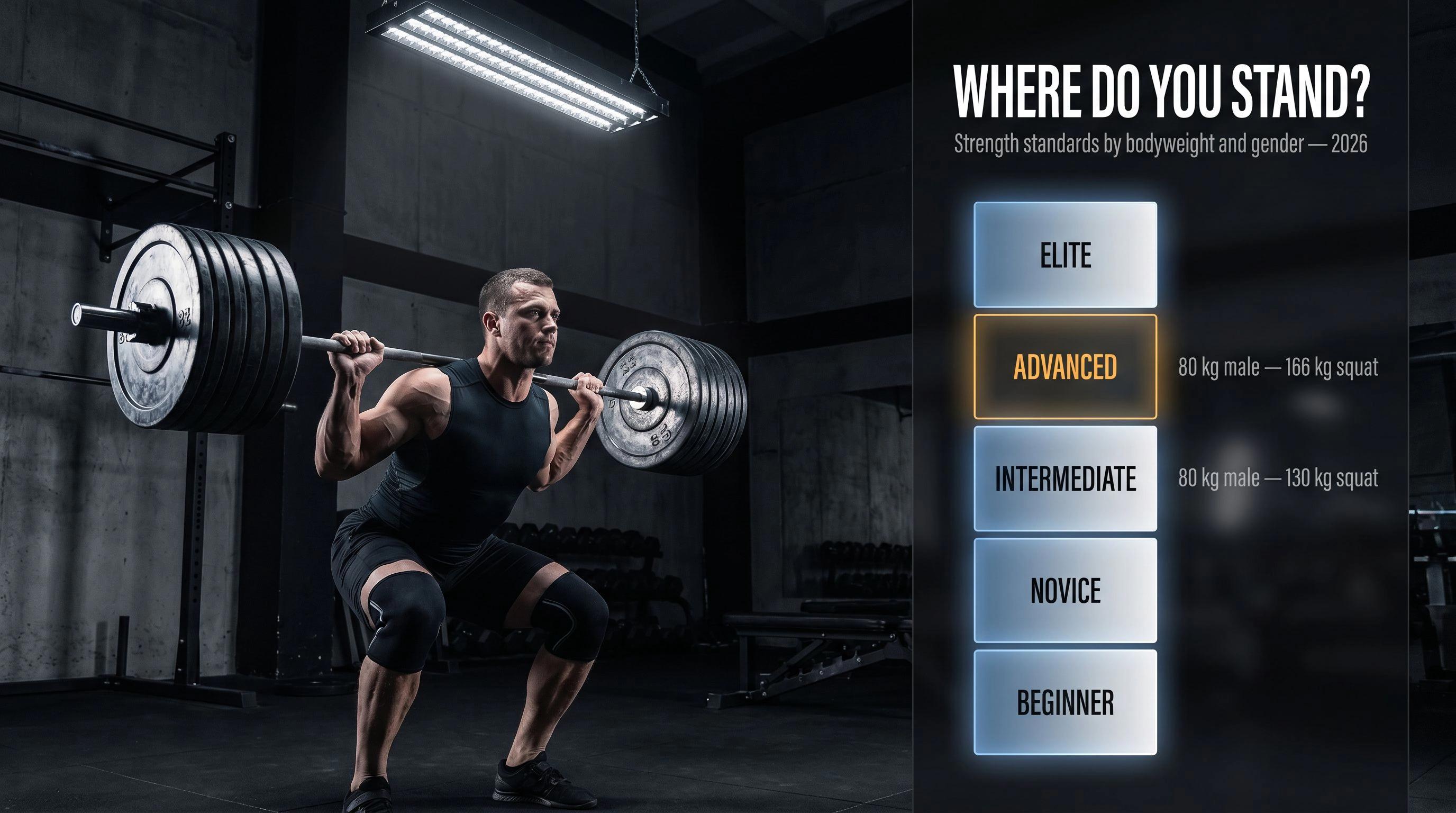
Want to know exactly where you stand? Enter your lifts into our free strength standards calculator to score every major lift on Stronger's six-level scale, from Beginner to World Class, for your bodyweight and gender. Stronger's levels use their own standards, so they won't line up exactly with the Strength Level tiers in the tables below.
What Counts as Strong? Bodyweight Multipliers by Lift
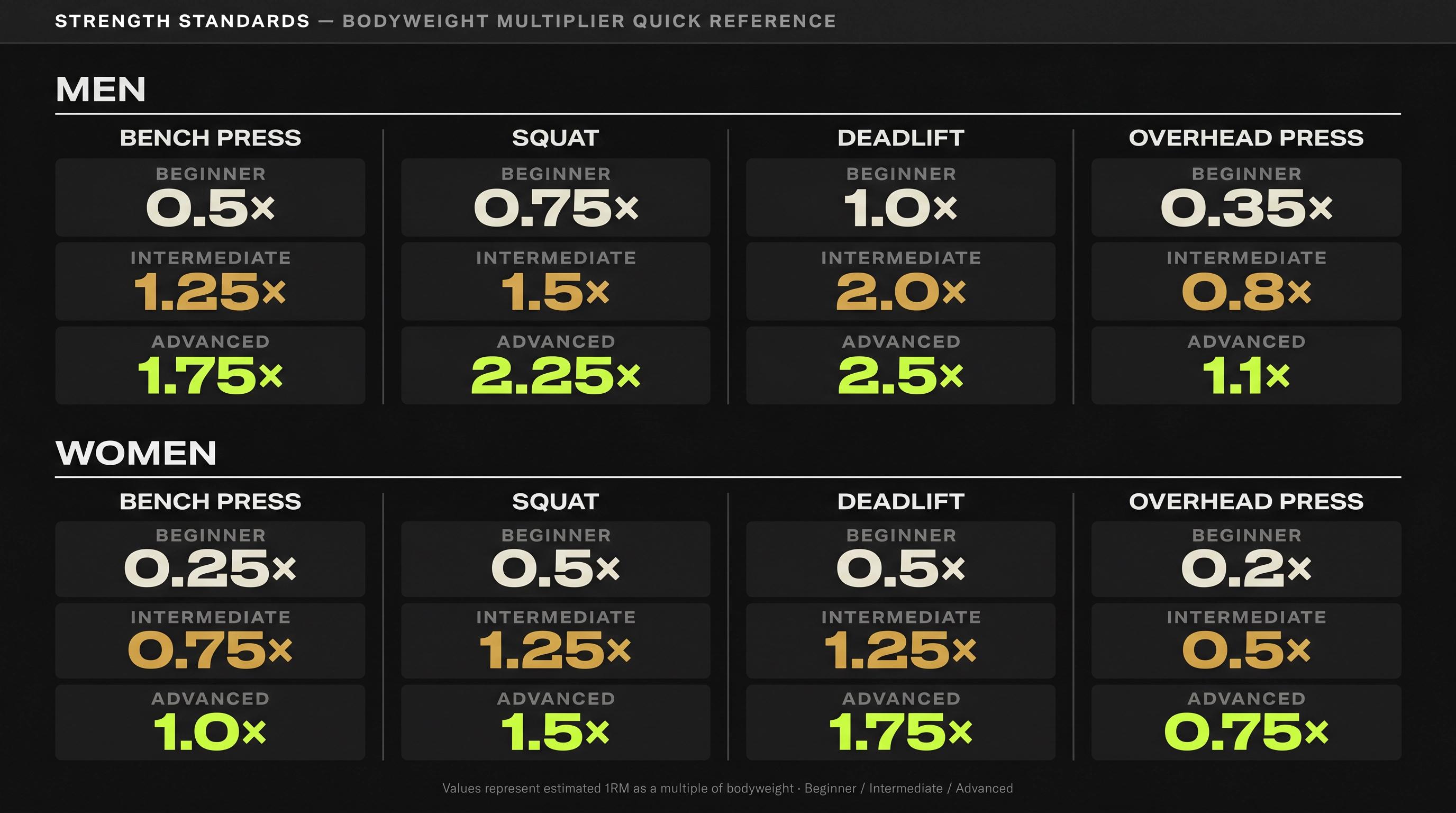
For most adult gym-goers, these bodyweight multipliers are a reasonable first-pass target.
| Gender category | Bench press | Squat | Deadlift | Overhead press |
|---|---|---|---|---|
| Men, beginner | ~0.5× bodyweight | ~0.75× bodyweight | ~1.0× bodyweight | ~0.35× bodyweight |
| Men, intermediate | ~1.25× bodyweight | ~1.5× bodyweight | ~2.0× bodyweight | ~0.8× bodyweight |
| Men, advanced | ~1.75× bodyweight | ~2.25× bodyweight | ~2.5× bodyweight | ~1.1× bodyweight |
| Women, beginner | ~0.25× bodyweight | ~0.5× bodyweight | ~0.5× bodyweight | ~0.2× bodyweight |
| Women, intermediate | ~0.75× bodyweight | ~1.25× bodyweight | ~1.25× bodyweight | ~0.5× bodyweight |
| Women, advanced | ~1.0× bodyweight | ~1.5× bodyweight | ~1.75× bodyweight | ~0.75× bodyweight |
Those ratios are useful for a quick gut-check — they're the numbers you're thinking of when you hear "one-times bodyweight bench, two-times bodyweight deadlift." But they're a starting point, not the end of the story. Strength does not scale linearly with bodyweight. Heavier lifters usually lift more weight in absolute terms, while lighter lifters tend to have higher strength-to-bodyweight ratios. A 60 kg male benching 2× bodyweight (120 kg) sits just below the elite benchmark, while a 110 kg male benching 2× bodyweight (220 kg) is well past it. The full bodyweight-indexed tables below handle that non-linearity properly.
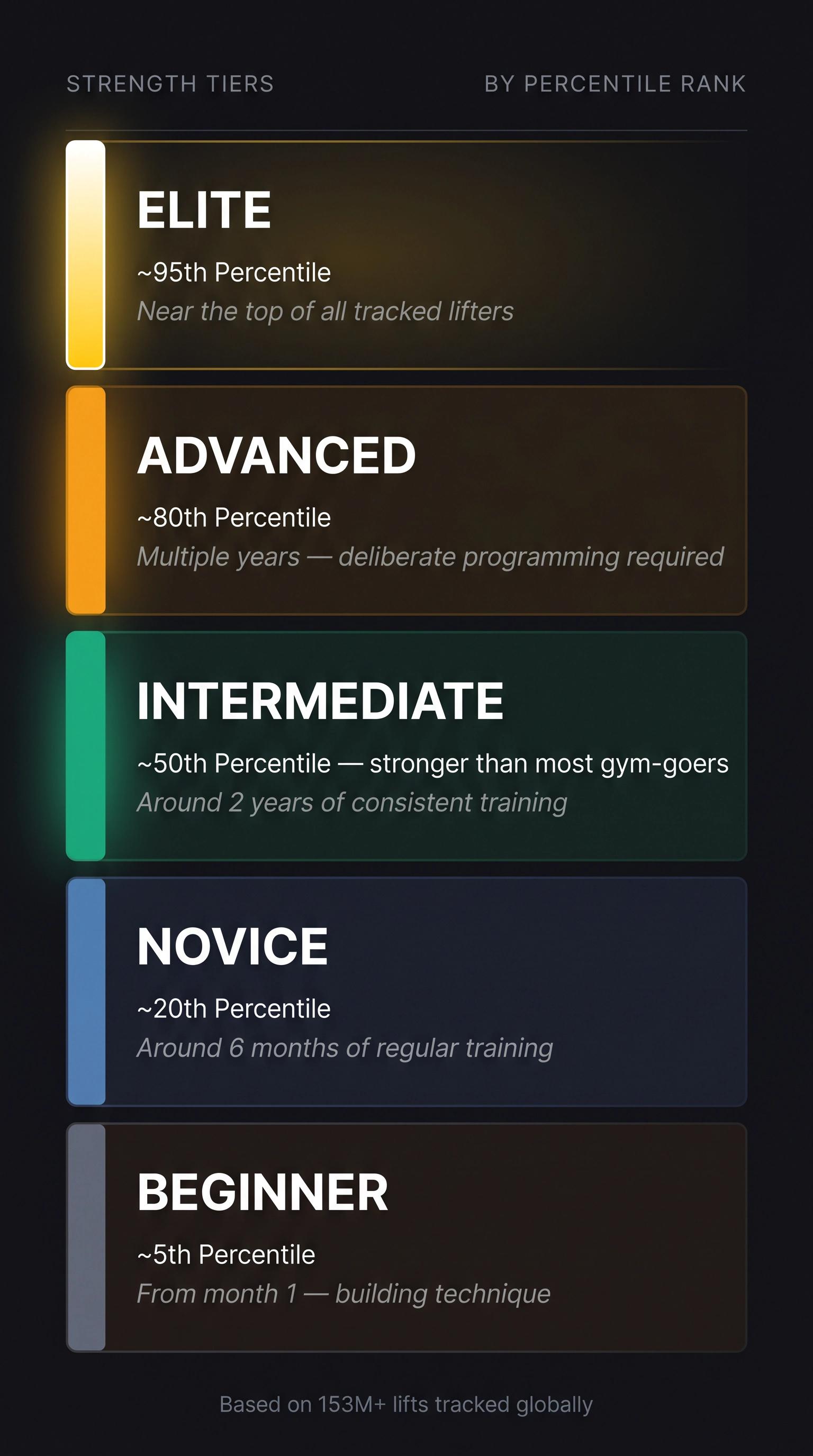
The tables in this guide use current public community benchmark data from Strength Level, whose calculator reports standards drawn from more than 153 million user-entered lifts and more than 13 million lifters as of our April 21, 2026 review. (Strength Level) Strength Level defines its tiers (which are separate from the levels in Stronger's Strength Score) roughly by percentile — beginner around the 5th, novice around the 20th, intermediate around the 50th, advanced around the 80th and elite around the 95th — so when you read "intermediate," read it as "right in the middle of tracked lifters at your bodyweight and gender." (Strength Level)
To use these tables correctly, two rules: one about the number you plug in, and one about the weight on the bar.
How to Read Strength Standards (and What 1RM Means)
Use these standards against your estimated one-rep max, not your best set of five or your most-used working weight. The tables are built around 1RM — the heaviest load you could lift for a single, clean repetition — so comparing a hard 3×5 working weight to them will make you look weaker than you actually are. We cover estimation further down, but for now, either know your tested 1RM or calculate it from a hard set of 3–5 reps.
A few worked examples for how to look yourself up:
- If you weigh 80 kg and bench 100 kg, use the 80 kg bodyweight row in the bench press table.
- If you weigh 63 kg, use the nearest row or average the two closest (60 kg and 65 kg).
- If you train in pounds, multiply the kilogram values by 2.205 (100 kg ≈ 220 lb).
All numbers below are 1RM values in kilograms. For the barbell lifts, the listed weight includes the bar itself, which is how the benchmark pages define these lifts — don't subtract 20 kg thinking "the bar doesn't count." (Strength Level)
What each strength level means
| Level | Practical meaning |
|---|---|
| Beginner | You've started training and can perform the lift, but technique and consistency still matter more than chasing heavy singles. |
| Novice | You have several months of regular training and are building a base. |
| Intermediate | You're around the middle of trained lifters in your bodyweight and gender category. This is already stronger than most casual gym-goers. |
| Advanced | You're stronger than most trained lifters and likely need more deliberate programming to keep moving forward. |
| Elite | You're near the top of the public benchmark population. For powerlifting-style lifts, this often overlaps with competitive strength sport territory. |
Strength Level's own tier definitions pair percentile ranking with approximate training history: beginner after at least a month of practice, novice after about six months of regular training, intermediate after at least two years, and advanced or elite after multiple years of serious progression. (Strength Level) If your training age is much shorter than that and your numbers are already at intermediate, you're ahead of the curve. If your training age is longer and you're still at novice, technique or programming is usually the bottleneck, not genetics. Understanding how to get stronger systematically is what separates those who plateau at novice from those who keep climbing.
Start with bench — it's the most tested lift, and also the one most often overestimated.
Bench Press Strength Standards by Bodyweight (Men & Women)
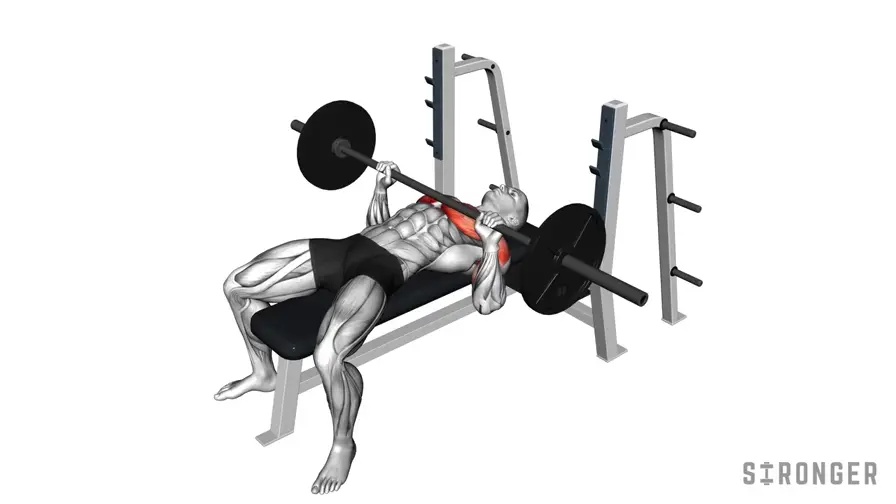
The bench press is the most popular upper-body strength benchmark because it's easy to test, easy to compare and widely trained. It's also one of the easiest lifts to overestimate if you compare a touch-and-go gym bench — where the bar bounces slightly off the chest — to a paused competition bench where you have to hold a motionless bar on the chest before pressing it back. The paused version is usually a few percent lighter. Our complete bench press guide covers the setup, grip, bar path and common mistakes that determine how reliably you can move this weight.
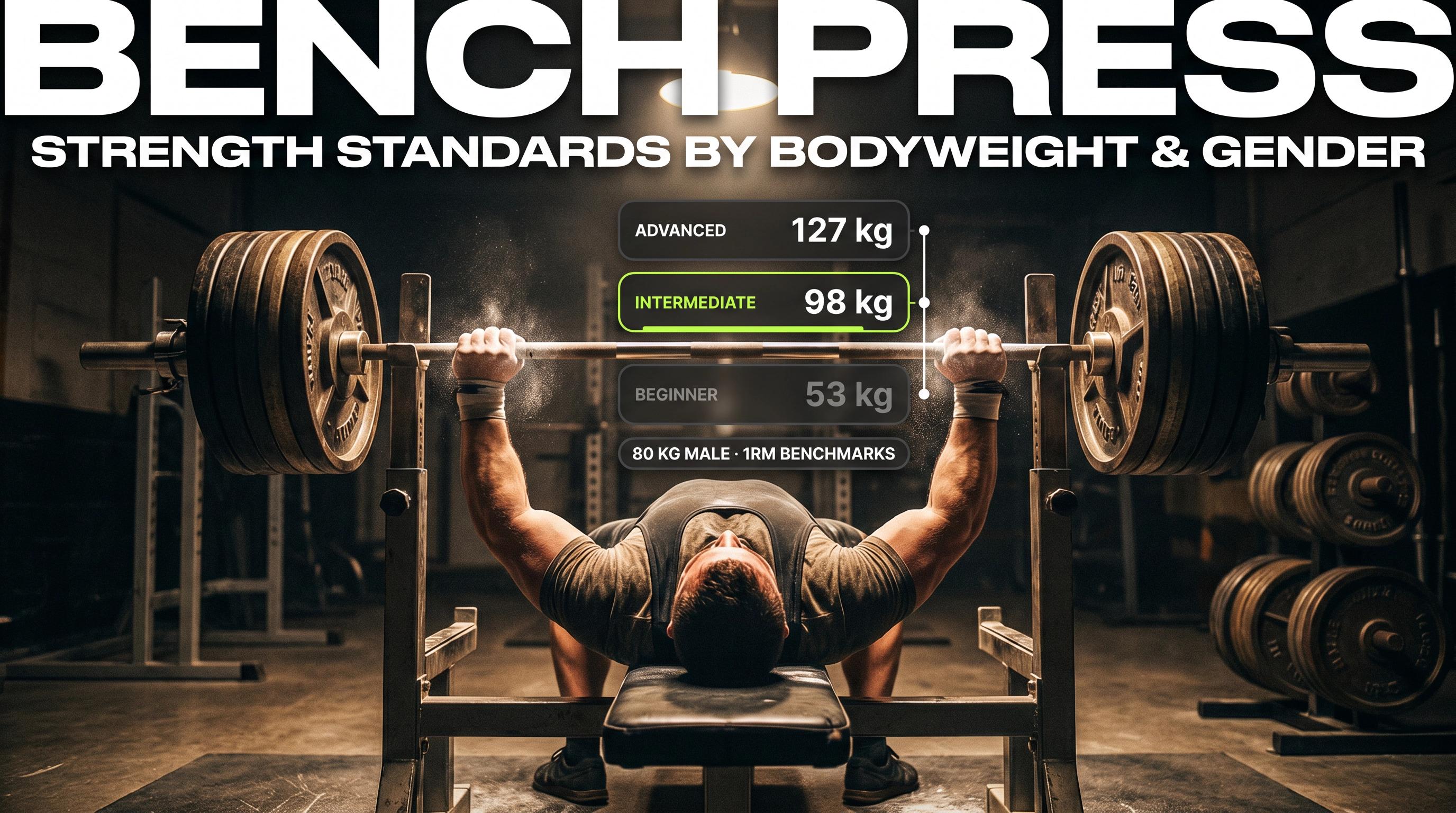
The current Strength Level bench press page reports 48,420,918 bench press lifts in its dataset at the time of our review. Its general male 1RM standards are 47 kg beginner, 70 kg novice, 98 kg intermediate, 132 kg advanced and 169 kg elite; the general female 1RM standards are 17 kg beginner, 31 kg novice, 51 kg intermediate, 74 kg advanced and 101 kg elite. (Strength Level)
Male bench press standards (kg 1RM)
| Bodyweight | Beginner | Novice | Intermediate | Advanced | Elite |
|---|---|---|---|---|---|
| 50 kg | 24 | 38 | 57 | 79 | 103 |
| 55 kg | 29 | 45 | 64 | 87 | 113 |
| 60 kg | 34 | 51 | 72 | 96 | 123 |
| 65 kg | 39 | 57 | 79 | 104 | 132 |
| 70 kg | 44 | 62 | 85 | 112 | 141 |
| 75 kg | 49 | 68 | 92 | 119 | 149 |
| 80 kg | 53 | 74 | 98 | 127 | 157 |
| 85 kg | 58 | 79 | 105 | 134 | 165 |
| 90 kg | 62 | 84 | 111 | 141 | 172 |
| 95 kg | 67 | 89 | 116 | 147 | 180 |
| 100 kg | 71 | 94 | 122 | 153 | 187 |
| 105 kg | 75 | 99 | 128 | 160 | 194 |
| 110 kg | 80 | 104 | 133 | 166 | 200 |
| 115 kg | 84 | 109 | 138 | 172 | 207 |
| 120 kg | 88 | 113 | 143 | 177 | 213 |
| 125 kg | 92 | 118 | 148 | 183 | 219 |
| 130 kg | 95 | 122 | 153 | 188 | 225 |
| 135 kg | 99 | 126 | 158 | 194 | 231 |
| 140 kg | 103 | 130 | 163 | 199 | 236 |
Female bench press standards (kg 1RM)
| Bodyweight | Beginner | Novice | Intermediate | Advanced | Elite |
|---|---|---|---|---|---|
| 40 kg | 8 | 18 | 32 | 50 | 70 |
| 45 kg | 10 | 21 | 36 | 55 | 76 |
| 50 kg | 12 | 24 | 40 | 59 | 82 |
| 55 kg | 15 | 27 | 43 | 64 | 87 |
| 60 kg | 17 | 29 | 47 | 68 | 92 |
| 65 kg | 19 | 32 | 50 | 72 | 96 |
| 70 kg | 20 | 34 | 53 | 75 | 101 |
| 75 kg | 22 | 37 | 56 | 79 | 105 |
| 80 kg | 24 | 39 | 59 | 82 | 109 |
| 85 kg | 26 | 41 | 62 | 86 | 112 |
| 90 kg | 28 | 44 | 64 | 89 | 116 |
| 95 kg | 29 | 46 | 67 | 92 | 119 |
| 100 kg | 31 | 48 | 69 | 95 | 123 |
| 105 kg | 33 | 50 | 72 | 98 | 126 |
| 110 kg | 34 | 52 | 74 | 100 | 129 |
| 115 kg | 36 | 54 | 76 | 103 | 132 |
| 120 kg | 37 | 56 | 79 | 106 | 135 |
How to read your bench press result
If you're an 80 kg male with a 100 kg bench press, you're just above the intermediate benchmark of 98 kg and still a noticeable distance from the advanced benchmark of 127 kg. Your next meaningful goal isn't "bench 140 next month" — it's building from 100 kg toward the 110–120 kg range while keeping your technique repeatable. Jumping tiers usually takes a full training block, not a single heavy session.
If you're a 60 kg female with a 50 kg bench press, you're just above the intermediate benchmark of 47 kg and moving toward the advanced benchmark of 68 kg. That's a healthy position to be in — the 50-to-68 kg range is typically where steady, programmed progressive overload pays off fastest for female lifters.
For powerlifting-style comparison, be stricter with your own numbers: lower the bar to the chest or abdominal area, don't bounce, and use a consistent pause if you're comparing to competition standards. The 2026 IPF technical rules list bench press failure conditions including not lowering the bar to the chest or abdominal area and not completing the press correctly. (powerlifting.sport) If your gym bench is touch-and-go, expect your paused number to come in a few percent lighter.
Bench is just the first of four. Squat is next — and here, depth changes everything.
Squat Strength Standards by Bodyweight (Men & Women)
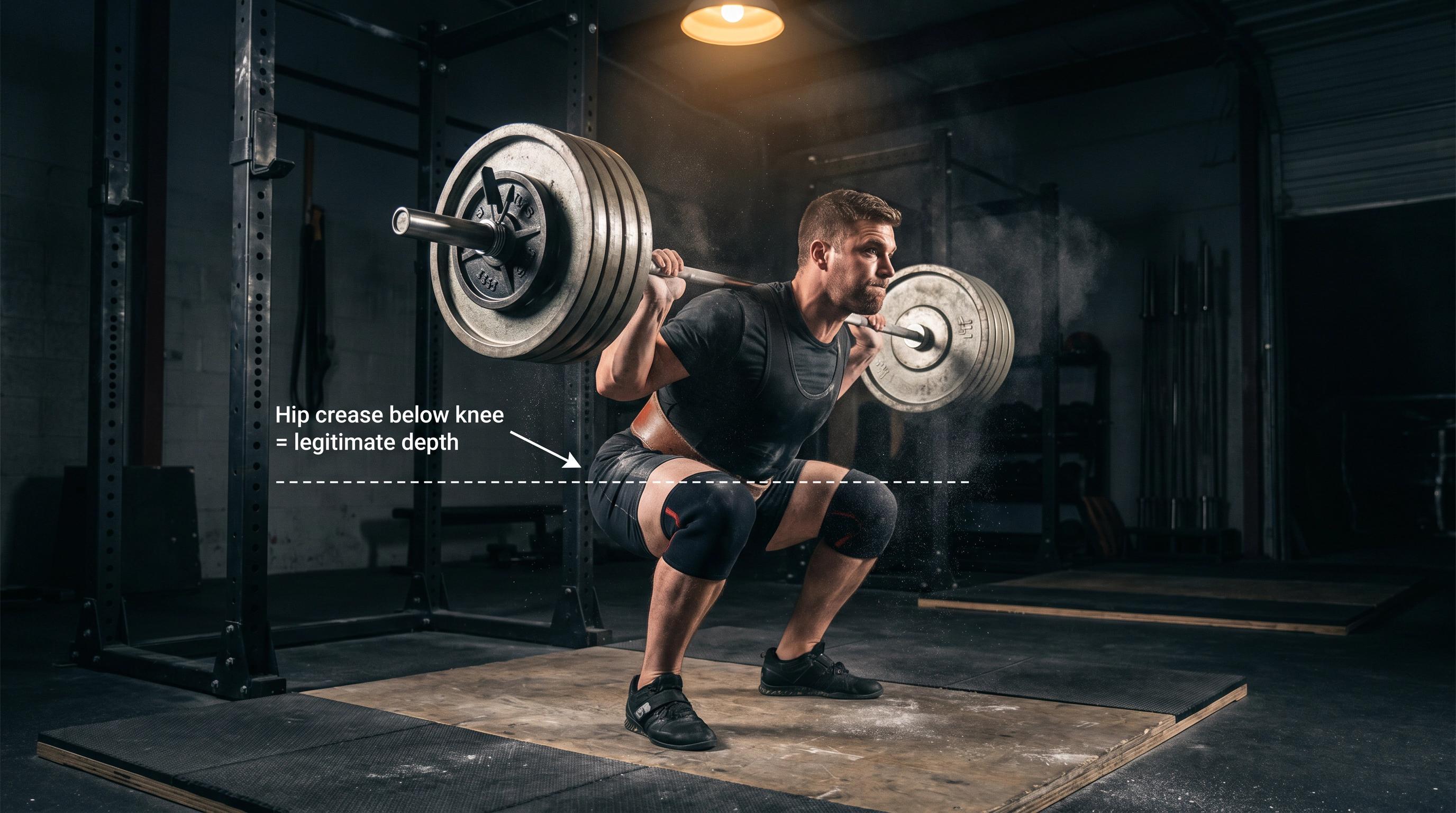
The squat is one of the best lower-body strength benchmarks, but only if depth is consistent. A partial squat and a competition-depth squat are not the same lift. We've seen plenty of lifters report "400 lb squats" that wouldn't pass a powerlifting side judge because the hip crease never dropped below the top of the knee. If you're comparing yourself to a dataset built around legitimate depth, your numbers have to come from legitimate depth too. Our complete squat guide covers exactly this — how to set up for consistent, below-parallel depth and what cues actually transfer to heavier loads.
The current Strength Level squat page reports 24,851,640 squat lifts in its dataset. Its general male squat standards are 64 kg beginner, 93 kg novice, 130 kg intermediate, 173 kg advanced and 219 kg elite; its general female squat standards are 30 kg beginner, 48 kg novice, 73 kg intermediate, 103 kg advanced and 136 kg elite. (Strength Level)
Male squat standards (kg 1RM)
| Bodyweight | Beginner | Novice | Intermediate | Advanced | Elite |
|---|---|---|---|---|---|
| 50 kg | 33 | 52 | 76 | 104 | 136 |
| 55 kg | 40 | 60 | 86 | 116 | 149 |
| 60 kg | 47 | 68 | 95 | 127 | 161 |
| 65 kg | 53 | 76 | 104 | 137 | 173 |
| 70 kg | 59 | 83 | 113 | 147 | 184 |
| 75 kg | 66 | 91 | 122 | 157 | 195 |
| 80 kg | 72 | 98 | 130 | 166 | 205 |
| 85 kg | 78 | 105 | 138 | 175 | 215 |
| 90 kg | 83 | 112 | 146 | 184 | 225 |
| 95 kg | 89 | 118 | 153 | 192 | 234 |
| 100 kg | 95 | 125 | 160 | 201 | 243 |
| 105 kg | 100 | 131 | 168 | 209 | 252 |
| 110 kg | 106 | 137 | 174 | 216 | 260 |
| 115 kg | 111 | 143 | 181 | 224 | 269 |
| 120 kg | 116 | 149 | 188 | 231 | 277 |
| 125 kg | 121 | 155 | 194 | 238 | 284 |
| 130 kg | 126 | 160 | 201 | 245 | 292 |
| 135 kg | 131 | 166 | 207 | 252 | 299 |
| 140 kg | 136 | 171 | 213 | 259 | 307 |
Female squat standards (kg 1RM)
| Bodyweight | Beginner | Novice | Intermediate | Advanced | Elite |
|---|---|---|---|---|---|
| 40 kg | 17 | 31 | 51 | 75 | 101 |
| 45 kg | 20 | 36 | 56 | 81 | 109 |
| 50 kg | 23 | 39 | 61 | 87 | 115 |
| 55 kg | 26 | 43 | 65 | 92 | 122 |
| 60 kg | 29 | 47 | 70 | 97 | 128 |
| 65 kg | 32 | 50 | 74 | 102 | 133 |
| 70 kg | 34 | 53 | 78 | 106 | 138 |
| 75 kg | 37 | 56 | 81 | 111 | 143 |
| 80 kg | 39 | 59 | 85 | 115 | 148 |
| 85 kg | 41 | 62 | 88 | 119 | 152 |
| 90 kg | 44 | 65 | 91 | 123 | 157 |
| 95 kg | 46 | 68 | 95 | 126 | 161 |
| 100 kg | 48 | 70 | 98 | 130 | 165 |
| 105 kg | 50 | 73 | 101 | 133 | 169 |
| 110 kg | 52 | 75 | 103 | 136 | 172 |
| 115 kg | 54 | 77 | 106 | 140 | 176 |
| 120 kg | 56 | 80 | 109 | 143 | 179 |
How to read your squat result
If you're an 80 kg male with a 140 kg squat, you're comfortably above intermediate (130 kg) and closing on advanced (166 kg). If you're a 65 kg female with an 80 kg squat, you're above the 74 kg intermediate mark and roughly 20 kg away from the 102 kg advanced benchmark.
For consistent comparison, squat depth is the variable that changes everything. Our own Stronger squat guide cues lifters to descend until the hip crease is below the knee, and the 2026 IPF technical rules list insufficient depth as a failed squat when the hip joint does not descend below the top of the knees. (Stronger) (powerlifting.sport) If you're not sure where your real depth lands, film one working set from the side and stop the video at the bottom position. A lot of numbers shrink honestly after that exercise — and so does a lot of future progress, because you're suddenly training a harder lift.
If bench is the most overestimated lift, deadlift is the most variable — body proportions, grip style and bar choice can swing the number more than any other movement.
Deadlift Strength Standards by Bodyweight (Men & Women)
The deadlift is usually the heaviest of the big three barbell lifts. It rewards posterior-chain strength, grip, bracing and leverage, and it's the lift where body proportions can make the biggest visible difference. A tall lifter with long arms may have a shorter range of motion than a stocky lifter with short arms at the same bodyweight. The standards below don't try to adjust for that — they describe what lifters at each bodyweight actually pull, leverages and all. For a deeper look at what drives deadlift numbers up — or holds them back — our complete deadlift guide covers every aspect of technique from starting position to lockout.
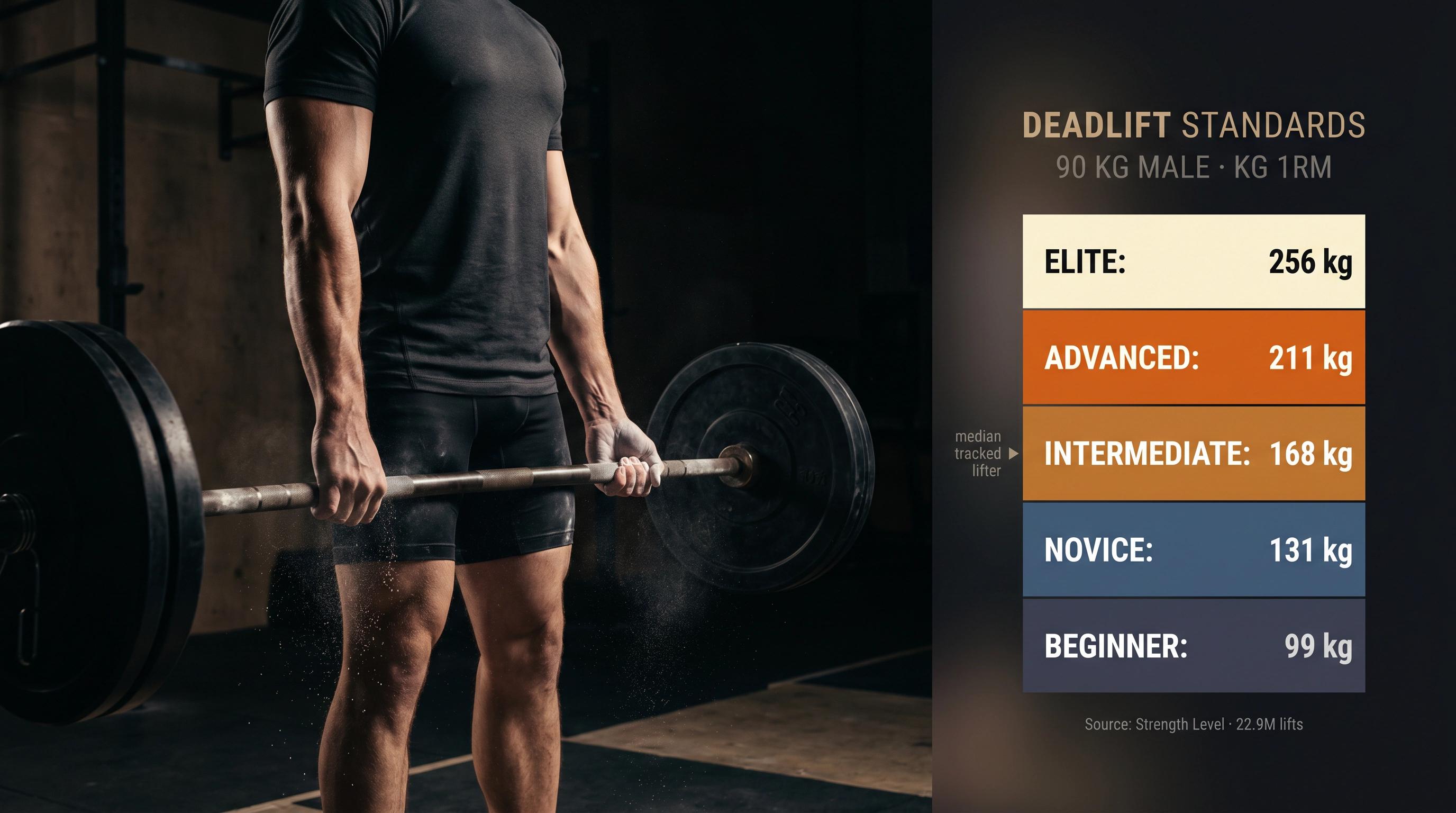
The current Strength Level deadlift page reports 22,866,078 deadlift lifts in its dataset. Its general male deadlift standards are 78 kg beginner, 112 kg novice, 152 kg intermediate, 200 kg advanced and 250 kg elite; its general female deadlift standards are 38 kg beginner, 60 kg novice, 87 kg intermediate, 120 kg advanced and 157 kg elite. (Strength Level)
Male deadlift standards (kg 1RM)
| Bodyweight | Beginner | Novice | Intermediate | Advanced | Elite |
|---|---|---|---|---|---|
| 50 kg | 44 | 65 | 93 | 125 | 160 |
| 55 kg | 51 | 74 | 103 | 137 | 174 |
| 60 kg | 58 | 83 | 114 | 149 | 187 |
| 65 kg | 66 | 92 | 124 | 160 | 200 |
| 70 kg | 73 | 100 | 133 | 171 | 212 |
| 75 kg | 79 | 108 | 142 | 182 | 224 |
| 80 kg | 86 | 116 | 151 | 192 | 235 |
| 85 kg | 93 | 123 | 160 | 201 | 245 |
| 90 kg | 99 | 131 | 168 | 211 | 256 |
| 95 kg | 105 | 138 | 176 | 220 | 266 |
| 100 kg | 111 | 145 | 184 | 228 | 275 |
| 105 kg | 117 | 151 | 192 | 237 | 284 |
| 110 kg | 123 | 158 | 199 | 245 | 293 |
| 115 kg | 129 | 164 | 206 | 253 | 302 |
| 120 kg | 134 | 171 | 213 | 261 | 311 |
| 125 kg | 140 | 177 | 220 | 268 | 319 |
| 130 kg | 145 | 183 | 227 | 276 | 327 |
| 135 kg | 150 | 188 | 233 | 283 | 335 |
| 140 kg | 155 | 194 | 240 | 290 | 342 |
Female deadlift standards (kg 1RM)
| Bodyweight | Beginner | Novice | Intermediate | Advanced | Elite |
|---|---|---|---|---|---|
| 40 kg | 24 | 40 | 62 | 89 | 118 |
| 45 kg | 27 | 45 | 68 | 95 | 126 |
| 50 kg | 31 | 49 | 73 | 102 | 133 |
| 55 kg | 34 | 53 | 78 | 107 | 140 |
| 60 kg | 37 | 57 | 83 | 113 | 146 |
| 65 kg | 40 | 61 | 87 | 118 | 152 |
| 70 kg | 43 | 64 | 91 | 123 | 157 |
| 75 kg | 45 | 67 | 95 | 127 | 163 |
| 80 kg | 48 | 71 | 99 | 132 | 168 |
| 85 kg | 51 | 74 | 102 | 136 | 172 |
| 90 kg | 53 | 77 | 106 | 140 | 177 |
| 95 kg | 55 | 79 | 109 | 144 | 181 |
| 100 kg | 58 | 82 | 112 | 147 | 185 |
| 105 kg | 60 | 85 | 116 | 151 | 189 |
| 110 kg | 62 | 87 | 119 | 154 | 193 |
| 115 kg | 64 | 90 | 121 | 158 | 197 |
| 120 kg | 66 | 92 | 124 | 161 | 200 |
How to read your deadlift result
If you're a 90 kg male with a 180 kg deadlift, you're above intermediate (168 kg) and not far off advanced (211 kg). That's a strong position — double-bodyweight is a round milestone, but the next real target is the 200+ kg pull that starts to feel heavy even for trained lifters.
If you're a 60 kg female with a 100 kg deadlift, you're above intermediate (83 kg) and moving toward advanced (113 kg). Female deadlift numbers at lighter bodyweights often outperform bench and squat ratios, because the deadlift rewards technique and posterior-chain leverage more than it rewards upper-body mass.
For comparison purposes, a deadlift has to finish at full lockout — the point where you're standing upright with the bar held against the thighs, rather than still in the middle of the pull. The IPF technical rules describe the completed deadlift as standing erect with the knees locked and the shoulders back, with the bar controlled until the down command. (powerlifting.sport) A deadlift that ends with a soft lockout or a hitch isn't the same lift the standards were built around.
One more lift — the overhead press. It's not a powerlifting competition lift, but it's the cleanest test of strict upper-body strength you can run with a barbell.
Overhead Press Strength Standards by Bodyweight (Men & Women)
The overhead press is a strict upper-body strength test. It's less commonly used in powerlifting because it's not a competition lift, but it's one of the best simple benchmarks for shoulders, triceps, upper back, trunk control and full-body tension. The numbers look low next to bench press numbers — that's expected. You have less total muscle mass contributing, no bench to stabilize against, and a longer range of motion against gravity. The military press — the standing barbell variety — is the specific movement this data is built around.
The current Strength Level shoulder press page reports 5,614,045 shoulder press lifts in its dataset. Its general male standards are 30 kg beginner, 45 kg novice, 64 kg intermediate, 87 kg advanced and 112 kg elite; its general female standards are 13 kg beginner, 22 kg novice, 34 kg intermediate, 48 kg advanced and 65 kg elite. (Strength Level)
Male overhead press standards (kg 1RM)
| Bodyweight | Beginner | Novice | Intermediate | Advanced | Elite |
|---|---|---|---|---|---|
| 50 kg | 15 | 25 | 38 | 53 | 71 |
| 55 kg | 18 | 29 | 42 | 59 | 77 |
| 60 kg | 21 | 32 | 47 | 64 | 84 |
| 65 kg | 24 | 36 | 52 | 70 | 90 |
| 70 kg | 27 | 40 | 56 | 75 | 95 |
| 75 kg | 30 | 43 | 60 | 80 | 101 |
| 80 kg | 33 | 47 | 64 | 84 | 106 |
| 85 kg | 36 | 50 | 68 | 89 | 111 |
| 90 kg | 39 | 54 | 72 | 93 | 116 |
| 95 kg | 41 | 57 | 76 | 97 | 121 |
| 100 kg | 44 | 60 | 79 | 102 | 125 |
| 105 kg | 47 | 63 | 83 | 106 | 130 |
| 110 kg | 49 | 66 | 86 | 109 | 134 |
| 115 kg | 52 | 69 | 90 | 113 | 138 |
| 120 kg | 54 | 72 | 93 | 117 | 142 |
| 125 kg | 57 | 75 | 96 | 120 | 146 |
| 130 kg | 59 | 77 | 99 | 124 | 150 |
| 135 kg | 61 | 80 | 102 | 127 | 154 |
| 140 kg | 64 | 83 | 105 | 131 | 157 |
Female overhead press standards (kg 1RM)
| Bodyweight | Beginner | Novice | Intermediate | Advanced | Elite |
|---|---|---|---|---|---|
| 40 kg | 7 | 14 | 23 | 35 | 48 |
| 45 kg | 8 | 16 | 25 | 38 | 52 |
| 50 kg | 10 | 17 | 28 | 40 | 55 |
| 55 kg | 11 | 19 | 30 | 43 | 58 |
| 60 kg | 12 | 21 | 32 | 45 | 60 |
| 65 kg | 13 | 22 | 34 | 48 | 63 |
| 70 kg | 15 | 24 | 35 | 50 | 65 |
| 75 kg | 16 | 25 | 37 | 52 | 68 |
| 80 kg | 17 | 26 | 39 | 54 | 70 |
| 85 kg | 18 | 28 | 40 | 55 | 72 |
| 90 kg | 19 | 29 | 42 | 57 | 74 |
| 95 kg | 20 | 30 | 43 | 59 | 76 |
| 100 kg | 21 | 31 | 45 | 61 | 78 |
| 105 kg | 22 | 32 | 46 | 62 | 80 |
| 110 kg | 23 | 34 | 47 | 64 | 81 |
| 115 kg | 23 | 35 | 49 | 65 | 83 |
| 120 kg | 24 | 36 | 50 | 66 | 85 |
How to read your overhead press result
If you're an 85 kg male with a 70 kg strict press, you're just above the 68 kg intermediate benchmark. If you're a 65 kg female with a 40 kg strict press, you're between intermediate (34 kg) and advanced (48 kg).
For the cleanest comparison, treat this number as a strict standing barbell press — no leg drive, no push press, no excessive layback, and a controlled lockout overhead. If you're using dumbbells, a seated press or a machine press, track those separately rather than comparing them directly to this table. They're useful lifts; they're just not the same lift the dataset measures.
Now the complication — "elite" can mean something very different if the population you're comparing against isn't recreational gym lifters at all.
Ready to Get Stronger?
Join 2,000,000+ lifters tracking their workouts with Stronger. Available on iOS and Android.


Gym Strength Standards vs Powerlifting Standards: Key Differences
The tables above are useful for general gym comparison. They're built from a broad public lifting dataset, and they reflect what everyday trained lifters actually hit. Powerlifting standards are different — they use stricter rules, formal weight classes, tested attempts with three judges, and a population of athletes who showed up specifically to compete.
The International Powerlifting Federation's 2026 technical rulebook lists men's open weight classes as 59, 66, 74, 83, 93, 105, 120 and 120+ kg, and women's open weight classes as 47, 52, 57, 63, 69, 76, 84 and 84+ kg. The same rulebook defines age categories and technical failure criteria for the squat, bench press and deadlift. (powerlifting.sport) When you hear "74 kg class" or "83 kg class" in powerlifting, those are the boundaries lifters are actually cutting or pushing bodyweight to make.
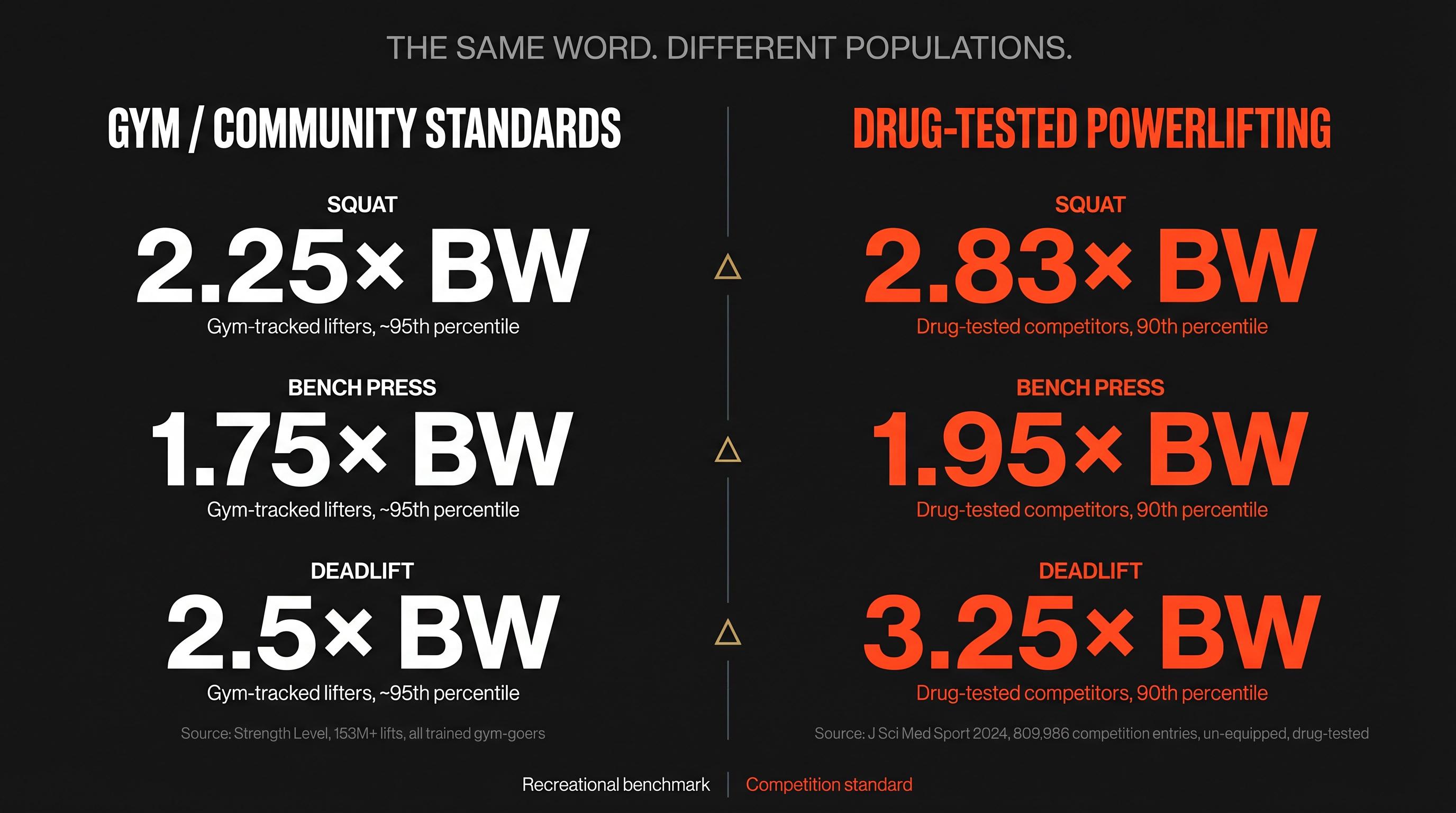
A 2024 peer-reviewed study in the Journal of Science and Medicine in Sport analysed 809,986 competition entries from un-equipped, drug-tested powerlifters — one of the largest normative datasets in the sport. For young adults aged 18–35, the 90th percentile relative strength values were noticeably higher than ordinary gym standards: male lifters reached roughly 2.83× bodyweight squat, 1.95× bench and 3.25× deadlift, and female lifters reached roughly 2.26× squat, 1.35× bench and 2.66× deadlift. (Monash University)
Those numbers are for a self-selected, drug-tested competitive population. That's why "elite" in one context is not the same as "elite" in another:
| Context | What "elite" usually means |
|---|---|
| General gym/community benchmark | Near the top of recreationally tracked lifters in a public dataset |
| Drug-tested powerlifting | Near the top of lifters competing under standardised rules |
| Professional or world-level strength sport | Much higher again, usually requiring federation-specific rankings and records |
So if your squat, bench or deadlift doesn't look "elite" against a powerlifting dataset, that doesn't mean you're weak. It means you're comparing yourself to a population selected specifically for strength sport — lifters who trained for years with the goal of moving as much weight as possible at a set bodyweight, and who then competed to prove it. For most people reading this, the 95th-percentile-of-gym-lifters "elite" is a more meaningful target than the 90th-percentile-of-powerlifters "elite."
That context explains one more thing you'll notice — not every source publishes the same standards.
Why Strength Standard Sites Show Different Numbers
Search "how much should I bench" and you'll find different numbers across Strength Level, powerlifting databases, other app-based trackers, YouTube coaches and gym articles. That doesn't automatically mean someone is lying. Usually, it means they're answering different questions with different data.
Another app-based dataset we reviewed, for example, publishes bench press standards based on about 24,400 of its users, giving an average bench value of around 220 lb (100 kg) for men and 104 lb (47 kg) for women. Its squat averages are roughly 265 lb (120 kg) for men and 154 lb (70 kg) for women. Its deadlift averages are about 150 kg for men and 89 kg for women across a similar population. Those numbers are broadly useful, but they're drawn from a different user population and methodology than Strength Level's larger public lift dataset, and they skew toward whoever uses that particular product. Competition databases are different again, because they only include lifters who entered meets and completed official attempts under a judge.
Here are the biggest reasons strength standards vary between sources:
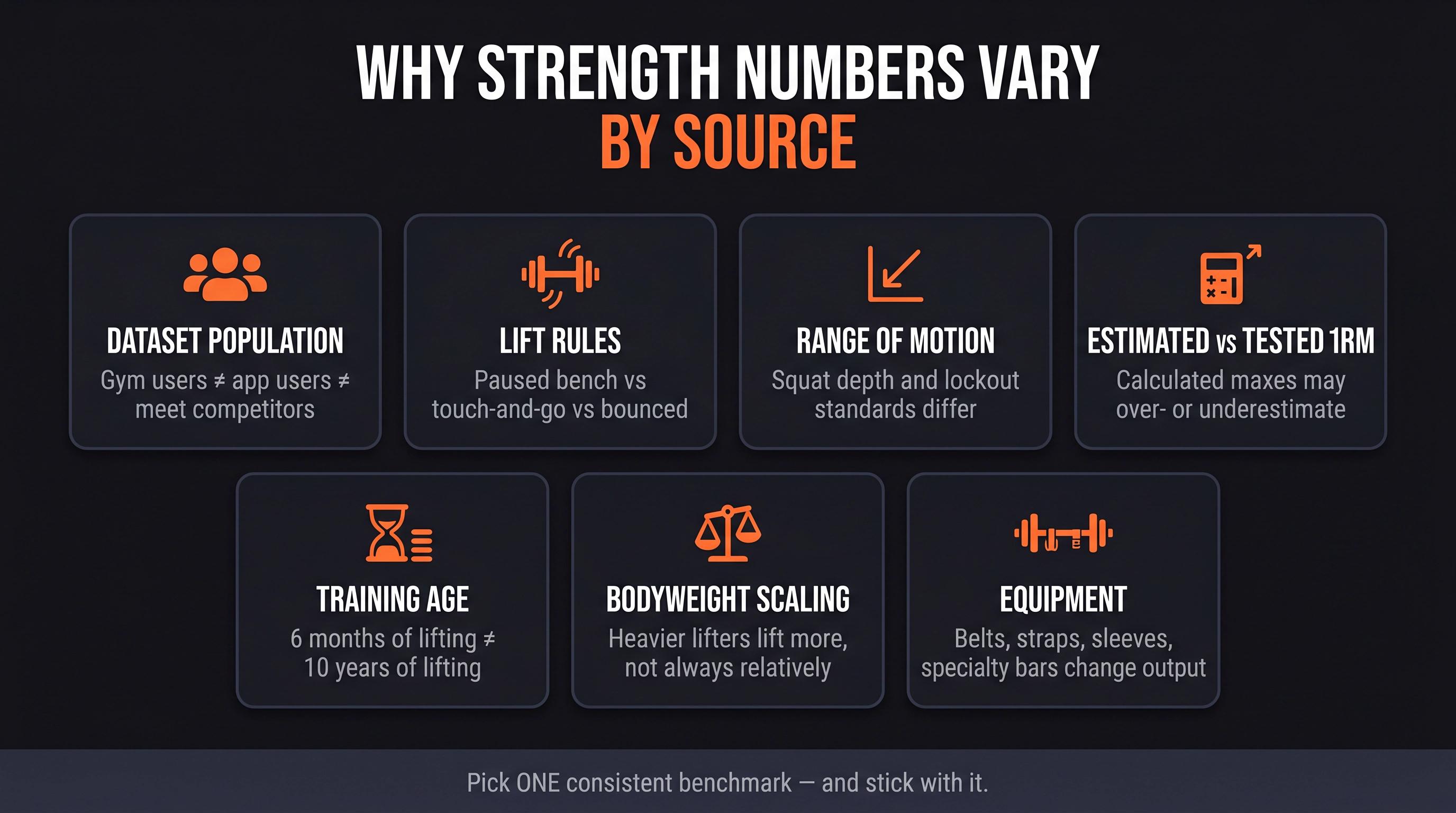
| Reason | Why it changes the number |
|---|---|
| Dataset population | A commercial-gym dataset, an app-user dataset and a powerlifting-meet dataset are not the same population. |
| Lift rules | A paused bench, a touch-and-go bench and a bounced bench can produce different numbers. |
| Range of motion | Squat depth and deadlift lockout standards change comparability. |
| Estimated vs tested 1RM | A calculated 1RM from a high-rep set may overestimate or underestimate true max strength. |
| Training age | Someone with six months of training should not be judged against someone with ten years of consistent lifting. |
| Bodyweight scaling | Heavier lifters usually lift more total weight, but not always more weight relative to bodyweight. |
| Equipment | Belts, straps, sleeves, deadlift bars, squat bars and machines change performance. |
The practical rule: pick a consistent benchmark and stick with it. If you like Strength Level's dataset, use Strength Level's tiers. If you want to compare yourself to competitive powerlifters at your weight class, use the IPF normative data. Don't mix — measuring yourself against a different source every time you search gives you noise, not information.
It's also the reason we built Stronger around tracking strength over time, not just comparing on one day. Our app logs every working set, detects PRs, tracks bodyweight alongside the lifts, plots your strength curves per exercise, and turns the full picture into a Strength Score that adjusts for context. A static table gives you one snapshot. A tracker gives you a trend, and the trend is what actually predicts whether you're getting stronger — regardless of which benchmark site you prefer.
Once you've picked a benchmark, the next question is how to read your own 1RM — because the tables assume one number you probably don't actually test every week.
How to Estimate Your 1RM Without Maxing Out
The cleanest way to use these tables is with a true one-rep max. But most lifters don't need to max out often, and probably shouldn't. A practical alternative is to use a hard set of 3–5 reps and estimate your 1RM from it.
Estimated 1RM = weight × (1 + reps ÷ 30)
Example: if you lift 100 kg for 5 reps → 100 × (1 + 5 ÷ 30) = 116.7 kg estimated 1RM
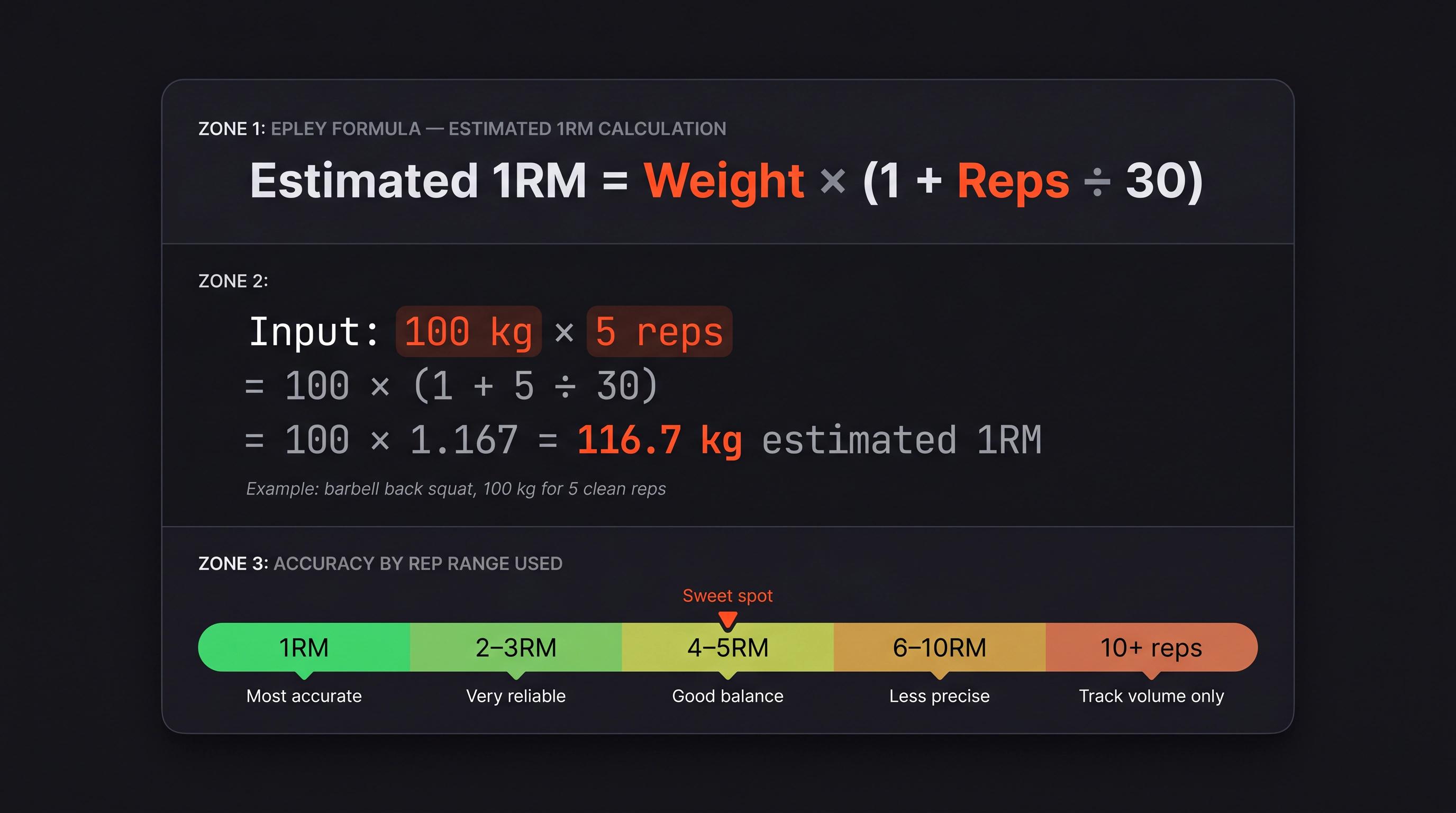
Estimated 1RMs are useful, but they're not perfect. A 2024 study in the International Journal of Strength and Conditioning tested multiple 1RM prediction equations in men and women across bench press, squat and arm curl before and after a 16-week resistance training programme. The authors found that selected equations can estimate maximum dynamic strength, but accuracy varied by sex, lift and equation. As a general rule, 1RM estimates tend to be more accurate from lower-rep efforts such as 3–5RM and less precise when based on higher-rep sets.
A useful rule of thumb:
| Rep max used | Reliability for 1RM estimate |
|---|---|
| 1RM | Best, but highest fatigue and highest need for skill |
| 2–3RM | Very useful for experienced lifters |
| 4–5RM | Good balance of safety and accuracy |
| 6–10RM | Useful, but less precise |
| 10+ reps | Better for tracking volume than estimating max strength |
Understanding which rep ranges best serve your goal — pure 1RM testing vs strength development vs hypertrophy — also changes how you structure your training blocks leading up to a retest. If your app or spreadsheet estimates a 1RM from every set, pay most attention to the trend over time rather than any one calculated number. A single estimate can be off by several kilograms. A rising trend across three months of training is harder to lie about.
Numbers in hand, the next question is what to do at your tier.
What to Do at Each Strength Level
Knowing your tier is useful only if it changes what you do next. Here's the short version by level — what to focus on, what to ignore, and what "progress" looks like.
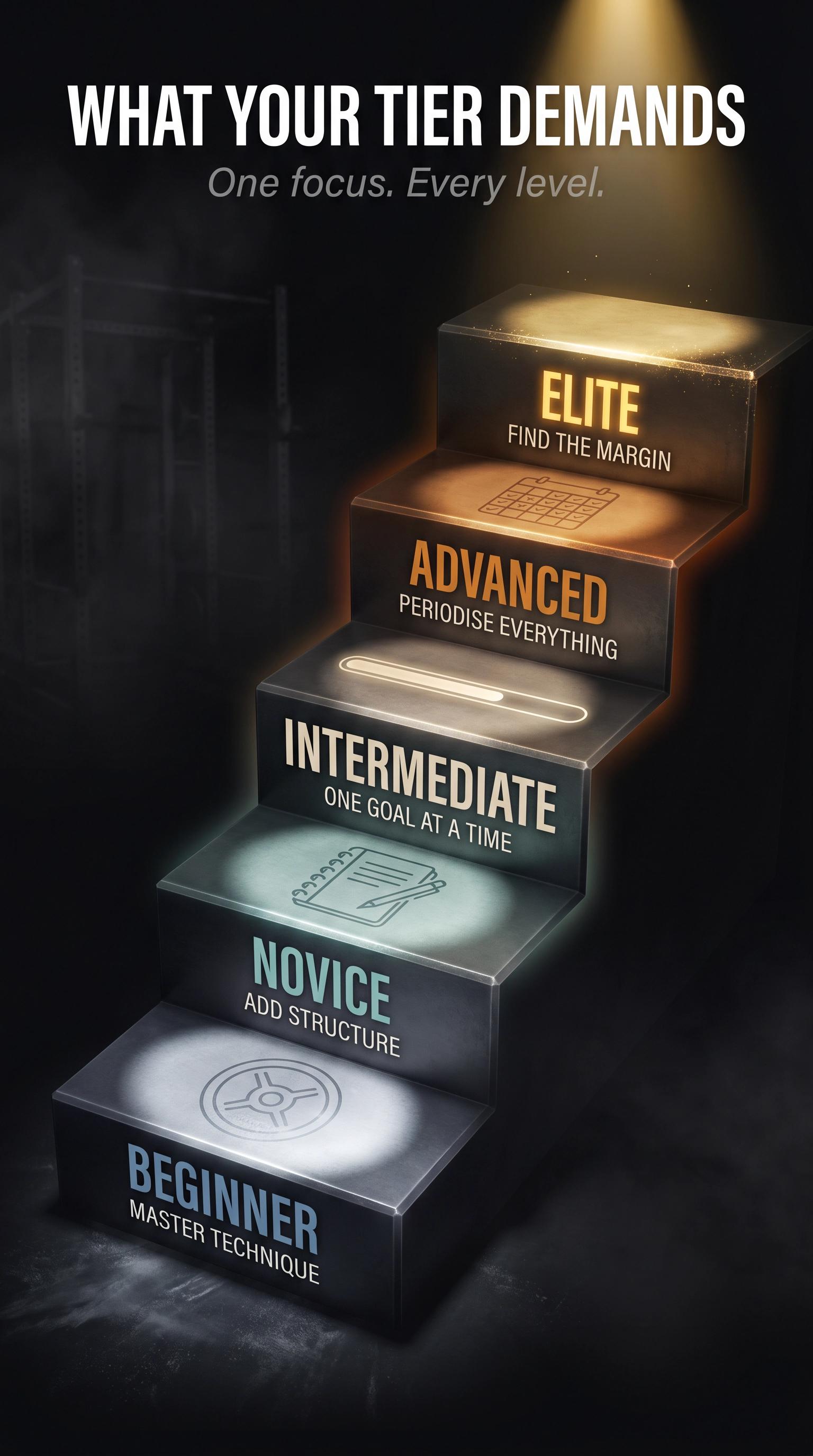
Training advice for beginner lifters
Your goal is not to "test" strength constantly. Your goal is to build skill.
Focus on:
- Learning consistent technique
- Training each main lift 1–3 times per week
- Adding weight gradually
- Keeping reps controlled
- Building confidence under the bar
A beginner who adds 2.5–5 kg to a lift every few weeks is winning, even if the number still looks small on a standards table. At this stage, a missed rep from bad bracing or a rushed setup costs you more than a conservative load would.
Training advice for novice lifters
You're past the "just learning the movement" stage. Now you need structure.
Focus on:
- Progressive overload
- Repeatable warm-ups
- Tracking every working set
- Keeping rest periods consistent
- Building muscle in the weak links of each lift
This is where most lifters benefit from a simple programme and a good tracker. A structure like the 5×5 workout programme — which cycles all three main barbell lifts with linear progression — works exceptionally well at this stage. Our Stronger app supports exactly this — logging sets, reps and weight, built-in rest timers, automatic PR detection, progress charts per exercise and custom routines. If your workouts currently live in a Notes app or a paper notebook, moving them somewhere that auto-detects PRs and rest intervals is usually worth one tier of progress by itself. Knowing how long to rest between sets for strength vs hypertrophy work is also a surprisingly impactful variable most novices overlook.
Training advice for intermediate lifters
Intermediate is the most important milestone in strength training. It means you're stronger than a large portion of people who train, but progress will probably slow down.
Focus on:
- One main progression target at a time
- Better exercise selection
- Enough weekly volume to grow
- Deloads when performance drops
- Technique consistency under heavier loads
This is also the stage where bodyweight changes start to matter. If you're very lean and trying to move from intermediate to advanced, gaining some muscle often helps. If your absolute strength is rising while bodyweight is stable, your relative strength is improving, and that's a real win even when the number on the bar isn't moving as fast. An upper lower split — which hits each pattern twice per week with sensible volume — is one of the most reliable structures for intermediate lifters trying to push past this stage.
Training advice for advanced lifters
Advanced lifters need fewer random workouts and more planned training.
Focus on:
- Periodisation
- Specific weak-point work
- Fatigue management
- Planned heavy exposures
- More precise recovery habits
- Comparing your own trend line, not just today's PR
We built Stronger's adaptive routines for lifters in exactly this band — the app adjusts weights, sets and reps based on your recent performance, offers deload suggestions when the data says you're accumulating fatigue, and gives you strength curves and volume-frequency analytics per exercise. At this level, the marginal gains come from seeing patterns you can't see manually in a spreadsheet.
Training advice for elite lifters
Elite standards are not just "good gym numbers." They usually require years of consistent training, favourable leverages, enough muscle mass, strong technique and disciplined recovery.
At this level, your next improvement might come from:
- A better peak
- Smaller technical changes
- More specific accessory work
- A higher-quality training block
- Better nutrition and sleep
- A competition-style testing environment
Your progress may now be measured in single-digit kilograms per year, not per month. That's normal — it's also why comparing against your own past bests matters more than comparing to a standards table you've already cleared.
Tier is one dimension. The more revealing analysis is usually your lifts compared against each other.
How to Tell Which Lift Is Holding You Back
The most useful way to use strength standards isn't to obsess over one lift. It's to compare your lifts against each other, find the one that's furthest behind its siblings, and ask why.
Take a worked example. An 80 kg male lifter has:
| Lift | 1RM | Standard comparison |
|---|---|---|
| Bench press | 105 kg | Slightly above intermediate |
| Squat | 115 kg | Below intermediate |
| Deadlift | 180 kg | Between intermediate and advanced |
| Overhead press | 55 kg | Below intermediate |
This lifter's deadlift is clearly ahead of schedule, their bench is solid, and their squat and overhead press are both trailing. That's information — but it does not automatically mean "train squat and shoulders harder."
It could mean any of these:
- Squat technique is inconsistent session to session
- Squat depth is stricter than the benchmark population (so the number is artificially lower for a fair reason)
- Quads are undertrained relative to hips and back
- Upper-back strength is limiting the press
- The programme has too much deadlift emphasis and not enough squat volume
- Recovery is being spent on one lift at the expense of the others
The right next step depends on which of those it is — and that's where a standards table ends and your own logbook begins. A good strength standard should lead to a better training decision, not just an ego boost or a confidence hit. That's exactly the diagnostic logic built into our Strength Score — instead of tracking each lift in isolation, it shows you the relative gaps across your full profile.
That's the real value of these tables: diagnostic, not decorative. It's also exactly the loop we turned into a product.
How Stronger Turns Strength Standards Into a Training Loop
Static standards tables are useful, but they don't update. You do. Your bodyweight changes. Your training age changes. The lift that was "below intermediate" last quarter is the lift you just hit an advanced PR on. A table can't see any of that.
That's why we built Stronger — and specifically our Strength Score — around the same principle these standards are built on, but as a continuously updating score rather than a one-time snapshot.
The Stronger features page shows how the Strength Score section sits at the centre of the app — adjusting for bodyweight and gender, comparing you against global averages, and tracking your score across weeks and months of training.
The Strength Score. Adjusts for bodyweight, gender and lift selection. Instead of reading the bench table, then the squat table, then the deadlift table, then the OHP table and mentally averaging, you get one number that reflects your full strength profile and updates automatically every time you log a session. It's the closest thing to asking "how strong am I right now, relative to people like me?" and getting an honest, current answer.
The loop these standards imply, built in. The pattern underneath every useful use of strength standards is the same five steps — log → compare → identify weak point → train → retest. We wired that loop directly into the app:
- Log the session. Sets, reps, weight, RPE, rest timers, warm-ups, drop sets. Quick Log for short sessions, full logging for programmed days.
- Compare. Your Strength Score against global averages, against friends, against your own past. Per-exercise strength curves show the trend per lift, not just per session.
- Identify weak point. Volume and frequency analytics per muscle group surface the lift or region that's actually lagging — the thing this post teaches you to look for manually, detected automatically.
- Train. Proven programs, our custom routine builder, or AI-generated adaptive routines that adjust weights, sets and reps based on how your recent sessions actually went.
- Retest. Estimated 1RM tracking and automatic PR detection mean you don't have to max out to know whether you're moving. The trend carries the answer.
Friends and groups matter. Strength is easier to sustain when it's socially legible. Our friend leaderboards, weekly and monthly challenges, and group comparisons exist because a private score is a less motivating score. When the people you lift with can see your progress (only what you want them to see), retesting feels less like a chore and more like a rematch.
If you've read this far and already pictured your numbers against these tables, the next step is the automated version. Start your Strength Score with Stronger — free trial, iOS and Android. The first workout you log becomes your baseline. The score takes care of itself from there.
A few nuances worth covering before the FAQ — gender comparisons, absolute vs relative strength, how to actually improve each lift, and how often you should bother retesting.
Male vs Female Strength Standards: How the Categories Work
Most public strength datasets and powerlifting federations publish male/female categories. This guide uses "gender category" in the practical sense people search for it online, while the underlying datasets usually refer to male and female categories.
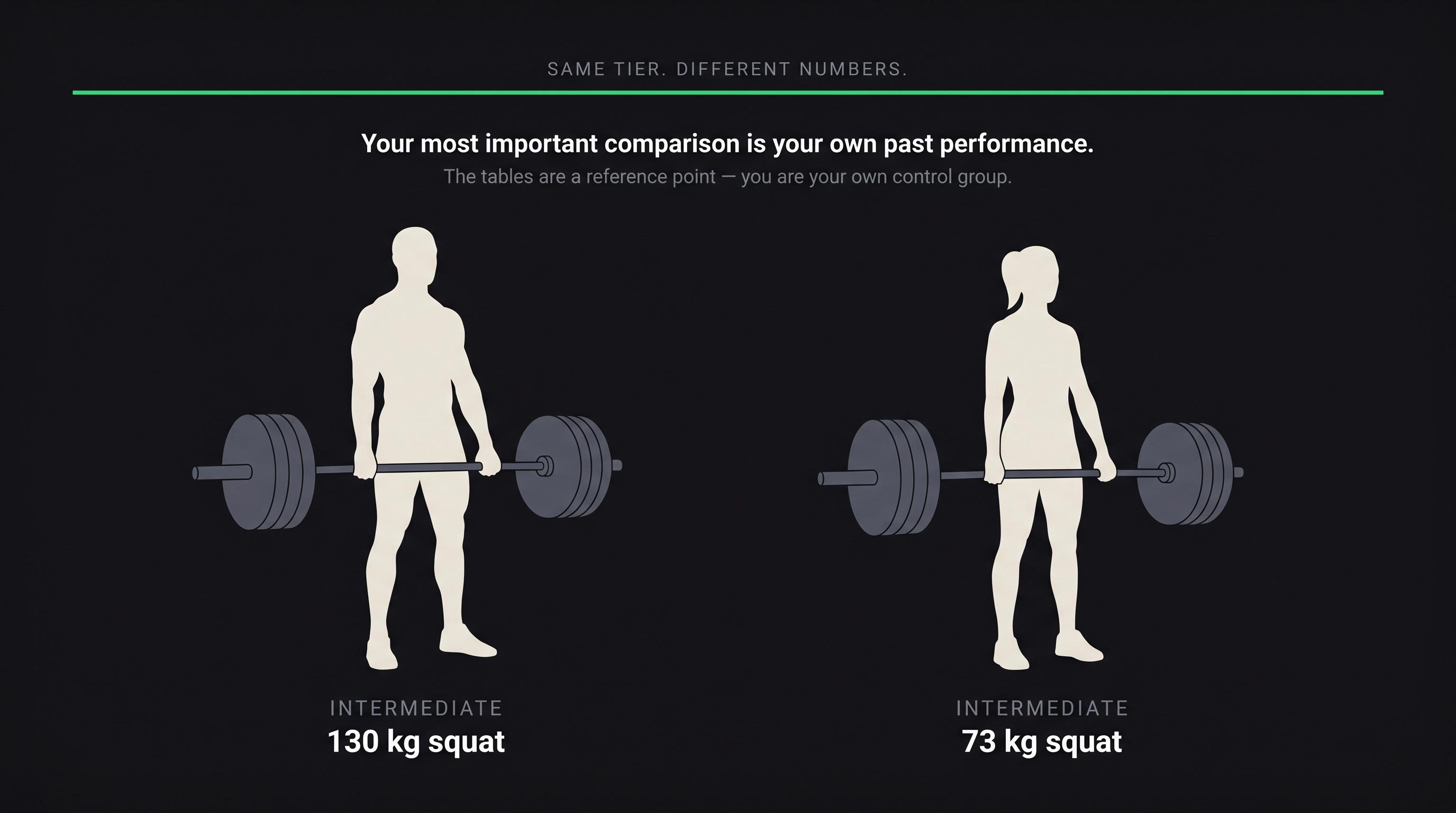
For everyday training, choose the table that matches the benchmark you want to compare against. For competition, use the rules of the federation you compete in. For personal progress, your most important comparison is still your own past performance at your current bodyweight, training age and technique standard. The tables are a reference point — you are your own control group.
Bodyweight Ratio vs Absolute Strength: Which Matters More?
Both matter, and they answer different questions:
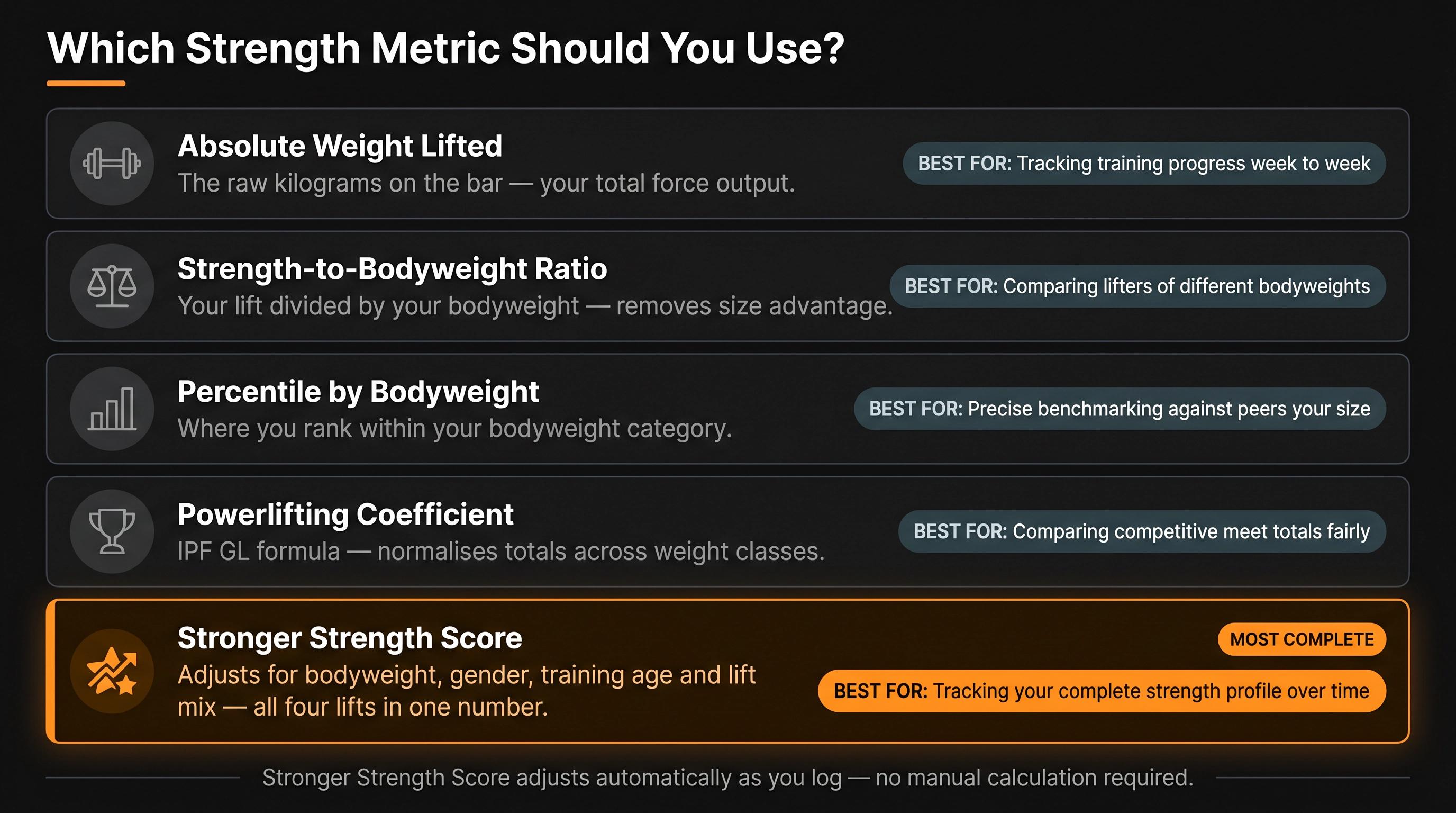
| Metric | Best for |
|---|---|
| Absolute weight lifted | Training progress, muscle and total force output |
| Strength-to-bodyweight ratio | Comparing lifters of different bodyweights |
| Percentile by bodyweight | More precise benchmarking |
| Powerlifting coefficient | Comparing competitive totals across weight classes |
| Stronger Strength Score | Tracking a more complete strength profile over time |
Powerlifting uses coefficient systems because bodyweight changes strength performance in a non-linear way. The IPF GL Points system was introduced for IPF events to compare lifters across bodyweight categories more fairly — it's what lets a 66 kg lifter and a 120 kg lifter win a meet-wide best-lifter award against each other on the same scoreboard. (powerlifting.sport)
For everyday gym tracking, you don't need to calculate coefficients after every workout. You need a simple loop:
Log → compare → identify weak point → train → retest.
That's exactly the loop Stronger is designed around — track workouts, measure Strength Score, follow routines, and compare progress with friends or groups. (Stronger)
Ready to Get Stronger?
Join 2,000,000+ lifters tracking their workouts with Stronger. Available on iOS and Android.
How to Improve Each Barbell Lift
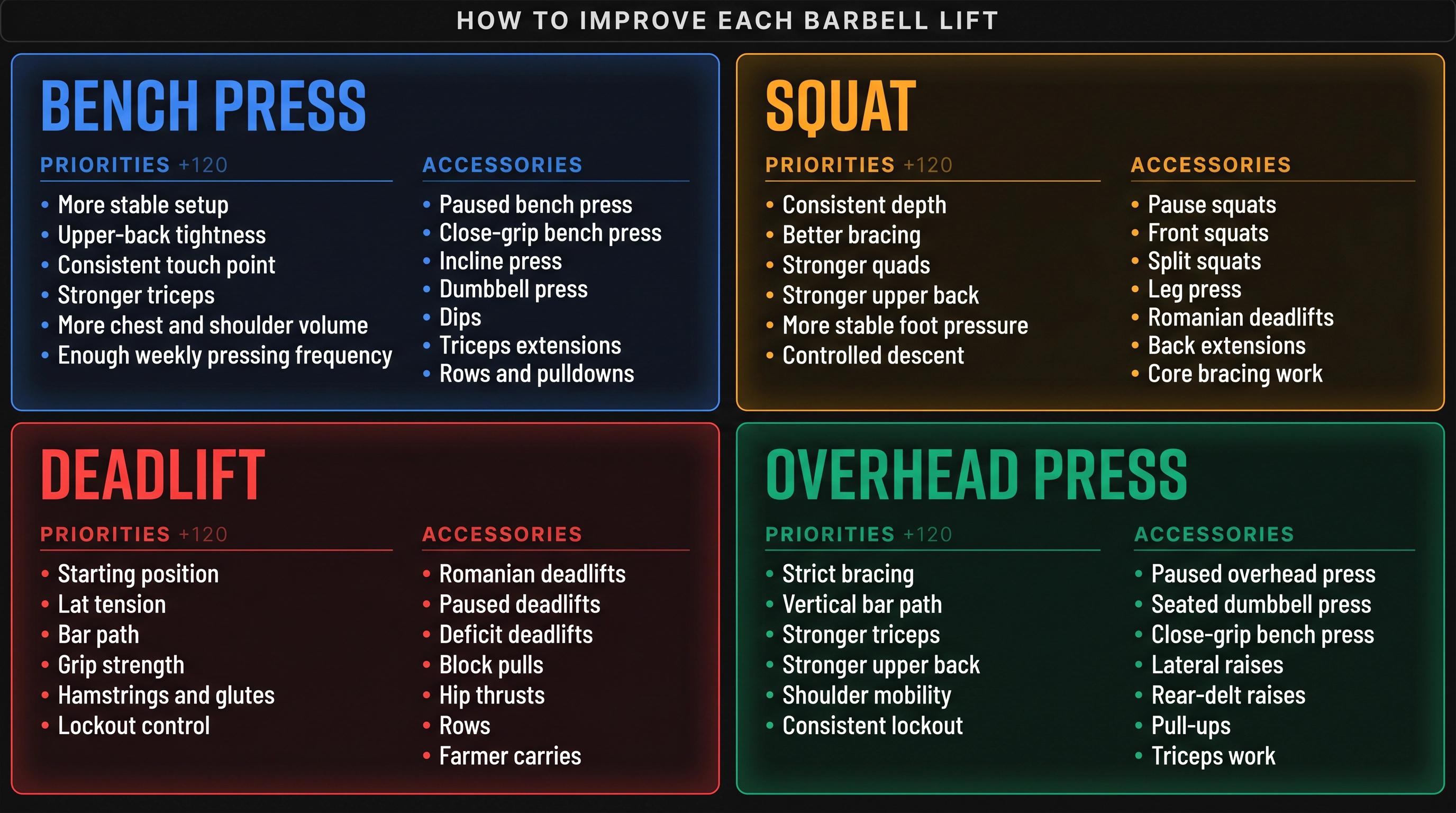
Once you've identified a lift that's lagging, the question isn't "do more of it." It's "do the right work for this lift, at the right frequency, with the right accessories." A quick field guide per lift:
How to improve your bench press
Prioritise:
- More stable setup
- Upper-back tightness
- Consistent touch point
- Stronger triceps
- More chest and shoulder volume
- Enough weekly pressing frequency
Useful accessories:
- Paused bench press
- Close-grip bench press
- Incline press
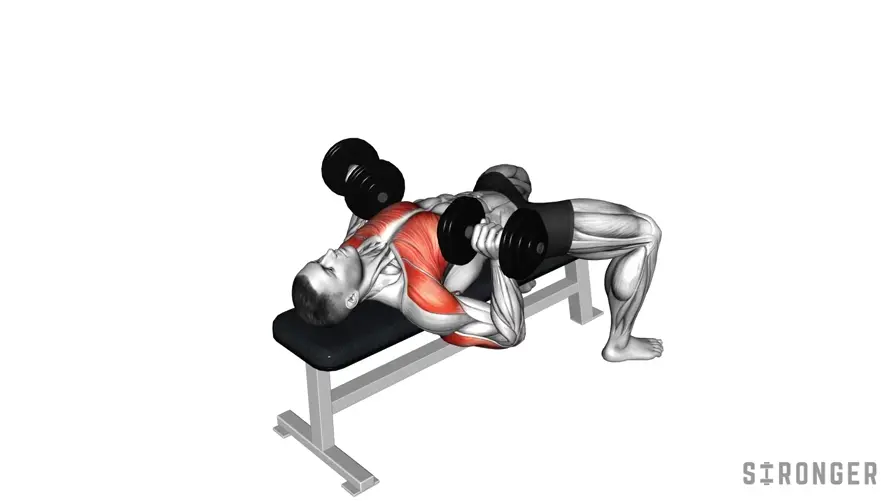
- Dumbbell press
- Dips
- Triceps extensions
- Rows and pulldowns
How to improve your squat
Prioritise:
- Consistent depth
- Better bracing
- Stronger quads
- Stronger upper back
- More stable foot pressure
- Controlled descent
Useful accessories:
- Pause squats
- Front squats
- Split squats
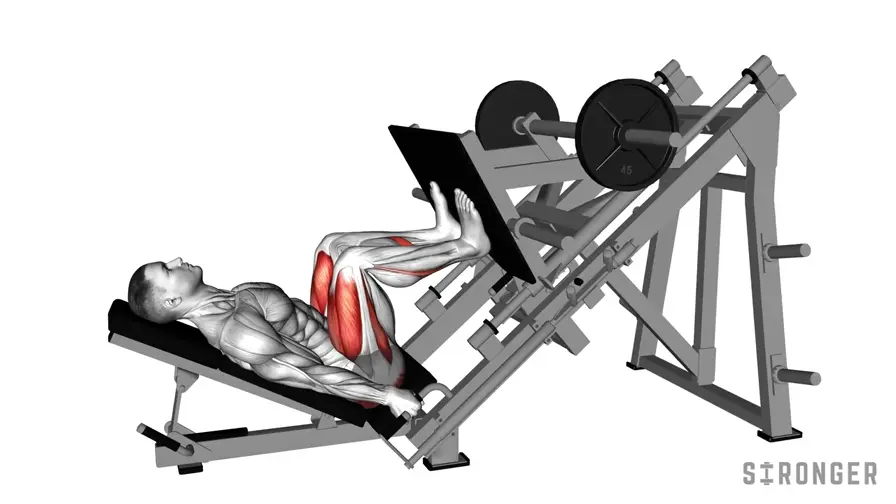
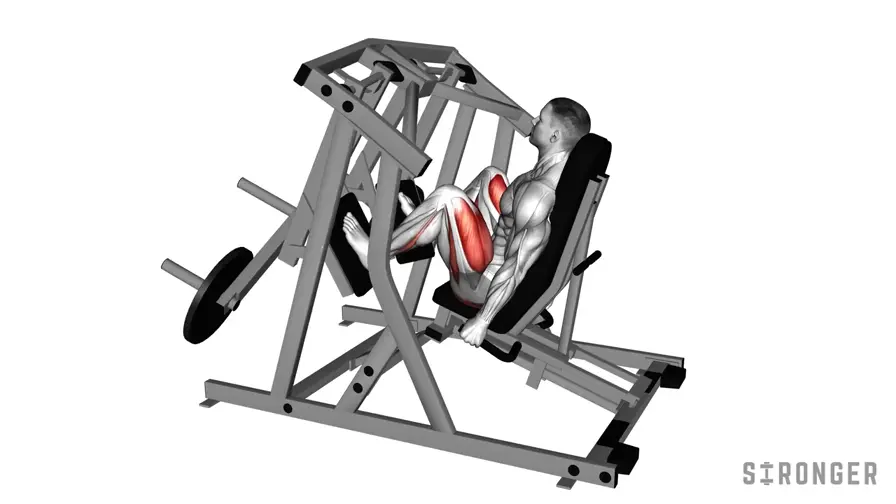
- Leg press
- Romanian deadlifts
- Back extensions
- Core bracing work
Our own Stronger squat guide covers the cues we recommend for depth and bracing: maintain a neutral spine, brace before the descent and drive through the whole foot, not just the heels or toes. (Stronger)
How to improve your deadlift
Prioritise:
- Starting position
- Lat tension
- Bar path
- Grip strength
- Hamstrings and glutes
- Lockout control
Useful accessories:
- Romanian deadlifts
- Paused deadlifts
- Deficit deadlifts
- Block pulls
- Hip thrusts
- Rows
- Farmer carries
How to improve your overhead press
Prioritise:
- Strict bracing
- Vertical bar path
- Stronger triceps
- Stronger upper back
- Shoulder mobility
- Consistent lockout
Useful accessories:
- Paused overhead press
- Seated dumbbell press
- Close-grip bench press
- Lateral raises
- Rear-delt raises
- Pull-ups
- Triceps work
How Often Should You Retest Your Strength?
You do not need to max out every week. In fact, you probably shouldn't.
| Training level | Retest frequency |
|---|---|
| Beginner | Rarely; use rep PRs and technique progress |
| Novice | Every 8–12 weeks if desired |
| Intermediate | Every 8–16 weeks, usually after a training block |
| Advanced | At the end of planned blocks or competition peaks |
| Elite | Only when testing fits the programme |
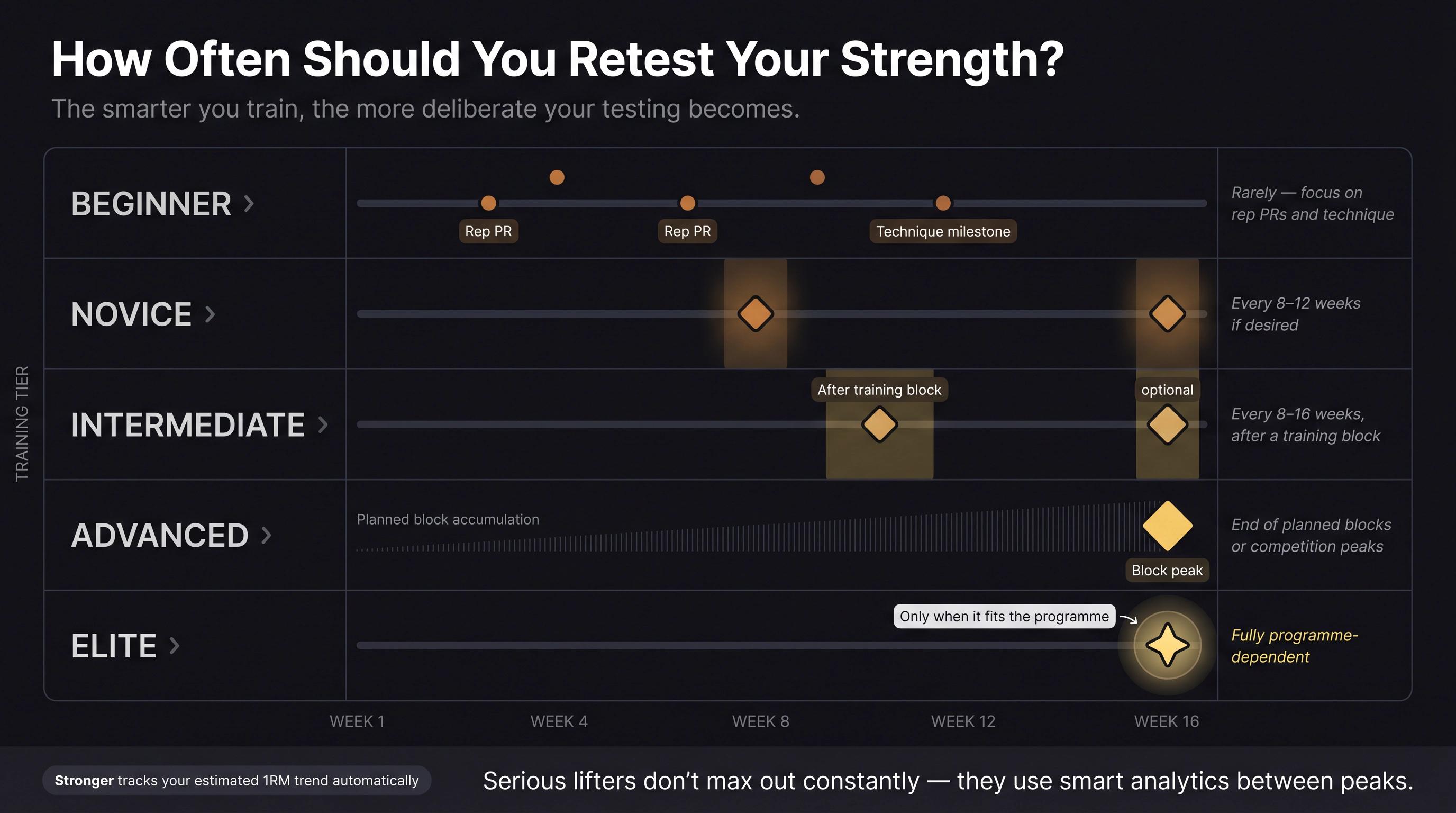
A good tracker makes formal retesting less necessary, because you can see estimated 1RM trends, PR events and volume changes without turning every session into a max-out day. Stronger includes PR detection, strength curves, workout history, bodyweight tracking and volume/frequency analytics — the set of tools that lets you trust the trend rather than needing a fresh 1RM to confirm it. (Stronger)
How to Use Strength Standards to Keep Getting Stronger
Strength standards aren't there to label you. They're there to give you a clearer target.
Use the tables like this:
- Find your bodyweight and gender category.
- Compare your estimated 1RM for each lift.
- Identify your current tier.
- Pick the next realistic benchmark.
- Train consistently until your numbers move.
If your bench is novice, your squat is intermediate and your deadlift is advanced, that's not a problem. It's information. The goal isn't to be perfectly balanced overnight — it's to know what to work on next and to make sure the signal you're reading matches the training decision you're making. That's exactly where getting stronger in a systematic, trackable way pays off most.
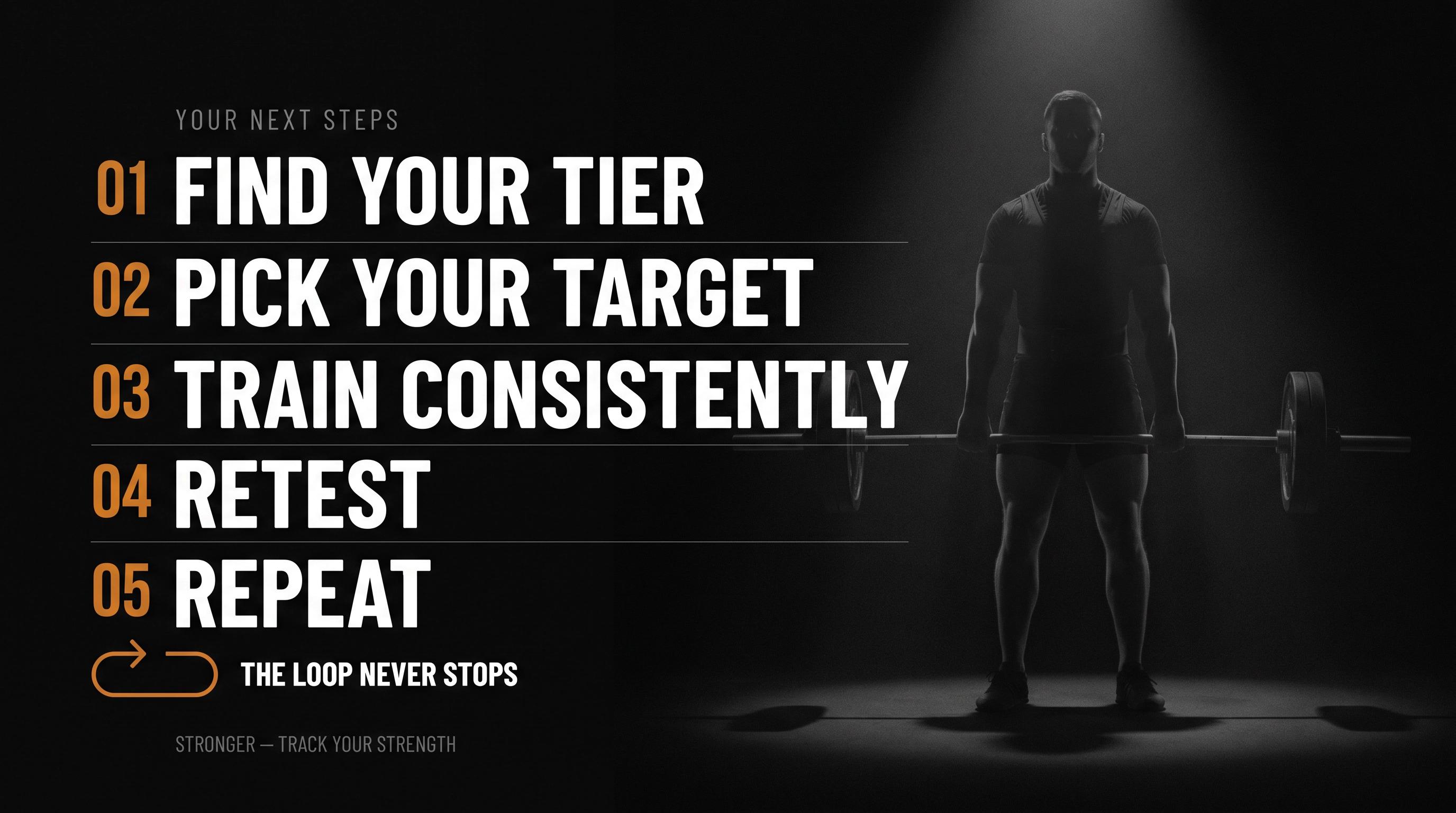
Stronger helps you turn that benchmark into a daily habit: log your sets, detect PRs, track bodyweight, monitor strength curves, follow adaptive routines and watch your Strength Score change over time. Strength standards are the snapshot. Stronger is the video. (Stronger)
Strength Standards FAQ
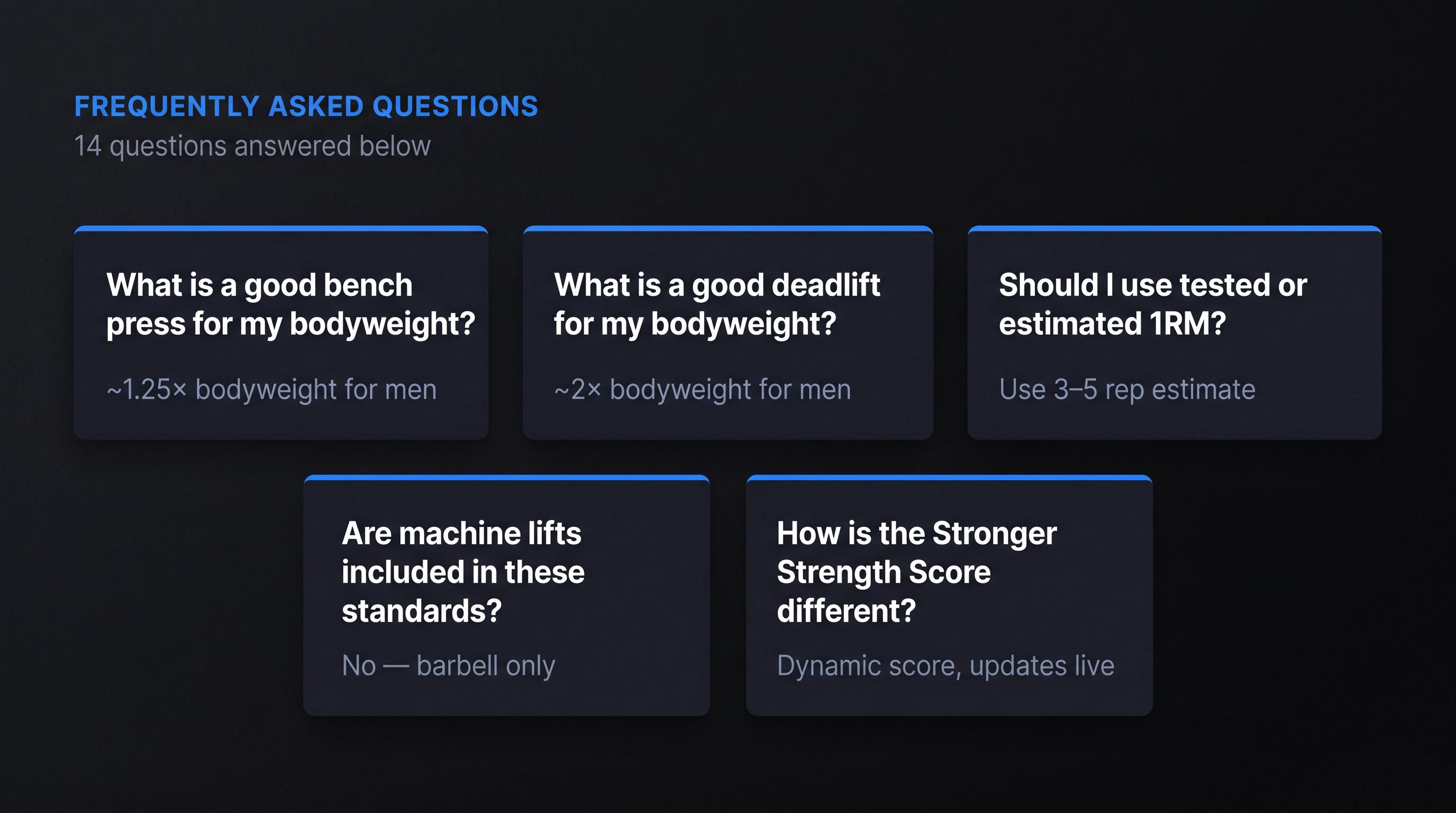
What is a good bench press for my bodyweight?
A good bench press for most trained lifters is around the intermediate standard for their bodyweight. For men, that's often around 1.25× bodyweight. For women, it's often around 0.75× bodyweight. Exact targets vary by bodyweight, so use the full table above instead of relying only on ratios, because the same ratio can land in different tiers at different bodyweights. (Strength Level) For the full technique breakdown behind what makes a quality bench press, see our bench press guide.
What is a good squat for my bodyweight?
A good squat for most trained lifters is around the intermediate standard. For men, that's often around 1.5× bodyweight. For women, it's often around 1.25× bodyweight. Depth matters — compare only squats performed to a consistent, below-parallel range of motion. (Strength Level) Our squat guide covers how to consistently reach and verify competition-style depth.
What is a good deadlift for my bodyweight?
A good deadlift is often heavier than your squat or bench. For men, an intermediate deadlift is commonly around 2× bodyweight. For women, it's commonly around 1.25× bodyweight. Advanced and elite deadlifts vary heavily by bodyweight, leverage, grip and training history. (Strength Level) See our deadlift guide for a full breakdown of setup and pull mechanics.
What is a good overhead press for my bodyweight?
For men, an intermediate strict overhead press is often around 0.8× bodyweight. For women, it's often around 0.5× bodyweight. The overhead press is usually much lower than the bench press because it uses less total muscle mass and has less external support. (Strength Level)
Are these standards for raw lifting?
These are general barbell strength standards, not equipped powerlifting standards. They're best used for raw gym lifting with normal technique — no bench shirt, no squat suit, no bottom-position support. If you use supportive equipment, machines, partial range of motion or unusual variations, track those separately rather than comparing them directly to these tiers.
Should I use kilograms or pounds?
Use whichever unit you train with. The tables are in kilograms. To convert to pounds, multiply by 2.205 (so 100 kg is about 220 lb, and 225 lb is about 102 kg). The tier thresholds are the same either way.
Should I compare my tested 1RM or estimated 1RM?
Use a tested 1RM if you're experienced and can test safely. Otherwise, use an estimated 1RM from a hard set of 3–5 reps using the formula above. Research on 1RM prediction equations shows that estimates can be useful, but accuracy varies by equation, exercise and sex. As a rule of thumb, lower-rep efforts (3–5RM) give the cleanest estimate.
Why is my strength standard lower after losing weight?
Because these standards compare both absolute strength and bodyweight. If you lose bodyweight and keep most of your strength, your relative strength may actually improve even if your absolute 1RM drops slightly — you just moved into a lighter bodyweight row where the tier thresholds are lower. If you lose weight quickly, some absolute strength loss is common, so expect a short transition period.
Why do heavier lifters have lower bodyweight ratios?
Strength doesn't scale linearly with bodyweight. A 120 kg lifter may lift more absolute weight than a 70 kg lifter, but not always proportionally more. That's why powerlifting uses coefficient systems such as IPF GL to compare performances across weight classes fairly. (powerlifting.sport)
Are machine lifts included?
No. These standards are for barbell lifts. Machine chest press, Smith machine squat, trap-bar deadlift, leg press and dumbbell press are different exercises with different mechanics, different stabilizer demands and different numbers. Track them separately.
How is the Stronger Strength Score different from these tables?
These public tables are educational benchmark snapshots based on external public datasets. Our Strength Score is a proprietary metric that accounts for bodyweight, gender and lift selection, then turns your full strength profile into a single trackable score that updates automatically as you log. The tables tell you where you stand today. Stronger's Strength Score tells you how that position is changing and what to do next. (Stronger)
How often do these strength standards change?
The underlying public datasets update as more lifts are logged, so tier thresholds drift a little over time — usually by a few kilograms per year at most, with larger lifter pools producing more stable numbers. The IPF rulebook updates its technical criteria and weight classes periodically (the 2026 rules are current as of this post). We review this guide at least annually so the numbers here match the current reference data.
What bodyweight should I use if mine fluctuates?
Use your current trained bodyweight — ideally measured first thing in the morning, on a consistent schedule, rather than after a meal or a water-heavy day. If your bodyweight swings a few kilograms between sessions, that's normal. If it shifts a full row in the tables (5+ kg), re-check your tier at the new bodyweight. Our app tracks bodyweight over time so you don't have to reason about any single measurement.
Can I use these standards if I only train with dumbbells or machines?
Not directly. These tables are built around barbell lifts with standard technique, and the mechanics of dumbbell presses, machine presses, trap-bar deadlifts and leg presses are different enough that the numbers aren't comparable — a dumbbell press uses more stabilizer work per kilogram, a machine press uses less, and a trap-bar deadlift sits somewhere between a squat and a conventional deadlift biomechanically. If you only train with dumbbells or machines, track your own progress against your own past performance rather than trying to cross-reference these tiers.
Sources and Data
| Source | Date / currency note | Used for |
|---|---|---|
| Strength Level | Accessed April 2026. Pages show current 2026 site context but no public last-updated date was found during review. | Primary bodyweight-by-gender standards for bench press, squat, deadlift and shoulder press. (Strength Level) |
| International Powerlifting Federation Technical Rules | Latest official rulebook update shown as March 1, 2026. | Powerlifting weight classes, age categories and technical lift standards. (powerlifting.sport) |
| van den Hoek et al., Journal of Science and Medicine in Sport | Published 2024. | Peer-reviewed powerlifting normative data from 809,986 competition entries. (Monash University) |
| Ribeiro et al., International Journal of Strength and Conditioning | Published 2024. | Evidence on 1RM prediction equations and estimated max accuracy. |
| Stronger official website and features page | Accessed April 2026. | Stronger product features, Strength Score positioning, tracking, adaptive routines and analytics. (Stronger) |
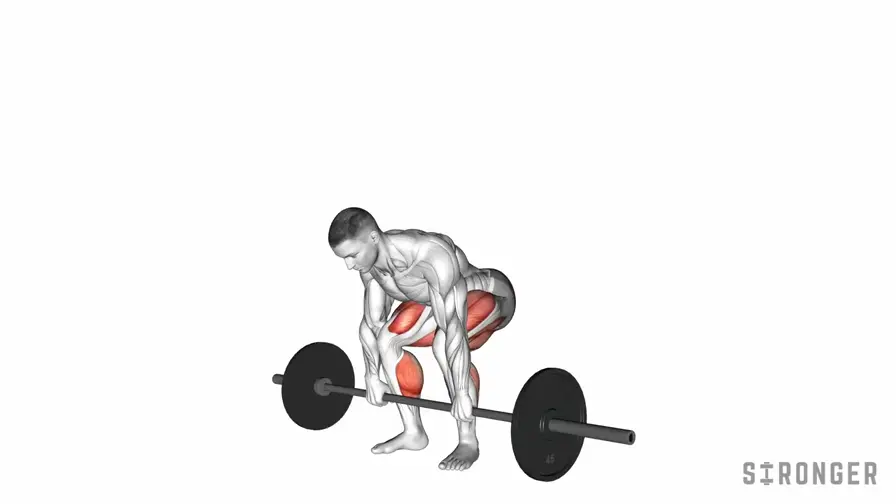
Exercises in this guide
Stronger Editorial Team
Certified strength & conditioning specialists with 10+ years of coaching experience
The Stronger editorial team produces evidence-based training content for lifters of all levels.
Ready to Get Stronger?
Join 2,000,000+ lifters tracking their workouts with Stronger. Available on iOS and Android.