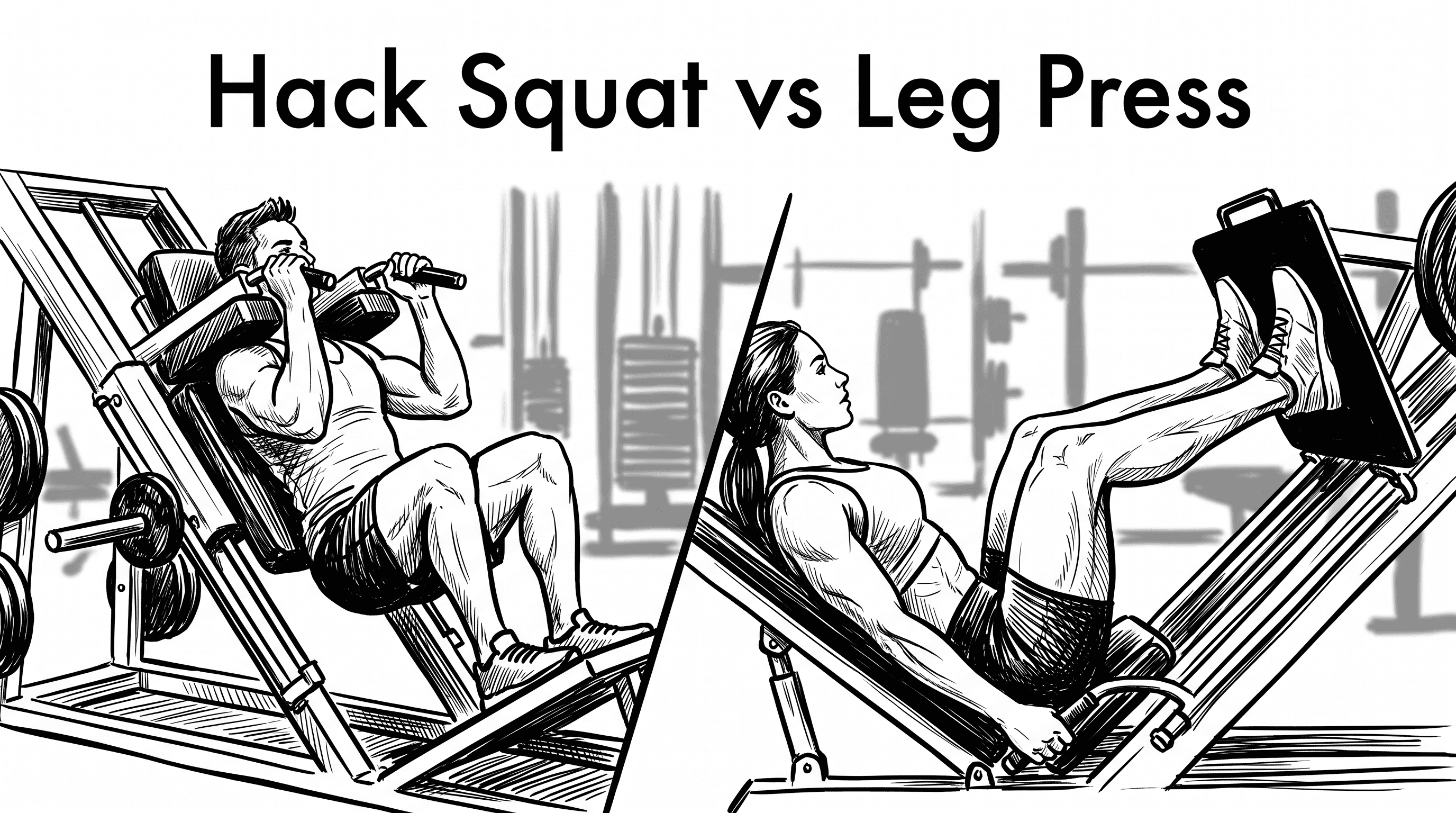

Leg Press vs Squat: They're Not Interchangeable
The debate gets framed wrong almost every time. Someone asks whether leg press can replace squats, and the internet answers with "squats are king" or "leg press is safer for beginners" or — worst of all — "both are great, just use both!" None of those answers are wrong exactly. They're just not useful.
The real issue is that the leg press and the squat don't just train different exercises. They train different stress patterns. Different stress means different adaptation. And different adaptation means you cannot simply swap one for the other and expect the same results — even if both exercises make your quads sore the next day.
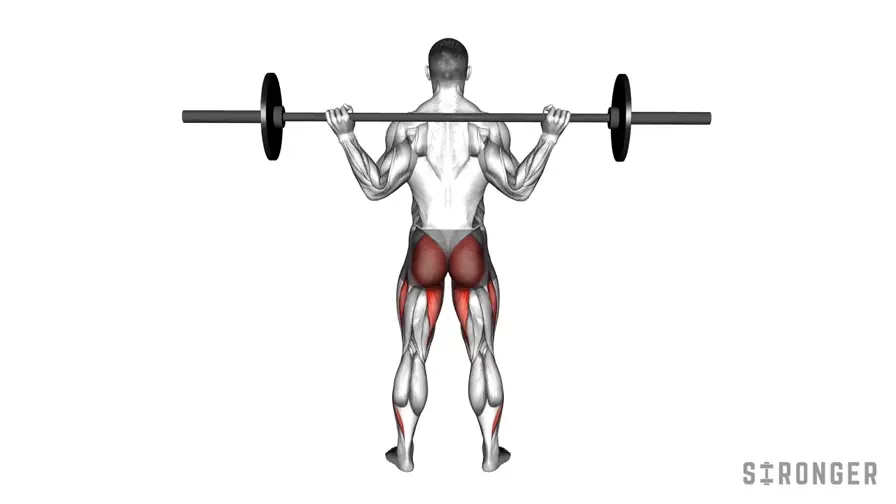
Here's what we'll cover: why the same muscles doesn't mean the same stimulus, what the research actually shows about transfer and hypertrophy, when leg press genuinely earns its place (and when it doesn't), and how to program both so your numbers actually mean something. Stronger's exercise library categorizes the barbell back squat as a barbell compound lift engaging quads, glutes, hamstrings, abs, and back — while the leg press is a machine compound emphasizing quads, glutes, and hamstrings with the torso fully supported. That distinction isn't cosmetic. It's the whole story.
Is Leg Press the Same as Squats? Here's the Truth
The leg press can replace some of the squat's muscle-building work. It cannot replace the squat as a movement skill, a strength standard, an athletic pattern, or a full-body bracing exercise.
That's the debate settled — but a one-sentence answer doesn't tell you what to do about it. For that, you need to understand why the two exercises produce different results even when they seem to work the same muscles.
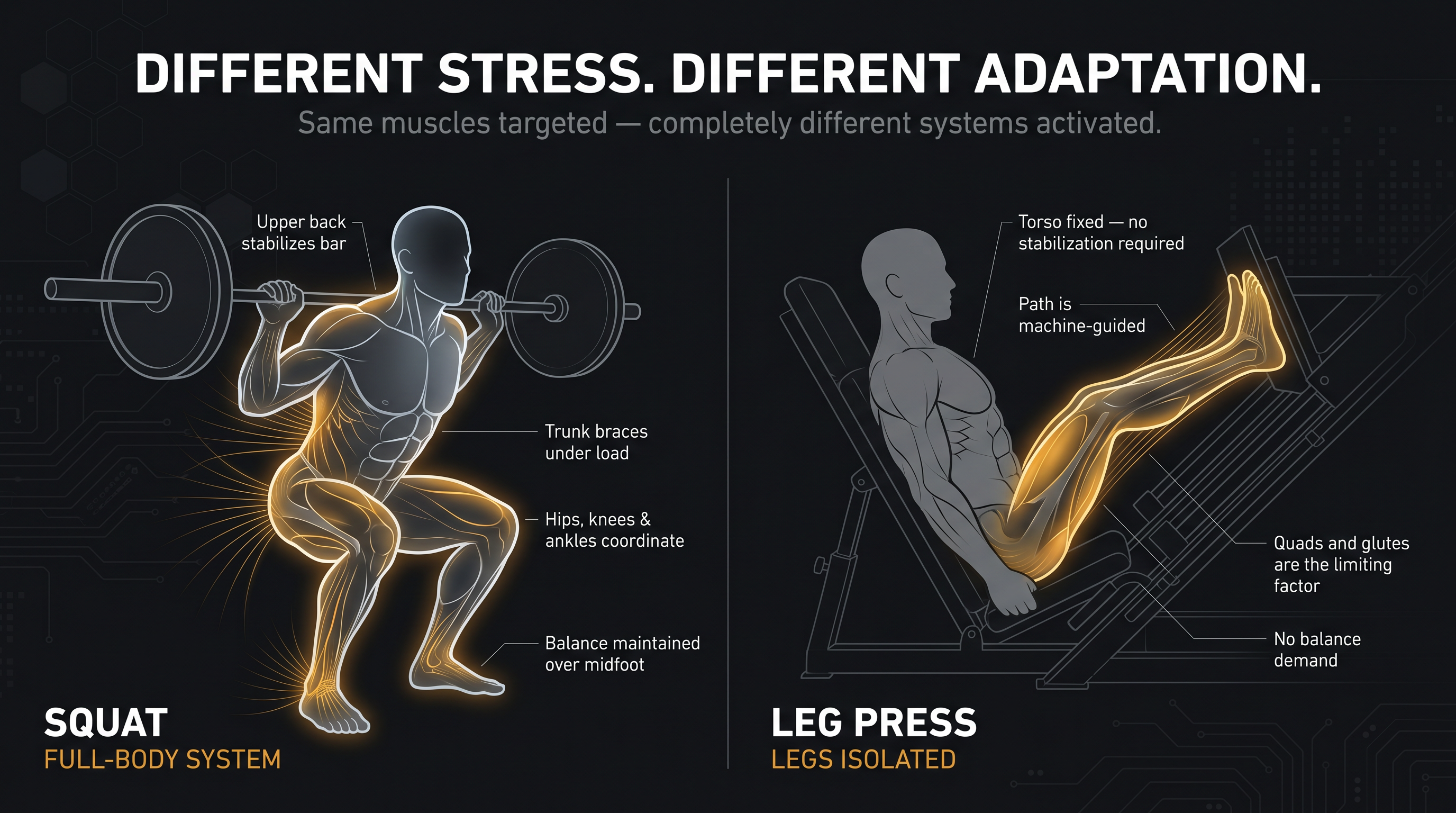
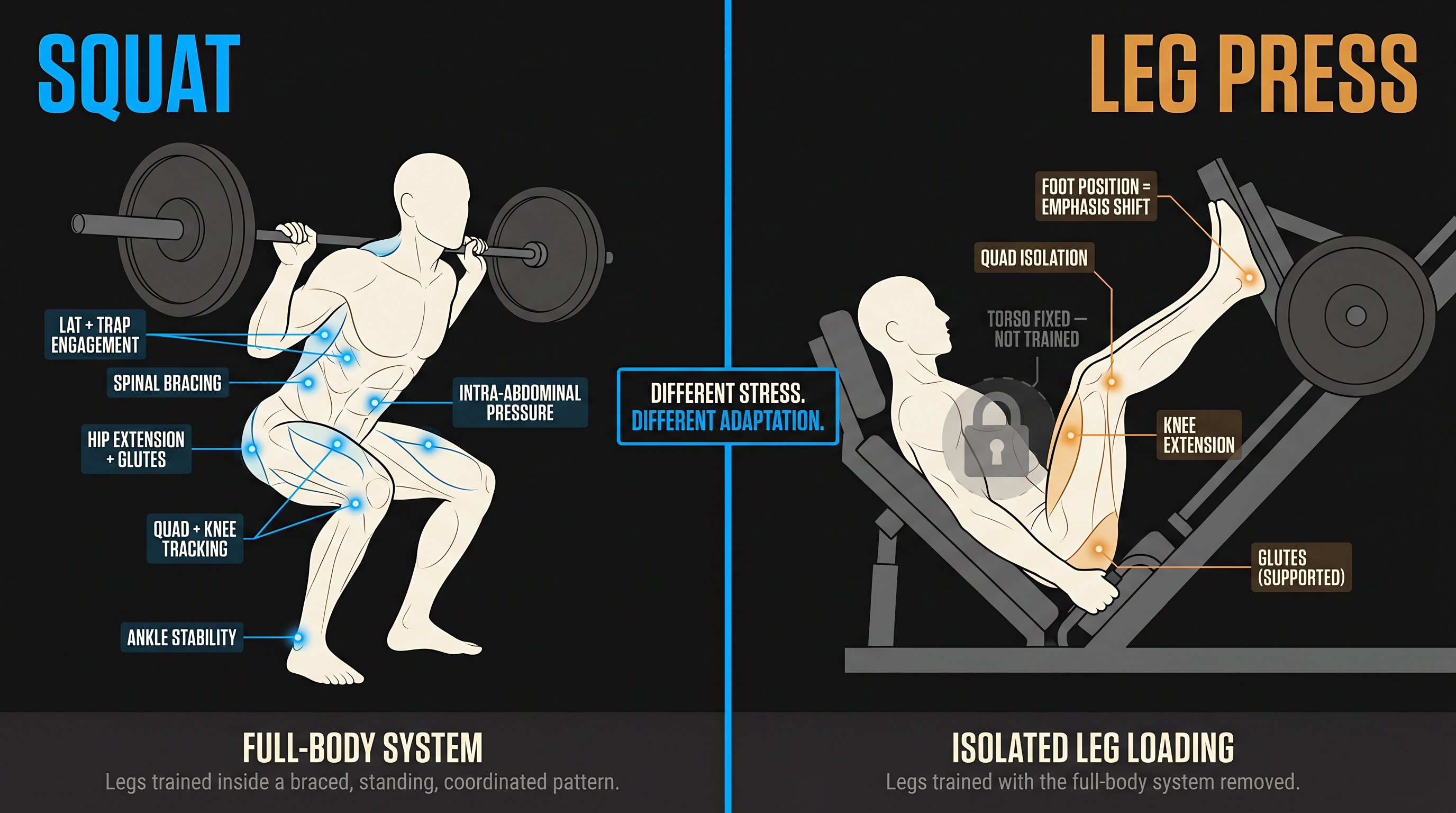
A squat is a loaded free-weight movement that requires your ankles, knees, hips, spine, trunk, and upper back to coordinate while the load stays controlled over your base of support. A leg press is a supported machine movement where your torso is fixed, the path is guided, and the legs handle most of the visible work. Both are compound lower-body exercises. Both create muscle damage and growth stimulus. They just create different stress — and different stress produces different adaptation.
So the useful question is never: "Which one is better?"
The useful question is: "Better for what?"
Why Leg Press and Squats Aren't the Same Stimulus
Your body doesn't adapt to exercise names. It adapts to the exact mechanical stress you expose it to.
That stress comes from five things:
- Which tissues produce force
- Which joint angles they produce force through
- How much stability the movement demands
- Where the load sits relative to your body
- How similar the movement pattern is to the thing you want to improve
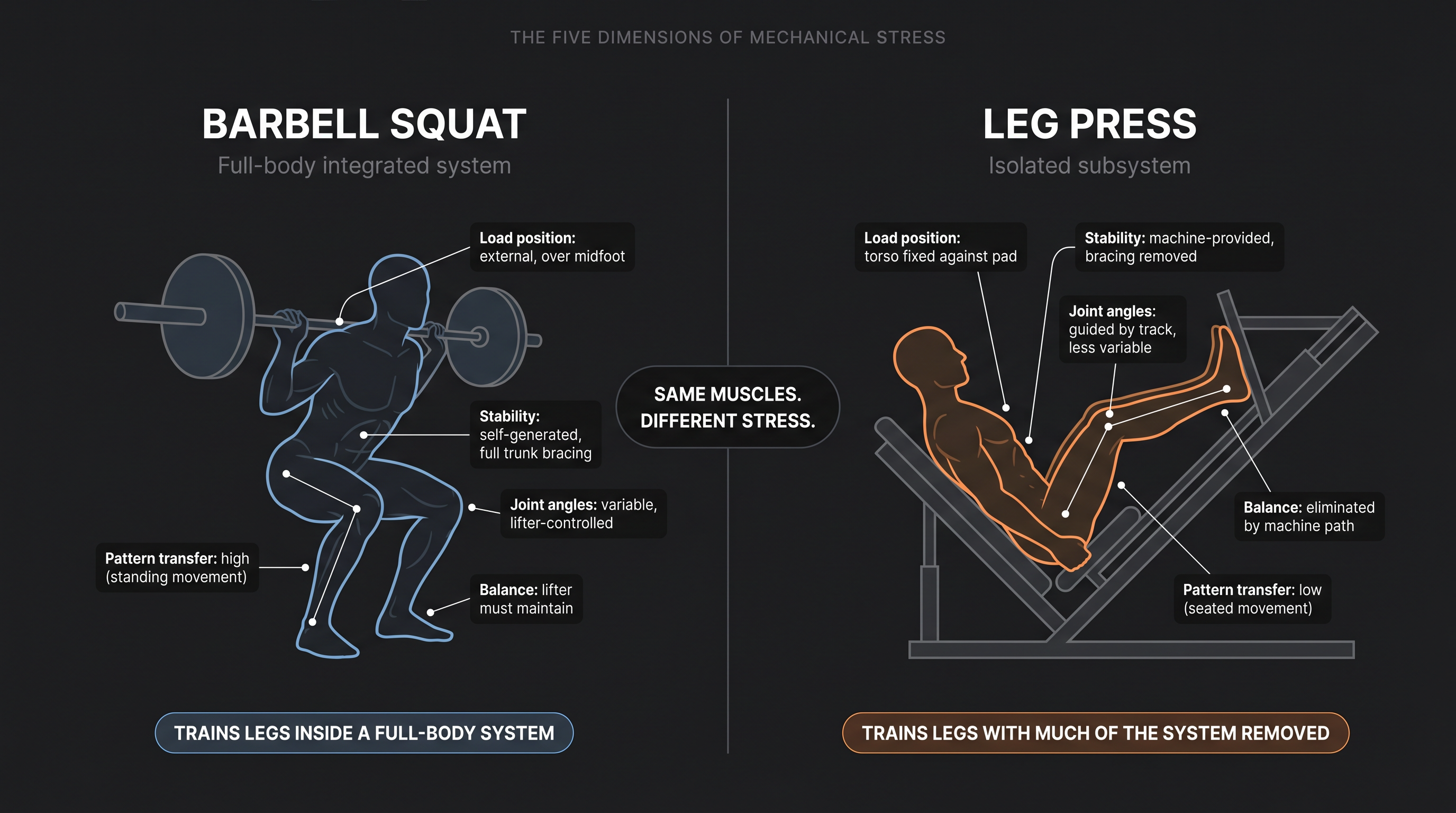
The squat and leg press overlap on point one: both can train quads and glutes. They split on every other point.
A 2024 clinical biomechanics review in the International Journal of Sports Physical Therapy described the squat as a highly modifiable movement where trunk recruitment is required to stabilize the spine and torso while simultaneously strengthening the hip and knee extensors. Stance width, foot rotation, trunk angle, tibia position, and depth can all shift joint loading and muscular demand. The squat isn't just a "leg exercise with a bar." It's a leg exercise inside a full-body bracing system. (IJSPT)
The leg press deliberately removes many of those demands. That is not a weakness. It's the point.
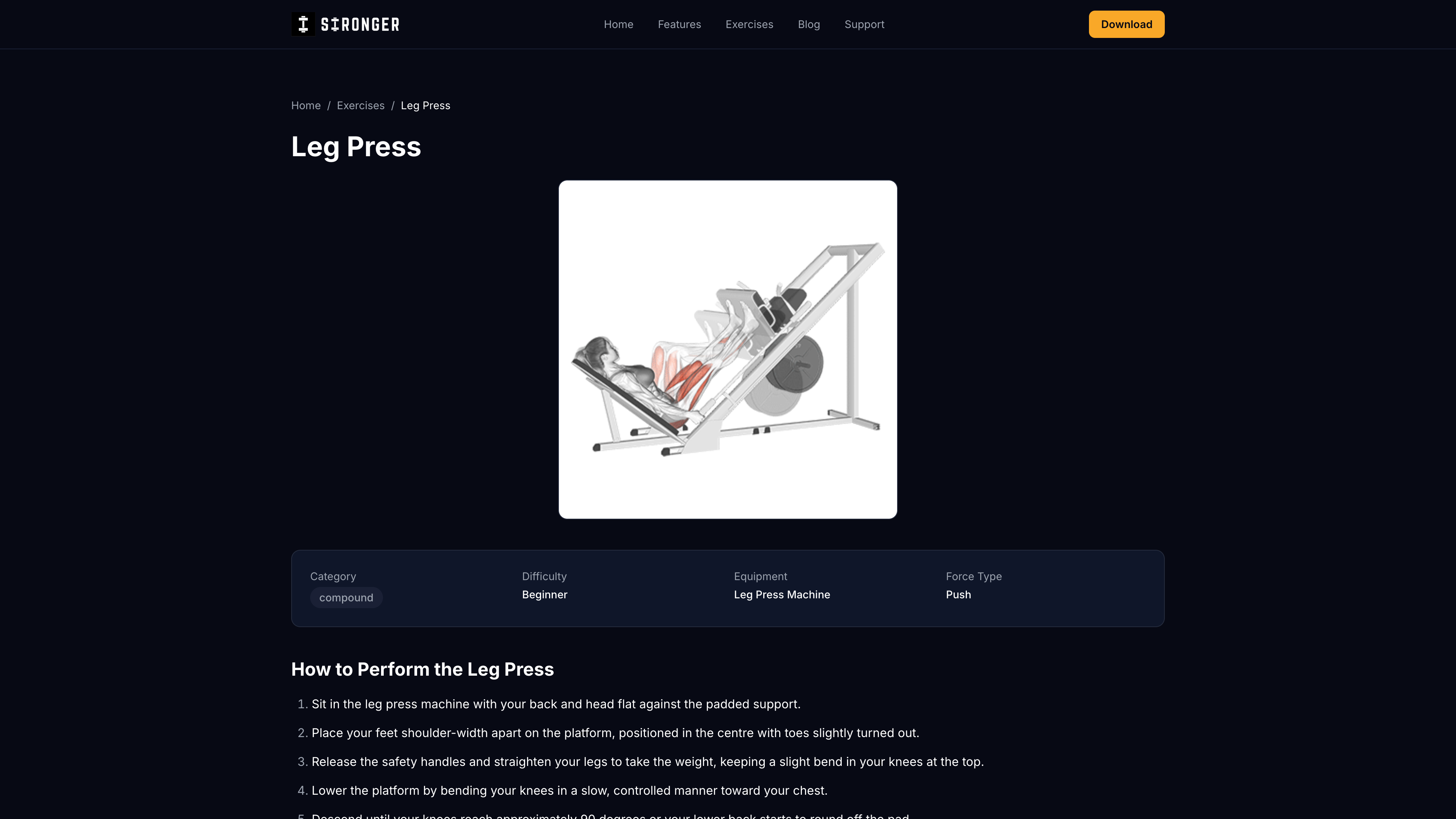
By fixing the torso and guiding the path, the leg press lets you load the legs hard without balance, bar position, or bracing becoming the limiting factor. Stronger's leg press guide positions it exactly this way: useful for heavy loading with less spinal compression, accessory work after squats, high-rep finishers, and controlled hard sets close to failure.
The key distinction: the squat trains your legs inside a full-body system. The leg press trains your legs with much of that system taken out. Both are useful. They're just not the same stimulus, which means they're not interchangeable.
What Research Says About Leg Press vs Squat Performance
Do Squats or Leg Press Transfer Better to Athletic Performance?
The most direct evidence comes from older but rarely-contested head-to-head training studies.
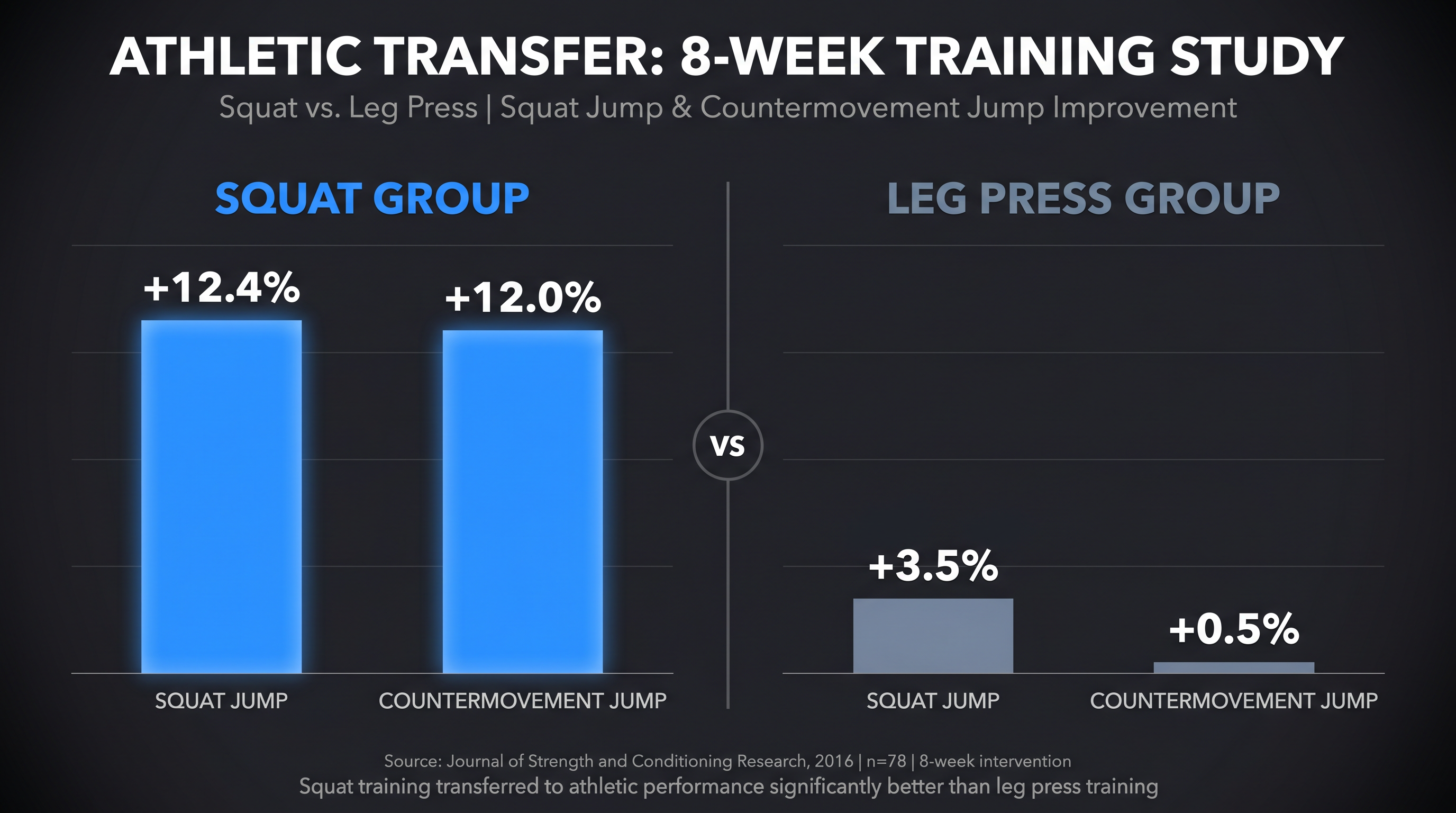
A 2016 Journal of Strength and Conditioning Research study put 78 students through eight weeks of either squat or 45-degree leg press training. The results were clear-cut:
- Squat group: squat jump improved 12.4%, countermovement jump improved 12.0%
- Leg press group: squat jump improved 3.5%, countermovement jump improved 0.5%
Free-weight squat training transferred to jump performance significantly better than leg press training. (PubMed)
A 2018 study comparing squat-only, leg-press-only, and combined training also found that squat training transferred better to maximal squat strength — confirming the task-specific transfer principle. You get better at what the movement actually resembles.
These studies used college students, not elite athletes, so the exact percentages shouldn't be applied universally. But the directional finding is robust: squat strength is not just "leg strength." It's leg strength expressed through a standing, braced, coordinated pattern.
How Squat Technique Changes Which Muscles You Actually Train
Even the squat is not one fixed thing.
A 2026 Scientific Reports study of 29 elite powerlifters squatting at 70–90% of their 1RM found that joint demands shifted with both load intensity and technique. Hip joint moments accounted for a large share of total lower-limb demand, especially at heavier intensities. High-bar vs. low-bar position, stance width, and individual technique choices can meaningfully shift demand between the knee and hip extensors. (Nature/Scientific Reports)
A 2026 Frontiers in Physiology study on foot-position variations confirmed that changing foot placement alters squat mechanics — including quadriceps activation, ankle kinematics, and vertical force production. (Frontiers)
The practical implication: a high-bar, narrow-stance squat with heel elevation trains differently than a wide-stance, low-bar powerlifting squat. When someone asks "can leg press replace squats?" a fair follow-up is: which squat, done how, for what goal?
How Much Joint Stress Do Heavy Squats Actually Create?
A 2025 PLOS ONE study modeled lower-limb joint contact forces in 29 top-ranked powerlifters squatting at 70–90% of 1RM. At 90% 1RM, peak joint contact forces reached:
- ~15.5× bodyweight at the hip
- ~23.2× bodyweight at the tibiofemoral joint
- ~26.7× bodyweight at the patellofemoral joint
- ~11.5× bodyweight at the ankle
These are elite powerlifters under near-maximal loads — not thresholds for recreational lifters. But they illustrate why load management, depth, progression, and fatigue matter in squat programming. The leg press earns its place here: when your lower back, bracing capacity, or technical threshold is the limiting factor, the leg press can keep training the legs without requiring the same full-system effort.
Can You Build Muscle with Leg Press Instead of Squats?
Muscle growth responds to mechanical tension, sufficient effort, adequate range of motion, enough weekly volume, and recovery. Barbells aren't required. Progressive overload — consistently increasing the demands on your muscles over time — is what drives adaptation regardless of which tool you use.
A 2023 systematic review and meta-analysis on range of motion in resistance training found that full range of motion offered trivial-to-small advantages over partial range for most outcomes, with an important exception: training at long muscle lengths may be especially beneficial for hypertrophy. A 2025 Journal of Sports Sciences study tested different knee-flexion ranges during unilateral leg presses in trained lifters over eight weeks, and found no difference in quadriceps growth between a leg trained through roughly 100 degrees of knee flexion and a leg trained through each lifter's maximum range. (PubMed)
Practically: don't turn the leg press into an ego half-rep contest. Control the eccentric, use a repeatable depth that loads the quads meaningfully, and stop before your pelvis rolls and your lower back rounds off the pad.
Leg Press vs Squat: Muscles Worked (What's Different)
How Each Exercise Trains the Quads Differently
Both exercises can train the quads hard. The difference is what tends to end the set.
On a squat, the set may stop because your quads are cooked — but it can also stop because your back angle collapses, your bracing fails, your balance shifts, or your bar path drifts. On a leg press, the torso is supported, which means the quads more often become the actual limiting factor.
This is why the leg press is so effective for hypertrophy: it lets you accumulate hard quad volume without every set becoming a full-body event. Understanding the right rep ranges for hypertrophy will help you get the most out of this advantage.
Foot placement changes the emphasis. Lower feet on the platform typically increase knee flexion demand and quad stress. Higher feet shift more demand toward the glutes and hamstrings. Don't oversell this distinction — Stronger's leg press guide gives the same practical note: foot position changes emphasis, it doesn't flip a switch between muscles.
Leg Press vs Squat for Glutes: What Actually Works
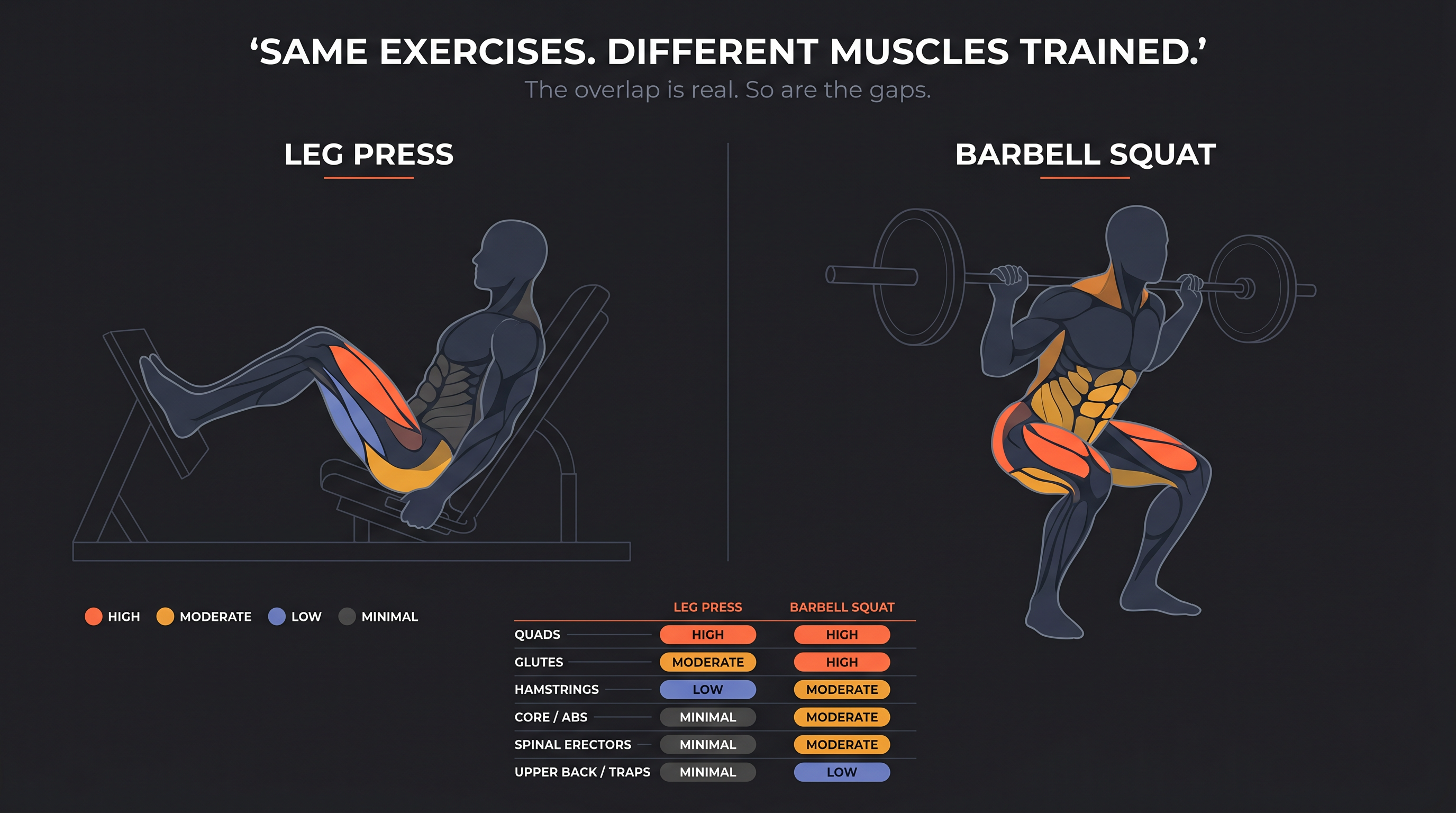
Squats can be excellent for glutes, especially with sufficient depth and hip extension demand. But squat style matters — a high-bar squat, low-bar squat, front squat, and split squat all load the glutes differently because hip angle, knee angle, torso angle, and balance demands change.
A 2025 Frontiers in Physiology systematic review on gluteus maximus hypertrophy found that what matters is loading hip extension well — not any one specific exercise. (Frontiers) If you want to build that capability, our hip thrust guide covers every variation worth using for maximum glute development.
Leg press can train glutes, especially with a higher or wider foot position and sufficient depth. But because your torso is fixed against the pad, it won't challenge the hip extension pattern under a standing load the same way a free-weight squat does. Adding hip thrusts to your lower-body day fills this gap directly.
Do Squats and Leg Press Train Your Hamstrings Enough?
Neither exercise is adequate for complete hamstring training.
The hamstrings cross both the hip and the knee. In squats and leg presses, both joints move simultaneously — but the hamstrings don't get challenged through the lengthened hip-extension or knee-flexion stress you'd get from Romanian deadlifts, good mornings, Nordic curls, or leg curls.
If your leg day is only squats and leg press, your quads and glutes may be well-covered. Your hamstrings almost certainly need direct work.
Why the Squat Wins for Core and Upper Back Strength
This is where the squat wins without contest.
The leg press does not ask your abs, spinal erectors, lats, or traps to stabilize a heavy load in space. That's useful when you want less systemic fatigue. It's a real limitation if your goal is building full-body strength under a free weight.
Stronger's squat guide emphasizes bracing, trunk position, and knees tracking over toes for exactly this reason — those aren't minor cues. They're part of what the squat actually trains.
Ready to Get Stronger?
Join 2,000,000+ lifters tracking their workouts with Stronger. Available on iOS and Android.


Can You Replace Squats with Leg Press?
The answer depends entirely on your goal.
| Your Goal | Better Main Choice | Why |
|---|---|---|
| Improve barbell squat strength | Squat | You need the specific skill: bar path, bracing, depth, balance |
| Build quads with less technical limitation | Leg press | Easier to push close to failure without balance becoming the bottleneck |
| Train for powerlifting | Squat | The squat is the tested lift; leg press is accessory work |
| Add leg volume after heavy squats | Leg press | Loads quads/glutes after lower back and stabilizers are fatigued |
| Reduce spinal loading | Leg press | Torso support removes most axial-loading demand |
| Improve jump or athletic transfer | Usually squat | Direct studies show better transfer from squat training |
| Train around temporary back irritation | Often leg press, carefully | Useful option; setup, range, and symptoms still matter |
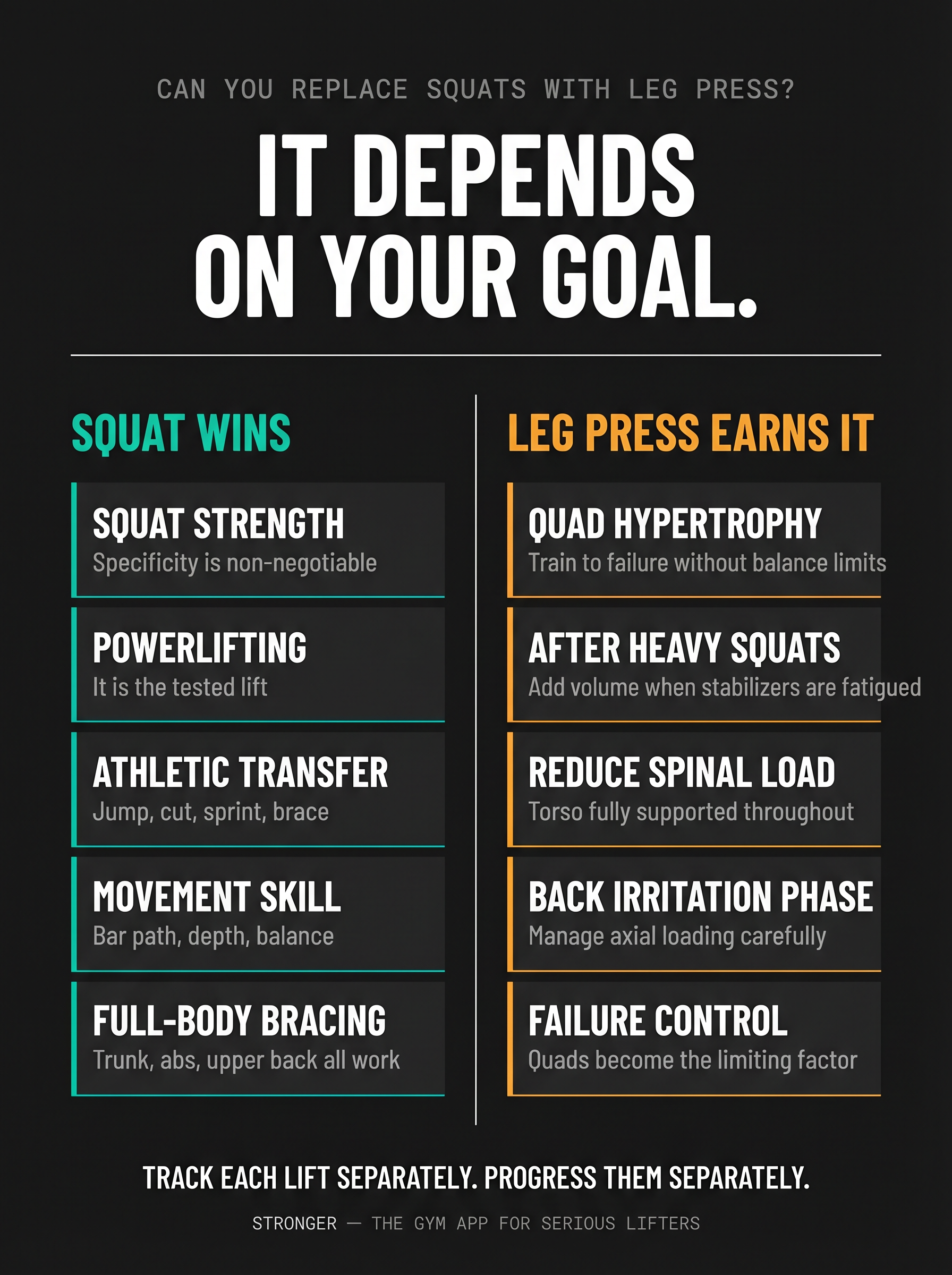
For hypertrophy: Yes, largely. Leg press can replace most squat volume if your program also addresses glutes, hamstrings, adductors, and single-leg control. A bodybuilder doesn't have to barbell squat to build excellent legs.
For squat strength: No. Specificity is non-negotiable. Leg press can build the leg muscle that supports a squat, but it doesn't teach bar position, bracing under load, balance over the midfoot, depth consistency, or the confidence of standing up with a heavy bar on your back. If you want to squat more, you have to squat.
For powerlifting: Absolutely not as a replacement. The squat is a tested lift. Leg press is accessory work.
For athletes: Generally no. Standing force production, bracing, coordination, and balance transfer to jumping, cutting, sprinting, and absorbing impact more directly through squat training than through a seated machine. The 2016 study above found significantly better transfer from squat training to jump performance than from leg press training. (PubMed)
For general fitness: Sometimes, but it's not a clean substitution. The CDC's physical activity guidance for adults calls for muscle-strengthening work for all major muscle groups at least twice weekly. (CDC) A well-designed lower-body program — leg press, split squats, step-ups, hip hinges, hamstring curls — can meet that standard without barbell back squats. But "strengthening the legs" and "replacing the squat" are not the same thing.
For back pain or injury: Maybe, but don't treat it as a permission slip. The leg press reduces axial loading, but it can still load the lumbar spine if your lower back rounds off the pad. Pain comes from load, depth, fatigue, bracing, ankle mobility, or programming — not just the exercise name. If pain is sharp, persistent, worsening, or linked to an injury, get assessed by a qualified clinician.
How to Program Squats and Leg Press in the Same Workout
The best answer for most intermediate lifters isn't squat or leg press. It's squat and leg press, each with a defined job.
ACSM's 2026 resistance-training position stand update emphasizes individualization and evidence-based programming. Their guidance notes that strength work typically uses heavier loading around 80%+ 1RM with 2–3 sets per exercise, while hypertrophy programming often targets approximately 10 sets per muscle per week — adjusted to the individual and goal. (ACSM) Understanding the right rep ranges for each goal will help you apply this guidance precisely.
Stronger's compound exercise guide puts it plainly: demanding technical compounds belong first in the session, and machines aren't worse than free weights — they're different tools with specific use cases.
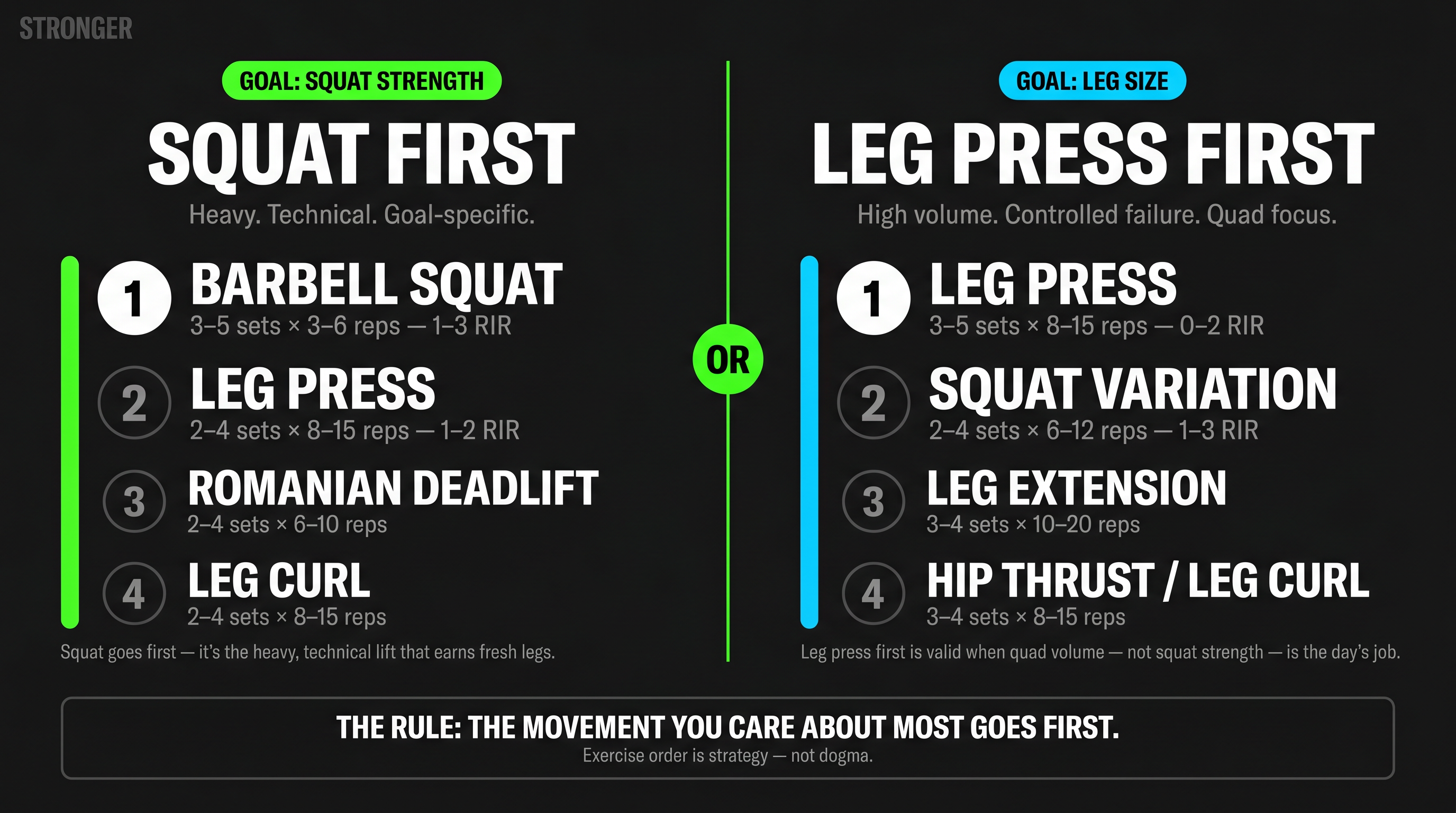
Strength-Focused Lower Body Day: Squat First, Leg Press Second
Use when squat strength is the primary goal.
| Exercise | Sets × Reps | Effort |
|---|---|---|
| Barbell squat | 3–5 × 3–6 | 1–3 reps in reserve |
| Leg press | 2–4 × 8–15 | 1–2 reps in reserve |
| Romanian deadlift | 2–4 × 6–10 | Controlled |
| Leg curl | 2–4 × 8–15 | Close to failure |
| Calves or core | 2–4 × 8–20 | Controlled |
The squat comes first because it's the heavy, technical, goal-specific movement. The leg press follows to add quad and glute volume without forcing another heavy barbell movement when you're already fatigued.
Hypertrophy Lower Body Day: When to Leg Press First
Use when leg size is the priority.
| Exercise | Sets × Reps | Effort |
|---|---|---|
| Leg press | 3–5 × 8–15 | 0–2 reps in reserve |
| Squat variation | 2–4 × 6–12 | 1–3 reps in reserve |
| Leg extension | 2–4 × 10–20 | Close to failure |
| Hip hinge or hip thrust | 2–4 × 6–12 | Controlled |
| Leg curl | 2–4 × 8–15 | Close to failure |
If quad volume is the priority, starting with leg press is fine. The tradeoff is that squat performance afterward will be lower — which isn't a problem if squat strength isn't the current goal.
Training Without Squats: How to Build Legs Using Leg Press
Use when heavy barbell squats aren't currently a good fit — back irritation, technique rebuilding, or a deliberate focus shift.
| Exercise | Sets × Reps | Effort |
|---|---|---|
| Leg press | 4–5 × 8–15 | Controlled, no pelvic roll |
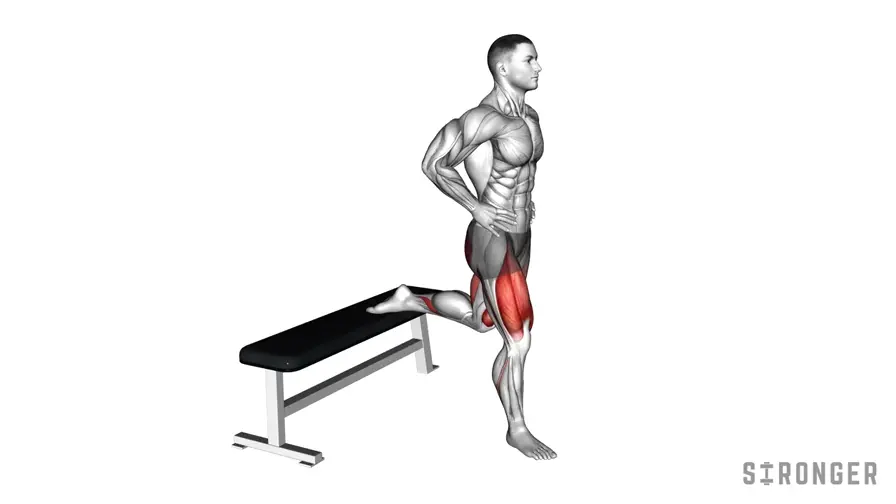
| Split squat | 3 × 8–12 each side | Controlled |
| Hip thrust | 3 × 8–12 | Controlled |
| Romanian deadlift | 3 × 6–10 | Controlled |
| Leg curl | 3 × 10–15 | Close to failure |
| Light squat pattern practice | 2 × 8–10 | Pain-free, technical focus |
A no-squat phase is a training tool, not a permanent exit. Even during this phase, keep the squat pattern alive with lighter goblet squats or bodyweight work so the skill doesn't erode entirely.
The ordering rule: the movement you care about most goes first. If squat strength matters, squat first while you're fresh. If quad volume is the goal and squat performance that day is secondary, leg press first is a valid choice. Exercise order isn't a moral decision. It's strategy — and an upper/lower training structure is one of the most effective frameworks for organizing it.
Squat and Leg Press Form: The Technique Cues That Matter
Squat Technique: Key Cues for Consistent Reps
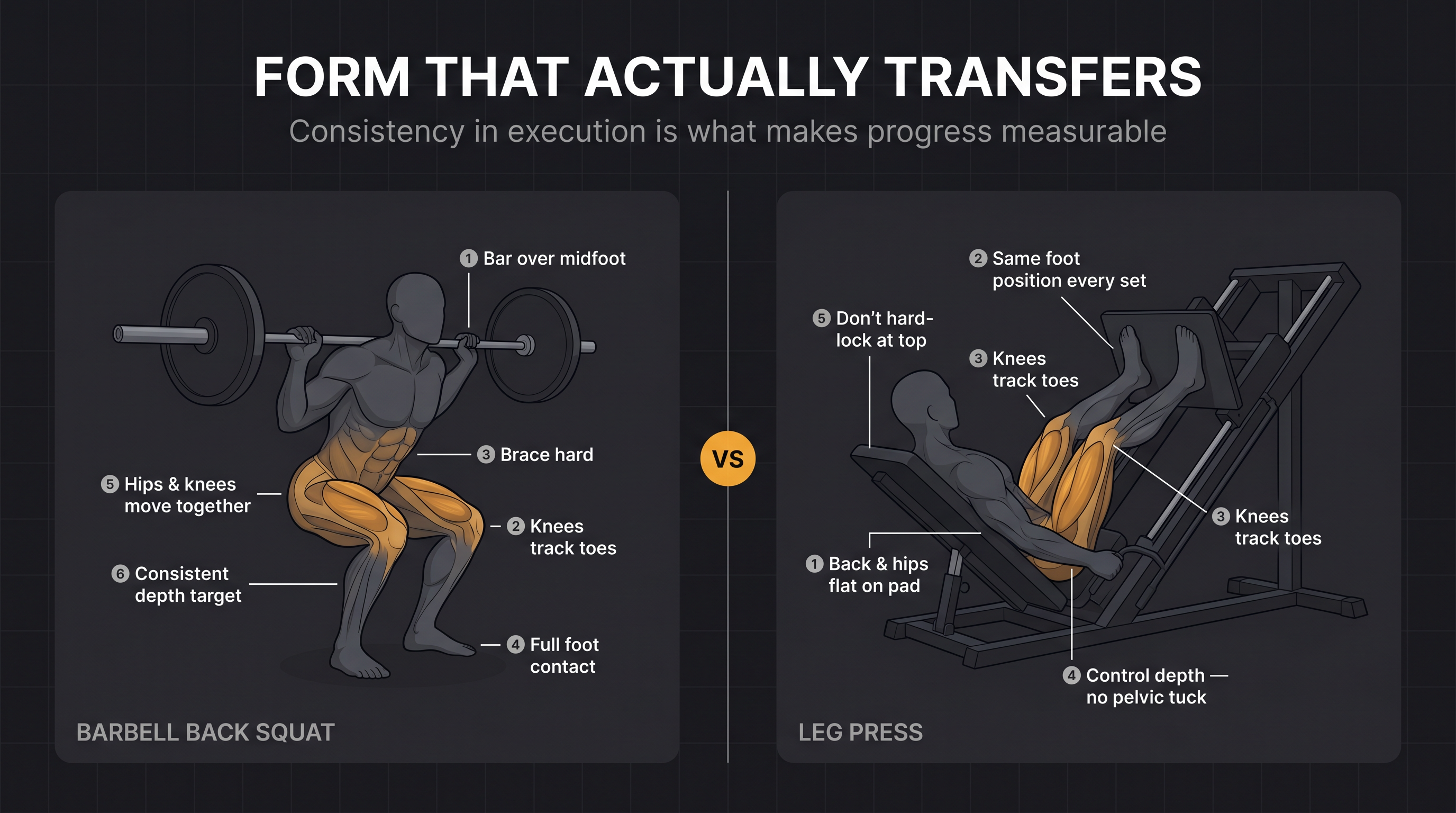
A squat is only meaningful as a progress metric if the reps are consistent. Changing depth, stance, shoes, or bar position between sessions means you're comparing setups, not strength.
Key cues from Stronger's barbell back squat guide:
- Set the bar securely and brace hard before each rep
- Keep the bar balanced over the midfoot throughout
- Let the hips and knees bend together — don't shoot one first
- Keep the knees tracking in line with the toes
- Use a consistent, repeatable depth target
- Drive through the full foot, not just the toes
- Use safety pins when training heavy without a spotter
- End the set when technique breaks — not three reps later
Common errors to watch for:
- Knees caving inward
- Excessive forward lean
- Inconsistent depth
- Rising onto the toes
- Losing the brace at the bottom
Leg Press Technique: How to Set Up for Real Quad Work
The leg press is easier to learn than the squat — and much easier to ego-load. More plates on the sled doesn't mean harder quad training. It often just means shorter range and more joint stress with less actual muscle work.
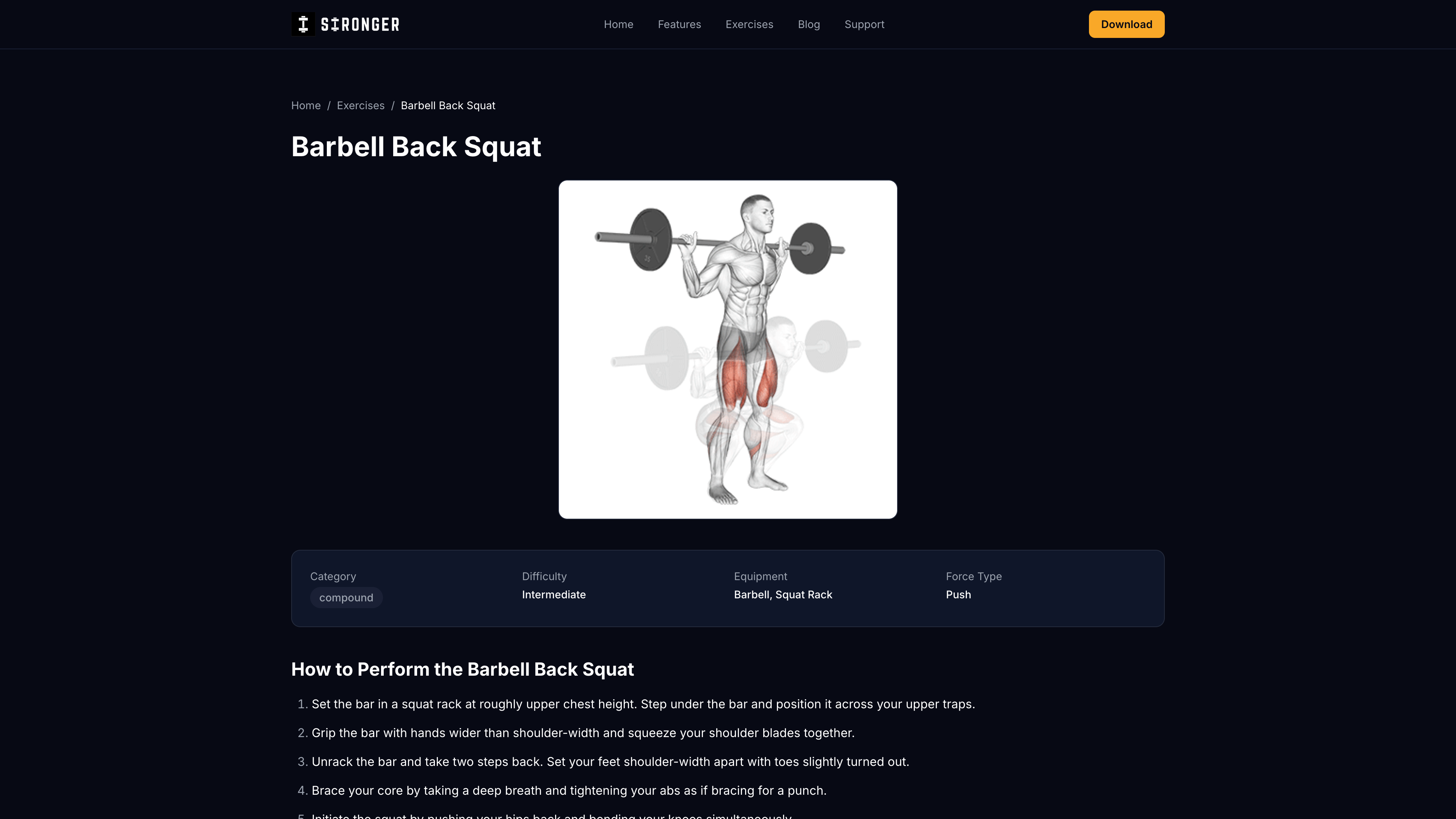
Key cues from Stronger's leg press guide:
- Set your back and hips firmly against the pad before each set
- Choose a foot position you can replicate session to session
- Keep knees tracking in line with toes throughout the movement
- Lower to a controlled depth before your pelvis tucks under
- Don't bounce out of the bottom
- Don't hard-lock the knees at the top of the rep
- Control the eccentric for 2–3 seconds if hypertrophy is the goal
The most reliable way to make leg press progress trackable: same machine, same seat setting, same foot position, same depth, same rep style every session. Otherwise you're measuring setup variation, not strength.
Leg Press vs Squat Myths You Need to Stop Believing
Myth 1: "Leg press is cheating."
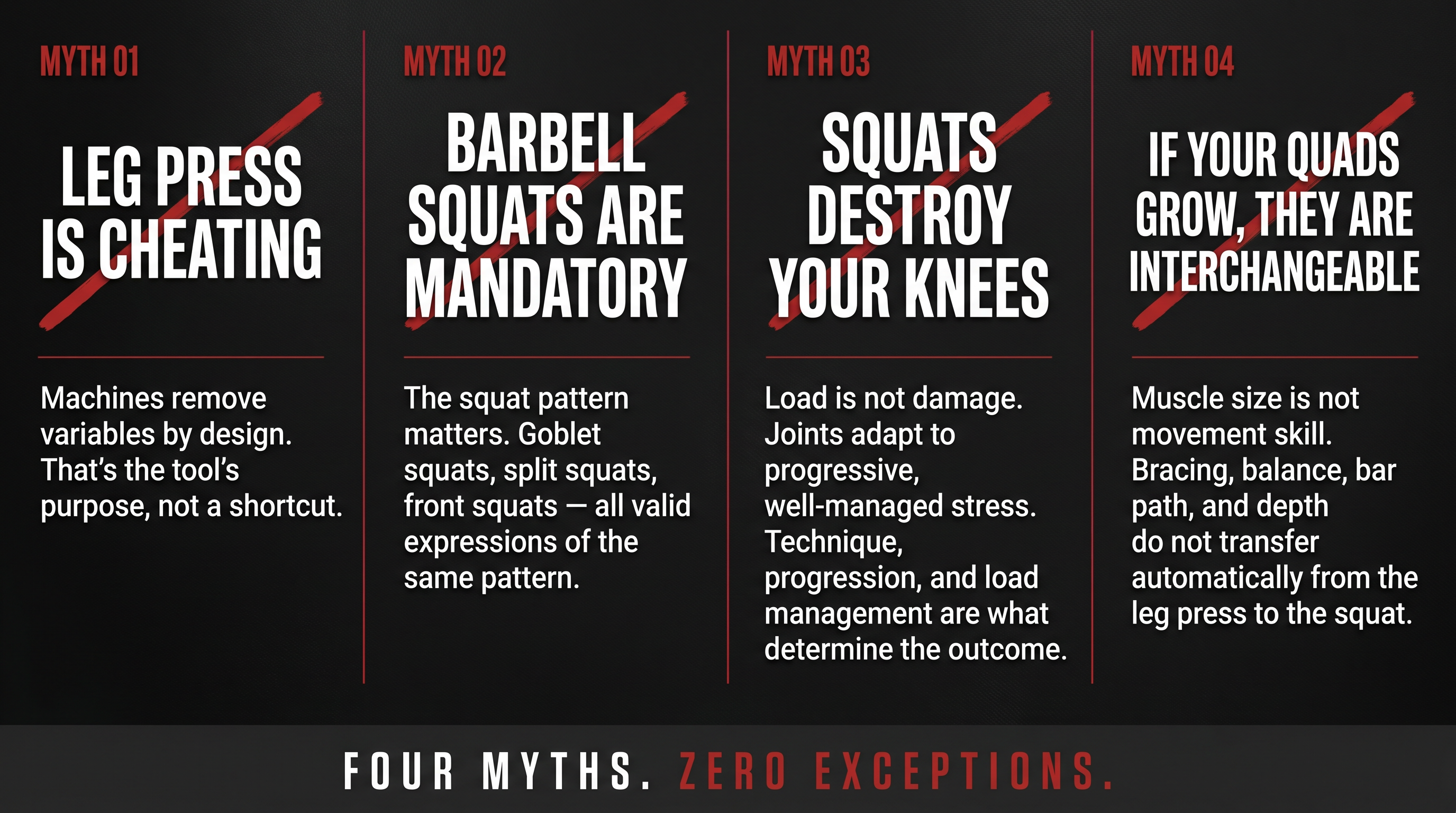
No. The leg press is a machine exercise. Machines remove some variables — balance, bar path, bracing. That's not cheating; it's the tool's design. If balance and bracing are limiting your ability to train your quads hard, removing those constraints is often the smarter choice. As Stronger's compound exercise guide puts it: machines aren't worse than free weights, they're different tools.
Myth 2: "Barbell squats are mandatory."
Barbell back squats are not mandatory for every lifter. The squat pattern — loading the knees and hips through a controlled range of motion — is valuable. The specific barbell back squat is one way to express it. Goblet squats, safety-bar squats, front squats, split squats, and heel-elevated squats are all legitimate variations depending on your goals, mobility, and equipment access.
Myth 3: "Squats are bad for your knees."
Not automatically. Heavy squats place large loads on the knee joint — that's true. But load is not the same as damage. Joints adapt to progressive, well-managed loading over time. The 2025 elite powerlifter joint contact force data shows that heavy squats produce large forces precisely because elite lifters are well-adapted to them. (PLOS ONE) Load management, progression, and technique are what determine whether those forces become an adaptation or an injury.
Myth 4: "If my quads grow, the exercises are interchangeable."
Bigger quads help your squat — but they don't automatically teach bracing, balance, depth, bar path, or the mental skill of standing up under heavy load. Muscle size can carry over to strength, but strength is also skill. The two are related, not identical.
Why Your Leg Press Numbers Don't Translate to Squat Strength
Leg press numbers are almost always inflated compared to squat numbers. That doesn't make them fake. It makes them non-transferable.
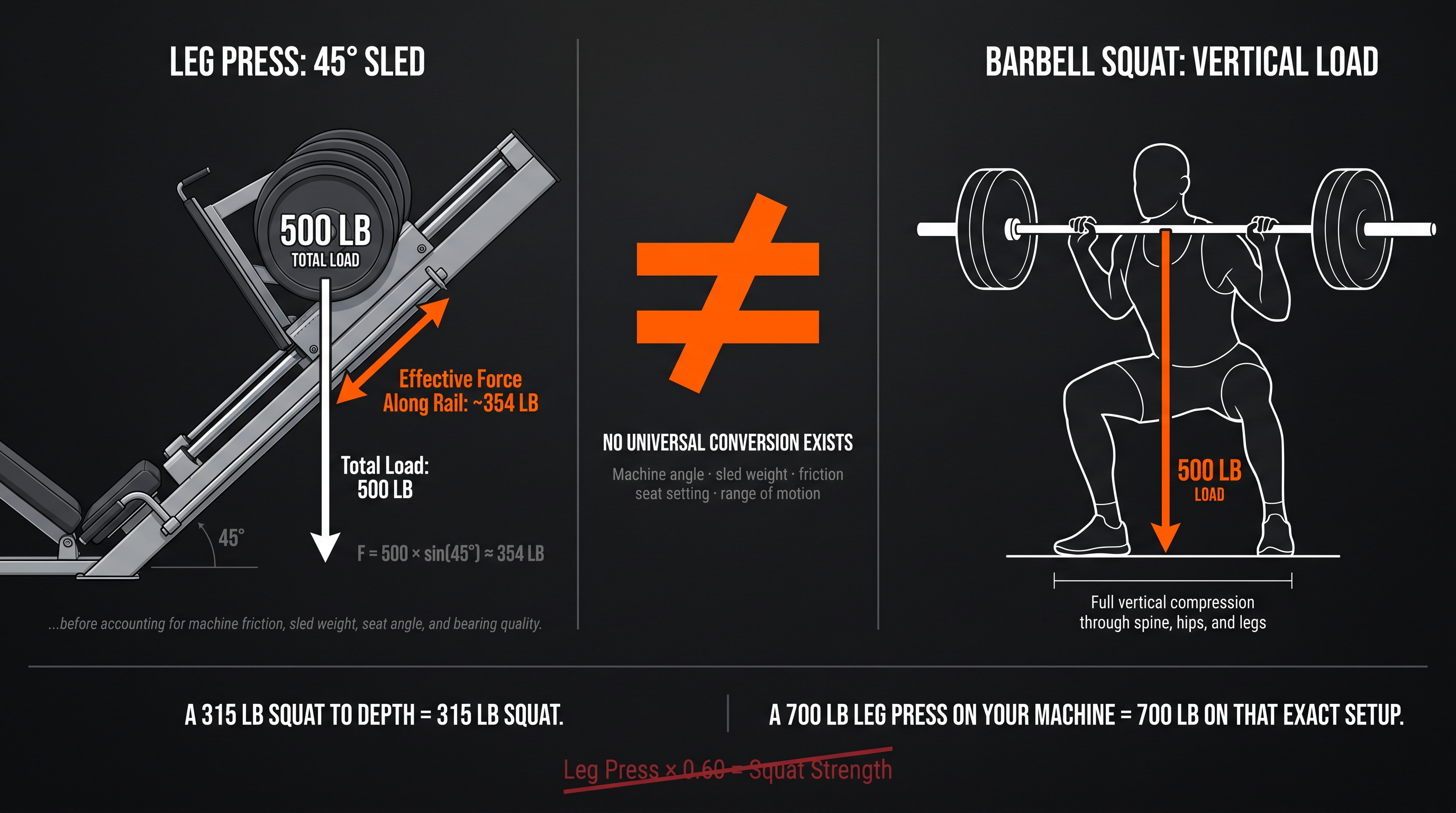
On a 45-degree leg press machine, the sled moves along an angled track. In a friction-free scenario, 500 lb loaded on a 45-degree sled doesn't require the same muscular force as standing with 500 lb on your back — the angle reduces the effective force component along the rail. Then real machines add their own variables: sled weight, friction, bearing quality, safety stop resistance, seat angle, footplate angle, and range of motion.
There is no honest universal conversion like "your squat is 60% of your leg press." Those ratios float around the internet. They're meaningless. A 315 lb squat to consistent depth is a 315 lb squat. A 700 lb leg press on a specific machine, seat setting, and depth is a 700 lb leg press on that exact setup.
Track them separately. Progress them separately. Stop expecting one number to explain the other.
Ready to Get Stronger?
Join 2,000,000+ lifters tracking their workouts with Stronger. Available on iOS and Android.
Track Leg Press and Squats Separately in Stronger
Serious lifters beat casual lifters not by having better opinions about exercise selection. They win by keeping cleaner data.
In Stronger, log each lift as its own exercise with its own history. The app supports workout logging with automatic PR detection, progress charts, custom routines, 400+ exercises including squat and leg press variations, Strength Score tracking, adaptive programming, and group challenges. When you track squats and leg presses separately, you can see exactly which lift is improving, how each one affects your broader strength profile, and where your training load is actually landing. That's progressive overload made visible — not a feeling, but a number.
For squats, track:
- Variation (high-bar, low-bar, front squat, safety-bar, smith)
- Stance width
- Depth standard you're holding yourself to
- Shoes or heel elevation used
- Top set and back-off sets
- Reps in reserve or RPE per set
- Bodyweight (if strength-to-bodyweight ratios matter to you)
For leg press, track:
- Machine type and gym location
- Seat setting
- Foot position (height and width)
- Range of motion
- Whether the sled weight is included in your total
- Tempo
- Reps in reserve or RPE per set
This level of tracking turns progress into a real signal rather than a rough feeling. A leg press PR means something when you're comparing it against previous leg presses under identical conditions. A squat PR means something when depth and technique are consistent. Mix the data and your training signal becomes noise.
Download Stronger and start logging both lifts with the structure that makes them comparable. Your Strength Score tracks progress across major compound movements — and the leg press vs. squat distinction isn't an inconvenience in the data. It's the kind of specificity that makes your numbers actually useful.
Leg Press vs Squat: Which One Should You Actually Use?
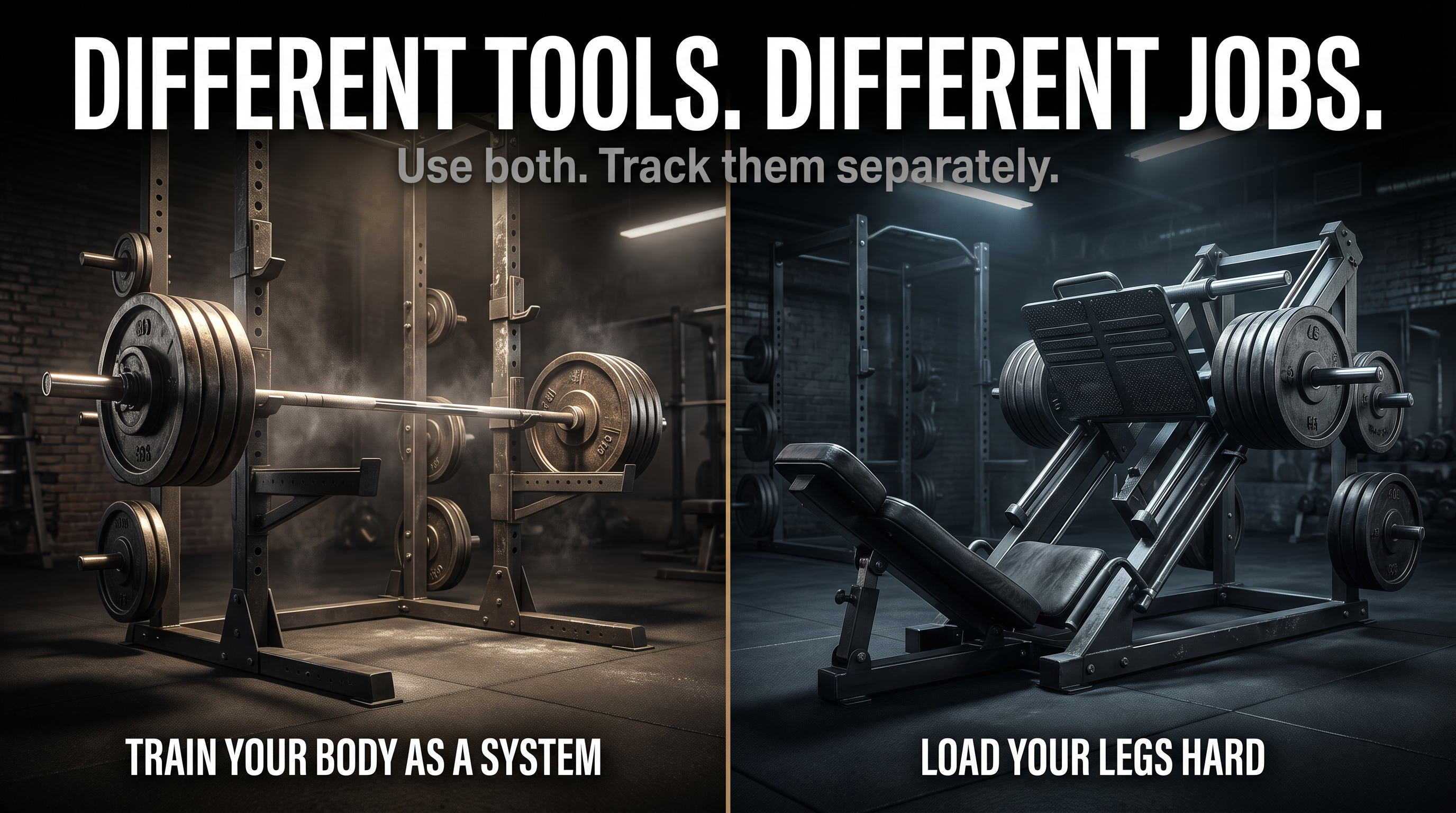
The squat and leg press are not interchangeable. That's not a problem — it's useful information.
The squat trains lower-body strength inside a full-body, standing, braced movement pattern. The leg press trains lower-body force with more support and fewer stability demands. Use the squat when skill, transfer, balance, and barbell strength matter. Use the leg press when you want more leg volume, more controlled failure, or less spinal and systemic fatigue.
Use the squat to train your body as a system. Use the leg press to load your legs hard.
Track them separately, progress them honestly, and stop pretending one number explains the other. They're different tools. That's what makes them both worth having.
Frequently Asked Questions
Is leg press as good as squats?
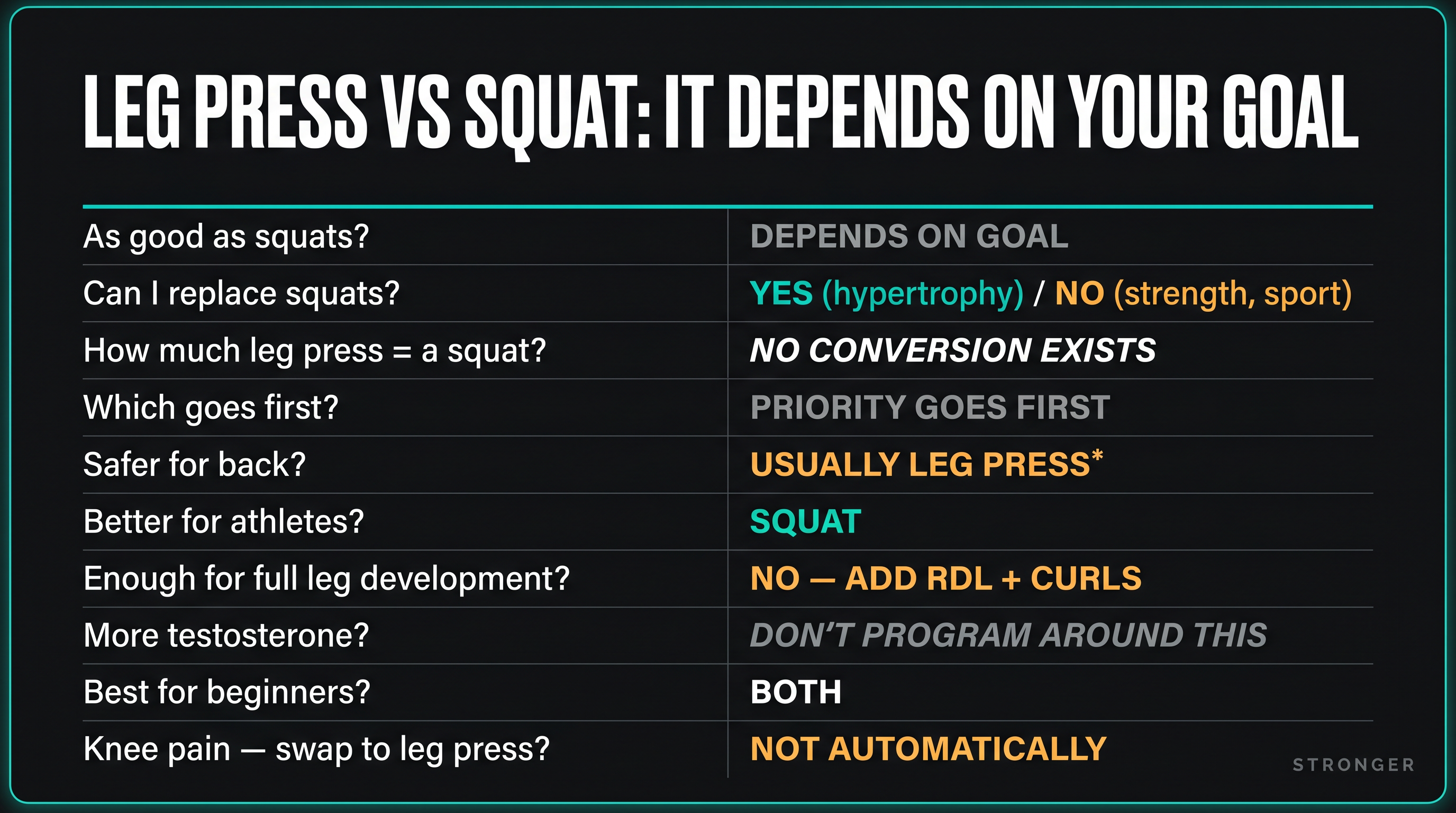
It depends on what you mean by "as good." For building quad mass, the leg press can be excellent — often better than squats for people whose limiting factor is bracing or balance rather than leg strength. For building squat strength, athletic transfer, or full-body bracing capacity, no. For adding hard leg volume without high systemic fatigue, it may be more efficient. The exercises aren't comparable on a single scale because they train different stress patterns.
Can I do leg press instead of squats?
Yes, if your goal doesn't require squatting. For bodybuilding and general hypertrophy, leg press can cover most of squat's quad-building role — as long as your program also includes work for glutes, hamstrings, adductors, and single-leg control. For powerlifting, squat strength, or athletic performance, no — the specificity of the squat is non-negotiable.
How much leg press equals a squat?
There's no reliable conversion. Machine angle, sled weight, friction, bearing quality, seat position, foot position, range of motion, and whether your bodyweight is involved all affect the number. Track each lift on its own terms. A 315 lb squat to consistent depth is a 315 lb squat. A 700 lb leg press on your gym's machine at your usual setup is a 700 lb leg press on that exact setup — period.
Should I squat or leg press first?
Put the priority first. If squat strength is the goal, squat first while you're fresh. If quad hypertrophy is the goal and squat performance that day is secondary, leg press first is a valid choice. Exercise order is a strategic decision, not a moral one.
Is leg press safer for my back?
Usually, in the sense that a supported torso reduces axial spinal loading compared to a barbell squat. But it's not automatically safe. If your lower back rounds off the pad at the bottom, you're still loading your spine in a compromised position. Load, depth, and setup still matter. If pain is sharp, persistent, or worsening, get it assessed rather than just swapping exercises.
Are squats better for athletes?
Generally, yes — if the comparison is squat training versus seated leg press as the primary lower-body strength movement. Squats train standing force production, balance, coordination, and bracing patterns that transfer more directly to jumping, cutting, landing, and sprinting. The 2016 training study found significantly better transfer from squat training to jump performance than from leg press training. (PubMed)
Is leg press enough for legs?
For quads, it can be highly effective. For complete lower-body development, no. A full program still needs hip extension work for glutes, direct hamstring training (Romanian deadlifts, leg curls, Nordic curls), and ideally some single-leg work for balance and coordination. Leg press plus step-ups, Romanian deadlifts, split squats, and calf work is far more complete than leg press alone.
Do squats build more testosterone than leg press?
Don't build your program around this. Acute hormone spikes after large compound lifts are real but their effect on long-term hypertrophy outcomes is contested in the research. Progressive overload, sufficient volume, good technique, recovery, and consistency are what drive results — not chasing the biggest post-workout hormone response.
Should beginners squat or leg press?
Both. Beginners can use leg press to build load tolerance and confidence without the coordination demands of a barbell. They should also learn some form of squat pattern early — goblet squats, box squats, or bodyweight squats are accessible starting points before adding a loaded barbell. Learning to hinge and bend at the knees under control is a long-term skill worth developing from the start.
Can I replace squats with leg press if my knees hurt?
Not automatically. Leg press may feel better, worse, or about the same — depending on foot position, depth, load, and the actual source of the discomfort. Reducing load and controlling depth can help on either exercise. But pain from squats doesn't guarantee the leg press will be pain-free, and vice versa. If knee pain is persistent, sharp, or worsening, get it assessed by a qualified clinician rather than hoping a different exercise name resolves it.
Exercises in this guide
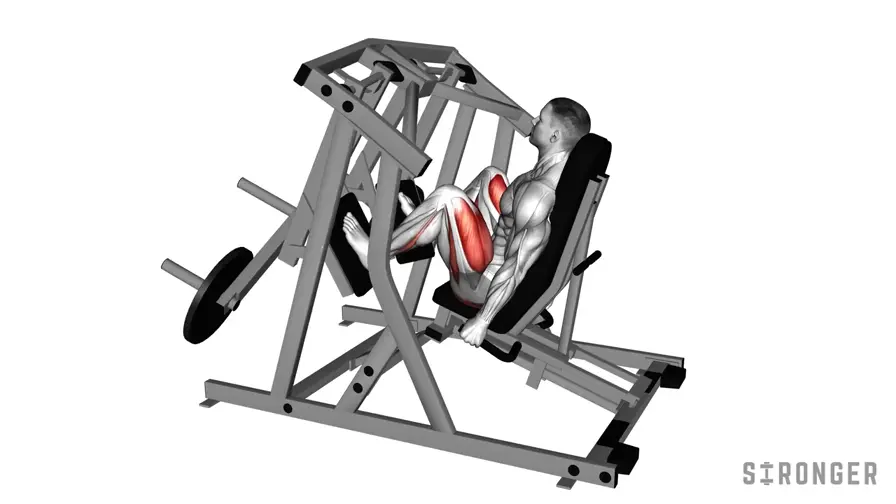
Machine Leg Press
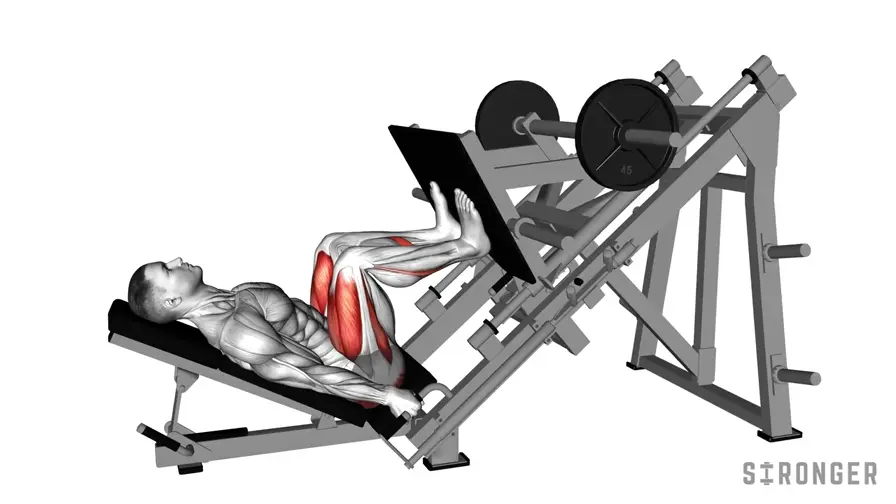
Leg Press
Barbell Back Squat
Deadlift
Bulgarian Split Squat
Stronger Editorial Team
Certified strength & conditioning specialists with 10+ years of coaching experience
The Stronger editorial team produces evidence-based training content for lifters of all levels.
Ready to Get Stronger?
Join 2,000,000+ lifters tracking their workouts with Stronger. Available on iOS and Android.