

Compound Exercises: The Complete Strength Guide
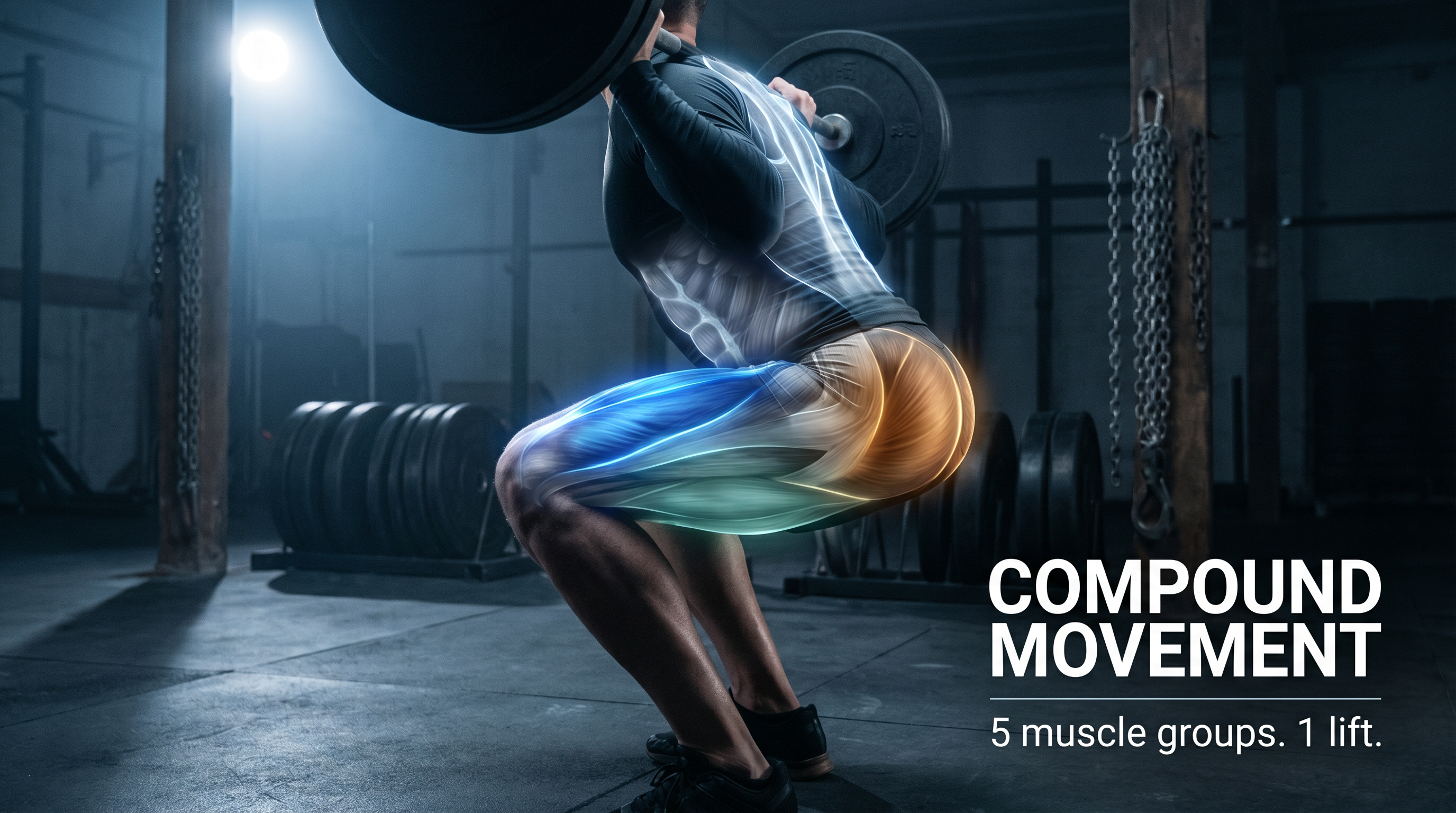
Every rep you do in the gym is an investment. Compound exercises pay the highest return on that investment: more muscles trained per movement, heavier weights lifted, clearer progress to measure, and movement patterns that translate directly to a stronger body — inside and outside the gym.
That's not a preference. It's the structure behind every effective training program we've built at Stronger, and it's backed by the strongest body of resistance training research available in 2026.
The principle is simple:
Build your workouts around compound lifts. Use isolation exercises to support them.
That one decision will make your training more efficient, more progressive, and easier to measure. Everything in this guide explains why — and shows you exactly how to do it.
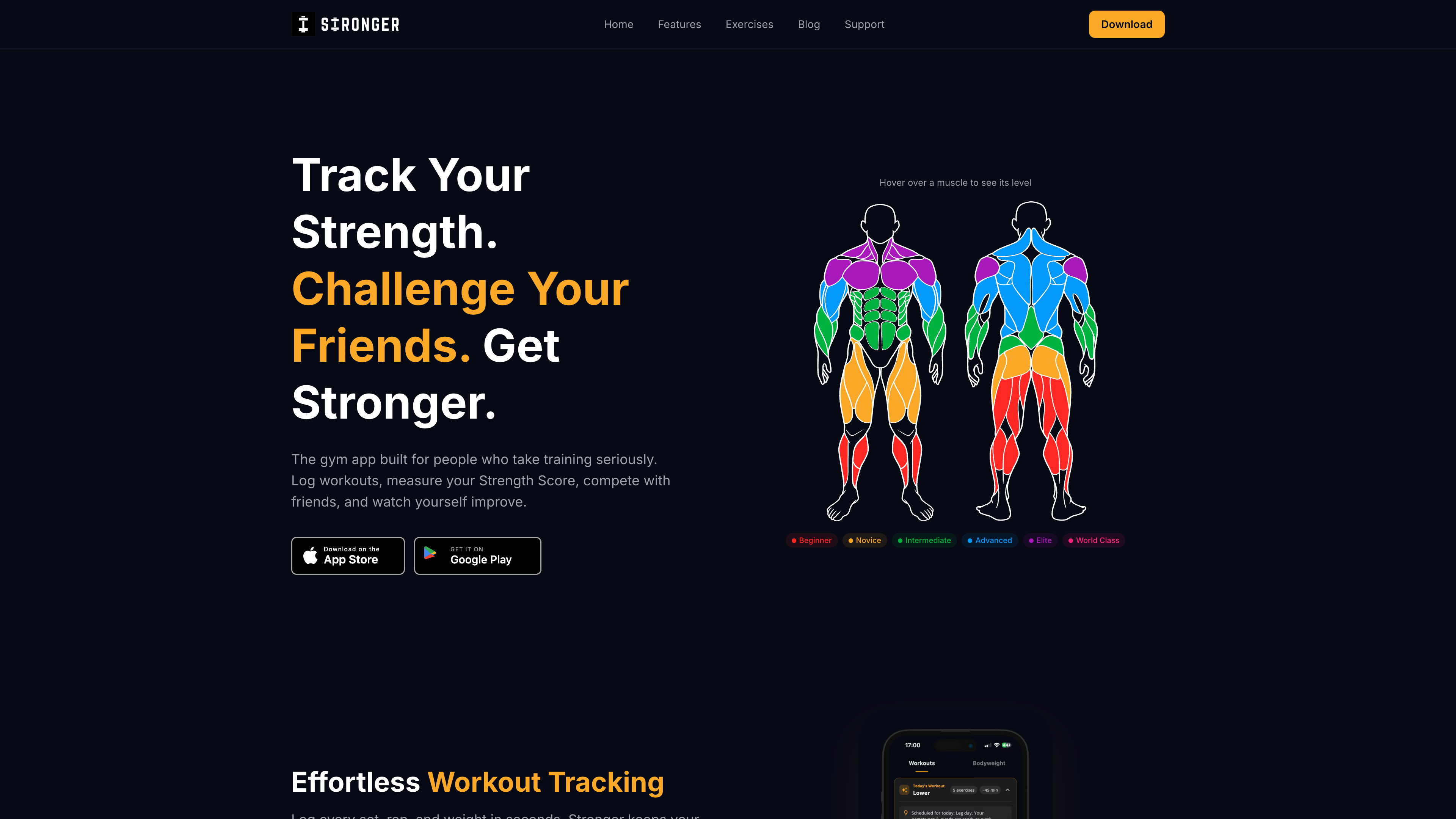
Stronger is the app this guide is built around — a strength-tracking platform designed for lifters who train around compound movements and need a clear, measurable record of their progress.
What Are Compound Exercises?
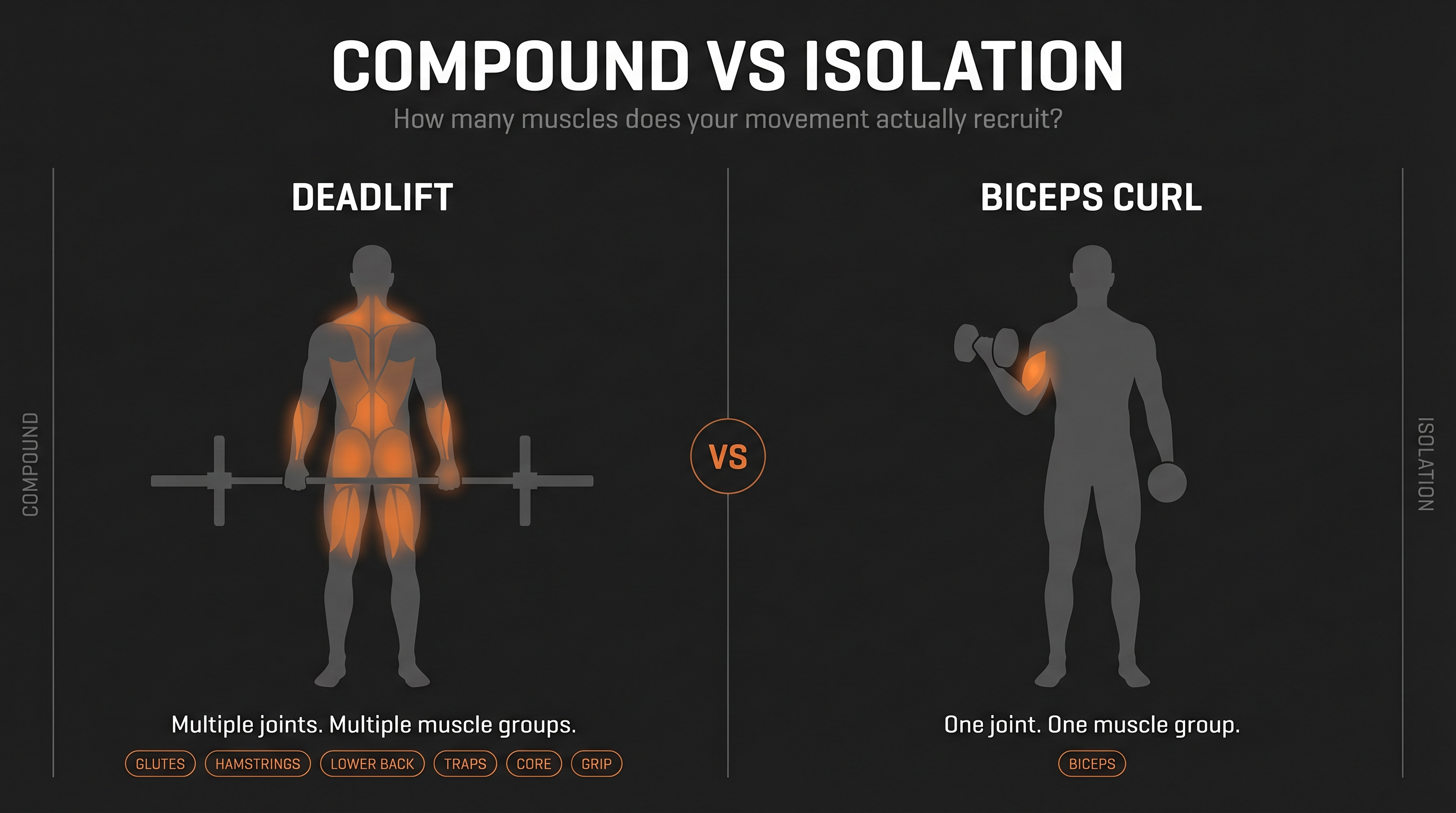
A compound exercise uses multiple joints and multiple muscle groups at the same time.
A squat engages your hips, knees, ankles, and trunk while training your quads, glutes, hamstrings, calves, and core simultaneously. A bench press moves through the shoulder and elbow joints while training your chest, triceps, front delts, and stabilizers. A deadlift recruits your hips, knees, grip, lower and upper back, glutes, and hamstrings in one coordinated pull.
An isolation exercise, by contrast, usually involves one primary joint and one primary muscle group. A biceps curl trains elbow flexion. A leg extension trains knee extension. A lateral raise targets the side deltoid. Both have their place — but they tell a narrower training story.
UNSW's 2024 exercise physiology explainer defines compound exercises as movements where multiple joints and muscle groups work together, grouping them into patterns like squat, hinge, push, and pull — patterns that mimic daily tasks including standing from a chair, lifting from the floor, and placing objects overhead. (UNSW Sites)
| Movement Pattern | What It Trains | Example Exercises |
|---|---|---|
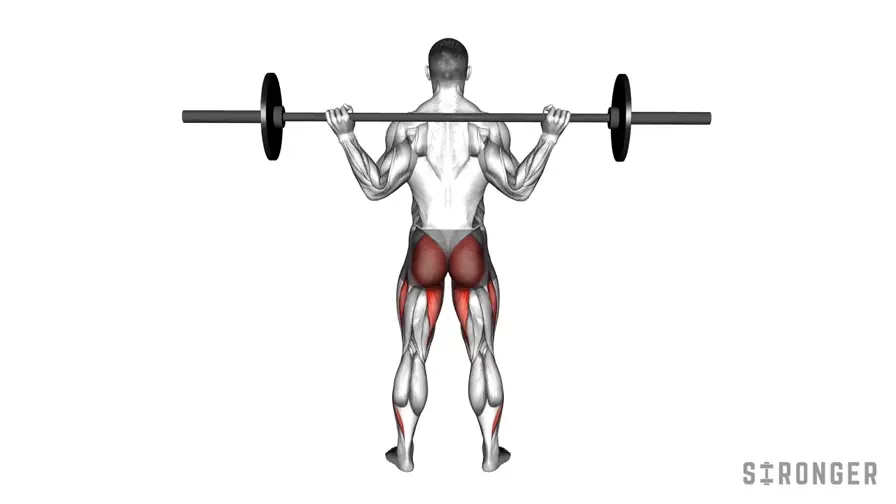
| Squat | Knee-dominant lower-body strength | Back squat, front squat, goblet squat, leg press |
| Hinge | Posterior chain and hip extension | Deadlift, Romanian deadlift, hip thrust, kettlebell swing |
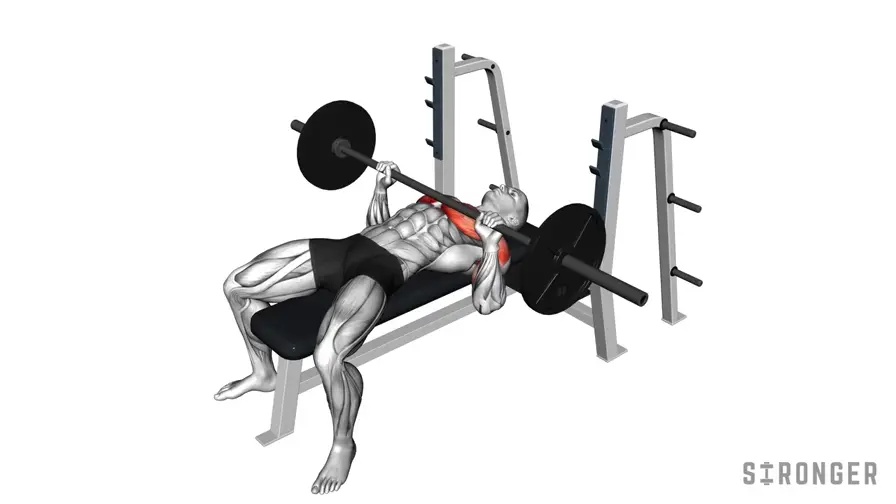
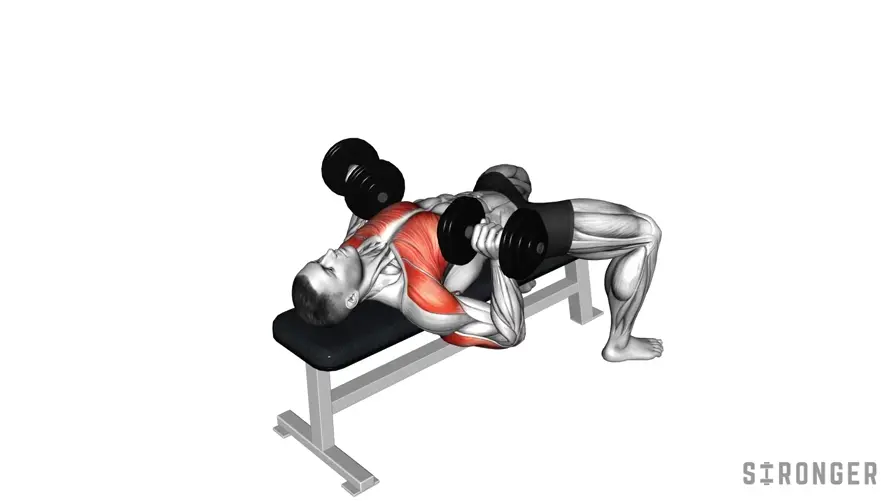
| Horizontal push | Chest, shoulders, triceps | Bench press, dumbbell press, push-up |
| Vertical push | Shoulders, triceps, trunk stability | Overhead press, dumbbell shoulder press |
| Horizontal pull | Upper back, lats, rear delts, biceps | Barbell row, cable row, dumbbell row |
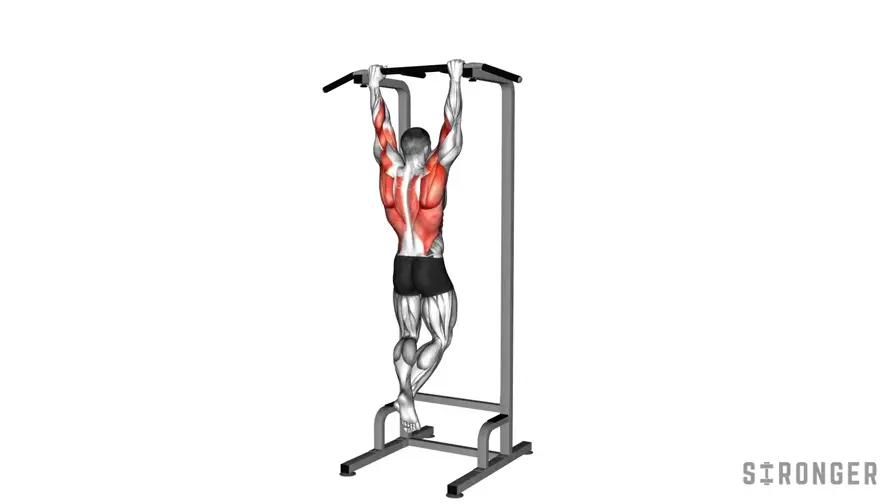
| Vertical pull | Lats, upper back, biceps | Pull-up, chin-up, lat pulldown |
| Lunge / split squat | Single-leg strength and stability | Reverse lunge, Bulgarian split squat, walking lunge |
| Carry | Grip, trunk, traps, gait strength | Farmer carry, suitcase carry |
Knowing what makes a movement compound is useful. But knowing why these movements dominate serious training programs — that's where the real answer lives.
Why Build Your Training Around Compound Exercises?
Do Compound Exercises Build Functional Real-World Strength?
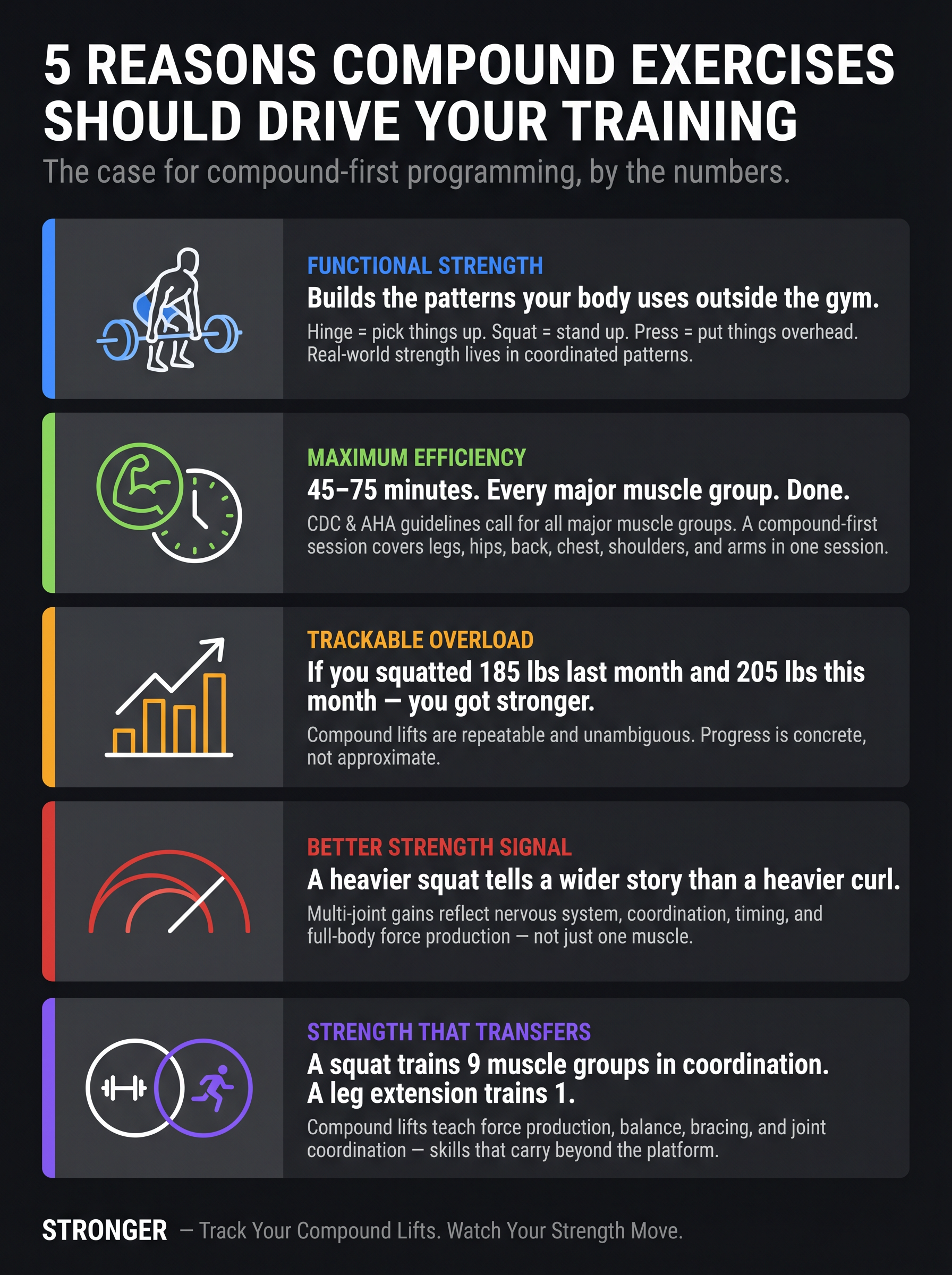
A hinge looks like picking something up from the floor. A squat looks like sitting down and standing up. A vertical press looks like putting something overhead. A row or pull-up rebuilds the pulling strength that desk work and modern life erodes.
This is why compound training feels purposeful rather than cosmetic. You're not isolating muscles in a controlled environment — you're building the patterns your body uses for every loaded task it will ever face. UNSW's 2024 article makes exactly this point: compound movements mimic daily functional tasks, which is part of why the research on their benefits is so consistent. (UNSW Sites)
Real-world strength isn't stored in one muscle. It lives in coordinated patterns. That's what compound lifts develop.
Are Compound Exercises the Most Efficient Way to Train All Muscle Groups?
Public health guidelines don't say "do twelve different arm exercises." They specify training all major muscle groups — and compound lifts are the most direct path to that target.
The CDC's adult physical activity guidance (updated December 2023) recommends at least two days of muscle-strengthening activity each week and specifies movements that work all major muscle groups: legs, hips, back, abdomen, chest, shoulders, and arms. (CDC) The American Heart Association's adult recommendations (last reviewed January 2024) call for moderate- to high-intensity muscle-strengthening activity at least two days per week as well. (American Heart Association)
A simple full-body session built around squats, presses, rows, hinges, and pull-ups can train nearly every major muscle group in 45–75 minutes. Recreating that same stimulus using only isolation exercises would require significantly more exercises, transitions, and setup time — and most people don't have that kind of time or patience.
Compound-first training is how you get more done in less time without cutting corners on what actually matters.
How Do Compound Exercises Make Progressive Overload Easier to Track?
Progressive overload means doing more over time — more weight, more reps, more sets, better technique, longer range of motion. It's the mechanism behind virtually all long-term strength and muscle gains.
Compound lifts are the best vehicle for progressive overload because they're repeatable and unambiguous. If you squatted 185 lbs for 5 reps last month and 205 lbs for 5 reps this month with the same depth and form, you got stronger. If your pull-ups moved from 5 reps to 10, you progressed. If your bench press jumped from 3 sets of 8 to 4 sets of 8 at the same load, your volume increased.
Every one of those is a concrete, measurable change.
Our strength guide reinforces this: the most effective strength exercises involve multiple joints, allow heavier loading, are easy to progressively overload, and have a long range of motion. We specifically recommend building strength programs around lifts like the squat, deadlift, bench press, overhead press, rows, and pull-ups.
But progressive overload only becomes a system when you track it. If you don't record weights, reps, sets, and rest periods, you're guessing. Stronger is built around exactly this: logging every set and rep, detecting personal records automatically, and keeping a complete training history so your next session always has a clear target. (Stronger Features)
Why Compound Lifts Give You a Better Measure of Strength Gains
A single-joint lift tells you a narrow story. A heavier biceps curl means your elbow flexors improved — useful, but limited.
A stronger squat, deadlift, press, row, or pull-up tells a wider story. It means multiple muscle groups coordinated to produce more force through a larger movement pattern. That's not just muscle — it's the nervous system, timing, coordination, and full-body force production all improving together.
This is why compound lifts form the backbone of Stronger's Strength Score, a proprietary metric that rates your strength across 12 muscle groups and overall, adjusted for bodyweight and sex, on six levels from Beginner to World Class. (Stronger Features) Rather than tracking one exercise in isolation, Strength Score gives you a single number that reflects how your full-body strength is actually moving over time.
For serious lifters, that's a fundamental shift: from "I worked hard today" to "my measurable strength is moving."
How Compound Exercises Build Strength That Transfers Beyond the Gym
Strength is more than muscle size. It's the ability to coordinate muscles, joints, balance, bracing, and force production under load.
A leg extension can grow your quads. A squat teaches your quads, glutes, trunk, hips, knees, ankles, and upper back to produce and control force together. A chest fly can train your pecs. A bench press integrates your pecs, triceps, shoulders, upper back, grip, and leg drive into one system.
The research supports this distinction clearly. A 2024 umbrella review in the Journal of Sport and Health Science found that resistance training consistently improves muscle mass, strength, and physical function — and that training variables like load, weekly frequency, volume, and exercise order all affect outcomes. (ScienceDirect) The structure you choose matters. Compound-first programming gives you the best structure for organizing that work.
Compound vs. Isolation Exercises: Which Should You Prioritize?
Asking "which is better, compound or isolation?" is the wrong question.
The better question is: which exercise does the main job, and which exercise supports it?
For most lifters, compound exercises do the main job. Isolation exercises support the program by adding targeted volume, addressing weak points, or training muscles that compound lifts don't hit hard enough.
When to use compound exercises:
- Building the foundation of your program
- Training multiple muscle groups efficiently
- Developing maximal strength
- Practicing movement patterns
- Measuring progress over time
- Training when time is limited
When to use isolation exercises:
- Adding hypertrophy volume without high systemic fatigue
- Building specific muscles
- Correcting weak points
- Training around injury limitations
- Finishing a muscle group after heavy compounds
- Bodybuilding or physique-focused goals
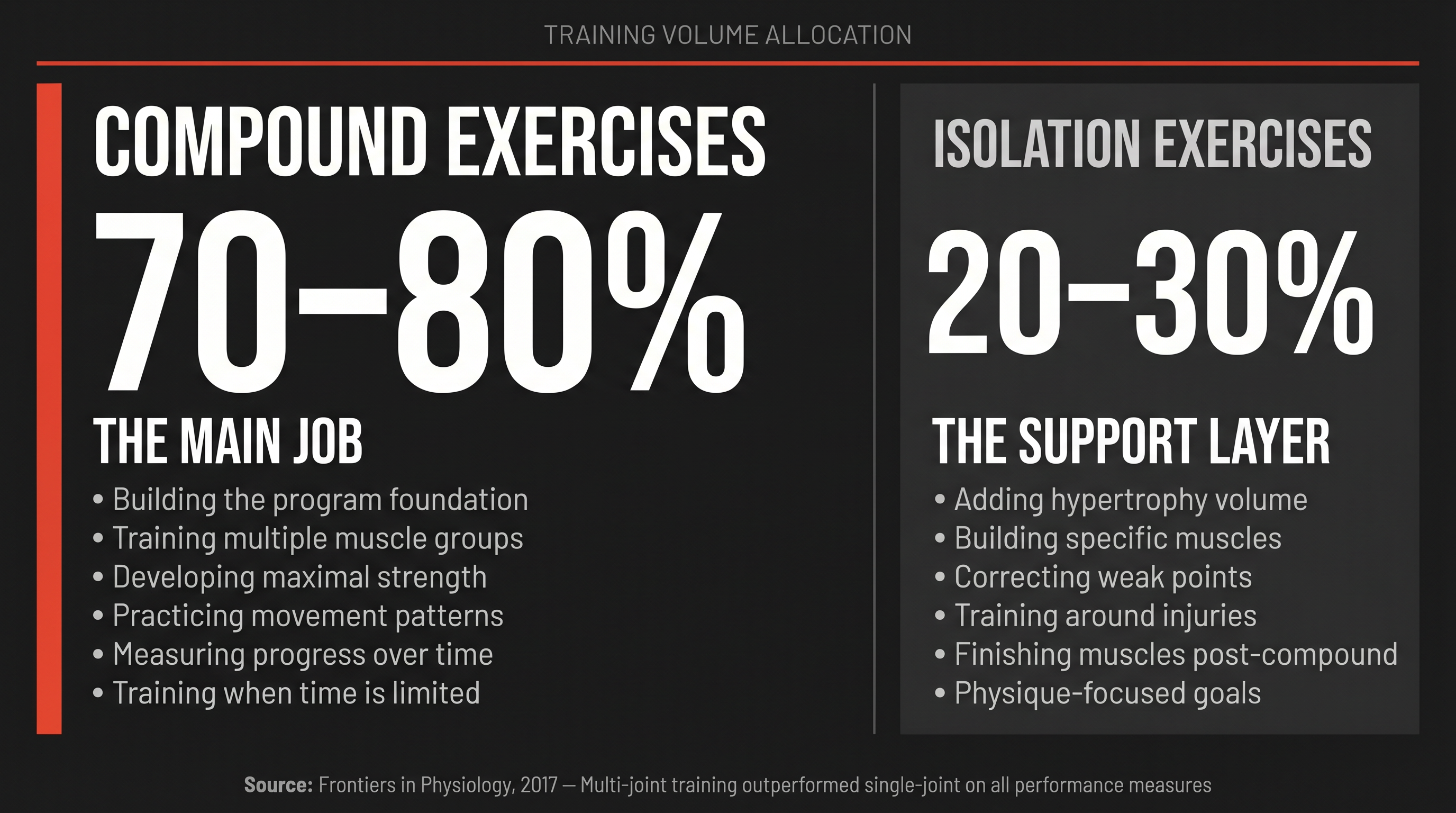
The research on this comparison is more limited than many people assume. A 2017 Frontiers study compared single-joint and multi-joint resistance training over eight weeks with total work volume equated. Both groups improved body composition, but the multi-joint group improved more on performance measures including VO₂max, bench press 1RM, knee extension 1RM, and squat 1RM. Because this study is from 2017 and had a small sample, treat it as useful directional evidence rather than a definitive answer. (Frontiers in Physiology)
Older research also found that adding single-joint exercises to a program already built around multi-joint exercises didn't clearly add strength or size benefits in certain groups — particularly over short interventions. These studies are older and short-term, so the practical takeaway isn't "never isolate"; it's "don't let isolation work replace the lifts that give you the biggest return." (PubMed)
The split that works for most serious lifters:
70–80% of your hard training work should come from compound lifts. The remaining 20–30% can come from targeted accessory and isolation work.
That ratio is what our strength guide recommends for most lifters — and it's the ratio that keeps training both efficient and well-rounded.
Which specific compound lifts you should prioritize depends entirely on your goal.
Best Compound Exercises for Every Training Goal
There's no single "best" compound exercise. The best choice depends on your goal, equipment, skill level, body structure, and recovery capacity.
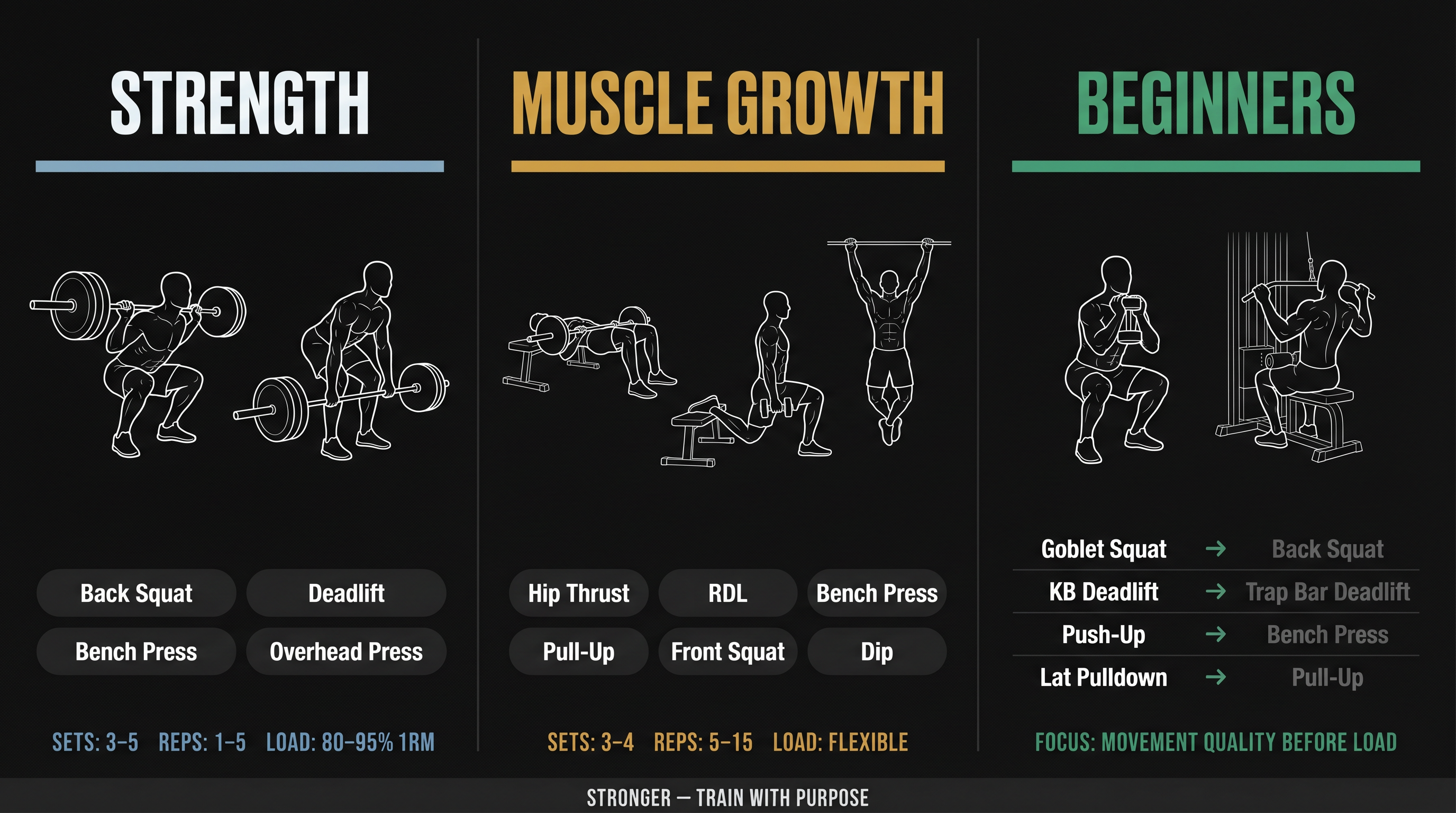
Best Compound Exercises for Strength
| Goal | Primary Lifts | Why They Work |
|---|---|---|
| Maximal lower-body strength | Back squat, front squat, deadlift, trap bar deadlift | Heavy loading, large muscle mass, clear progression |
| Upper-body pressing strength | Bench press, overhead press, weighted dip | Easy to load and track over time |
| Upper-body pulling strength | Pull-up, chin-up, barbell row, chest-supported row | Builds lats, upper back, grip, and pulling power |
| Full-body strength | Deadlift, trap bar deadlift, farmer carry | Trains force production, bracing, grip, and posture |
For strength-focused compound work, our squat guide recommends 4–5 sets of 3–5 reps at roughly 80–90% of your one-rep maximum (1RM) for squat work, while our deadlift guide suggests 3–5 sets of 1–5 reps at roughly 85–95% 1RM. These are exercise-specific examples — not universal rules — but they illustrate how heavy compound lifts are typically programmed when the goal is maximal strength.
Want to take your barbell back squat to the next level? The 5x5 workout program is one of the most proven compound-first strength structures available.
Best Compound Exercises for Muscle Growth
| Muscle Emphasis | Compound Lifts to Prioritize | Good Accessories |
|---|---|---|
| Quads | Front squat, high-bar squat, leg press, Bulgarian split squat | Leg extension |
| Glutes | Hip thrust, squat, Romanian deadlift, lunge | Cable kickback, abduction |
| Hamstrings | Romanian deadlift, deadlift, good morning | Leg curl |
| Chest | Bench press, incline press, weighted dip, push-up | Fly, cable crossover |
| Back | Pull-up, lat pulldown, barbell row, cable row | Pullover, rear-delt fly |
| Shoulders | Overhead press, incline press, landmine press | Lateral raise, rear-delt raise |
| Arms | Chin-up, close-grip bench, dip, row | Curl, triceps extension |
For hypertrophy, the current evidence is more flexible than old gym rules suggest. A 2021 network meta-analysis found that muscle growth can occur across low, moderate, and high loading zones when sets are taken to volitional failure — but strength gains are superior with heavier loads. (PMC) That means your hypertrophy compounds don't all need to be heavy triples. Sets of 5–10, 6–12, and even 10–15 can all stimulate muscle growth, depending on the lift and your ability to maintain form.
For the best glute results, the hip thrust sits at the top of the hinge hierarchy — our hip thrust guide covers every variation, how to load them progressively, and how they fit into a compound-first program. For Romanian deadlifts, the hamstring focus combined with heavy hip loading makes them one of the most productive posterior-chain builders in any program. And for Bulgarian split squats, the single-leg loading creates serious quad and glute stimulus with surprisingly low systemic fatigue — one of the best bang-for-buck compound lifts in any split.
Understanding the right rep ranges for each hypertrophy lift is the difference between spinning your wheels and actually building muscle. Our complete rep ranges guide breaks down the evidence for low, moderate, and high rep zones across different goals.
Best Compound Exercises for Beginners
Beginners don't need the most advanced version of every lift. They need the version they can perform consistently, safely, and with enough load to progress.
| Pattern | Beginner-Friendly Option | Progression |
|---|---|---|
| Squat | Goblet squat | Front squat or back squat |
| Hinge | Kettlebell deadlift | Romanian deadlift or trap bar deadlift |
| Horizontal push | Push-up or dumbbell bench press | Barbell bench press |
| Vertical push | Seated dumbbell press | Standing overhead press |
| Horizontal pull | Cable row or chest-supported row | Barbell row |
| Vertical pull | Lat pulldown or assisted pull-up | Pull-up or chin-up |
| Single-leg | Split squat | Bulgarian split squat |
| Carry | Farmer carry | Heavier farmer carry or suitcase carry |
The goblet squat is the ideal squat entry point — it teaches proper depth and knee tracking without the technical complexity of a barbell. The trap bar deadlift gives beginners a hinge movement that's more forgiving on the lower back than conventional pulls. And assisted pull-ups let beginners build vertical pulling strength before they have the strength to do full unassisted reps.
The goal isn't to earn barbell lifts as fast as possible. The goal is to build movement quality, then load it — and each beginner option in this table gives you a pattern to master before progressing to more demanding variations.
Now that you know which exercises to use, here's how to organize them into a program that actually works.
Ready to Get Stronger?
Join 2,000,000+ lifters tracking their workouts with Stronger. Available on iOS and Android.
Start tracking freeHow to Program Compound Exercises: A Step-by-Step Plan
A good compound-focused program answers five questions:
- Which movement patterns will you train?
- How often will each pattern appear?
- Which lifts will be your main progress markers?
- What rep ranges will you use?
- How will you recover enough to repeat the work?
Here's how to answer each one.
Should You Do Compound Exercises First in Every Workout?
The exercise you care about most should come first — not last, after you're already tired.
If your goal is a stronger squat, squat first. If your goal is bench strength, bench first. If you want to improve your pull-ups, do them before rows and curls.
A 2021 systematic review and meta-analysis on exercise order found that strength gains are greatest in the exercises performed earlier in a session. (PubMed) The practical takeaway is simple: the lift that matters most to your progress goes first, not as a warm-up at the end.
How Often Should You Do Compound Exercises Each Week?
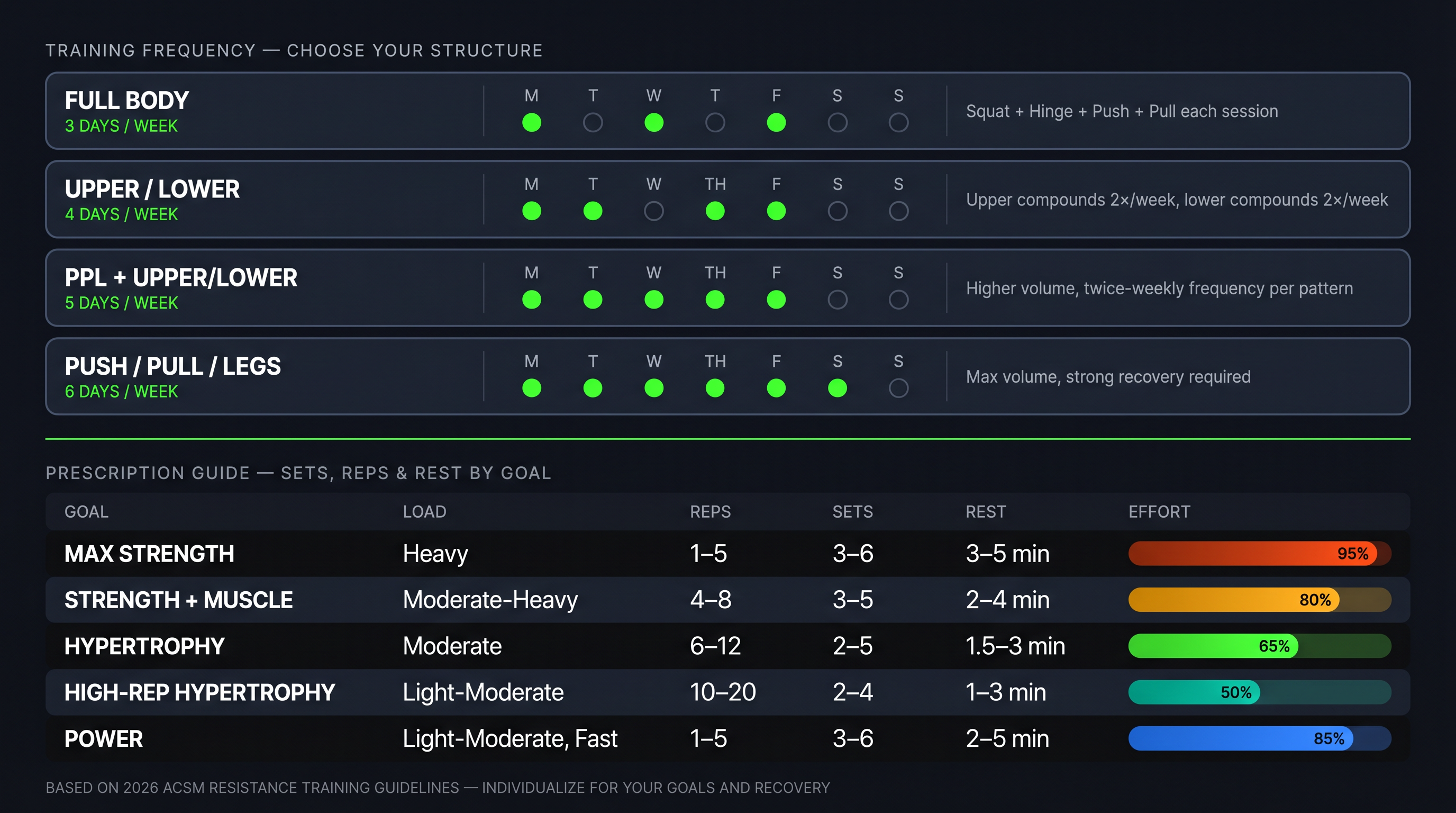
The 2026 update to the American College of Sports Medicine (ACSM) resistance training guidelines — the first such update in 17 years — emphasized consistency above complicated programming and highlighted training all major muscle groups at least twice per week. The guidelines also stress that programs should be individualized based on goals, enjoyment, and safety. (ACSM)
For most lifters, one of these structures hits that frequency target:
| Schedule | Best For | Compound Structure |
|---|---|---|
| 3-day full body | Beginners, busy lifters | Squat/hinge + push + pull each session |
| 4-day upper/lower | Intermediate lifters | Upper compounds twice, lower compounds twice |
| 5-day PPL + upper/lower | Hypertrophy-focused lifters | Higher volume with twice-weekly frequency |
| 6-day push/pull/legs | Advanced lifters with strong recovery | More total volume and exercise variety |
If you're not sure where to start, use a 3-day full-body plan. It's simple, repeatable, and gives you frequent practice on the lifts that matter most. Our 3-day workout split guide covers the exact structure, exercise selection, and progression scheme for busy lifters who want results without overcomplicating things.
How Many Sets and Reps Should You Do for Compound Exercises?
| Goal | Load | Reps | Sets | Rest |
|---|---|---|---|---|
| Max strength | Heavy | 1–5 | 3–6 | 3–5 min |
| Strength + muscle | Moderate-heavy | 4–8 | 3–5 | 2–4 min |
| Hypertrophy | Moderate | 6–12 | 2–5 | 1.5–3 min |
| Higher-rep hypertrophy | Light-moderate | 10–20 | 2–4 | 1–3 min |
| Power | Light-moderate, fast | 1–5 | 3–6 | 2–5 min |
The 2026 ACSM guidelines summarize the research clearly: strength-focused training typically uses heavier loads around 80% 1RM for 2–3 sets per exercise; hypertrophy benefits from higher weekly volume around 10 sets per muscle group; power development uses moderate loads moved quickly. (ACSM)
For a deeper look at how rep zones affect different outcomes, our rep ranges guide breaks down the evidence for strength (1–5), hypertrophy (6–12), and endurance (15+) training with specific examples and programs.
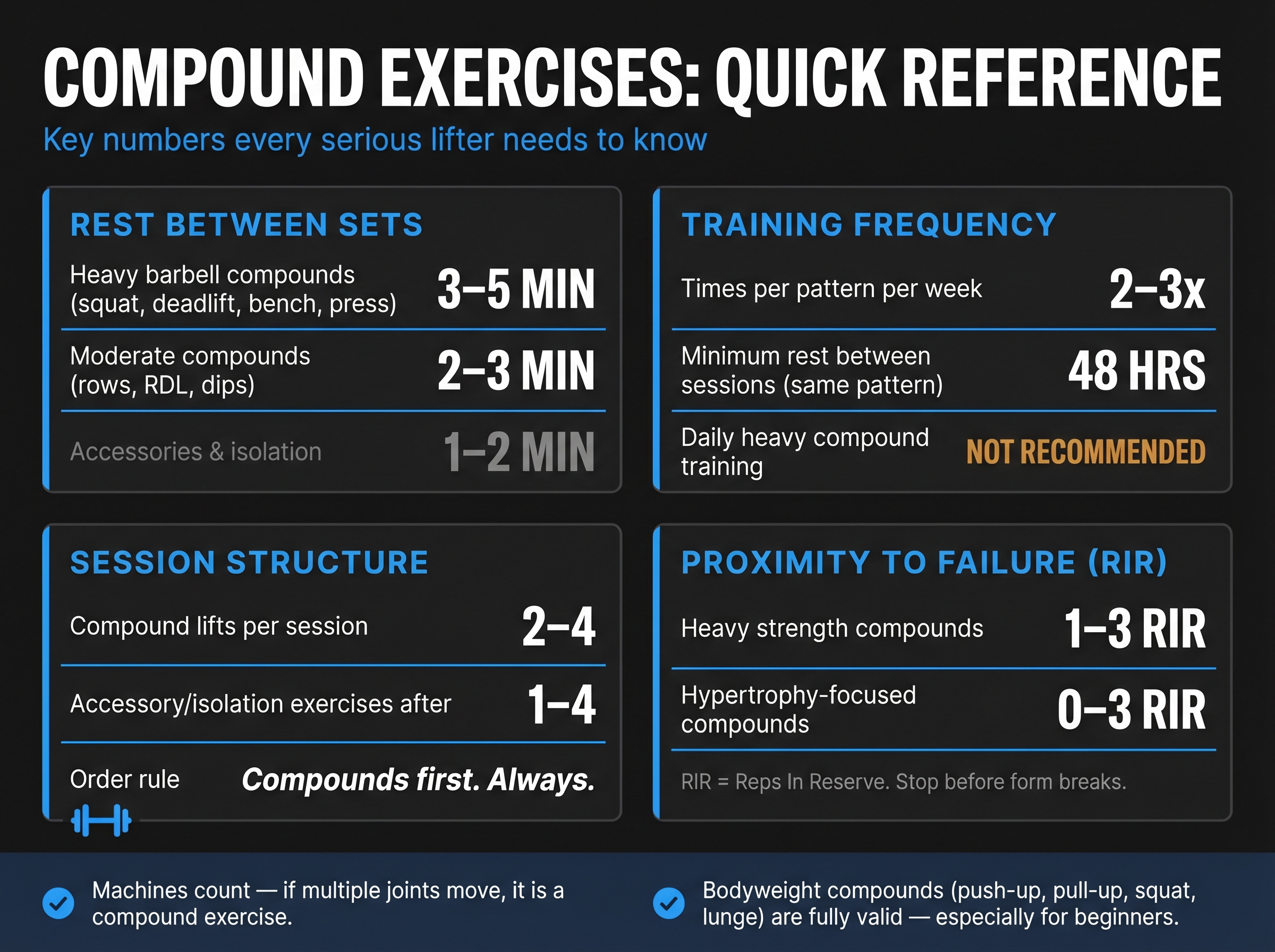
For heavy compound lifts, rest periods are non-negotiable. Our rest-period guide recommends 3–5 minutes for heavy barbell compounds and 2–3 minutes for moderate compound movements — shorter rest periods work well for smaller accessory lifts. A 2024 systematic review with Bayesian meta-analysis on inter-set rest intervals found a small but consistent hypertrophy benefit to resting more than 60 seconds, likely because longer rest helps maintain volume load across sets. (Frontiers in Sports and Active Living)
But templates are where all of this becomes concrete.
Compound Workout Programs: 3, 4, and 5-Day Templates
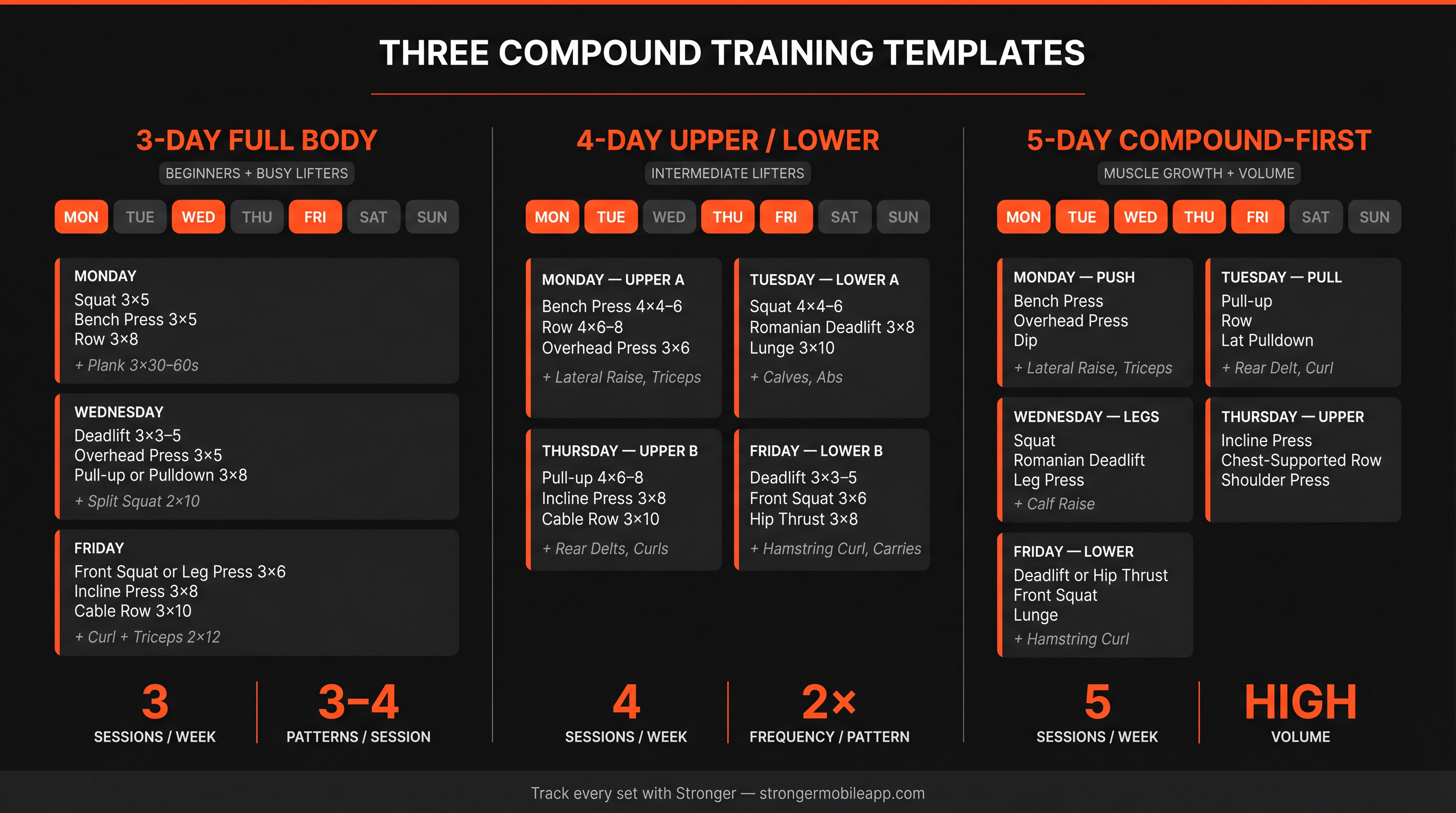
3-Day Full-Body Compound Workout for Beginners
Best for beginners, busy lifters, or anyone rebuilding consistency. See our full full-body workout guide for a deeper breakdown of exercise selection, frequency, and progression within this structure.
| Day | Main Lift | Secondary Compound | Pull | Accessory |
|---|---|---|---|---|
| Monday | Squat 3×5 | Bench press 3×5 | Row 3×8 | Plank 3×30–60 sec |
| Wednesday | Deadlift 3×3–5 | Overhead press 3×5 | Pull-up or pulldown 3×8 | Split squat 2×10 |
| Friday | Front squat or leg press 3×6 | Incline press 3×8 | Cable row 3×10 | Curl + triceps 2×12 |
Progression: add a small amount of weight when you complete all prescribed reps with good form. When the lift gets too heavy to progress every session, switch to weekly progression.
4-Day Upper/Lower Compound Workout Split
Best for intermediate lifters who want both strength and muscle. Our 4-day workout split guide and upper/lower split guide walk through exactly how to structure the exercise pairing, loading, and progression for this schedule.
| Day | Focus | Main Compounds | Accessories |
|---|---|---|---|
| Monday | Upper A | Bench press 4×4–6, row 4×6–8, overhead press 3×6 | Lateral raise, triceps |
| Tuesday | Lower A | Squat 4×4–6, Romanian deadlift 3×8, lunge 3×10 | Calves, abs |
| Thursday | Upper B | Pull-up 4×6–8, incline press 3×8, cable row 3×10 | Rear delts, curls |
| Friday | Lower B | Deadlift 3×3–5, front squat 3×6, hip thrust 3×8 | Hamstring curl, carries |
Progression: use heavier work early in the week and slightly higher-rep work later. Track estimated 1RM, total volume, and reps achieved per session.
5-Day Compound-First Workout for Muscle Growth
Best for lifters who want more volume without abandoning the compound foundation. The push/pull/legs structure and 5-day split guide cover the volume management and exercise rotation for this approach in detail.
| Day | Focus | Main Work |
|---|---|---|
| Monday | Push | Bench press, overhead press, dip, lateral raise, triceps |
| Tuesday | Pull | Pull-up, row, pulldown, rear delt, curl |
| Wednesday | Legs | Squat, Romanian deadlift, leg press, calf raise |
| Thursday | Upper | Incline press, chest-supported row, shoulder press, pulldown |
| Friday | Lower | Deadlift or hip thrust, front squat, lunge, hamstring curl |
Progression: keep 1–2 main lifts per session as your measurable progress markers. Use accessories to add volume without destroying recovery.
Templates give you the structure. Progression is what makes that structure work over months and years.
How to Progress Your Compound Exercises Over Time
What Is Linear Progression for Compound Lifts?
The simplest method: add weight every session.
Example: Squat 3×5
| Week | Weight | Sets × Reps |
|---|---|---|
| Week 1 | 135 lbs | 3 × 5 |
| Week 2 | 140 lbs | 3 × 5 |
| Week 3 | 145 lbs | 3 × 5 |
Add weight as long as technique stays consistent. When you can no longer add weight every session, move to a weekly progression model. Our progressive overload guide covers all six methods of applying progressive overload — including linear progression, double progression, and autoregulation — with specific examples across the major compound lifts.
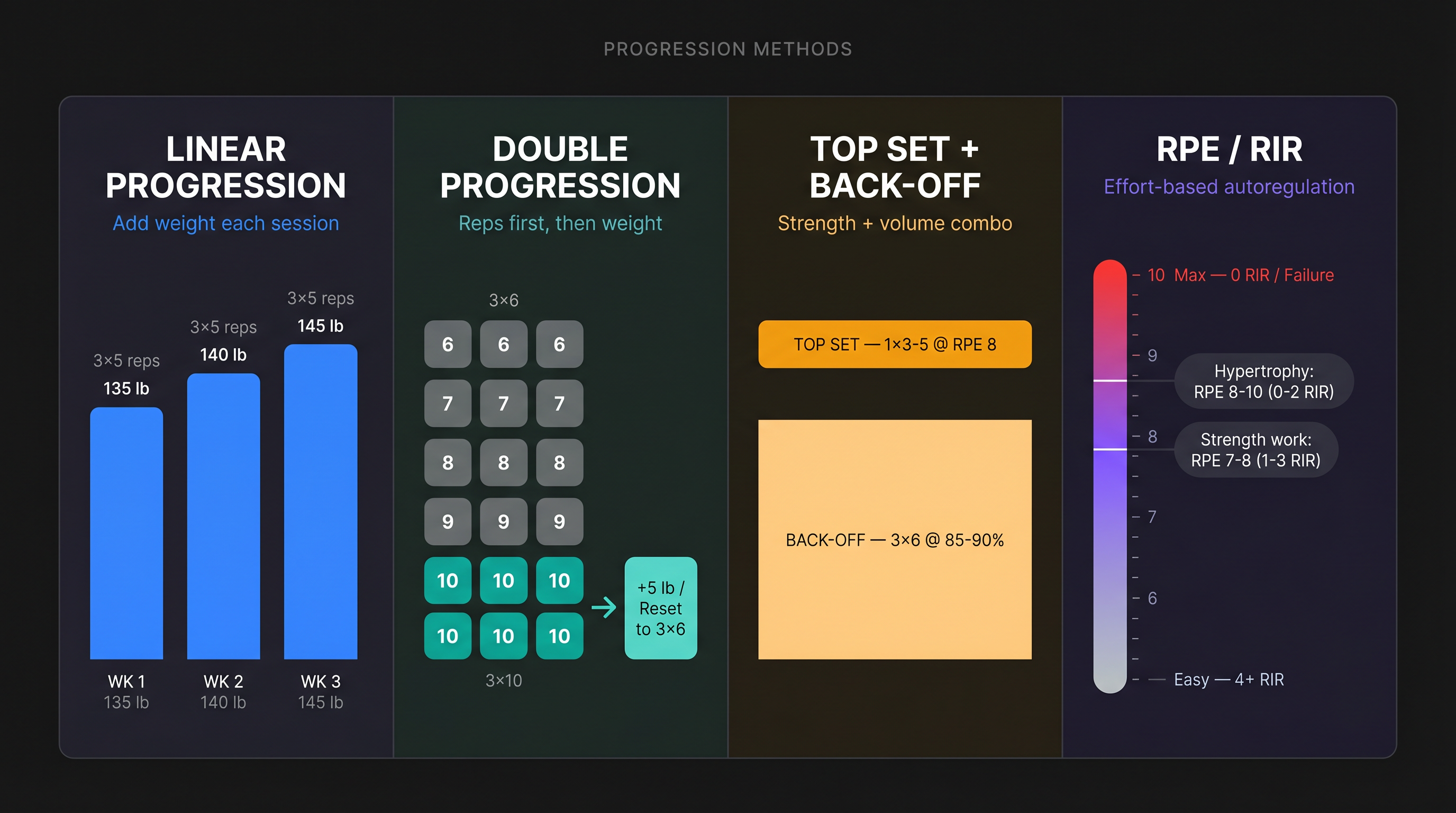
How to Use Double Progression for Compound Exercises
Work within a rep range, add reps before you add weight.
Example: Bench press 3×6–10
- Start with a weight you can lift for 3×6
- Add reps until you reach 3×10
- Increase weight
- Repeat
This works especially well for dumbbell presses, rows, pulldowns, split squats, and Romanian deadlifts.
How to Use Top Sets and Back-Off Sets in Compound Training
Combine heavy strength work with submaximal volume.
Example: Deadlift
- Top set: 1×3–5 at Rate of Perceived Exertion (RPE) 8
- Back-off sets: 2–4×5–8 at 85–90% of top-set load
This lets you practice heavy strength while still accumulating useful volume — without maxing out every session.
How to Use RPE and RIR for Compound Exercise Programming
RPE means Rate of Perceived Exertion — a 1–10 scale of effort. Reps in Reserve (RIR) means how many reps you had left before failure.
An RPE 8 set means you probably had about 2 reps left. An RIR of 0 means you hit failure.
A 2024 Sports Medicine meta-regression found that strength gains were similar across a wide range of reps in reserve, while hypertrophy appeared to improve as sets were taken closer to failure. The authors cautioned that exact relationships remain uncertain because RIR had to be estimated from available study descriptions rather than directly measured. (PubMed)
The practical application:
- For heavy compound strength work: stop with 1–3 reps in reserve most of the time
- For hypertrophy-focused compounds: stop with 0–3 reps in reserve
- For isolation exercises: going closer to failure is generally easier to recover from because fatigue is local and manageable
How to Do Compound Exercises with Proper Technique
Compound lifts are not dangerous by default — but they're less forgiving than isolation exercises. The more muscle mass and load involved, the more your setup matters.
How to Choose the Right Compound Exercise Variation
You don't need to force your body into a specific barbell lift from day one.
If back squats feel awkward, start with goblet squats or front squats. If conventional deadlifts bother your back, try trap bar deadlifts, Romanian deadlifts, rack pulls, or hip thrusts. If barbell bench pressing irritates your shoulders, try dumbbell presses, push-ups, or neutral-grip pressing.
The best compound lift is the one you can load, repeat, and recover from consistently.
How to Warm Up for Compound Exercises
A good compound warm-up isn't five minutes of random cardio. It should include:
- General movement to raise temperature
- Mobility work for the joints involved
- Technique rehearsal with light weight
- Gradual warm-up sets
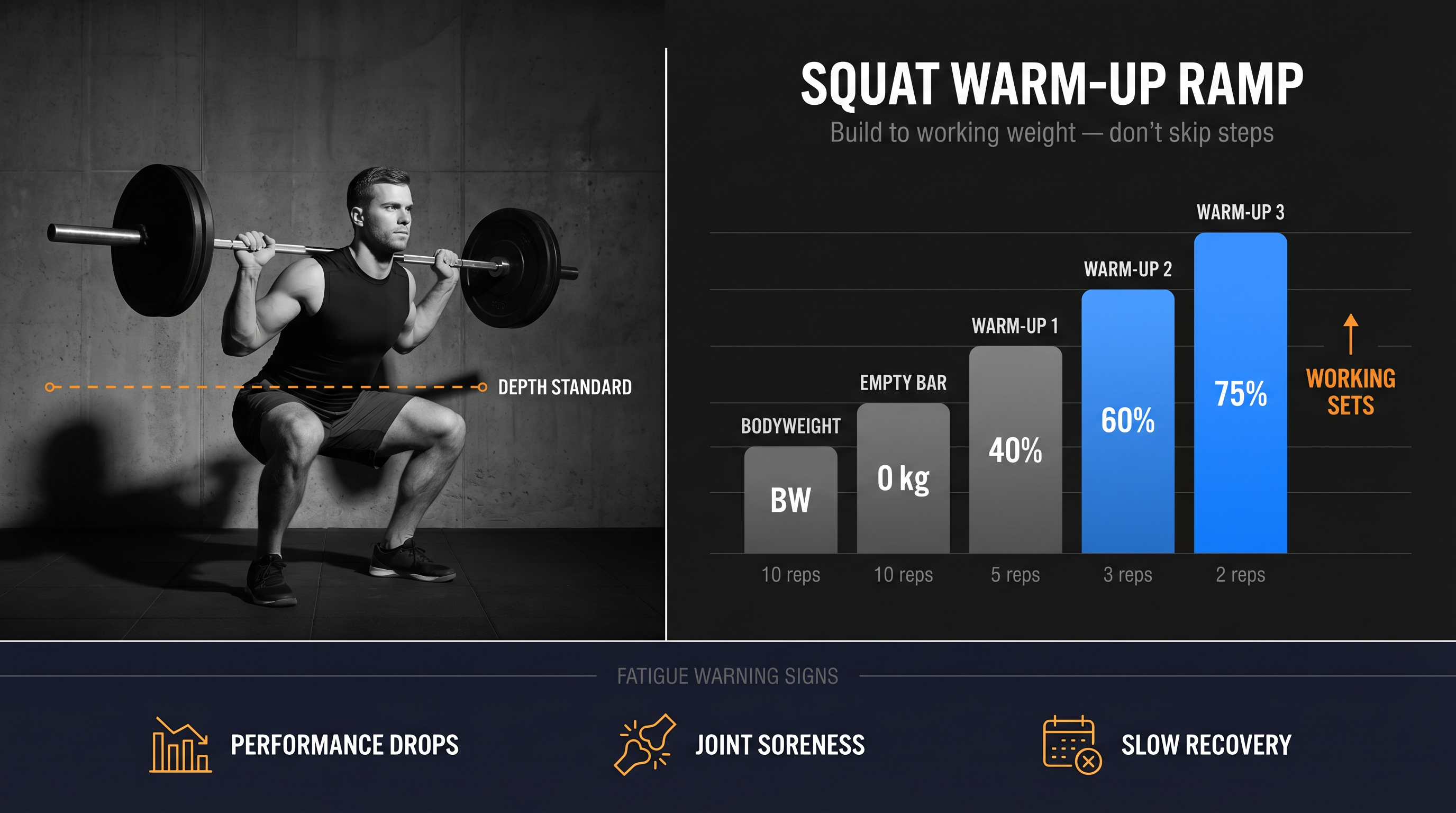
Example warm-up for squats:
| Warm-Up Set | Load | Reps |
|---|---|---|
| Bodyweight squat | — | 10 |
| Empty bar | — | 10 |
| Warm-up 1 | 40% of working weight | 5 |
| Warm-up 2 | 60% of working weight | 3 |
| Warm-up 3 | 75% of working weight | 2 |
| Working sets | — | — |
Our squat guide walks through the complete warm-up protocol and setup for the back squat, including how to use warm-up sets to build into your working weight without burning yourself out.
Why Consistent Range of Motion Matters in Compound Lifts
Progress only counts if the movement standard stays the same.
A squat that gets heavier by getting shallower isn't progress. A bench press that improves because every rep bounces off the chest isn't progress. A deadlift that moves more weight because your back rounds further each week isn't the goal.
Film your sets when needed. Our squat guide specifically recommends filming from the side to check depth and bar path, and using safety bars or a spotter when training near max effort.
How to Manage Fatigue from Heavy Compound Training
Compound lifts create more systemic fatigue than isolation exercises. That's part of why they work — but it also means you can't simply add more volume indefinitely.
Signs you may be doing too much compound work:
- Performance drops across multiple sessions
- Technique breaks down earlier than usual
- Joints feel worse week to week
- Sleep quality decreases
- Motivation drops sharply
- Recovery requires longer and longer between sessions
When these signs appear, don't quit the lifts — reduce volume, reduce load, take a deload week, or swap one demanding lift for a less fatiguing variation.
Are Compound Exercises Safe If You Have a History of Injury?
A 2024 updated systematic review in BMJ Open Sport & Exercise Medicine reported injury incidence in weightlifting and powerlifting at around 1.0–4.4 injuries per 1,000 hours of training. The most common sites were the lower back, shoulder, elbow, knee, and hands — suggesting barbell training requires sensible loading and technique management, but is far from automatically reckless. (BMJ Open Sport & Exercise Medicine)
If you have cardiovascular disease, high blood pressure, diabetes, a history of serious injury, or unexplained pain, speak with a qualified clinician before heavy resistance training. The American Heart Association's updated scientific statement notes that resistance training is safe and effective for cardiovascular health in adults with and without cardiovascular disease when prescribed appropriately. (American College of Cardiology)
Even with clean technique and good variation selection, certain mistakes consistently stall progress or create injury risk.
Common Compound Exercise Mistakes and How to Avoid Them
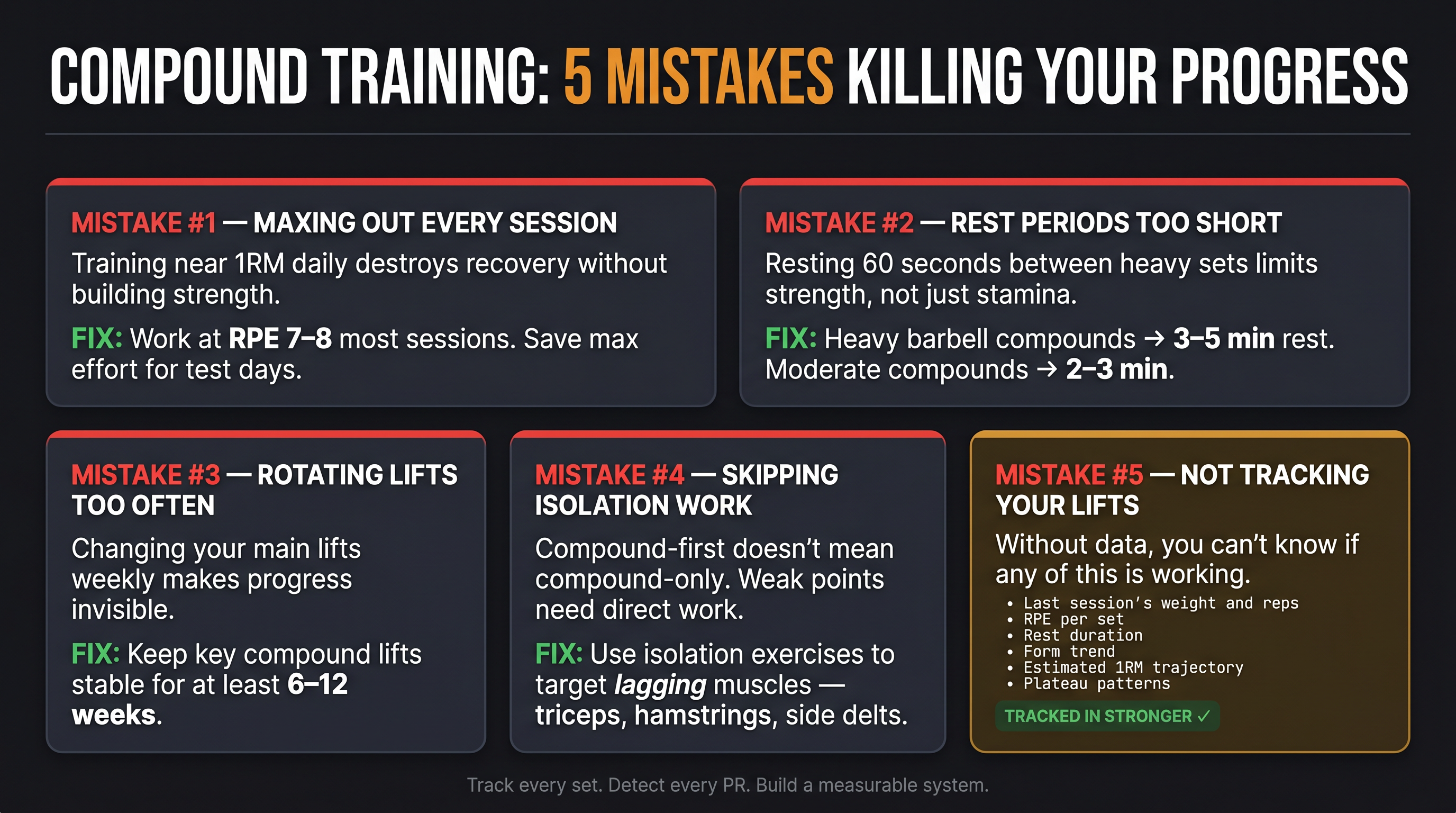
Why You Shouldn't Max Out on Compound Lifts Every Session
Heavy singles have their place. But maxing out too often is one of the most reliable ways to stall progress.
Most long-term strength comes from high-quality work below failure: sets of 3–8 for strength, sets of 6–12 for muscle, and enough volume to practice the lift without burying recovery. Think of near-maximum effort as a tool you use strategically — not a daily habit. Our bench press guide goes into detail on how to structure heavy pressing work with the right balance of top sets and back-off volume.
How Short Rest Periods Hurt Your Compound Lift Performance
Short rest periods can make a workout feel harder. Harder isn't always better.
If you squat heavy and rest 60 seconds, your next set will likely be limited by fatigue rather than strength. Our rest-period guide recommends 3–5 minutes between heavy barbell compound sets and 2–3 minutes for moderate compound movements. Use shorter rest only when the goal shifts to metabolic conditioning rather than strength or hypertrophy.
Why Switching Compound Exercises Too Often Kills Progress
Variation is useful. Randomness is not.
If you swap your main lifts every week, you make progress almost impossible to measure. Keep your key compound lifts stable for at least 6–12 weeks. Rotate accessories more freely — they're where variation adds value without disrupting the progress signal on your primary lifts.
Should You Skip Isolation Exercises If You Do Compound Lifts?
Compound-first doesn't mean compound-only.
If your triceps limit your bench, targeted triceps work will help. If your hamstrings lag behind your quads, leg curls and Romanian deadlifts belong in your program. If your side delts aren't responding to overhead pressing, lateral raises are appropriate. Isolation exercises aren't "less serious" — they're just not the foundation.
Why Tracking Your Compound Lifts Is Essential for Progress
This is the mistake that makes all the others worse — because without data, you can't tell whether anything is working.
To turn compound training into a system, you need to know:
- What you lifted last session
- How many reps you completed
- How hard it felt (RPE)
- How long you rested
- Whether form improved or declined
- Whether your estimated 1RM is trending upward
- Whether a plateau is one bad session or a real pattern
Stronger's PR detection, complete training history, adaptive routines, and built-in rest timers exist for exactly this reason: turning your compound lifts from disconnected workouts into measurable, accountable progress. (Stronger Features)
Ready to Get Stronger?
Join 2,000,000+ lifters tracking their workouts with Stronger. Available on iOS and Android.
Start tracking freeTrain Compound Lifts with Stronger
Compound training works best when it's measurable. That's where a training app becomes more than a digital notebook — it becomes the system that makes your programming actually run.
Stronger was built around the compound training principles covered in this guide. Here's how it puts them into practice:
Stronger's features page shows the real product in action — the Strength Score dashboard with per-muscle strength levels, workout tracking that records every set and rep, and the full feature set built around compound lift progression.
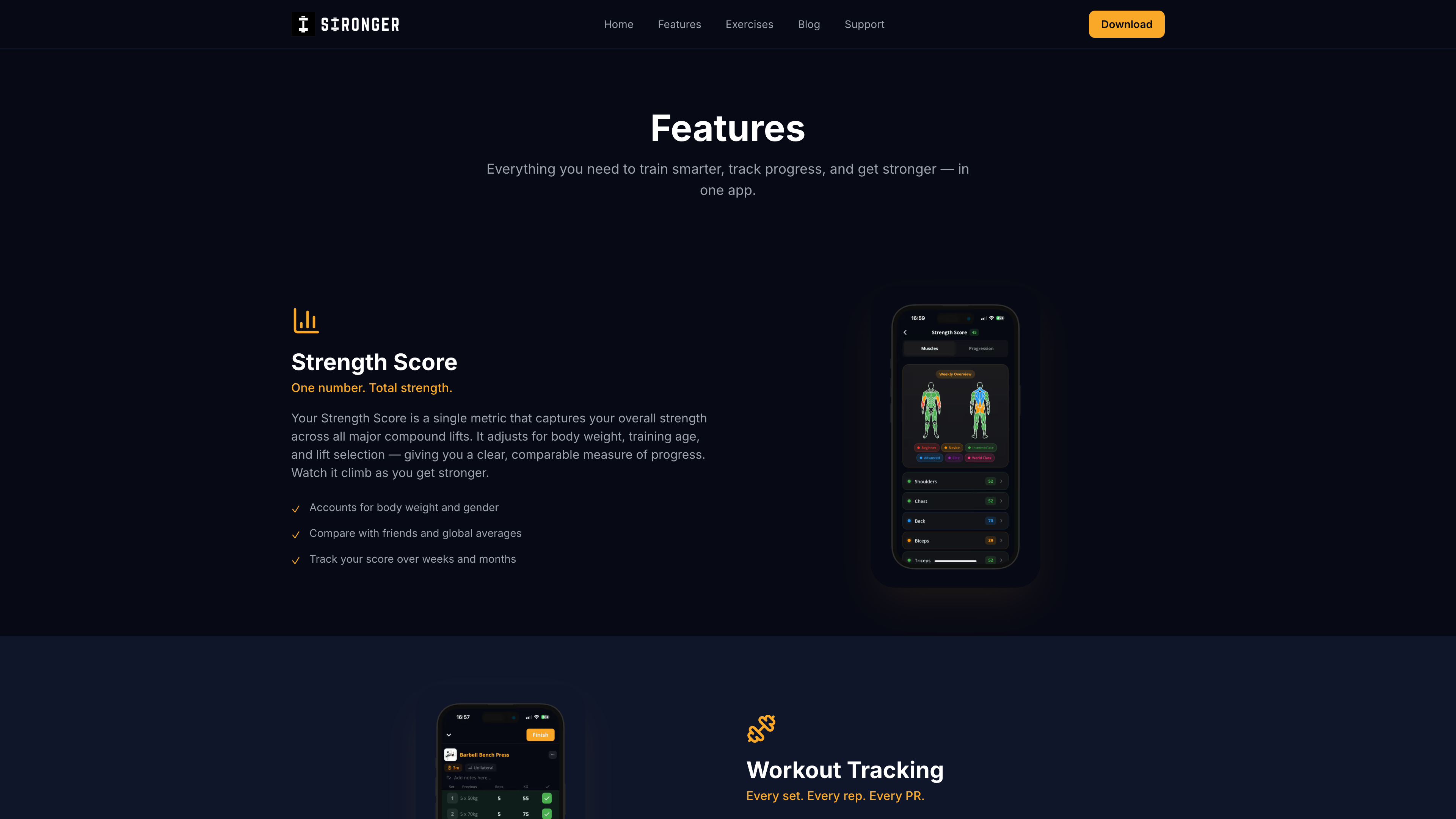
Log every set, rep, and weight. See your exact numbers from your last session before every set. No guessing, no digging through notes. Your last squat session is right there when you start your warm-up.
Automatic PR detection.Stronger flags personal records in real time — by exercise and by rep range. You know the moment you beat your best bench press at 5 reps. That feedback loop is one of the most reliable motivation tools in strength training.
Built-in rest timers. Set your rest period for heavy barbell work and let the timer run. Use longer rests for heavy compounds (3–5 minutes) and shorter ones for accessories, so you're not watching a clock or guessing when to go.
Full training history. See 6 months of squat progress, not just last week. Track your estimated 1RM over time. Identify plateaus before they become stalls. Stronger's training history gives you the longitudinal view that one-session apps can't.
Adaptive routines built around compound patterns.Stronger's AI-generated and adaptive routines are built around the squat, hinge, push, pull, and carry patterns. The app adjusts weights, sets, and reps based on your actual performance — so the program responds to how you're actually training, not just what was planned on paper.
Strength Score: strength benchmarking that adjusts for you.Stronger's Strength Score rates your strength across 12 muscle groups and overall, adjusted for bodyweight and sex, on six levels from Beginner to World Class. (Stronger Features) That means it tracks real-world strength progress — not just raw numbers, but how strong you are relative to yourself and your peers. It answers the question serious lifters actually care about: am I getting stronger in the lifts that matter?
Start tracking your compound lifts with Stronger →
The Bottom Line on Compound Exercise Training
Compound exercises should drive your training because they give you the clearest path to stronger, more measurable, more efficient workouts.
They train more muscle at once. They let you move heavier loads. They build movement skill across patterns that transfer to everything. They make progressive overload visible and verifiable. They turn strength into something you can watch improve over time — not just feel.
But the goal isn't compound-only purity. The goal is a better system:
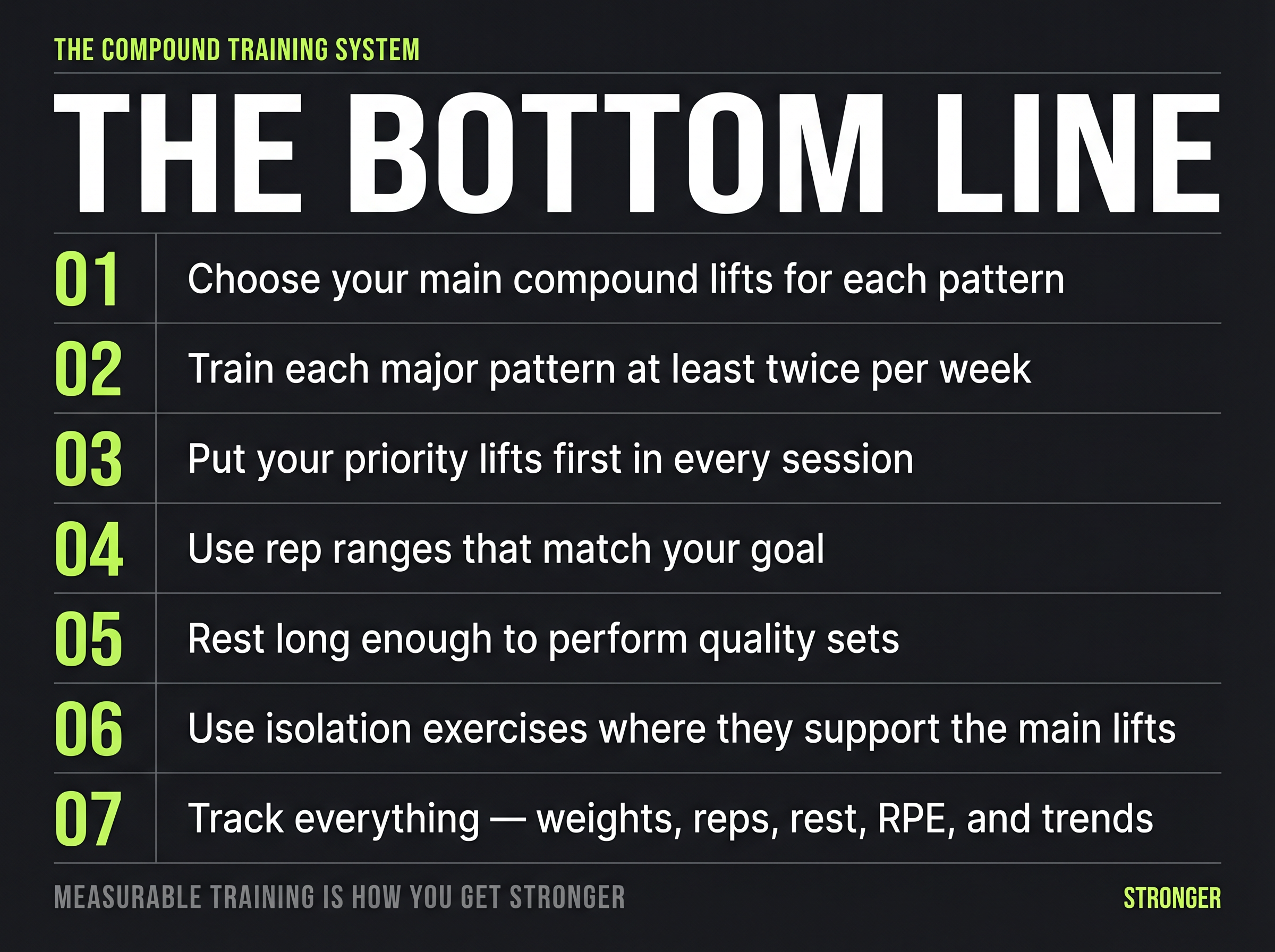
- Choose your main compound lifts for each pattern
- Train each major pattern at least twice per week
- Put your priority lifts first in every session
- Use rep ranges that match your goal
- Rest long enough to perform quality sets
- Use isolation exercises where they support the main lifts
- Track everything — weights, reps, rest, RPE, and trends
Do that consistently for months — not days — and your training stops being random. It becomes measurable. And measurable training is how you get stronger.
Build your compound training program in Stronger →
Compound Exercises: Frequently Asked Questions
Are compound exercises better than isolation exercises?
For overall strength, training efficiency, and measurable progression, compound exercises should usually be prioritized. They train more muscle per movement, allow heavier loading, and give you a clearer progress signal.
That said, isolation exercises are genuinely valuable for hypertrophy, addressing weak points, training around injuries, and physique-specific goals. A strong program uses both: compounds as the foundation, isolation as the support structure. Our how-to-get-stronger guide walks through how to build that structure in practice.
Can I build muscle with only compound exercises?
Yes — especially as a beginner or intermediate lifter. Squats, presses, rows, deadlifts, lunges, pull-ups, and dips can build significant muscle mass.
However, a compound-only program may undertrain certain muscles or make it difficult to add volume without accumulating excessive systemic fatigue. Isolation exercises are particularly useful for muscles like the side delts, calves, biceps, triceps, and rear delts, which compound lifts may not stress enough for maximum growth.
Are compound exercises good for fat loss?
They can absolutely help — compound lifts train a large amount of muscle, support strength and muscle retention during a calorie deficit, and contribute to overall energy expenditure. But fat loss ultimately depends on your calorie balance, nutrition, sleep, and consistency.
Think of compound training as the best strength-training foundation you can have while losing fat — not a fat-burning category unto itself.
The British Heart Foundation's 2025 compound exercise guide frames them as useful for weight management when combined with a healthy diet, highlighting scalable examples like squats, press-ups, deadlift variations, and shoulder presses.
Should beginners start with compound exercises?
Yes — but they should start with appropriate variations.
A beginner doesn't need to start with a heavy barbell back squat or conventional deadlift. Goblet squats, kettlebell deadlifts, dumbbell presses, cable rows, assisted pull-ups, and split squats are excellent entry points. They build the movement pattern before adding load.
Learn the pattern first. Load it second.
How many compound exercises should I do per workout?
Most lifters do best with 2–4 compound exercises per session, followed by 1–4 accessory or isolation exercises.
A practical example:
- Main compound: squat
- Secondary compound: Romanian deadlift
- Upper compound: row
- Accessories: leg curl, calf raise, core work
Attempting six or more heavy compound lifts in a single session typically creates more fatigue than productive training stimulus. For the right framework for organizing sessions, our full-body workout guide and 4-day workout split guide both show exactly how many compounds fit per session and per week.
Should I do compound exercises before isolation exercises?
Almost always, yes.
Put the most demanding, technical, and important exercises first, when your energy and focus are highest. Isolation work fits better after your main compound lifts, where you can train smaller muscles without compromising squat, deadlift, press, or pull-up performance.
How close to failure should you take compound exercises?
For heavy compound strength work, most sets should stop with 1–3 reps in reserve. This provides a strong training stimulus while keeping technique intact.
For hypertrophy-focused compounds, 0–3 reps in reserve can work. For isolation exercises, going closer to failure is generally easier to recover from.
The 2024 proximity-to-failure meta-regression in Sports Medicine found that hypertrophy may improve as sets are taken closer to failure, while strength gains were similar across a wider range of remaining reps. (PubMed)
What are the big compound lifts?
The classic big lifts are:
- Barbell back squat
- Deadlift
- Barbell bench press
- Military press (overhead press)
- Barbell row
- Pull-up or chin-up
But compound training is broader than the traditional powerlifting-style barbell movements. Lunges, hip thrusts, push-ups, dips, leg presses, dumbbell presses, cable rows, lat pulldowns, and farmer carries are all compound exercises. Browse our full exercise library to find the right variation for your equipment and goals.
Do machines count as compound exercises?
Yes — if multiple joints and muscle groups are involved.
A leg press is a compound exercise. A chest press machine is a compound exercise. A cable row is a compound exercise. Machines can be excellent training tools, especially when they allow stable, repeatable loading with less technical complexity than free weights.
Free weights aren't automatically better. They're different — and for certain lifters, certain goals, and certain injury contexts, machines are the smarter choice.
How long should I rest between compound exercises?
For heavy barbell compound lifts (squats, deadlifts, bench press, overhead press), rest 3–5 minutes between sets. For moderate compound movements (rows, Romanian deadlifts, dips), 2–3 minutes is generally sufficient.
Shorter rest periods are fine for accessory and isolation exercises. The goal with heavy compounds is to perform the next set with as much strength as the previous — and that requires adequate recovery between efforts. Our rest between sets guide covers the research behind every rest interval recommendation, with specific advice for strength vs. hypertrophy goals.
Can I do compound exercises every day?
Not recommended for most lifters — and rarely necessary.
Heavy compound lifts create significant systemic fatigue. Most people recover best when each major pattern appears 2–3 times per week with at least 48 hours between sessions that stress the same movement.
Lighter variations or technique practice can be done more frequently — but daily heavy compound training typically leads to stalled progress or accumulated fatigue over time.
What compound exercises can I do at home without equipment?
Bodyweight compound exercises are genuinely effective, particularly for beginners and as supplementary work.
The best bodyweight compound options:
- Squat pattern: bodyweight squat, jump squat, wall sit
- Hinge pattern: hip hinge with hip extension, single-leg deadlift (bodyweight)
- Push:push-up, pike push-up, decline push-up
- Pull: pull-up or chin-up (if you have a bar), inverted row under a table
- Lunge: reverse lunge, walking lunge, step-up
- Carry: any walk carrying heavy household objects
A pull-up bar (around $20–30) massively expands your options. Add resistance bands, and bodyweight compound training becomes a legitimate full program for intermediate lifters.
Exercises in this guide
Stronger Editorial Team
Certified strength & conditioning specialists with 10+ years of coaching experience
The Stronger editorial team produces evidence-based training content for lifters of all levels.
Ready to Get Stronger?
Join 2,000,000+ lifters tracking their workouts with Stronger. Available on iOS and Android.
Start tracking free