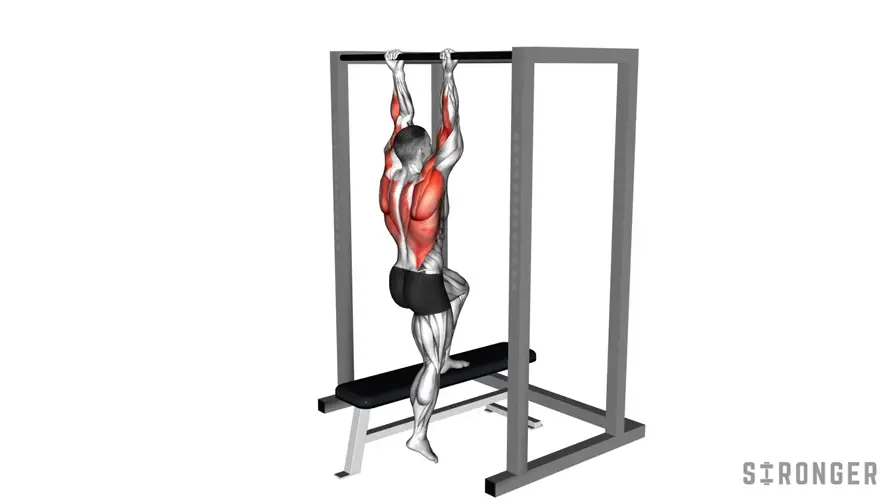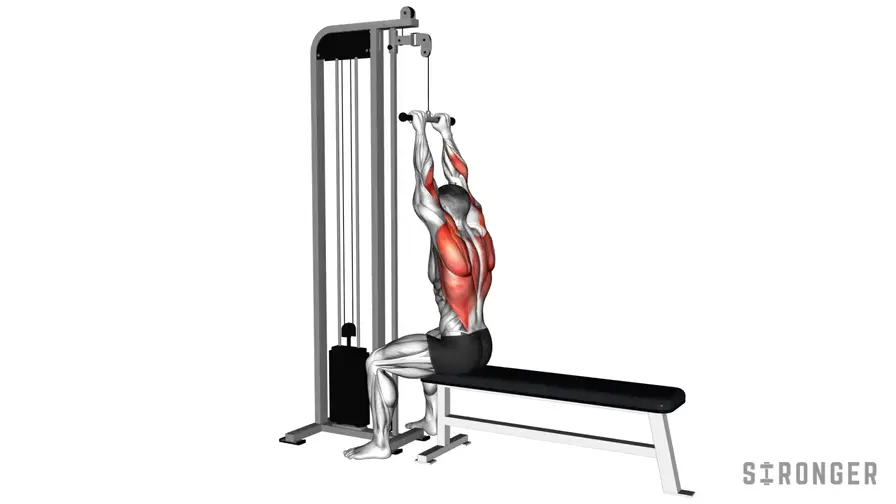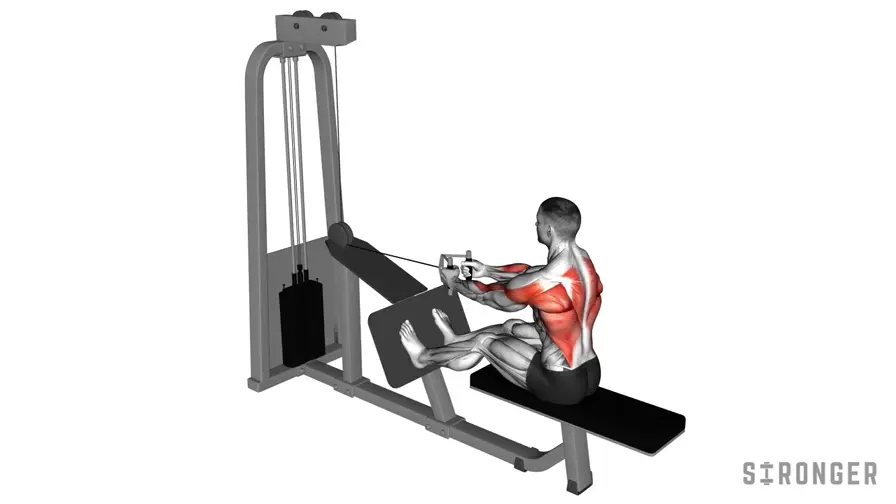

Assisted Pull-Up
Category
compoundDifficulty
beginner
Equipment
machine
Force Type
pull
How to Perform the Assisted Pull-Up
- Set the counterweight on the assisted pull-up machine — a higher weight provides more assistance.
- Step onto the knee pad or platform and grip the handles with an overhand (pronated) grip, slightly wider than shoulder width.
- Begin in a full hang with arms extended, shoulders packed down and away from your ears.
- Pull yourself upward by driving your elbows down toward your hips, engaging your lats as the primary mover.
- Continue pulling until your chin clears the bar or handles.
- Hold briefly at the top, then lower yourself under control back to the full hang position.
- Repeat for the prescribed number of reps, maintaining strict form throughout the set.
Common Mistakes to Avoid
Gripping too wide or too narrow
Use a grip slightly wider than shoulder width for optimal lat engagement and comfortable range of motion.
Not achieving full range of motion
Fully extend your arms at the bottom and pull your chin above the bar at the top for maximum muscle activation.
Using momentum and swinging
Keep your body stable and core tight; if you need to swing, increase the counterweight and focus on strict form.
Muscles Worked
Benefits
- ✓Enables beginners to train the pull-up movement pattern with proper form.
- ✓Excellent for building lat and upper back width with a controlled progression.
- ✓Allows for precise load management to facilitate gradual strength increases.
Pro Tips
- ●Think about pulling your elbows to your back pockets to better engage the lats.
- ●Reduce the counterweight by small increments each week to steadily progress.
- ●Control the eccentric (lowering) phase for 2-3 seconds to build strength and muscle.
Variations
Recommended Sets & Reps
Strength
4-5 sets of 4-6 reps with minimal assistance
Hypertrophy
3-4 sets of 8-12 reps at moderate assistance
Endurance
2-3 sets of 15-20 reps at higher assistance
Track Your Assisted Pull-Up in Stronger
Log your sets, watch your assisted pull-up progress over time, and see how it feeds your Strength Score. Join 2,000,000+ lifters on iOS and Android.
Start tracking freeTraining Guides
Articles featuring the assisted pull-up in workout programs and training advice.