

Arnold Split: The Complete 6-Day Bodybuilding Program
Most Arnold Split guides online are one of two things: a cropped photo of a shirtless 25-year-old with six exercises listed and no progression plan, or a direct copy of Arnold's professional two-a-day competition prep that would destroy anyone who tried it without pharmaceutical recovery support. Neither version is useful for an intermediate lifter who wants to actually build muscle.
The Arnold split is a genuine, evidence-backed bodybuilding structure. Trained properly, it gives every major muscle group two hard weekly exposures, lets you pair chest and back for savage antagonist supersets, and carves out a dedicated day for arms and shoulders that PPL simply doesn't.
The ACSM's 2026 resistance training position stand — the first major update in 17 years, synthesizing 137 systematic reviews and data from over 30,000 participants — confirms that accumulating sufficient weekly volume is central to hypertrophy, and recommends training major muscle groups at least twice per week to maximise strength. (ACSM) The Arnold split delivers both.
This is our version: the classic structure, updated for real recovery, current hypertrophy evidence, and lifters who want to run six days a week without burning out by week four. You'll find the complete 6-day program below, along with progression rules, nutrition guidance, exercise swaps, and everything you need to track and progress it properly.
Educational note: this is a high-volume resistance-training program. If you are injured, returning after a long layoff, or under medical supervision, get qualified guidance before starting.
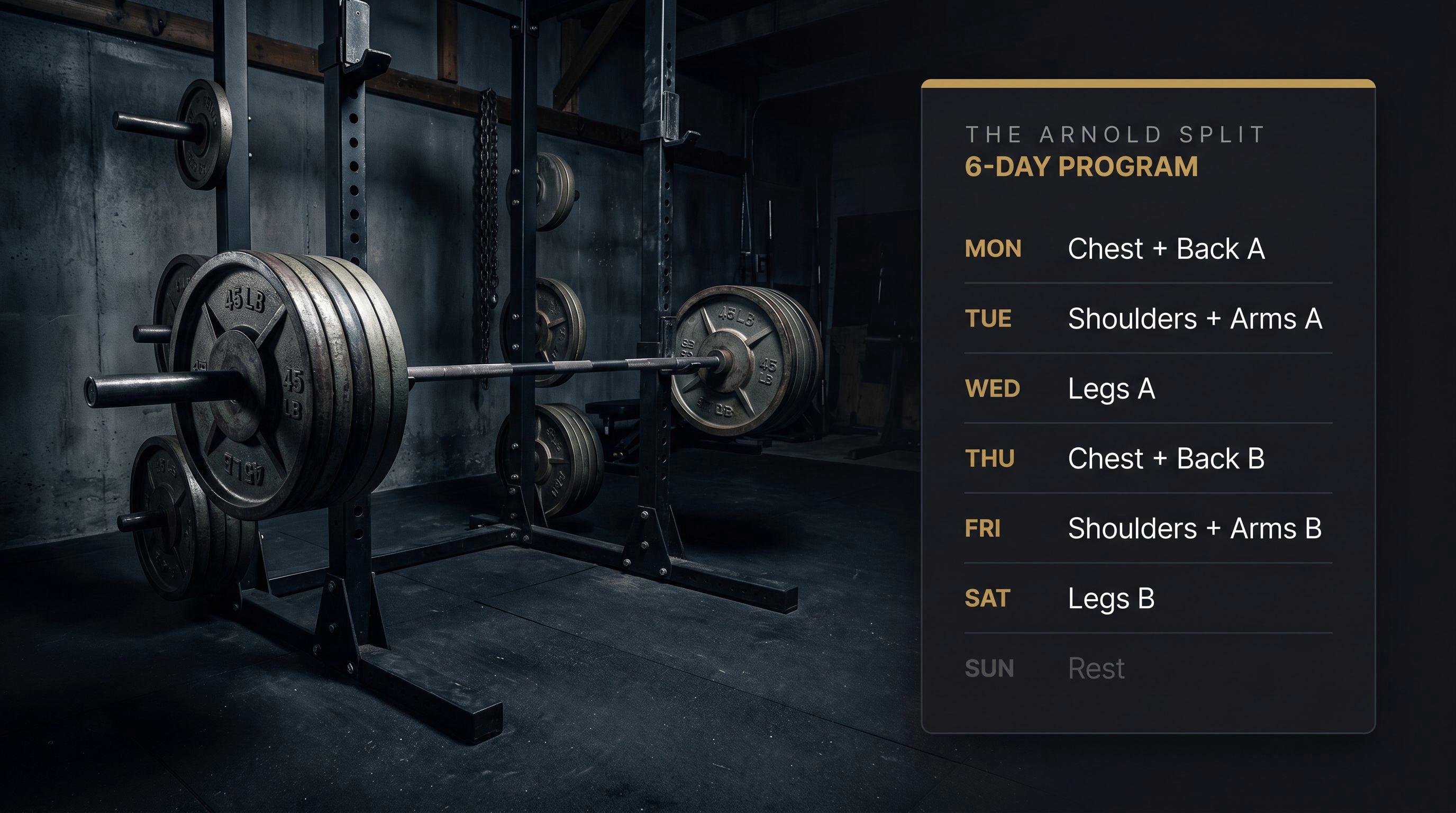
What Is the Arnold Split?
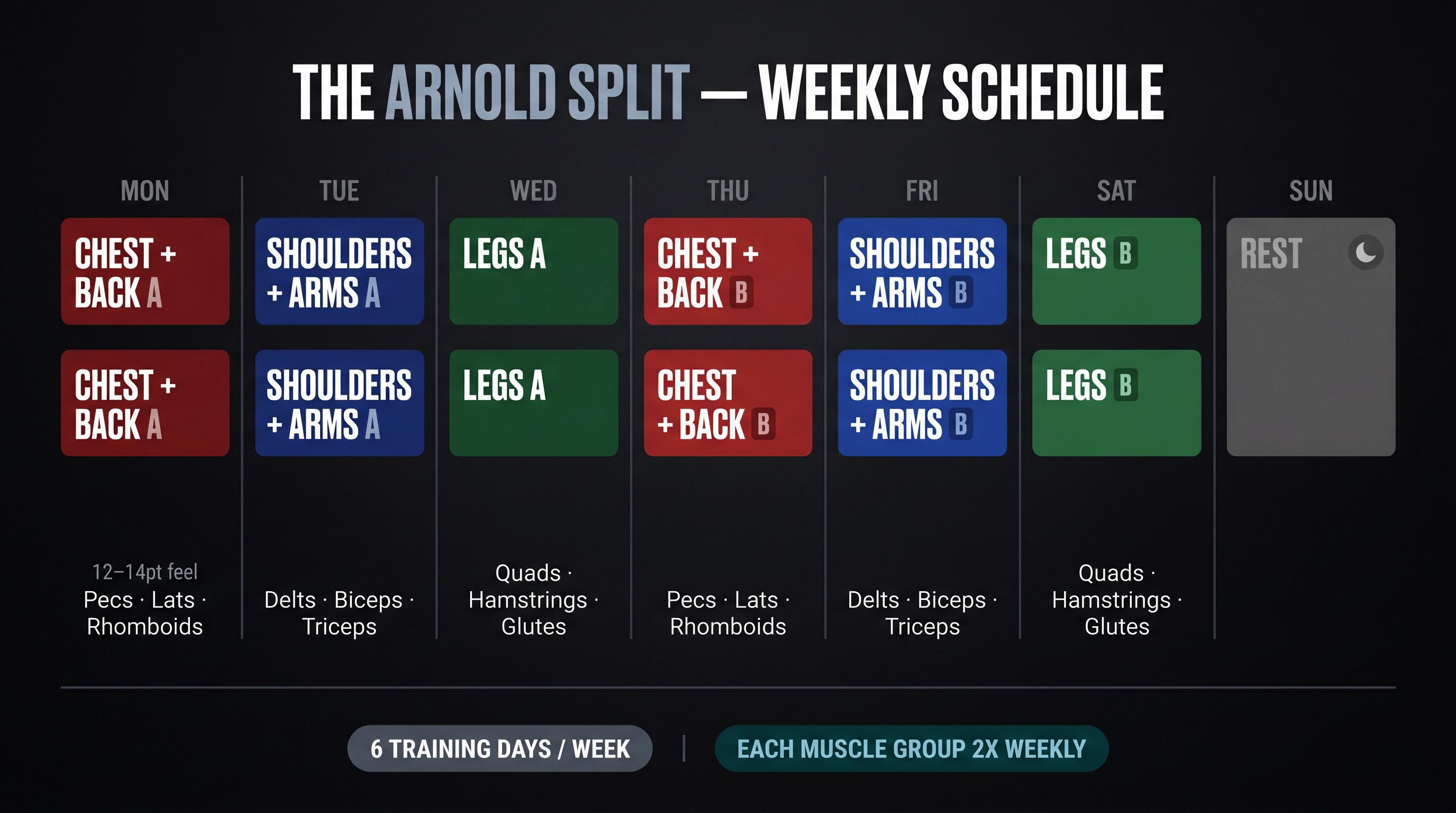
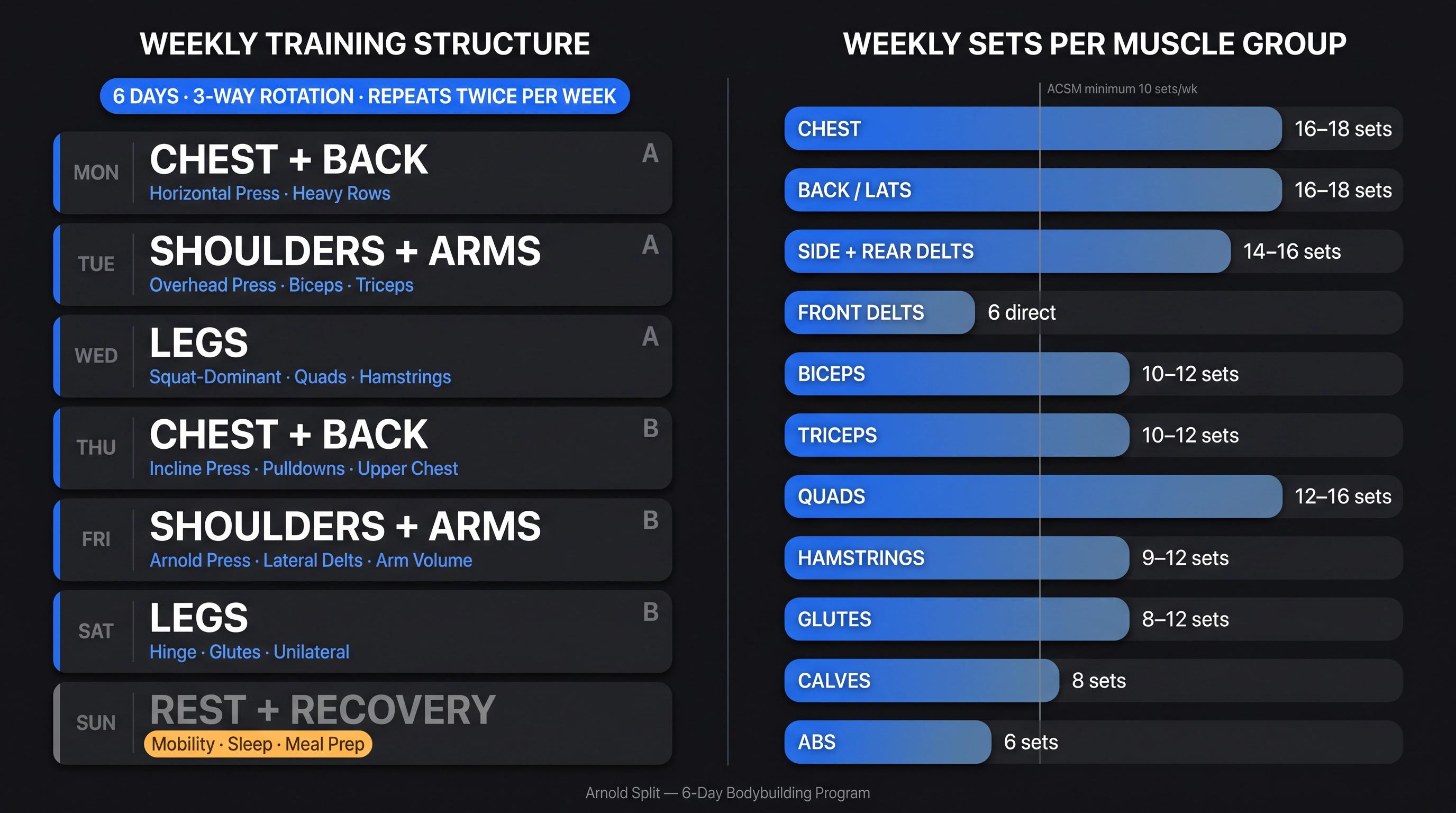
The Arnold split is a 6-day bodybuilding program built around a three-way rotation that repeats twice per week:
| Day | Workout |
|---|---|
| Monday | Chest + Back A |
| Tuesday | Shoulders + Arms A |
| Wednesday | Legs A |
| Thursday | Chest + Back B |
| Friday | Shoulders + Arms B |
| Saturday | Legs B |
| Sunday | Rest |
Arnold's own description of his famous training split — published through his Pump Club newsletter — centered on the same chest/back, shoulders/arms, and legs pairing he used throughout his Olympia years. He later described using the same rotation structure with reduced volume after stepping back from elite competition. (Arnold's Pump Club)
The split trains each major muscle group roughly twice per week. That's not coincidence — it's the structural advantage that separates this program from a standard bro split, and it aligns with current evidence showing that distributing volume across multiple weekly sessions is one of the most reliable ways to accumulate quality work without cramming everything into a single exhausting day.
Before you copy the table and start Monday, here's who this split is actually built for.
Who Should Use the Arnold Split?
This program is designed for intermediate to advanced lifters. Use it if you can say yes to most of these:
| Question | Why it matters |
|---|---|
| Can you train 5–6 days per week reliably? | The rotation only produces results if you actually complete it. |
| Can you recover from high weekly volume hitting the same muscles twice per week? | Chest, back, delts, arms, and legs all get two exposures weekly. |
| Do you already know how to bench, row, squat, hinge, press, and pull down with good form? | This is not the place to learn foundational movement patterns from scratch. |
| Is muscle growth — not maximal powerlifting strength — your primary goal? | The Arnold split is a bodybuilding structure first. |
| Can you track sets, reps, loads, rest, and recovery consistently? | High-frequency training collapses when progression is random. |
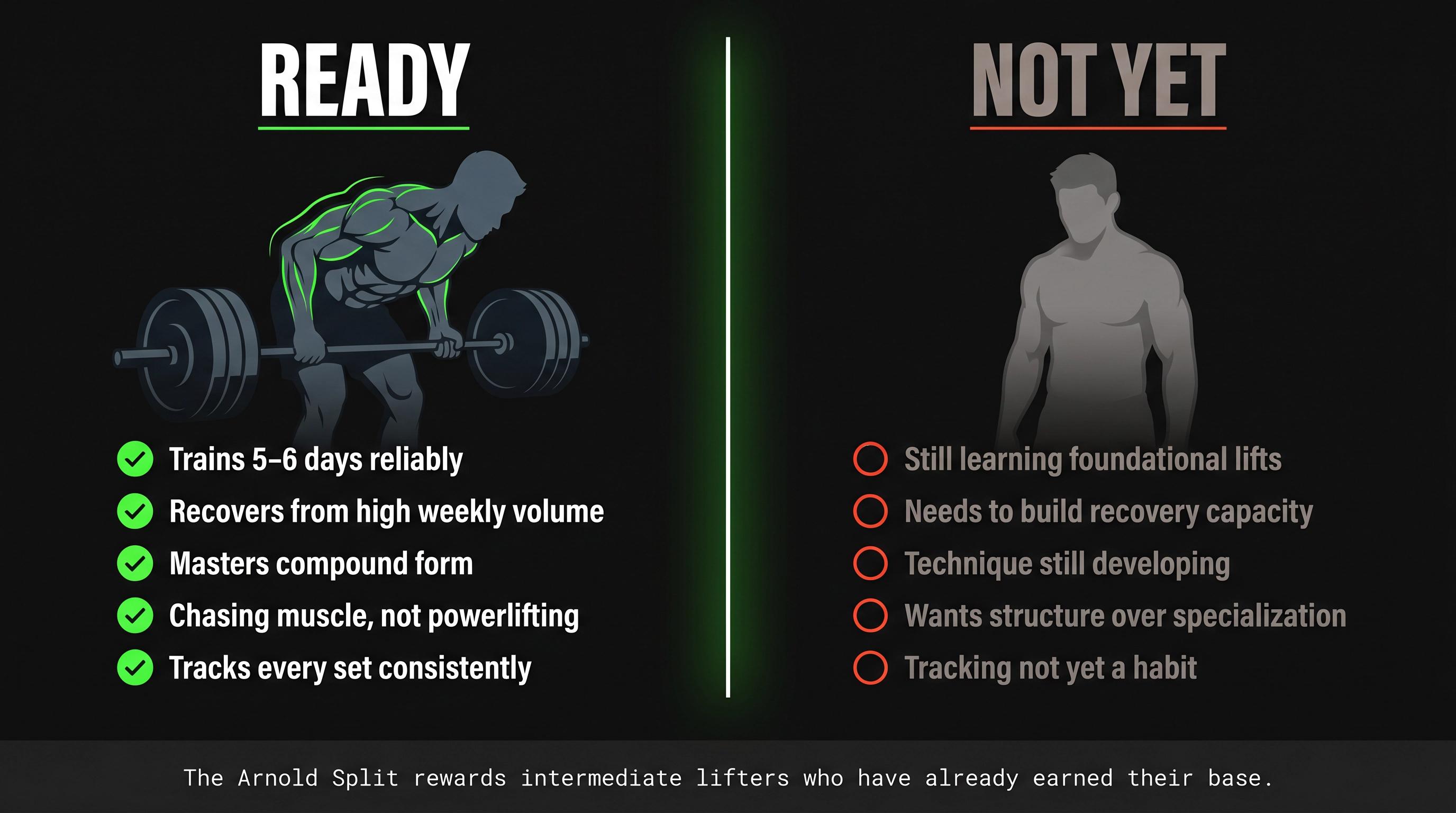
Do not start here if you're a complete beginner. A 3-day full-body program or a 4-day upper/lower split will build skill, strength, and lifting consistency faster with far less accumulated fatigue. As we cover in our strength-building guide, the fundamentals — progressive overload, specificity, recovery, and consistency — matter more than the complexity of any split. (Stronger)
If you've been training consistently for at least a year, can execute major compound lifts with solid technique, and want more bodybuilding volume with a specific emphasis on arms and shoulders, the Arnold split is an excellent choice.
Why the Arnold Split Works
Why Twice-Per-Week Training Builds More Muscle
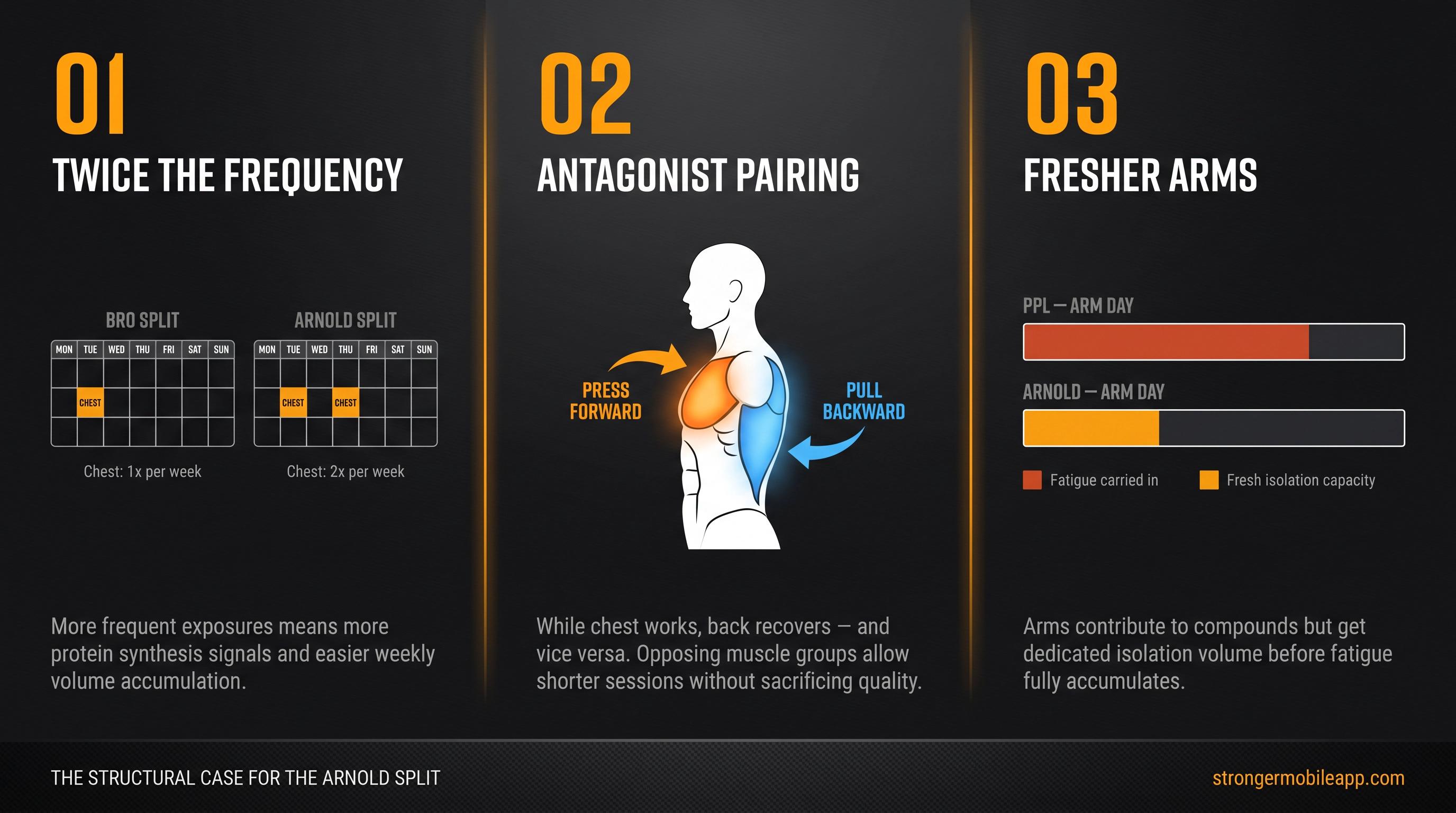
The classic bro split trains each muscle group once per week in a dedicated high-volume session. The Arnold split trains each major area twice per week. This means more frequent practice on key lifts, more chances to accumulate quality weekly volume, and more regular protein synthesis stimulation.
Twice-per-week training is not magic — what matters is the total quality work distributed across the week, not the number itself. But the structure makes it much easier to reach sufficient weekly volume without cramming 20 sets of chest into a single session where fatigue undermines the quality of your later sets.
Why Train Chest and Back on the Same Day?
Pressing and pulling movements use opposing muscle groups. A bench press moves the upper arm forward; a row or pulldown pulls it back. That makes chest and back ideal partners for antagonist supersets — pairing a press with a row or a pulldown.
Supersets are optional, not mandatory. The real benefit is that while your chest is working, your back is recovering, which can reduce total session time without cutting into quality. For deeper context on what actually drives muscle growth, our compound exercises guide breaks down why mechanical tension — consistent, hard effort on multi-joint movements with full range of motion and progressive loading — is what matters most, with "the pump" better understood as a useful byproduct than the primary driver. Current evidence continues to place mechanical tension at the center of the hypertrophy process. (ScienceDirect)
Benefits of a Dedicated Arm and Shoulder Day
In a push/pull/legs split, triceps finish a push day after already contributing to chest pressing and shoulder pressing, and biceps finish a pull day after helping on rows and pulldowns. That can work perfectly well. But it means arms arrive at their isolation work partially fatigued.
In the Arnold split, the shoulders and arms day comes after chest and back, not during it. Arms have contributed to the previous day's compound work, but they get dedicated isolation volume before their fatigue accumulates to the point of limiting quality. This is one of the main reasons the Arnold split has always been popular with lifters specifically chasing arm and shoulder development.
Why Consistency and Tracking Matter on This Split
Arnold's own modern training philosophy is not about endlessly changing programs. His Pump Club writing emphasizes follow-through, full movements, and doing a little more over time. (Arnold's Pump Club) That principle is exactly what makes a 6-day split work: repeated exposures on the same exercises, logged performance you can actually compare, and small, consistent increments of progress. The split punishes randomness and rewards systems.
The Biggest Problem with the Arnold Split
The problem is not the split itself. It's volume creep.
Plenty of Arnold Split routines online copy old-school professional bodybuilding volume directly. The result: eight to ten exercises per session, failure on every set, inadequate rest, six days of accumulating fatigue, and no real progression because recovery is always compromised. After three weeks, performance drops, joints ache, and most people conclude that the Arnold split "doesn't work for natural lifters."
The split works fine. The volume they copied doesn't.
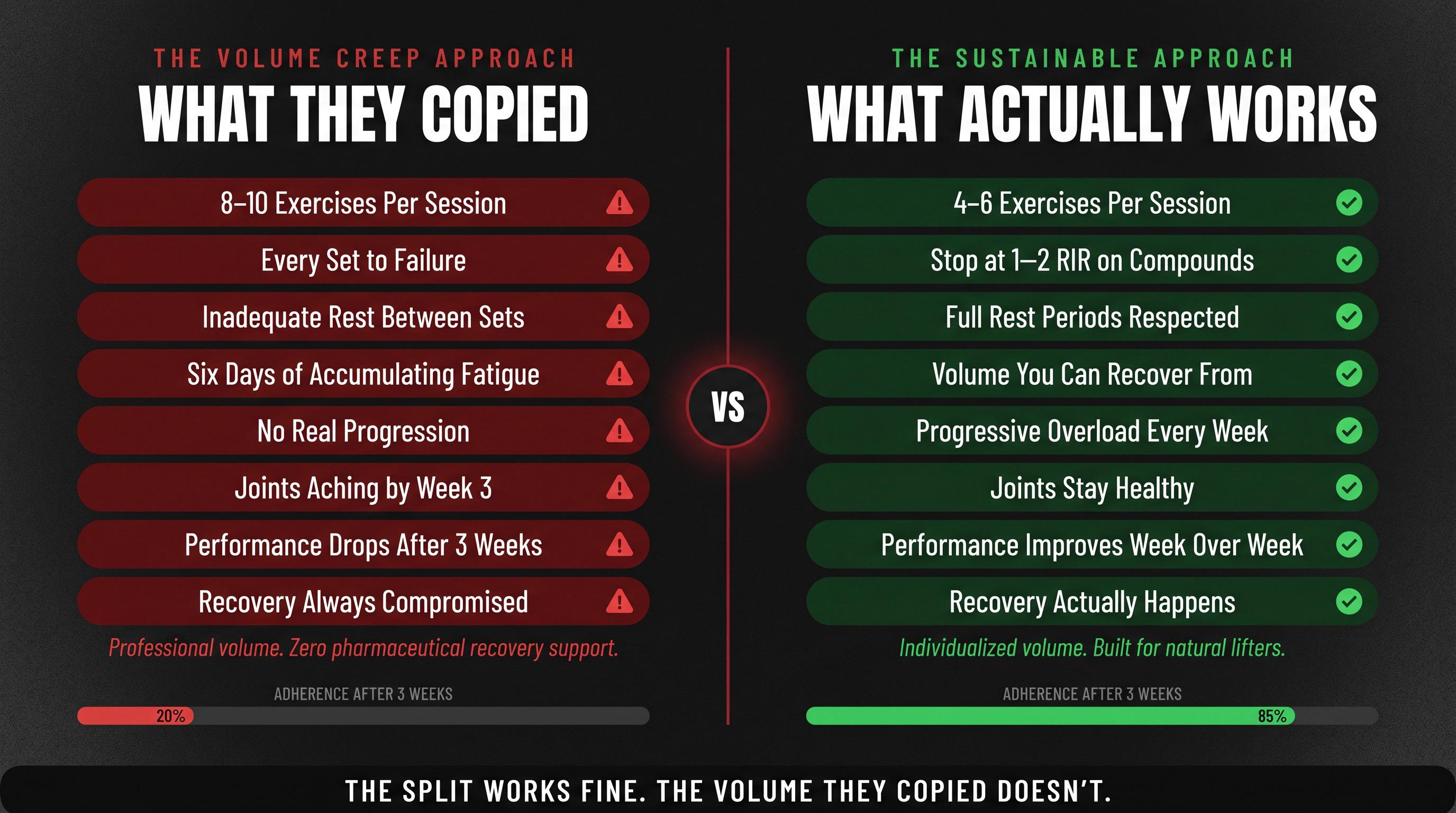
The ACSM's 2026 position stand is clear on this point: programs should be individualized for safety, enjoyment, and long-term adherence, and techniques like training to failure and advanced periodization are optional rather than essential for most healthy adults. (ACSM) If a program is too demanding to maintain, it loses its effectiveness — no matter how impressive it looks on paper.
The modern Arnold split should be hard. It should not feel like punishment. The version below is built around that principle.
Arnold Split Weekly Schedule and Volume Overview
This program uses two distinct workouts for each of the three training days. The A versions tend to be heavier and more compound-focused; the B versions lean into variation, different angles, and slightly higher rep ranges.
| Day | Focus | Main Emphasis |
|---|---|---|
| Day 1 | Chest + Back A | Horizontal pressing and heavy rowing |
| Day 2 | Shoulders + Arms A | Overhead press, side delts, biceps, triceps |
| Day 3 | Legs A | Squat-dominant lower body |
| Day 4 | Chest + Back B | Incline pressing, pulldowns, chest-supported back work |
| Day 5 | Shoulders + Arms B | Dumbbell/Arnold press, lateral delts, arm volume |
| Day 6 | Legs B | Hinge, glutes, hamstrings, unilateral legs |
| Day 7 | Rest | Recovery, mobility, light walking |
How Many Sets Per Muscle Group Each Week?
This program lands in a high-but-manageable hypertrophy range for most intermediate lifters. ACSM's 2026 guidance frames roughly 10 weekly sets per muscle group as a useful minimum target for hypertrophy, with advanced lifters often needing more than the minimum to continue progressing. (ACSM) Understanding rep ranges — how set and rep schemes interact with intensity — helps you make informed decisions about where to start and when to push volume higher.
The key is not chasing the highest possible set count — it's finding the maximum volume you can genuinely recover from and improve on week over week.
| Muscle Group | Direct Weekly Sets | Notes |
|---|---|---|
| Chest | 16–18 | Presses, dips or machine press, flyes |
| Back/lats | 16–18 | Rows, pulldowns, pull-ups, pullovers |
| Side/rear delts | 14–16 | Lateral raises, rear delt flyes, face pulls |
| Front delts | 6 direct + pressing overlap | Keep direct front-delt volume controlled |
| Biceps | 10–12 | Curl variations plus pulling overlap |
| Triceps | 10–12 | Extensions, pressdowns, close-grip/dip variation |
| Quads | 12–16 | Squats, leg press, split squats, extensions |
| Hamstrings | 9–12 | RDLs, leg curls, hinge variation |
| Glutes | 8–12 | Squats, RDLs, hip thrusts, split squats |
| Calves | 8 | Standing + seated calf work |
| Abs | 6 | Add more only if recovery and time allow |
Before we get to the daily workouts, two things every session shares: how hard to push and how long to rest.
How Hard Should Each Set Be?
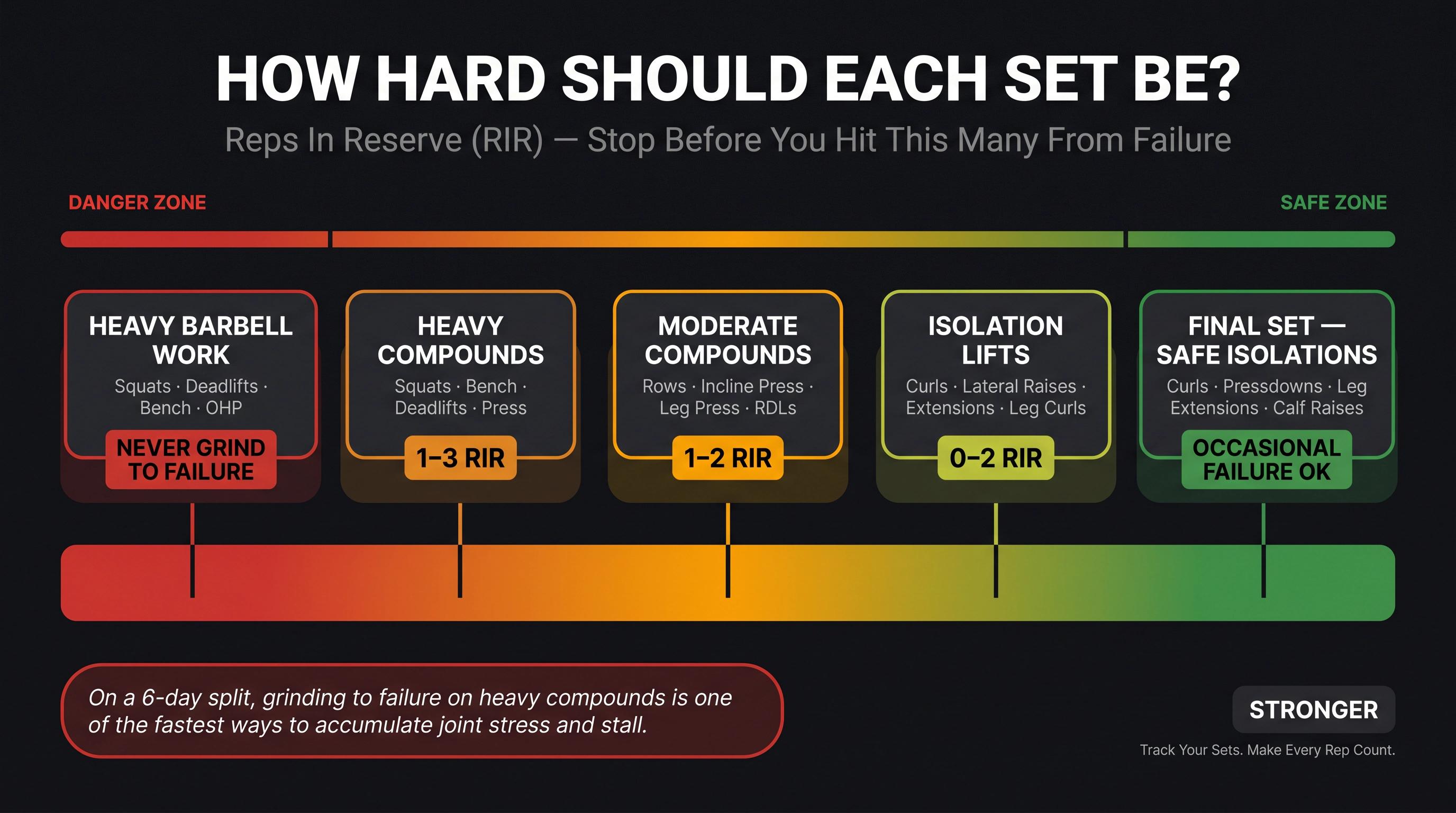
Use RIR — reps in reserve. RIR tells you how many reps you could still do before true muscular failure. A set with 2 RIR means you stop when you could have done 2 more.
| Set Type | Target Effort |
|---|---|
| Heavy compounds (squats, bench, deadlifts, overhead press) | Stop with 1–3 RIR — do not grind to failure |
| Moderate compounds (rows, incline presses, leg press, RDLs) | Stop with 1–2 RIR |
| Isolation lifts (curls, lateral raises, extensions, leg curls) | Stop with 0–2 RIR |
| Final set of safer isolation lifts | Occasional failure is acceptable |
| Heavy barbell work | Never grind to failure regularly |
On a six-day split, training to failure on heavy compound movements is one of the fastest ways to accumulate joint stress and stall. Save true failure for movements that are both easy to recover from and safe to miss: lateral raises, curls, pressdowns, leg extensions, leg curls, calf raises, and machine work.
How Long to Rest Between Sets
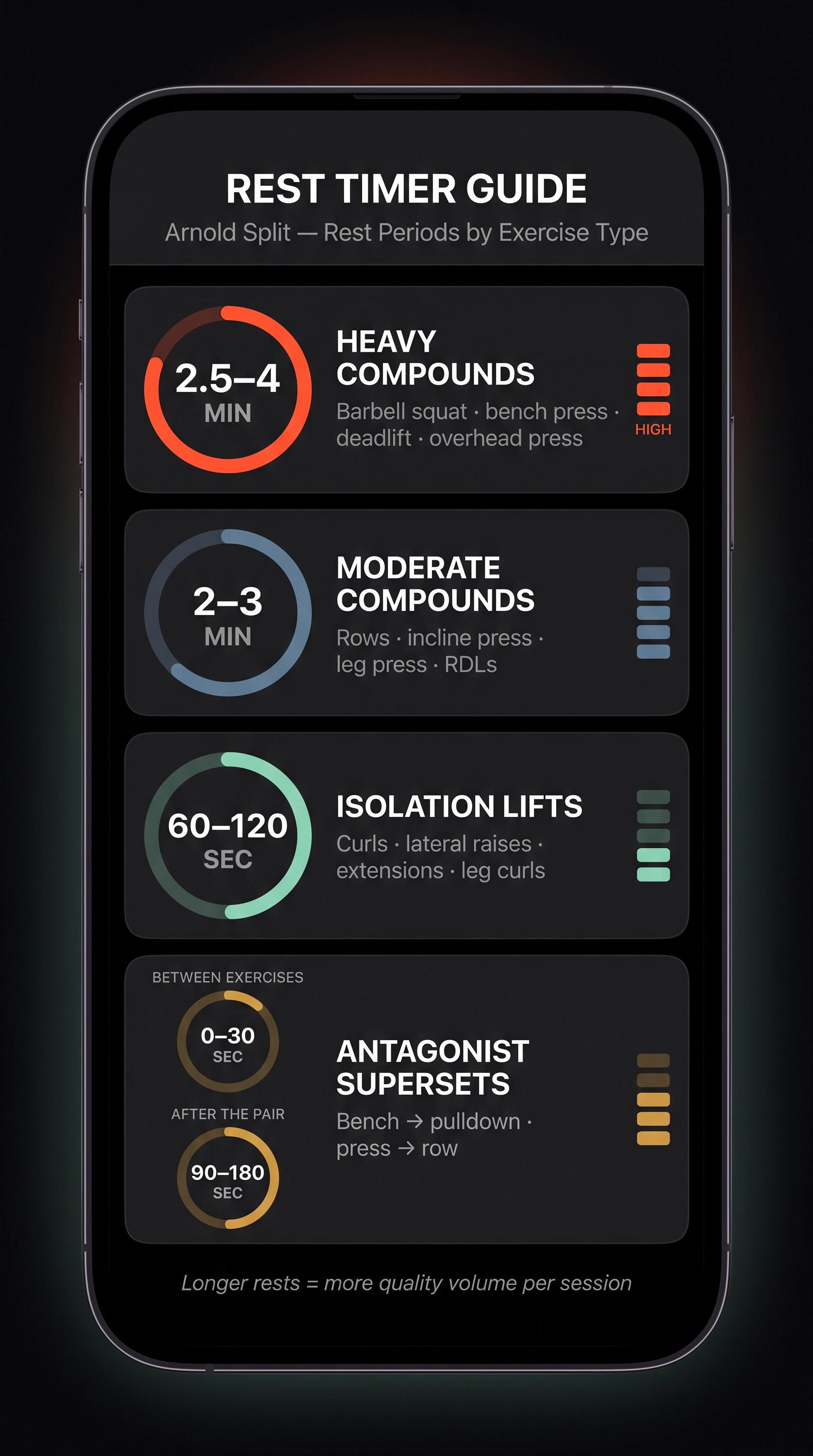
Rest is a training variable, not a waste of time. Cutting rest short reduces the load and reps available on your next set — which means your total quality volume drops even if the session feels harder. We cover this in detail in our rest periods guide. (Stronger)
| Exercise Type | Rest |
|---|---|
| Heavy squats, deadlifts, bench press, overhead press | 2.5–4 minutes |
| Rows, pull-ups, incline presses, leg press, RDLs | 2–3 minutes |
| Isolation lifts | 60–120 seconds |
| Antagonist supersets | 0–30 seconds between exercises, then 90–180 seconds after the pair |
Controlled research found better strength and hypertrophy outcomes with 3-minute rest intervals compared to 1-minute rests in resistance-trained men. This is not a license to scroll for five minutes between every set — it is a reminder that adequate rest is what makes your sets productive rather than just exhausting.
With those rules established, here is the complete program.
Ready to Get Stronger?
Join 2,000,000+ lifters tracking their workouts with Stronger. Available on iOS and Android.
Start tracking freeThe Complete 6-Day Arnold Split Workout Plan
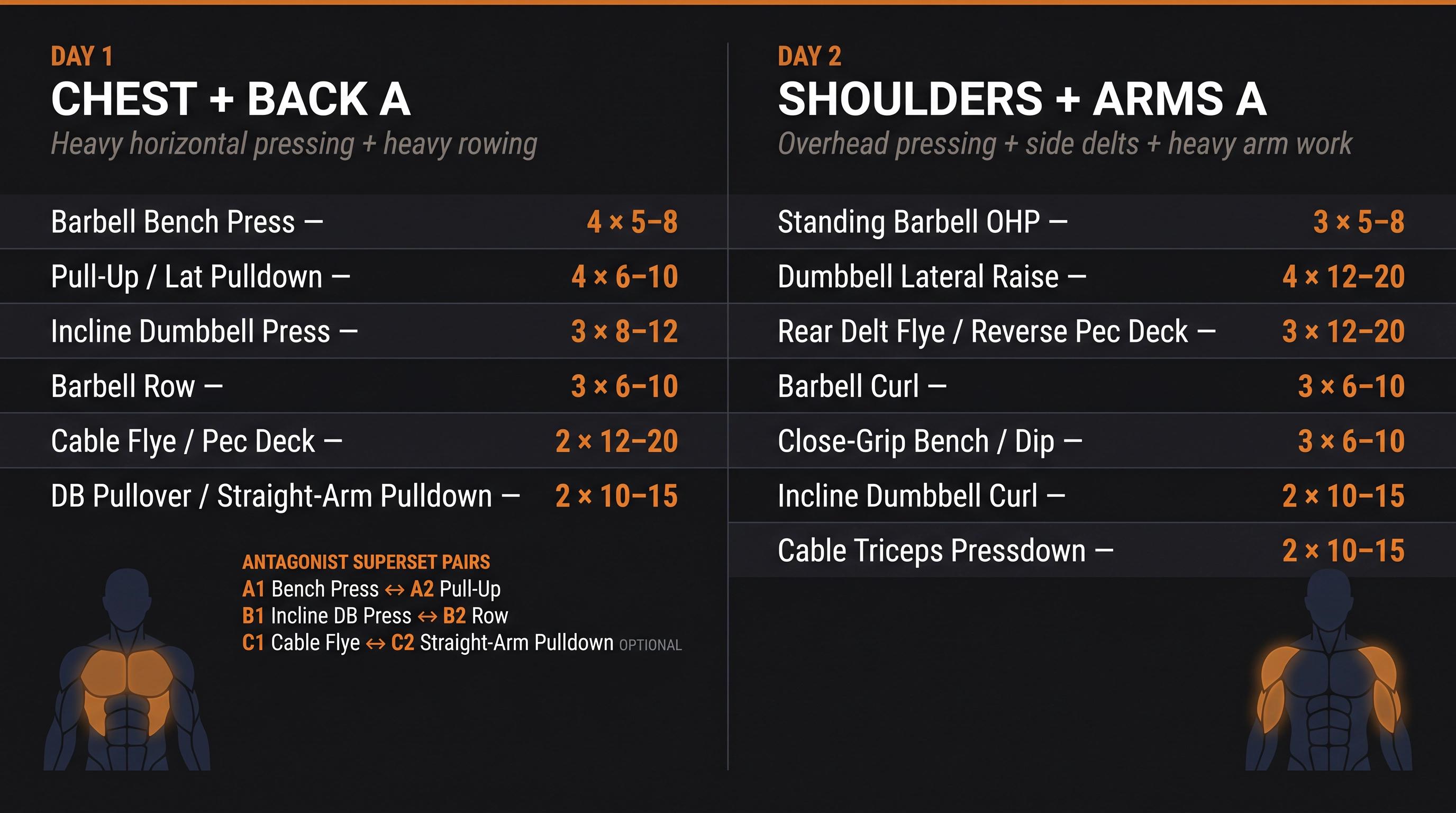
Day 1 — Chest + Back A
Goal: Heavy horizontal pressing, heavy rowing, and balanced chest/back volume.
| Exercise | Sets | Reps | Rest | Notes |
|---|---|---|---|---|
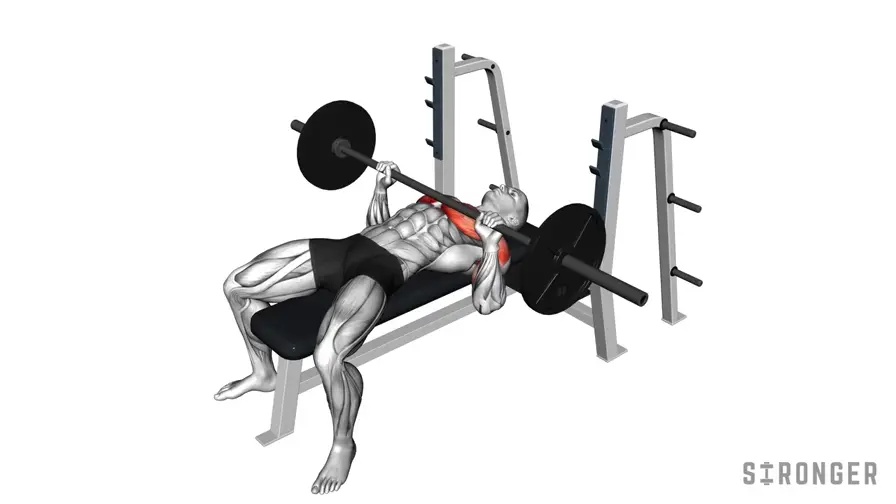
| Barbell bench press | 4 | 5–8 | 2.5–4 min | Main chest strength lift. Stop at 1–2 RIR. |
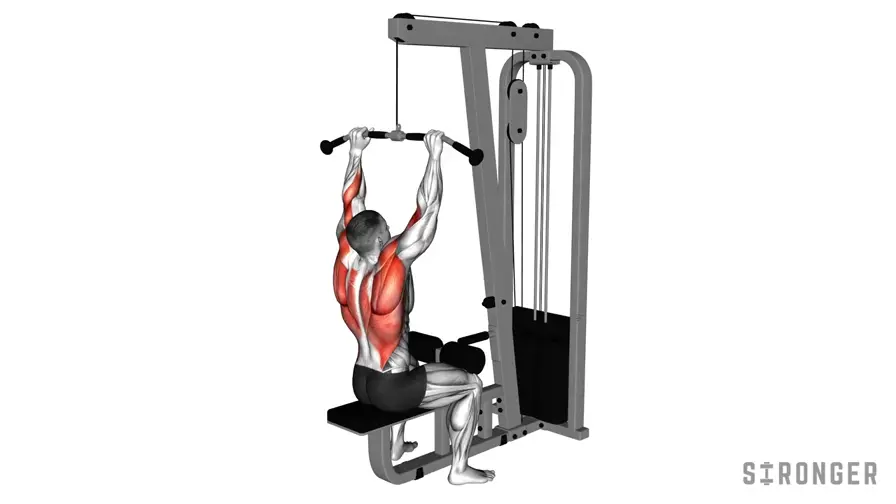
| Pull-up or lat pulldown | 4 | 6–10 | 2–3 min | Full stretch, controlled reps. |
| Incline dumbbell press | 3 | 8–12 | 2–3 min | Slight incline — don't let it become a shoulder press. |
| Barbell row or chest-supported row | 3 | 6–10 | 2–3 min | Use chest-supported if lower back fatigue builds. |
| Cable flye or pec deck | 2 | 12–20 | 60–120 sec | Deep stretch, controlled squeeze. |
| Dumbbell pullover or straight-arm pulldown | 2 | 10–15 | 60–120 sec | Keep ribs down; feel the lats, not the shoulders. |
For complete bench press technique — including setup, grip width, and how to fix common errors — see our bench press guide.
Optional antagonist superset structure (if you need to save time):
| Superset | Exercise 1 | Exercise 2 |
|---|---|---|
| A1/A2 | Bench press | Pull-up or pulldown |
| B1/B2 | Incline dumbbell press | Row |
| C1/C2 | Cable flye | Straight-arm pulldown |
For heavy bench and heavy rows, straight sets often produce better performance. Superset the moderate and isolation work first.
Day 2 — Shoulders + Arms A
Goal: Pressing strength, side delts, rear delts, and heavy arm work.
| Exercise | Sets | Reps | Rest | Notes |
|---|---|---|---|---|
| Standing barbell overhead press | 3 | 5–8 | 2.5–4 min | Brace hard. No grinding reps. |
| Dumbbell lateral raise | 4 | 12–20 | 60–120 sec | Lead with elbows; control the bottom range. |
| Reverse pec deck or rear delt cable flye | 3 | 12–20 | 60–120 sec | Rear delts need direct work — don't skip this. |
| Barbell curl | 3 | 6–10 | 90–150 sec | Strict form. No hip swing. |
| Close-grip bench press or assisted dip | 3 | 6–10 | 2–3 min | Pick the version your shoulders tolerate. |
| Incline dumbbell curl | 2 | 10–15 | 60–120 sec | Excellent lengthened biceps stimulus. |
| Cable triceps pressdown | 2 | 10–15 | 60–120 sec | Lock in elbows; avoid shoulder movement. |
Shoulder-friendly swaps:
| If This Bothers You | Use This Instead |
|---|---|
| Standing overhead press | Seated dumbbell press or machine shoulder press |
| Dips | Close-grip bench, machine dip, or cable pressdown |
| Barbell curl | EZ-bar curl or cable curl |
| Skull crushers | Overhead cable extension or rope pressdown |
Day 3 — Legs A
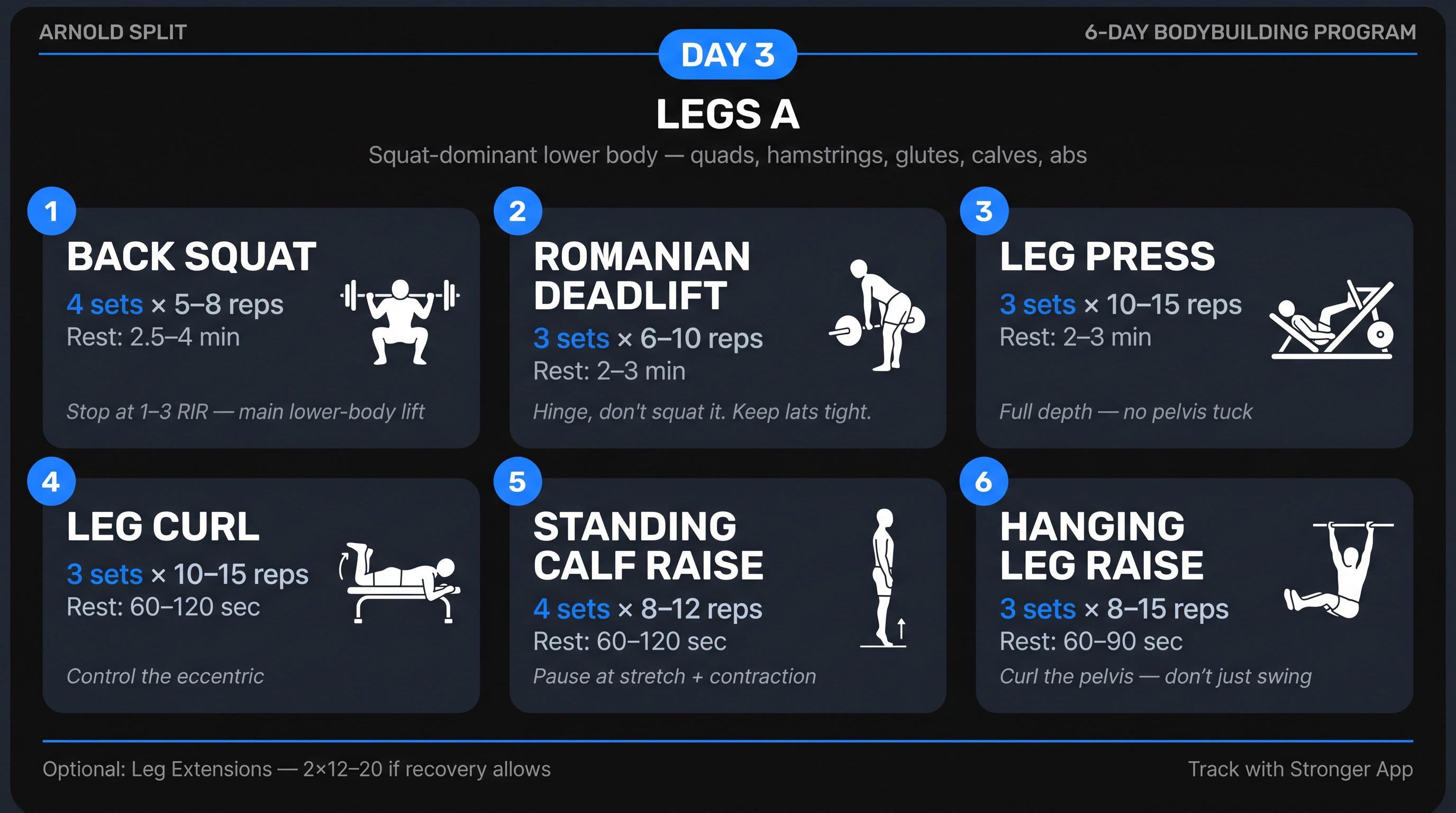
Goal: Squat-dominant leg training with quads, hamstrings, calves, and abs.
| Exercise | Sets | Reps | Rest | Notes |
|---|---|---|---|---|
| Back squat | 4 | 5–8 | 2.5–4 min | Main lower-body lift. Stop at 1–3 RIR. |
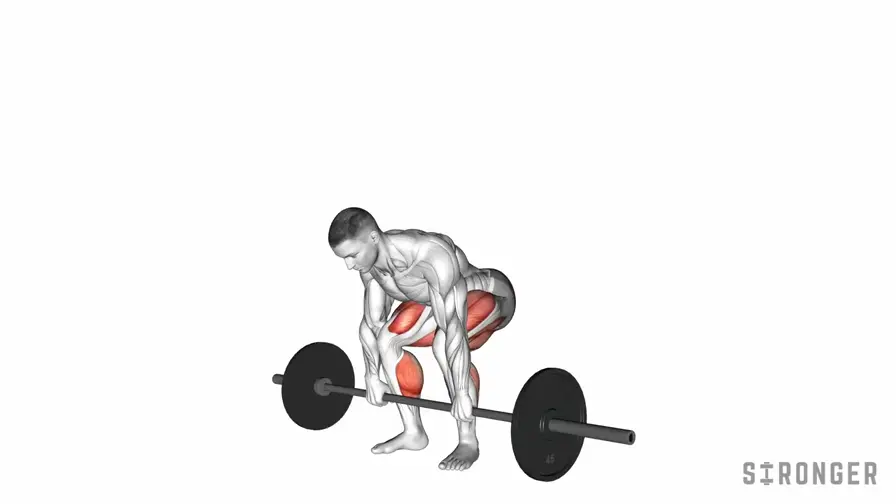
| Romanian deadlift | 3 | 6–10 | 2–3 min | Hinge, don't squat it. Keep lats tight. |
| Leg press | 3 | 10–15 | 2–3 min | Use full depth without the pelvis curling under. |
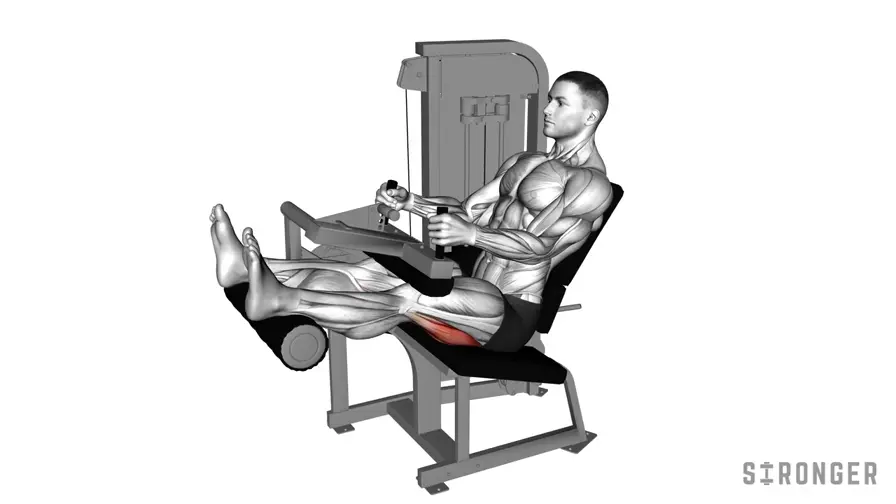
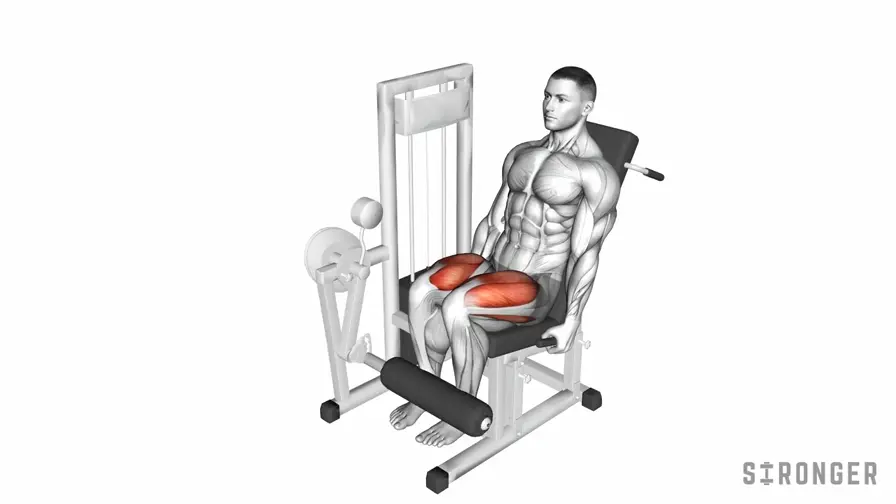
| Seated or lying leg curl | 3 | 10–15 | 60–120 sec | Control the eccentric. |
| Standing calf raise | 4 | 8–12 | 60–120 sec | Pause at the stretched and contracted positions. |
| Hanging leg raise or reverse crunch | 3 | 8–15 | 60–90 sec | Curl the pelvis; don't just swing your legs. |
Optional quad finisher: Leg extensions — 2 sets of 12–20 — only if your knees tolerate them and recovery is good.
Day 4 — Chest + Back B
Goal: Incline pressing, upper chest emphasis, back thickness, and vertical pulling.
| Exercise | Sets | Reps | Rest | Notes |
|---|---|---|---|---|
| Incline barbell bench press | 3 | 6–10 | 2.5–4 min | Moderate incline. Keep shoulder blades set. |
| Chest-supported row or T-bar row | 4 | 6–10 | 2–3 min | Heavy back work without excessive lower-back fatigue. |
| Dumbbell bench press or machine chest press | 3 | 8–12 | 2–3 min | Choose the version you can load cleanly. |
| Neutral-grip pulldown | 3 | 8–12 | 2–3 min | Pull elbows down, not just hands. |
| Cable crossover or pec deck | 2 | 12–20 | 60–120 sec | Bias the stretched position. |
| One-arm cable row | 2 | 10–15 each side | 60–120 sec | Use this to identify and fix left-right asymmetry. |
A note on deadlifts: Some classic versions of this program include deadlifts or heavy lower-back work on chest/back days. In this modern version, we manage lower-back fatigue more carefully — you're already squatting, rowing, hinging, and training six days per week. If you want to deadlift, move it to Legs B, keep it to 2–3 hard sets, and remove another hinge movement to compensate. See our deadlift guide for technique guidance and loading strategies.
Day 5 — Shoulders + Arms B
Goal: Delt size, arm volume, and bodybuilding-style pump work.
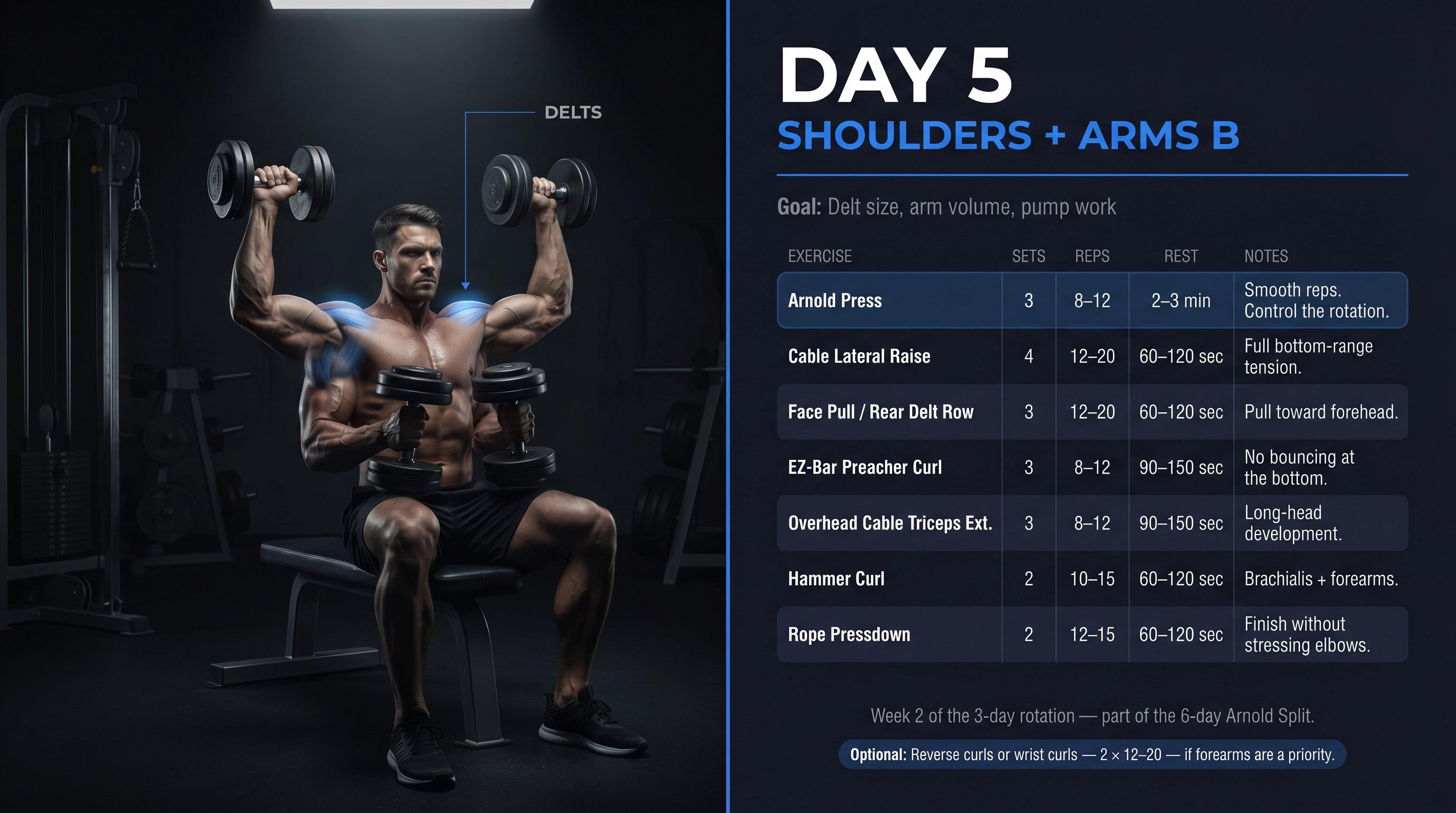
| Exercise | Sets | Reps | Rest | Notes |
|---|---|---|---|---|
| Seated dumbbell press or Arnold press | 3 | 8–12 | 2–3 min | Smooth reps. Don't chase max weight on this one. |
| Cable lateral raise | 4 | 12–20 | 60–120 sec | Cable keeps tension through the full bottom range. |
| Face pull or rear delt row | 3 | 12–20 | 60–120 sec | Pull toward your forehead or upper chest. |
| EZ-bar preacher curl | 3 | 8–12 | 90–150 sec | Stable upper arm — no bouncing at the bottom. |
| Overhead cable triceps extension | 3 | 8–12 | 90–150 sec | Excellent long-head triceps development. |
| Hammer curl | 2 | 10–15 | 60–120 sec | Brachialis and forearms. |
| Rope pressdown | 2 | 12–15 | 60–120 sec | Finish triceps without hammering the elbows. |
Optional forearm work: Reverse curls or wrist curls — 2 sets of 12–20 — if forearms are a priority. Skip them if elbows feel beat up at this point in the week.
Day 6 — Legs B
Goal: Hinge emphasis, glutes, hamstrings, unilateral leg work, calves, and abs.
| Exercise | Sets | Reps | Rest | Notes |
|---|---|---|---|---|
| Hack squat, front squat, or safety-bar squat | 3 | 6–10 | 2.5–4 min | Less spinal load than a second heavy back squat. |
| Hip thrust or barbell glute bridge | 3 | 8–12 | 2–3 min | Lock ribs down; pause at the top. |
| Bulgarian split squat | 2–3 | 8–12 each side | 2–3 min | Brutal but effective. Keep every rep controlled. |
| Leg extension | 2–3 | 12–20 | 60–120 sec | Quad isolation without loading the spine. |
| Seated leg curl | 3 | 10–15 | 60–120 sec | Complements RDLs from Day 3 nicely. |
| Seated calf raise | 4 | 12–20 | 60–120 sec | Biases the soleus more than standing raises. |
| Cable crunch | 3 | 10–15 | 60–90 sec | Add load progressively over time. |
If you want to deadlift, use this substitute structure for Day 6 instead:
| Exercise | Sets | Reps |
|---|---|---|
| Deadlift or trap-bar deadlift | 2–3 | 3–5 |
| Hack squat or leg press | 3 | 8–12 |
| Seated leg curl | 3 | 10–15 |
| Bulgarian split squat | 2 | 8–12 each side |
| Calf raise | 4 | 10–20 |
| Cable crunch | 3 | 10–15 |
Don't max out deadlifts on a six-day bodybuilding split. Treat them as a heavy hinge movement, not a weekly ego test.
Day 7 — Rest and Recovery
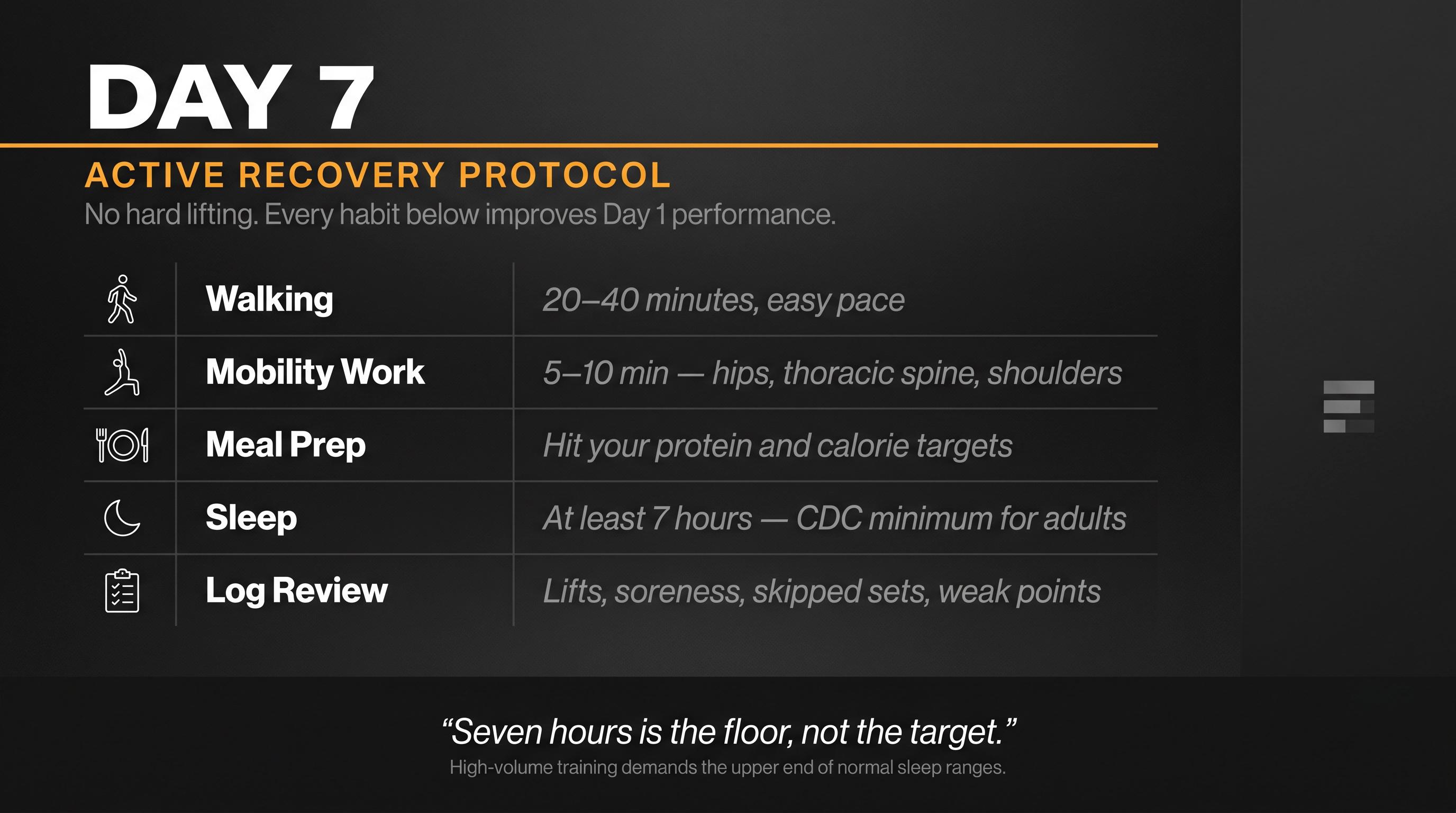
Rest does not mean sitting completely still. It means no hard lifting. These recovery habits will directly improve your performance on Day 1 of the next rotation:
| Recovery Habit | Target |
|---|---|
| Walking | 20–40 minutes, easy pace |
| Mobility work | 5–10 minutes for hips, thoracic spine, and shoulders |
| Meal prep | Make it easier to hit your protein and calorie targets |
| Sleep | At least 7 hours — CDC guidance for adults (CDC) |
| Logging review | Check your lifts, soreness, skipped sets, and weak points |
High-volume lifters frequently need the upper end of normal sleep ranges. Seven hours is the floor, not the target.
How to Progress on the Arnold Split
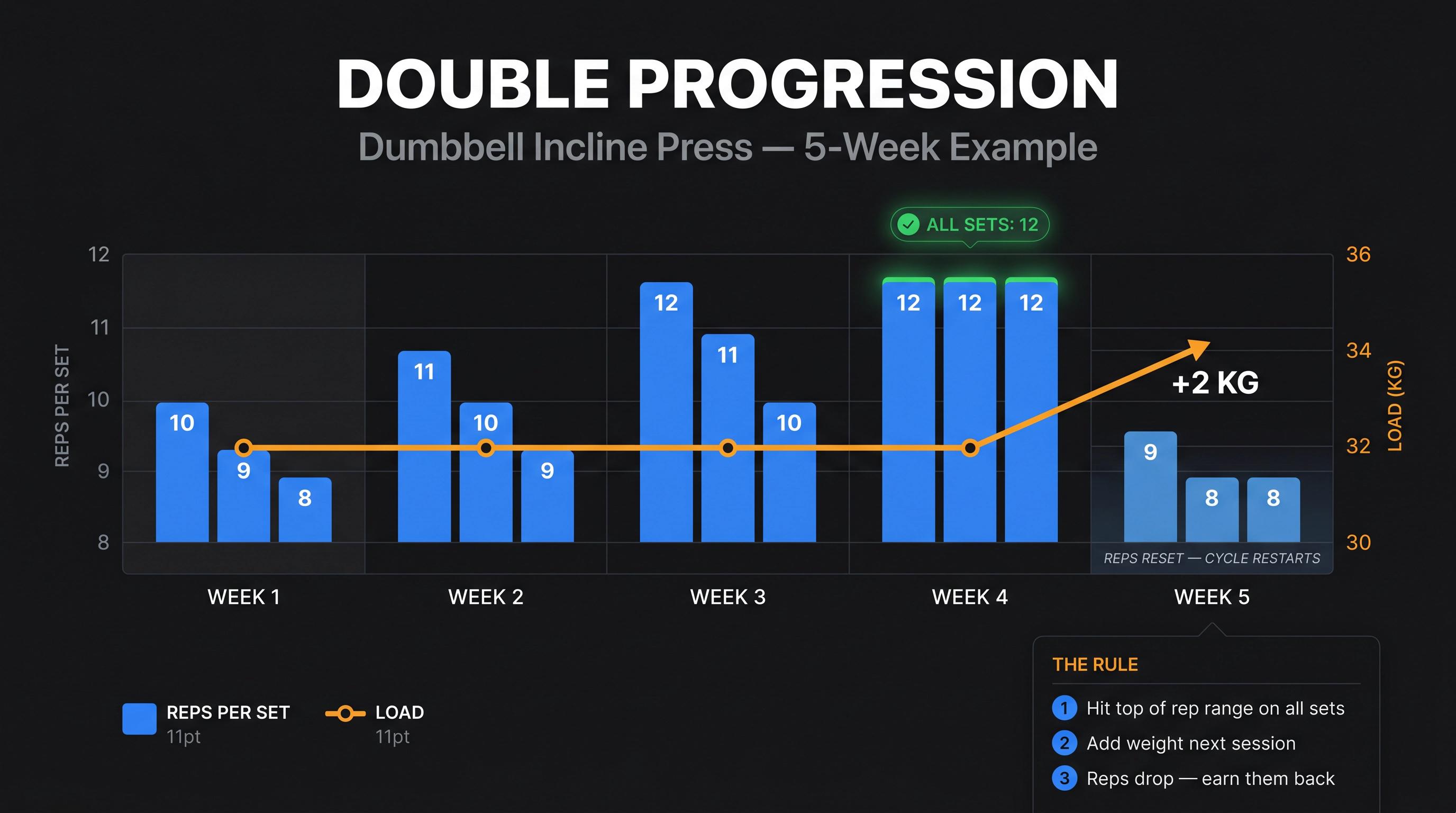
Double Progression: The Simplest Method
Double progression is the most reliable approach for this program. Here's how it works:
- Pick a rep range — for example, 8–12.
- Use the same weight until you can hit the top of that range on all working sets with good form.
- Add weight next session.
- Your reps will drop back toward the bottom of the range.
- Repeat.
Here's what that looks like in practice:
| Week | Dumbbell Incline Press |
|---|---|
| Week 1 | 32 kg × 10, 9, 8 |
| Week 2 | 32 kg × 11, 10, 9 |
| Week 3 | 32 kg × 12, 11, 10 |
| Week 4 | 32 kg × 12, 12, 12 |
| Week 5 | 34 kg × 9, 8, 8 |
That is real, measurable progress. No new exercise. No "shocking the muscle." No elaborate periodization scheme. Just consistent, tracked, incremental overload.
Progression Rules by Exercise Type
| Exercise Type | Progression Rule |
|---|---|
| Heavy barbell lifts | Add weight when all sets hit the top of the rep range with 1–2 RIR |
| Dumbbell compounds | Add reps first; add weight when jumps are manageable |
| Cable and machine work | Add reps, then small weight increases |
| Lateral raises | Progress slowly; cleaner reps beat heavier cheating |
| Pull-ups | Add reps until you can do 10+ clean reps, then add a load |
| Abs and calves | Add reps first, then load, then pauses |
What Counts as Progress?
Progress is not limited to adding weight to the bar. On a demanding six-day program, progress can look like:
| Progress Type | Example |
|---|---|
| More load | 100 kg bench for 8 reps instead of 95 kg |
| More reps | 100 kg bench for 9 reps instead of 8 |
| More sets | 3 hard sets instead of 2 on a lagging muscle group |
| Better form | Same load with deeper range of motion |
| Better control | Slower eccentric, cleaner pause, less momentum |
| Better recovery | Same performance with less soreness and fatigue |
| Better consistency | Completing all 6 workouts for 8 consecutive weeks |
As we explain in our progressive overload guide, overload can mean adding weight, adding reps, adding sets, or improving the quality of execution — all of it counts. (Stronger)
How Long to Run the Arnold Split (and When to Deload)
How Long Should You Run the Arnold Split?
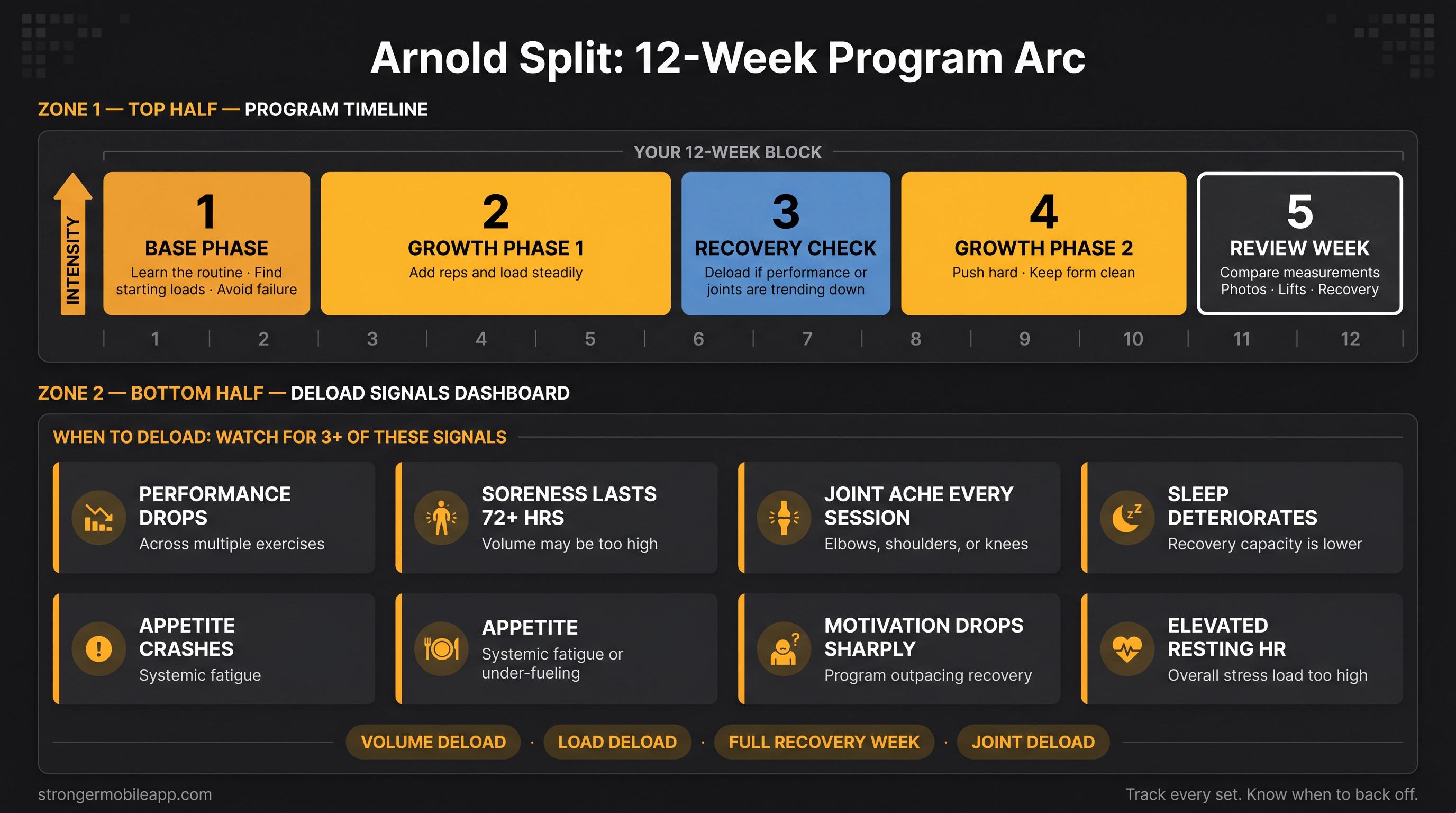
Run this program for 8–12 weeks before drawing any conclusions. That window gives you enough time to learn the routine, hit consistent progression, and generate a meaningful data set.
| Phase | Weeks | Goal |
|---|---|---|
| Base phase | 1–2 | Learn the routine, find starting loads, avoid failure |
| Growth phase | 3–6 | Add reps and load steadily |
| Recovery check | 7 | Deload if performance or joints are trending down |
| Growth phase 2 | 8–11 | Push hard but keep form clean |
| Review week | 12 | Compare measurements, photos, lifts, and recovery |
A word on expectations: in an 8–12 week block, realistic fat-free mass gains for most resistance-trained lifters are modest — often in the range of 1–2 kg, with gains generally slowing as training experience increases. (ScienceDirect) Advanced lifters may gain less; newer intermediate lifters may gain more. Body composition changes depend heavily on food intake, sleep quality, stress, and consistency. The goal of the program review at week 12 is to evaluate your actual trajectory, not to compare against some ideal outcome.
When to Take a Deload
Deload when recovery is clearly trending downward — not just because one workout felt hard. Take a deload week if you notice three or more of these signals persisting for a full week:
| Recovery Signal | What It Suggests |
|---|---|
| Performance drops across multiple exercises | Accumulated fatigue exceeding recovery capacity |
| Soreness lasting more than 72 hours | Volume may be too high |
| Elbows, shoulders, or knees ache every session | Joint stress is accumulating |
| Sleep quality deteriorates | Recovery capacity is lower than usual |
| Appetite crashes or becomes unpredictable | Systemic fatigue or under-fueling |
| Motivation drops sharply | Program may be outpacing recovery |
| Resting heart rate is unusually elevated | Overall stress load may be too high |
How to Deload on the Arnold Split
| Deload Style | How to Do It |
|---|---|
| Volume deload | Keep weights similar, cut sets by 40–50% |
| Load deload | Keep exercises, reduce load by 10–20% |
| Full recovery week | Train 3 easy full-body sessions instead of 6 days |
| Joint deload | Swap barbells for machines and cables for one week |
The simplest version: keep the same exercises, keep reps clean, stop every set 3–4 reps from failure, and cut every exercise to 1–2 work sets. One week of this, then get back to training.
Nutrition and Recovery for the Arnold Split
A six-day bodybuilding program does not work well on random nutrition. You are training almost every day — fuel it accordingly.
Protein: What You Actually Need
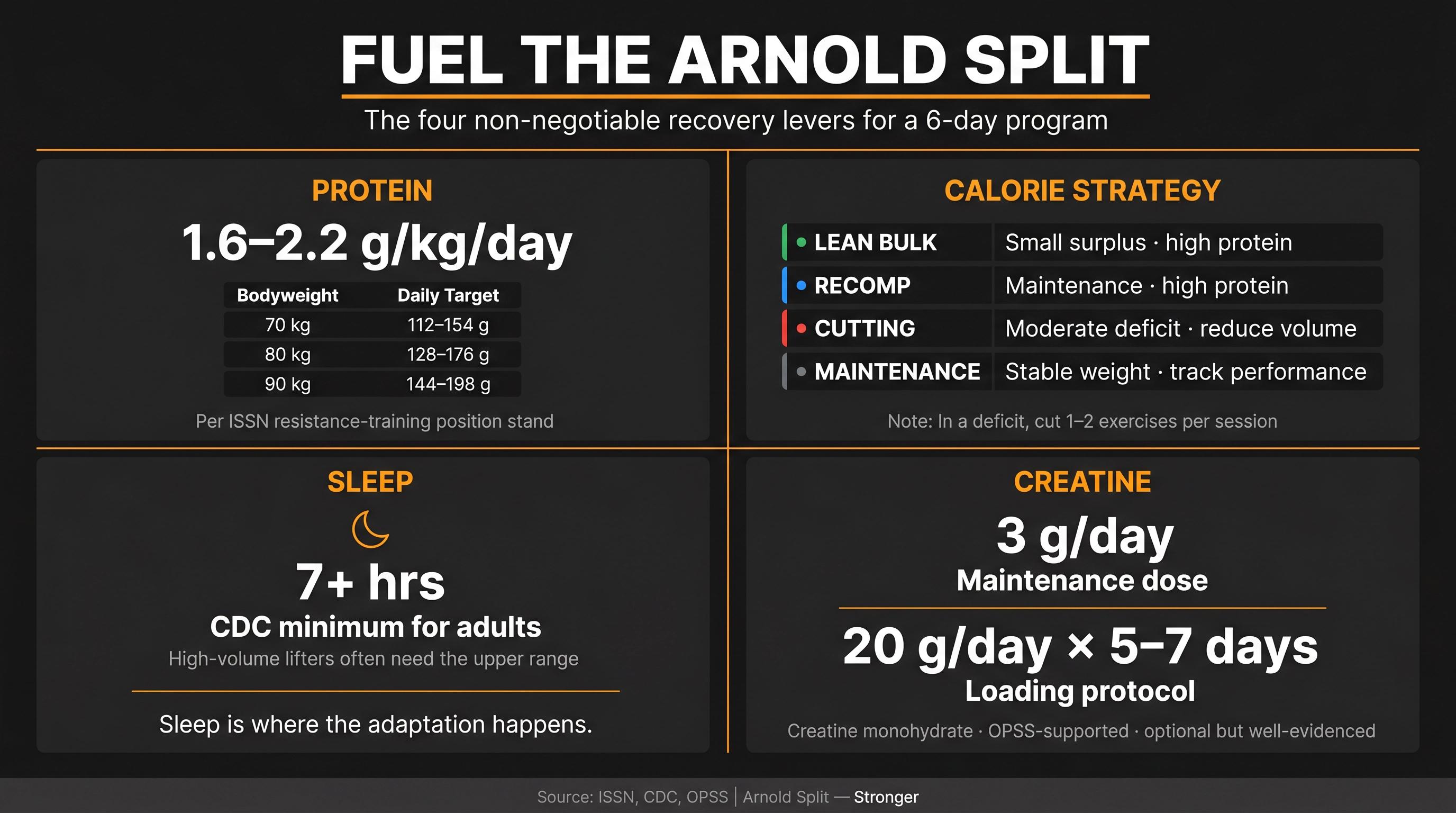
A practical target for most resistance-trained lifters trying to build or maintain muscle is 1.6–2.2 g of protein per kilogram of bodyweight per day. The ISSN's protein position stand has placed the sufficient range at 1.4–2.0 g/kg/day for exercising individuals, while a 2025 review focused on resistance-trained athletes found that the higher end of this range — around 1.6–2.2 g/kg/day — tends to be associated with better hypertrophy and strength outcomes. (PubMed)
| Bodyweight | Protein Target |
|---|---|
| 60 kg | 96–132 g/day |
| 70 kg | 112–154 g/day |
| 80 kg | 128–176 g/day |
| 90 kg | 144–198 g/day |
| 100 kg | 160–220 g/day |
How Many Calories Do You Need on the Arnold Split?
| Goal | Nutrition Direction |
|---|---|
| Lean bulk | Small calorie surplus, high protein, enough carbs to train hard |
| Recomposition | Maintenance calories or slight deficit, high protein |
| Cutting | Moderate deficit, high protein, reduce training volume slightly |
| Maintenance | Stable bodyweight, focus on performance and measurements |
If you're cutting, do not run the highest-volume version of this program. Reduce each session by 1–2 exercises, or cut most exercises by one set. The goal in a deficit is to maintain muscle and strength, not to hit personal volume records.
Carbohydrates are not mandatory for muscle gain, but they make this split significantly easier to perform. Putting the majority of your carbs around training sessions and earlier in the day usually helps session quality.
Sleep: The Underrated Recovery Tool
Sleep is where the adaptation happens. CDC data establishes that adults need at least 7 hours of sleep per 24-hour period, and high-volume lifters often need the upper end of the normal adult range to recover effectively. (CDC) Treating sleep as optional is one of the fastest ways to make a six-day program feel unsustainable.
Creatine: Worth It?
Creatine monohydrate is optional but very well-supported. OPSS — the U.S. Department of Defense supplement safety resource — notes that creatine monohydrate may support short, high-intensity performance and strength, with evidence supporting 3 g/day as safe and effective for maintenance, and 20 g/day for 5–7 days as a loading protocol. (opss.org) It's one of the most researched supplements in existence. If you're going to use anything beyond food, creatine is the right call.
Exercise Substitutions for the Arnold Split
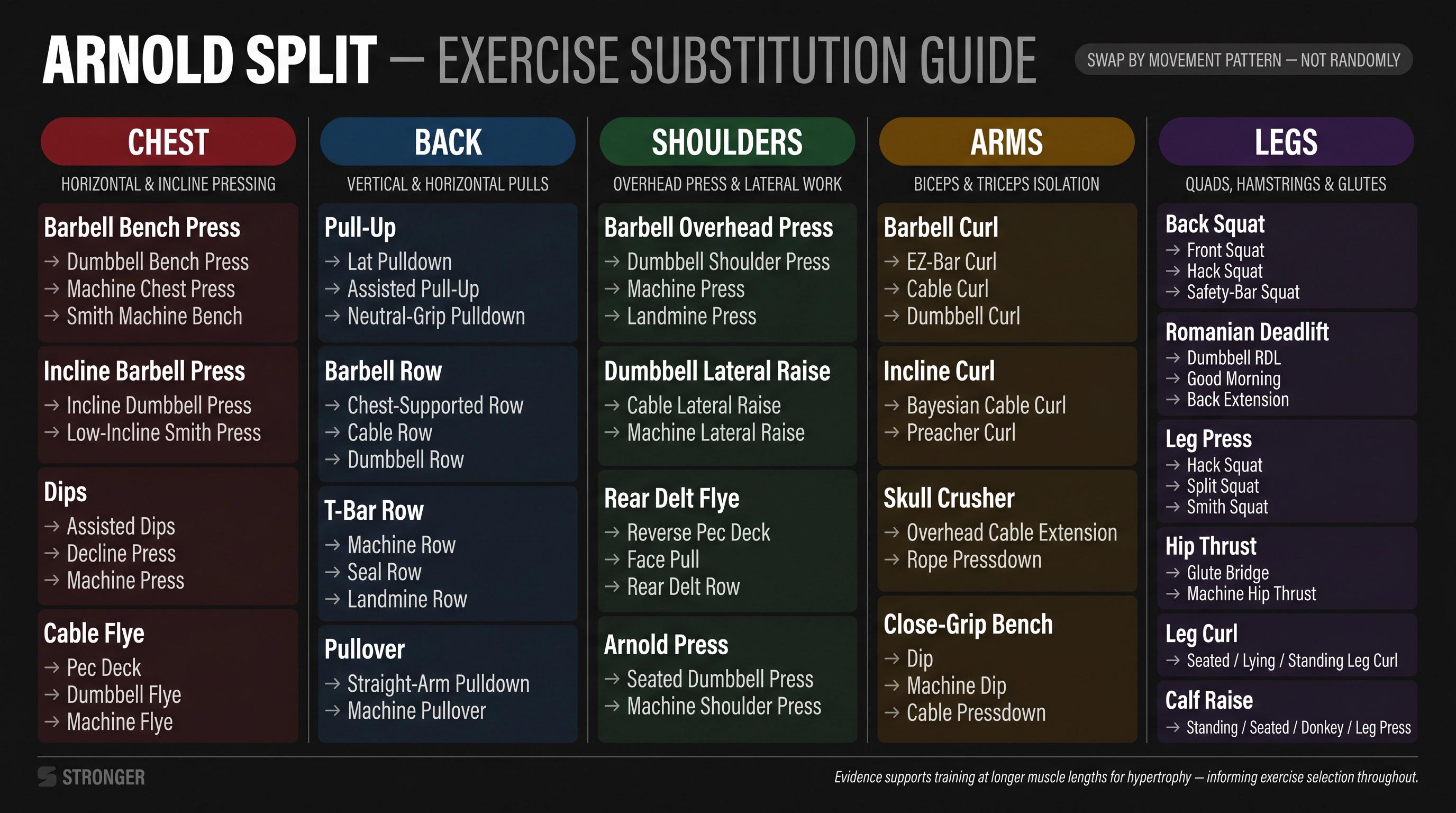
The program should fit your body and your gym. Swap exercises by movement pattern — not randomly.
Chest Substitutions
Browse our full chest exercise library for additional options. Common swaps:
| Main Exercise | Swap Options |
|---|---|
| Barbell bench press | Dumbbell bench press, machine chest press, Smith machine bench |
| Incline barbell press | Incline dumbbell press, low-incline Smith press |
| Dips | Assisted dips, decline press, machine press |
| Cable flye | Pec deck, dumbbell flye, machine flye |
Back Substitutions
Browse our full back exercise library for more options:
| Main Exercise | Swap Options |
|---|---|
| Pull-up | Lat pulldown, assisted pull-up, neutral-grip pulldown |
| Barbell row | Chest-supported row, cable row, dumbbell row |
| T-bar row | Machine row, seal row, landmine row |
| Pullover | Straight-arm pulldown, machine pullover |
Shoulder Substitutions
Browse our full shoulder exercise library for more options:
| Main Exercise | Swap Options |
|---|---|
| Barbell overhead press | Dumbbell shoulder press, machine press, landmine press |
| Dumbbell lateral raise | Cable lateral raise, machine lateral raise |
| Rear delt flye | Reverse pec deck, face pull, rear delt row |
| Arnold press | Seated dumbbell press, machine shoulder press |
Arm Substitutions
| Main Exercise | Swap Options |
|---|---|
| Barbell curl | EZ-bar curl, cable curl, dumbbell curl |
| Incline curl | Bayesian cable curl, preacher curl |
| Skull crusher | Overhead cable extension, rope pressdown |
| Close-grip bench | Dip, machine dip, cable pressdown |
Leg Substitutions
| Main Exercise | Swap Options |
|---|---|
| Back squat | Front squat, hack squat, safety-bar squat |
| Romanian deadlift | Dumbbell RDL, good morning, back extension |
| Leg press | Hack squat, split squat, Smith squat |
| Hip thrust | Glute bridge, machine hip thrust |
| Leg curl | Seated, lying, or standing leg curl |
| Calf raise | Standing, seated, donkey, or leg press calf raise |
A note on exercise selection: a 2025–2026 systematic review on resistance training suggests that training at longer muscle lengths may be superior for hypertrophy, though the evidence remains mixed. (ScienceDirect) This is one rationale behind including exercises like incline curls, overhead triceps extensions, RDLs, cable flyes, and deep squat patterns in the program — they train target muscles at longer lengths where evidence suggests a potential advantage.
Arnold Split vs. Push/Pull/Legs
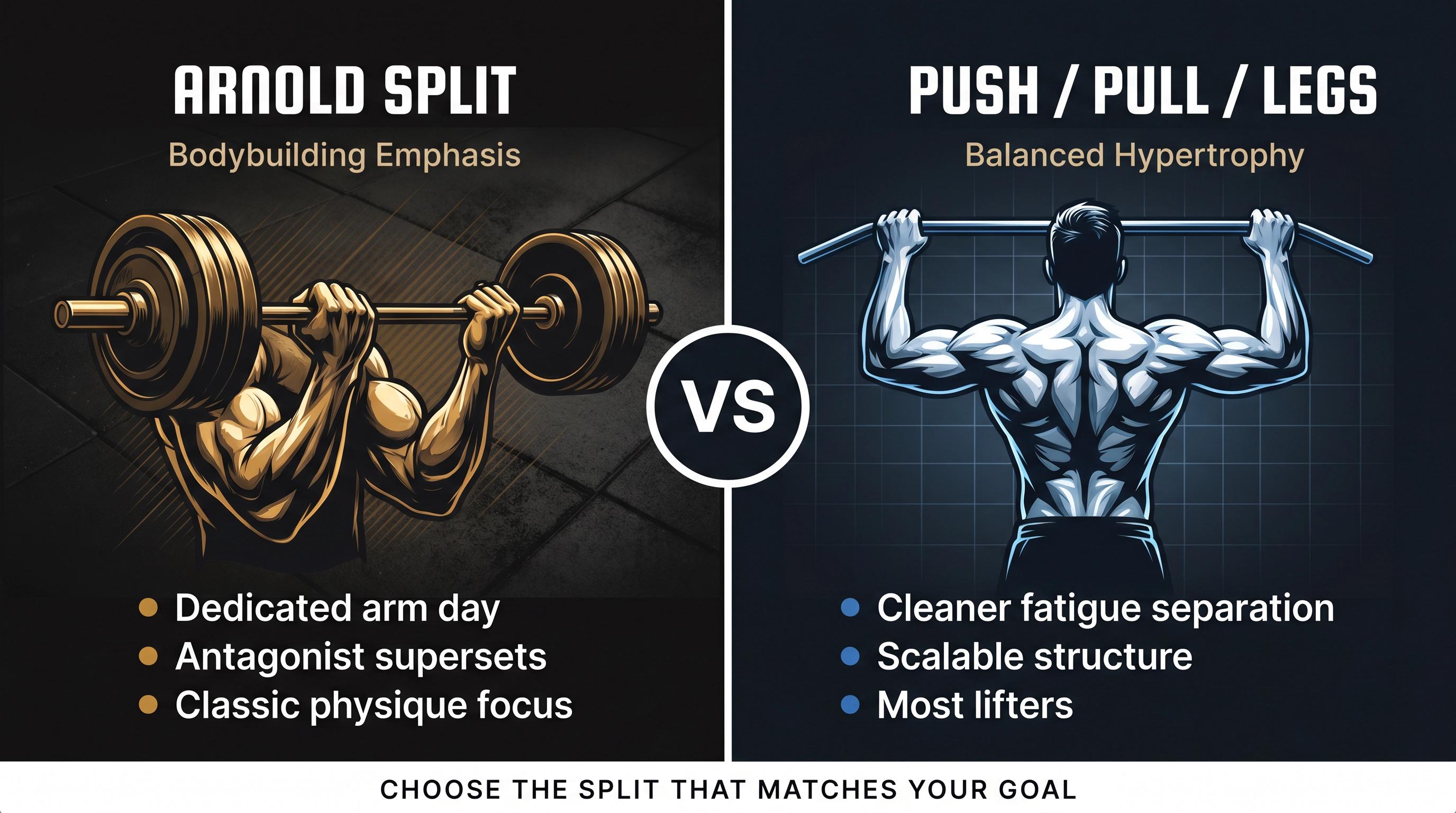
| Factor | Arnold Split | Push/Pull/Legs |
|---|---|---|
| Weekly structure | Chest/back, shoulders/arms, legs | Push, pull, legs |
| Best for | Bodybuilding, arm/shoulder emphasis, classic physique | Balanced hypertrophy, strength, cleaner recovery |
| Arm training | Dedicated arm day, fresher than after compounds | Arms come after compound push/pull work |
| Antagonist supersets | Excellent for chest/back and biceps/triceps pairings | Less natural for antagonist supersets |
| Recovery | More overlap between pressing, delts, triceps, and arms | Generally cleaner fatigue management |
| Best user | Intermediate/advanced lifter with bodybuilding goals | Most lifters wanting a scalable 6-day structure |
The Arnold split is not automatically better than PPL. It's more specialized. Choose it if you enjoy the structure, want extra emphasis on arm and shoulder development, and recover well from six days of high-frequency lifting. Choose Push Pull Legs if you want a simpler split with cleaner fatigue separation between muscle groups.
Arnold Split vs. Bro Split
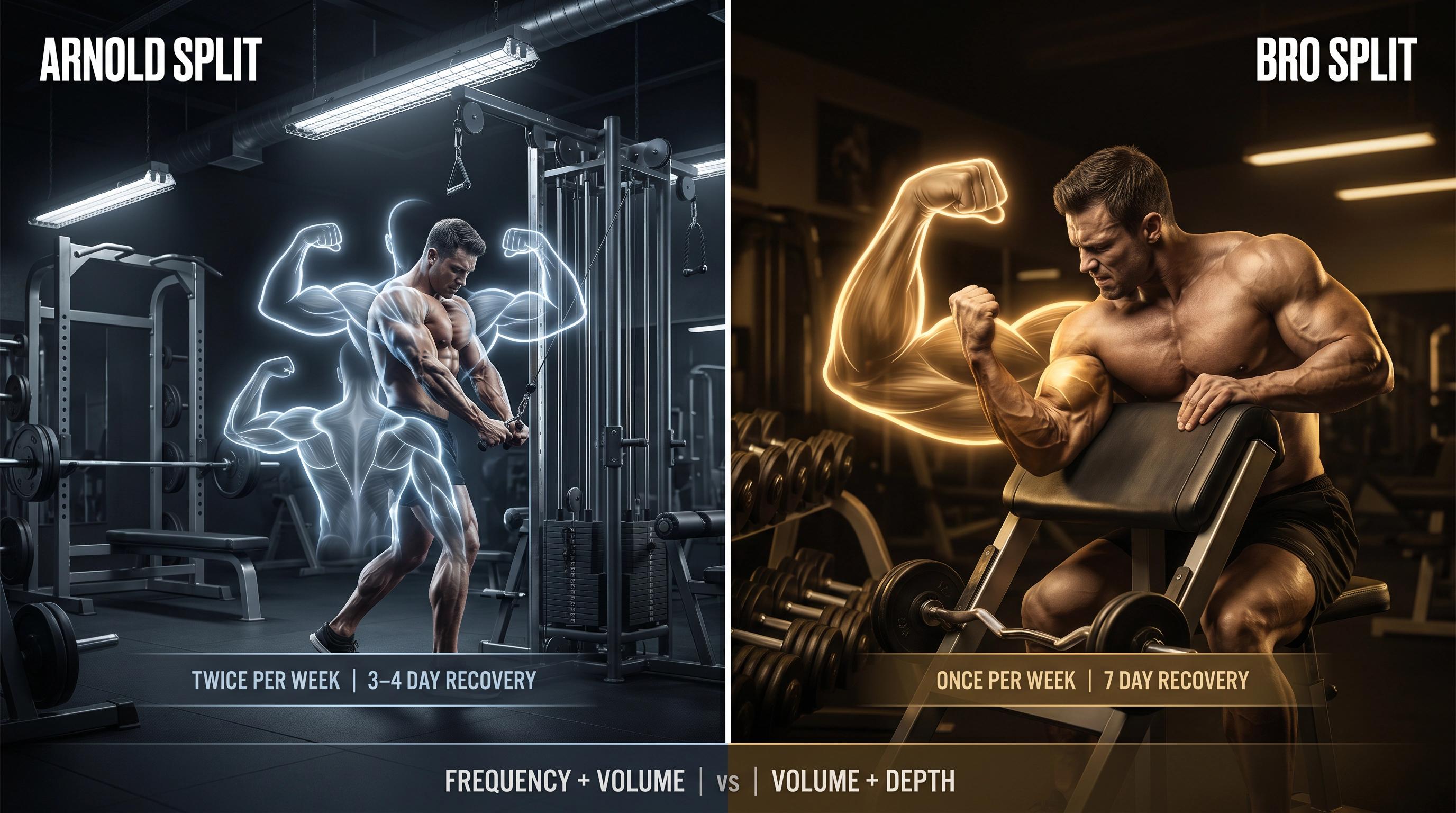
| Factor | Arnold Split | Bro Split |
|---|---|---|
| Frequency | Most muscles twice per week | Usually once per week |
| Weekly training days | 6 | Often 5 |
| Session volume per muscle | Moderate-high | Very high per muscle per session |
| Skill practice frequency | Higher | Lower |
| Recovery between same muscle | Shorter (3–4 days) | Longer (7 days) |
| Best for | Lifters who want frequency and volume together | Advanced lifters who prefer high-volume single-muscle days |
A bro split can work, particularly for advanced lifters who genuinely enjoy high-volume body-part sessions. But the Arnold split usually generates more frequent growth signals and more chances to practice and progress key lifts.
How to Modify the Arnold Split When Recovery Is Tough
Option 1: Run It as 3 Days On, 1 Day Off
Instead of forcing the rotation into a 7-day calendar week, use a rolling schedule:
| Day | Workout |
|---|---|
| Day 1 | Chest + Back |
| Day 2 | Shoulders + Arms |
| Day 3 | Legs |
| Day 4 | Rest |
| Day 5 | Chest + Back |
| Day 6 | Shoulders + Arms |
| Day 7 | Legs |
| Day 8 | Rest |
This is often the best version for natural lifters with demanding jobs, inconsistent sleep, or high fatigue from leg and back work. The rotation completes every 8 days instead of every 7.
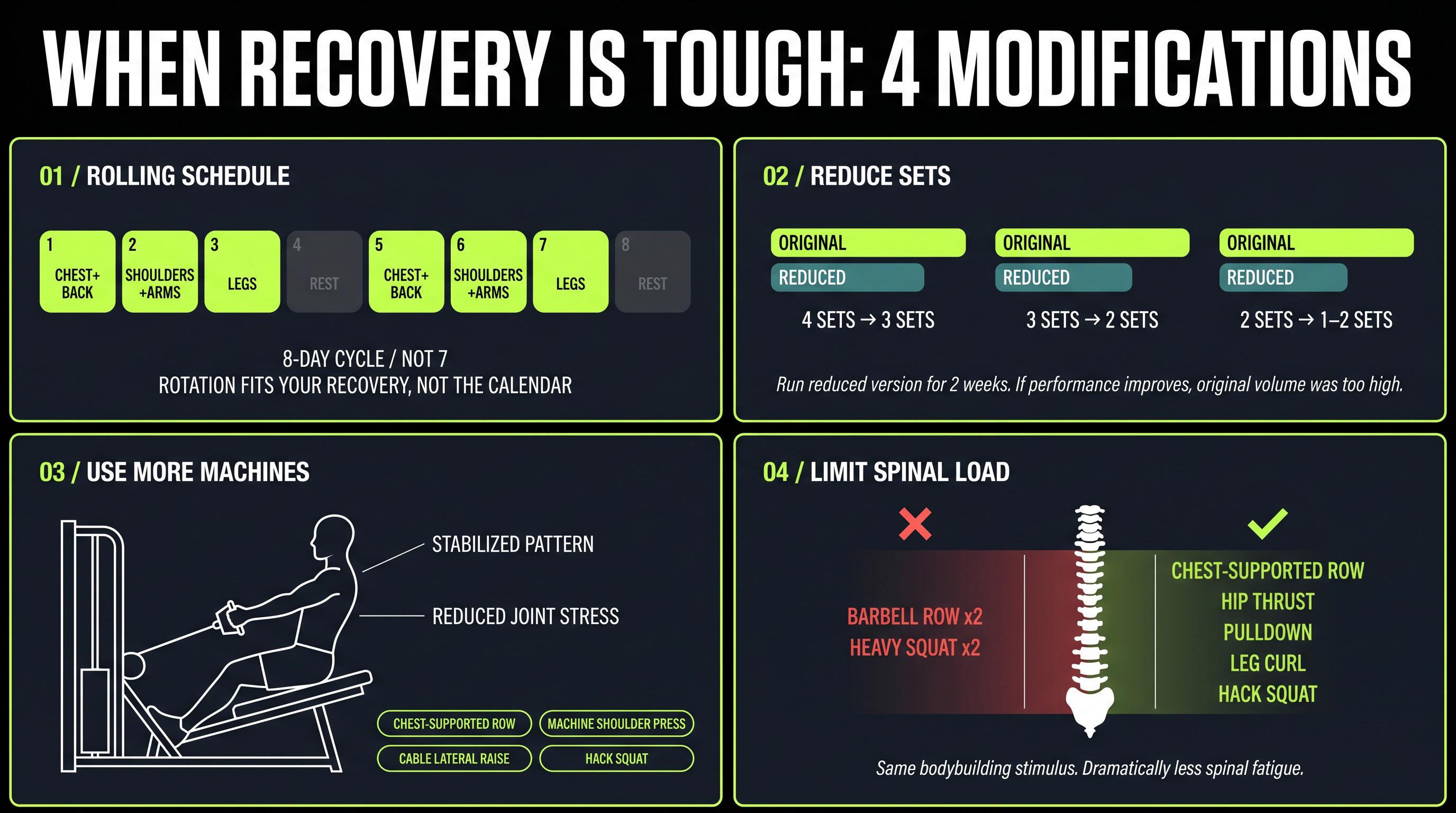
Option 2: Reduce Every Exercise by One Set
This is the fastest way to preserve the split's structure while lowering cumulative fatigue.
| Original | Reduced |
|---|---|
| 4 sets | 3 sets |
| 3 sets | 2 sets |
| 2 sets | 1–2 sets |
Run the reduced version for two weeks. If performance improves, your original volume was probably too high.
Option 3: Use More Machines
Machines are not inferior for bodybuilding goals. They can reduce setup time, stabilize the movement pattern, and make it easier to train close to failure without technique breaking down. ACSM's 2026 position stand notes that many equipment types can be effective and that machine versus free-weight choice does not need to be treated as a universal rule. (ACSM) Chest-supported rows, machine shoulder presses, and cable work are perfectly good substitutes when your joints or recovery need a break from heavy free-weight loading.
Option 4: Keep Heavy Spinal Loading to Once Per Week
If your lower back is chronically tired, don't barbell row hard twice, squat twice, RDL, and deadlift all in the same week. Use chest-supported rows, pulldowns, hip thrusts, leg curls, and hack squats to maintain the bodybuilding stimulus while dramatically reducing spinal fatigue.
Ready to Get Stronger?
Join 2,000,000+ lifters tracking their workouts with Stronger. Available on iOS and Android.
Start tracking freeSix Mistakes That Quietly Kill the Arnold Split
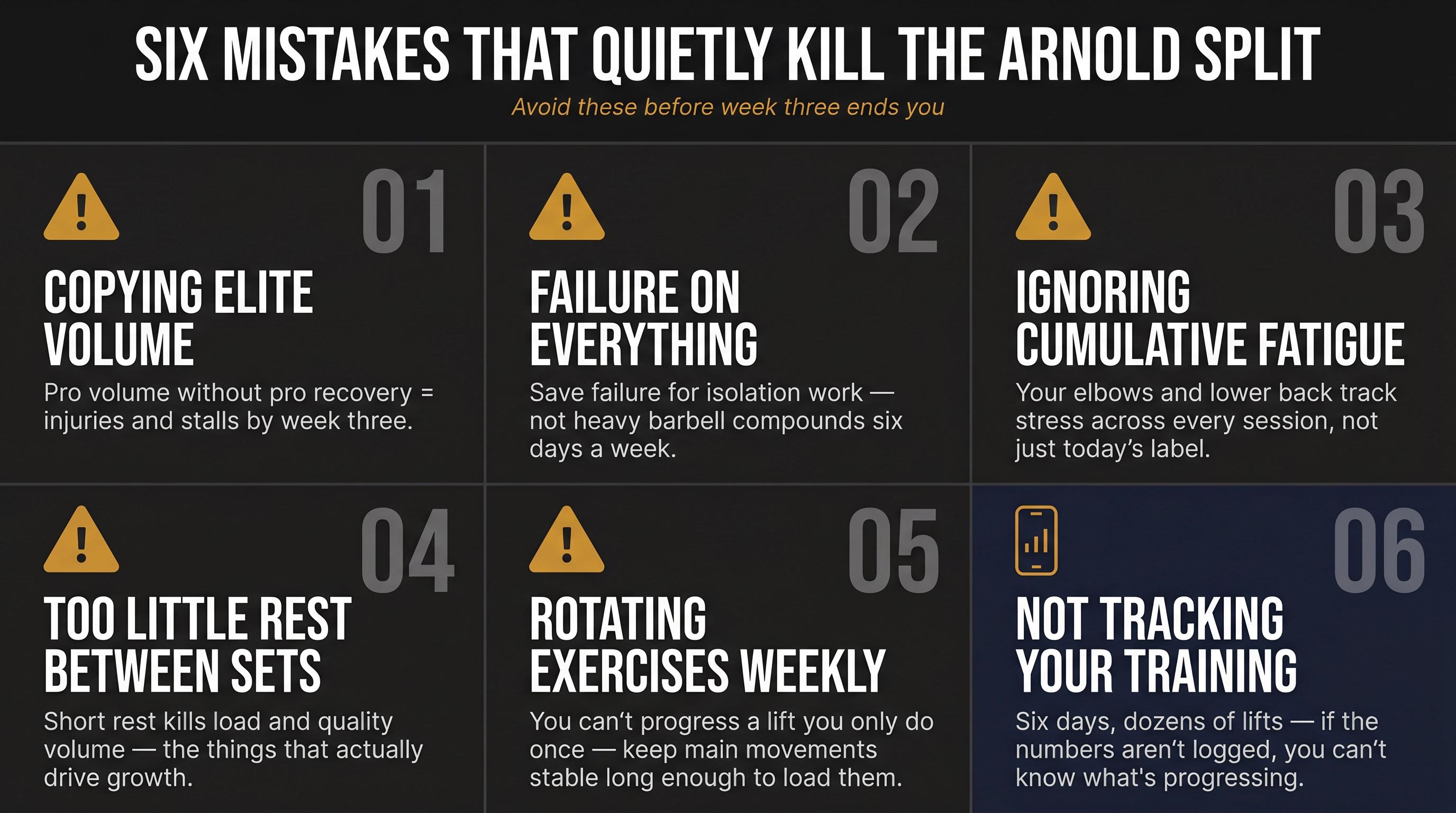
Mistake 1: Copying Elite Bodybuilding Volume
Arnold's training environment — caloric surplus, pharmaceutical recovery support, full-time training with multiple daily sessions — is not your environment. The spirit of the split is consistency, volume, and progressive overload. Copying volume that professionals used to maintain condition in the final weeks of competition prep is how you accumulate injury and stall out in week three.
Mistake 2: Training to Failure on Everything
Failure has a legitimate place in bodybuilding. That place is on safer isolation lifts, not heavy barbell movements trained six days per week. Heavy compounds should stop short of failure. Use failure sparingly on lateral raises, curls, pressdowns, leg extensions, and calf raises.
Mistake 3: Ignoring Overlap and Cumulative Fatigue
Chest day hits front delts and triceps. Back day loads biceps. Shoulder day hits triceps again. Arm day loads elbows a third time. Squats and rows accumulate lower-back stress. Your joints don't care what the workout label says — they track cumulative stress across the week. Design the program accordingly.
Mistake 4: Resting Too Little Between Sets
Short rest periods can make a workout feel intense, but they reduce load, reps, and total quality volume — the things that actually drive adaptation. Use enough rest to make the next set productive.
Mistake 5: Changing Exercises Every Week
Don't rotate exercises constantly. Keep your main lifts stable long enough to progress them meaningfully. Change accessories when they consistently bother your joints, stop feeling productive, or clearly no longer fit your current goal.
Mistake 6: Not Tracking Your Training
A six-day program has more moving parts than anyone can hold in working memory. Bench press, rows, squats, overhead press, curls, lateral raises, leg curls — if you don't know whether these lifts are actually moving upward over time, you don't know whether the program is working. This is where tracking stops being optional.
How Stronger Helps You Run the Arnold Split
The Arnold split is exactly the kind of program that separates lifters who use a serious tracking system from those who don't. Six workouts, eighteen or more exercises, twice-weekly frequency for every muscle group — running this from memory means losing track of what you lifted, missing progression opportunities, and having no reliable way to tell whether the program is working.
Stronger is built specifically for lifters like this.
Build the program once, use it every week. In Stronger, you build all six workouts as saved routines. Every time you open the app for Chest + Back A, the structure is there: exercises in order, your previous sets visible, and rest timers ready. No setup, no friction, no fumbling through notes mid-session.
Track every set, see every PR. Log sets, reps, and weight directly in the app. Stronger flags PRs as they happen — so when you finally hit 32 kg on incline dumbbell press for 12×3 and are ready to go up to 34 kg, you'll know exactly when that moment arrived. You can also log RPE per set, giving you a record of how hard each session actually was — useful data for adjusting volume or recognizing deload signals before they become problems.
Strength Score: your overall progress in one number. Stronger's proprietary Strength Score rates your strength across 12 muscle groups and overall, adjusted for bodyweight and sex, on six levels from Beginner to World Class. See how you stack up using our strength standards benchmarks. On a program like the Arnold split that trains multiple muscle groups twice per week, your Strength Score gives you a broader view of progress than any single lift can — and it helps you spot genuine weak points, not just the ones that feel weak during a bad session.
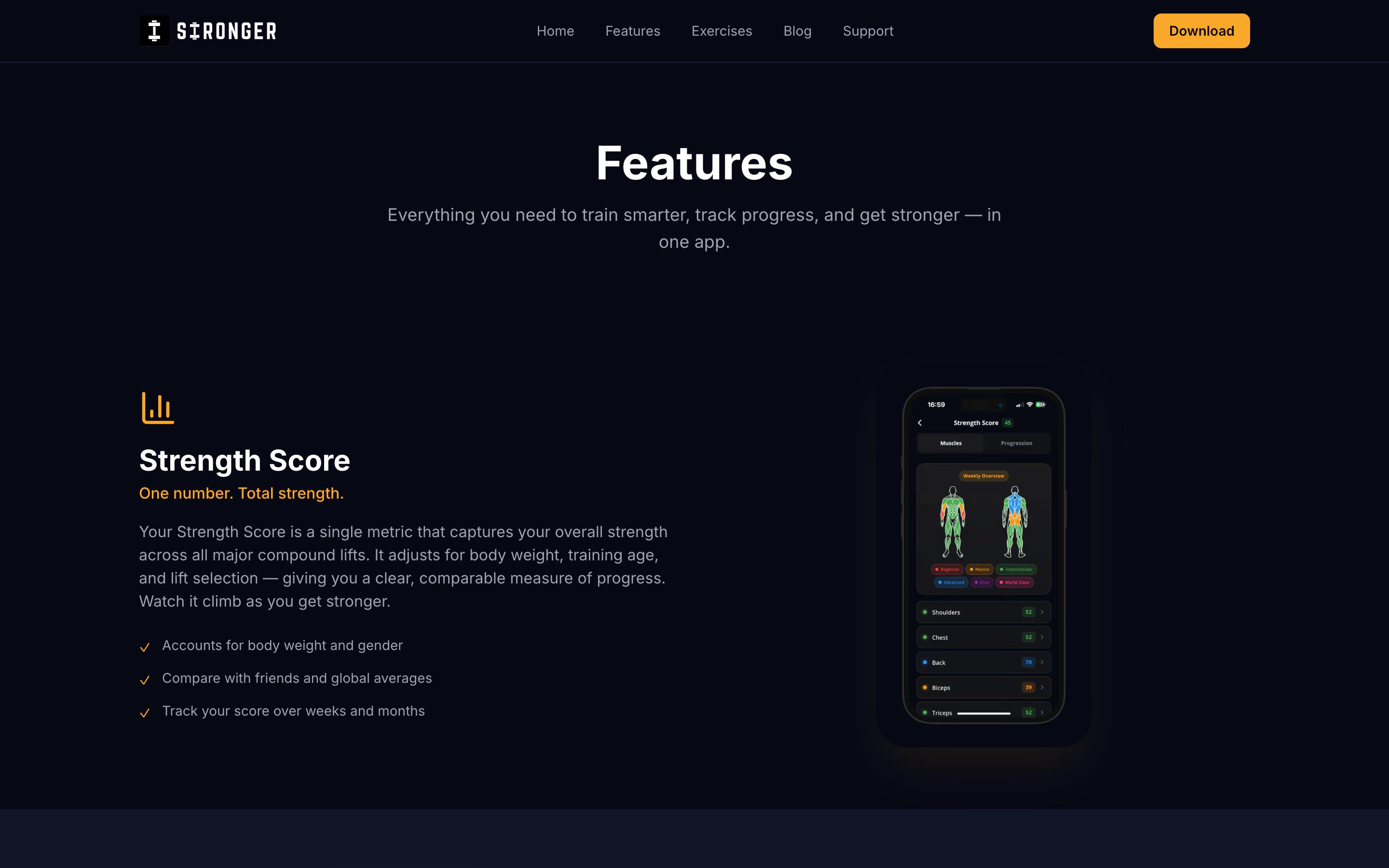
Volume and frequency analytics. Stronger tracks your weekly volume by muscle group, so you can see whether you're actually hitting those 16–18 sets per week for chest and back or drifting below target. On a demanding six-day split, this kind of oversight prevents the gradual set-by-set drift that quietly turns a legitimate program into junk volume over time.
Social accountability. Training six days a week is a real commitment. Stronger's group challenges, leaderboards, and activity feeds turn that commitment into something social — and social accountability is one of the most reliable behavioral tools for maintaining a demanding training schedule. When your group sees your lift numbers go up week over week, the split stops feeling like a solo slog.
Here's exactly what we'd track on this program:
| Metric | Why It Matters |
|---|---|
| Exercise PRs | Shows whether key lifts are progressing |
| Weekly sets per muscle group | Prevents accidental volume creep |
| RPE or RIR per set | Shows whether effort is rising too fast |
| Rest periods | Keeps performance comparisons meaningful |
| Bodyweight | Helps interpret strength and size changes |
| Measurements and photos | Bodybuilding progress is not only about bar weight |
| Missed workouts | Reveals whether six days is actually sustainable |
| Strength Score | Identifies strong and weak areas across the full program |
Stronger is free to download. Premium unlocks the Strength Score, deep analytics, AI-generated routines, and the full library of 400+ exercises. Try it free for 7 days and build your Arnold Split program before your next training week starts.
Frequently Asked Questions About the Arnold Split
Is the Arnold Split Good for Beginners?
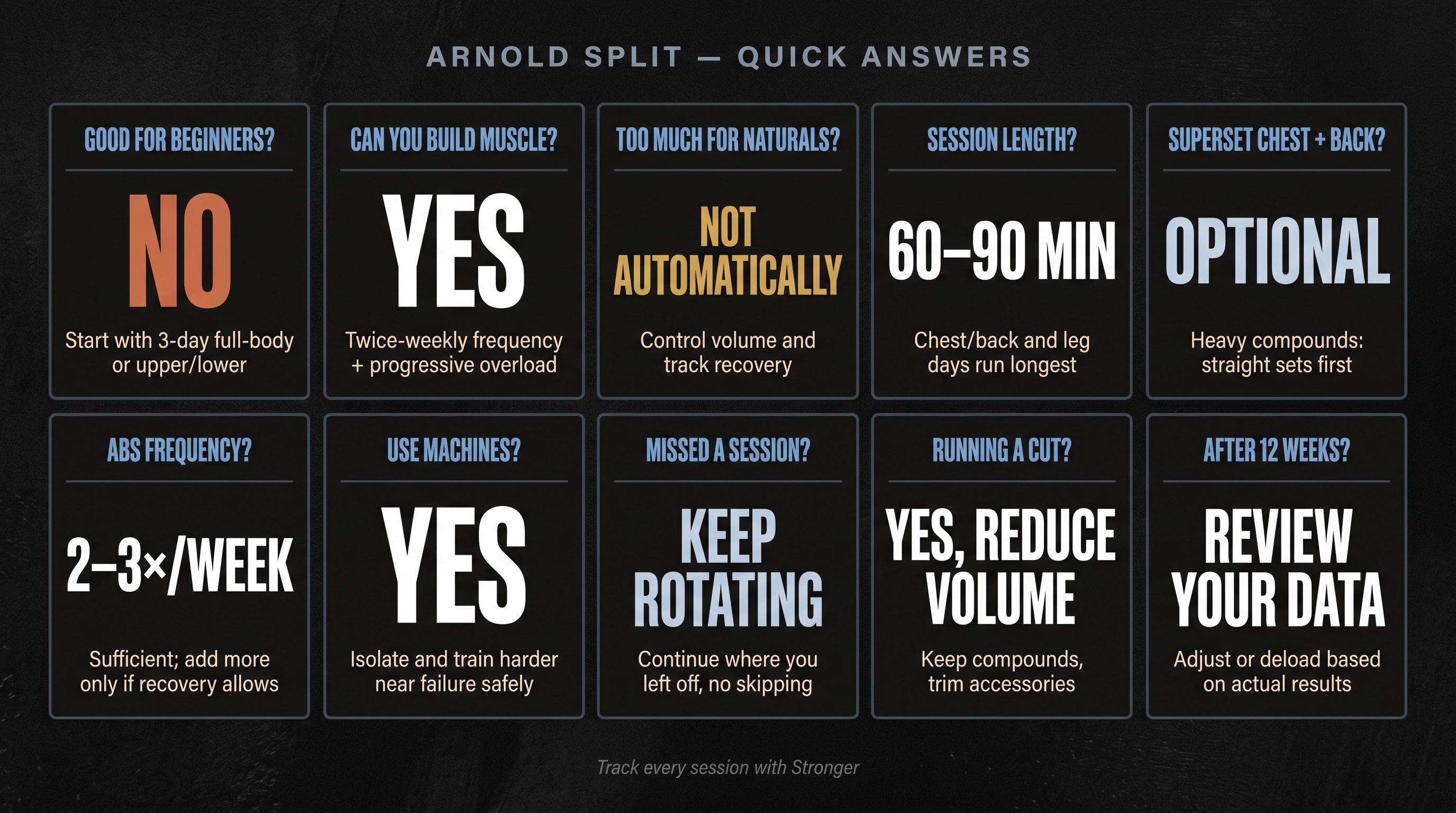
No, not as a starting point. Beginners respond best to lower-frequency, simpler programs that develop movement patterns and build base strength with recoverable volume. A 3-day full-body or 4-day upper/lower program will produce faster skill development, fewer injury risks, and better long-term consistency. Move to the Arnold split when you can execute major compound lifts with solid technique and you're no longer making rapid beginner gains on a simpler program.
Can You Build Muscle with the Arnold Split?
Yes. The split trains each major muscle group roughly twice per week, provides plenty of room for hypertrophy volume, and uses exercises that are straightforward to progressively overload. It works best when combined with adequate protein intake, sufficient calories, quality sleep, and consistent tracking. Those factors do more to determine your results than any specific program structure.
Is the Arnold Split Too Much for Natural Lifters?
Not automatically. Six days per week can absolutely work for natural lifters when volume is controlled, failure is reserved for appropriate movements, sleep and nutrition support recovery, and progression is tracked rather than assumed. The mistake is copying extreme two-a-day or maximum-volume routines designed for professional bodybuilders in preparation for competition. The version in this guide is calibrated for natural intermediate lifters — start here, then adjust based on your data.
How Long Are Arnold Split Workouts?
Most sessions take 60–90 minutes. Chest/back days and leg days typically run longer because of the heavier compound work and longer rest periods. If your workouts consistently exceed 90 minutes, use antagonist supersets on moderate work, cut one set per exercise, or trim one accessory movement.
Should I Superset Chest and Back?
You can, but it's not mandatory. Supersetting chest and back is time-efficient and creates a significant pump. For the heaviest compound work — barbell bench press and heavy rows — straight sets usually produce better quality performance. Start supersetting on the moderate and isolation work, and add supersets to the heavier movements only if your recovery allows it.
How Often Should I Train Abs on the Arnold Split?
This program includes two direct ab sessions per week, which is sufficient for most lifters. You can train abs more frequently, but daily ab training is not necessary and not noticeably superior. If recovery, session time, and performance are all solid, you can add an additional direct ab session — but add it last and remove it first if anything starts to feel like too much.
Can I Use Machines on the Arnold Split?
Yes, and you should when they serve the purpose better than free weights. Machines are excellent for bodybuilding — they isolate the target muscle, reduce stabilization demand, and make it easier to train productively close to failure. Use free weights where they help you overload safely and build movement quality; use machines where they let you train harder with less joint or lower-back stress.
What If I Miss a Workout Day?
Don't skip the missed session and jump ahead in the calendar. Continue the rotation from where you left off. If you miss Thursday's Chest + Back B, do it Friday, then continue with Shoulders + Arms B the following day. The Arnold split works as a rotation, not as a rigid weekly schedule. One missed day that gets made up is never a problem.
Can I Run the Arnold Split While Cutting?
Yes, but reduce volume. Keep the heavy compound movements in the program, but cut one or two accessory exercises per session and reduce high-rep isolation work. In a calorie deficit, your primary goal is maintaining muscle mass and training performance — not setting volume records or chasing new PRs. Some lifters also find the rolling 3-on-1-off schedule easier to maintain during a cut.
What Should I Do After 12 Weeks on the Arnold Split?
Review your actual data. If your lifts have progressed, measurements and photos show improvement, and recovery has been consistently manageable, run another 8–12 week block with small adjustments — swap one or two accessory exercises, adjust volume slightly, or focus on a weak area. If joints are showing wear or performance has plateaued, drop to a lower-volume 4-day upper/lower or 5-day split for 6–8 weeks before returning. Use Stronger's analytics to make that decision based on data, not on how you feel on any given day.
Should You Try the Arnold Split?
The Arnold split is not magic. It is a demanding but effective bodybuilding structure built on principles that hold up under scrutiny:
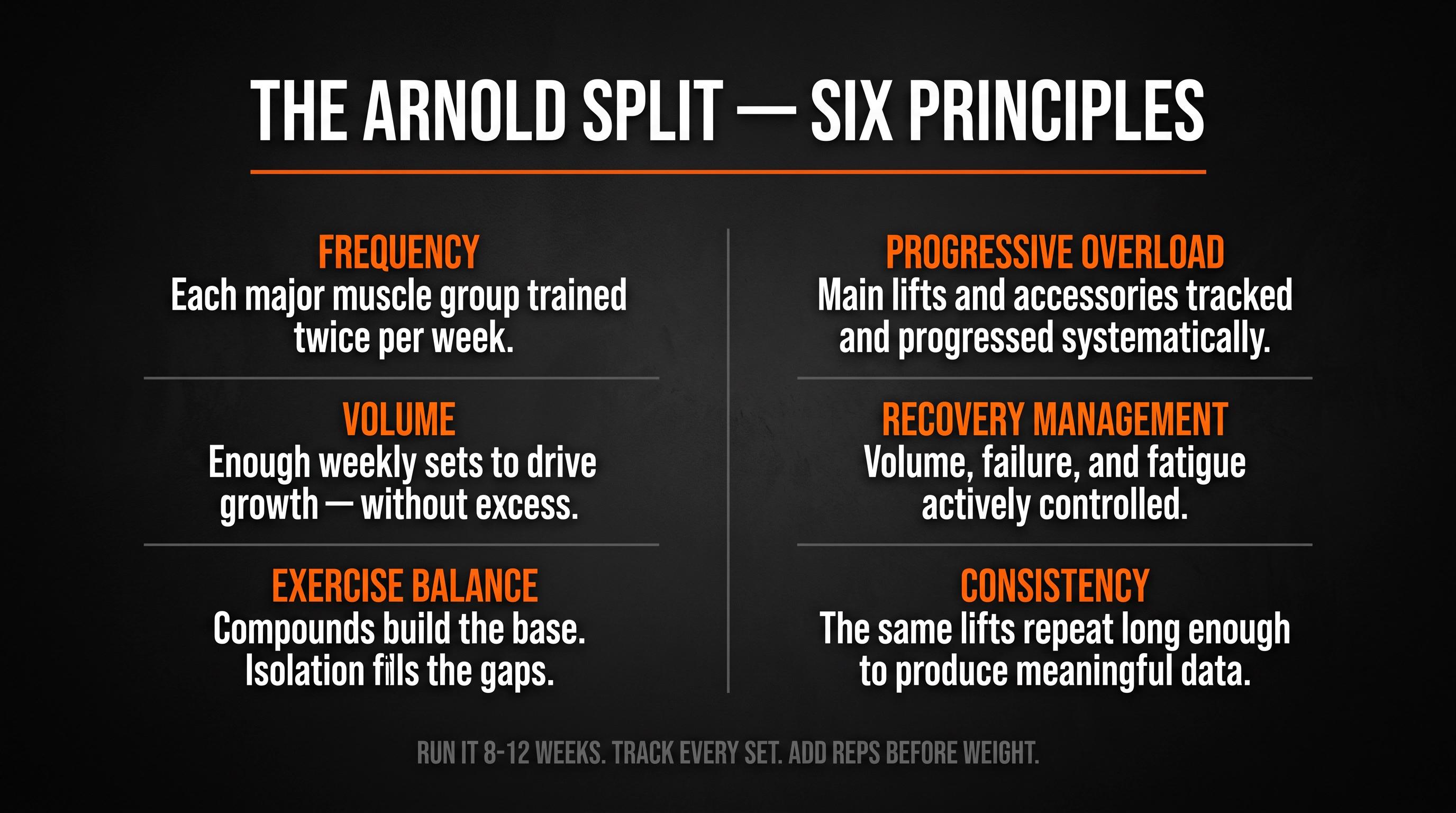
| Principle | How This Program Applies It |
|---|---|
| Frequency | Each major muscle group is trained about twice per week |
| Volume | Enough weekly sets to drive growth, without copying extreme programs |
| Progressive overload | Main lifts and accessories are tracked and progressed systematically |
| Exercise balance | Compounds build the base; isolation work fills the gaps |
| Recovery management | Volume, failure, and lower-back fatigue are actively controlled |
| Consistency | The same lifts repeat long enough to produce meaningful data |
Run it for 8–12 weeks. Track every set. Add reps before you add weight. Eat enough protein. Sleep enough. Deload when the signals tell you to — not when your ego tells you you're fine.
That is how you take an old-school bodybuilding split and turn it into a modern program that actually builds muscle.
Sources

This guide was researched and written in May 2026. Scientific guidance, app references, and program interpretations were checked against sources available at that time.
- American College of Sports Medicine, March 17–18, 2026: 2026 resistance-training position stand summary. First major update since 2009, synthesizing 137 systematic reviews and 30,000+ participants. (ACSM)
- Arnold's Pump Club, accessed May 2026: Arnold Schwarzenegger's description of his famous split and modern training philosophy. (Arnold's Pump Club)
- Van Every et al., Journal of Sport and Health Science, 2025/2026: Review on load-induced hypertrophy, mechanical tension, and realistic muscle growth expectations. (ScienceDirect)
- Wolf et al., Sports Medicine and Health Science, 2025/2026: Systematic review on longer-muscle-length resistance training and hypertrophy. (ScienceDirect)
- ISSN protein position stand, 2017 + 2025 athlete protein review: Protein intake ranges for exercising individuals and resistance-trained athletes. (PubMed)
- OPSS, April 2025: Creatine monohydrate performance and dosing guidance. (opss.org)
- CDC, 2024: Adult sleep recommendations. (CDC)
Additional program references consulted: StrengthLog, Liftosaur.
Exercises in this guide
Stronger Editorial Team
Certified strength & conditioning specialists with 10+ years of coaching experience
The Stronger editorial team produces evidence-based training content for lifters of all levels.
Ready to Get Stronger?
Join 2,000,000+ lifters tracking their workouts with Stronger. Available on iOS and Android.
Start tracking free