
RPE Chart for Lifting: Scale, Conversions & How to Use It
Last updated: April 30, 2026
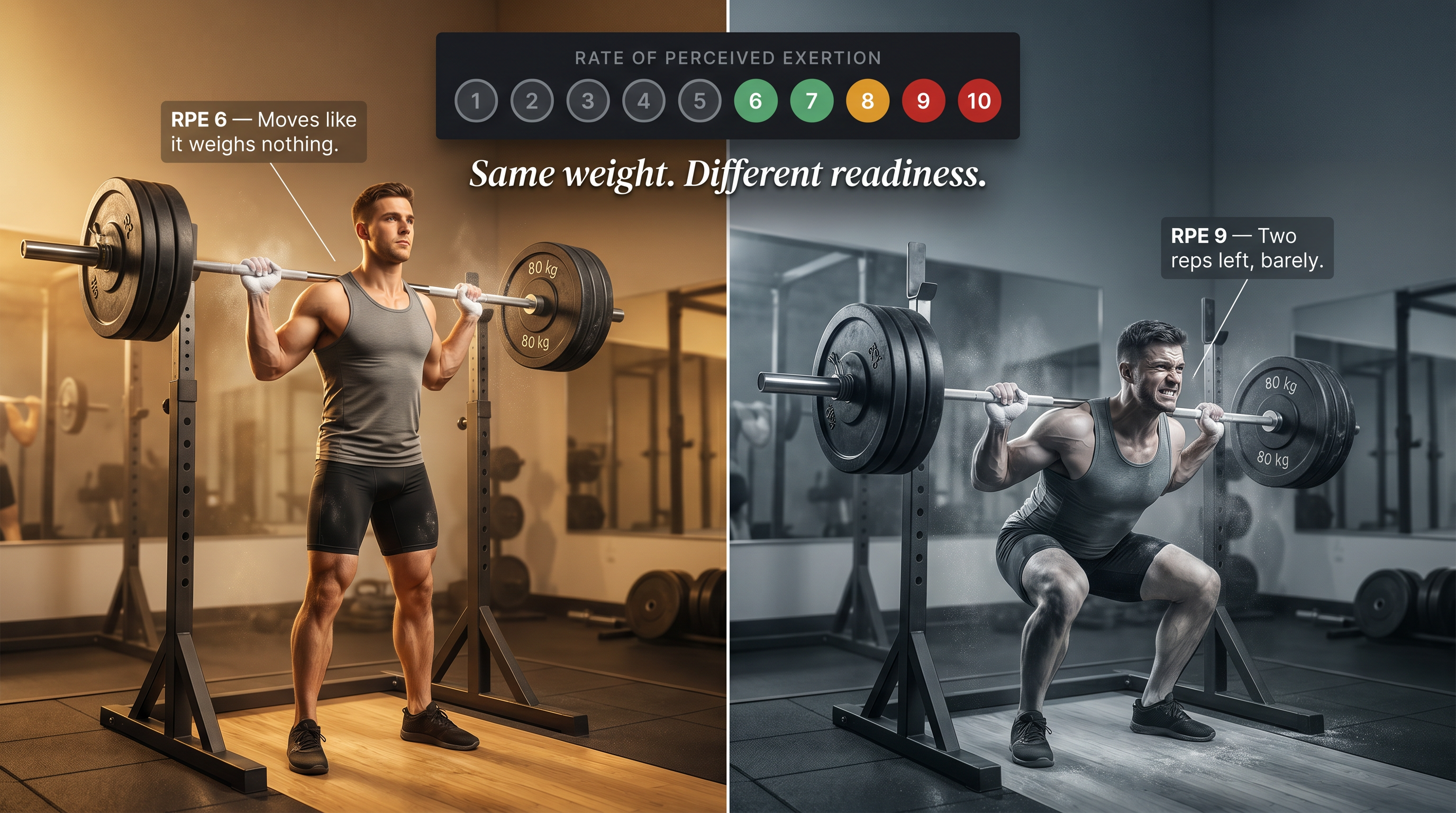
Your program says: Back Squat — 4 sets of 5 at 80%.
So you load the bar and lift. Some days, 80% moves like 60%. Other days it parks itself halfway up. The weight is identical. Your readiness is not. And your spreadsheet has no way to tell the difference.
That is the problem RPE solves.
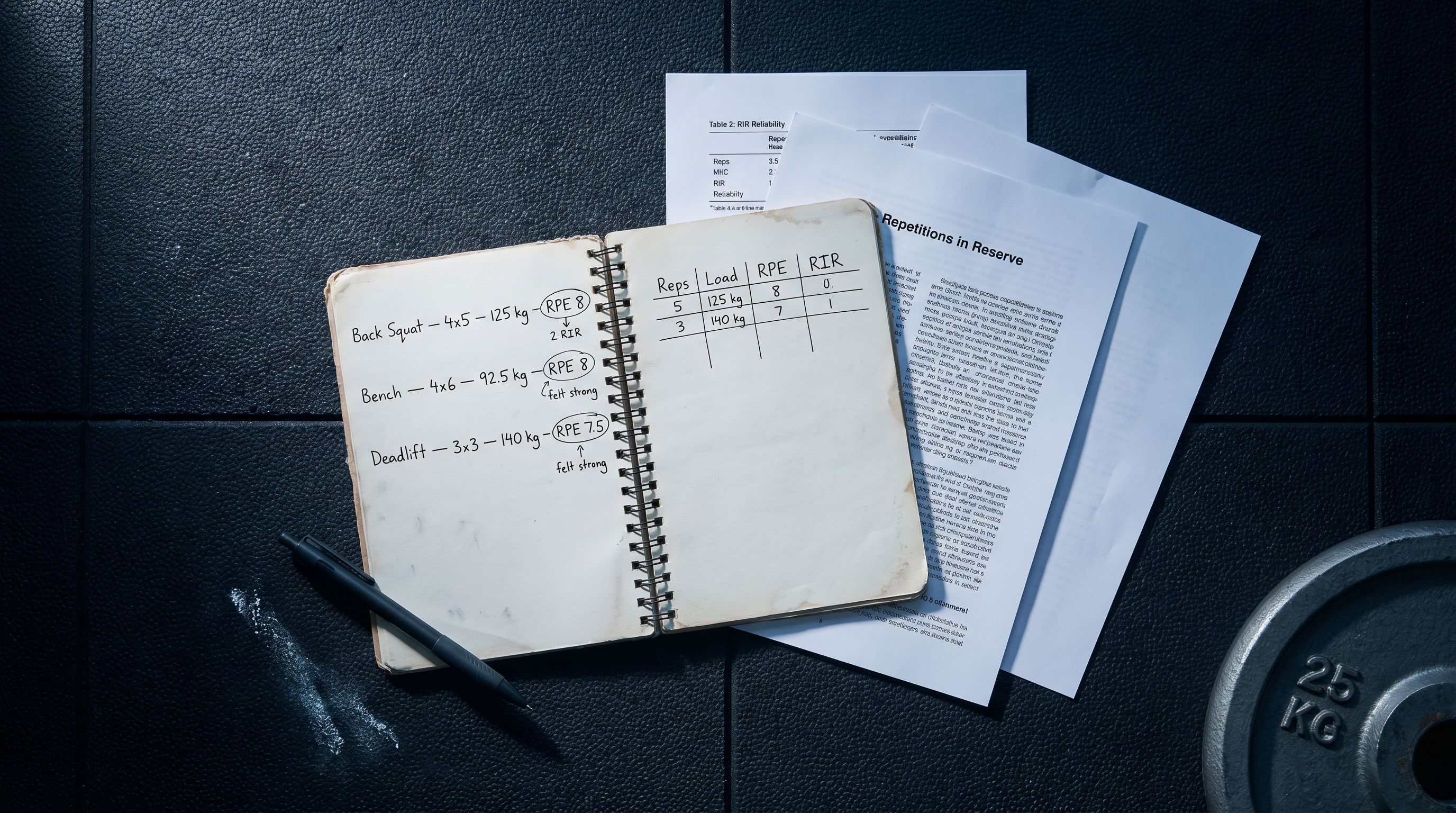
RPE — rate of perceived exertion — is a 1–10 effort scale for lifting. It answers the question your percentage-based plan cannot: how hard was that set for you, today, given your actual readiness? In Stronger, we added set-level RPE logging because we kept seeing the same pattern in training data: the lifters who tracked effort alongside weight and reps understood their progress far better than those tracking weight alone. This guide gives you the full chart, the complete RPE-to-%1RM conversion table, and the exact system for using RPE in real workouts — beginner through advanced.
By the end, you will know what every number on the scale means, how to convert between RPE and percentage of your one-rep max (1RM), how to adjust weight on the fly, and how to track it all so your training history actually tells you something useful.
What is RPE in lifting? The 1–10 scale explained
In the gym, RPE is almost always measured using reps in reserve — the number of clean reps you could have completed after the set ended. The relationship is direct:
RPE = 10 − RIR RIR = 10 − RPE
So when you finish a set and think "I had 2 reps left," that set was RPE 8. One rep left means RPE 9. Three reps left means RPE 7.
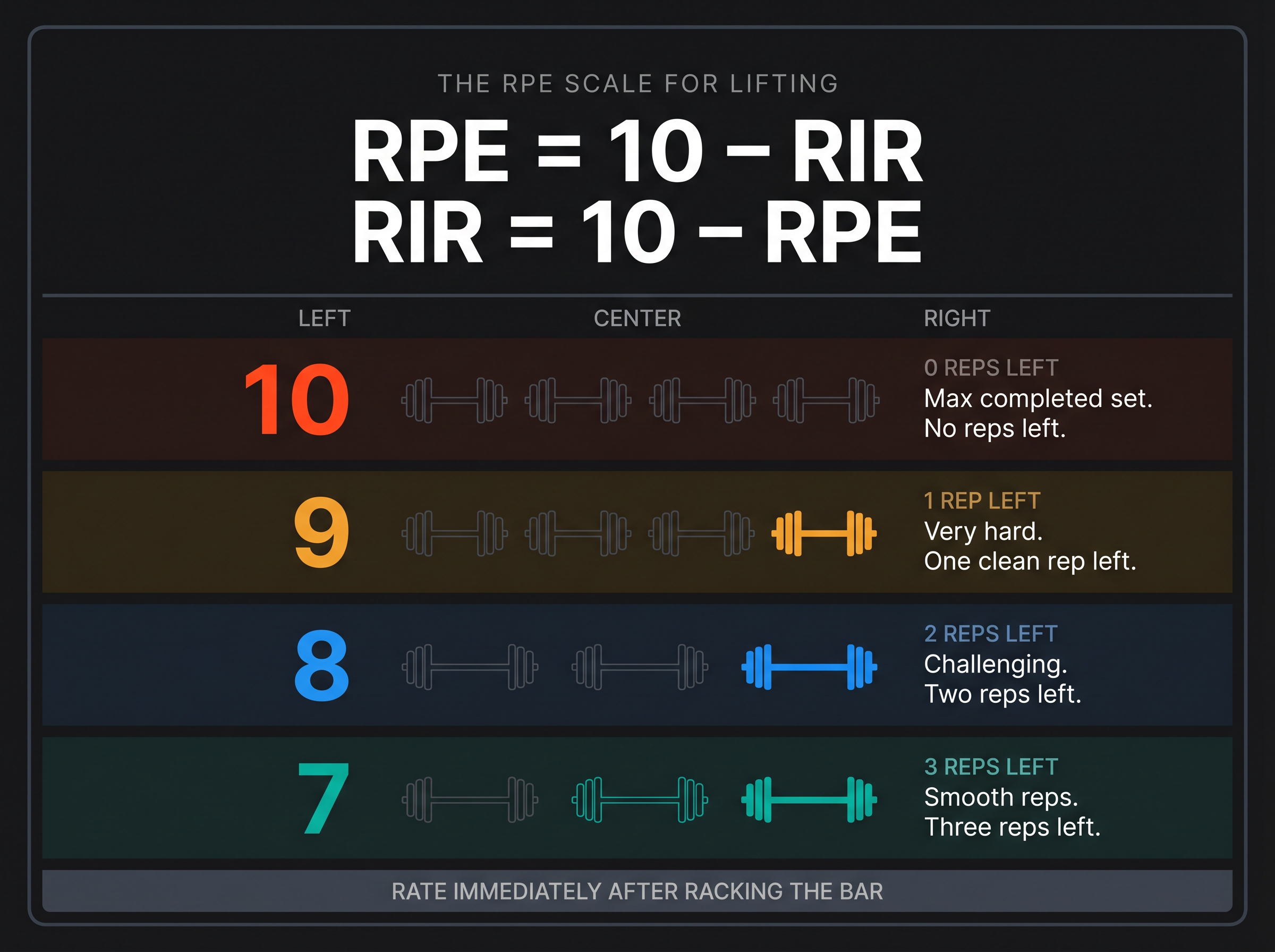
The four-line cheat sheet most coaches use:
| RPE | Reps in Reserve | Translation |
|---|---|---|
| 10 | 0 | No clean reps left — hardest completed set |
| 9 | 1 | One rep left |
| 8 | 2 | Two reps left |
| 7 | 3 | Three reps left |
This is different from the original Borg RPE scale, which was designed for cardiovascular exercise and runs from 6 to 20. For lifting, the 1–10 RIR-based version is what coaches mean when they write "4x5 @ RPE 8" in a program. NASM's overview covers both formats; Barbell Medicine specifically describes the lifting version as a 1–10 scale where RPE 10 means no more reps at the same weight.
The reason this system works for strength training is that it ties a subjective feeling to a concrete, measurable thing — the number of reps you had left. That makes it trainable, comparable across sessions, and useful as a load-selection tool. Eric Helms, John Cronin, Adam Storey, and Michael Zourdos described RIR-based RPE as a more precise resistance-training tool because it can adjust load to match athlete capability on a set-by-set basis — which was a key insight when applied to lifting programs. [OUCI — Helms et al.]
RPE chart for lifting: complete 1–10 reference
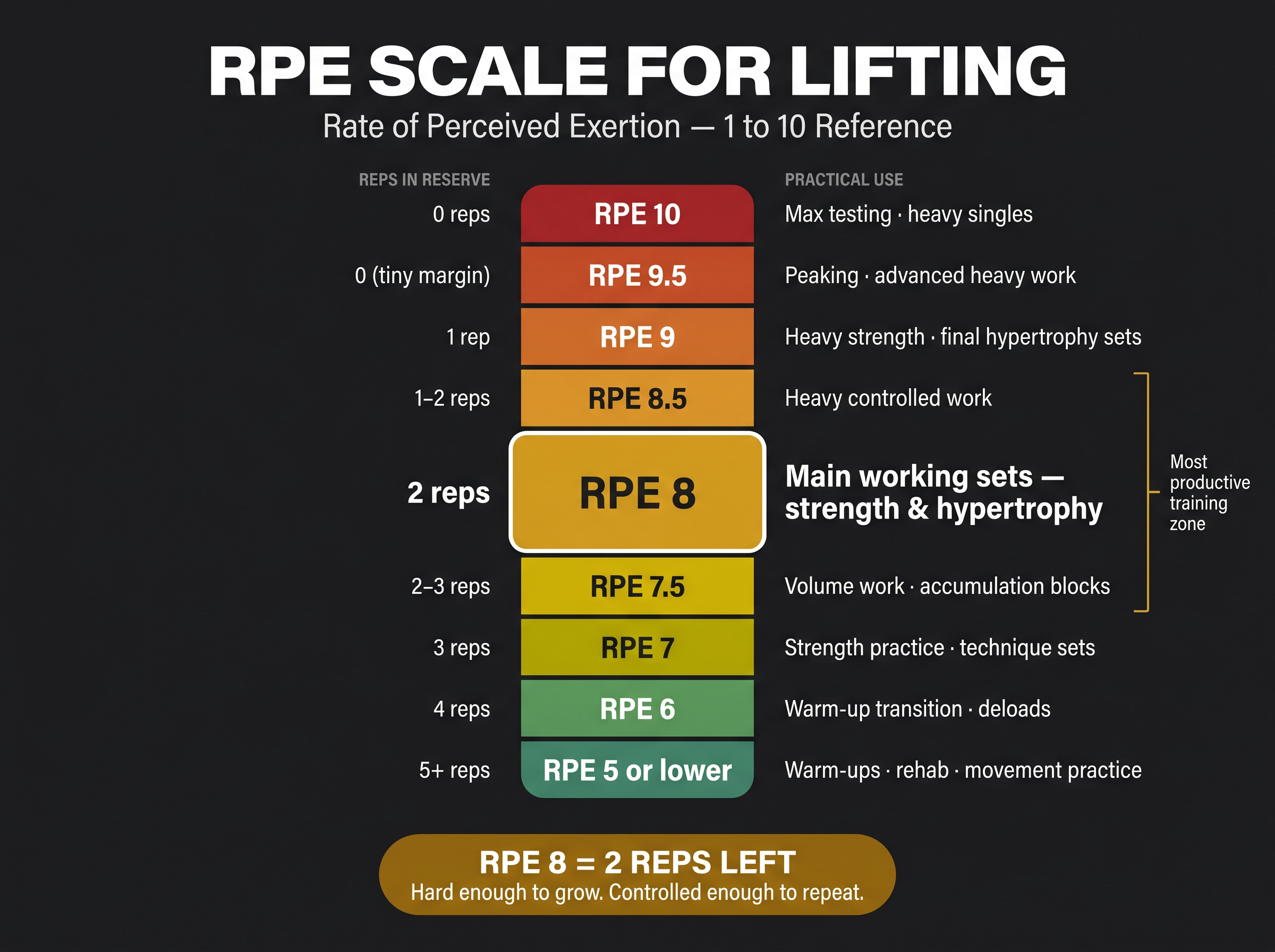
Use this chart immediately after each working set. Ask: "How many more clean reps could I have done with the same weight and the same technique?"
| RPE | Reps in Reserve | What It Means in Lifting | Practical Use |
|---|---|---|---|
| 10 | 0 | Maximal completed set. No clean reps left. | Testing, final heavy single, occasional isolation failure |
| 9.5 | 0 | No full rep left, but a tiny load increase was possible. | Peaking, advanced lifters, rare heavy work |
| 9 | 1 | Very hard. One clean rep left. | Heavy strength work, final hypertrophy sets |
| 8.5 | 1–2 | Hard, between one and two reps left. | Heavy but controlled work |
| 8 | 2 | Challenging, strong technique, two reps left. | Main working sets for strength and hypertrophy |
| 7.5 | 2–3 | Productive but clearly submaximal. | Volume work, accumulation blocks |
| 7 | 3 | Smooth reps, three reps left. | Strength practice, technique, early sets |
| 6 | 4 | Easy-to-moderate working weight. | Warm-up transition, deloads, speed work |
| 5 or lower | 5+ | Easy. More like technique or warm-up work. | Warm-ups, rehab, learning movement patterns |
The core formula, one more time:
RPE 8 = 2 reps left. If you had 2 reps left, you were at RPE 8 — regardless of the weight on the bar.
Most productive training for strength and hypertrophy lives between RPE 6 and RPE 9. You can touch heavy territory without living at RPE 10.
RPE vs RIR vs %1RM: what's the difference?
These three tools are related but do different jobs. Understanding the difference changes how you program.
| Term | Meaning | Best Use |
|---|---|---|
| RPE | How hard the set felt on a 1–10 scale | Autoregulating load and effort |
| RIR | How many clean reps you had left | Judging proximity to failure |
| %1RM | Load as a percentage of your one-rep max | Planning intensity and comparing loads |
A complete training plan uses all three.
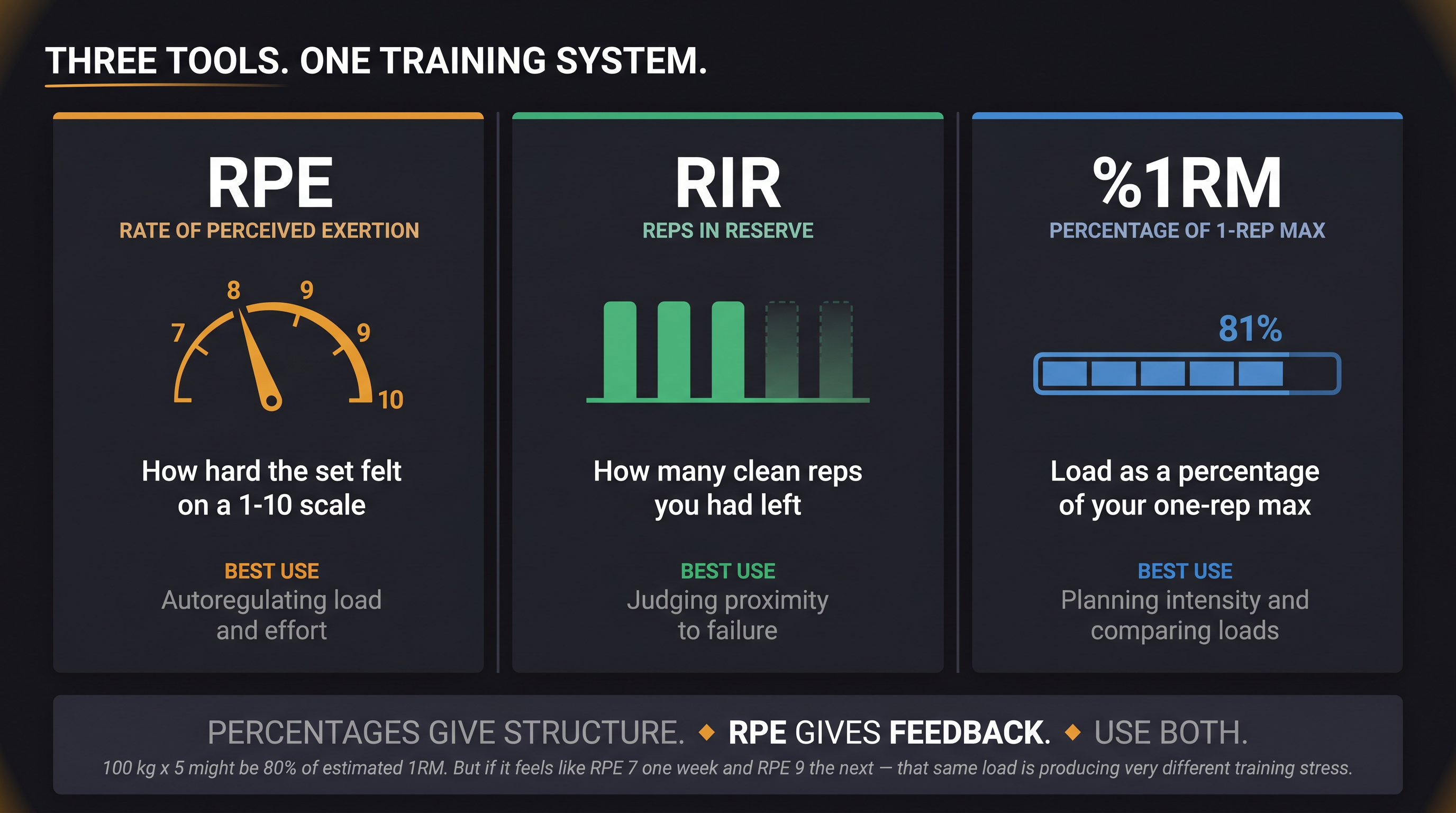
%1RM tells you how heavy the weight is. RPE and RIR tell you how hard that weight was today.
Here is why the distinction matters: 100 kg might be 80% of your estimated 1RM. But if 100 kg x 5 feels like RPE 7 one week and RPE 9 the next, that same load is producing a very different training stress. Sleep, nutrition, recovery and cumulative fatigue, stress, warm-up quality — all of it shows up in how an RPE feels even when the weight hasn't changed.
Percentages give structure. RPE gives feedback. Use both.
RPE to percentage of 1RM conversion chart
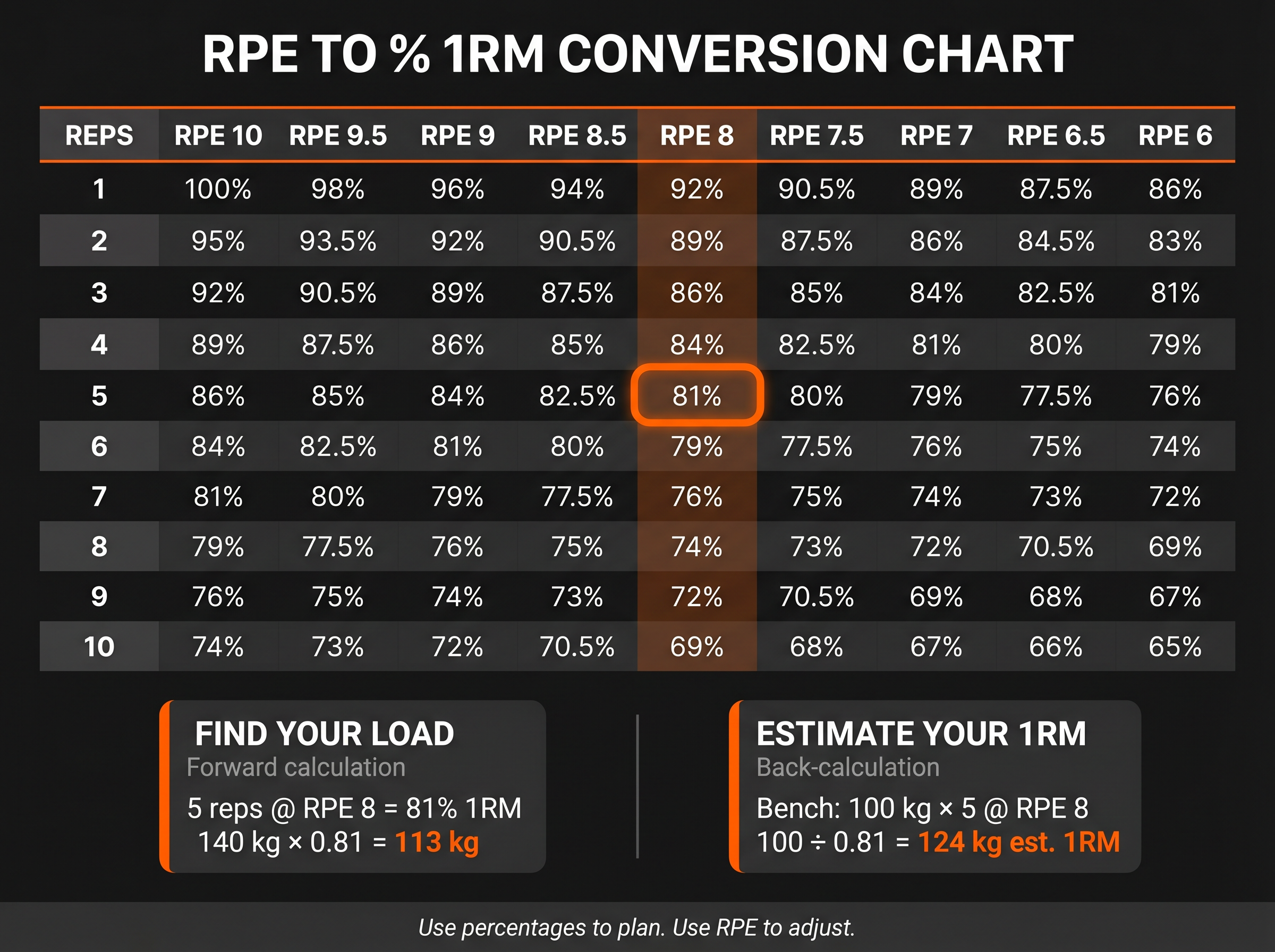
The table below estimates what percentage of your 1RM corresponds to a given rep target and RPE target. This is based on a widely used RPE-percentage mapping (RTS-style) and is rounded for practical gym use.
| Reps | RPE 10 | RPE 9.5 | RPE 9 | RPE 8.5 | RPE 8 | RPE 7.5 | RPE 7 | RPE 6.5 | RPE 6 |
|---|---|---|---|---|---|---|---|---|---|
| 1 | 100% | 98% | 96% | 94% | 92% | 90.5% | 89% | 87.5% | 86% |
| 2 | 95% | 93.5% | 92% | 90.5% | 89% | 87.5% | 86% | 84.5% | 83% |
| 3 | 92% | 90.5% | 89% | 87.5% | 86% | 85% | 84% | 82.5% | 81% |
| 4 | 89% | 87.5% | 86% | 85% | 84% | 82.5% | 81% | 80% | 79% |
| 5 | 86% | 85% | 84% | 82.5% | 81% | 80% | 79% | 77.5% | 76% |
| 6 | 84% | 82.5% | 81% | 80% | 79% | 77.5% | 76% | 75% | 74% |
| 7 | 81% | 80% | 79% | 77.5% | 76% | 75% | 74% | 73% | 72% |
| 8 | 79% | 77.5% | 76% | 75% | 74% | 73% | 72% | 70.5% | 69% |
| 9 | 76% | 75% | 74% | 73% | 72% | 70.5% | 69% | 68% | 67% |
| 10 | 74% | 73% | 72% | 70.5% | 69% | 68% | 67% | 66% | 65% |
Important: this is a planning tool, not a law. Different lifts and different lifters have different rep-max curves. Reactive Training Systems specifically recommends customizing RPE charts by lift, because individual charts are more accurate than generic ones.
How to use the RPE-to-1RM conversion table
Pick your target reps. Pick your target RPE. The intersection gives an estimated percentage of 1RM.
Example: 5 reps at RPE 8 = about 81% of 1RM
If your estimated 1RM is 140 kg:
140 kg × 0.81 = 113.4 kg
In the gym, round to the nearest available load — 112.5 kg or 115 kg.
How to calculate your estimated 1RM from an RPE set
You can work backwards. If you completed a set and know the reps, weight, and RPE, use:
Estimated 1RM = Weight ÷ chart percentage
Example: You bench pressed 100 kg x 5 @ RPE 8. The chart shows 5 reps @ RPE 8 ≈ 81%.
100 ÷ 0.81 = 123.5 kg estimated 1RM
Treat this as a trend, not a competition prediction. If your estimated 1RM rises week over week while technique stays consistent, you are getting stronger. Reactive Training Systems cautions against treating a single estimated max as absolute — the value is in the direction of the trend, not the exact number.
How to use RPE to pick the right weight for every set
Most lifters do not need RPE because they want a chart to stare at. They need it because they want to know what to actually put on the bar — and how to adjust when the plan doesn't match the day.
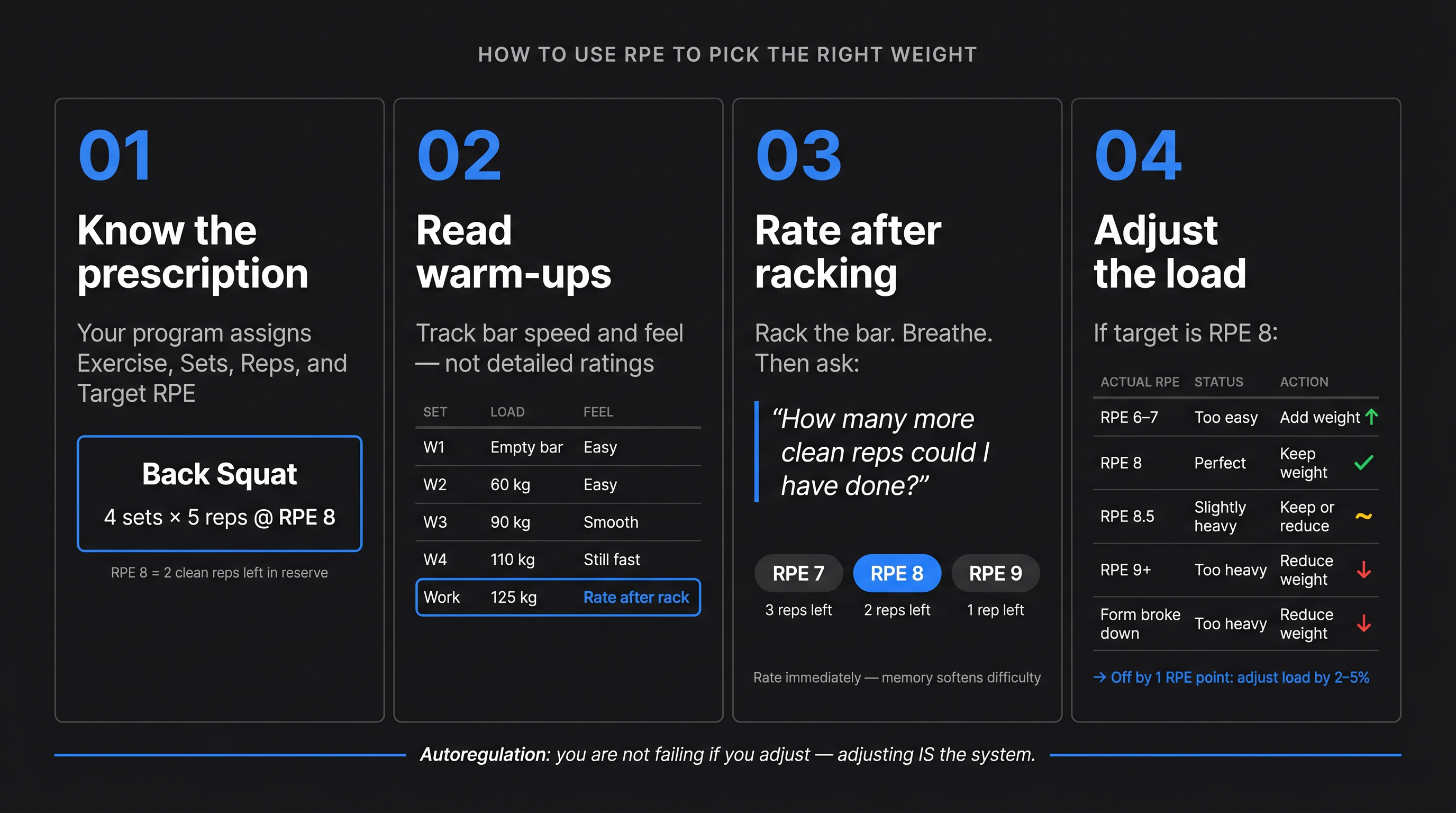
Here is the four-step process.
Step 1: Know your prescribed sets, reps, and RPE target
Your program gives you:
- Exercise
- Sets
- Reps
- Target RPE
Example: Back Squat — 4 sets of 5 @ RPE 8
That means every working set should feel like you had about 2 clean reps left.
Step 2: Use warm-ups to gauge how the bar feels
Do not rate every light warm-up set in detail. Just track how the bar feels. Is it moving fast? Does it feel heavier than normal? Those observations will guide your opening load choice.
| Set | Load | Reps | Notes |
|---|---|---|---|
| Warm-up 1 | Empty bar | 10 | Easy |
| Warm-up 2 | 60 kg | 5 | Easy |
| Warm-up 3 | 90 kg | 3 | Smooth |
| Warm-up 4 | 110 kg | 2 | Still fast |
| Working set | 125 kg | 5 | Rate after racking |
Step 3: Rate the set immediately after racking
Do not overthink it while you are lifting. Finish the set, rack the bar, breathe, then ask: "How many more clean reps could I have done?"
Rate immediately — before the next set starts and before your memory softens the difficulty. Reactive Training Systems recommends rating after the set rather than during, because execution and technique need to be your focus while you are under the bar.
Step 4: Adjust your load based on actual RPE
If the target is RPE 8:
| What Happened | Meaning | What to Do |
|---|---|---|
| Set felt RPE 6–7 | Too easy | Add weight |
| Set felt RPE 8 | Perfect | Keep weight |
| Set felt RPE 8.5 | Slightly heavy | Keep or reduce slightly |
| Set felt RPE 9+ | Too heavy | Reduce weight |
| Technique broke down | Too heavy regardless of RPE | Reduce weight |
A practical adjustment rule: if you are off by about 1 RPE point, adjust the load by roughly 2–5%. If you are off by 2 points, adjust more aggressively. In a 2018 study, Eric Helms and colleagues adjusted the load by 2% for every half RPE point a set missed its target (about 4% per rep), a similar calibration principle.
The key insight: you are not failing if you need to adjust. You are autoregulating — which is the entire point of using RPE.
Also useful: you can use RPE even when your program is built around percentages. The rule is simple:
Use percentages to plan. Use RPE to adjust.
If your program says 5x5 @ 80% and Set 1 feels like RPE 9.5, reduce the load. That set told you 80% was too heavy today. If it feels like RPE 6, you may be underloaded — add weight if technique is solid.
And if you don't know your 1RM, RPE works even better. Choose a rep target, build up load gradually, and stop when the set reaches your target RPE. You never need to test a maximum to use this system effectively.
Ready to Get Stronger?
Join 2,000,000+ lifters tracking their workouts with Stronger. Available on iOS and Android.


RPE in practice: real workout examples
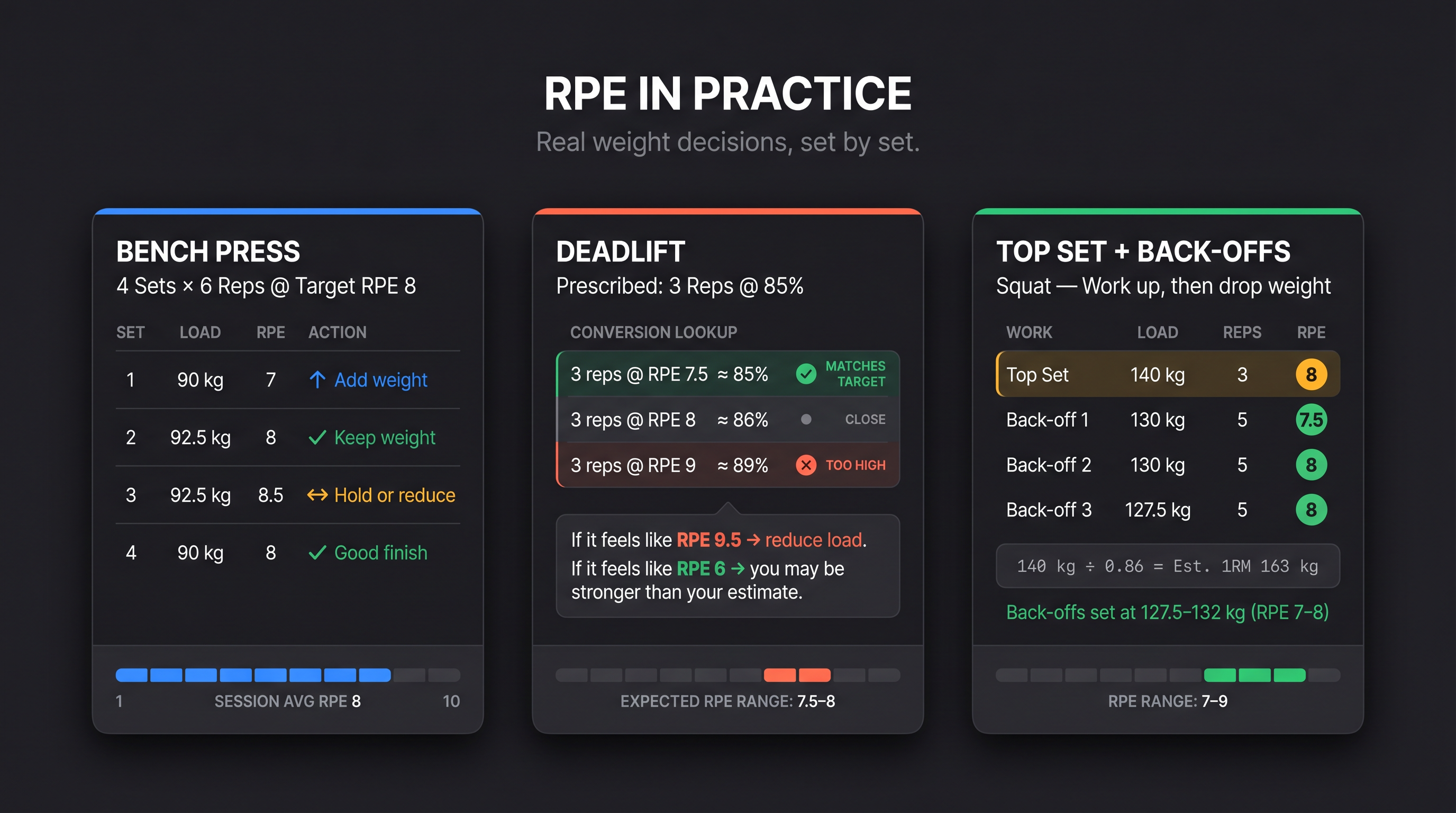
Bench press example: 4x6 at RPE 8
Your plan: Bench Press — 4 sets of 6 @ RPE 8
You estimate 90 kg should be close.
| Set | Load | Reps | Actual RPE | Decision |
|---|---|---|---|---|
| 1 | 90 kg | 6 | 7 | Too easy — add weight |
| 2 | 92.5 kg | 6 | 8 | Perfect — keep weight |
| 3 | 92.5 kg | 6 | 8.5 | Slightly heavy — keep or reduce |
| 4 | 90 kg | 6 | 8 | Good finish |
That is a successful session. You matched the planned effort without chasing a fixed number that your body wasn't ready for.
Converting percentages to RPE: deadlift example
Your program says: Deadlift — 3 reps at 85%
You want to know what RPE that should feel like. From the table:
- 3 reps @ RPE 7.5 ≈ 85%
- 3 reps @ RPE 8 ≈ 86%
- 3 reps @ RPE 9 ≈ 89%
So 3 reps at 85% should feel around RPE 7.5–8 for most lifters.
If it feels like RPE 9.5, one of three things has changed: your estimated max is off, your recovery is poor, or your technique isn't as efficient as usual. If it feels like RPE 6, you may be stronger than your current estimate.
Percentages give the structure. RPE tells you whether the structure fits today.
Top set and back-off sets: how RPE guides the drops
A classic strength setup: work up to a heavy top set, then drop the weight for volume.
Top set: 140 kg x 3 @ RPE 8
From the table, 3 reps @ RPE 8 ≈ 86%.
Estimated 1RM: 140 ÷ 0.86 = 163 kg
Now choose back-off volume. You want 5 reps @ RPE 7–8:
- 5 @ RPE 7 ≈ 79% → 163 × 0.79 = 128.8 kg
- 5 @ RPE 8 ≈ 81% → 163 × 0.81 = 132 kg
A reasonable back-off range: 127.5–132.5 kg
| Work | Load | Reps | RPE |
|---|---|---|---|
| Top set | 140 kg | 3 | 8 |
| Back-off 1 | 130 kg | 5 | 7.5 |
| Back-off 2 | 130 kg | 5 | 8 |
| Back-off 3 | 127.5 kg | 5 | 8 |
This is one of the best uses of RPE: your top set gives you a strength signal, and that day's performance tells you exactly where to set the back-off load.
What RPE should you train at?
The right RPE depends on your goal, your training age, and the exercise.
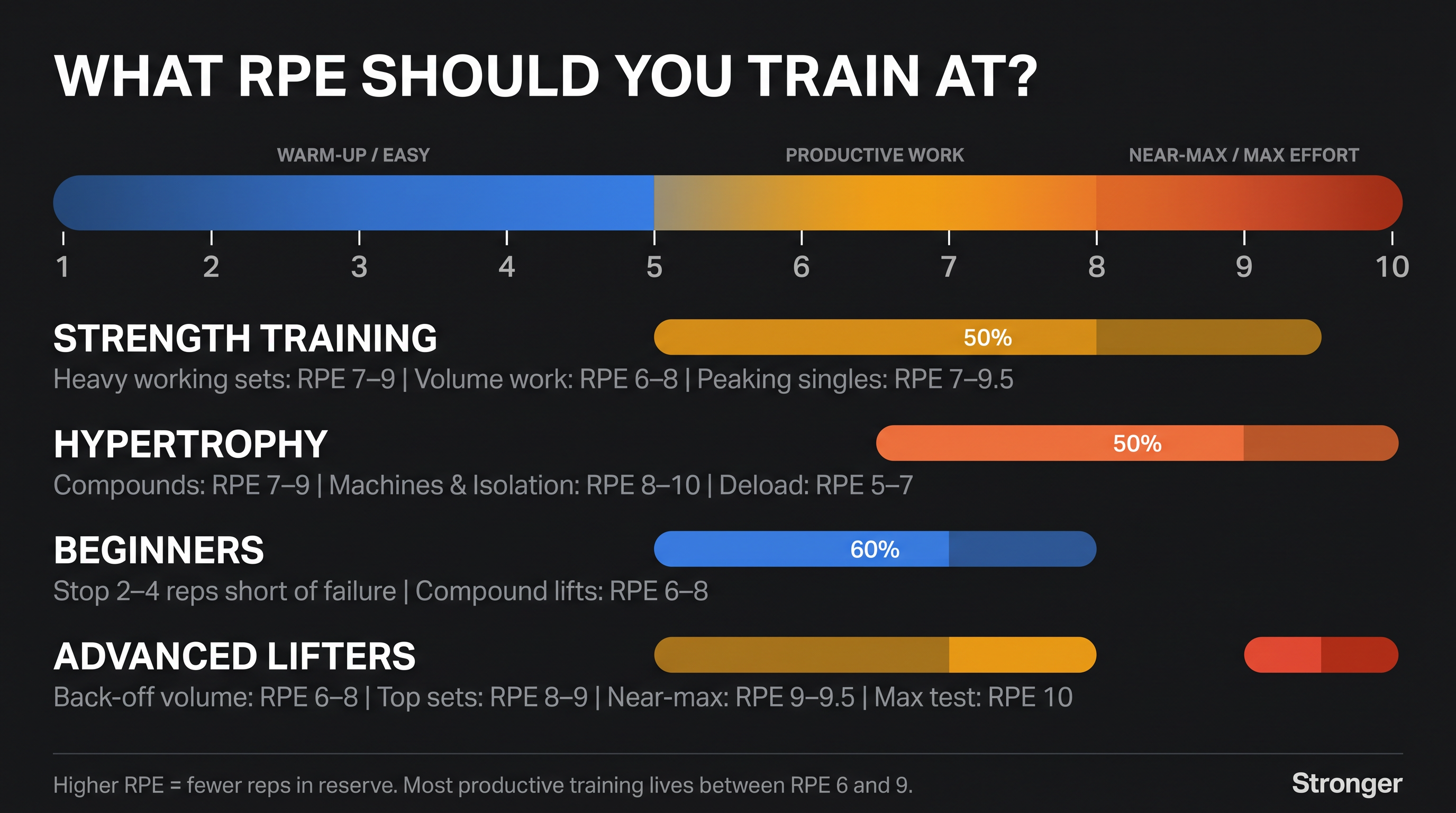
RPE ranges for strength training
Most productive strength work lives in the RPE 6–9 range. You need loads heavy enough to practice producing force, but you do not need to max out constantly. The 2026 ACSM resistance training update emphasizes individualized programming and highlights loads of at least 80% 1RM for 2–3 sets for strength training goals — while also noting that training to momentary failure does not consistently improve outcomes for the average healthy adult. [ACSM]
| Training Phase | Useful RPE Range |
|---|---|
| Technique work | RPE 5–7 |
| Volume strength work | RPE 6–8 |
| Heavy working sets | RPE 7–9 |
| Peaking singles | RPE 7–9.5 |
| True max testing | RPE 10 |
RPE ranges for muscle growth and hypertrophy
For hypertrophy, the evidence suggests training closer to failure for muscle growth produces better outcomes — but with important nuance. A 2024 Sports Medicine meta-regression found that strength gains were similar across a wide range of reps in reserve, while muscle hypertrophy tended to improve as sets were taken closer to failure. The researchers also noted limitations in how RIR was estimated across the studies. [Abertay University]
A Florida Atlantic University summary of that research suggested 0–5 reps short of failure for muscle growth and 3–5 reps short of failure for strength — while emphasizing that heavier loads matter more for strength than simply pushing to failure. [Florida Atlantic University]
| Exercise Type | Typical RPE Range |
|---|---|
| Heavy compounds | RPE 7–9 |
| Moderate compounds | RPE 8–9 |
| Machines | RPE 8–10 |
| Isolation lifts | RPE 8–10 |
| Deload hypertrophy work | RPE 5–7 |
For squats, deadlifts, and heavy barbell presses, constant RPE 10 work is rarely productive or sustainable. For lateral raises, curls, leg extensions, and machine rows, working close to failure is easier to recover from and safer to execute.
What RPE should beginners use?
Beginners should spend most training time around RPE 6–8.
Why? Because beginners are still developing technique, bracing, range of motion, and a sense of what "hard" actually feels like. RPE 10 on compound movements is not useful when every rep looks different.
The beginner rule: stop most compound sets with 2–4 clean reps in reserve. That is RPE 6–8. As technique stabilizes, you can gradually push closer to failure on exercises where form is solid.
RPE for advanced lifters: how to use it more aggressively
Advanced lifters use RPE more aggressively because they understand their limits better and their technique is stable across a wider effort range.
Common advanced RPE structure:
- Heavy singles: @ RPE 7–8 before volume work
- Top sets: @ RPE 8–9
- Back-off volume: @ RPE 6–8
- Occasional near-max work: @ RPE 9–9.5
- True RPE 10 testing: only when planned
Advanced lifters also benefit most from tracking RPE trends. When a weight that used to feel like RPE 7 suddenly feels like RPE 9, that is data — not an anomaly to push through. This is exactly where structured programs like a 5x5 strength program pair well with RPE: the program gives structure, RPE tells you whether it's working.
RPE by lift: squat, deadlift, bench press, and more
Not all exercises respond the same way to high RPE. This is one of the most important practical lessons in RPE-based training.
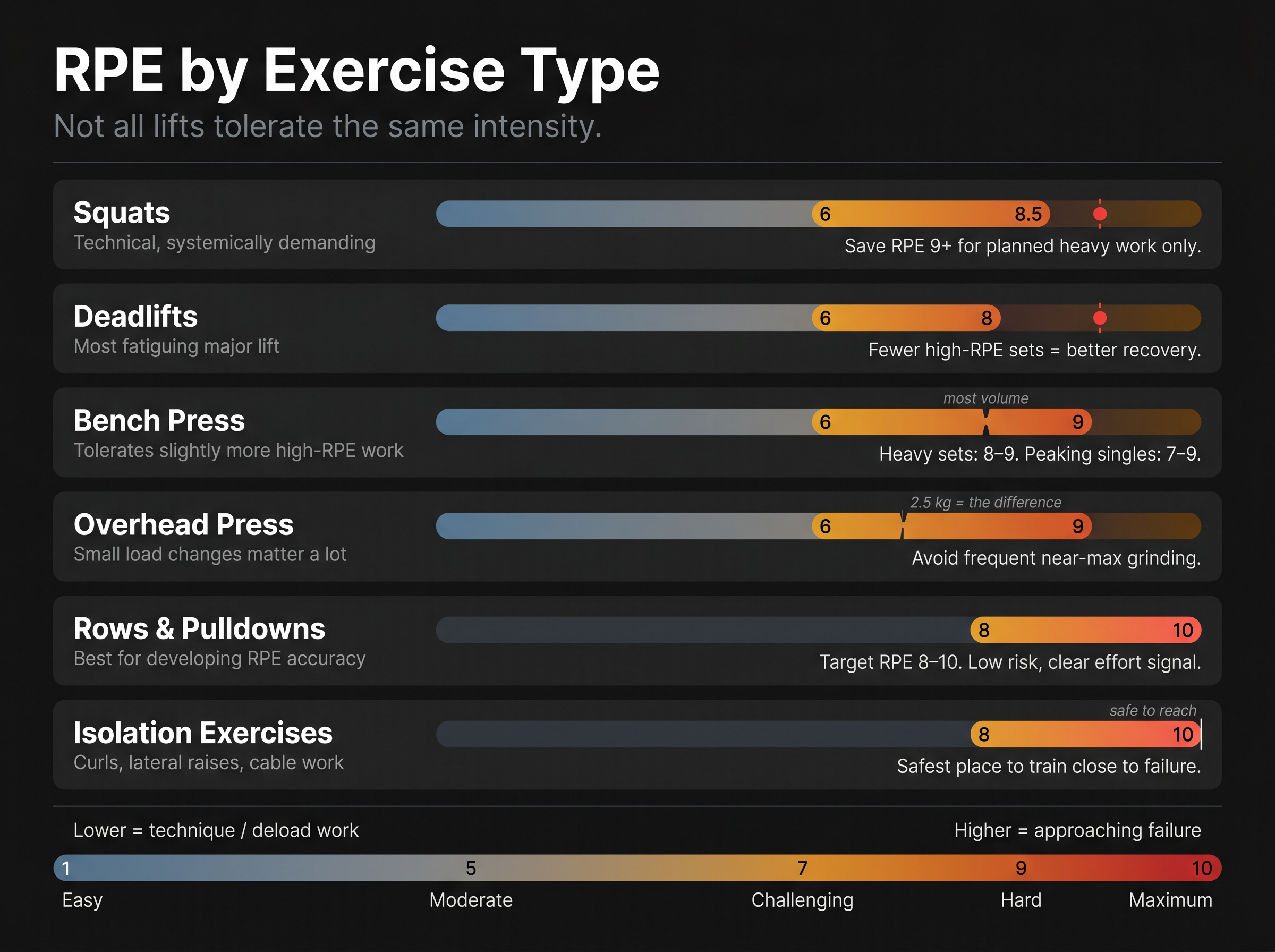
Squats are technical and systemically demanding. Most squat volume should stay around RPE 6–8.5. Save RPE 9+ for planned heavy work only. Squatting to failure frequently is usually counterproductive. Our complete squat guide covers the form and programming fundamentals you need to make high-RPE squat sessions productive.
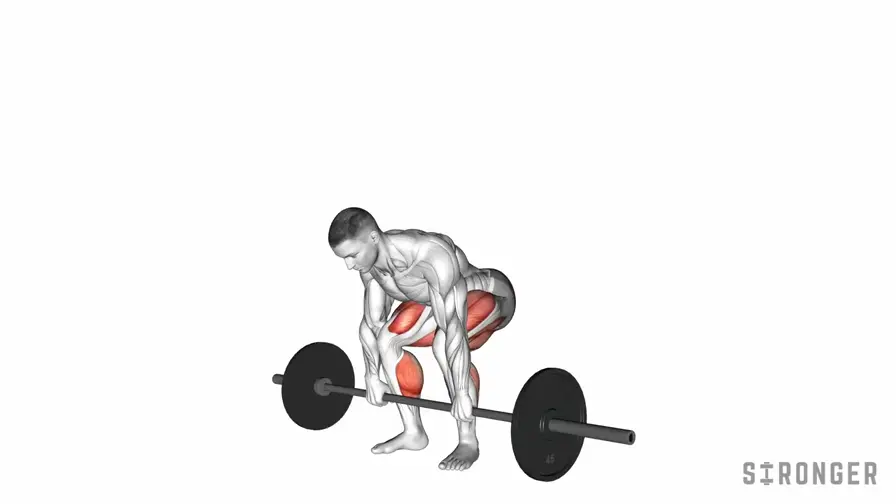
Deadlifts are the most fatiguing of the major lifts for most people. Fewer RPE 9+ deadlift sets per week is usually better for recovery. Most volume: RPE 6–8. Heavy pulls: RPE 8–9. True max testing: planned occasions only. See our deadlift guide for setup and technique that helps you accurately gauge effort on every pull.
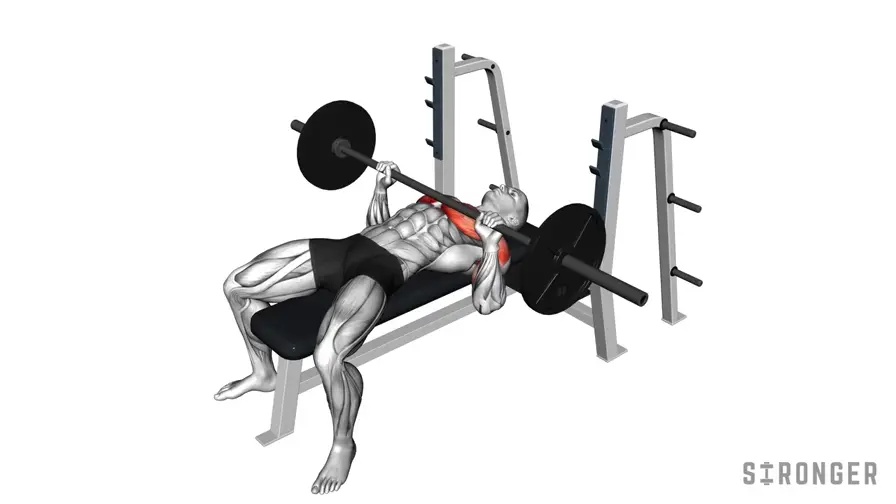
Bench press generally tolerates slightly more high-RPE work than squats or deadlifts. Most volume: RPE 6–8. Heavy sets: RPE 8–9. Peaking singles: RPE 7–9. Occasional grinders are acceptable when technique stays consistent. Our bench press guide covers the setup details that make a difference at higher intensities.
Overhead press is an exercise where small weight changes matter a lot — the difference between "fine" and "stuck" is often 2.5 kg. Most volume: RPE 6–8. Heavy sets: RPE 8–9. Avoid frequent near-max grinding. The overhead press guide explains why tiny adjustments matter so much with this lift.
Rows and pulldowns are some of the best exercises for developing RPE accuracy. Lower risk, easy to reset form, and the effort signal is clear. Target: RPE 8–10 on most working sets. Keep torso position and range of motion consistent so the rating is meaningful. Our barbell row guide covers the form cues that keep your row RPE ratings accurate.
Isolation exercises — lateral raises, curls, leg extensions, cable work — are the safest place to regularly train close to failure. RPE 8–10 is productive and recovery cost is low. Use strict form throughout so "more reps left" means something real.
How accurate is RPE? What the research says
RPE is useful. It is not infallible. Here is what the research actually shows.
A 2022 study in the Journal of Strength and Conditioning Research found RIR to be a reliable load-prescription tool in young novice males for the deadlift and bench press, with high test-retest reliability. [OUCI — Lovegrove et al.]
A 2023 study in Perceptual and Motor Skills found that intraset RIR predictions were more accurate when lifters were closer to failure and in later sets. Sex, training experience, and RIR-rating experience did not significantly affect prediction accuracy in that study's machine-based exercises. [Sage Journals]
A 2025 study in Experimental Gerontology found that predicted RIR was not accurate enough for precise resistance-exercise prescription in community-dwelling older adults, though it may still help with volume monitoring when interpreted alongside other signals. [ScienceDirect]
The right conclusion is not "RPE is perfect" or "RPE is useless."
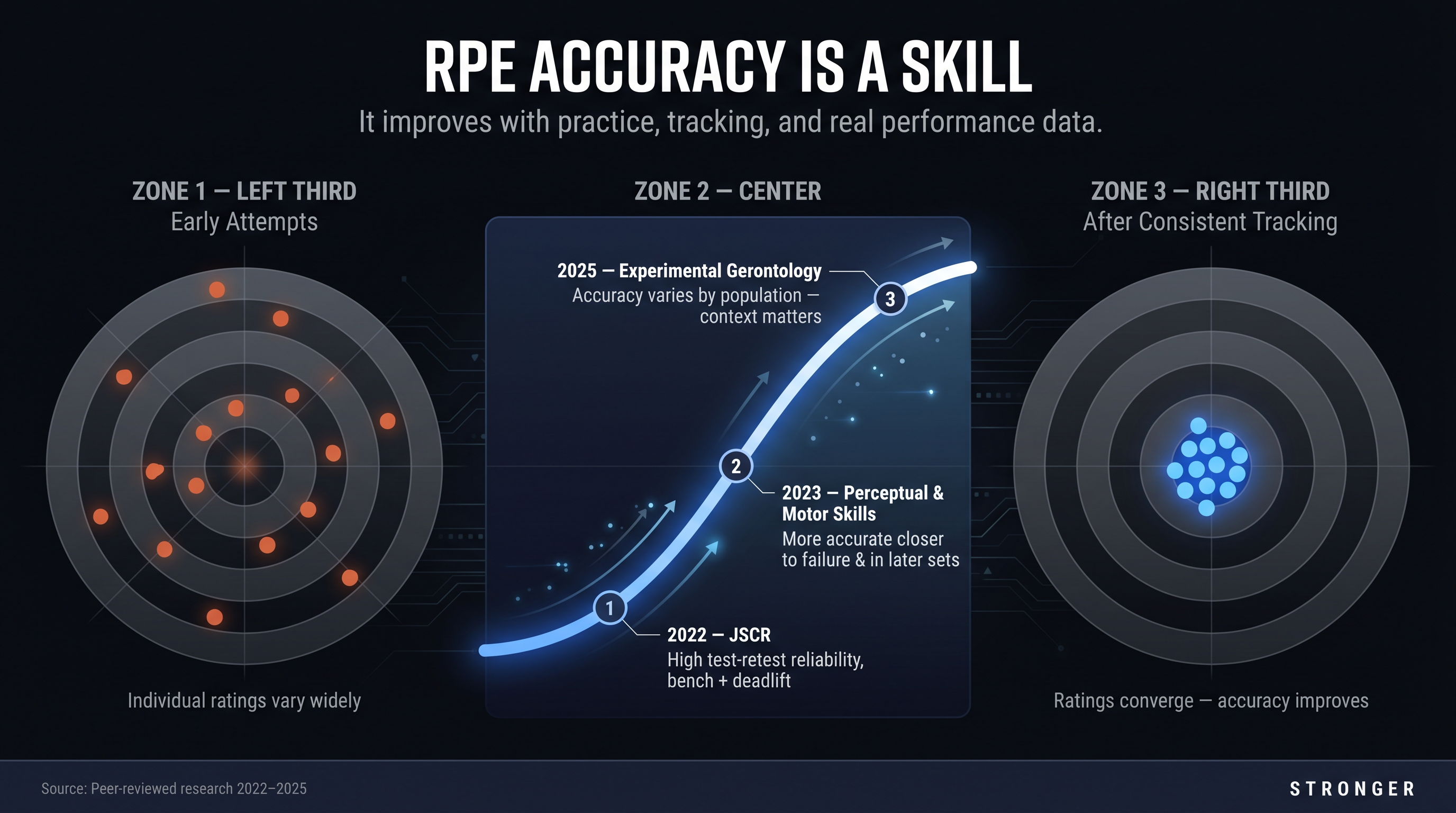
The right conclusion is:
RPE is a skill. It gets more useful the more you practice it, track it, and compare it to real performance data over time.
One bad RPE rating means nothing. A month of ratings is a valuable feedback system.
How to get better at rating RPE
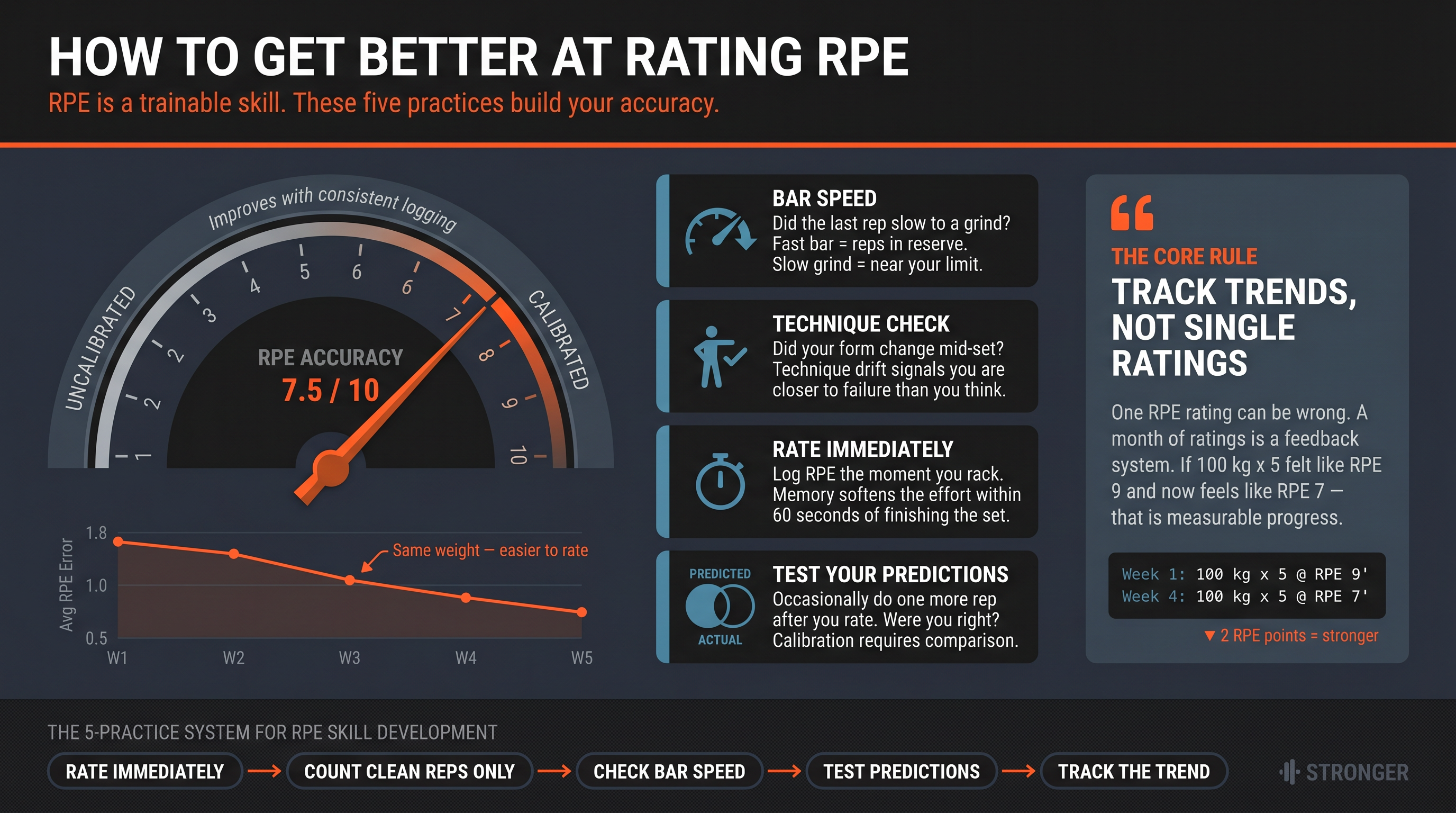
1. Rate every set immediately after you rack
Do not wait until the end of the workout to recall how a set felt. The moment you rack the bar — breathe, then ask: "How many more clean reps could I have done?" Write it down before the next set starts.
2. Count only clean reps in reserve
RPE should be based on reps you could complete with acceptable technique — not grinding, ugly ones that change movement patterns.
RIR = clean reps left before technical failure.
If you think you could squeeze out two more reps by turning a squat into a good morning, that is not 2 RIR. That is a technique breakdown waiting to happen.
3. Use bar speed to check your RPE accuracy
You do not need velocity tracking equipment. Just notice:
- Did the last rep move fast or slow?
- Did your technique change across the set?
- Did you need to grind?
- Did you hesitate before the last rep?
Bar speed does not equal RPE, but it helps you calibrate your perception against what actually happened.
4. Test your RPE predictions occasionally
Pick a safe exercise — a machine row, a leg extension — and after rating the set, do one more rep. Were you right? Did you actually have 2 reps left when you said you did?
Do this sparingly on compounds. The goal is calibration, not exhaustion.
5. Track RPE trends, not individual ratings
One RPE rating can be wrong. A month of RPE ratings is useful data.
If 100 kg x 5 used to feel like RPE 9 and now feels like RPE 7, you are stronger or more technically efficient. If that same weight suddenly feels 2 RPE points harder, something changed: sleep, recovery between sessions, stress, nutrition, warm-up, or cumulative training fatigue. The trend tells you something your spreadsheet cannot.
Common RPE mistakes and how to avoid them
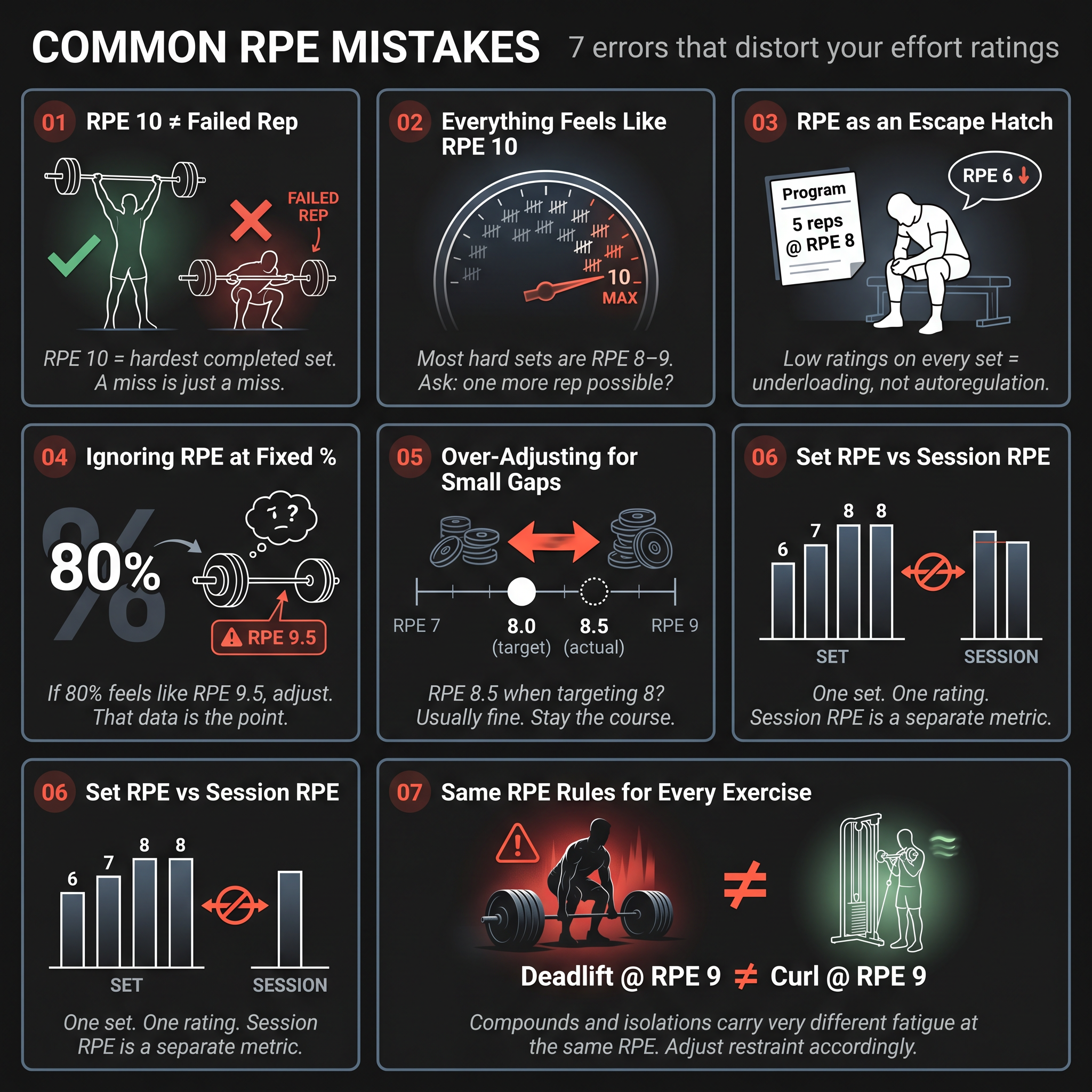
Mistake 1: Treating RPE 10 as a failed rep
A failed rep is not RPE 10.
RPE 10 means the hardest set you completed. You finished the prescribed reps and had no clean reps left — but you finished. Reactive Training Systems defines RPE 10 as a maximum-effort completed set. Missing a rep is simply a miss, not a working set target.
Mistake 2: Rating every hard set as RPE 10
If every set is RPE 10, your ratings are probably not accurate. Ask:
- Could I have done one more rep?
- Could I have added 2.5 kg?
- Did the last rep slow to a genuine grind?
- Was I scared of the weight, or was I physically at my limit?
Most "hard" sets are RPE 8–9, not 10.
Mistake 3: Using RPE as an excuse to avoid effort
Some lifters use RPE as an escape hatch. If the program says 5 reps @ RPE 8 and every set becomes RPE 6, you are underloading the session — not autoregulating it. RPE is a way to hit the right effort, not an excuse to avoid it.
Mistake 4: Ignoring RPE when training by percentage
If a set is prescribed at 80% but feels like RPE 9.5, grinding more sets at the same load creates junk fatigue. RPE exists so you can adjust — use it.
Mistake 5: Making large load adjustments for small RPE gaps
If you are within half an RPE point of target, you can usually keep the same load. Target RPE 8, actual RPE 8.5 — that is close enough for most training. Constant micro-adjustments create unnecessary complexity.
Mistake 6: Confusing set RPE with session RPE
Set RPE and session RPE are different things.
- Set RPE: how hard one specific set was
- Session RPE: how hard the whole workout felt overall
Both have value. Do not confuse them or blend them into one number.
Mistake 7: Applying the same RPE rules to every exercise
A set of deadlifts @ RPE 9 creates very different fatigue than a set of cable curls @ RPE 9. Use higher RPE more freely on stable, lower-risk exercises. Use more restraint with technical compounds.
RPE programming templates for every training goal
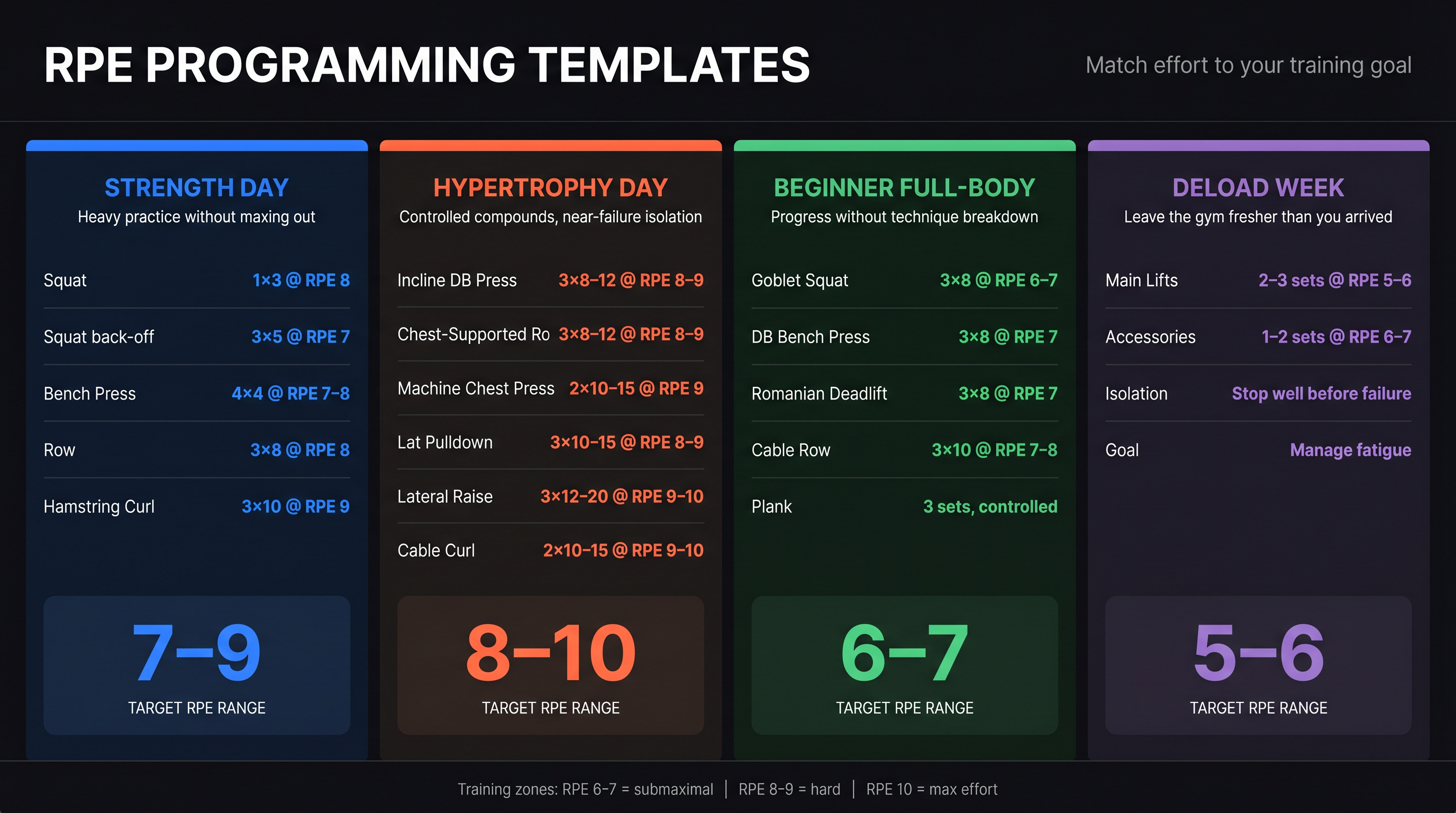
Strength day RPE template
| Exercise | Prescription |
|---|---|
| Squat | Work up to 1x3 @ RPE 8 |
| Squat back-off | 3x5 @ RPE 7 |
| Bench press | 4x4 @ RPE 7–8 |
| Row | 3x8 @ RPE 8 |
| Hamstring curl | 3x10 @ RPE 9 |
Why it works: heavy practice without constant maxing out. The back-off sets (lower-intensity volume after a heavy top set) let you accumulate work at a recoverable intensity.
Hypertrophy day RPE template
| Exercise | Prescription |
|---|---|
| Incline dumbbell press | 3x8–12 @ RPE 8–9 |
| Chest-supported row | 3x8–12 @ RPE 8–9 |
| Machine chest press | 2x10–15 @ RPE 9 |
| Lat pulldown | 3x10–15 @ RPE 8–9 |
| Lateral raise | 3x12–20 @ RPE 9–10 |
| Cable curl | 2x10–15 @ RPE 9–10 |
Why it works: compounds stay controlled while isolation work can go closer to failure safely.
Beginner full-body RPE template
| Exercise | Prescription |
|---|---|
| Goblet squat | 3x8 @ RPE 6–7 |
| Dumbbell bench press | 3x8 @ RPE 7 |
| Romanian deadlift | 3x8 @ RPE 7 |
| Cable row | 3x10 @ RPE 7–8 |
| Plank | 3 sets, controlled |
Why it works: enough challenge to stimulate progress without pushing to technique breakdown.
Deload week RPE template
| Exercise Type | Prescription |
|---|---|
| Main lifts | 2–3 sets @ RPE 5–6 |
| Accessories | 1–2 sets @ RPE 6–7 |
| Isolation | Stop well before failure |
| Goal | Leave the gym fresher than you arrived |
Why it works: you maintain the movement patterns while significantly reducing cumulative fatigue.
Ready to Get Stronger?
Join 2,000,000+ lifters tracking their workouts with Stronger. Available on iOS and Android.
How RPE and progressive overload work together
Progressive overload does not mean adding weight every session no matter what. It means increasing training demand over time in a way your body can actually recover from.
RPE gives you more levers to pull:
| Progression Type | Example |
|---|---|
| Add weight at same RPE | 100 kg x 5 @ 8 → 105 kg x 5 @ 8 |
| Add reps at same RPE | 100 kg x 5 @ 8 → 100 kg x 6 @ 8 |
| Same load, lower RPE | 100 kg x 5 @ 9 → 100 kg x 5 @ 7.5 |
| More sets at same RPE | 3 sets @ 8 → 4 sets @ 8 |
| Better technique at same load | Same numbers, cleaner, more controlled reps |
That last type matters more than most lifters realize. If your weight and reps are identical but your RPE dropped two points, you are progressing. The adaptation happened. The numbers just haven't caught up yet.
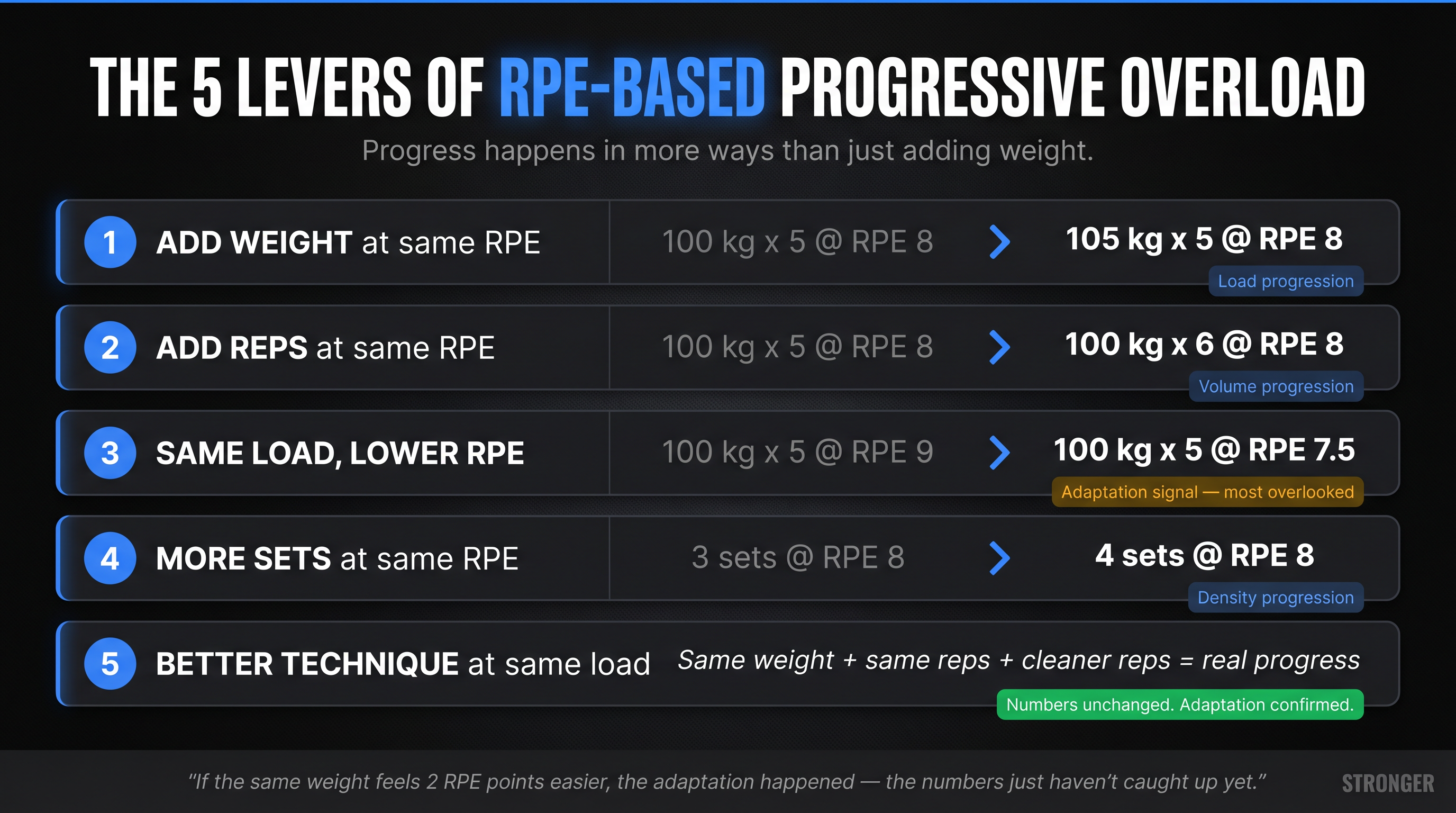
This is why tracking RPE is so powerful: it separates "I lifted the same weight" from "I lifted the same weight significantly more easily."
Track RPE for every set with Stronger
All of this only works if you record it. Memory of how a set felt is unreliable — the details blur within minutes of finishing the workout.
Stronger lets you log RPE on every set, because effort data adds so much context to your training. Every working set you log includes:
- Exercise
- Weight
- Reps
- Sets
- RPE per set
- Rest period
- PR detection (automatic)
- Progress over time
The reason this matters: RPE is not just a one-set number. It is training context.
Here is a real example of why that context is invaluable:
- Week 1: Bench press 90 kg x 6 @ RPE 9
- Week 4: Bench press 90 kg x 6 @ RPE 7.5
The weight and reps are identical. If you are only logging weight and reps, those two sessions look the same. But with RPE logged, you can see the second result clearly: the same weight got meaningfully easier. That is real strength gain — you just could not see it without the effort data.
Stronger is built around measurable lifting progress: logging sessions, reviewing training history, using adaptive routines, tracking analytics, and benchmarking your overall strength with our Strength Score system. RPE adds the layer that puts all of it in context — not just what you lifted, but how hard it actually was.
Use this guide alongside Stronger's other resources:
- Stronger Features — how Strength Score, adaptive routines, and analytics work together
- Stronger Exercise Library — pair better RPE ratings with better exercise execution (400+ exercises with instructions, muscles worked, and coaching cues)
- Compound Exercises Guide — applying RPE to squats, deadlifts, presses, rows, and pull-ups
Ready to start tracking RPE with every set? Download Stronger free and get started today.
Frequently asked questions about RPE in lifting
Understanding the basics
What does RPE mean in lifting?
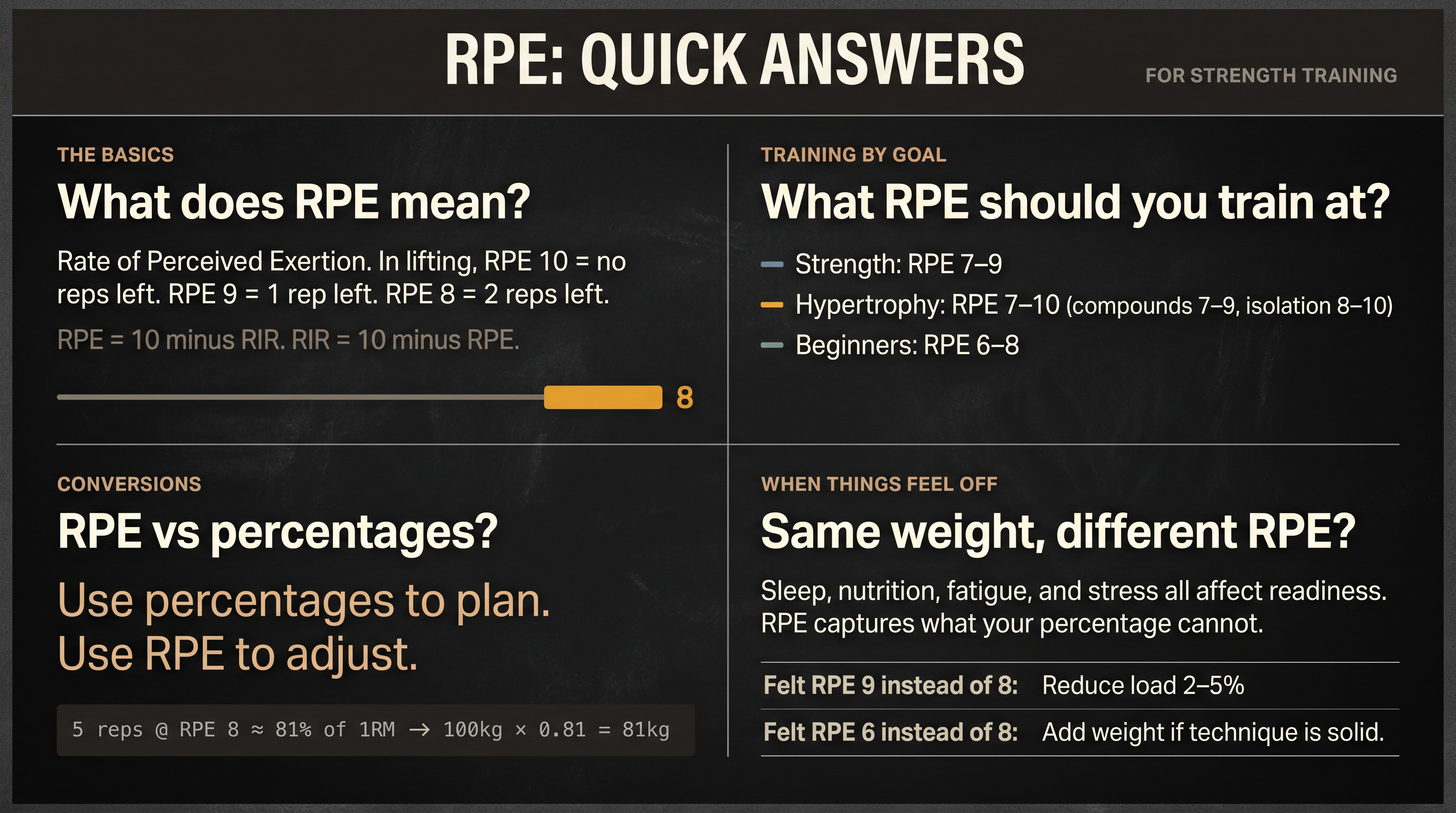
RPE stands for rate of perceived exertion. In lifting, it is a 1–10 effort score based on how many clean reps you had left at the end of a set. RPE 10 means no reps left, RPE 9 means one rep left, RPE 8 means two reps left, and RPE 7 means three reps left.
What is the difference between RPE and RIR?
RPE is the effort score on a 1–10 scale. RIR (reps in reserve) is the specific number of reps you had left. The conversion is direct: RPE = 10 − RIR. So 2 RIR equals RPE 8, and 3 RIR equals RPE 7.
Is RPE 10 the same as failing a rep?
No. RPE 10 means you completed the set and had no clean reps remaining — the hardest set you could finish. A missed rep (a true fail) is different. RPE 10 is not a target for most working sets; it is reserved for planned max testing or final sets on low-risk exercises.
Training guidance by goal and lift
Is RPE 8 good for building muscle?
Yes. RPE 8 means you stopped with about 2 reps in reserve, which is close enough to failure for productive hypertrophy on compound lifts. Isolation and machine exercises can often be pushed to RPE 9–10 with lower recovery cost.
Is RPE 8 good for strength?
Yes. RPE 8 is one of the most common and useful strength-training targets. It is heavy enough to practice force production, but not so heavy that recovery becomes the limiting factor. Most strength programs use top sets and volume work in the RPE 7–8 range.
Should beginners use RPE?
Yes, but simply. Start by asking: "How many clean reps did I have left?" Most beginner compound work should stop at around RPE 6–8 while technique is still developing. As form gets more consistent, you can push closer to failure on exercises where you feel stable.
What RPE should I use for squats?
Most squat volume should be around RPE 6–8.5. Use RPE 9+ sparingly for planned heavy work. Frequent squat failure is rarely productive and carries a higher technique-breakdown risk. Our squat guide covers the form basics that make RPE feedback more accurate on this lift.
What RPE should I use for deadlifts?
Most deadlift work should live around RPE 6–8. Heavy deadlift sets at RPE 8–9 can be useful, but frequent RPE 10 pulling is too fatiguing for most training blocks. Our deadlift guide walks through setup and technique fundamentals.
What RPE should I use for bodybuilding?
For hypertrophy, target RPE 7–9 on compound lifts and RPE 8–10 on isolation or machine exercises. The closer you train to failure, the more important recovery and strict technique become.
Calculations and conversion
Can I use RPE without knowing my 1RM?
Yes — and RPE is especially useful in this case. Choose your rep target, gradually increase the load, and stop when the set reaches your target RPE. You never need to test a true maximum to use this system effectively.
How do I convert RPE to percentage of 1RM?
Use both reps and RPE together. For example, 5 reps @ RPE 8 ≈ 81% of 1RM, while 3 reps @ RPE 8 ≈ 86% of 1RM. RPE alone is not enough — the number of reps changes the percentage estimate significantly.
Is RPE better than percentages?
Neither is "better" in isolation. Percentages are excellent for planning the structure of your program. RPE is excellent for adjusting that structure to match your actual readiness on any given day. The two systems work best together: use percentages to plan, use RPE to adjust.
How often should I train at RPE 10?
Rarely. RPE 10 is appropriate for planned max testing, occasional heavy singles during a peaking phase, and some isolation exercises where failure risk is low. It should not be the default for regular compound training.
When things feel off
Why does the same weight feel like different RPEs on different days?
Because your readiness changes. Sleep quality, nutrition, hydration, stress, accumulated fatigue, soreness, how well you recovered between sessions, and even motivation can all affect how heavy a load feels. That variability is exactly why RPE is useful — it helps you respond to your actual condition rather than forcing a number that may not fit.
What should I do if my target is RPE 8 but the set feels like RPE 9?
Reduce the load for the next set. A reduction of 2–5% is usually enough if you are off by one RPE point. Your job is to match the target effort, not the weight.
What should I do if my target is RPE 8 but the set feels like RPE 6?
Increase the load if your technique is strong and you feel good. You are under the planned effort, and the session will be less productive if every set stays there.
RPE in lifting: the key takeaways
RPE is not just a "feelings" score. Used consistently, it is a practical feedback system that answers the question your spreadsheet cannot: how hard was that for you today?
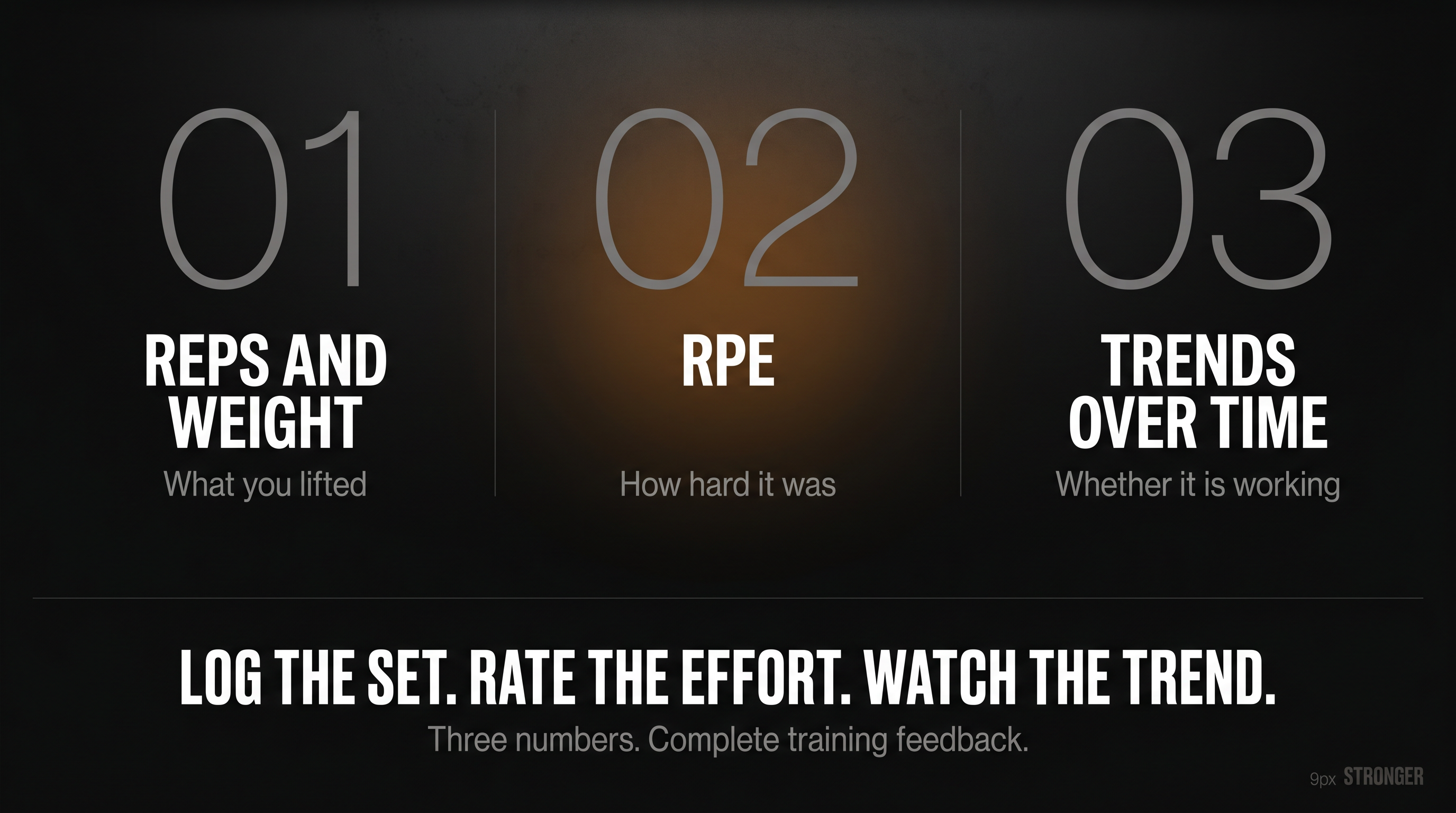
Three numbers tell the whole story of a training session:
- Reps and weight — what you lifted
- RPE — how hard it was
- Trends over time — whether it's working
For most training, the rules are simple:
- Use RPE 6–8 for technique work, volume sets, and sustainable strength building
- Use RPE 8–9 for hard working sets and heavy training
- Use RPE 9–10 carefully — mostly for planned heavy work and low-risk isolation exercises
- Track RPE consistently so your training history has context
The best program is not the one that destroys you every session. It is the one that gives you enough stimulus to adapt, enough recovery to repeat, and enough data to know what is actually working.
Log the set. Rate the effort. Watch the trend. Get stronger.
Sources
This guide was researched and updated on April 30, 2026. RPE science draws on both recent and foundational sources. Sources from 2024–2026 were prioritized where available; older sources are included where they are foundational to the field.
Exercises in this guide
Deadlift
Clean
Barbell Bench Press
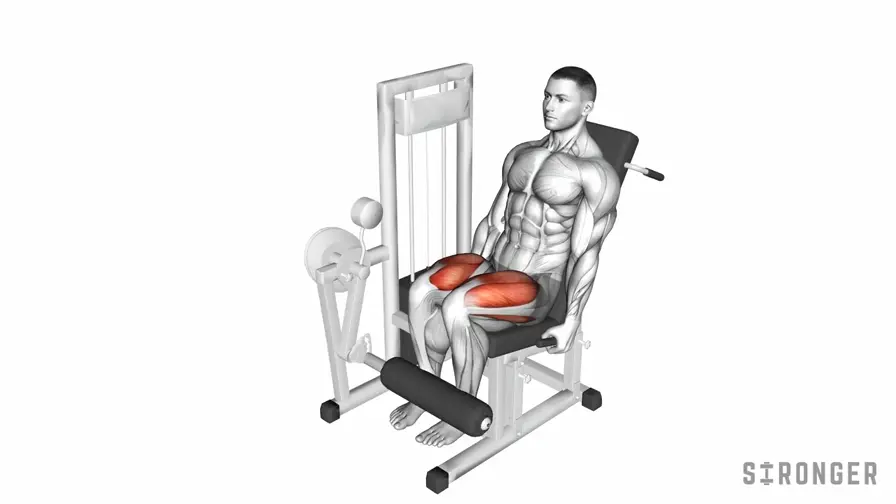
Leg Extension
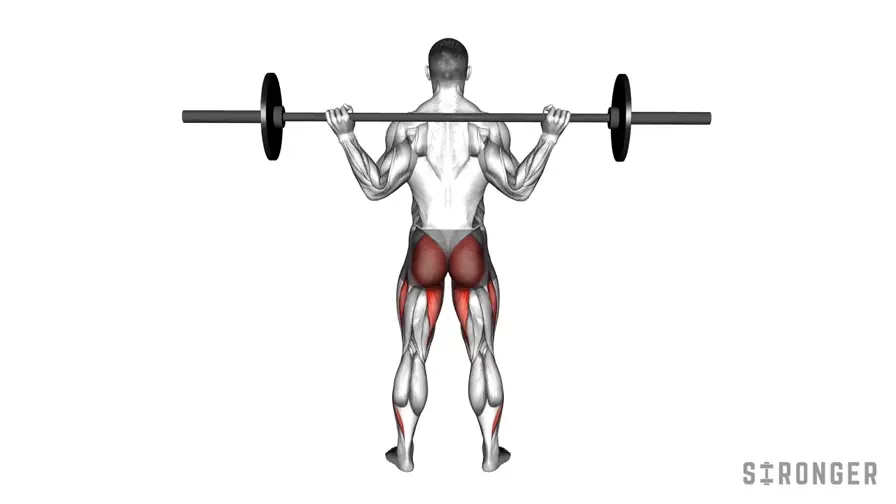
Barbell Back Squat
Stronger Editorial Team
Certified strength & conditioning specialists with 10+ years of coaching experience
The Stronger editorial team produces evidence-based training content for lifters of all levels.
Ready to Get Stronger?
Join 2,000,000+ lifters tracking their workouts with Stronger. Available on iOS and Android.