
Hypertrophy vs Strength: What Actually Changes
You have probably seen both in the gym. The lifter who looks like they should move serious weight — but can't. And the lifter who looks unremarkable until you watch them squat something that clears the room.
Neither is a paradox. Both are exactly what happens when training is optimised for one adaptation and not the other.
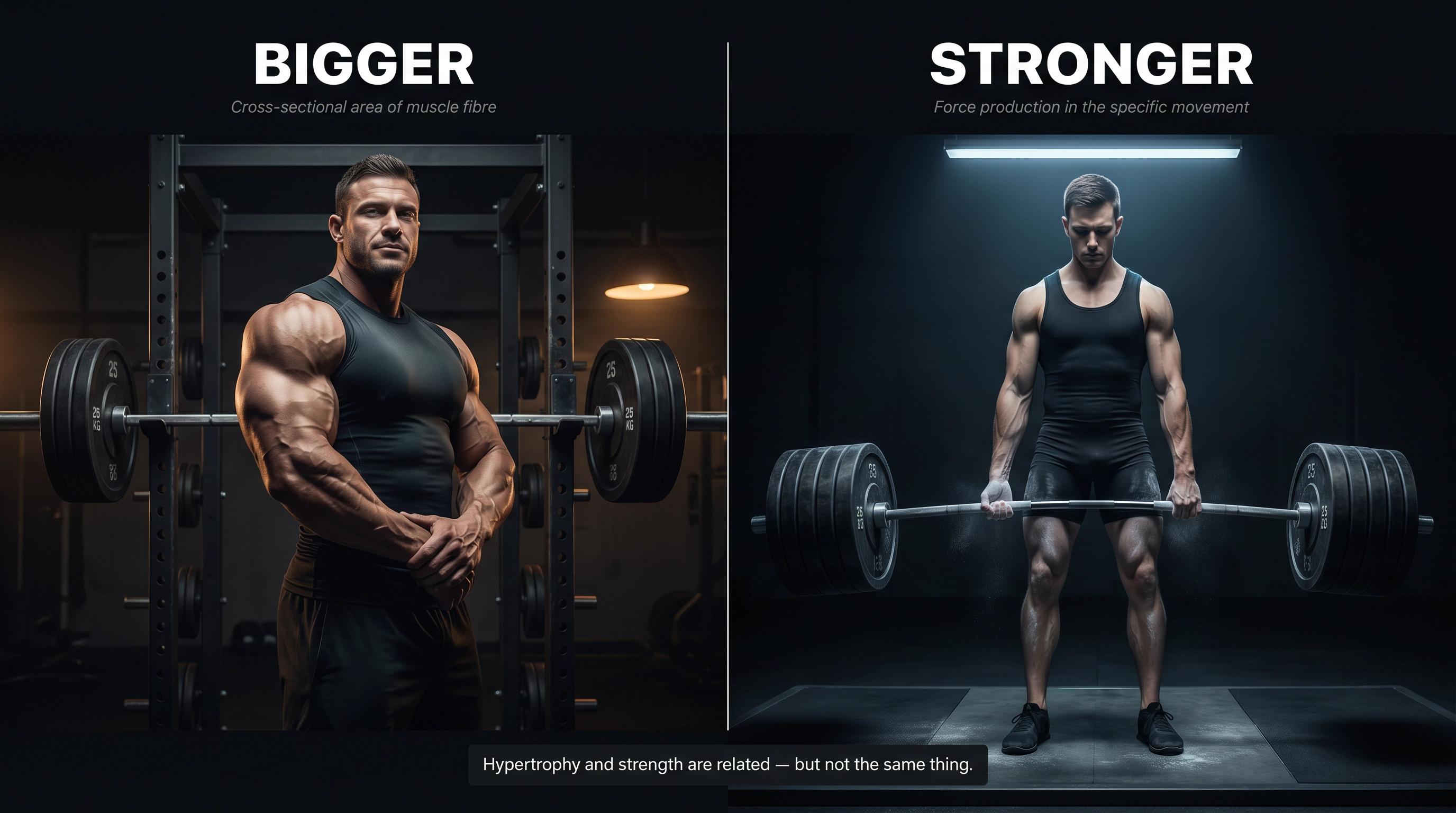
The real difference between hypertrophy and strength training is not rep ranges. Rep ranges are a downstream consequence of a deeper distinction. Hypertrophy changes how much muscle you have. Strength changes how much force you can produce in a specific movement. Those are related — but not the same thing. A larger muscle has more potential to produce force, but maximal strength also depends on your nervous system, technique, bar path, confidence under heavy loads, and how specifically you have practised the lift.
That is why two people can have similar physiques and very different one-rep maxes. It is also why you can get significantly stronger in your first months of lifting without looking noticeably different — early strength gains are often neural, not muscular.
The 2026 American College of Sports Medicine resistance training position stand — the first major update since 2009, built on 137 systematic reviews and data from more than 30,000 participants — confirmed that you can significantly improve your results by matching load, volume, effort, and progression to your specific goal.
The central practical message: For strength: heavier loads around 80% of your one-rep max. For hypertrophy: higher weekly volume, with roughly 10 hard sets per muscle group as a practical starting point. (ACSM)
At Stronger, we track both adaptations — because most serious lifters need both. This guide explains what actually changes, physiologically and practically, when you train for each.
Hypertrophy vs Strength: A Side-by-Side Comparison
Before getting into the mechanisms, here is the overview. Every variable in this table is explained properly in the sections below.
| Variable | Hypertrophy focus | Strength focus |
|---|---|---|
| Primary goal | Increase muscle size | Increase force output in specific lifts |
| Main measurement | Muscle size, body measurements, progress photos, training volume, reps over time | 1RM, 3RM, 5RM, estimated 1RM, Strength Score, lift-specific PRs |
| Main adaptation | Muscle fibre growth and local tissue adaptation | Neural efficiency, skill, coordination, muscle size, technical mastery |
| Typical reps | Mostly 5–20, often 6–12 for efficiency | Mostly 1–6 on main lifts, with some 6–10 accessory work |
| Load | Broad range works if sets are hard enough | Heavier loads matter more, especially ≥80% 1RM |
| Weekly volume | Higher priority; built around hard sets per muscle group | Enough to practise and build, but fatigue must be controlled |
| Failure | Useful near failure, especially for isolation and lighter loads | Usually stop short of failure on heavy compounds |
| Rest periods | Long enough to maintain reps and load; often 1.5–3 minutes | Longer; often 3–5 minutes for heavy compounds |
| Exercise choice | Stable exercises that load the target muscle well | Specific practice on the lift you want to improve |
| Progression | Add reps, sets, load, range of motion, or quality | Add load, improve bar speed, refine technique, increase estimated 1RM |
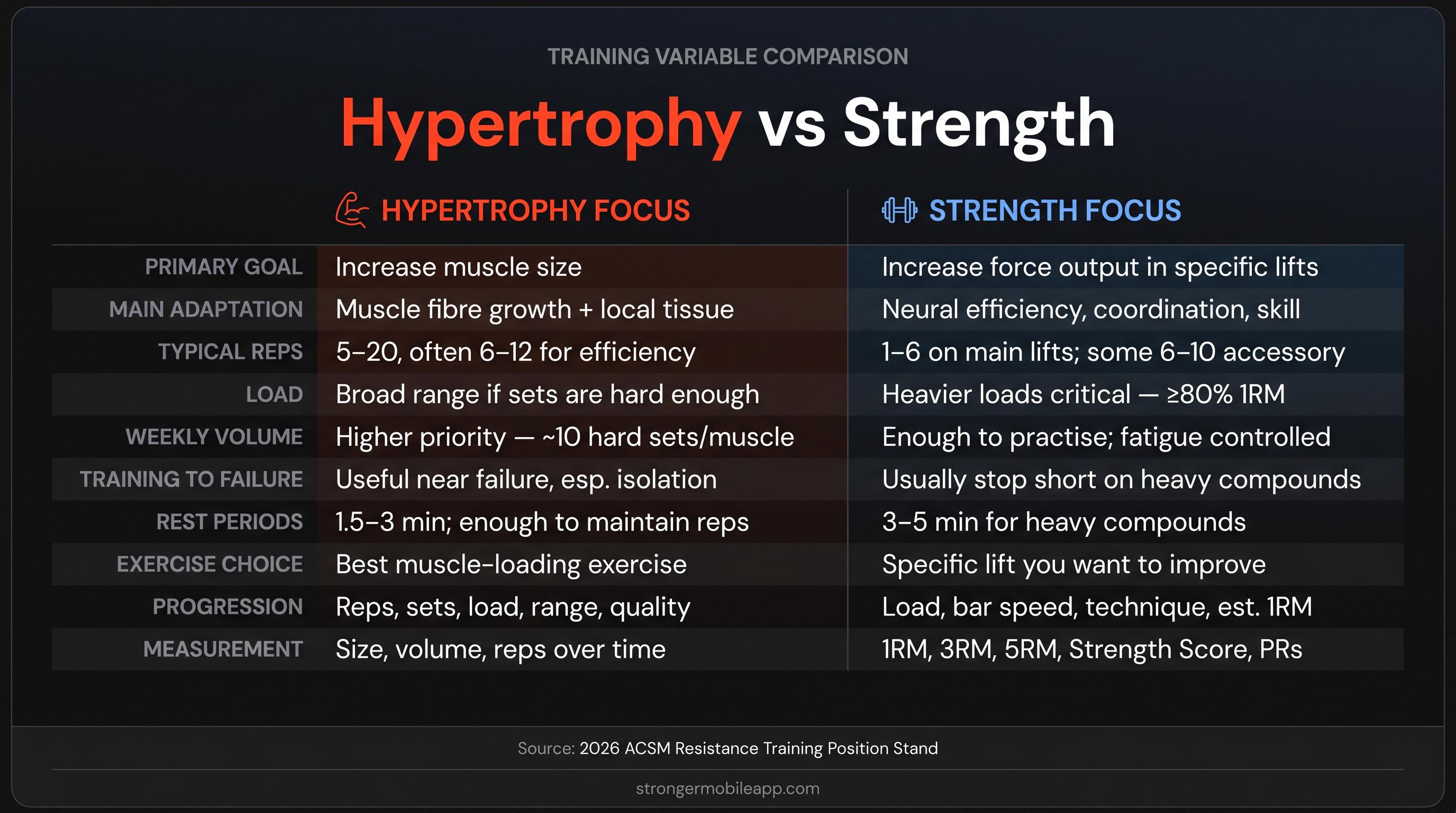
The biggest mistake is treating this as a forced binary. Most serious lifters need both — muscle gives strength somewhere to come from, and strength lets you use heavier loads to produce more productive hypertrophy work.
What Is Hypertrophy? The Science of Muscle Growth
Hypertrophy means an increase in muscle size.
In physiological terms, it refers to an increase in the cross-sectional area of muscle fibres — not just "toning" or "getting harder," but actual growth of contractile tissue and the local structures that support force production.
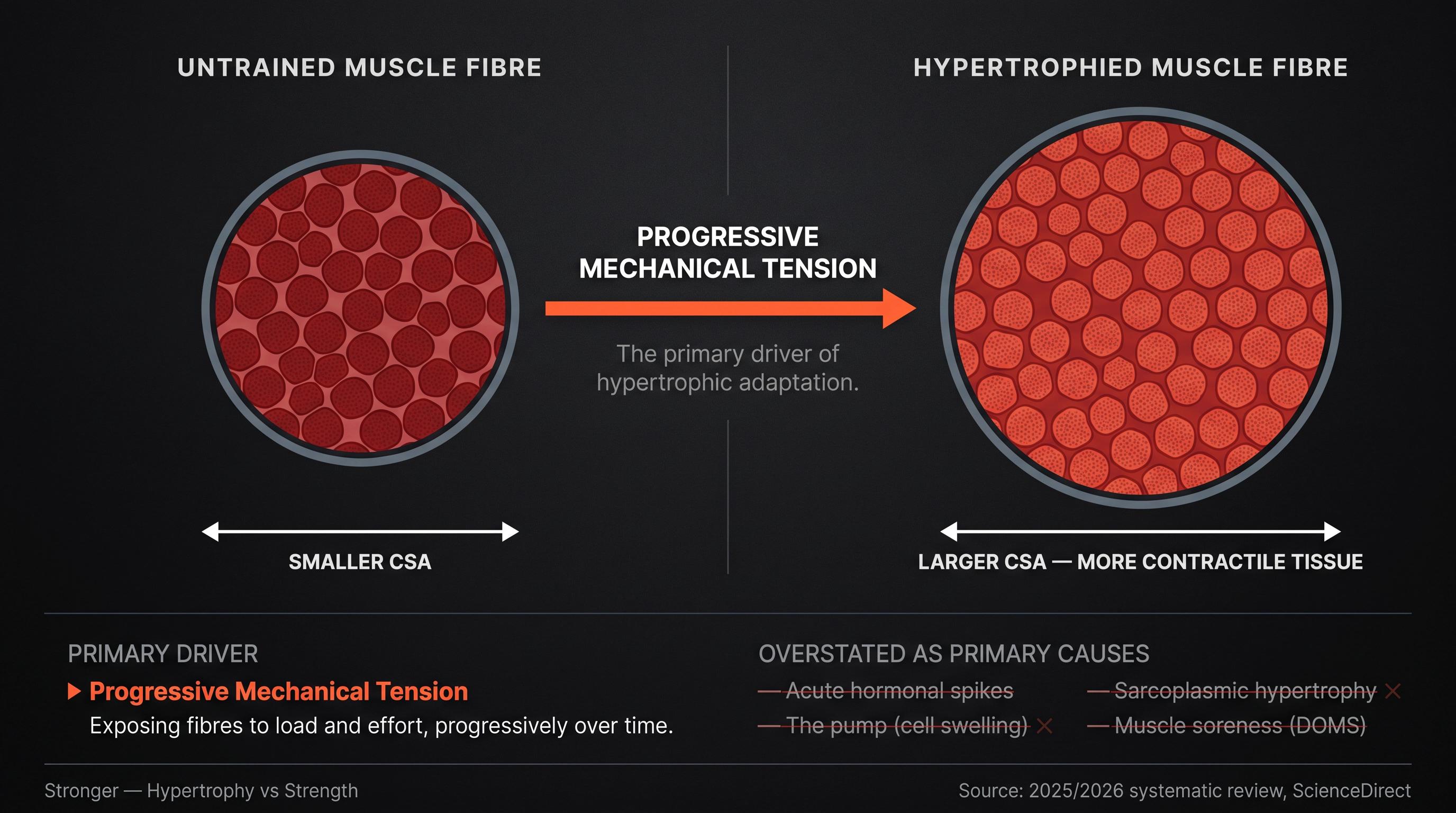
The strongest current explanation is that hypertrophy is driven primarily by progressive mechanical tension: repeatedly exposing muscle fibres to enough tension, effort, and weekly work that the body adapts by making the muscle larger. A 2025/2026 review on load-induced human skeletal muscle hypertrophy describes mechanical tension as the primary driver and argues that other commonly cited mechanisms — acute hormonal spikes, the pump, cell swelling, and sarcoplasmic hypertrophy — are often overstated as primary causes. (ScienceDirect)
This does not make the pump irrelevant. It can be a useful signal that the target muscle is working. But it is not the scoreboard. The scoreboard is whether you are loading the target muscle progressively over time and recovering well enough to grow.
What Is Strength Training? The Science of Force Production
Strength means the ability to produce force in a specific movement.
In the gym, it is usually measured by performance — how much you can squat, deadlift, bench press, press, row, or pull for a given number of reps. But strength is not just muscle size. It is muscle size plus the ability to use that muscle effectively.
A 2025 systematic review and meta-analysis in Scientific Reports describes maximal strength development as a combination of structural changes in muscle fibres and adaptive responses in the nervous system. Resistance training progressively remodels both systems so that muscles can exert force more effectively under high-intensity loads. (Nature)
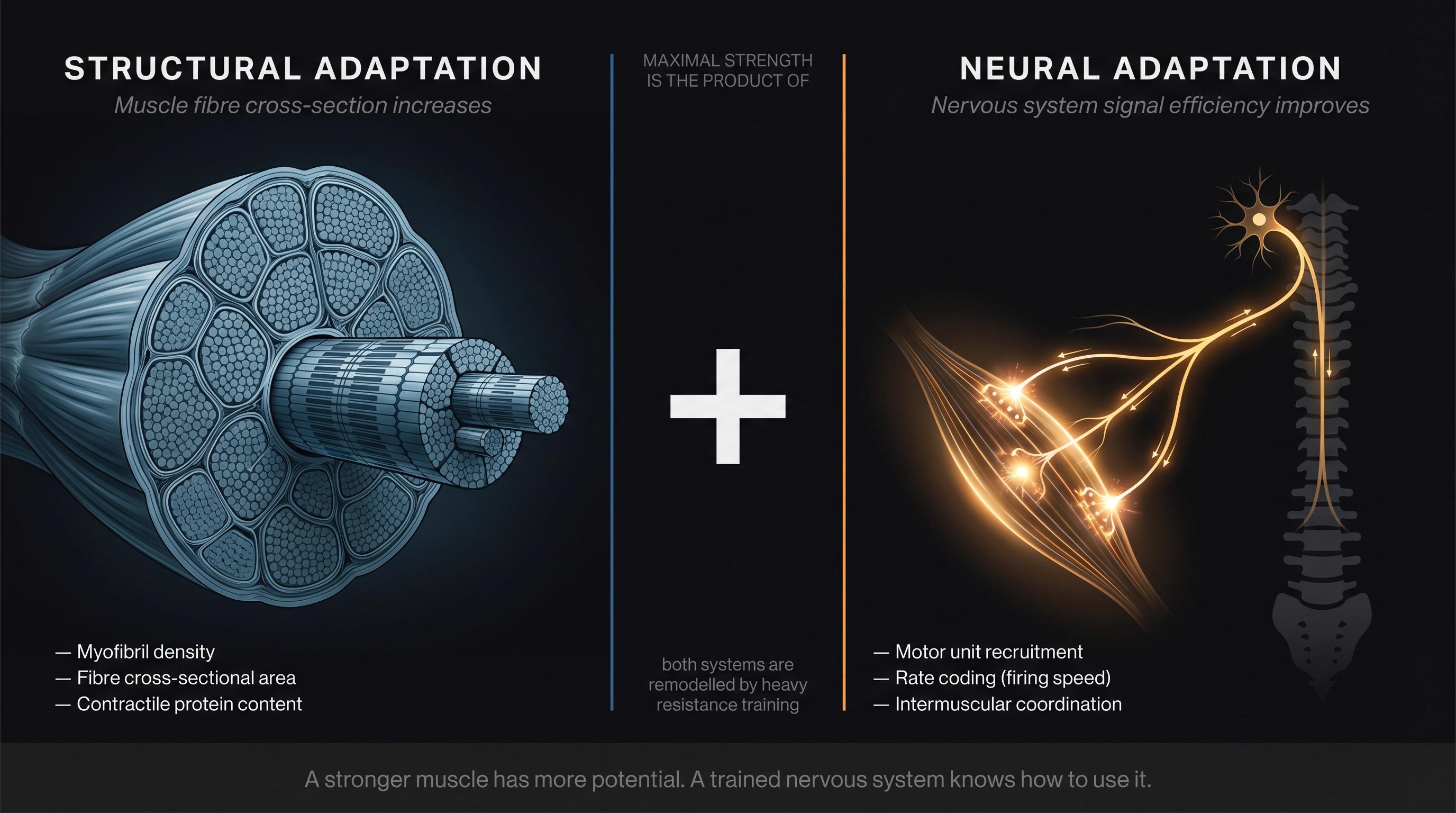
That is why strength is specific in a way that hypertrophy is not. A larger quad muscle can improve your squat, your leg press, your split squat, and your walking lunges. But a stronger back squat requires much more than bigger quads.
Muscle Size vs Strength: Why Size Is General and Strength Is Specific
A stronger back squat requires:
- Bracing under load
- Consistent bar path
- Depth standards
- Hip and ankle positioning
- Upper-back tightness
- Confidence under heavy loads
- Neural drive at high intensities
- Skill in the specific squat variation being tested
That list is not just "bigger muscles." Most of it is nervous system, technique, and practised skill.
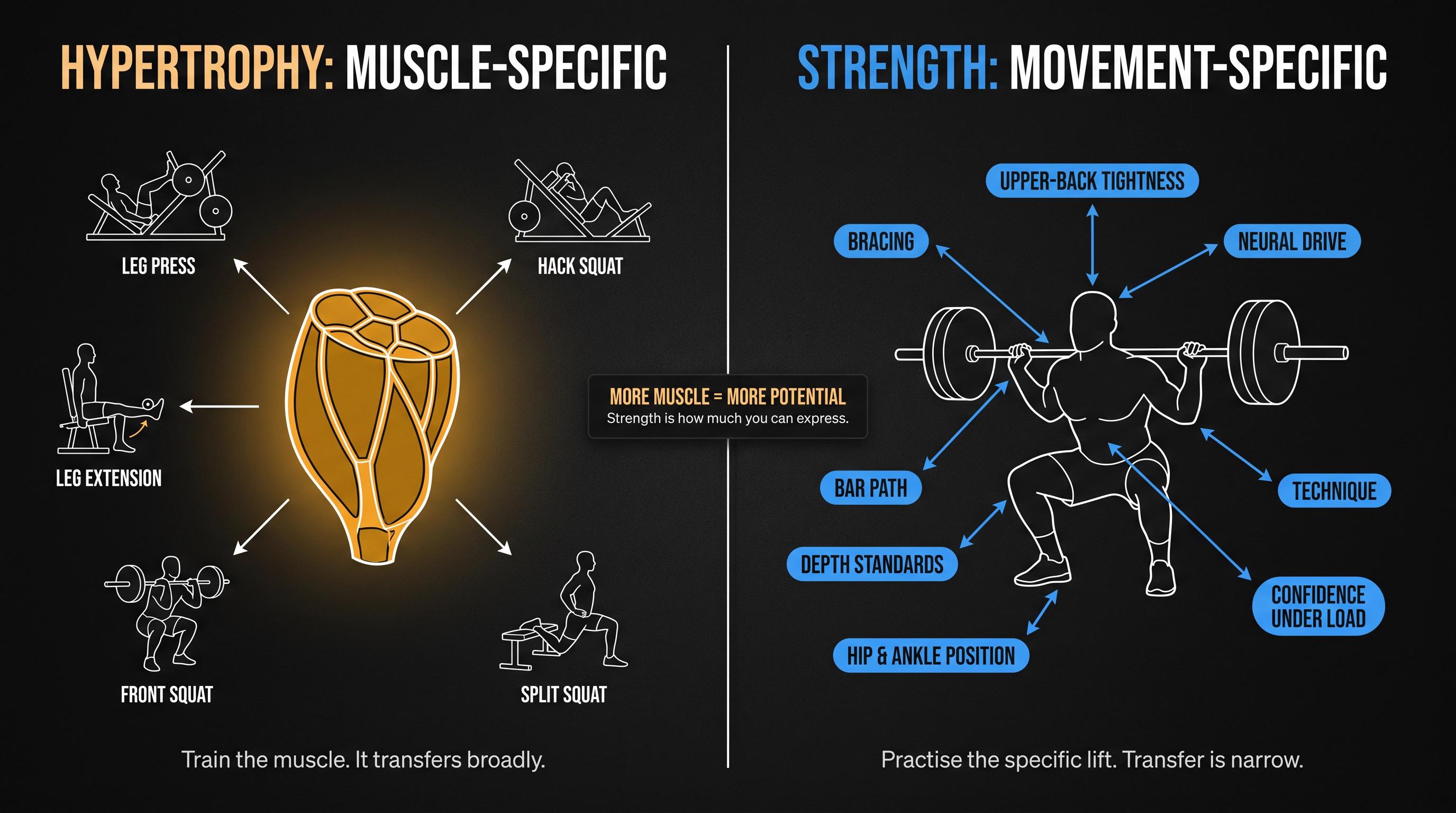
This produces the central distinction:
Hypertrophy is mostly muscle-specific. Strength is movement-specific.
If your goal is hypertrophy, the question is: "Which exercises load the target muscle effectively through a useful range of motion, with manageable fatigue?" If your goal is strength, the question is: "Which lift am I trying to improve, and how do I practise that specific movement while building the muscles that support it?"
Both are legitimate questions. They lead to different programme structures.
How Hypertrophy and Strength Training Change Your Body
How Hypertrophy Makes Your Muscles Bigger
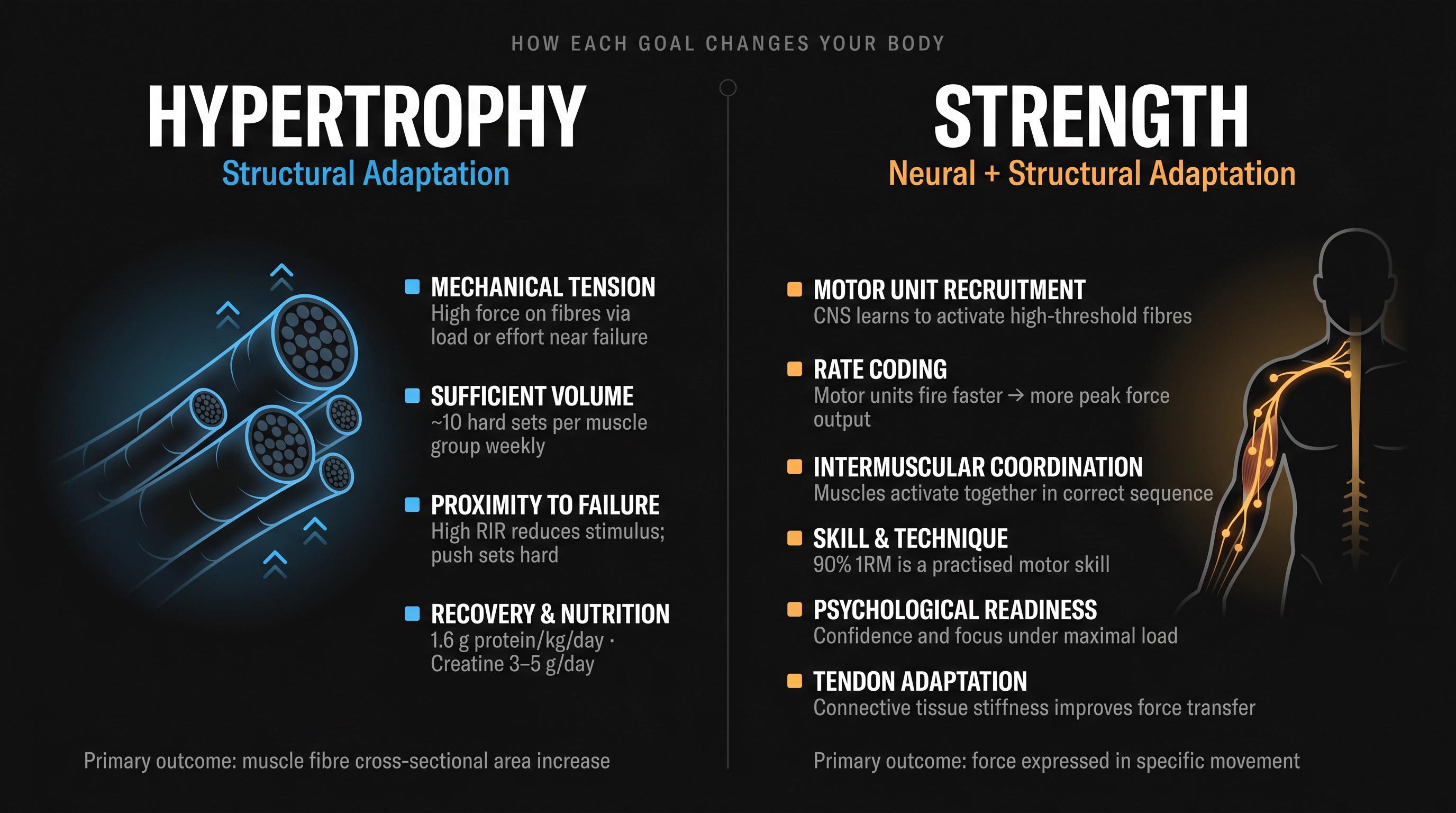
Hypertrophy training increases muscle size by repeatedly exposing fibres to tension, effort, and enough total weekly work. The main practical drivers are:
Mechanical tension. The target muscle must produce high force. This can happen with heavy loads, or with lighter loads taken close enough to failure that high-threshold motor units — the fibres with the greatest growth potential — are recruited.
Sufficient volume. You need enough hard sets per week to create a growth stimulus. The 2026 ACSM guidelines recommend aiming for higher weekly volume for muscle growth, with roughly 10 hard sets per muscle group as a practical starting target. (ACSM)
Proximity to failure. A 2024 meta-regression found that hypertrophy appears meaningfully influenced by reps in reserve (RIR — how many reps you had left before technical failure), while maximal strength is more influenced by load. (PubMed) The practical implication: for hypertrophy, you have to push sets hard, but you do not need to chase load at the expense of effort.
Recovery and nutrition. Muscle growth requires sufficient protein, energy, and sleep to convert the training signal into new tissue. A 2025 review found protein benefits were clearest when daily intake was below about 1.6 g per kilogram of bodyweight per day, with diminishing returns once intake consistently exceeded roughly 1.6–2.0 g/kg/day. The same review found measurable hypertrophy benefits from creatine monohydrate at 3–5 g/day in studies lasting at least 8–12 weeks. (PMC)
How Strength Training Improves Force Production
Strength training improves the ability to express force. That includes muscle growth, but it also includes adaptations that have nothing to do with muscle size:
Motor unit recruitment. Your nervous system becomes better at recruiting high-threshold motor units — fibres that are powerful but hard to activate at lower intensities. Heavy training specifically trains this pathway.
Rate coding. Motor units learn to fire more rapidly, which increases peak force output even before visible muscle growth occurs. This is one reason why beginners can increase strength significantly in the first several weeks of training without looking much different.
Intermuscular coordination. The right muscles learn to work together at the right time and in the right sequence.
Skill and technique. Heavy lifting is a practised skill. A set of three at 90% of your one-rep max feels and moves completely differently from a set of twelve at 65%.
Psychological readiness. Heavy loads require confidence, focus, and the ability to stay organised under tension. These develop with specific practice.
Tendon and connective tissue adaptation. Stronger connective tissue tolerates heavier loads and transmits force more efficiently from muscle to bone.
This is why a beginner can add meaningful weight to the bar each week without looking noticeably bigger. They are not growing rapidly — they are learning the lift, improving coordination, and getting better at expressing the muscle they already have.
How to Structure Training for Hypertrophy vs Strength
Load: Does It Matter More for Hypertrophy or Strength?
For hypertrophy, load is flexible. For strength, load is specific.
A foundational 2017 systematic review and meta-analysis established that maximal strength gains are best achieved with heavier loads, while hypertrophy can be achieved across a broader spectrum when sets are performed hard enough. While that study is older, its core finding is consistent with subsequent research and the 2026 ACSM guidance. (PubMed)
A 2021 network meta-analysis reached a similar conclusion: hypertrophy improvements appear relatively load-independent when training is carried out with sufficient effort, while strength gains are superior with higher-load programmes. (PubMed)
Practical translation:
For hypertrophy: you can build muscle with sets of 6, 10, 15, or even 20 reps if sets are genuinely challenging and the target muscle is loaded well.
For strength: you must spend meaningful time with heavy loads. Training exclusively in the 12–15 rep range, even hard, will not maximise your one-rep maximum. You need specific heavy practice.
Best Rep Ranges for Hypertrophy vs Strength
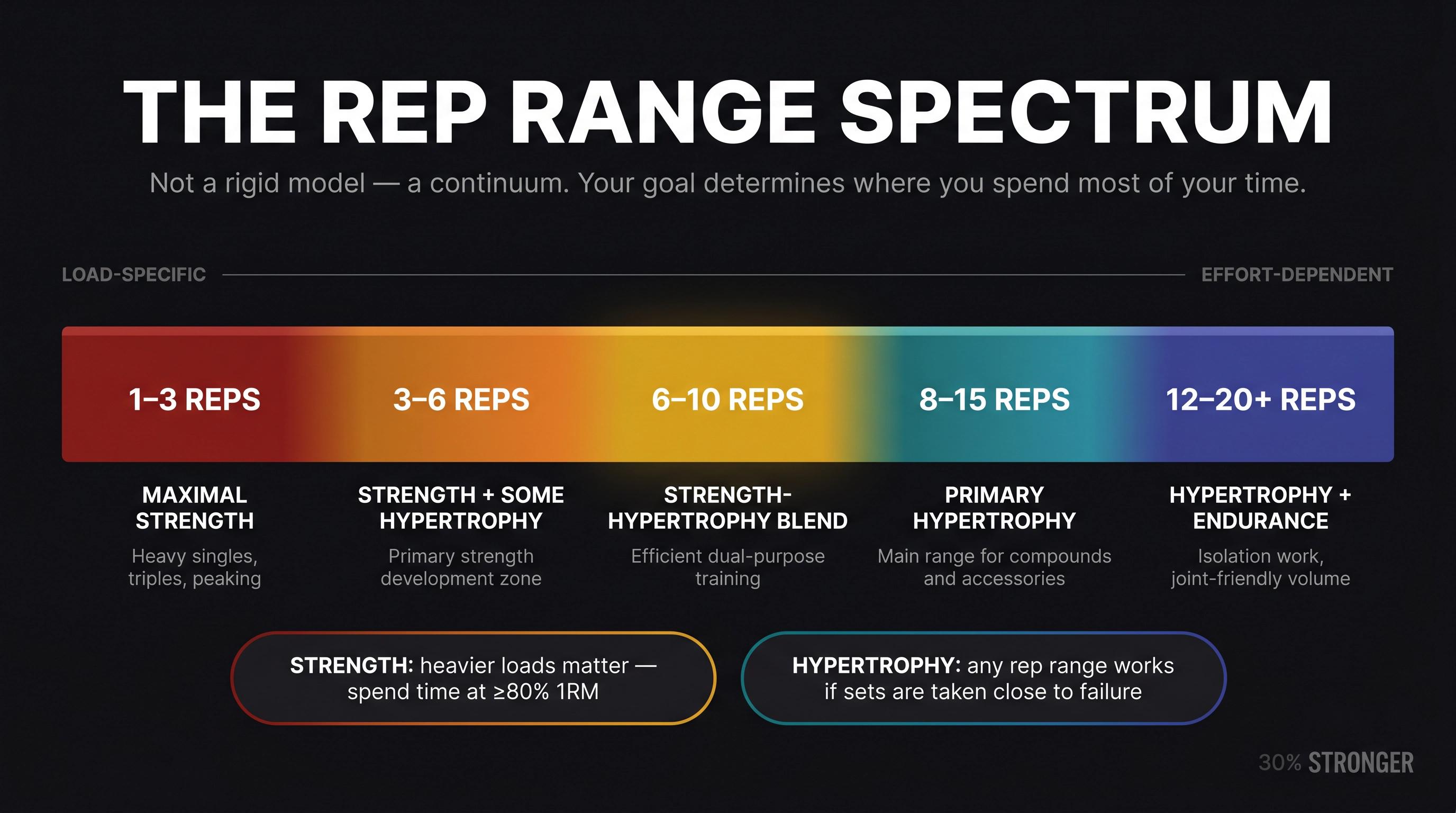
The traditional model — 1–5 reps for strength, 6–12 for hypertrophy, 15+ for endurance — is a useful starting point, but it is too rigid.
A more accurate model:
| Rep range | Best use |
|---|---|
| 1–3 reps | Maximal strength practice, heavy singles and triples, peaking |
| 3–6 reps | Strength development with some hypertrophy |
| 6–10 reps | Efficient blend of strength and hypertrophy |
| 8–15 reps | Main hypertrophy range for compounds and accessory work |
| 12–20+ reps | Hypertrophy for isolation work, joint-friendly volume, endurance |
Muscle growth can occur across a wide range of reps when sets are taken close enough to failure. Maximal strength development is more rep-range and load-specific. (Stronger)
Practical rule: For hypertrophy, choose the rep range that lets you train the muscle hard with good technique. For strength, choose the rep range that gives you enough heavy practice to improve the specific lift.
At Stronger, our AI-generated routines automatically adjust rep ranges to match your stated goal — whether you're training primarily for muscle, primarily for strength, or using a hybrid approach. Our adaptive programmes update based on your progress, so the rep ranges evolve as you do.
How Much Volume Do You Need for Each Goal?
Volume matters for both goals, but differently.
For hypertrophy, volume is one of the primary levers. If you are recovering well and not growing, adding hard sets for the target muscle is usually the correct first adjustment.
For strength, volume is important but more is not always better. Heavy sets create significant fatigue — both neural and systemic. You need enough practice and muscle-building work to improve, but not so much that you accumulate fatigue faster than you can recover.
The 2026 ACSM guidance recommends heavier loads for strength and higher weekly volume for hypertrophy, while consistently emphasising that individualisation matters more than rigid universal prescriptions. (ACSM)
A practical starting framework:
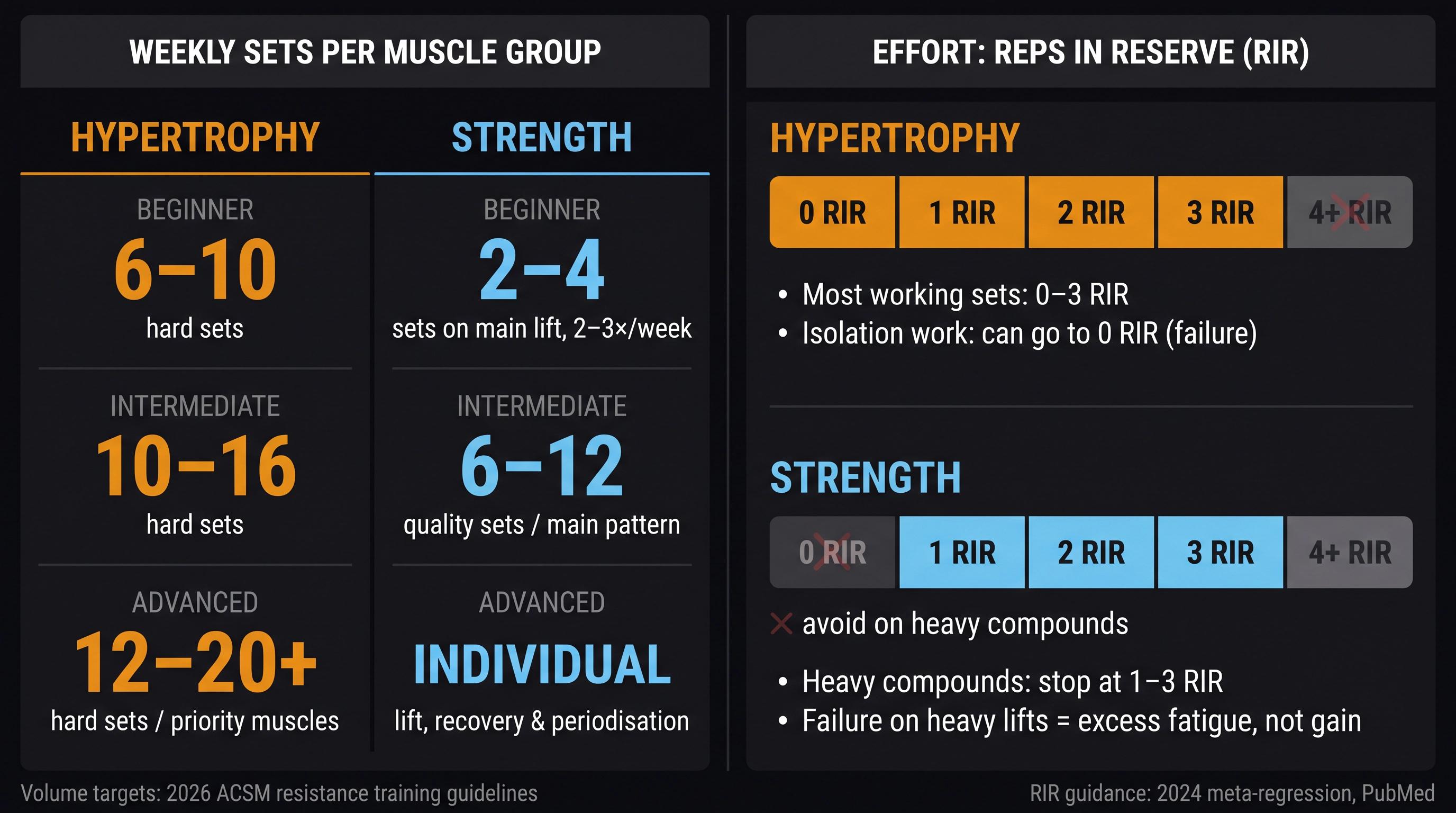
| Goal | Weekly sets per muscle group |
|---|---|
| Beginner hypertrophy | 6–10 hard sets |
| Intermediate hypertrophy | 10–16 hard sets |
| Advanced hypertrophy | 12–20+ hard sets for priority muscles |
| Beginner strength | 2–4 quality sets on the main lift, 2–3 times per week |
| Intermediate strength | 6–12 quality sets per main pattern per week |
| Advanced strength | Highly individual; depends on lift, recovery, and periodisation |
Do not add volume blindly. A 4-day training structure can work well for intermediate lifters looking to balance hypertrophy volume with adequate recovery. The right amount is whatever you can recover from while still progressing.
Should You Train to Failure for Hypertrophy or Strength?
Training to failure means completing a set until no more reps with acceptable technique are possible.
For hypertrophy, training close to failure is useful. For strength, it is a tool, not a default.
A 2022 systematic review and meta-analysis found no significant overall difference between failure and non-failure training for either strength or hypertrophy, though subgroup findings suggested a possible small hypertrophy advantage in trained lifters when training to failure. (ScienceDirect)
A 2023 Sports Medicine review similarly concluded that training to failure is likely not superior to non-failure training for hypertrophy, but also acknowledged that the literature is heterogeneous and the exact influence of failure proximity remains uncertain. (Springer Link)
The honest position, given that uncertainty:
For hypertrophy: most working sets should finish around 0–3 reps in reserve. Isolation exercises can be taken to failure more frequently because the fatigue and injury risk are lower.
For strength: most heavy compound sets should finish at 1–3 reps in reserve. Going to failure on heavy squats, deadlifts, and presses typically creates more cumulative fatigue than it creates training benefit.
How Long to Rest Between Sets for Hypertrophy vs Strength
Strength requires longer rest because the goal is maximum force production. Short rests on heavy sets reduce performance — you end up lifting less than you are capable of.
Hypertrophy also benefits from resting long enough to maintain volume output. The old conventional wisdom about 30–60 second rest periods being optimal for hypertrophy has not held up. A 2024 systematic review with Bayesian meta-analysis found a small hypertrophy benefit from rest intervals longer than 60 seconds, likely because longer rest maintains the quality and quantity of volume across sets. (Frontiers)
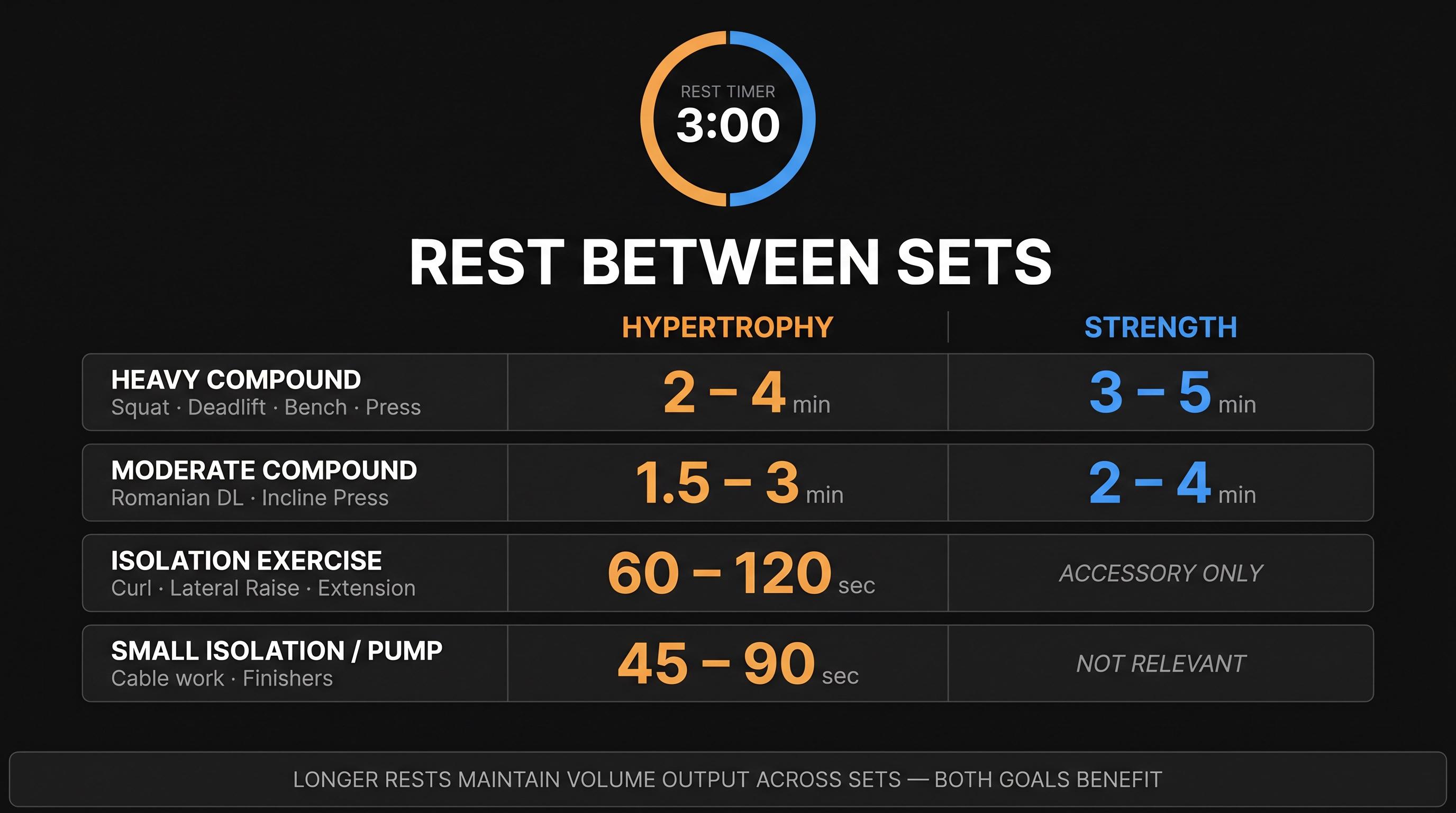
Practical rest targets:
| Exercise type | Hypertrophy rest | Strength rest |
|---|---|---|
| Heavy compound (squat, deadlift, bench, press) | 2–4 min | 3–5 min |
| Moderate compound lift | 1.5–3 min | 2–4 min |
| Isolation exercise | 60–120 sec | Usually accessory only |
| Small isolation or pump work | 45–90 sec | Usually not relevant |
Our guide on how long to rest between sets gives a similar breakdown: 3–5 minutes for heavy barbell compounds, 2–3 minutes for moderate compounds, and shorter rests for smaller isolation work. (Stronger)
The built-in rest timer in Stronger makes it easy to keep rest periods consistent — which matters more than most lifters realise, both for comparing performance across sessions and for keeping your training honest.
Which Exercises Work Best for Hypertrophy vs Strength?
For hypertrophy, the best exercise is the one that loads the target muscle hard, safely, and repeatably.
For strength, the best exercise is the one you want to get stronger at.
This creates genuinely different decisions. If your goal is bigger quads, leg press, hack squat, front squat, and leg extension can all be excellent choices. If your goal is a bigger back squat, the back squat must be central.
A 2023 systematic review comparing free weights and machine-based training found no clear overall difference in strength, jump performance, or hypertrophy when comparing the two directly — but it did find specificity effects: free-weight training tended to improve free-weight test results more, and machine training improved machine test results more. (PMC)
The equipment debate is often exaggerated. What matters is specificity to your goal.
For hypertrophy: use the tool that loads the target muscle best with good technique and manageable fatigue.
For strength: use the tool that matches the lift you are testing or working toward.
How Range of Motion Affects Hypertrophy and Strength
For hypertrophy, exercises that load the muscle well in a stretched position may offer additional benefits. Current research on longer-muscle-length resistance training suggests it may produce superior hypertrophy compared to training the muscle primarily in a shortened position — though the evidence is still mixed and evolving. (ScienceDirect)
A 2023 review on partial versus full range of motion found that full or longer range of motion may enhance most outcomes, although differences are typically trivial to small, and partial range training can still be useful when applied deliberately. (journal.iusca.org)
Practical rule: Use the largest pain-free range of motion you can control, especially for hypertrophy. For strength, use the range of motion required by your goal — a powerlifter needs competition-depth squats, a bodybuilder needs productive quad tension.
How to Programme for Hypertrophy: Volume, Reps, and Progression
A well-designed hypertrophy programme does not just "do high reps." It organises volume, exercise selection, and progression around muscles rather than movements.
Key Priorities for a Hypertrophy Programme
| Priority | What to do |
|---|---|
| Train each target muscle often enough | Usually 2 times per week works well for most lifters |
| Accumulate enough hard sets | Start around 10 hard sets per muscle group per week and adjust from there |
| Use productive exercises | Choose movements that load the target muscle with good stability and range |
| Train close enough to failure | Usually 0–3 RIR on most working sets |
| Progress over time | Add reps, load, sets, range of motion, or control quality |
| Recover | Sufficient protein, total calories, sleep, and no junk volume |
Sample 4-Day Hypertrophy Upper/Lower Split
A classic upper/lower split works well for most intermediate lifters targeting muscle growth — it gives each muscle group two exposures per week and enough session length to accumulate meaningful volume.
Effort: mostly 1–3 RIR; occasional failure on isolation exercises Rest: 2–3 minutes on compounds, 60–120 seconds on isolation work
| Day | Exercise | Sets | Reps |
|---|---|---|---|
| Upper 1 | Bench Press | 3 | 6–10 |
| Chest-Supported Row | 3 | 8–12 | |
| Incline Dumbbell Press | 3 | 8–12 | |
| Lat Pulldown | 3 | 10–12 | |
| Lateral Raise | 3 | 12–20 | |
| Triceps Pressdown | 2 | 10–15 | |
| Dumbbell Curl | 2 | 10–15 | |
| Lower 1 | High-Bar Squat | 3 | 6–10 |
| Romanian Deadlift | 3 | 8–12 | |
| Leg Press | 3 | 10–15 | |
| Leg Curl | 3 | 10–15 | |
| Calf Raise | 4 | 10–20 | |
| Upper 2 | Overhead Press | 3 | 6–10 |
| Pull-Up or Pulldown | 3 | 6–10 | |
| Machine Chest Press | 3 | 8–12 | |
| Cable Row | 3 | 8–12 | |
| Rear-Delt Fly | 3 | 12–20 | |
| Incline Curl | 2 | 10–15 | |
| Overhead Triceps Extension | 2 | 10–15 | |
| Lower 2 | Deadlift or Hip Thrust | 3 | 5–8 |
| Front Squat or Hack Squat | 3 | 8–12 | |
| Bulgarian Split Squat | 2–3 | 8–12/leg | |
| Leg Extension | 3 | 10–15 | |
| Seated Leg Curl | 3 | 10–15 |
How to Progress in a Hypertrophy Programme
Hypertrophy progression typically prioritises reps and volume before increasing load.
| Week | Incline Dumbbell Press |
|---|---|
| 1 | 30 kg × 10, 9, 8 |
| 2 | 30 kg × 11, 10, 9 |
| 3 | 30 kg × 12, 11, 10 |
| 4 | 30 kg × 12, 12, 12 |
| 5 | 32 kg × 9, 8, 8 — load increased |
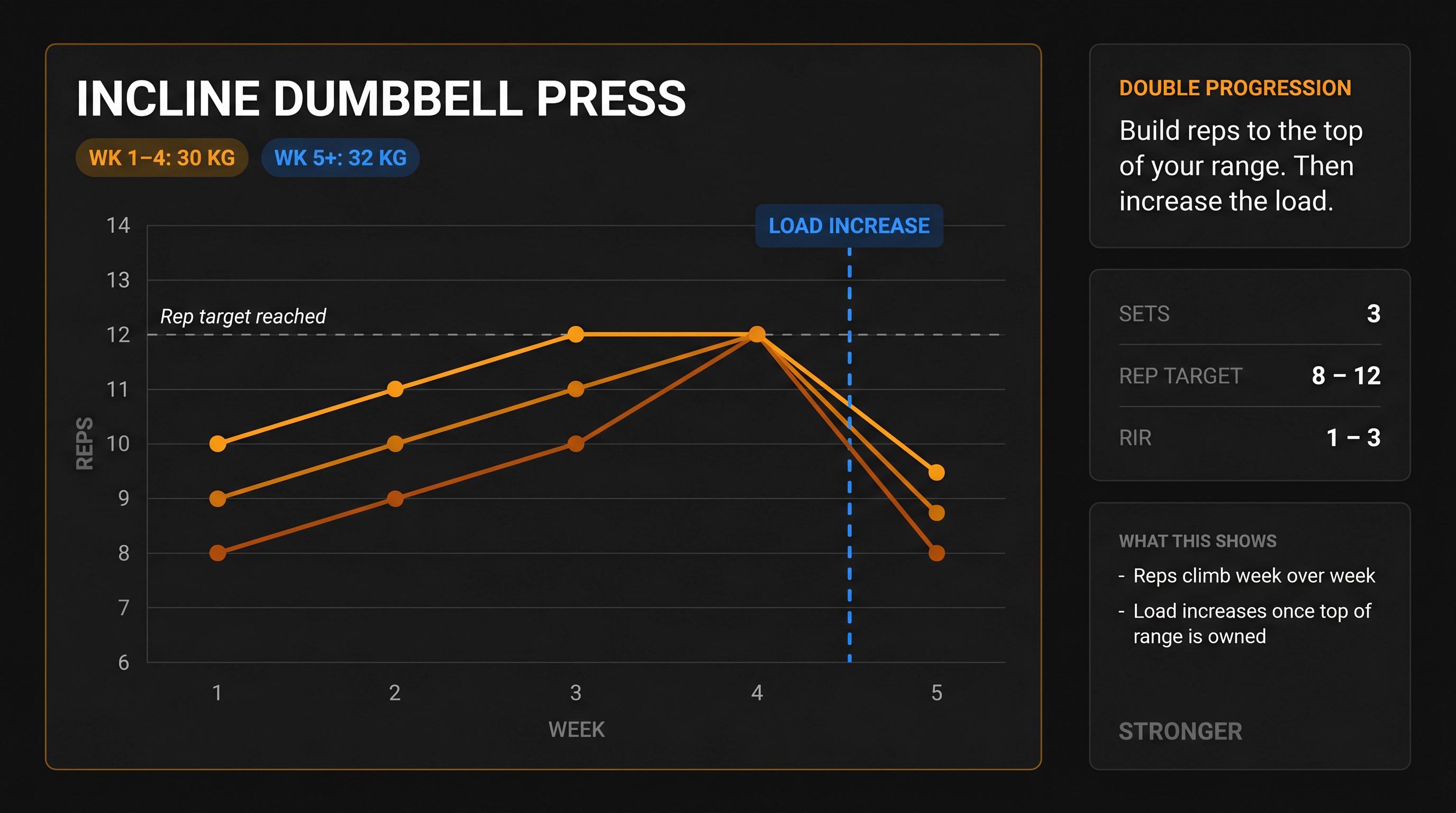
This is double progression — build reps until you own the whole rep range, then increase the load. Our progressive overload guide covers this in detail and recommends it as one of the most practical systems for most lifters, regardless of experience level. (Stronger)
Ready to Get Stronger?
Join 2,000,000+ lifters tracking their workouts with Stronger. Available on iOS and Android.


How to Programme for Strength: Load, Frequency, and Progression
A good strength programme does not just "lift heavy." It combines heavy practice, enough muscle-building volume, consistent technique, and deliberate fatigue management.
Key Priorities for a Strength Programme
| Priority | What to do |
|---|---|
| Practise the main lift | Squat to improve squat, bench to improve bench, deadlift to improve deadlift |
| Use heavy loads | Include regular work around 80%+ of 1RM |
| Stop short of failure | Keep heavy sets clean, fast enough, and technically repeatable |
| Rest long enough | 3–5 minutes for heavy compounds |
| Build supporting muscle | Use accessories to target weak links in your main lifts |
| Manage fatigue | Deload, rotate volume, and avoid testing maximums too frequently |
Structured strength programmes like 5x5 are built around exactly these principles — a small number of heavy compound sets per session, practised frequently, with load added systematically over weeks.
Sample 4-Day Strength-Focused Training Split
Effort: heavy work mostly 1–3 RIR Rest: 3–5 minutes on main lifts, 2–3 minutes on accessories
| Day | Exercise | Sets | Reps |
|---|---|---|---|
| Day 1 | Back Squat | 5 | 3 |
| Paused Squat | 3 | 4 | |
| Romanian Deadlift | 3 | 6–8 | |
| Leg Press | 3 | 8–10 | |
| Core Work | 3 | 8–15 | |
| Day 2 | Bench Press | 5 | 3 |
| Close-Grip Bench Press | 3 | 5 | |
| Barbell Row | 4 | 6–8 | |
| Dumbbell Press | 3 | 8–10 | |
| Triceps Extension | 3 | 10–12 | |
| Day 3 | Deadlift | 4 | 2–4 |
| Front Squat | 3 | 5 | |
| Hip Thrust or Good Morning | 3 | 6–8 | |
| Hamstring Curl | 3 | 10–12 | |
| Loaded Carry | 3 | 20–40 m | |
| Day 4 | Overhead Press | 5 | 3 |
| Bench Press Volume | 3 | 6 | |
| Pull-Up | 4 | 5–8 | |
| Lateral Raise | 3 | 12–20 | |
| Curl | 3 | 8–12 |
How to Progress in a Strength Programme
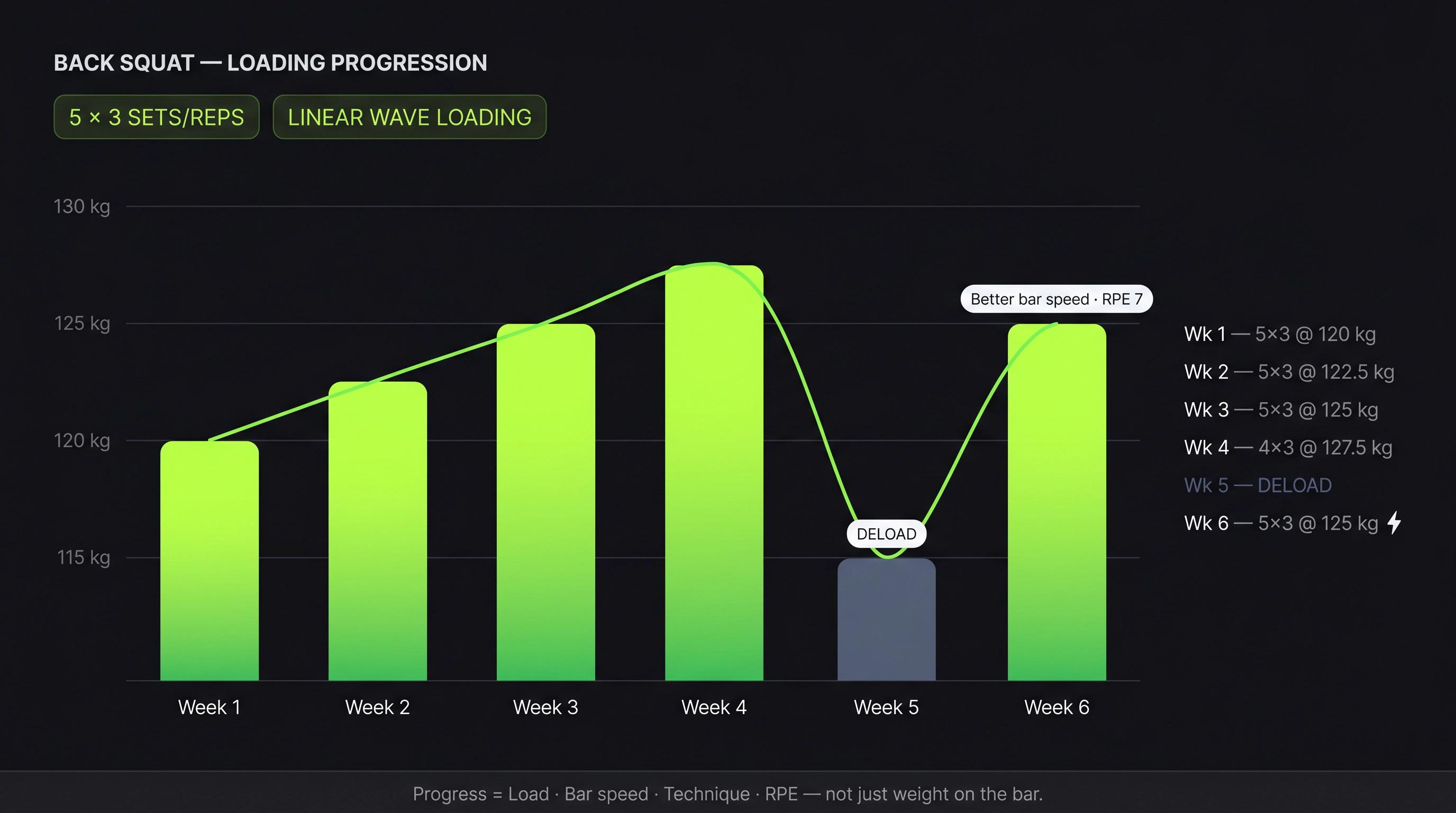
Strength progression typically prioritises load above all else.
| Week | Back Squat |
|---|---|
| 1 | 5 × 3 at 120 kg |
| 2 | 5 × 3 at 122.5 kg |
| 3 | 5 × 3 at 125 kg |
| 4 | 4 × 3 at 127.5 kg |
| 5 | Deload |
| 6 | 5 × 3 at 125 kg — better bar speed, lower RPE |
Strength progress is not always linear. Sometimes progress is better bar speed at the same load, cleaner technique, or the same weight at a lower RPE (rate of perceived exertion). These are all legitimate forms of progress — and tracking them accurately is what separates a data-informed lifter from one who is just guessing.
Can You Train for Both Hypertrophy and Strength? The Hybrid Approach
Yes. Most non-competitive lifters should.
The idea that you must commit fully to either "bodybuilder" or "powerlifter" is unhelpful. The best long-term approach for most serious gym-goers is a hybrid that includes:
- Heavy compound work to build and measure strength
- Moderate-rep compound volume to accumulate muscle-building stimulus
- Isolation work to develop muscles that heavy compounds under-train
- Consistent tracking to know whether the plan is working
This approach is often called powerbuilding — the name matters less than the structure underneath it. A push/pull/legs programme is one popular structured split that incorporates both heavy compound work and targeted hypertrophy accessories.
Sample Hybrid Upper Body Session
| Exercise | Purpose | Sets | Reps |
|---|---|---|---|
| Bench Press | Strength | 4 | 3–5 |
| Incline Dumbbell Press | Hypertrophy | 3 | 8–12 |
| Chest-Supported Row | Strength + hypertrophy | 4 | 6–10 |
| Cable Fly | Chest hypertrophy | 2–3 | 12–15 |
| Lateral Raise | Shoulder hypertrophy | 3 | 12–20 |
| Triceps Pressdown | Accessory hypertrophy | 2–3 | 10–15 |
The 80/20 Rule for Hypertrophy and Strength Training
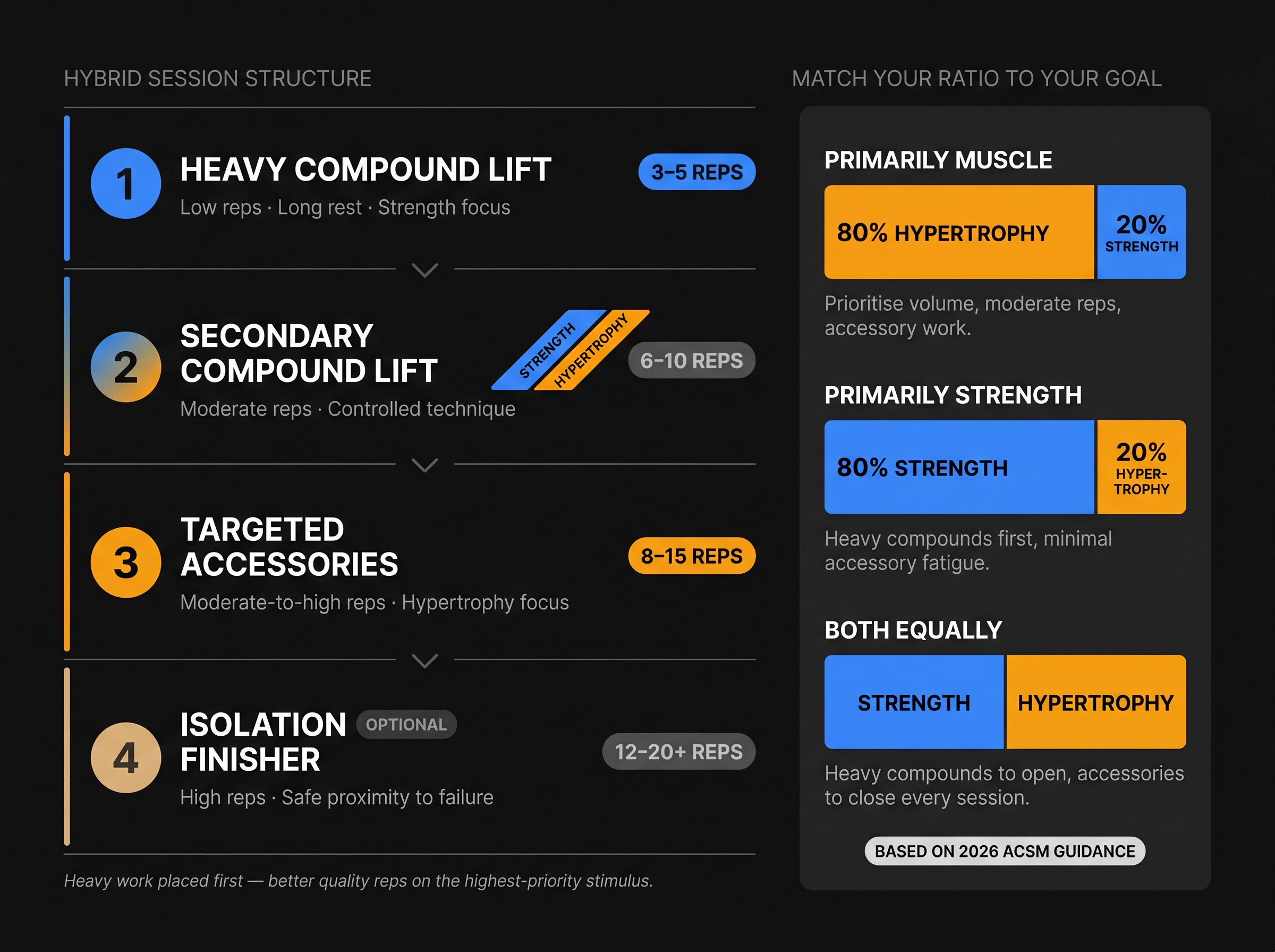
If you care primarily about muscle: 80% hypertrophy work, 20% heavy strength practice.
If you care primarily about strength: 80% strength-specific work, 20% hypertrophy accessories.
If you want both equally: start each session with heavy compound work, then use moderate and higher-rep accessories.
This matches the evidence. The 2026 ACSM guidance emphasises matching training variables to the goal, while consistently stressing that consistency, individualisation, and adherence matter more than chasing a theoretically perfect programme. (ACSM)
Stronger is built to support exactly this kind of training. Whether you want to focus on muscle, strength, or a hybrid approach, our AI routines adapt to your goal — and the app tracks both the volume metrics that matter for hypertrophy and the performance metrics that matter for strength, all in one place. Start your free trial and let the data drive the decisions.
The Best Session Order for Hybrid Training
For most lifters running a hybrid programme, the most effective session structure is:
- Heavy compound lift — low reps, longer rest, strength focus while you are freshest
- Secondary compound lift — moderate reps, controlled technique, strength and hypertrophy
- Targeted accessories — moderate-to-high reps, hypertrophy focus for the supporting muscles
- Optional isolation finisher — higher reps, safe proximity to failure
This structure is not arbitrary. Heavy work performed when fatigued degrades both technique and absolute load, which undercuts both the strength and hypertrophy stimulus. By placing heavy compounds first, you get better quality reps on the most important work and then accumulate productive hypertrophy volume after.
Example lower-body session:
| Exercise | Goal | Sets | Reps |
|---|---|---|---|
| Back Squat | Strength | 4 | 3–5 |
| Romanian Deadlift | Strength + hypertrophy | 3 | 6–8 |
| Leg Press | Quad hypertrophy | 3 | 10–12 |
| Leg Curl | Hamstring hypertrophy | 3 | 10–15 |
| Calf Raise | Calf hypertrophy | 4 | 10–20 |
| Hanging Leg Raise | Trunk | 3 | 8–15 |
Why You're Getting Stronger But Not Bigger (And What to Do)
This is more common than most lifters expect.
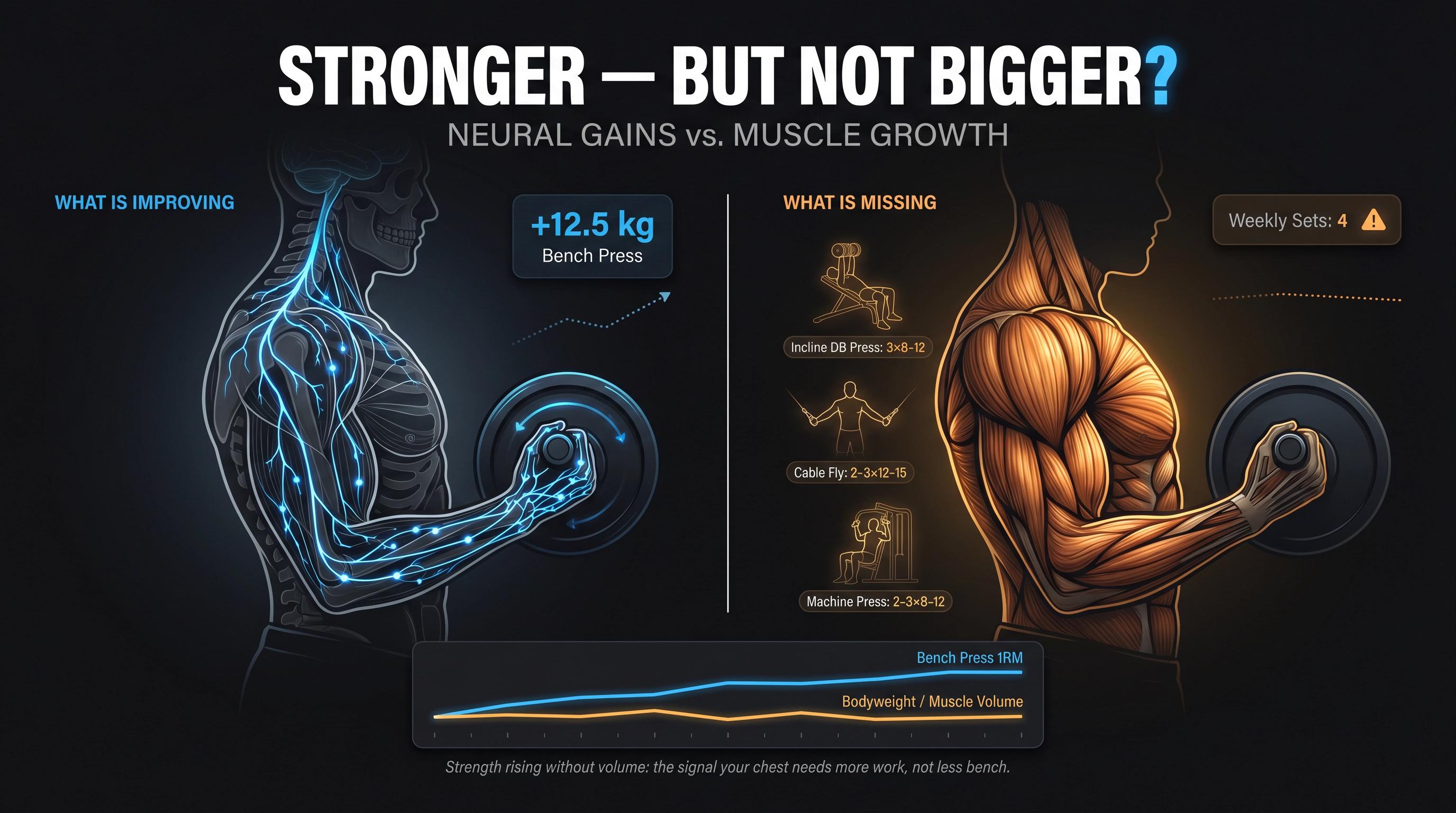
You may be improving neural efficiency, technique, and movement confidence without accumulating enough hypertrophy stimulus. This is especially likely if your training consists mostly of low-rep work, long rest periods, low weekly volume, and frequent heavy singles or triples. You are improving force expression without providing the volume stimulus the muscle needs to grow.
How to Add Hypertrophy Work When You're Not Growing
Add direct hypertrophy work for the lagging muscle.
If your bench press is going up but your chest is not growing, keep benching — you can find bench press form and programming guidance to ensure technique is not limiting your chest development — but also add:
- Incline dumbbell press: 3 × 8–12
- Machine chest press: 2–3 × 8–12
- Cable fly: 2–3 × 12–15
Then track whether your chest volume — total sets per week, reps per set, and loads — is actually increasing over time. The pattern of increasing numbers is the signal that hypertrophy is accumulating.
You may also need to eat more. If your bodyweight has been essentially flat for several months, visible muscle growth will be significantly slower regardless of how well you train.
Why You're Getting Bigger But Not Stronger (And What to Do)
This also happens, and the mechanism is the mirror image.
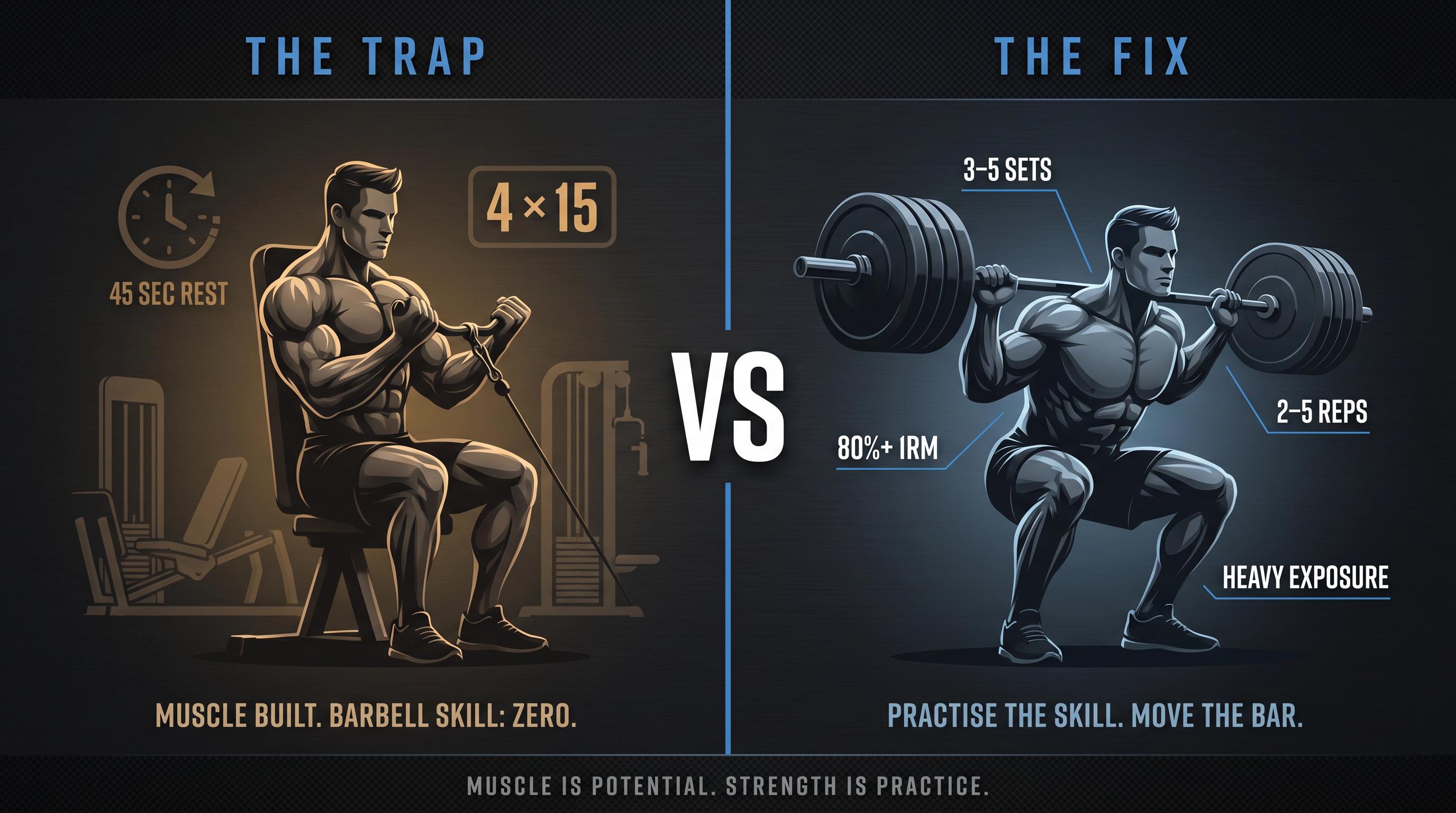
If your training consists primarily of machines, high rep ranges, short rest periods, and frequent failure sets, you can accumulate meaningful muscle without seeing dramatic improvements in barbell lift performance. You are building muscle without specifically practising the skill of heavy force expression.
How to Add Strength Practice When Your Lifts Stall
Add specific strength practice to the movements you want to improve.
If you want your squat to go up, include:
- A heavy squat exposure: 3–5 sets of 2–5 reps
- A secondary squat pattern: paused squat, front squat, or tempo squat
- Hypertrophy accessories for the supporting muscles: quads, glutes, hamstrings, trunk
- Consistent technique standards so progress is real, not just technique erosion
Strength is tested in a specific movement. Practise that movement.
Hypertrophy vs Strength for Beginners vs Advanced Lifters
Hypertrophy vs Strength for Beginners
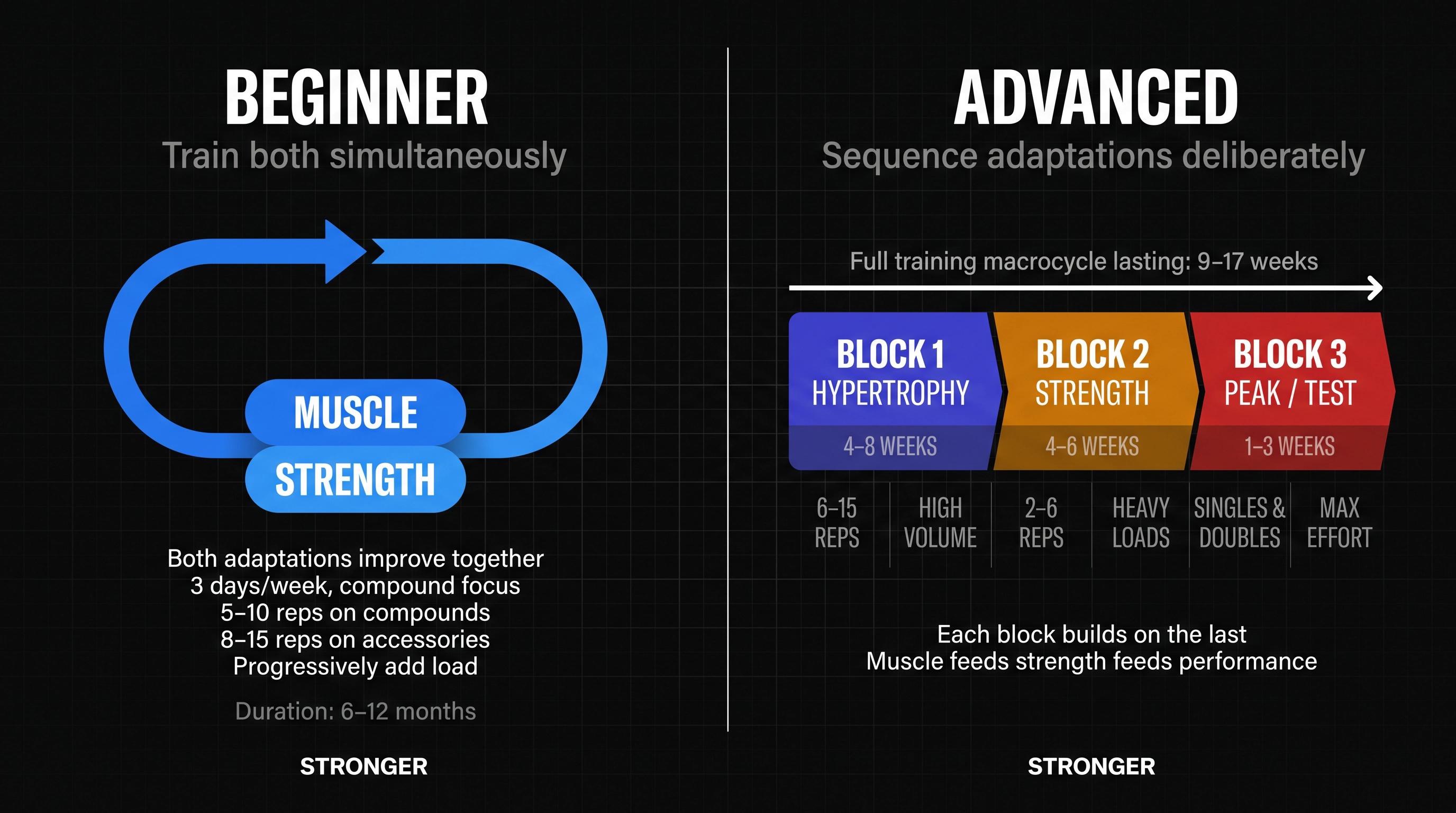
Beginners should not choose between hypertrophy and strength. They should do both.
In the first 6–12 months, the best programme is typically simple, compound-focused, moderate in volume, and straightforward to progress. You do not need a specialised bodybuilding split or an advanced peaking cycle. Both adaptations respond well to basic progressive overload at this stage.
A beginner's focus should be on:
- Learning the major movement patterns properly
- Adding reps or weight consistently
- Training each major muscle group at least twice per week
- Building a base of muscle and connective tissue
- Developing confidence with progressively heavier loads
Our guide on how to get stronger covers the same core principles: progressive overload, specificity, recovery, consistency, compound lifts, and tracking. (Stronger)
A full-body training approach works particularly well here — hitting each major pattern multiple times per week with moderate volume.
A simple beginner template that runs on a 3-day training structure:
| Day | Focus |
|---|---|
| Monday | Squat, bench press, row, Romanian deadlift, core |
| Wednesday | Deadlift, overhead press, pulldown, split squat, curl |
| Friday | Squat variation, incline press, row, hip thrust, lateral raise |
Use mostly 5–10 reps on compounds and 8–15 reps on accessories. Add weight when technique is solid and you are consistently reaching the top of your rep range.
Hypertrophy vs Strength for Advanced Lifters
Advanced lifters often benefit from separating hypertrophy and strength into distinct training phases. The stronger and more experienced you become, the harder it is to maximise multiple adaptations simultaneously. Sequencing them deliberately produces better outcomes.
Block 1 — Hypertrophy accumulation (4–8 weeks) Higher volume, moderate loads, more accessories, mostly 6–15 reps, 0–3 RIR. The goal is to build muscle and work capacity as the base for future strength gains.
Block 2 — Strength intensification (4–6 weeks) Heavier main lifts, reduced accessory volume, mostly 2–6 reps, 1–3 RIR. The goal is to convert accumulated muscle into heavier force expression.
Block 3 — Peak or test (1–3 weeks) Low volume, heavy singles and doubles, high specificity to the tested lifts. Controlled effort, not reckless maximums.
This is why advanced lifters often appear to be "switching goals." They are not abandoning hypertrophy — they are sequencing adaptations intelligently. A 5-day training schedule can support the higher volume demands of the accumulation phase for experienced lifters who have built the recovery capacity to handle it.
How to Track Hypertrophy vs Strength Progress
You improve what you measure. And for hypertrophy and strength, the right things to measure are different.
The most common mistake for hypertrophy-focused lifters is only tracking scale weight. For strength-focused lifters, the equivalent mistake is only tracking how heavy the session felt.
What to Track for Hypertrophy Progress
| Metric | Why it matters |
|---|---|
| Weekly hard sets per muscle group | Shows whether volume is sufficient to drive growth |
| Reps and load by exercise over time | Shows progressive overload in action |
| Bodyweight trend | Helps interpret muscle gain vs fat loss context |
| Body measurements | Arms, chest, waist, thighs, shoulders — actual size changes |
| Progress photos | Reveals visual changes that the scale misses |
| Recovery markers | Sleep quality, soreness, motivation, and training performance |
What to Track for Strength Progress
| Metric | Why it matters |
|---|---|
| Top sets | Shows high-end performance on the main lift |
| Back-off sets | Shows repeatable strength below maximum effort |
| Estimated 1RM | Tracks progress without needing to test maximums regularly |
| Lift-specific PRs | Shows whether the specific movement is actually improving |
| Technique consistency | Prevents fake progress from reduced range or degraded form |
| Rest periods | Keeps performance comparisons honest across sessions |
This is exactly the kind of tracking that Stronger is built around. Every session logs sets, reps, and weight with automatic PR detection. The Strength Score rates your strength across 12 muscle groups and overall, adjusted for bodyweight and sex, on six levels from Beginner to World Class. Per-exercise strength curves show how each lift is trending over time. Volume and frequency tracking per muscle group shows whether hypertrophy stimulus is accumulating. Body measurements can be logged alongside your training data. And rest timers keep your sessions comparable. (Stronger)
When the data is all in one place, you stop guessing. You know whether the programme is working — for whichever goal you are training toward.
Should You Train for Hypertrophy or Strength? How to Choose
Use this decision framework.
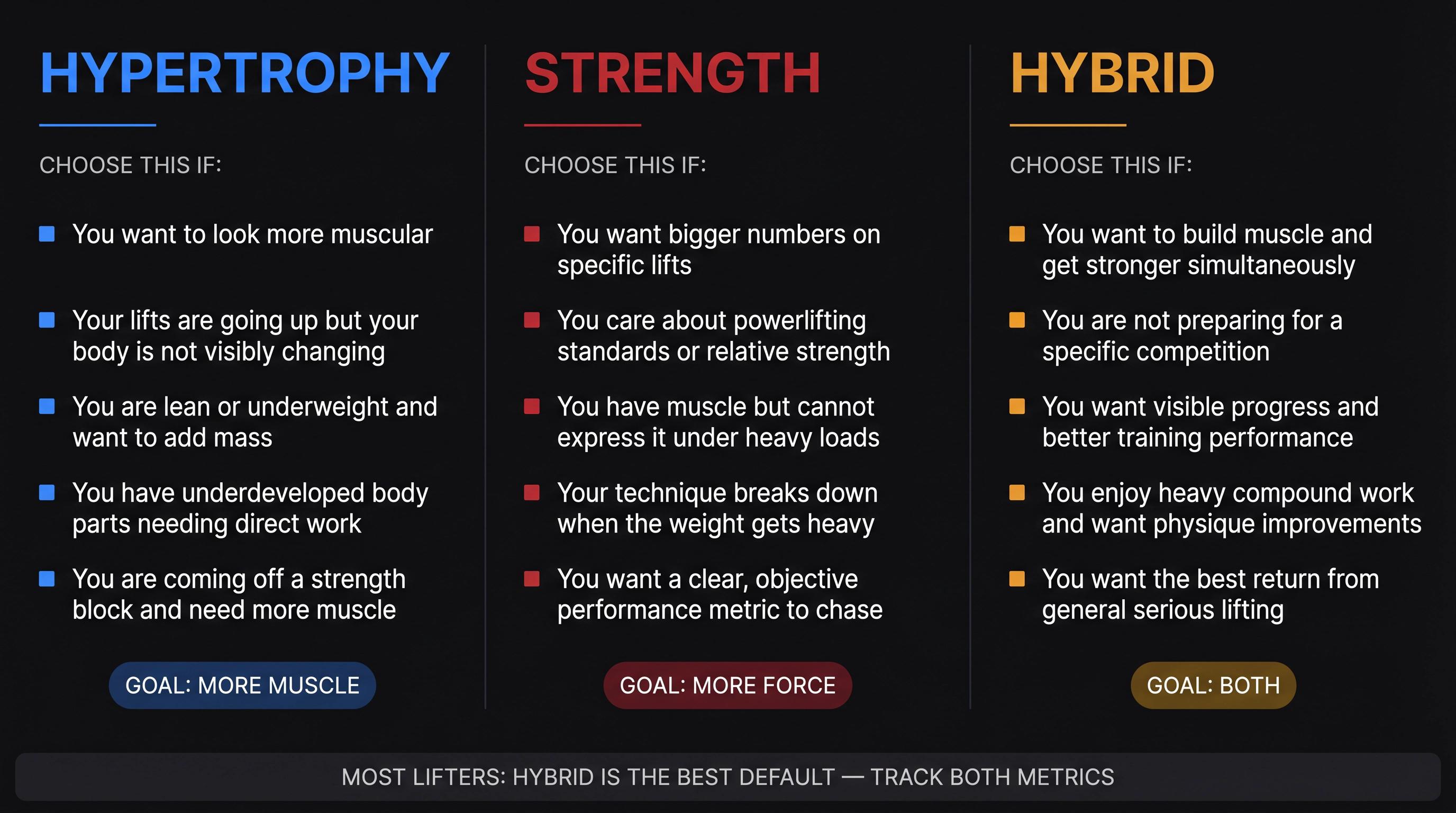
Choose hypertrophy as the primary goal if:
- You want to look more muscular
- Your lifts are going up but your body is not visibly changing
- You are relatively lean or underweight and want to add mass
- You have underdeveloped body parts that need direct work
- You are coming off a long strength block and need to build more muscle
Choose strength as the primary goal if:
- You want bigger numbers on specific lifts
- You care about powerlifting standards or relative strength
- You have muscle but cannot express it under heavy loads
- Your technique breaks down when the weight gets heavy
- You want a clear, objective performance metric to chase
Choose hybrid training if:
- You want to build muscle and get stronger simultaneously
- You are not preparing for a specific competition
- You want visible progress and better training performance
- You enjoy heavy compound work but also want physique improvements
- You want the best return from general serious lifting
For most people using Stronger, hybrid training is the best default: track your main compound lifts, push your Strength Score forward over time, and use hypertrophy accessories to build the muscle that supports those lifts.
Train Smarter With Stronger
Stronger is built for exactly the kind of training this post describes — whether your goal is hypertrophy, strength, or the hybrid approach that works best for most serious lifters.
Here is what you get:
For hypertrophy tracking:
- Volume and frequency analytics per muscle group — so you always know whether you are getting enough hard sets
- Progressive overload tracking per exercise — reps, loads, and trends over time
- Body measurements and bodyweight logging in a dedicated view
- PR detection across exercises and rep ranges
For strength tracking:
- Strength Score — our proprietary metric that rates your strength across 12 muscle groups and overall, adjusted for bodyweight and sex, on six levels from Beginner to World Class. It tracks your progress over time.
- Per-exercise strength curves — see exactly how each of your main lifts is trending
- Estimated 1RM tracking — know your strength level without testing maximums every week
- Top set and back-off set logging with rest timers built in
- RPE per set — log your effort rating alongside each working set
For your programme:
- AI-generated routines personalised to your goal (hypertrophy, strength, powerbuilding, or bodybuilding)
- Adaptive programming that adjusts weights, sets, and reps as you progress
- 400+ exercises with instructions and muscle targeting maps
- Proven pre-built programmes for every goal
For motivation:
- Friend challenges and group leaderboards
- Weekly and monthly competition formats
- Shareable post-workout summaries
- Achievement tracking and progress milestones
Download Stronger on iOS or Android and start your free trial today. Every feature described above is included in your 7-day free trial and in Premium.
Ready to Get Stronger?
Join 2,000,000+ lifters tracking their workouts with Stronger. Available on iOS and Android.
Nutrition for Hypertrophy vs Strength: What to Eat
Nutrition does not change as dramatically as training when you shift between hypertrophy and strength focus, but the emphasis does shift.
Nutrition for Hypertrophy
You need enough total energy and protein to turn the training signal into new muscle tissue.
Practical targets:
- Protein: roughly 1.6–2.0 g per kilogram of bodyweight per day for most lifters
- Calories: at maintenance or a slight surplus if muscle gain is the priority
- Carbohydrates: enough to support training performance and recovery
- Creatine: optional but well-supported — 3–5 g/day, with benefits most reliable in studies lasting at least 8–12 weeks
The 2025 hypertrophy supplement review found protein benefits are clearest when daily intake is below roughly 1.6 g/kg/day, with diminishing returns beyond 1.6–2.0 g/kg/day. (PMC)
Nutrition for Strength Training
The protein targets are similar. The main difference is performance and recovery context.
A strength-focused lifter cutting calories aggressively can maintain most muscle tissue but may struggle to produce their best numbers under heavy loads. A lifter in a slight caloric surplus tends to recover better, tolerate more volume, and perform better under maximal effort.
If you want to build strength without significant weight gain, keep protein high, manage training fatigue carefully, and accept slower progress. Strength and major weight loss at the same time is possible but requires genuine patience.
Nutrition During a Cut
Neither hypertrophy nor strength training is inherently "better" for fat loss — fat loss comes primarily from an energy deficit. Resistance training helps you retain muscle and maintain performance while that deficit is in place. The best approach during a cut typically includes:
- Heavy compounds to preserve strength
- Moderate-rep volume to maintain muscle
- Sufficient protein throughout
- A calorie deficit you can actually sustain over weeks and months
- Cardio as a supplementary tool, not a replacement for the lifting
During a dedicated cut, simply maintaining your strength while losing bodyweight is often excellent progress. Do not expect the same rate of performance gain as a bulk or maintenance phase.
Common Myths About Hypertrophy and Strength Training
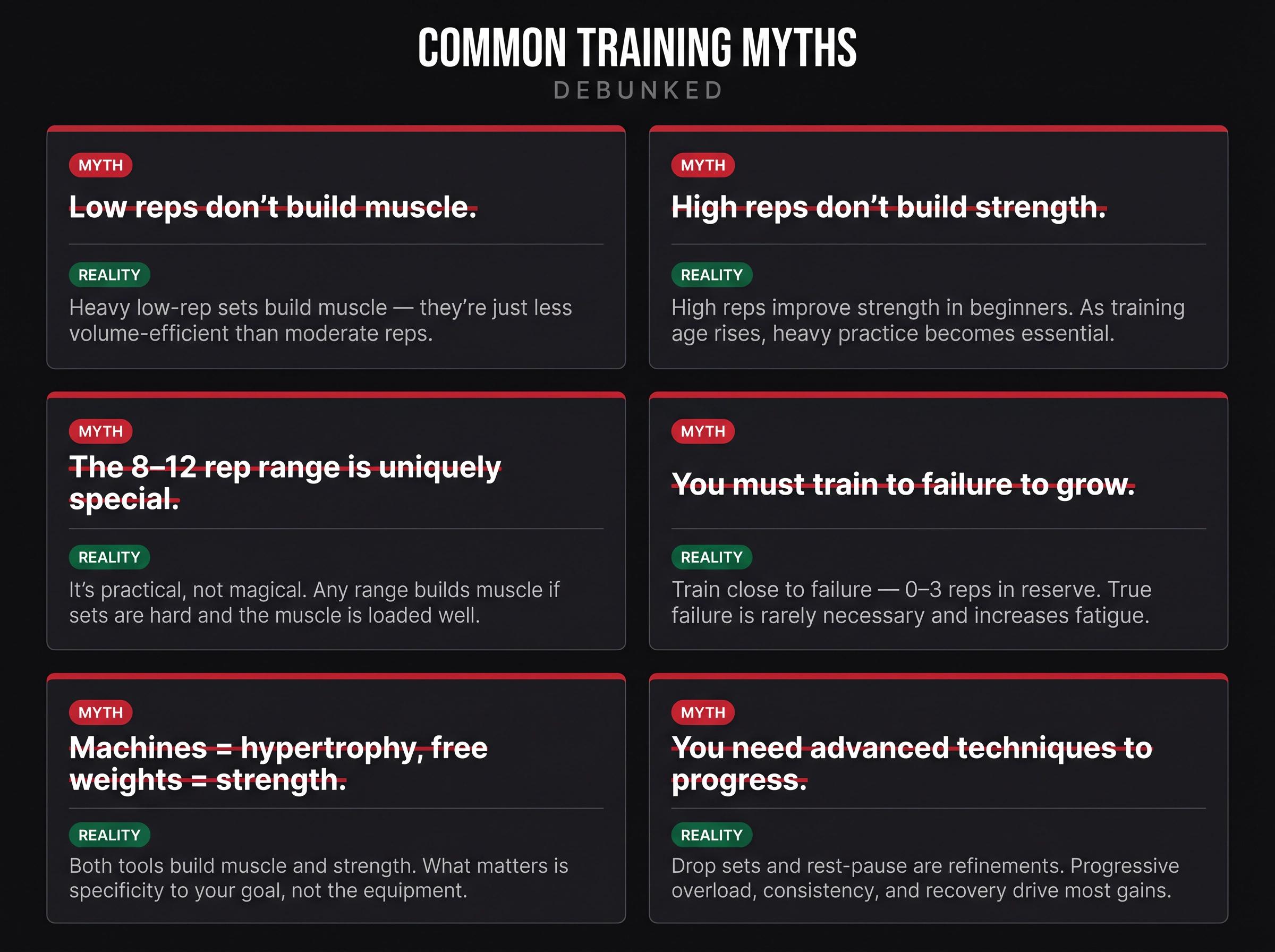
Myth 1: Low reps do not build muscle. They can. Heavy, low-rep training builds muscle — especially when total weekly work is sufficient. The issue is efficiency: sets of 1–3 require long rest periods and create high fatigue relative to the number of stimulating reps accumulated per session. Not the optimal delivery mechanism for hypertrophy volume, but capable of producing it.
Myth 2: High reps do not build strength. High reps can improve strength, particularly in beginners, because almost any form of progressive resistance training works at early stages. As training age increases, maximal strength becomes more specific and harder to improve with high-rep only training. To lift heavy, you eventually need heavy practice.
Myth 3: The 8–12 rep range is uniquely effective for muscle growth. It is not magic — it is practical. Sets of 8–12 are heavy enough to create meaningful mechanical tension and long enough to accumulate volume efficiently. That combination is why the range works well, not because muscle fibres only respond to it.
Myth 4: You must train to failure to grow. You usually need to train close to failure — not always to it. The evidence on failure vs. non-failure training is genuinely mixed. Failure can be a useful tool on safer isolation exercises. Taking every heavy compound set to failure is an efficient way to accumulate fatigue without proportionate benefit.
Myth 5: Machines are for hypertrophy, free weights are for strength. Both tools build muscle and strength. The critical distinction is specificity. If you are testing a barbell squat, barbell squatting needs to be central to your training. If you want quad growth, a hack squat or leg press can be equally effective and sometimes more practical.
Myth 6: You need advanced techniques to make progress. Drop sets, rest-pause sets, supersets, and intensity techniques have their uses, but they are not prerequisites for muscle growth or strength gains. The 2026 ACSM position stand found that advanced training techniques such as failure training, specific equipment choices, and complex periodisation did not consistently change outcomes for the average healthy adult. A 2026 systematic review on advanced resistance training systems similarly found no overall hypertrophic advantage of advanced methods over traditional multi-set training. (ACSM)
Progressive overload, consistency, and good recovery drive most of the adaptation. Advanced techniques are refinements, not foundations.
Hypertrophy vs Strength: The Bottom Line
Hypertrophy and strength are not competing goals. They are different adaptations with a large shared foundation — and understanding the distinction changes how you train, what you measure, and whether your programme is actually moving you forward.
Hypertrophy asks: Is the target muscle receiving enough progressive, challenging, recoverable work to grow?
Strength asks: Am I practising the specific lift with enough heavy, high-quality work to produce more force?
For most lifters, the answer is not to pick one. It is to do both intelligently: build the muscle, practise the lift, track the right variables, and progress with data rather than guesswork.
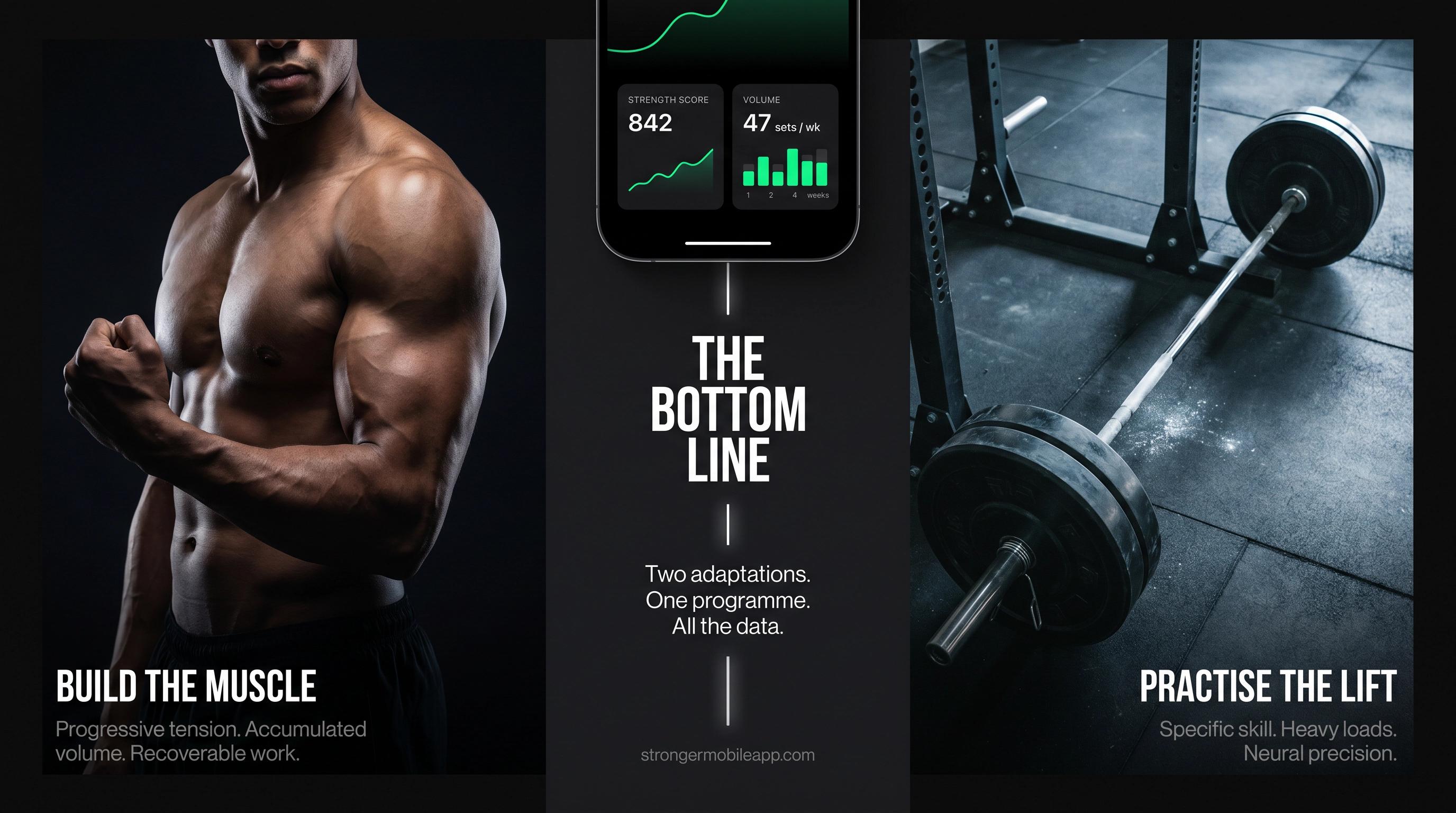
Stronger is the system we built for exactly this. Log every set, track your PRs, monitor your Strength Score across compound lifts, follow per-exercise strength curves, review volume and frequency by muscle group, and use your actual training data to know whether the programme is working — for whichever goal you are chasing. (Stronger)
Build muscle. Practise heavy. Track everything. Progress intelligently.
Frequently Asked Questions
Is hypertrophy training the same as bodybuilding?
Not exactly. Bodybuilding is a sport and aesthetic goal. Hypertrophy training is the method — the physiological process of increasing muscle size. A powerlifter can use hypertrophy training during an off-season to build the quads, pecs, triceps, back, and hamstrings that support bigger competition lifts. The method is universal; the goal it serves varies.
Can you build strength without hypertrophy?
Yes, especially as a beginner or during a technically focused strength phase. Neural adaptations — improved motor unit recruitment, rate coding, intermuscular coordination, and movement skill — can increase strength substantially without large visible muscle changes. Long-term, though, more muscle generally raises your strength ceiling.
Can you build muscle without getting stronger?
Yes, but only temporarily. If the numbers you lift never increase — reps, sets, or load — hypertrophy will eventually stall. Muscle growth requires some form of progressive overload over time. Staying comfortable with the same weights is not a muscle-building strategy.
What rep range is best for hypertrophy?
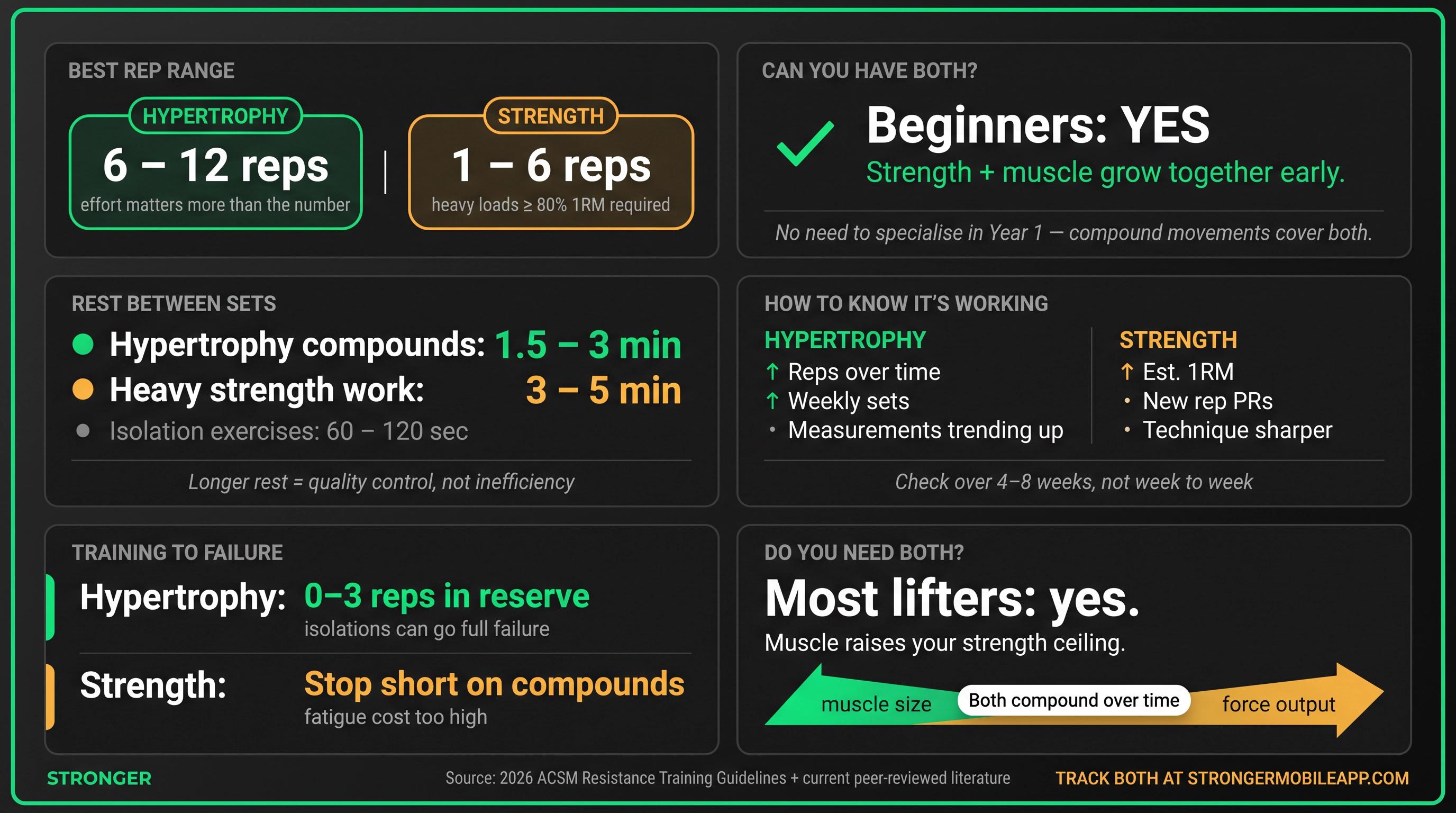
There is no single magic range. Most lifters do well with a significant portion of work in the 6–12 range, supplemented by heavier 4–8 rep work on compounds and lighter 12–20 rep work on isolation exercises. The key requirement is that sets are challenging enough — muscle growth responds to effort relative to capacity, not to a specific rep number. (Stronger)
What rep range is best for strength?
For maximal strength development, most main lift work should include regular exposure to loads around 80% 1RM or above, typically in the 1–6 rep range. Accessory and hypertrophy work can use higher rep ranges to build the supporting muscle and general work capacity.
Should you train to failure?
Use failure selectively, not as a default. For hypertrophy, most working sets should finish around 0–3 reps in reserve, with safer isolation exercises occasionally taken all the way to failure. For strength, avoid routine failure on heavy compound lifts — the fatigue cost is high relative to the training benefit.
How long should you rest between sets?
For heavy strength work, rest 3–5 minutes to allow full neuromuscular recovery between quality sets. For hypertrophy-focused compounds, rest around 1.5–3 minutes. For isolation exercises, 60–120 seconds is usually sufficient. Longer rest periods are not inefficiency — they are quality control. (Stronger)
Are machines effective for building strength?
Machines build strength in the movements they train. But if your goal is a stronger barbell lift, you need to practise that barbell lift. Machines can support strength development through hypertrophy work on the target muscles — but they cannot fully replace specific practise on the movement being tested.
Is hypertrophy or strength training better for beginners?
Both, simultaneously. Beginners respond strongly to almost any progressive resistance training, so a simple compound-based programme that includes both heavy work and moderate-rep volume will produce strength gains, hypertrophy, and skill development at the same time. There is no need to specialise early — get started with a straightforward 3-day routine that covers the major patterns twice a week.
How do I know if my programme is working?
For hypertrophy: look for increasing reps, loads, or weekly sets over time, body measurements trending in the right direction, and stable recovery markers. For strength: look for improved estimated 1RM, better top set performance, cleaner technique, and new rep PRs on your main lifts. If none of these metrics are moving over 4–8 weeks, the programme needs adjustment.
Does Stronger work for both hypertrophy and strength goals?
Yes — Stronger tracks the specific metrics that matter for each goal. Volume and frequency analytics and progressive overload tracking per exercise for hypertrophy. Strength Score, estimated 1RM tracking, per-exercise strength curves, and PR detection for strength. The AI routines can be set to either goal, and the adaptive programming adjusts based on your actual progress. Whether your priority is muscle, strength, or a hybrid, the app adapts to it.
Research Sources and Evidence
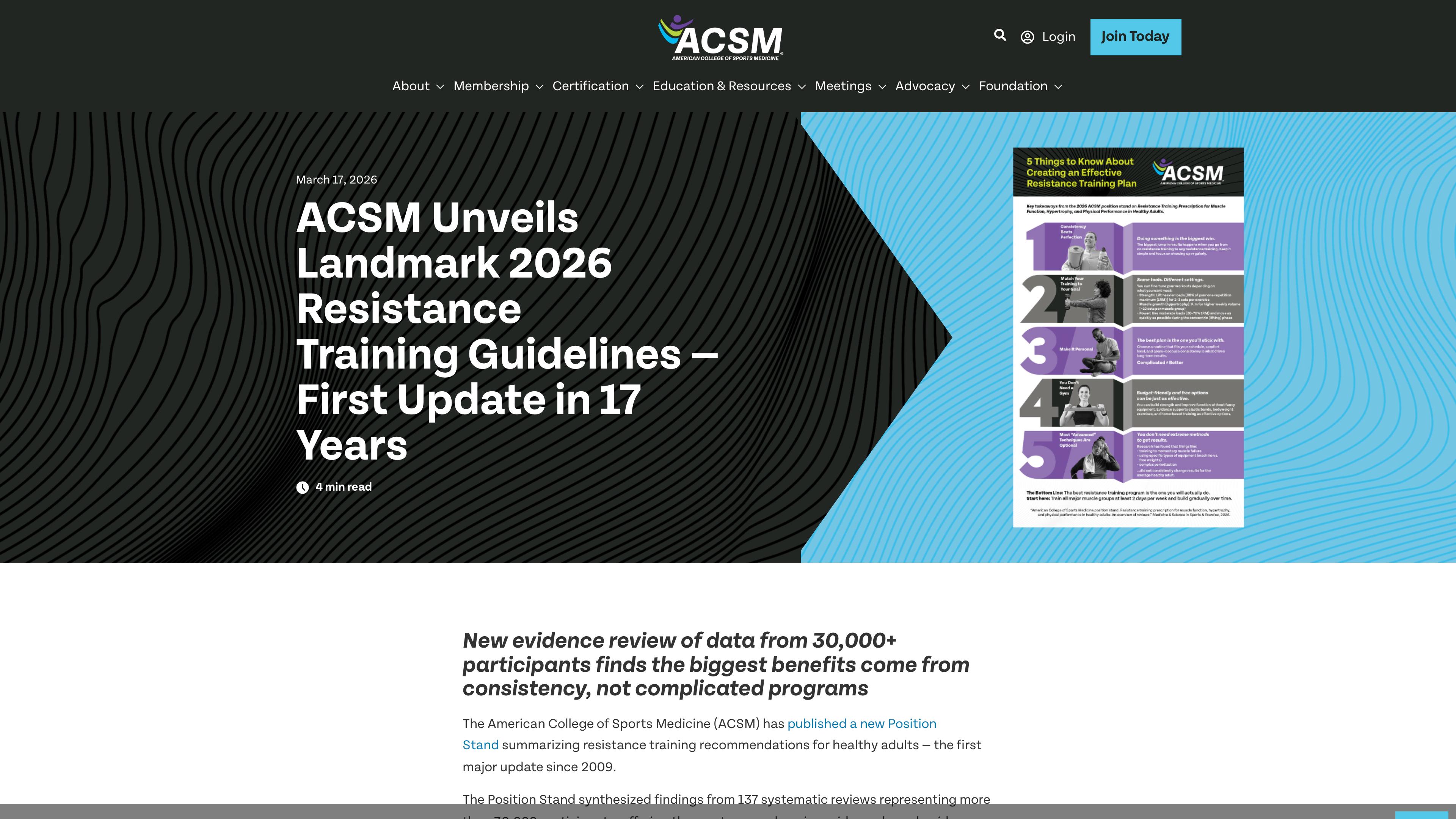
Key sources include the ACSM 2026 resistance training guidance; 2024–2025 evidence on rest intervals, proximity to failure, neuromuscular adaptation, equipment specificity, and nutrition; and Stronger's 2026 internal guides on rep ranges, progressive overload, rest periods, compound exercises, and app features. (ACSM)
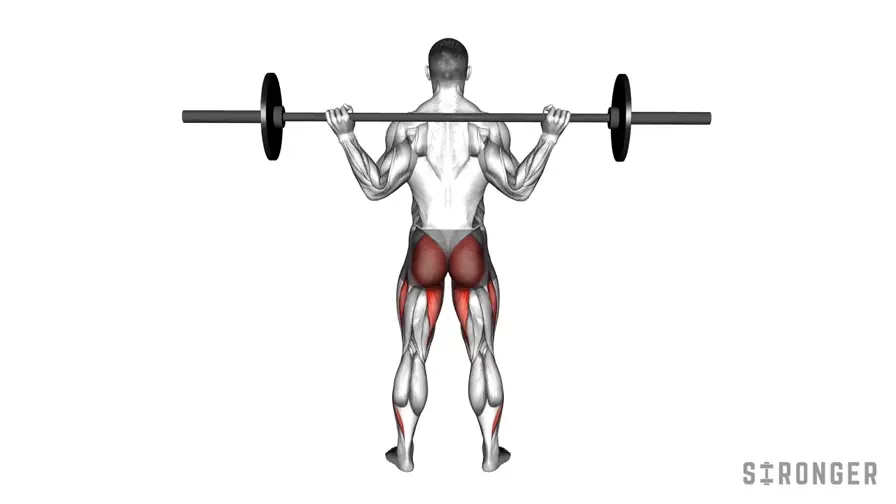
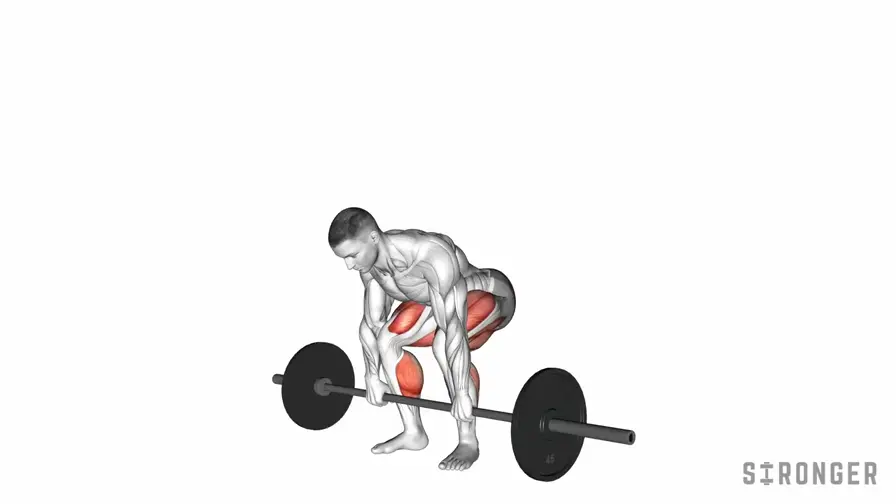
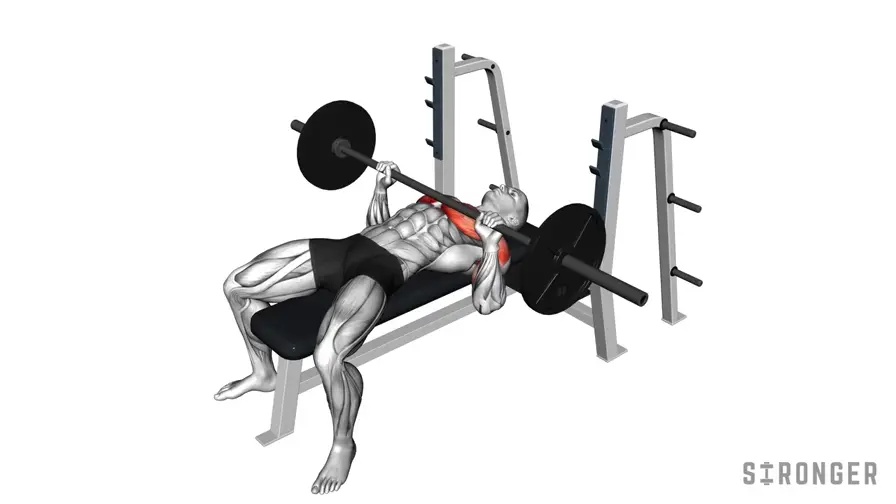
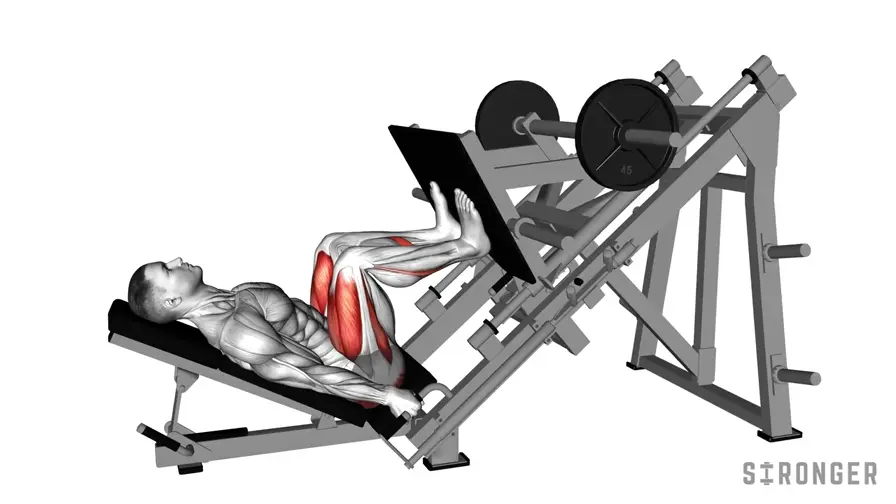
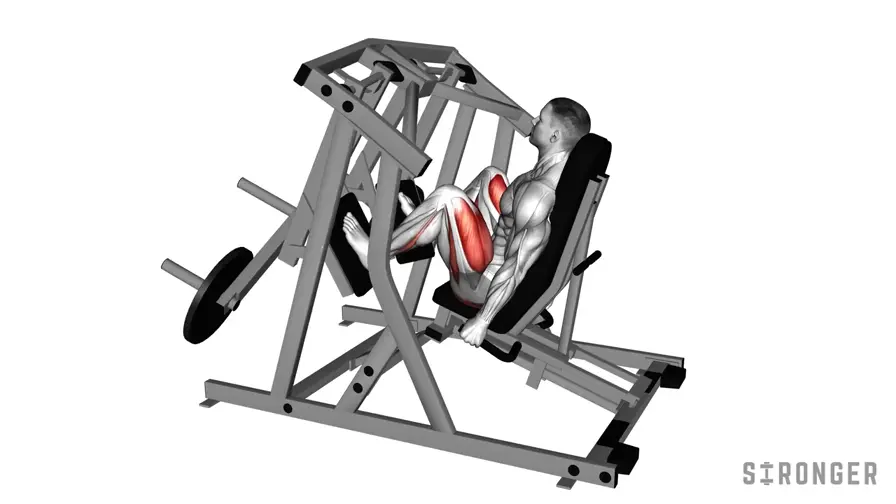
Exercises in this guide
Stronger Editorial Team
Certified strength & conditioning specialists with 10+ years of coaching experience
The Stronger editorial team produces evidence-based training content for lifters of all levels.
Ready to Get Stronger?
Join 2,000,000+ lifters tracking their workouts with Stronger. Available on iOS and Android.