
Romanian Deadlift vs Deadlift: Which Builds More Muscle?
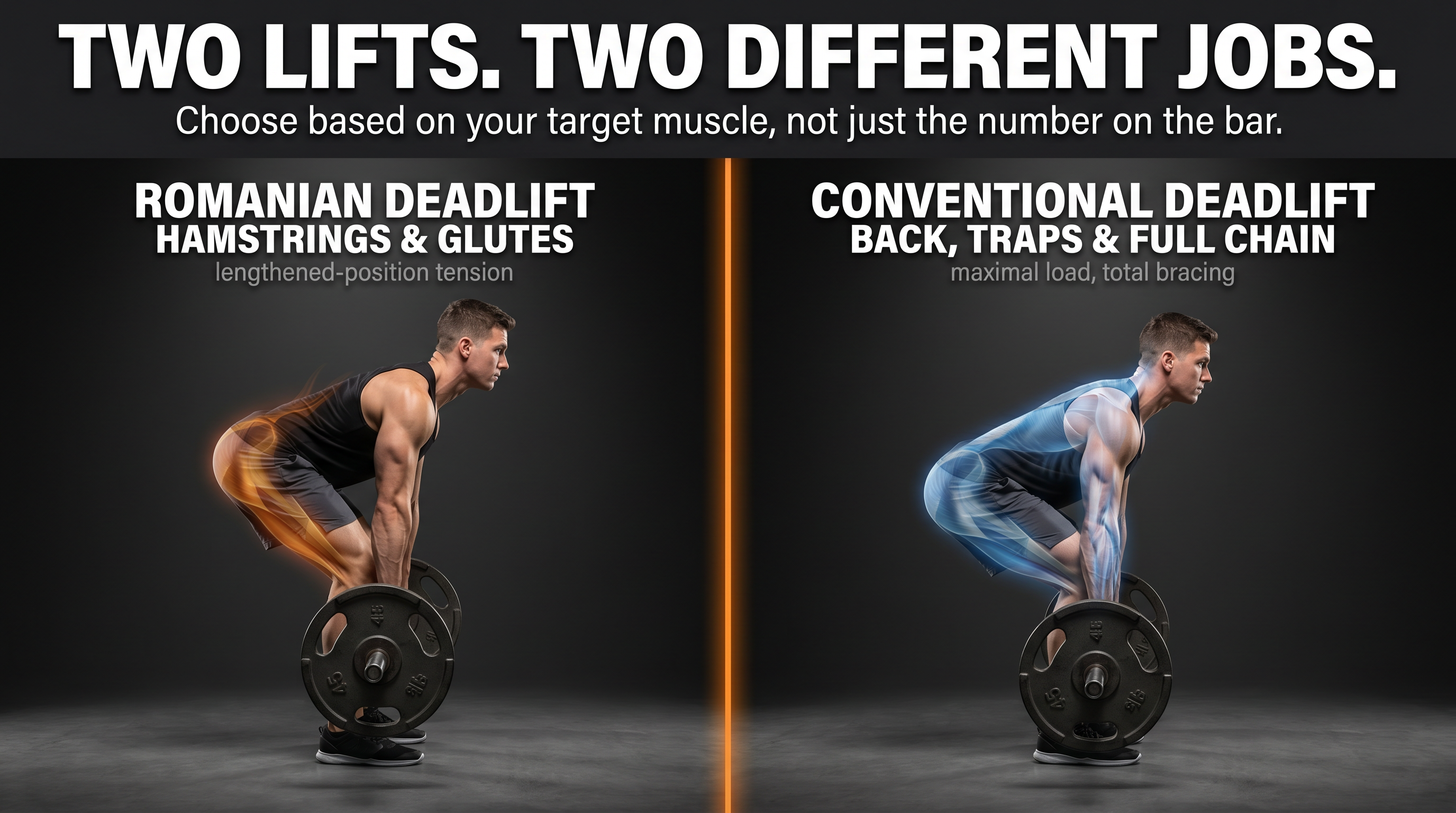
Here's the straight answer: for building bigger hamstrings, the Romanian deadlift wins. For total-body strength, back thickness, and full-body bracing, the conventional deadlift wins. If you've been getting conflicting advice about which to prioritize, both sides are right — they're just right about different muscles.
That distinction matters enormously for how you program. If you choose one over the other and use it for everything, you're leaving muscle on the table. If you understand what each actually does, you can use both intelligently and build faster.
We've mapped this out in our exercise guides, and we've looked at the current research on muscle activation and hypertrophy. The short version: these are different tools, not interchangeable ones.
| Goal | Better Choice | Why |
|---|---|---|
| Bigger hamstrings | Romanian deadlift | More direct hip-hinge tension on hamstrings; trains them in a lengthened position |
| Bigger glutes | Both (RDL + hip thrust or squat) | Deadlifts load heavy hip extension; RDLs load the glutes in a stretched position |
| Bigger back, traps, grip | Conventional deadlift | Heavier loading, full-body bracing, more upper-back demand |
| Bigger quads | Conventional deadlift (squats are still better) | More knee extension than RDLs |
| Powerlifting strength | Conventional deadlift | You need to train the lift from the floor |
| Bodybuilding with less fatigue | Romanian deadlift | More targeted stimulus, easier to program for hamstring volume |
For most lifters, the best answer isn't "deadlift OR Romanian deadlift." It's: deadlift heavy enough to build full-body strength, then use RDLs to build the hamstrings and glutes with cleaner, more repeatable volume. That's the setup that works.
The rest of this article explains why — covering the biomechanics, what the research actually shows (and where it falls short), and how to program both for real muscle growth.
What's the Difference Between an RDL and a Conventional Deadlift?
Both are hip-hinge movements. Both load the posterior chain. Both use a barbell, dumbbells, or kettlebells. But three mechanical differences change everything about which muscles bear the load.
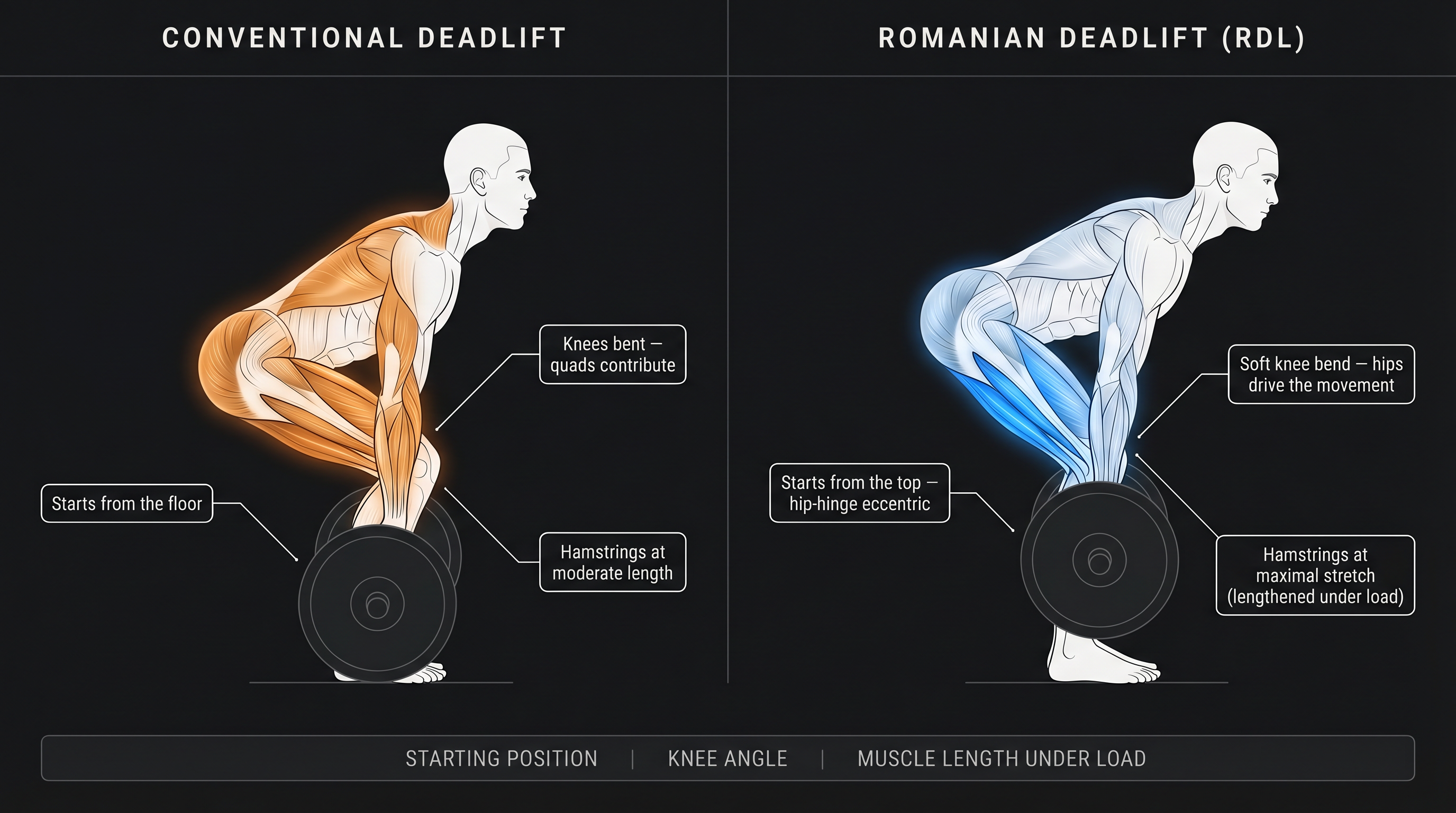
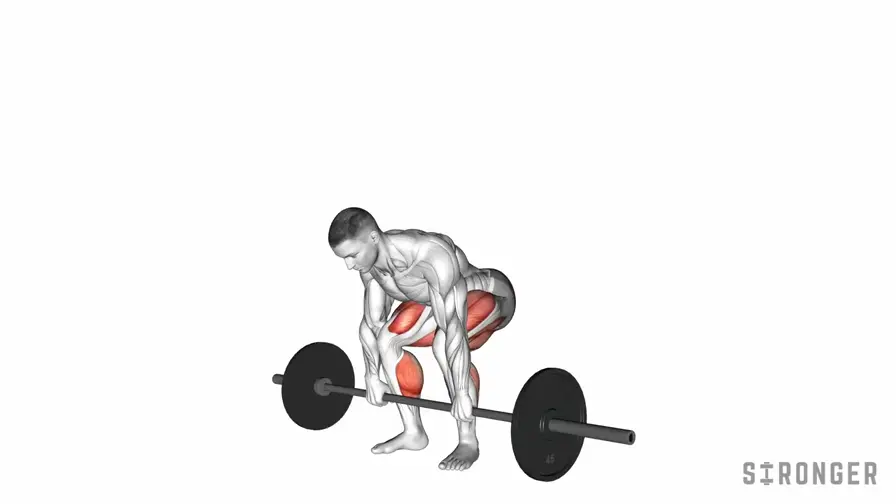
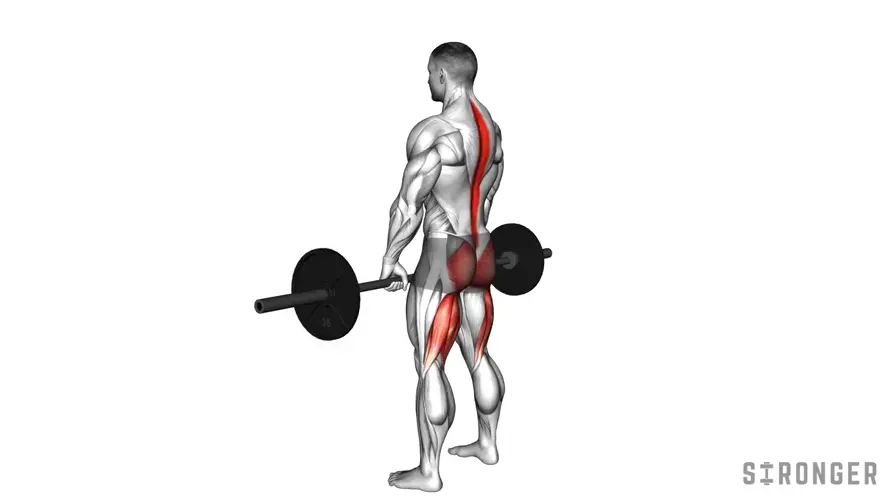
Starting position. The conventional deadlift starts from the floor. You set the bar over your midfoot, grip it just outside your knees, brace, and push the floor away. The Romanian deadlift starts from the top — you stand with the weight in your hands, push your hips back, lower until you feel a strong hamstring stretch, then drive your hips forward to stand. That difference in starting position changes the entire loading pattern. For a full breakdown of conventional deadlift setup and technique, our complete deadlift guide covers every detail.
Knee bend. In a conventional deadlift, your knees bend more, your shins are closer to the bar, and your quads contribute meaningfully to the lift. In an RDL, you maintain a slight bend but don't drop into a partial squat — the movement is driven almost entirely by the hips. Less quad involvement means the hamstrings and glutes have to do more of the work.
Bar path and muscle length during the lowering phase. This is the critical variable. In a conventional deadlift, the bar comes off the floor with the hamstrings already at moderate length. In an RDL, you control the bar as your hamstrings lengthen progressively — and you stop when the hamstrings reach maximal stretch. That controlled lengthening under load is what makes RDLs a superior hamstring stimulus, and we'll get into the science behind why in a moment.
Our deadlift guide describes the main muscles as back, hamstrings, and glutes, with quads, forearms, traps, and abs contributing. (Stronger) Our RDL guide lists hamstrings and glutes as the primary muscles, with back and forearms as secondary. (Stronger) The overlap is real — but so is the difference.
Why Lifting More Weight Doesn't Always Build More Muscle
This is where beginners and even intermediate lifters get tripped up.
You might be deadlifting 400 lb and doing RDLs with 250 lb. The conventional deadlift is heavier — but that doesn't mean it's building your hamstrings faster. It's heavier because more muscles are sharing the load: hamstrings, glutes, quads, erectors, lats, traps, and forearms all pitch in. Because they're compound movements that recruit multiple muscle groups simultaneously, the total system load is high — but the demand on any single muscle is diluted. The RDL is lighter because you've removed most of the knee extension and made the hamstrings and glutes do more of the hinge work.
The better question for hypertrophy isn't "which lift is heavier?" It's: which lift gives the target muscle more high-quality, recoverable tension?
A 250 lb RDL can outpace a 400 lb conventional deadlift for hamstring growth — not because it's more impressive, but because it puts more of the stress directly on the hamstrings, lets you control the lowering phase, and allows you to do more repeatable hard sets without wrecking the rest of your training week.
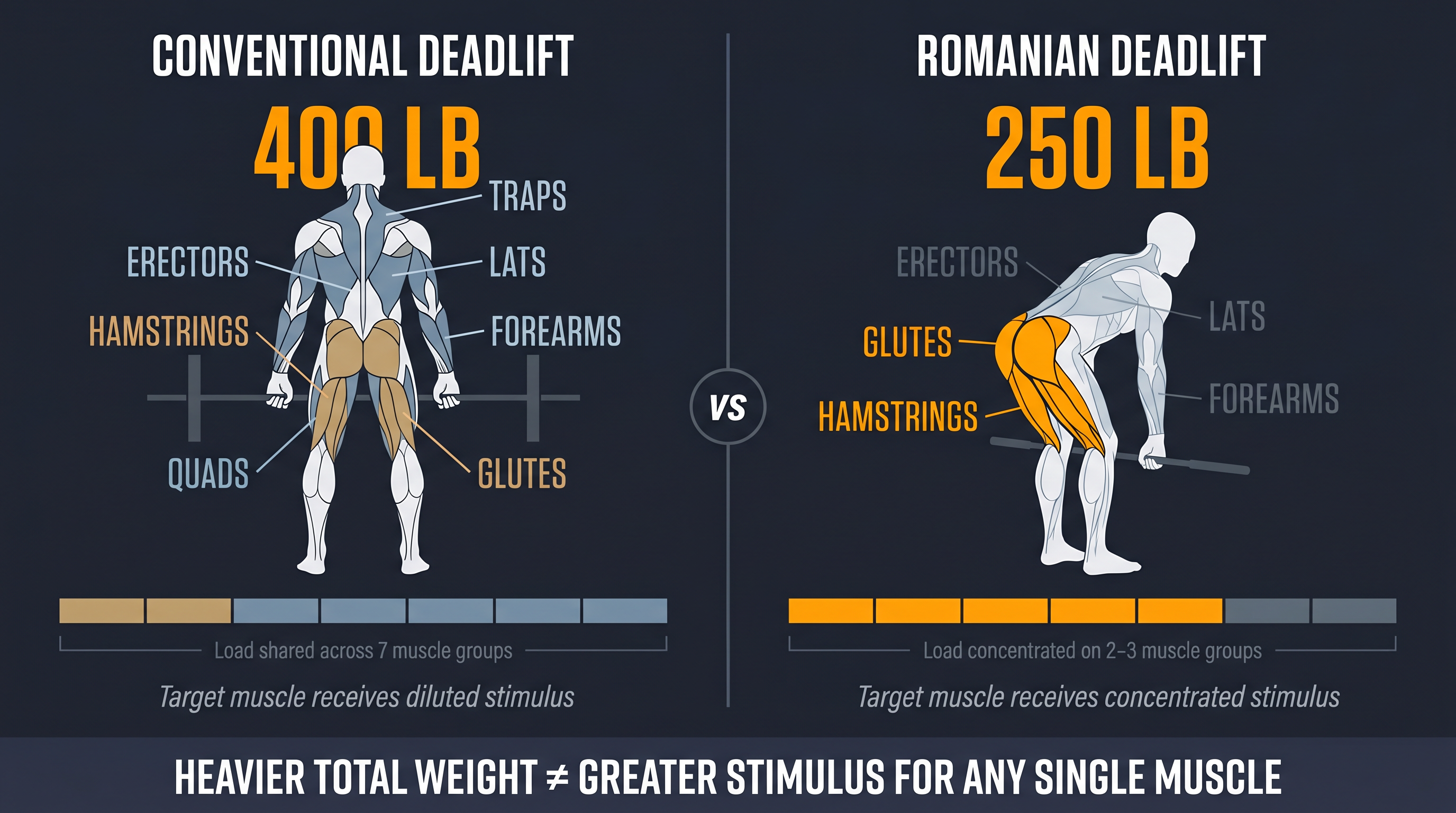
This is why the answer changes by muscle group. For some muscles, the conventional deadlift wins. For others, the RDL wins. And for a few, neither is the optimal tool.
Ready to Get Stronger?
Join 2,000,000+ lifters tracking their workouts with Stronger. Available on iOS and Android.


RDL vs Deadlift: Which Muscles Does Each Build?
Hamstrings: Does the RDL or Deadlift Build More?
The hamstrings cross both the hip and the knee (except for the short head of the biceps femoris, which only crosses the knee). (NIH/NCBI) That anatomy means hip-hinge movements with relatively straight knees can place the hamstrings under heavy tension while they're lengthened — and that's exactly what RDLs do.
This matters because of where hypertrophy research has been going. A 2025 systematic review found that longer-muscle-length resistance training may be superior for hypertrophy and longitudinal growth, though the evidence remains mixed. (ScienceDirect) A 2026 meta-analysis that compared partial reps performed at long versus short muscle lengths found that the long-length partials produced significantly greater hypertrophy. (Ulster University)
There's also direct hamstring evidence. A 2024 Loughborough University study comparing Nordic curl training with lengthened-state eccentric training found that the lengthened-state approach produced greater total hamstring volume gains — +18% versus +11% over 12 weeks. (Maeo et al., 2024, Medicine & Science in Sports & Exercise) This wasn't a study on RDLs specifically, but it supports the same mechanical principle: hamstrings grow well when trained hard at long muscle lengths.
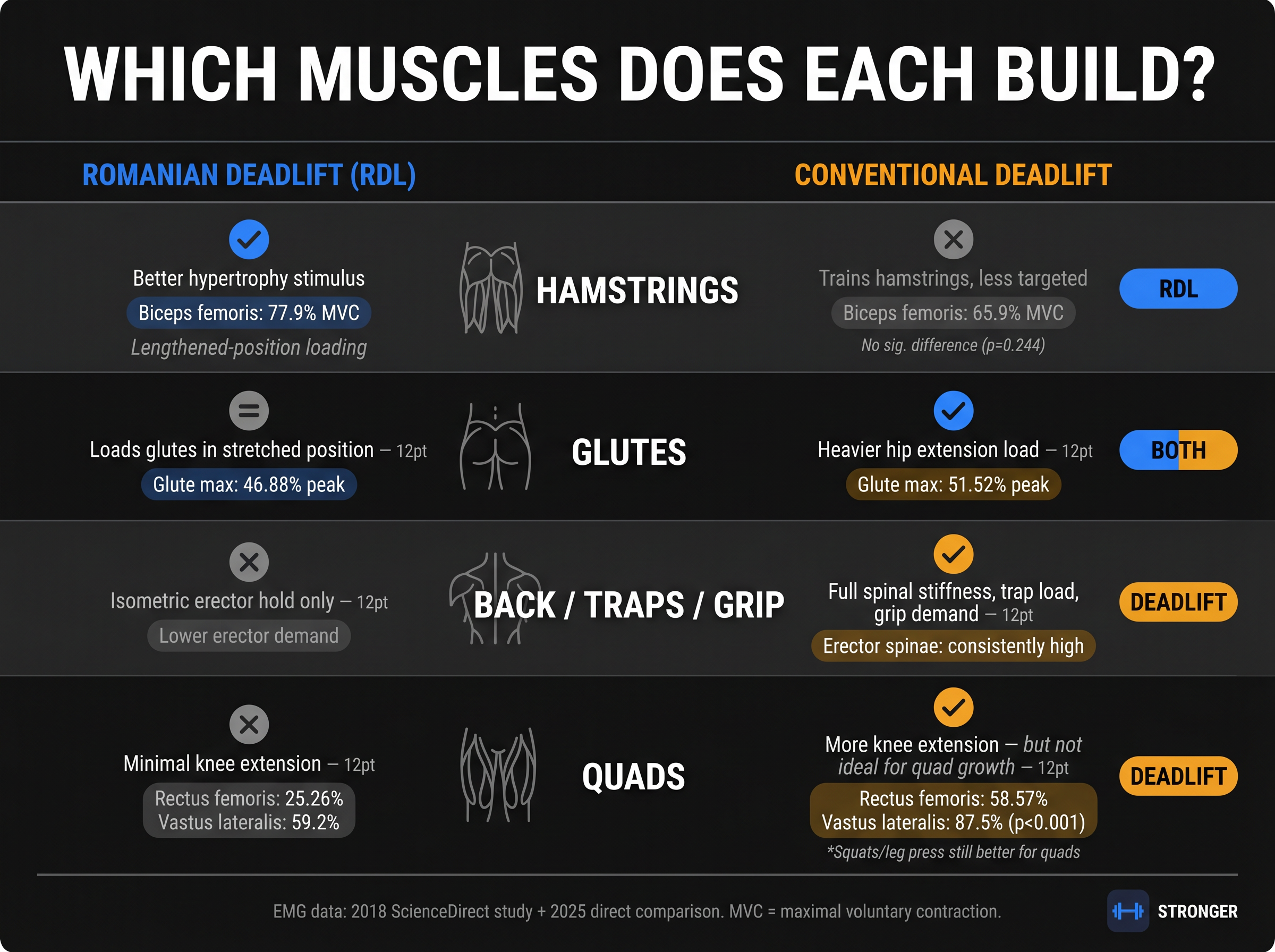
What about direct deadlift-versus-RDL evidence? A 2025 study found higher vastus lateralis (quad) activation in the conventional deadlift, but no statistically significant difference in biceps femoris (the main hamstring muscle) activation — with p = 0.244. The means actually favored the RDL (77.9% vs 65.9%), but the statistical difference wasn't reliable enough to conclude superiority.
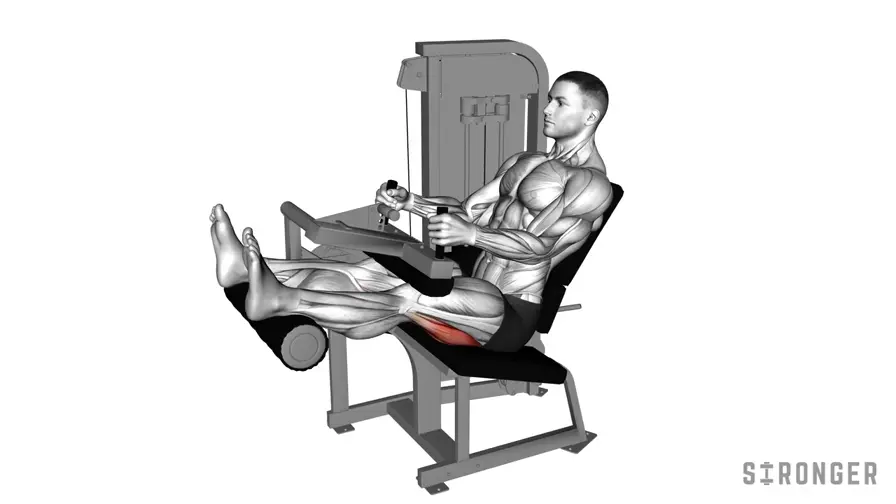
Here's the important thing to understand about that finding: EMG (electromyography — the measurement of electrical activity in a muscle during exercise) captures what's activating in the moment. It doesn't capture range of motion, muscle length during loading, fatigue accumulation, or how well a movement can be progressed over months. In practice, RDLs are easier to program for direct hamstring work — controlled reps, moderate loads, repeatable sets, without every session becoming a full-body recovery event. A leg curl trains the knee-flexion function of the hamstrings that neither deadlift variation covers well — which is why it belongs in any complete hamstring program alongside RDLs.
Bottom line for hamstrings: the RDL is the better default hypertrophy exercise.
Glutes: Which Deadlift Variation Builds More?
For glutes, the answer is genuinely more nuanced.
The conventional deadlift can train the glutes hard through heavy hip extension. A 2018 study comparing the two lifts found greater glute max activation in the conventional deadlift — 51.52% peak versus 46.88% peak. (ScienceDirect) That's a meaningful difference in activation, but as our hip thrust guide notes, high activation in the moment doesn't automatically mean greater long-term growth.
The RDL trains the glutes differently: you're loading hip extension while the hips are flexed, which means the glutes are working in a more stretched position. A 2025 systematic review and meta-analysis in Frontiers on gluteus maximus hypertrophy found that resistance training has a moderate positive effect on glute size, and that programs using multiple hip-extension exercises can increase glute development. (Frontiers)
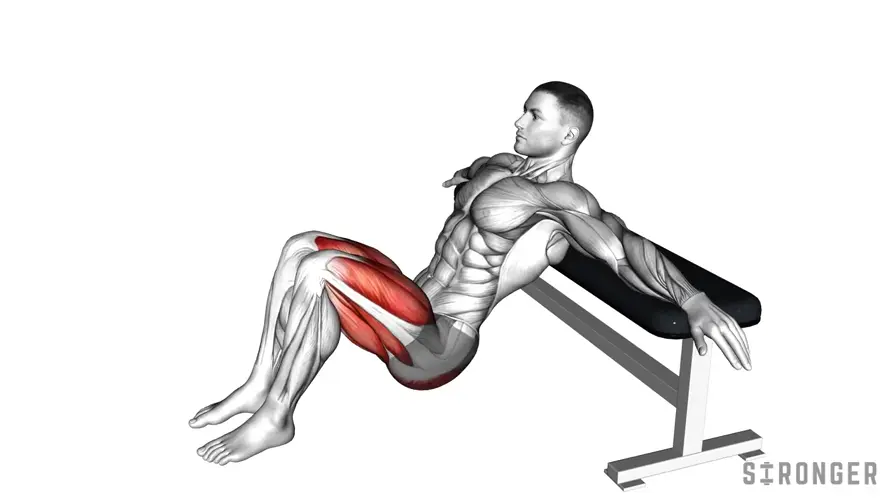
That's the practical take-away: if glutes are the priority, don't rely on either lift alone. A strong glute program typically includes heavy hip extension (deadlifts), lengthened-position hip extension (RDLs or split squats), and a direct glute movement like hip thrusts, squats, or leg presses.
Bottom line for glutes: use both, and add a glute-focused lift to your rotation.
Back, Traps, and Grip: Why the Conventional Deadlift Wins
For building the kind of back thickness and posterior-chain density that makes a physique look powerful, the conventional deadlift is clearly superior.
The RDL still trains the spinal erectors isometrically, challenges your grip, and demands lat activation to keep the bar close. But the conventional deadlift allows heavier loading and requires more total-body stiffness — from the initial floor break through the lockout. A 2020 systematic review of EMG activity across deadlift variations found that erector spinae and quadriceps activation tended to be high across deadlift variants; the RDL was one of the exceptions where hamstring activation exceeded erector activity. (PLOS ONE)
In plain terms: conventional deadlifts feel like a whole-back lift. RDLs feel like hamstrings and glutes, with the back working hard to hold position. For erector thickness, trap development, and grip strength, the conventional deadlift wins. If you want to build that upper-back density further, pairing deadlifts with a dedicated barbell row gives you the pulling volume the deadlift alone doesn't provide.
Bottom line for back: conventional deadlift is the better builder of posterior-chain "armor."
Quads: Conventional Deadlift Wins, But Neither Is Your Best Option
The conventional deadlift involves more knee extension, so the quads contribute more. The 2018 EMG study found rectus femoris activation of 58.57% in the conventional deadlift versus 25.26% in the RDL. (ScienceDirect) The 2025 study showed the same pattern for vastus lateralis: 87.5% versus 59.2% (p < 0.001).
But that doesn't make the conventional deadlift a great quad hypertrophy exercise. If quad growth is your goal, squats, leg presses, hack squats, and split squats are more direct and better at accumulating quality quad volume.
Bottom line for quads: conventional deadlift beats RDL, but neither should be your primary quad builder.
What Does the Research Say About RDLs vs Deadlifts for Muscle Growth?
One thing worth stating plainly: there is no long-term, controlled hypertrophy trial that has put trained lifters on conventional deadlifts-only or RDLs-only for months and measured every relevant muscle. The research base we're working from is a combination of EMG studies, acute activation data, and hypertrophy research on related principles — like muscle-length training and lengthened-position eccentric work.
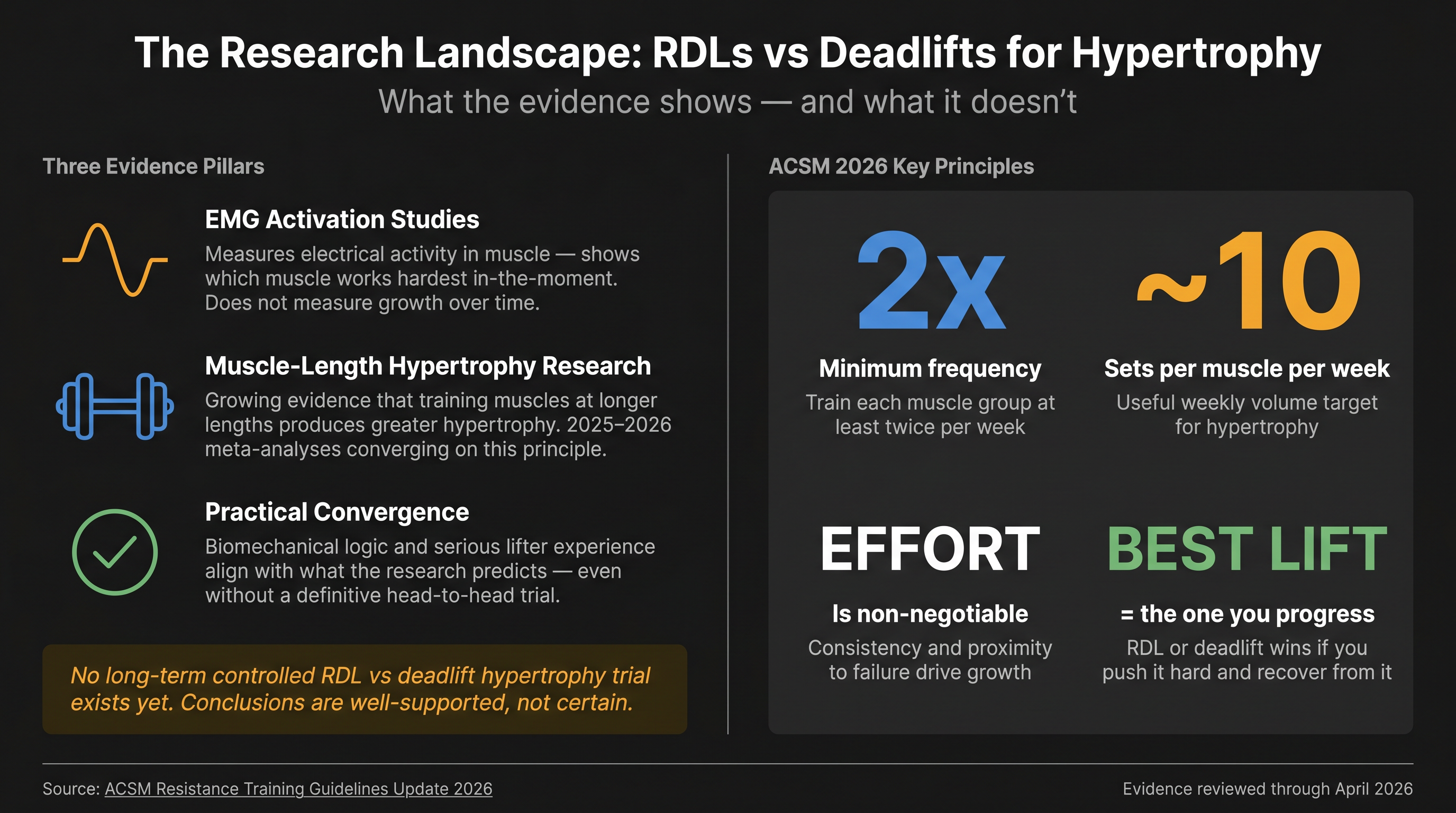
That's not a reason to distrust the evidence. It's a reason to hold your conclusions with appropriate confidence: the biomechanical logic is clear, the muscle-length research is converging, and the practical experience of serious lifters matches what the science predicts. But anyone claiming absolute certainty about the exact hypertrophy difference between these lifts is overstating what the data currently shows.
What we can say with confidence: the ACSM's 2026 resistance training position stand recommends training all major muscle groups at least twice a week, and found that muscle growth was enhanced by higher weekly volumes of roughly 10 or more sets per muscle group. (ACSM) Our guide to getting stronger covers these principles in full — that principle matters more than which lift wins the comparison. The best lift is the one you can push hard, recover from, and progress over time.
How to Program RDLs and Deadlifts Together for Maximum Muscle
The Hypertrophy Split: Separate RDL and Deadlift Days
Separate the two lifts into distinct training sessions — one focused on targeted hamstring and glute volume, one focused on heavy strength work.
Day 1 — Hamstrings and Glutes
| Exercise | Sets | Reps | Notes |
|---|---|---|---|
| Romanian deadlift | 3–4 | 8–12 | Stop at deep hamstring stretch; 1–3 reps in reserve |
| Hip thrust | 3–4 | 8–12 | Pause briefly at lockout |
| Leg curl | 2–4 | 10–15 | Train knee-flexion function of hamstrings too |
| Split squat or leg press | 2–4 | 8–12 | Additional glute and quad volume |
Day 2 — Strength and Full Posterior Chain
| Exercise | Sets | Reps | Notes |
|---|---|---|---|
| Conventional deadlift | 2–4 | 3–6 | Heavy, clean reps; no max-effort ego grinding |
| Squat or leg press | 3–4 | 6–10 | Quad and glute volume |
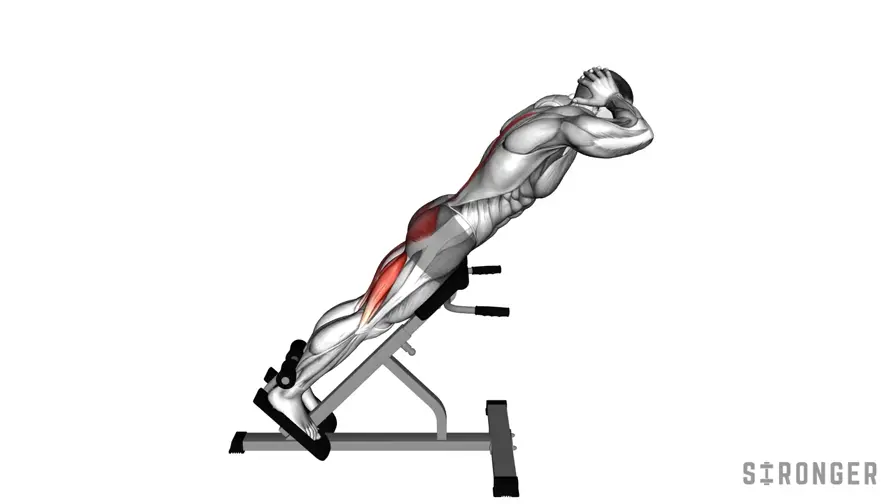
| Back extension | 2–3 | 10–15 | Glutes and erectors |
| Row or pulldown | 3–4 | 8–12 | Upper-back support |
This setup gives the RDL its own day as a primary lift — so you're not doing it pre-fatigued — and uses the conventional deadlift as a strength anchor. The two lifts serve different functions and thrive in different contexts.
The Bodybuilding Split: Skip Heavy Conventional Deadlifts
If you're training for physique and don't care about powerlifting-style floor pulls, you can build an excellent posterior chain without ever doing conventional deadlifts.
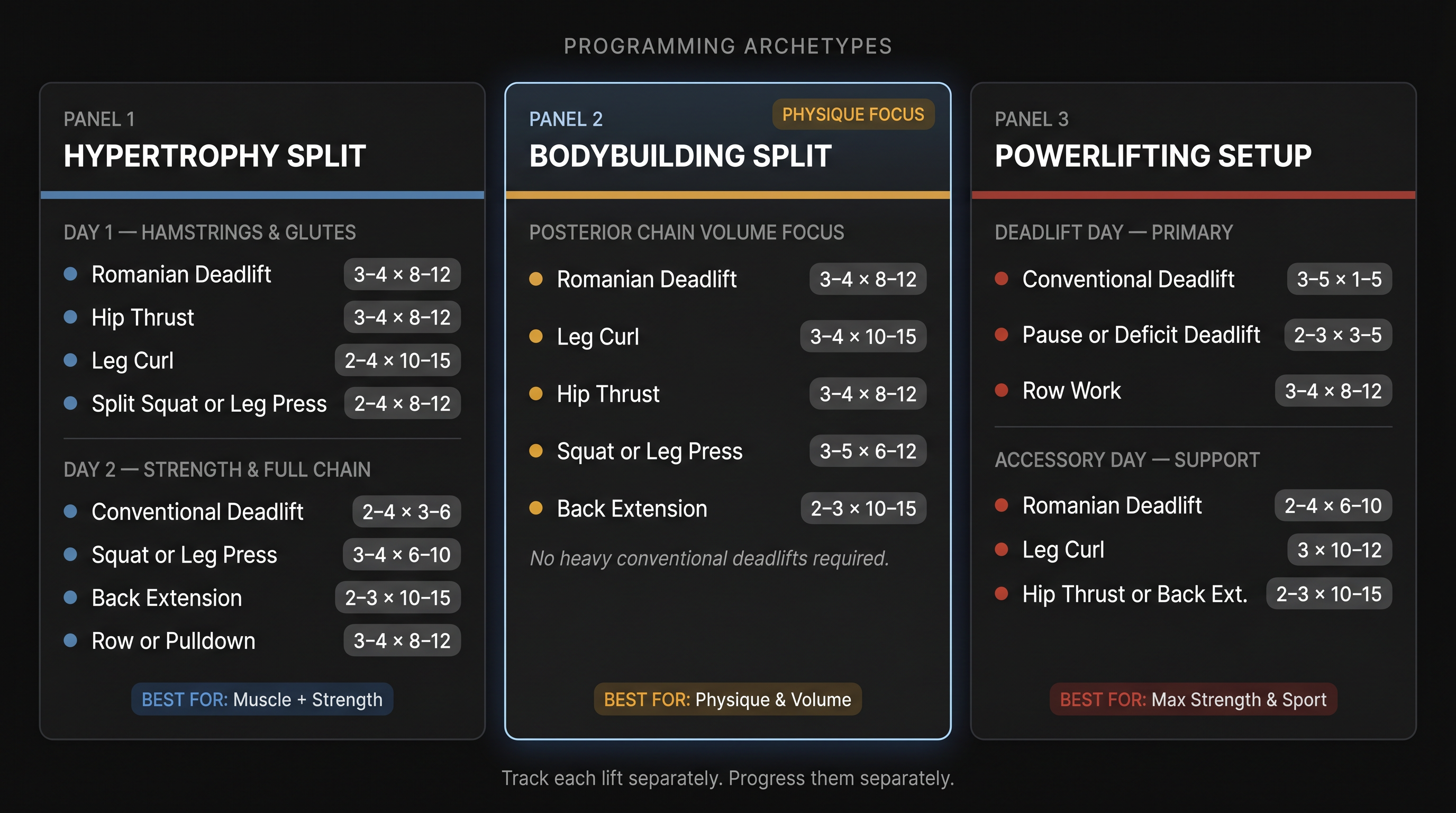
- Romanian deadlift: 3–4 sets of 8–12
- Leg curl: 3–4 sets of 10–15
- Hip thrust: 3–4 sets of 8–12
- Squat or leg press: 3–5 sets of 6–12
- Back extension: 2–3 sets of 10–15
This approach often produces better physique outcomes because you're accumulating more direct target-muscle volume with less full-body fatigue. The fatigue cost of heavy conventional deadlifts is real — they pull from recovery that could otherwise go toward additional quality sets.
The Powerlifting Setup: Deadlift First, RDL as Accessory
If you compete or care about your conventional deadlift number, keep the deadlift as your main lift and use RDLs to build the supporting structures. A 5x5-style strength program structured around low-rep heavy work is a proven foundation for this approach.
Deadlift day: Conventional deadlift 3–5 sets of 1–5 reps, pause or deficit deadlift variation, row work, bracing work.
Accessory day: Romanian deadlift 2–4 sets of 6–10 reps, leg curl, hip thrust or back extension.
This lets the deadlift train the skill and specificity, while the RDL builds the hamstrings and hip-hinge strength that the deadlift relies on.
How to Progress Your Deadlift and RDL Over Time
For deadlifts:
- Work in sets of 3–5 reps, starting with 2 reps in reserve
- Add 5–10 lb only when all sets feel clean — bar path stays close, brace holds throughout
- Don't grind near-failure attempts every week; consistent progress beats sporadic maxing
- See our progressive overload guide for the full breakdown
For RDLs — use double progression:
- Pick a weight you can do for 8 controlled reps with consistent depth
- Keep the load the same until you can hit 12 reps on all 3 sets
- Then add weight and drop back to 8–9 reps
- The key: maintain the same range of motion — shortening the rep to touch above your knees isn't progress, it's cheating the set
For loading and rep zones:
- Our rep range guide covers when to work in the 1–5, 6–12, and higher rep zones and what each produces
Rest between sets:
- Heavy deadlifts: 3–5 minutes (neural recovery and full-body tension quality)
- RDLs for hypertrophy: 2–3 minutes
- Accessory work: shorter rest is fine
- See our rest between sets guide for the full reasoning
Track Your Deadlift and RDL Progress in Stronger
One of the most common tracking mistakes: logging all posterior-chain work as a single category and then wondering why you're not seeing clearer results.
The conventional deadlift and the Romanian deadlift are different exercises with different mechanics, different loading patterns, and different progression curves. Log them separately. Compare their histories separately. Progress them separately.
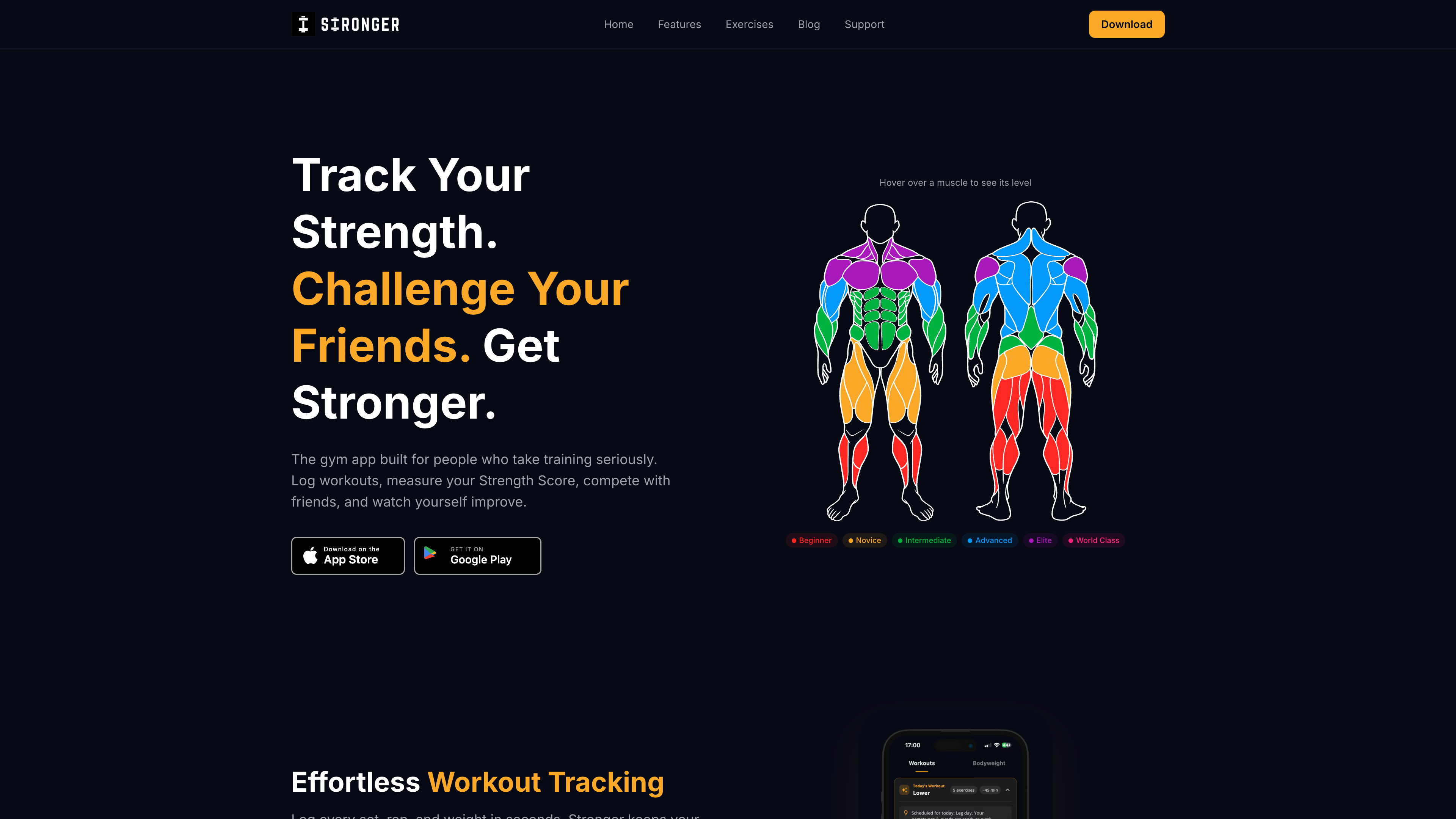
Inside Stronger, you can:
- Use exercise history to compare your deadlift and RDL progress independently — if your RDL hasn't moved in six weeks but your deadlift has, the problem is posterior-chain volume, not strength
- Log RPE per set to stop turning every deadlift session into a max test — an RPE 7–8 on your working sets means you're building, not testing
- Use rest timers to keep performance consistent across both lifts
- Track volume and frequency by muscle group to see whether your hamstrings and glutes are actually getting enough weekly work
- Use adaptive routines if you want the app to adjust sets, reps, and weights as your performance changes
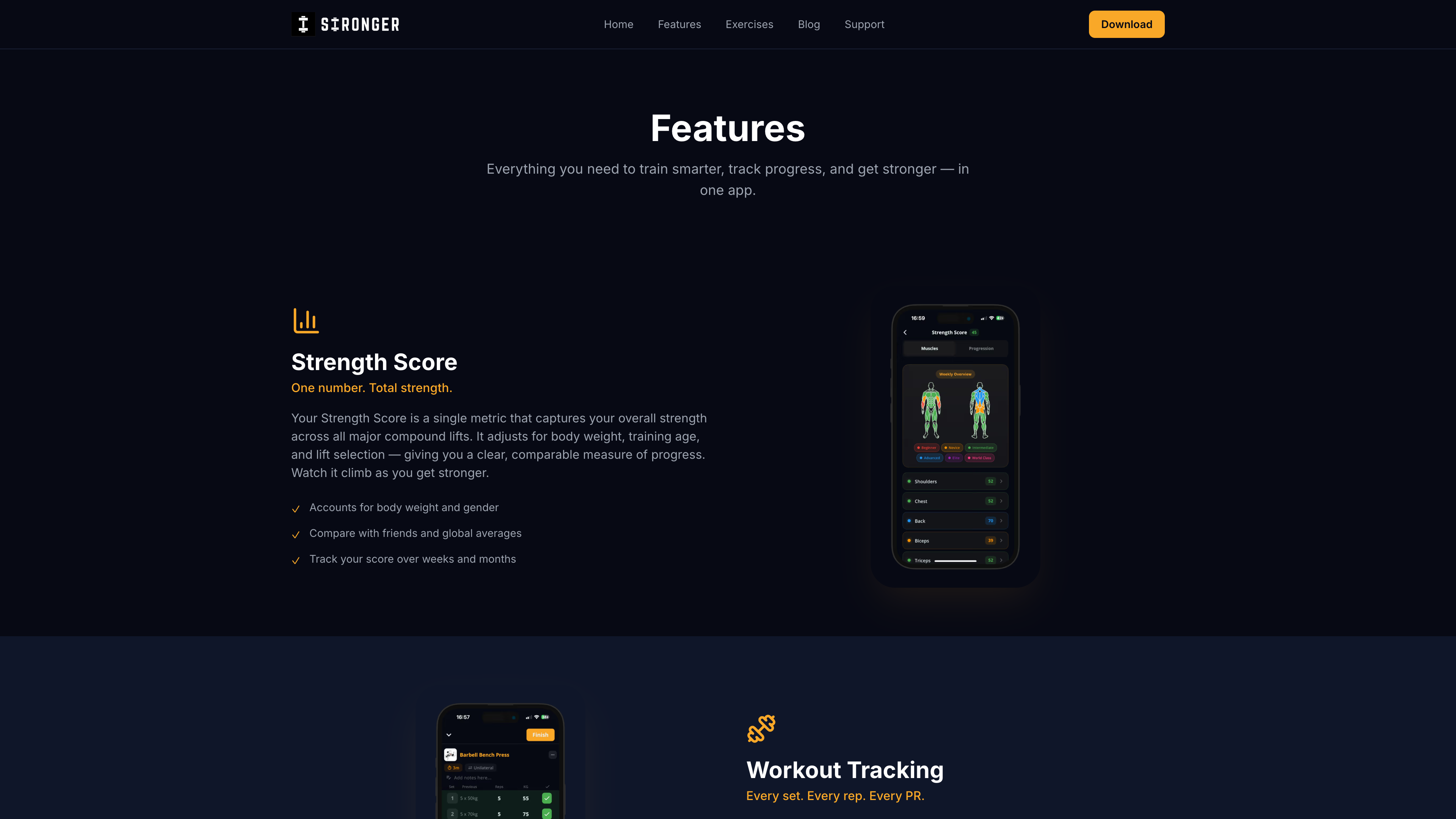
The features page has the full breakdown of what's included across both free and Premium plans.
The better question isn't "did I deadlift more this week?" It's: are my target muscles getting stronger across enough clean weekly work? That's the hypertrophy question. And it's much easier to answer when you have the data.
Ready to Get Stronger?
Join 2,000,000+ lifters tracking their workouts with Stronger. Available on iOS and Android.
RDL vs Deadlift: Which Should You Prioritize?
Here's the final answer, laid out clearly by goal:
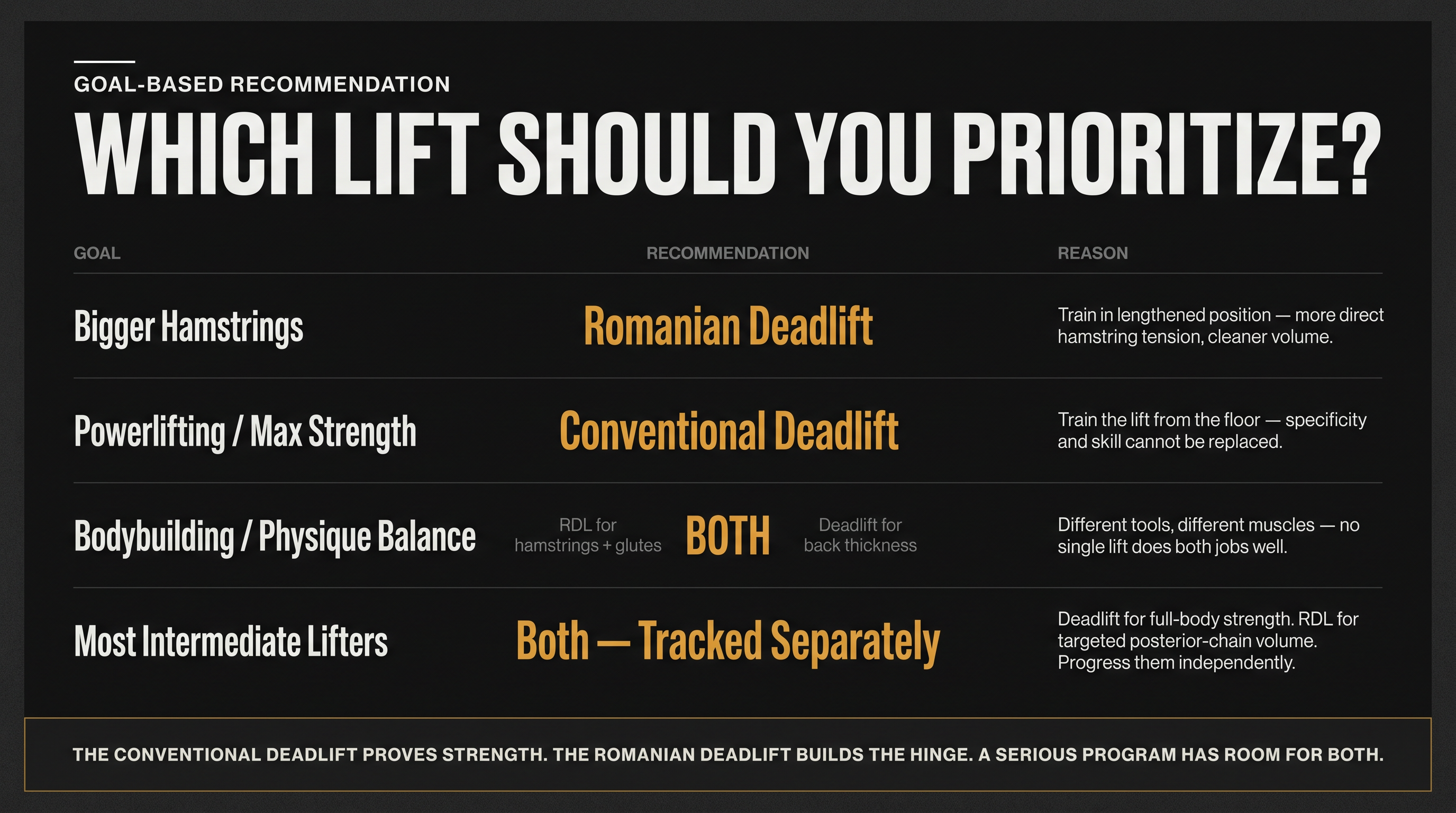
If your primary goal is building bigger hamstrings: make RDLs your main hinge movement. Program them with controlled reps, consistent depth, and a clear progression plan. Use conventional deadlifts for strength and back development.
If your primary goal is powerlifting or max-strength floor pulls: the conventional deadlift is the primary lift. RDLs are an excellent accessory that builds the supporting structures without replacing the skill of pulling from the floor.
If your primary goal is bodybuilding with balanced posterior-chain development: use both. RDLs as the hamstring and glute hypertrophy tool; conventional deadlifts (or trap bar, rack pull, or block pull variations) for back thickness and full-body bracing.
For most intermediate lifters: deadlift heavy enough to build full-body strength, then use RDLs to build the hamstrings and glutes with targeted, repeatable volume. Track them separately. Progress them separately. Don't let either lift be everything.
The conventional deadlift proves strength. The Romanian deadlift builds the hinge. A serious program has room for both.
Frequently Asked Questions
Is the Romanian deadlift better than the deadlift for muscle growth?
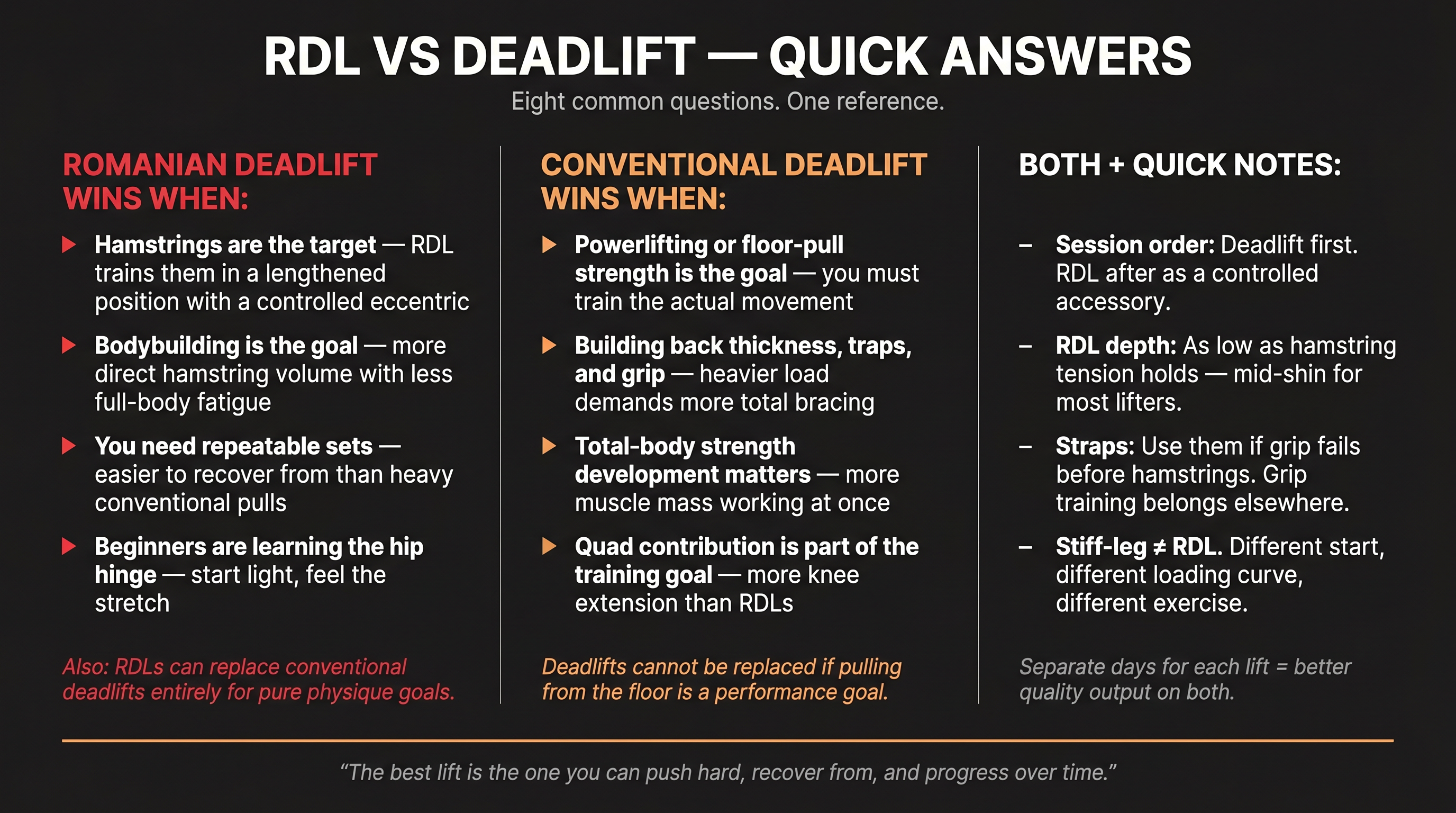
For hamstrings specifically, usually yes. The RDL trains the hamstrings in a lengthened position with a controlled eccentric — which current research suggests is a superior stimulus for hamstring hypertrophy. For total-body muscle, the conventional deadlift trains more muscle mass simultaneously and allows heavier loading, giving it an edge for overall development. You can explore the full mechanics in our deadlift guide.
Do deadlifts build hamstrings?
Yes, but they're not the most efficient hamstring hypertrophy tool. Conventional deadlifts train the hamstrings, but they also distribute work across the back, glutes, quads, grip, and core. The hamstrings get stimulus, but not the isolated, lengthened-position tension that drives the most direct hamstring growth. For that, RDLs and leg curls are more effective tools.
Can RDLs replace conventional deadlifts?
For pure bodybuilding goals, yes. If you're training for physique and not competing in powerlifting, RDLs can serve as your primary hinge movement — especially when paired with rows, back extensions, and other back work to cover what the conventional deadlift would have provided. They cannot replace conventional deadlifts if strength from the floor is a goal.
Should I do RDLs before or after deadlifts?
If you're doing both in the same session, deadlift first. Your hinge pattern, spinal erectors, and glutes will be fresher. Use RDLs after as a more controlled accessory. If hamstring growth is the top priority, separating them across the week gives you better quality output on both — Monday for deadlifts, Thursday for RDLs, for example.
How low should you go on RDLs?
As low as you can while maintaining your spinal position, keeping the bar close, and feeling genuine hamstring tension. For many lifters, that's around mid-shin. You don't need to touch the floor — and rounding your back to squeeze out extra range of motion isn't more depth, it's worse form.
Should I use straps for RDLs?
If your grip is failing before your hamstrings, use straps. The goal of the RDL is posterior-chain hypertrophy. If your hands are the limiting factor, you're training your grip and not your hamstrings. Grip training has its place — it doesn't belong in your main hamstring work.
Are stiff-leg deadlifts the same as RDLs?
Not exactly. Stiff-leg deadlifts typically use less knee bend and may start from the floor, which changes the hamstring loading pattern. RDLs start from the top, keep a soft knee bend, and emphasize the controlled hip-hinge motion. Both train the hamstrings and glutes effectively; the RDL is usually the better choice for controlled hypertrophy volume because of the consistent starting position.
Can beginners do RDLs?
Yes — and RDLs are often an excellent way for beginners to learn the hip hinge before loading up conventional deadlifts. Start light, use dumbbells if the barbell feels awkward, and focus on feeling the hamstrings stretch while keeping the weight close to your body. The hip-hinge pattern transfers to every posterior-chain movement you'll do for the rest of your training career.
This article references exercise content from our deadlift guide and uses research reviewed through April 2026. The direct deadlift-versus-RDL hypertrophy evidence is limited; older EMG studies from 2018 and 2020 are included because they remain among the most relevant direct comparison sources for this topic.
Exercises in this guide
Stronger Editorial Team
Certified strength & conditioning specialists with 10+ years of coaching experience
The Stronger editorial team produces evidence-based training content for lifters of all levels.
Ready to Get Stronger?
Join 2,000,000+ lifters tracking their workouts with Stronger. Available on iOS and Android.