

Fitbod decides your workout.
Stronger tells you if it's working.
Fitbod generates each session from your equipment, recovery, and history. That's its whole job, and it's good at it. Stronger does the opposite: you keep the wheel, and it turns your own training into a Strength Score, ranks you against real standards, finds your weak point, and puts you on a leaderboard with friends. One reduces planning. The other increases proof.
One outsources the decision.
The other proves the result.
Most "best workout app" lists drop these two in the same bucket. They shouldn't. They're built around opposite jobs, and which one you need is the entire comparison.
Tell it your equipment, goal, and schedule. It builds the session, picks the weights, orders the exercises, and adapts next time from your recovery. The product removes the decision.
// "Less Planning. More Progress." — its actual tagline
You run your split. It logs fast, then reads the work back: a Strength Score, your weakest muscle flagged, ranked challenges with friends. AI is a co-pilot you can override, not a boss. The product proves the result.
// "Track your strength. Challenge your friends."
- Decision outsourcing
- Generates your workout for you
- Fitbod, Dr. Muscle
- Decision support
- You program; it tracks, benchmarks, motivates
- Stronger
- Pure logging
- Fast, minimal logbook
- Strong, Hevy
- Structured programs
- Named multi-week plans
- Boostcamp
Stronger lives in the honest middle almost nobody owns: more help than a bare spreadsheet, more control than a black box. If "I never want to think about programming" is genuinely you, stay on Fitbod. If you're past that, keep reading.
Rank yourself right now.
Fitbod has a strength score buried inside its algorithm, feeding the recommendations it won't fully explain. Stronger puts that number front and center, where you can watch it climb. Drag your bench.
// illustrative model, bench standards relative to bodyweight
A 1.22×-bodyweight bench puts you in Advanced. This is the headline number in Stronger, and the one Fitbod turns into a weight suggestion you never see the math behind.
Curious where you land on the big three lifts? Our strength standards guide breaks down exactly what beginner-to-elite means for squat, bench, and deadlift.
Nobody leaves Fitbod because it has no features.
They leave when the algorithm starts making calls they don't agree with, and they can't see the reasoning behind. It's trust erosion, not feature envy. The most telling complaints come from loyal users, not haters, and in their own words it always sounds the same.
"The algorithm recommends weights way below my potential. I want to see progress so I increased the weight myself."
"Right now I just have to trust that what it is giving me is reasonable and effective."
"Who supersets squats and deadlifts?!?"
"Fitbod's AI is a One Size Fits Most kind of thing."
"The last 7 years of my Fitbod journey have been awesome... recently there has been a drastic fast turn for the worse."
"Auto-generated workouts often don't make sense to me."
To Fitbod's real credit, the company doesn't hide from this. Its own team posted publicly that the experience had "not been where we want it" and owned that the algorithm had been overshooting weight recommendations, causing abrupt jumps in reps and weights, and producing workouts that weren't structured enough. That's an honest company with an active community. It's also a precise description of the wall serious lifters hit. When a coach drops your weight, you can ask why. When an app does it silently, you start second-guessing everything. — Fitbod team, r/fitbod ↗
That user — years in, habit built, now wanting more control and clearer reasoning — is exactly who Stronger is for. Not "Fitbod sucks." More like: you outgrew autopilot.
The honest scorecard.
Real winners called on each row, not a rigged table. Fitbod takes the rows about generating and guiding. Stronger takes the rows about measuring, proving, and competing. The one you care about decides this.
 Fitbod
 Stronger
- Generates today's workout for you
- Core feature WIN
- AI routines on request
- You stay in control of your own program
- Algorithm-first; you correct it
- You-first by default WIN
- Structured multi-week blocks
- Only "Focus Exercises" follow a 4-week phase
- Proven programs + builder WIN
- Explains why it changed your weights
- Often silent
- History, targets, score all visible WIN
- Strength Score as the main event
- Internal score feeds the algorithm
- Front and center, ranked WIN
- Weak-point analysis, by muscle
- Drives recommendations
- Ranked & flagged for you WIN
- Est. 1RM, strength curves, volume by muscle
- Progress, PRs, est. strength
- ✓ + RPE per set, weak-point feedback
- Friend challenges & leaderboards
- Strava sharing only
- Groups, ranked challenges, feeds WIN
- Head-to-head Strength Score vs friends
- ✗
- Built in WIN
- Custom exercises tracked like any lift
- Created, but don't feed recs; can't edit
- First-class & scored WIN
- Equipment profiles for changing gyms
- Home / gym / hotel WIN
- Equipment filters, not profiles
- Apple Watch & Wear OS logging
- Apple Watch + Wear OS WIN
- No Apple Watch app
- Scale & track record
- 15M+ downloads, ~273K iOS WIN
- 500K+ Play, ~15K iOS
- Free logging after the trial
- No — paid plan required
- Free tier keeps planning WIN
- Price, monthly / annual
- $15.99 / $95.99
- $9.99 / $59.99 WIN
Fitbod wins the rows about generating, guiding, and going wherever you train. Stronger wins the rows about owning your program and proving it's working. Decide which job you actually need done, then pick the app that does it.
Which one is actually right for you?
Tap what actually matters to you. We'll call it honestly, even when the answer is Fitbod.
Lifters who want control plus proof land on Stronger. If your list leans toward outsourcing the plan, the biggest video library, and wrist logging, Fitbod is the smarter buy.
Where Fitbod genuinely wins
We won't pretend these away. If any of them is your top priority, Fitbod is the better app, and you should know that before you switch.
It removes the planning entirely
This is its real product-market fit, and it's excellent at it. Users tell the same story: they show up, open the app, and the workout is there. As one put it, "there are no barriers to getting to the gym." If "just tell me what to do" is what you want, nothing here beats it.
A bigger library, with demos for everything
Its store copy lists 1,000+ exercises and its help center cites 1,600+ HD movements with demonstration videos. Stronger has 400+ — plenty for serious strength work, but smaller. For beginners especially, a video for every movement is the difference between trying it and skipping it.
Equipment profiles for wherever you train
Set up separate profiles for home, your commercial gym, and a hotel gym, then generate an equipment-aware session on the spot. If you train in a lot of different places, that's a real, specific advantage Stronger doesn't match.
A mature wearable story
Fitbod documents Apple Watch and Wear OS, plus Apple Health, Strava, and Fitbit. Its Watch app logs sets, adjusts reps and weight, and shows your rest timer. We'll be straight about our own Watch situation below — if wrist logging is a must-have today, Fitbod's answer is clearer.
Scale and track record
15M+ downloads claimed, 120M+ workouts logged, and 4.8 stars from roughly 273,000 iOS ratings with Apple Editor's Choice. Stronger is a strong challenger — 4.8 stars, ~15K iOS ratings, 500K+ Play downloads — but younger and smaller. Fitbod is the more established app. That's just true.
It's easier to hand to a beginner
On someone's first day in the gym, "what now?" is the whole problem, and Fitbod's autopilot plus video library solves it cold. Stronger can scaffold a beginner with AI routines and visual guidance, but it truly shines once you have a routine and want to track and benchmark it.
Read those again. Not one of them is why people search "Fitbod alternative." They search because they stopped trusting the workout the algorithm handed them — and that's a different problem entirely.
It makes your progress impossible to ignore.
Fitbod can tell you your bench stalled. Stronger tells you where you actually stand: it ranks every muscle group against real standards, surfaces the one holding the rest back, and turns your own lifts into a Strength Score you watch climb — then lets you stack it against friends. The difference between a plan you follow and a verdict you chase.
New to driving progress over time? Start with our progressive overload guide, then see how to get stronger.
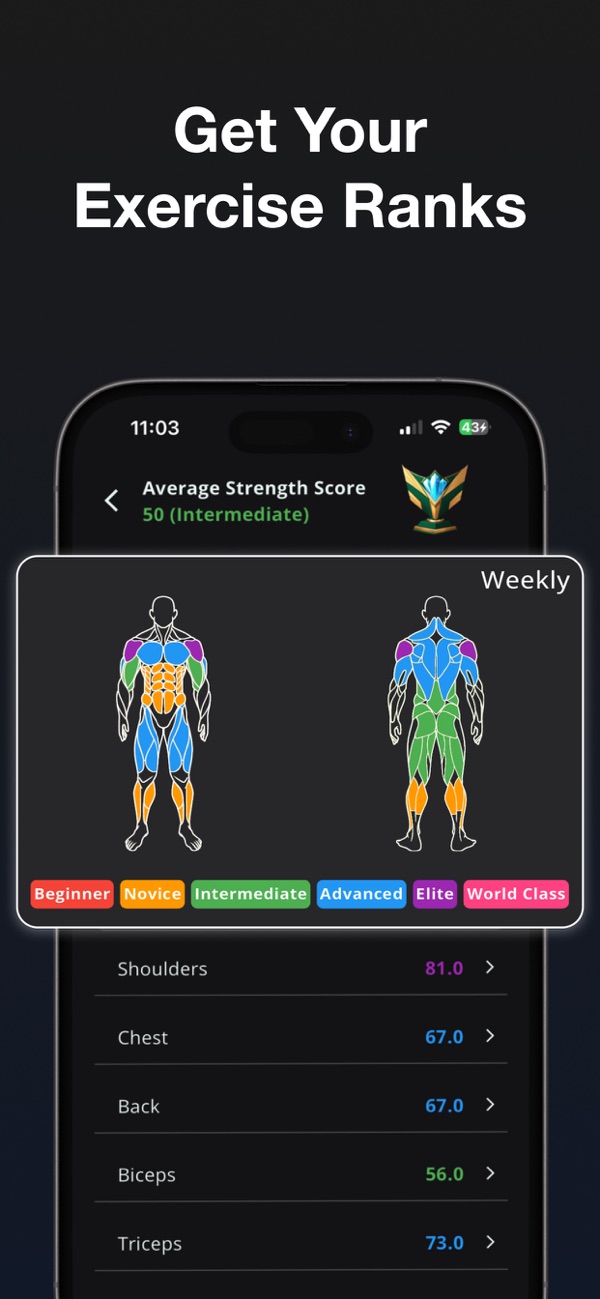
Stronger is cheaper — and it doesn't gate the basics.
Fitbod charges $15.99/mo for outsourced decisions and a big content library. Stronger charges $9.99/mo for measurement, momentum, and motivation around the training you already do. And here's the part that matters most.
Fitbod
subscription-first- View past workoutsFree
- Log new workoutsPaid only
- Family sharingNo
- Trial7-day
Stronger
7-DAY FREE TRIAL- ✦A Strength Score & global ranks
- ✦Weak-point analysis & deep stats
- ✦Adaptive routines you stay in control of
- ✦Ranked friend challenges
Our annual price isn't perfectly consistent across surfaces yet — you may see a $39.99 annual price in the App Store. We'd rather tell you than have you find it. Take the in-app plan screen as the real one.
The detail that decides it: once Fitbod's trial ends, you can view old workouts but logging a new one requires a paid plan. Stronger gates depth, not the core loop — the free tier keeps planning and visual guidance alive after the trial. Don't pick on price alone, but know exactly what each dollar buys.
A straight answer on Apple Watch
Stronger does not have an Apple Watch app. Log your workouts on iPhone or Android.
If wrist-based logging is the single most important thing to you, Fitbod has the more reliable answer today — go in with eyes open and check the live listings. If your priorities are fast phone-first logging, a Strength Score, deep analytics, and friend challenges, that's the ground Stronger is built on, and the Watch question matters less. Pick on the axis you actually care about.
Questions a Fitbod user asks
Is Stronger a Fitbod clone?
No, and it isn't trying to be. Fitbod is a workout generator — its job is deciding your session. Stronger is a strength tracker with a scoreboard: logging, a Strength Score, analytics, and competition, with you in control of the program. Different jobs.
Does Stronger generate workouts like Fitbod?
Stronger has AI-generated and adaptive routines, but they're decision support, not autopilot. They give you a starting point or adjust suggestions; they don't silently rewrite your program every session. If you want the app to fully run your training, Fitbod does that better.
Doesn't Fitbod already have a strength score?
Both apps have strength scoring — Fitbod has an Overall Strength Score and mStrength that feed its algorithm. The difference is emphasis: in Fitbod the score is a measurement layer inside a coaching engine; in Stronger the Strength Score is the main event — bodyweight-, gender-, and training-age-adjusted, ranked beginner to elite, and built for comparing with friends.
Is Fitbod better for beginners?
Often, yes. For someone walking into the gym thinking "what now?", Fitbod's autopilot and large video library are genuinely valuable. Stronger can serve beginners with AI routines and visual guidance, but it shines once you have a routine and want to track and benchmark it.
Which is better for serious lifters who want progressive overload?
Stronger, for most. You keep your program — PPL, upper/lower, 5×5, 5/3/1 — log fast, track PRs and estimated 1RM, watch volume and frequency by muscle group, and see your Strength Score move. Fitbod supports progressive overload too, but many experienced users end up overriding its recommendations, at which point you're paying for a generator you're fighting.
Which app is cheaper?
Stronger — $9.99/month versus Fitbod's $15.99/month, and a lower annual price. Just as importantly, Stronger's free tier still lets you plan workouts, while Fitbod requires a paid subscription to log new workouts once the trial ends.
Which Fitbod alternative has friend challenges and leaderboards?
Stronger. Groups, weekly and monthly challenges, leaderboards, and head-to-head Strength Score comparison are core features. This is the clearest thing Stronger does that Fitbod doesn't — Fitbod can share to Strava, but it isn't built around friend competition.
Can I import my Fitbod history into Stronger?
Not via a direct import right now. Export your Fitbod data to keep it, then rebuild your main lifts in Stronger in a few minutes and set your starting weights from your recent working sets. You only need your current working weights, not years of history, to get value from day one.
Is Fitbod bad?
No. It's a mature, popular app that's excellent at removing planning friction, and plenty of people have trained with it for years and gotten stronger. It's just built for a different job. Switch only if you've outgrown the "generate my workout" model and want more control and clearer feedback. Still comparing the field? Our best workout tracker apps roundup lays the options out side by side.
You didn't fail at Fitbod.
You outgrew autopilot.
Keep your Fitbod account during the trial. Rebuild your split in Stronger in a few minutes, log your next session, and watch your Strength Score climb. If it doesn't change how you train, you've lost nothing but a week.


Or look around first — explore the features, try the free RPE calculator, or see how Stronger works.
Stronger vs everything else
- vs HevySocial tracker→
- vs StrongMinimalist logger→
- vs JEFITExercise database→
- vs BoostcampProgram library→
- vs CaliberCoaching app→
- vs StrengthLogFree-tier logger→
- vs RepCountNo-bloat logger→
- vs StravaSocial-proof layer→
- vs LiftoffGamified ranking→