
Time Under Tension: Does It Actually Build Muscle?
You have probably heard that you need to slow down your reps. Count to three on the way down. Make the set burn longer. Chase that "40 to 60 second window." And if you are not controlling every second under load, you are leaving gains on the table.
That advice is not entirely wrong. It is just missing the more important part — and when you focus on the clock instead of what actually drives muscle growth, your training suffers for it.
Time under tension is a real training variable. The idea that it is the primary one is not supported by the current evidence. A 2025 systematic review and meta-analysis on repetition tempo found that faster and slower tempos produced broadly similar hypertrophy when other variables were controlled — and that tempo had a minimal overall effect on muscle growth. The 2026 American College of Sports Medicine position stand, which synthesised 137 systematic reviews and more than 30,000 participants, reported that time under tension did not consistently impact training outcomes.
That is not a knock on controlled reps. It is a recalibration of where tempo sits in the priority stack.
By the end of this article, you will understand what the research actually says about time under tension, why the usual framing misses the key distinction, and exactly how to use tempo to make your training better — without letting it become the thing you are optimizing for.
What Is Time Under Tension?
Time under tension (TUT) is the amount of time a muscle spends working under load — during a rep, a set, a session, or across a training week.
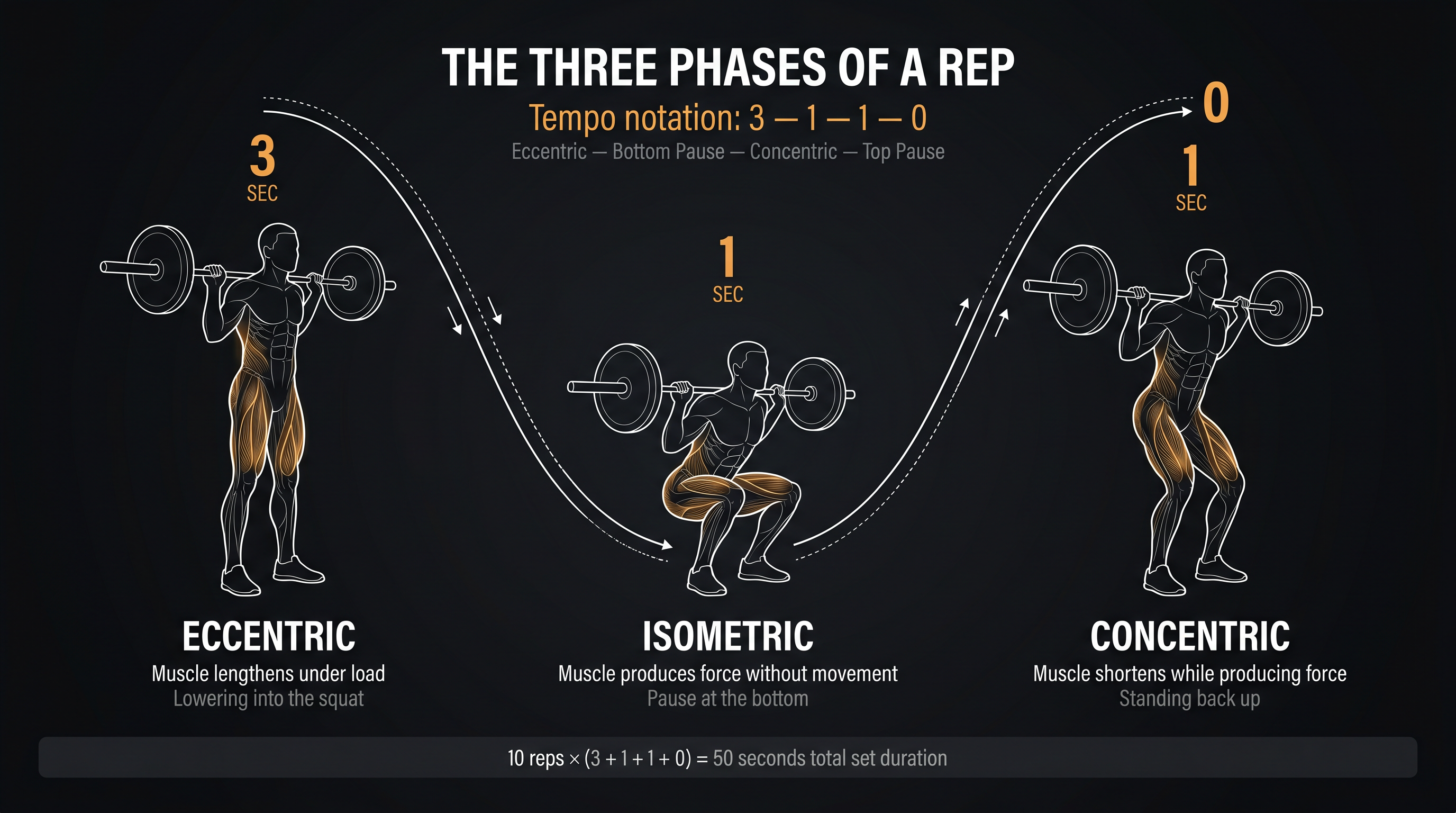
Every resistance exercise rep moves through three phases:
| Phase | What it means | Example in a squat |
|---|---|---|
| Eccentric | Muscle lengthens while controlling load | Lowering into the squat |
| Isometric | Muscle produces force without visible movement | Pause at the bottom |
| Concentric | Muscle shortens while producing force | Standing back up |
Tempo is often written as four numbers — for example, 3-1-1-0:
| Number | Phase | Meaning |
|---|---|---|
| 3 | Eccentric | 3 seconds lowering |
| 1 | Bottom pause | 1 second pause |
| 1 | Concentric | 1 second lifting |
| 0 | Top pause | No pause at lockout |
If you do 10 reps at a 3-1-1-0 tempo, the set takes 10 × (3 + 1 + 1 + 0) = 50 seconds. That is the simple math.
The problem is that muscle growth is not simple math. A 50-second set with poor effort, light load, short range of motion, and tension leaking away from the target muscle is not automatically better than a 25-second set performed hard, controlled, and progressively overloaded. Once you understand that distinction, the whole TUT conversation changes.
Time Under Tension vs. Mechanical Tension: What Actually Matters
This is the key point, and it is the one most TUT advice skips entirely.
Time under tension tells you how long something lasted.
Mechanical tension tells you how much force the muscle fibers had to produce under load.
Those are not the same thing.
Think of it this way: standing under a light rain for 60 seconds does not get you wetter than standing under a firehose for 10 seconds. Duration matters, but intensity matters too. In lifting, a muscle that produces high force under load for 25 seconds has experienced more mechanical tension than a muscle that produces low force for 50 seconds — even though the second set lasted twice as long.
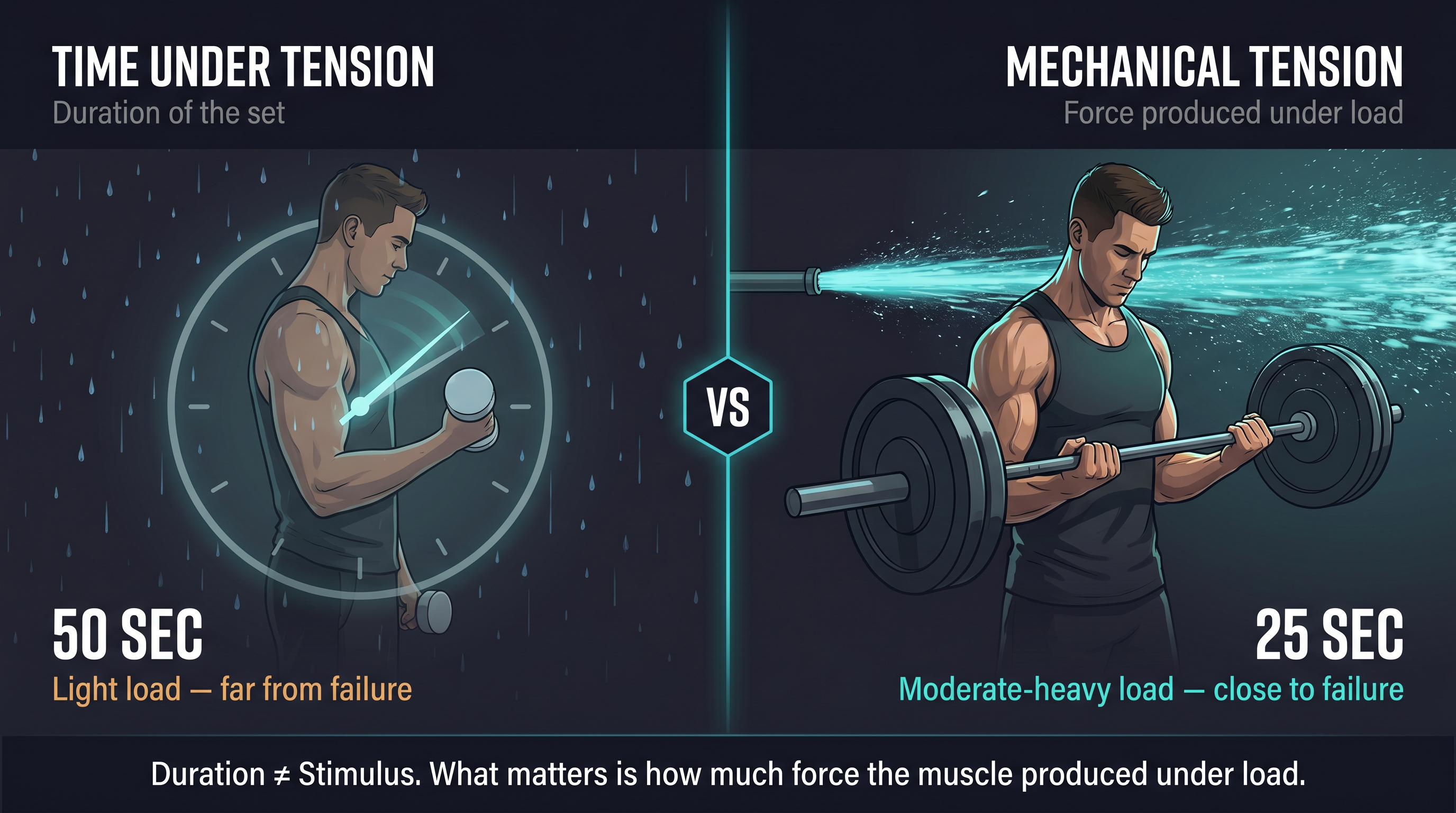
Here is what that looks like in practice:
| Set | Load | Reps | Tempo | Duration | Likely stimulus |
|---|---|---|---|---|---|
| Slow light curl | Very light | 10 | 5 sec per rep | 50 sec | May burn, but low tension if far from failure |
| Hard controlled curl | Moderate | 10 | 2–3 sec per rep | 20–30 sec | Strong hypertrophy stimulus if close to failure |
| Heavy bench set | Heavy | 5 | Controlled down, strong up | 15–25 sec | Strong strength stimulus, useful hypertrophy too |
| Super-slow leg press | Light/moderate | 5 | 10+ sec per rep | 50+ sec | Fatiguing, but may reduce load too much |
The current mechanistic view is that mechanical tension is the primary driver of resistance-training-induced hypertrophy — not the pump, not acute hormone spikes, not metabolite buildup. A 2025/2026 review in the Journal of Sport and Health Science makes this point clearly, noting that metabolite accumulation and cell swelling lack strong causal evidence as direct hypertrophy drivers.
So the better question is not: "How long should the set last?"
It is: "Did the target muscle experience high enough tension, through enough useful reps, close enough to failure, often enough, for enough weeks?"
Once you internalize that distinction, every piece of TUT advice looks different.
What Does the Research Say About Rep Tempo and Muscle Growth?
Here is where the evidence gets clearest — and where the "slow reps are always better" idea runs out of support.
The 2026 ACSM position stand is the most authoritative source available on this question. It synthesised 137 systematic reviews covering more than 30,000 participants, with an evidence base current to October 2024. Its conclusion is direct: time under tension did not consistently impact training outcomes. It also found that hypertrophy is enhanced by higher weekly volume — specifically 10 or more sets per muscle per week — and that strength is enhanced more by heavier loads, complete range of motion, and training at least twice per week. (PubMed)
The 2025 meta-analysis by Enes and colleagues looked specifically at repetition tempo and hypertrophy. Across 14 included studies comparing faster and slower interventions, both produced hypertrophy — and the between-condition differences were trivial. The cleanest practical takeaway: tempo appears to have minimal overall effect on hypertrophy, though there may be small differences in specific situations. (ResearchGate)
The 2015 meta-analysis by Schoenfeld, Ogborn, and Krieger is older but still directly relevant. It found similar hypertrophy outcomes when repetition duration ranged from 0.5 to 8 seconds per rep. It also suggested that deliberately very slow reps — especially above 10 seconds per rep — may be inferior for hypertrophy, though the evidence on very slow training was limited at the time. (Springer)
Taken together, those three sources point in the same direction: a wide range of tempos can build muscle, extremely slow reps are not magic, and tempo's influence on hypertrophy — while real — is modest compared to other variables.
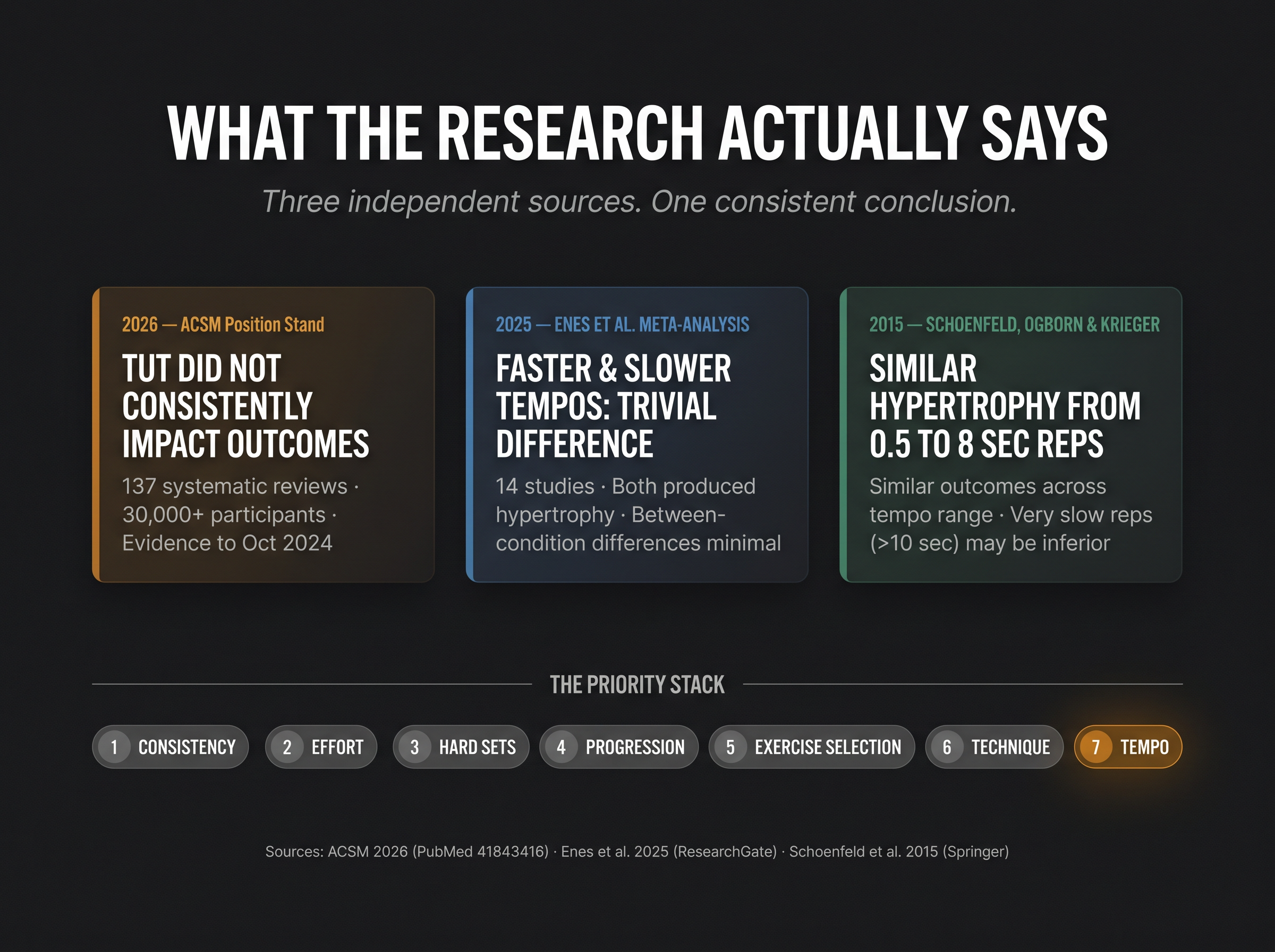
Some coaches have claimed that 40 to 60 seconds per set is the optimal TUT window. Human Kinetics discusses this idea directly, while also noting that TUT has to be interpreted alongside rep range, load, eccentric and concentric structure, and total work across the session. The 40 to 60 second range is often cited because many good hypertrophy sets naturally fall somewhere in that window — but that is descriptive, not causal. The body does not detect "42 seconds" and start growing. It detects mechanical tension, effort, and volume accumulated over time.
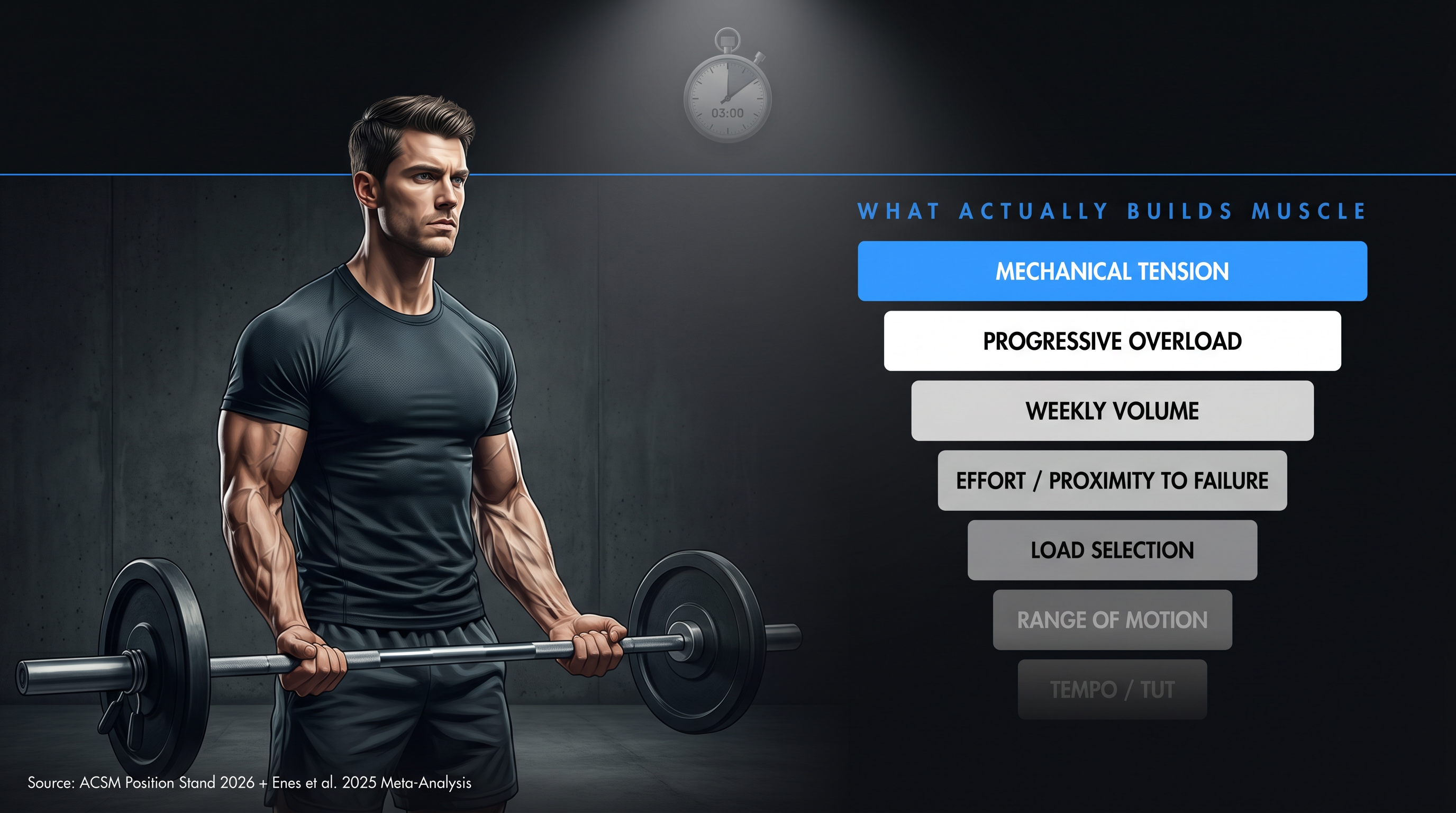
For most lifters, the order of importance looks like this:
- Train consistently
- Use enough effort
- Accumulate enough hard sets
- Progress over time
- Choose exercises that load the target muscle well
- Use controlled technique
- Fine-tune tempo after the basics are already working
Tempo is in the list. It just is not near the top.
When Slow Reps Actually Help Your Training
None of this means you should rush every set. Controlled reps are not overrated — the overrating is in treating tempo as the primary driver rather than a quality-of-execution tool.
Here is when controlled, slower reps genuinely help:
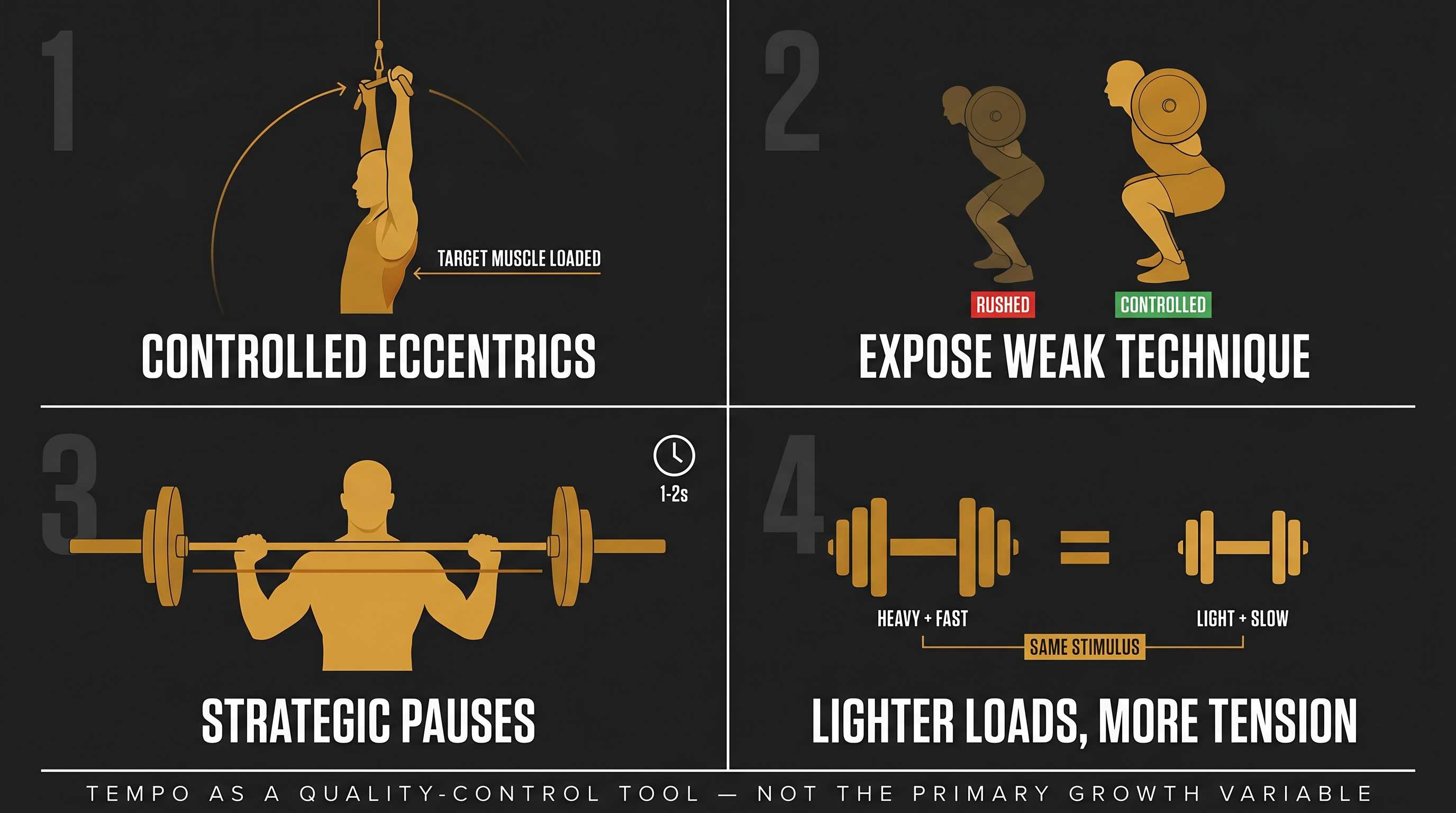
1. Controlled eccentrics improve muscle activation
A deliberate lowering phase stops you from bouncing, swinging, or dropping the weight. That forces the target muscle to do more of the work — and on many exercises, the eccentric phase is where the target muscle is under the most load.
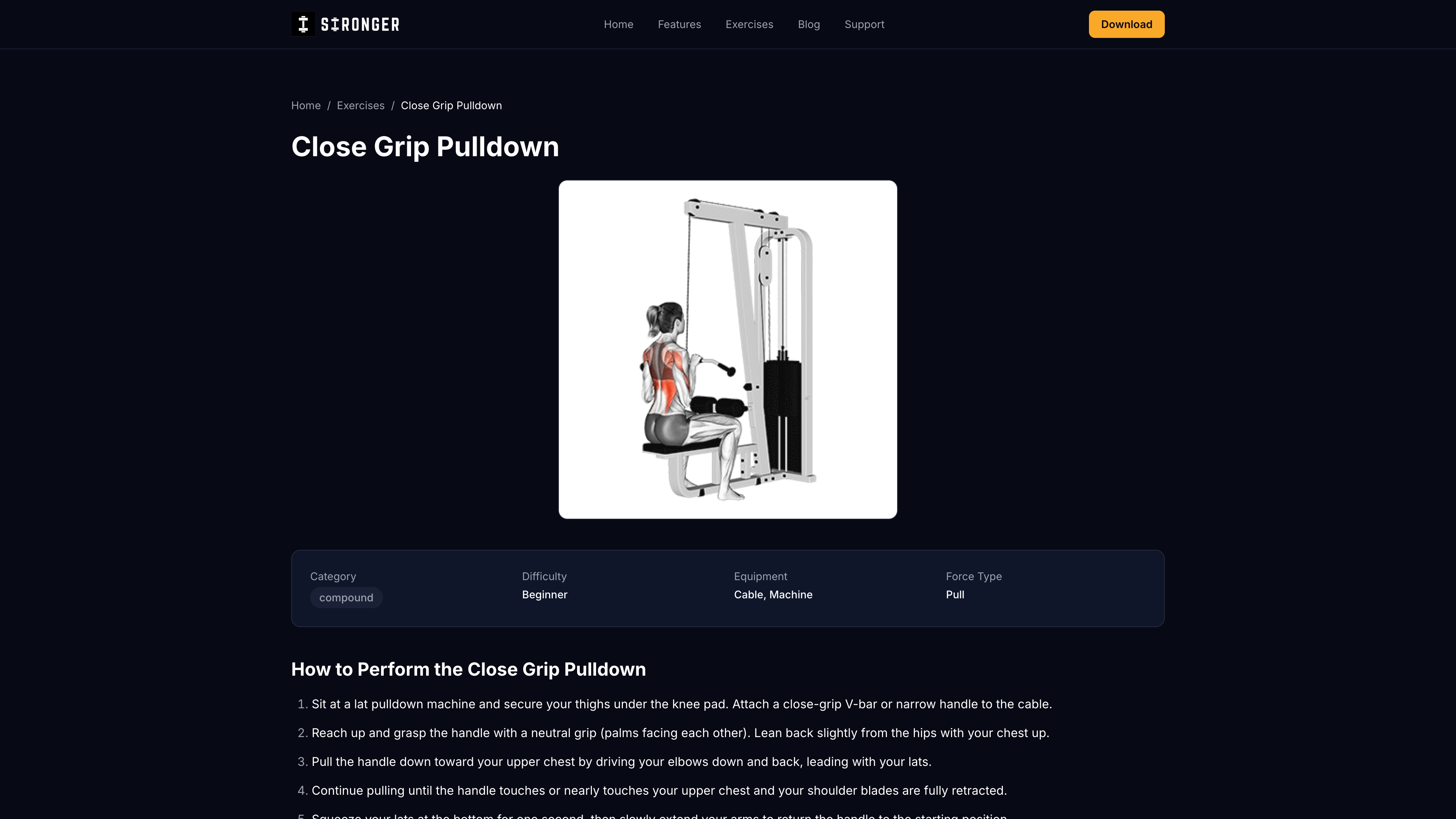
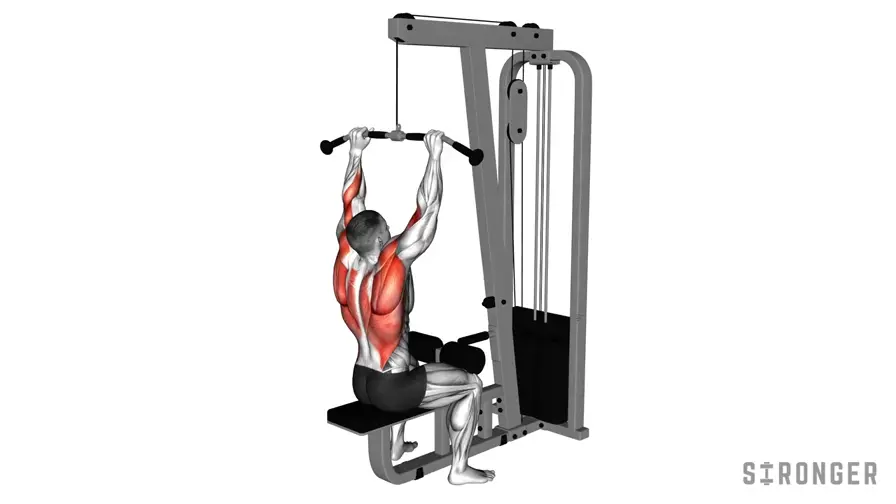
On a close-grip pulldown, for example, a controlled 2 to 3 second negative keeps tension on the lats through the full stretch at the top. That is a genuinely useful application of time under tension — not because the stopwatch is magic, but because the controlled lowering improves how the exercise actually works.
2. Slow reps expose weak technique
If you cannot lower a squat under control without collapsing, you probably do not own that range yet. Slowing down makes flaws visible and forces you to confront them:
| Problem | What tempo reveals |
|---|---|
| Bouncing out of the bottom | You lose position when the stretch reflex is removed |
| Swinging curls | The target muscle cannot control the load |
| Half-reps | You are avoiding the hard range |
| Rushing eccentrics | You are using more momentum than muscle |
Controlled reps are one of the most efficient tools for identifying why a muscle is not getting trained the way you think it is.
3. Strategic pauses build strength in key positions
Pauses are useful when they make the target muscle work harder in a position you actually care about:
| Exercise | Useful pause |
|---|---|
| Bench press | Brief pause on chest for control and strength specificity |
| Squat | Pause near bottom to own that position |
| Leg extension | Squeeze at top if you can keep tension |
| Pulldown | Stretch at top, controlled squeeze at bottom |
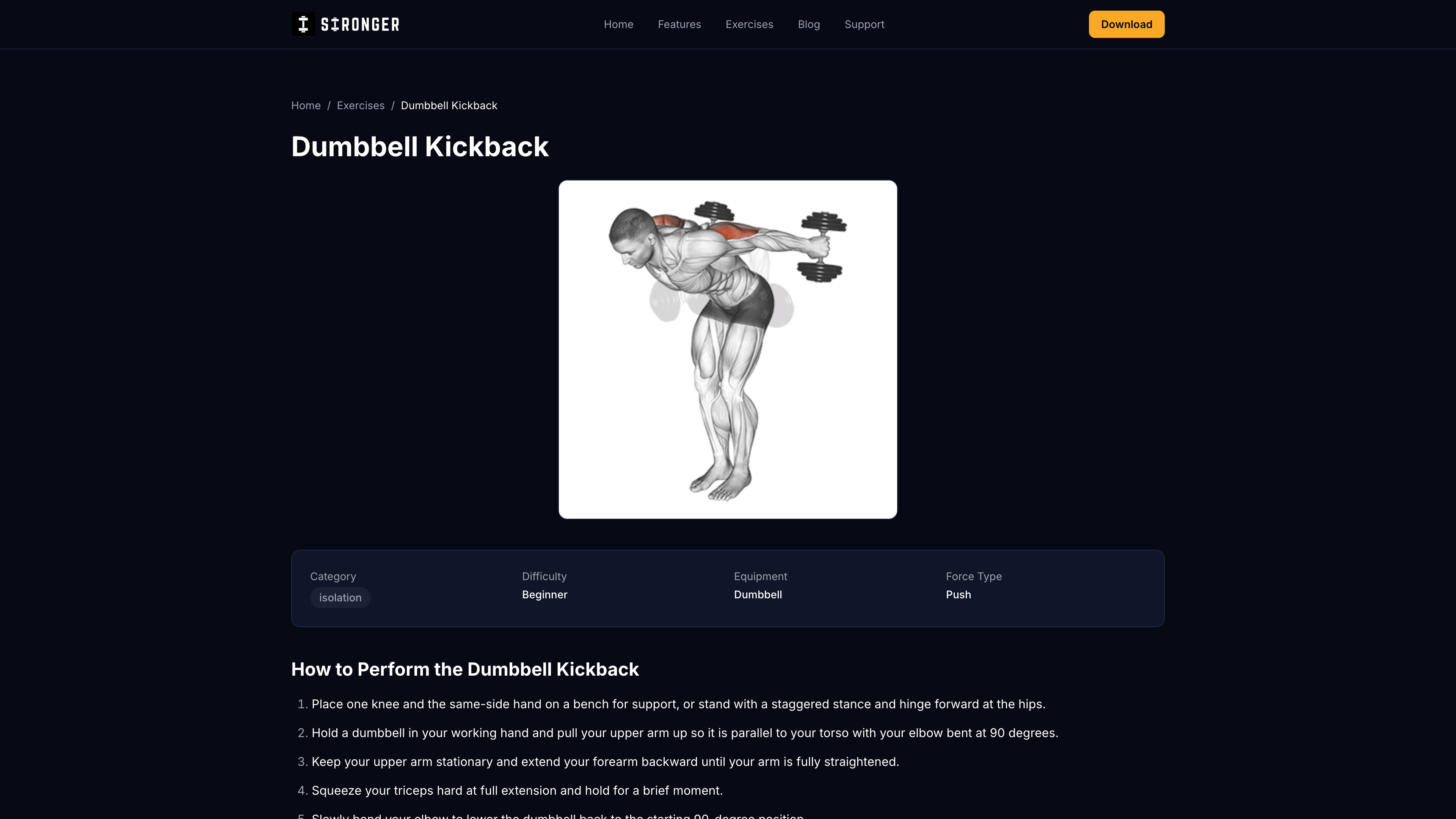
| Dumbbell kickback | Brief hold at full extension |
Our dumbbell kickback guide recommends a brief lockout squeeze to maximise time under tension at the strongest contraction point — a smart cue for an isolation lift where peak contraction is the whole point of the exercise.
4. Slow reps make lighter loads harder
This is a legitimate tool in specific situations: training around joint irritation, working with limited equipment, using machine accessories after heavy compounds, or learning a new movement pattern. The key caveat is that the set still needs to be meaningfully hard. A lighter load at a slower tempo that feels easy is not doing much for hypertrophy. The difficulty has to come from somewhere — either load, proximity to failure, or both.
Ready to Get Stronger?
Join 2,000,000+ lifters tracking their workouts with Stronger. Available on iOS and Android.


4 Ways Time Under Tension Can Hurt Your Training
TUT becomes a problem when it makes training worse rather than better. These are the most common mistakes.
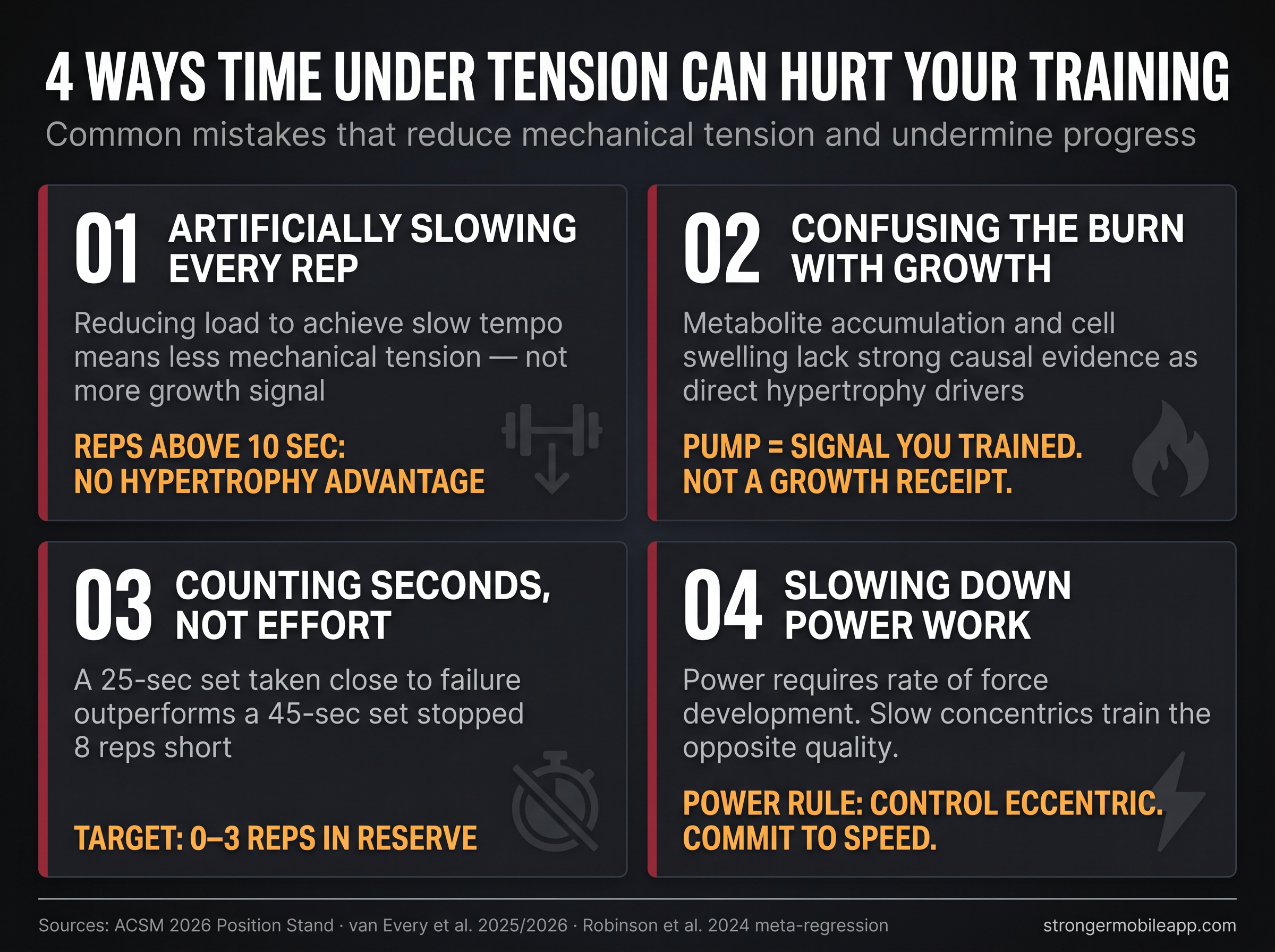
Mistake 1: Artificially slowing every rep
Turning every set into a slow-motion performance almost always requires reducing the load. Sometimes that is the right trade. Often, it just means less mechanical tension. The 2015 meta-analysis found similar hypertrophy across 0.5 to 8 second reps and raised concerns about very slow reps above 10 seconds per rep. Extremely slow training creates fatigue and discomfort, but those sensations are not automatically signs of a productive stimulus.
Mistake 2: Confusing the burn with a growth signal
The burn during a set is mostly a sign that metabolites are accumulating — hydrogen ions, lactate, and other byproducts of hard muscular work. That can confirm the set was difficult, but it does not prove the set was optimal for hypertrophy. The van Every et al. review argues that metabolite accumulation and cell swelling lack strong causal evidence as direct hypertrophy drivers.
A pump can be useful feedback that you trained the muscle. It is not a growth receipt.
Mistake 3: Counting seconds instead of tracking effort
A set that lasts 45 seconds but stops 8 reps short of failure is probably less useful for hypertrophy than a 25-second set taken close to failure. A 2024 meta-regression in Sports Medicine on proximity to failure found that strength gains were broadly similar across a range of repetitions in reserve, but hypertrophy improved as sets were taken closer to failure. The authors noted that the exact relationship is still being refined because RIR had to be estimated from study descriptions — so treat the specific numbers as directional guidance. For most hypertrophy work, most working sets should finish around 0 to 3 reps in reserve.
Mistake 4: Slowing down power work
For power, moving fast is the point. The ACSM 2026 position stand is explicit: power is enhanced by moderate loads and a fast concentric phase. (PubMed) If your training includes jumps, explosive presses, Olympic lift variations, or sprint work, deliberately slow concentrics are counterproductive. Control the eccentric, then commit to speed.
What Actually Drives Muscle Growth: The Real Priority Order
If time under tension is not the primary variable, what is? Here is the honest hierarchy — and where TUT actually fits within it.
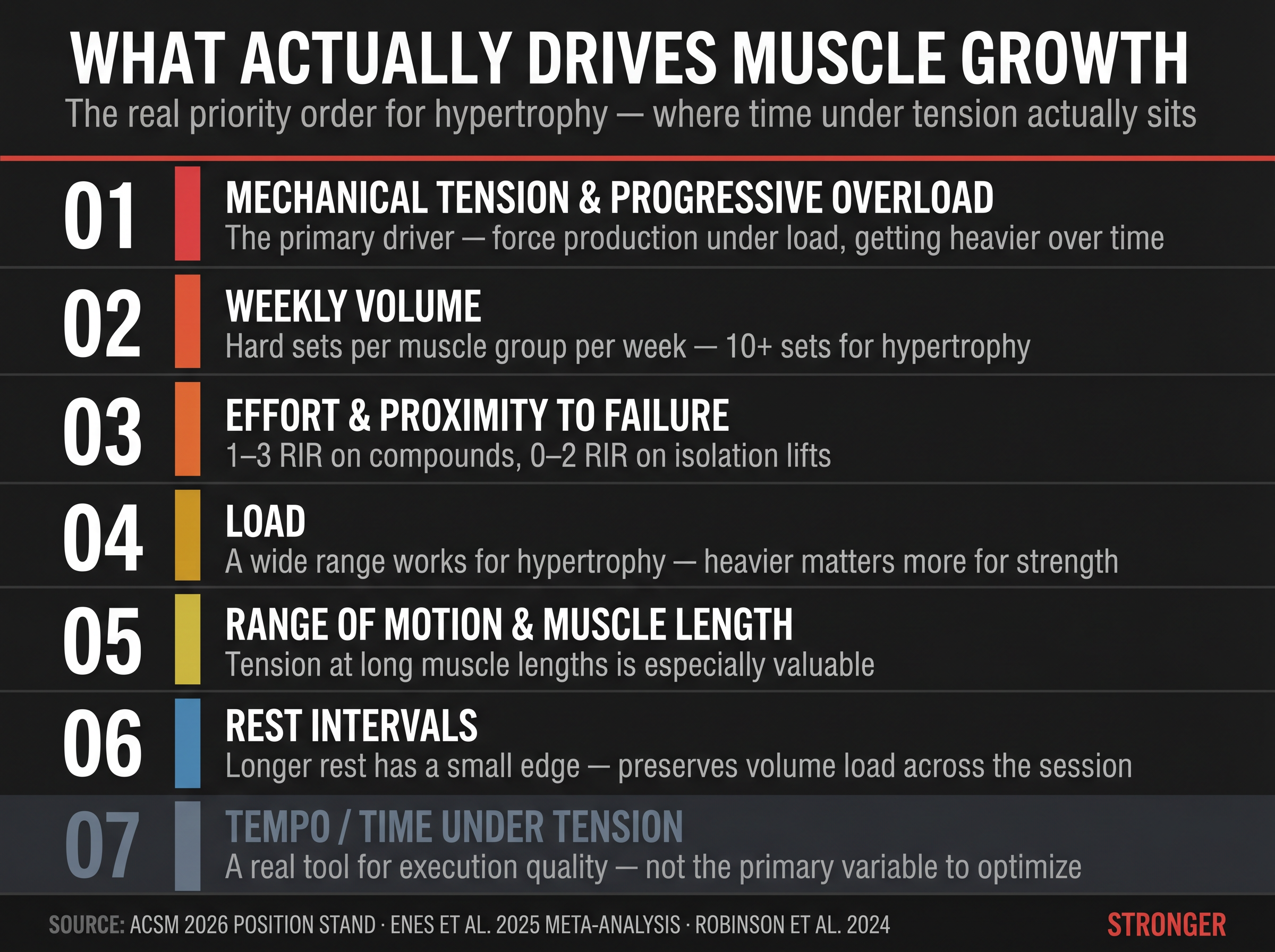
1. Mechanical tension and progressive overload
Muscle fibers need to produce force under load. This is why progressive overload matters more than any individual training variable. Progressive overload does not only mean adding weight to the bar. It includes:
| Form of progression | Example |
|---|---|
| More load | 80 kg for 8 reps → 82.5 kg for 8 reps |
| More reps | 80 kg for 8 reps → 80 kg for 10 reps |
| More sets | 3 hard sets → 4 hard sets |
| Better range of motion | Same load, deeper controlled reps |
| Better control | Same load, less bouncing or swinging |
| Better proximity to failure | Same load and reps, fewer reps left in reserve |
| Better density | Same work completed with appropriate rest |
2. Weekly volume
Volume is measured as hard sets per muscle group per week. The ACSM 2026 position stand reports that hypertrophy is enhanced by higher weekly volume, with 10 or more sets per week noted in the abstract. (PubMed) That does not mean everyone needs 20 sets per muscle — it means volume must be high enough to create adaptation, but not so high that recovery collapses.
A practical starting range:
| Lifter level | Rough hypertrophy starting point |
|---|---|
| Beginner | 6–10 hard sets per muscle per week |
| Intermediate | 8–16 hard sets per muscle per week |
| Advanced | 10–20+ hard sets per muscle per week, adjusted carefully |
3. Effort and proximity to failure
If the set is too easy, tempo will not save it. For muscle growth, most sets should be meaningfully hard — not always all-out failure, but close enough that the final few reps require real focus.
| Goal | Useful effort target |
|---|---|
| Hypertrophy — compound lifts | Usually 1–3 RIR |
| Hypertrophy — isolation lifts | Often 0–2 RIR |
| Heavy strength work | Often 2–5 RIR, depending on phase |
| Beginner technique work | Farther from failure while learning |
| Deloads | Intentionally easier |
The Robinson et al. 2024 meta-regression found that hypertrophy tends to improve as sets are stopped closer to failure, while strength does not depend on failure to the same degree.
4. Load
For muscle gain, a wide range of loads can work if sets are hard enough. For strength, heavier loads matter more. A 2021 network meta-analysis found no clear hypertrophy differences between low, moderate, and high loads when sets were taken to volitional failure, but strength gains were superior with moderate and heavy loads compared with low-load training.
| Goal | Load guidance |
|---|---|
| Hypertrophy | Many loads can work — usually 5–30 reps if close to failure |
| Strength | Heavier loads are more specific |
| Power | Moderate loads, fast intent |
| Joint-friendly accessory work | Lighter loads can work well |
5. Range of motion and muscle length
Tension at longer muscle lengths may be especially valuable for hypertrophy. A 2026 systematic review and meta-analysis on partial reps found that longer-length training produced greater hypertrophy overall, with effects favouring distal and central muscle regions too.
That means the loaded stretch is not something to skip. On the incline dumbbell curl, let the biceps lengthen under control. On the Romanian deadlift, feel the hamstring stretch.
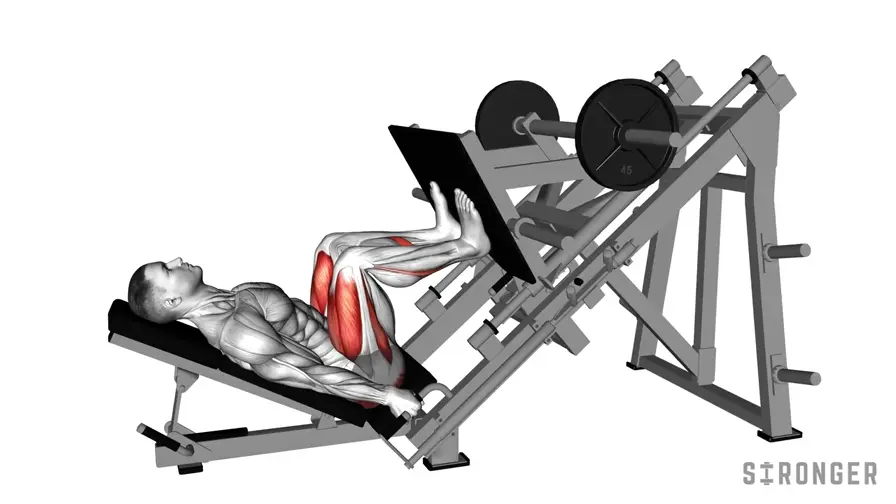
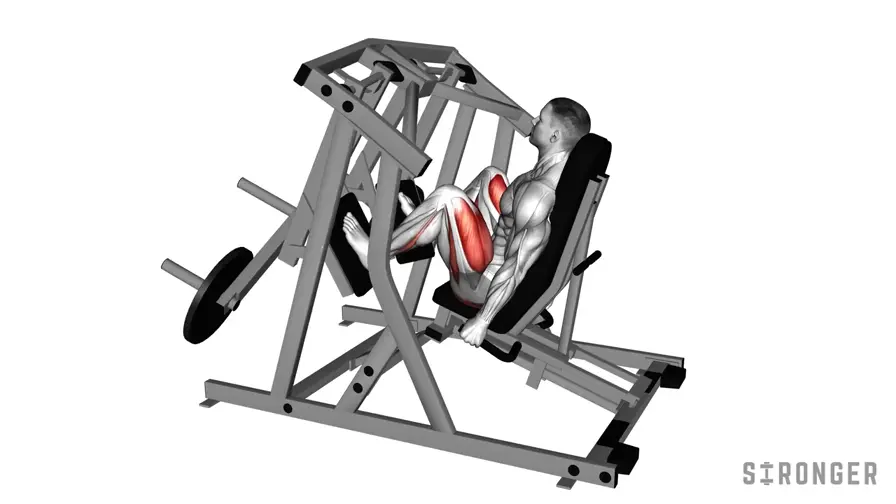
On the lat pulldown, reach fully overhead before pulling. On the leg press, lower through a deep controlled range without rounding the lower back.
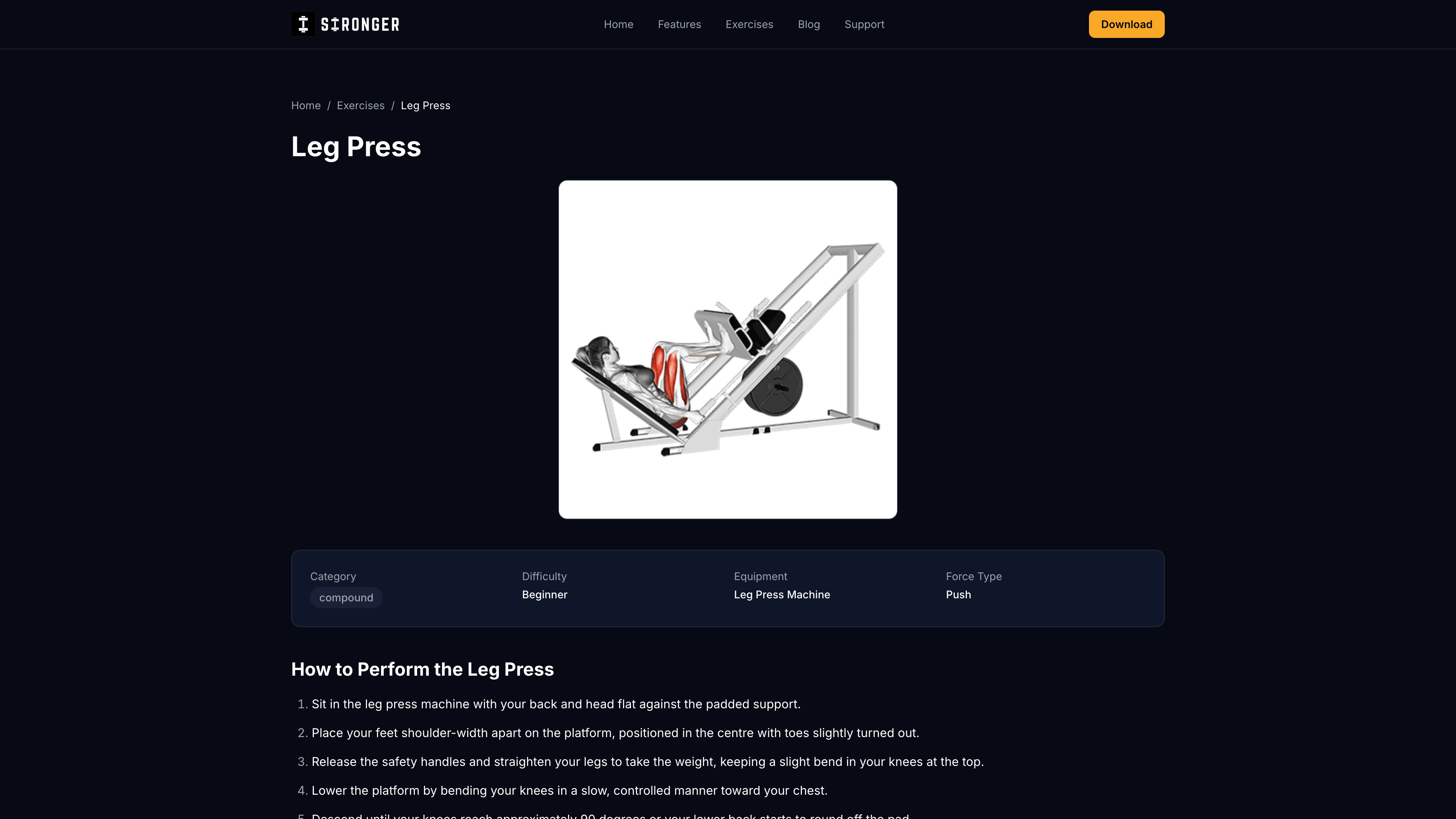
The "constant tension" cue can actually work against this goal. Some lifters avoid lockout, cut range short, and skip the stretch entirely in order to keep the muscle burning. But the stretched position is one of the most productive parts of the rep.
6. Rest intervals
A 2024 Bayesian meta-analysis on inter-set rest intervals found that hypertrophy can occur across a wide range of rest periods, with longer rest showing a small advantage — likely because it helps preserve performance and volume load across the session. There is no strong reason to force short rest periods specifically for hypertrophy. See our complete guide to rest between sets for the full breakdown.
| Exercise type | Hypertrophy rest |
|---|---|
| Heavy squat / deadlift / leg press | 2–4 minutes |
| Bench / row / overhead press | 2–3 minutes |
| Machine compound lifts | 1.5–3 minutes |
| Isolation lifts | 1–2 minutes |
7. Tempo
It is in the hierarchy. It just comes after all of the above.
Best Rep Tempo for Your Training Goal
Knowing what the research says is one thing. Knowing what to actually do in your next session is another.
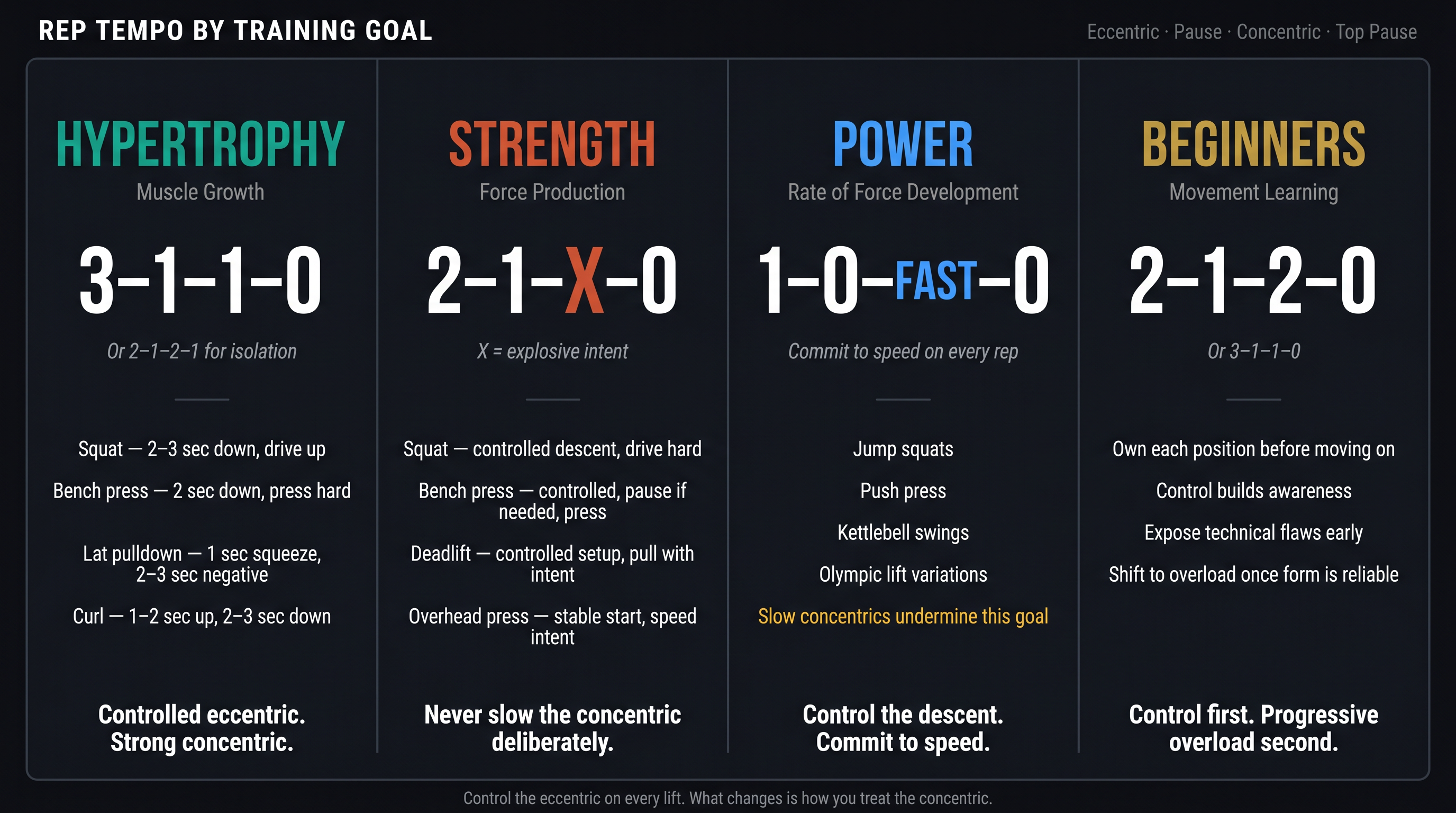
Best tempo for hypertrophy
Use a controlled eccentric, a stable transition, and a strong concentric.
Best default: 2–3 seconds down, no bounce, lift with intent
| Exercise | Practical tempo |
|---|---|
| Squat | 2–3 sec down, controlled bottom, drive up |
| Bench press | 2 sec down, optional brief pause, press hard |
| Lat pulldown | Pull strong, 1 sec squeeze, 2–3 sec negative |
| Leg press | 2–3 sec lower, deep controlled range, press smoothly |
| Lateral raise | Controlled up, controlled down, no swinging |
| Curl | 1–2 sec up, 2–3 sec down |
For exercises where control matters most, 3-1-1-0 (3 sec eccentric, 1 sec pause, 1 sec concentric, no top pause) is a solid starting point. For isolation work, 2-1-2-1 — a pause at both the stretched and contracted positions — can help maintain tension through the full range.
Best tempo for strength
Do not intentionally slow the concentric. Strength is the combination of skill and force production, and practicing forceful movement is part of the adaptation.
Best default: controlled eccentric, explosive intent on the concentric
| Lift | Tempo approach |
|---|---|
| Squat | Controlled descent, tight bottom position, drive hard |
| Bench press | Controlled descent, pause if needed, press aggressively |
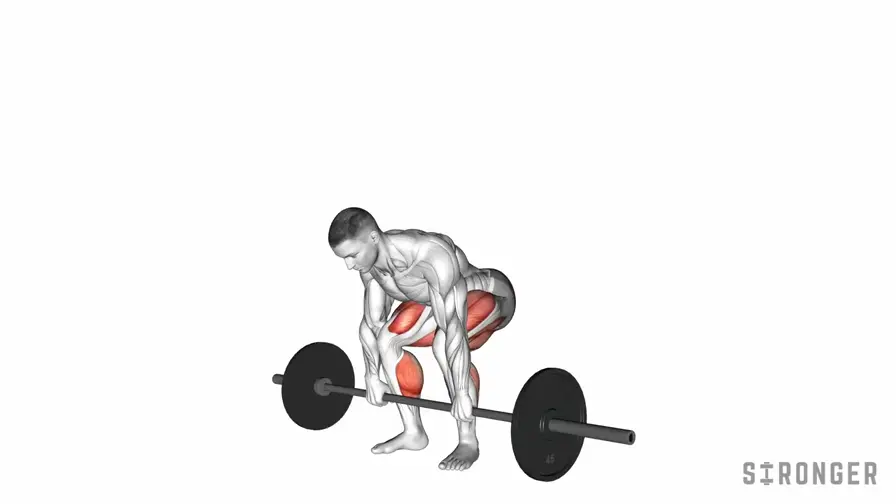
| Deadlift | Controlled setup, pull with intent, controlled return |
| Overhead press | Stable start, press with speed intent |
Best tempo for power
Too much time under tension can actively undermine the goal. Power depends on rate of force development — how quickly you can produce peak force — and deliberately slow concentrics train the opposite quality.
Best default: short controlled eccentric, fast concentric
This applies to jump squats, push presses, kettlebell swings, and Olympic lift variations. Control the lowering, then commit to the speed.
Best tempo for beginners
Tempo is genuinely useful for learning movement. A simple controlled tempo teaches you to own each position before moving to the next.
Best default: 2-1-2-0 or 3-1-1-0
This builds control without making every set counterproductively slow. Once technique is reliable, the priority shifts to progressive overload.
Track What Actually Drives Muscle Growth with Stronger
The logical conclusion of everything above is this: if mechanical tension, progressive overload, effort, and volume are the real drivers of muscle growth — and the evidence says they are — then those are the variables you need to track. Not seconds.
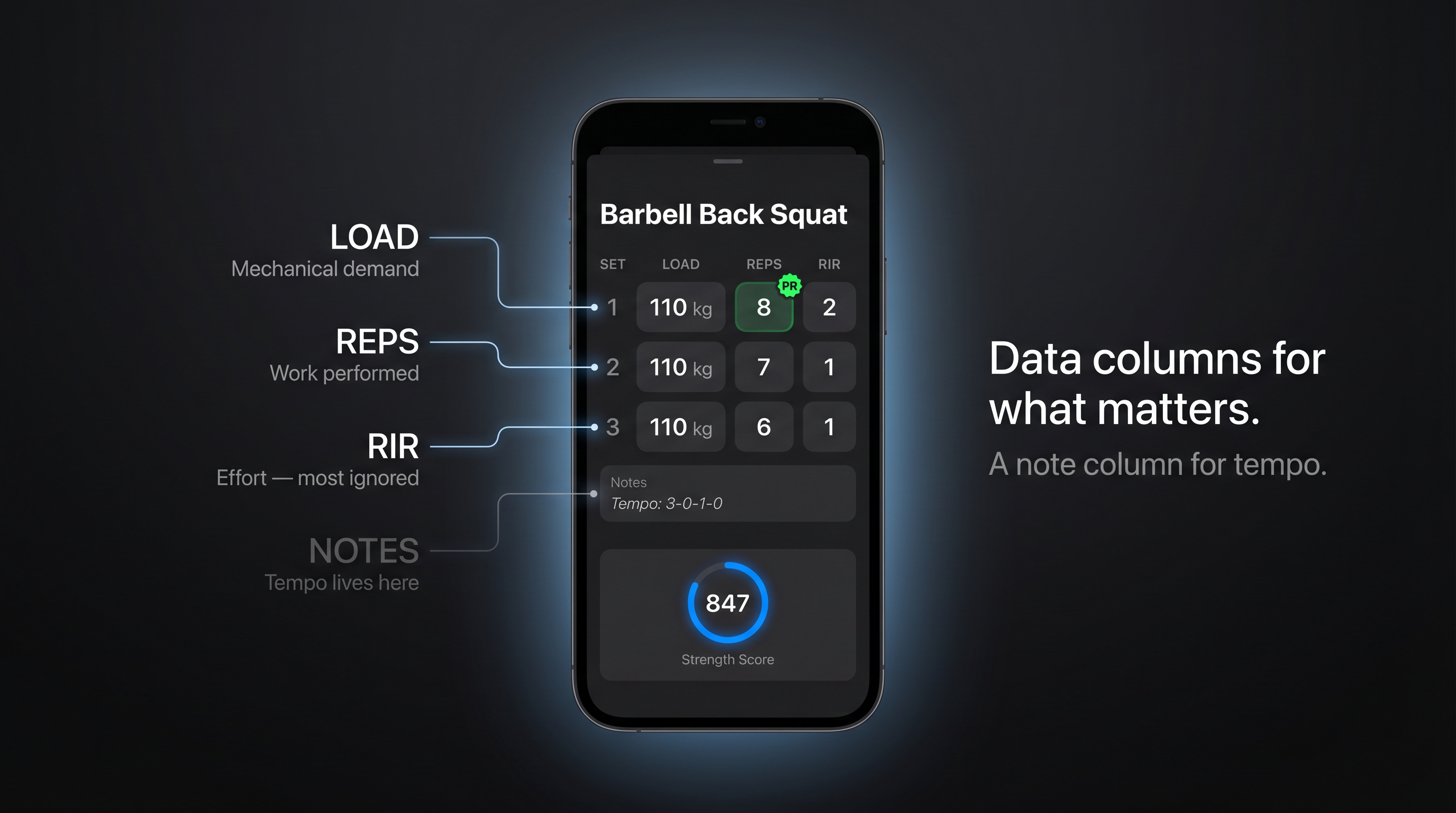

Here is the minimum useful tracking list:
| Variable | Why it matters |
|---|---|
| Exercise | Tells you what muscle pattern you trained |
| Sets | The main volume unit |
| Reps | Work performed |
| Load | Mechanical demand |
| RIR / RPE | Effort — the variable most often ignored |
| Rest | Performance context |
| Range of motion / form notes | Quality control |
| Tempo notes | Useful when tempo is intentionally changed |
Time under tension gets a note column. Everything else gets a data column. That order matters.
This is exactly what we built Stronger for. Our workout tracking covers every variable that actually drives progress: sets, reps, load, RPE per set, rest timers, personal record detection, strength curves, volume and frequency analytics, and muscle-group breakdowns. Check the features page for the full picture — but the core idea is simple: we give you data on the things that matter, so your progress is based on actual training information rather than memory or gut feel.
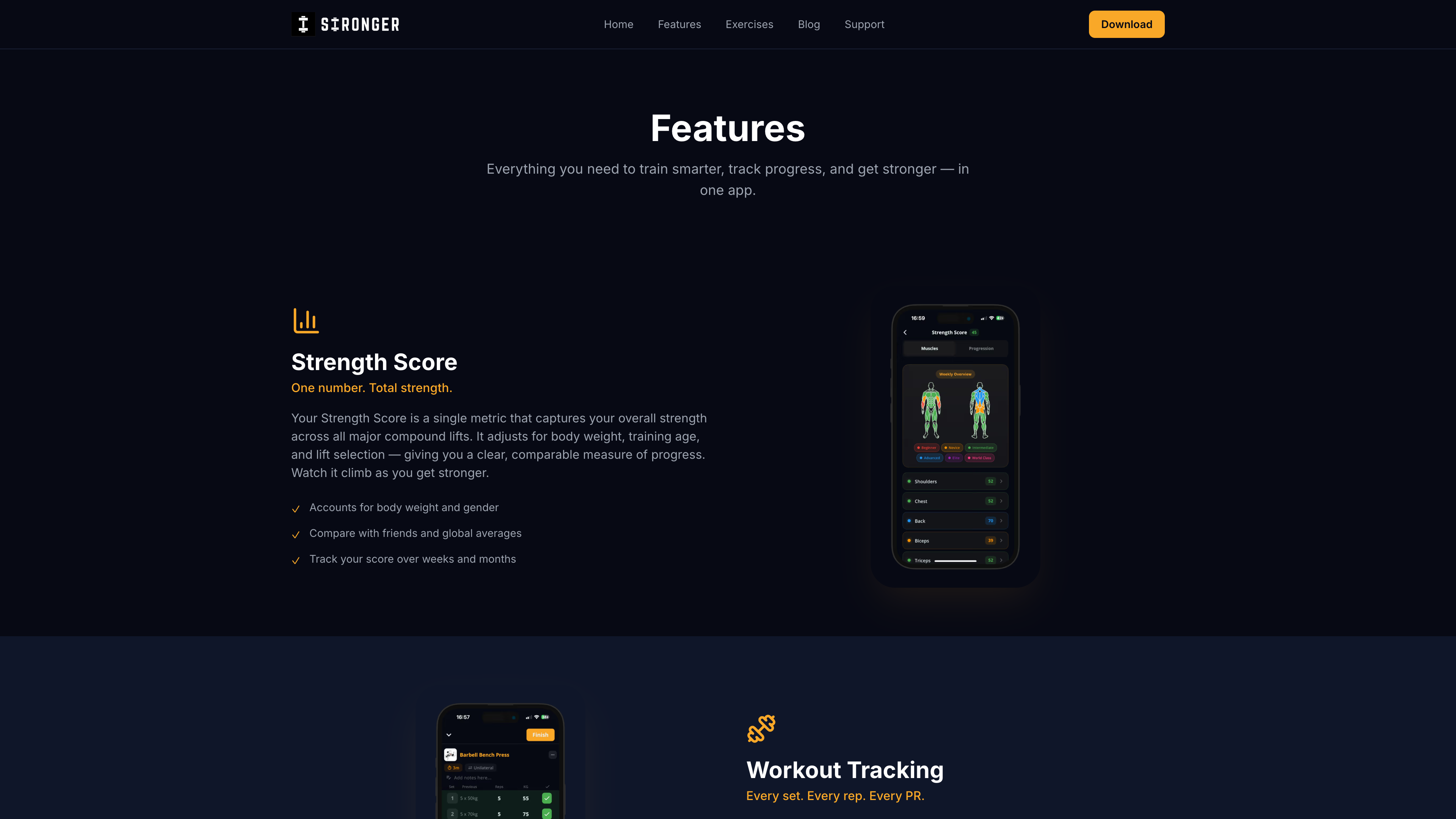
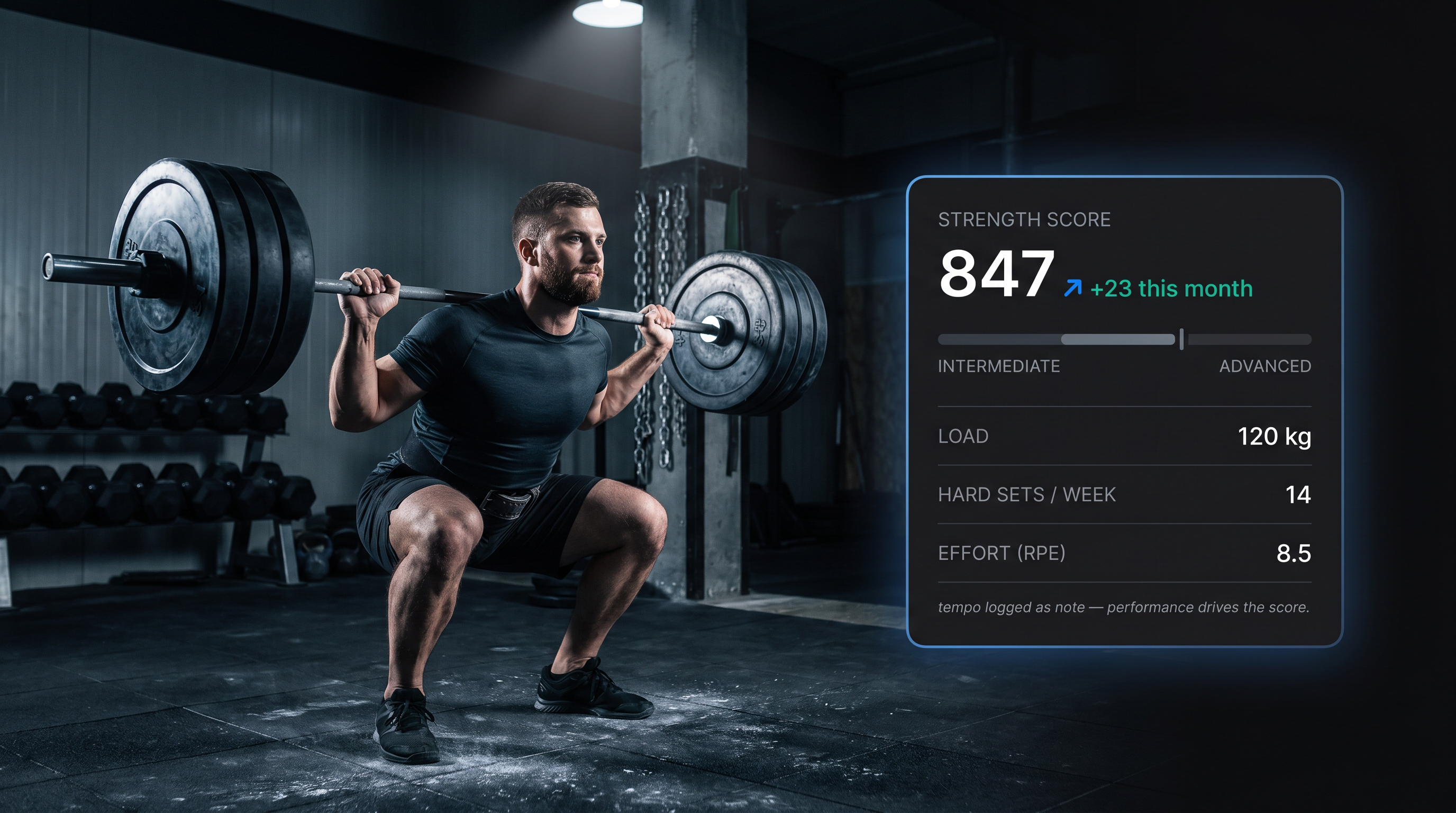
The Strength Score, our proprietary benchmarking metric, takes this further. It rates your strength across 12 muscle groups and overall, adjusted for bodyweight and sex, on six levels from Beginner to World Class, so you can see progress against real benchmarks over time. That is what progressive overload looks like when it is made measurable. Not "I think my reps felt harder this week." Actual evidence that you are getting stronger.
If you are not already tracking with Stronger, the 7-day free trial is the fastest way to see what this looks like in practice. Your first session tells you your Strength Score. Every session after that tells you whether it is moving.
4-Week Time Under Tension Experiment: Test It in Your Own Training
If you want to know whether deliberate tempo work helps you specifically, here is a clean way to find out.
Pick one exercise where you regularly lose control or feel disconnected from the target muscle. Good candidates:
- Leg press
- Lat pulldown
- Dumbbell bench press
- Lateral raise
- Incline curl
- Romanian deadlift
- Cable row
Keep everything else — load, sets, rest, frequency — stable for 4 weeks.
Week 1: Baseline
Use your normal tempo and log everything:
| Metric | Example |
|---|---|
| Load | 80 kg |
| Reps | 10, 9, 8 |
| RIR | 2, 1, 1 |
| Rest | 2 min |
| Notes | Reps rushed near end |
Weeks 2–4: Controlled tempo
Apply a simple 3-0-1-0 tempo (3 seconds eccentric, no pause, 1 second concentric). Log the same metrics each week.
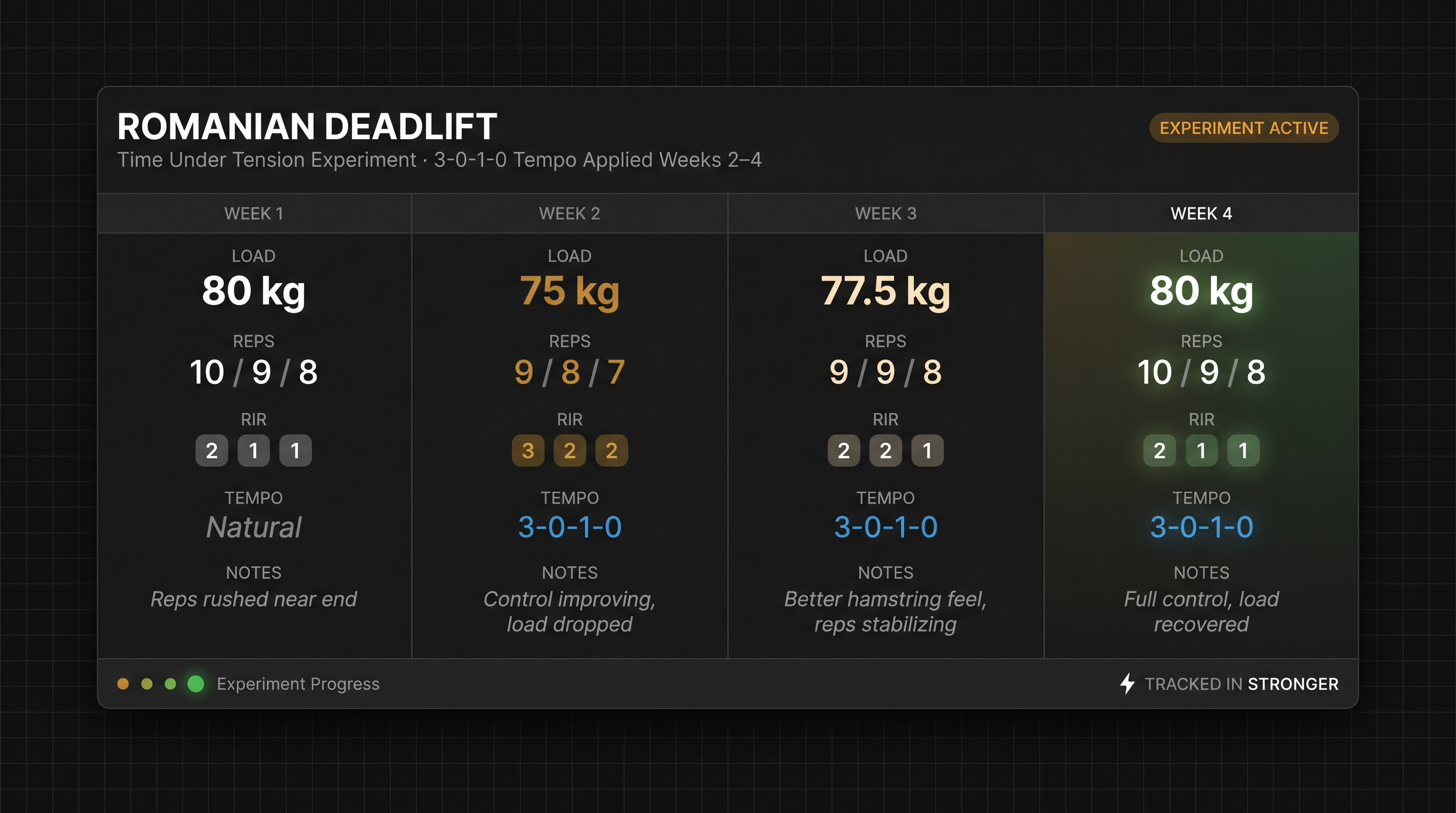
Success does not mean the set burns more. Success means:
- Better feel of the target muscle working
- Better control through the full range of motion
- Less joint irritation
- Stable or improving reps and load over the 4 weeks
- Cleaner range of motion
- Progress returning after the initial adaptation period
Failure means:
- Load dropped so much that progression stalled
- The target muscle is not actually working better
- Joints feel worse
- The exercise feels worse, not better
After 4 weeks, keep the tempo if it improved the exercise. Drop it if it only made training slower without making it better. Tracking these variables accurately is straightforward in Stronger — log the tempo as a note on the exercise, track reps and load as usual, and let the data tell you whether the experiment is working.
If you have been told a lot of things about time under tension over the years, you have also probably heard some of them stated as hard rules. Here is what the evidence actually says about the most common ones.
Ready to Get Stronger?
Join 2,000,000+ lifters tracking their workouts with Stronger. Available on iOS and Android.
Common Time Under Tension Myths, Debunked
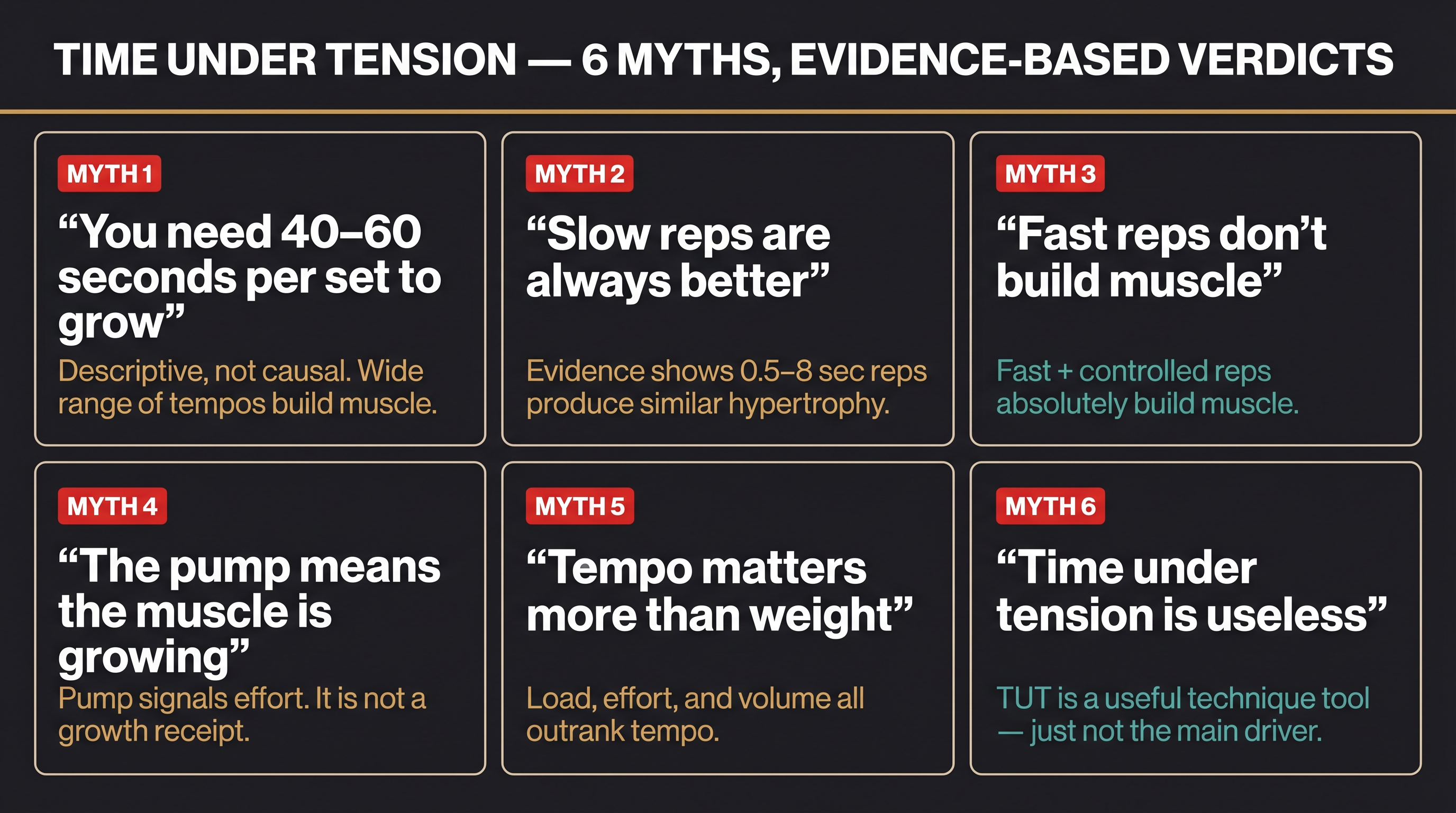
Myth 1: "You need 40–60 seconds per set to grow"
Not exactly. Sets in that range can work, and many good hypertrophy sets naturally fall somewhere in that window. But current evidence shows hypertrophy can happen across different tempos and set durations when the rest of training is sound. (ResearchGate) The 40 to 60 second range is descriptive, not magical.
Myth 2: "Slow reps are always better"
No. Slow reps can improve control and execution, but deliberately slowing everything can reduce load and overall performance. The 2015 meta-analysis found similar hypertrophy from 0.5 to 8 second reps and raised concerns that very slow reps above 10 seconds per rep may be inferior for hypertrophy.
Myth 3: "Fast reps don't build muscle"
Wrong. Fast does not mean sloppy. Fast intent with controlled technique can absolutely build muscle and is especially important for strength and power. The issue is not speed — it is whether control and effort are present.
Myth 4: "The pump means the muscle is growing"
Not necessarily. The pump is a sign you trained the muscle. It is not a receipt for growth. The van Every et al. review does not support cell swelling or metabolite accumulation as strong direct causes of hypertrophy.
Myth 5: "Tempo matters more than weight"
No. Tempo and load interact. A slow rep with minimal load and no real effort is not a strong stimulus. The target is controlled, progressive, hard training — and load, effort, and volume all outrank tempo in the hierarchy. Our guide to building strength covers what the real priority stack looks like.
Myth 6: "Time under tension is useless"
Also wrong. TUT is a legitimate tool for improving technique, building mind-muscle connection, managing load during joint-sensitive periods, and making accessory work more effective. It just is not the main variable to optimize.
The Bottom Line on Time Under Tension
Train by performance first. Use time under tension as the quality-control tool it is, not the master variable.
The research is consistent: tempo matters enough to control your reps. It does not matter enough to replace progressive overload, sufficient volume, and real effort as your primary training priorities. A muscle that is exposed to high mechanical tension, close to failure, consistently, over enough weeks — that muscle grows. The stopwatch is a secondary input, not the headline.
Slow down enough to own the lift. Do not slow down so much that you stop training hard.
We built Stronger around the variables that actually drive progress — not the ones that merely feel like they should. If you are logging your sessions, tracking your Strength Score, and seeing real numbers move week over week, the tempo is already doing its job. The data confirms it.
Start your free 7-day trial with Stronger and track the variables that actually matter.
Frequently Asked Questions
Is time under tension good for building muscle?
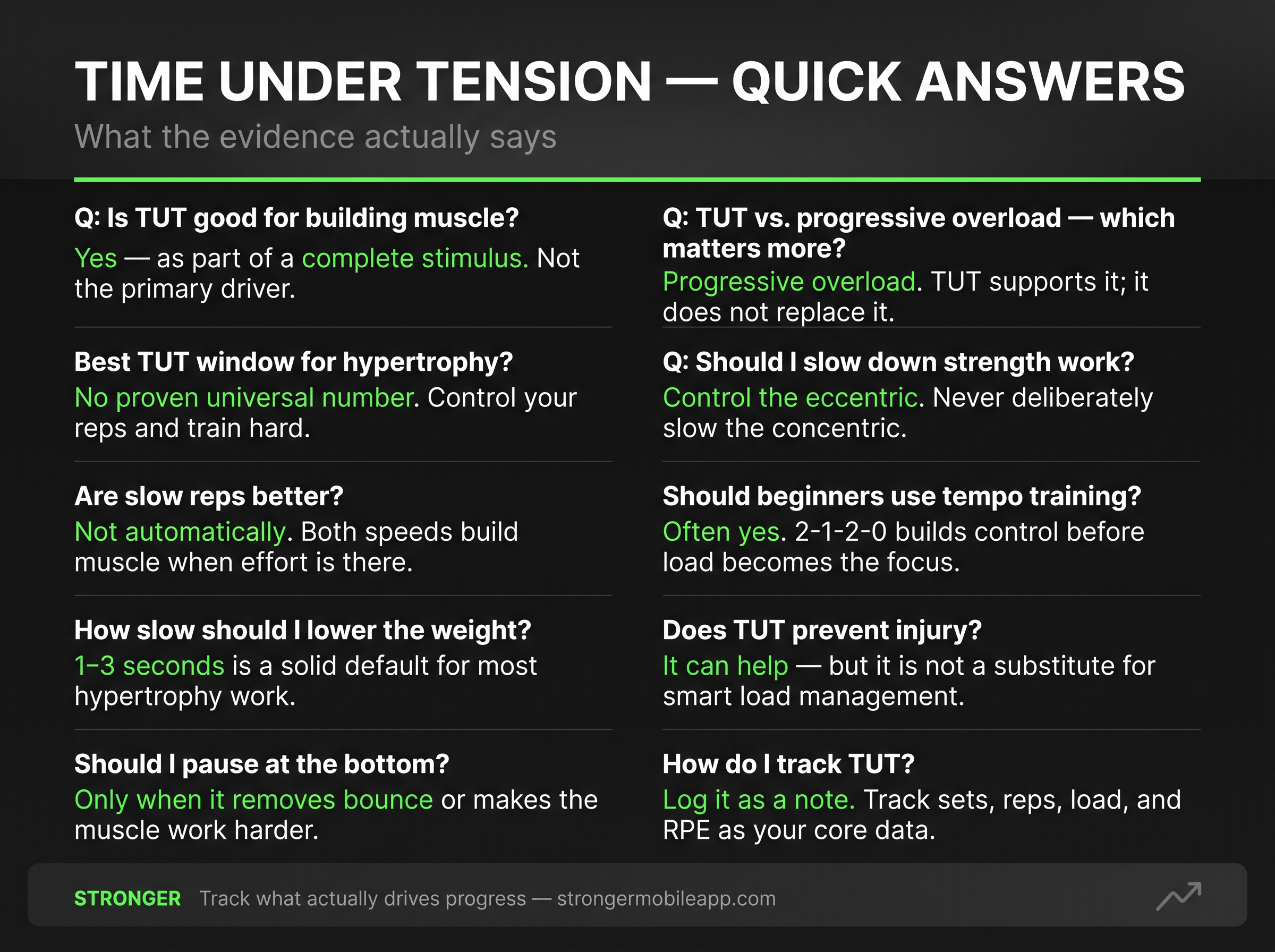
Yes — as part of a complete training stimulus. Controlled reps help you keep tension on the target muscle, reduce sloppy technique, and improve the quality of each set. But set duration alone does not guarantee more growth. A muscle needs enough mechanical tension, sufficient effort, adequate weekly volume and rep ranges, and progression over time.
What is the best time under tension for hypertrophy?
There is no proven universal best number. Many good hypertrophy sets naturally fall between 20 and 60 seconds because they use moderate reps with controlled technique. But current research does not support a strict optimal window. Use controlled reps, train close enough to failure, and let the duration follow from the rep range and tempo — not the other way around.
Are slow reps better than fast reps?
Not automatically. Both can build muscle when technique is sound and effort is sufficient. For strength and power, fast concentric intent is usually more important. For hypertrophy, controlled eccentrics and proximity to failure matter more than the specific speed of the lift.
How slow should I lower the weight?
For most hypertrophy work, 1 to 3 seconds is a good default. Use longer eccentrics when they genuinely improve your feel for the target muscle or reduce technical errors. Do not slow down to the point that load and performance collapse — that trades mechanical tension for sensation.
Should I pause at the bottom of every rep?
Only when it helps. Pauses are excellent for removing bounce, building positional strength, and loading the stretched position — but they are not mandatory on every exercise. Use them where the bounce is costing you control or where the pause adds a genuine challenge to the target muscle.
Does time under tension matter more than progressive overload?
No. Progressive overload — getting stronger, doing more high-quality work, improving your execution over time — is more important than any individual tempo choice. TUT can improve rep quality, which in turn supports progressive overload. But it is the downstream tool, not the upstream driver.
Should I use time under tension for strength training?
Use controlled technique, yes. Artificially slow concentrics, usually no. Strength work benefits from deliberate, controlled eccentrics and forceful concentrics that practice the quality you are training. Slowing the concentric on strength work trains you to be slow — which is the opposite of the adaptation you need. Our science-based strength guide goes deeper on what actually matters for getting stronger.
Should beginners use tempo training?
Often yes. A simple tempo like 2-1-2-0 helps beginners develop control and body awareness before load becomes the priority. Once technique is reliable, the focus should shift toward progressive overload.
Does time under tension help with injury prevention?
It can. Controlled reps reduce momentum-driven technique errors and give you more awareness of joint positions. But time under tension is not a substitute for proper load management, adequate rest and recovery, good programming, and professional guidance when you are training through pain or injury.
How do I track time under tension in my workouts?
Track it as a note, not the primary metric. When tempo is intentionally part of the plan — for example, "3-second eccentric on RDL" — log it alongside the exercise. Your core tracking should still be sets, reps, load, RPE or RIR, and rest. Those are the variables that will tell you whether your training is actually working. Stronger makes it straightforward to log all of these in one place, with your Strength Score updating automatically as you improve.
Exercises in this guide
Stronger Editorial Team
Certified strength & conditioning specialists with 10+ years of coaching experience
The Stronger editorial team produces evidence-based training content for lifters of all levels.
Ready to Get Stronger?
Join 2,000,000+ lifters tracking their workouts with Stronger. Available on iOS and Android.