

Gym Etiquette: 37 Unwritten Rules Every Lifter Should Know
There's only one rule that actually matters at the gym.
Everything else — re-racking weights, wiping benches, not filming strangers, not sitting on the leg press for fourteen minutes while editing a TikTok — is just a specific application of it.
The rule: leave the equipment, the space, and the people around you better than you found them.
That's it. That one sentence handles about 90% of gym etiquette. The other 10% is the stuff nobody ever writes down — what to say when someone is hogging a machine, how to ask for a spot without making it weird, what the actual rules are for filming in the gym (they've changed), and why the person who loads three plates then disappears for six minutes might not know they're doing anything wrong.
We've built Stronger for people who take lifting seriously — and serious lifters understand the unwritten code that keeps a shared training floor functional. This guide covers all 37 rules: from the basics every new gym-goer needs to know, to the things that even experienced lifters keep getting wrong.
The #1 Gym Etiquette Rule That Covers Everything
Leave it better than you found it.
That applies to the 45 lb plates you borrowed, the bench you sweated on, the cable station you left at maximum height with the rope tangled around the carabiner, and the general mood of the people lifting around you.
It's not about being quiet or small or training less intensely. Heavy lifters grunt. Deadlifts make noise. Chalk exists. None of that breaks the rule.
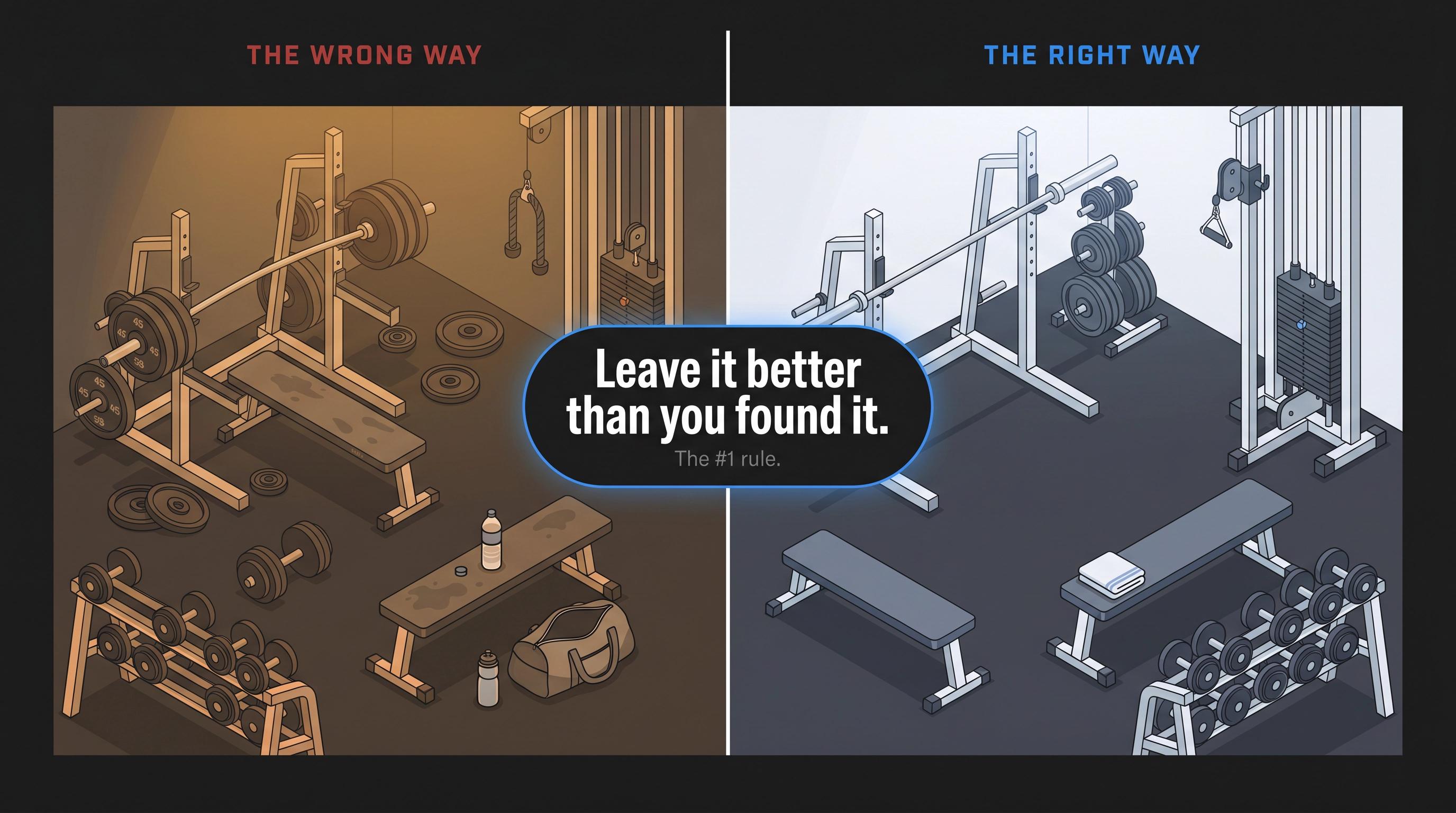
What breaks the rule: leaving plates on a bar for the next person to unload, sitting on equipment you're not actively using, filming people who didn't consent to be filmed, and giving form advice to someone who didn't ask for it.
The gym is a shared training floor, not your private studio. The lifters who understand this — who re-rack their weights, know what to say, and train hard without making themselves everyone else's problem — are the ones everybody is happy to share equipment with.
The 37 rules below are the specific applications of that one principle, organized by the situations where they actually come up.
Gym Etiquette Checklist: Quick Reference for Every Situation
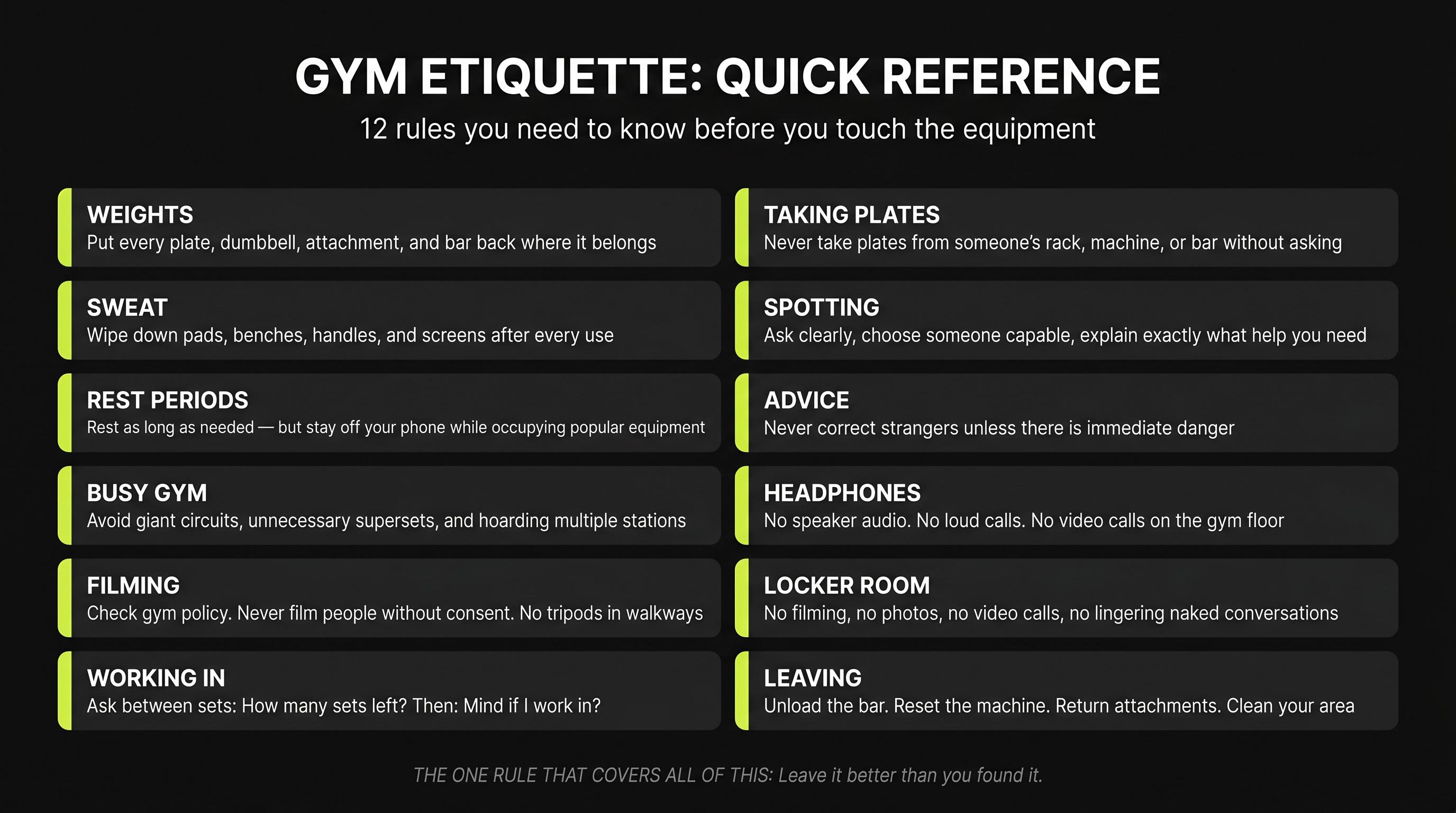
Before we get into detail, here's the version you can actually remember mid-workout:
| Situation | Good etiquette |
|---|---|
| Using weights | Put every plate, dumbbell, attachment, and bar back where it belongs |
| Sweating on equipment | Wipe down pads, benches, handles, and screens after use |
| Resting between sets | Rest as long as your training needs — but don't disappear into your phone while occupying popular equipment |
| Busy gym | Avoid giant circuits, unnecessary supersets, and hoarding multiple stations |
| Filming | Check the gym policy, never film people without consent, keep tripods out of walkways, never expect others to avoid your camera |
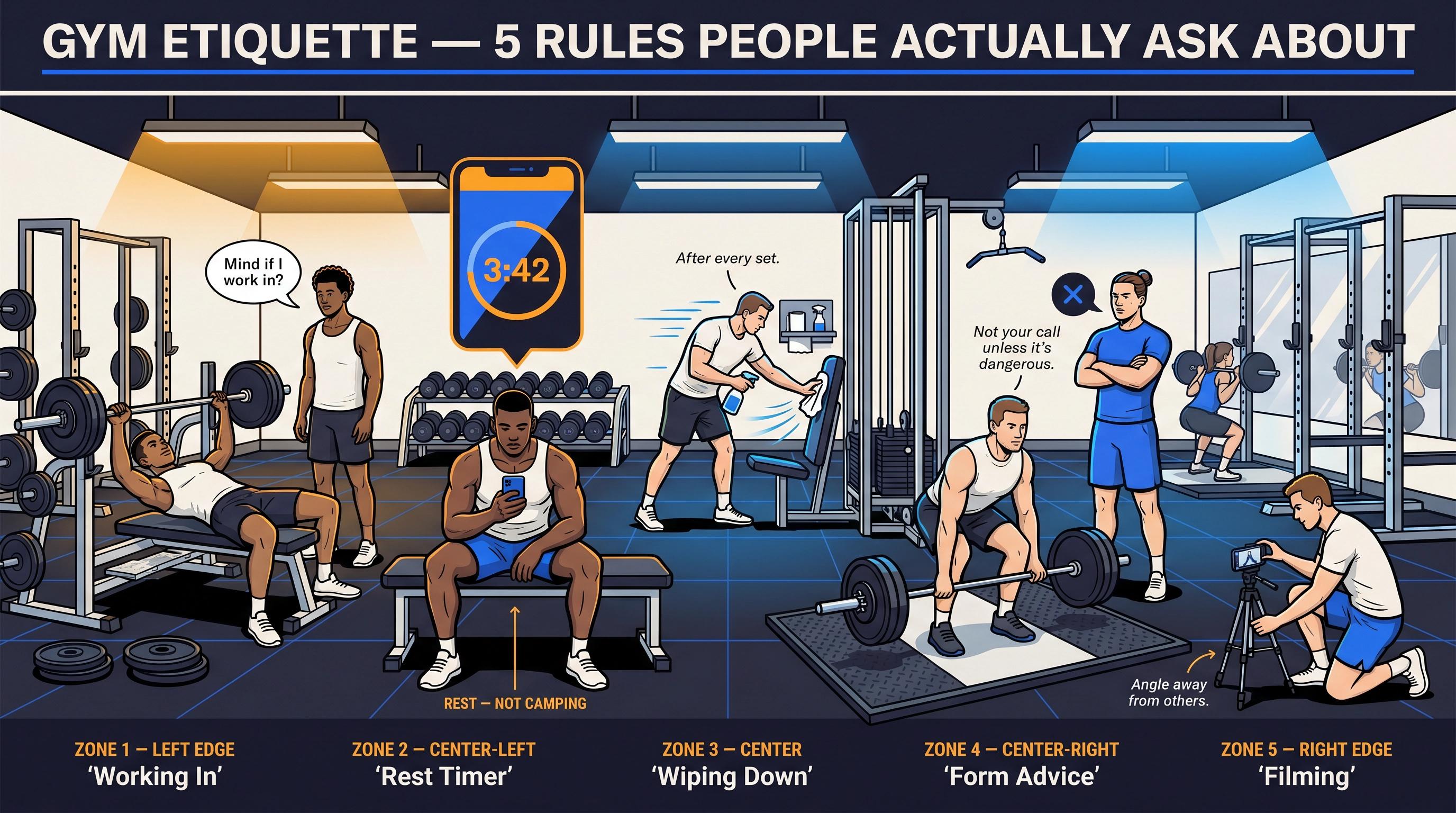
| Asking to share | Ask between sets: "How many sets do you have left?" then "Mind if I work in?" |
| Taking plates | Never take plates from someone's rack, machine, or bar without asking |
| Spotting | Ask clearly, choose someone capable, explain exactly what help you want |
| Advice | Don't correct strangers unless there is immediate danger |
| Headphones | No speaker audio, no loud calls, no video calls on the gym floor |
| Locker room | No filming, no photos, no video calls, no lingering naked conversations |
| Leaving | Unload the bar, reset the machine, return attachments, clean your area |
Planet Fitness requires headphones or earbuds for mobile audio, limits voice/video calls to lobby areas, and permits gym-floor self-filming only in limited circumstances. Equinox prohibits recording in private areas and group classes, bans tripods and professional equipment, and prohibits voice/video calls on the club floor. PureGym requires members to return weights and equipment, avoid hogging machines, and not take pictures or videos of other members without permission. (planetfitness.com)
Gym Equipment Etiquette Rules Every Lifter Needs to Follow
1. Read Your Gym's Rules Before You Start Lifting
The first unwritten rule is to respect the written rules.
Every gym has its own culture. A powerlifting gym, commercial gym, university rec center, CrossFit box, hotel gym, and boutique studio treat the same behavior differently. Deadlifting in socks might be normal in one place and banned in another. Chalk might be encouraged somewhere and forbidden elsewhere. Dropping bumper plates might be fine on a platform and completely unacceptable beside the dumbbell rack.
PureGym's published rules say members must seek advice if unsure how to use equipment, return weights, avoid using equipment for long periods, not drop weights except in areas designed for heavy lifting, and not film other members without permission. (puregym.com)
The practical rule: when house rules and lifter culture disagree, house rules win. You don't have to love the rule. You just need to follow it while you're in that gym.
2. Re-Racking Weights: The Most Basic Gym Etiquette Rule
This is the most basic gym rule because it affects everyone.
When you leave plates on the leg press, dumbbells on the floor, or a loaded bar in the rack, you create three problems. First, someone else has to clean up after you. Second, other lifters can't tell whether the equipment is free. Third, loose equipment becomes a trip hazard — and a real one, not a hypothetical one.
Re-racking is not "being nice." It's the minimum cost of using shared equipment.
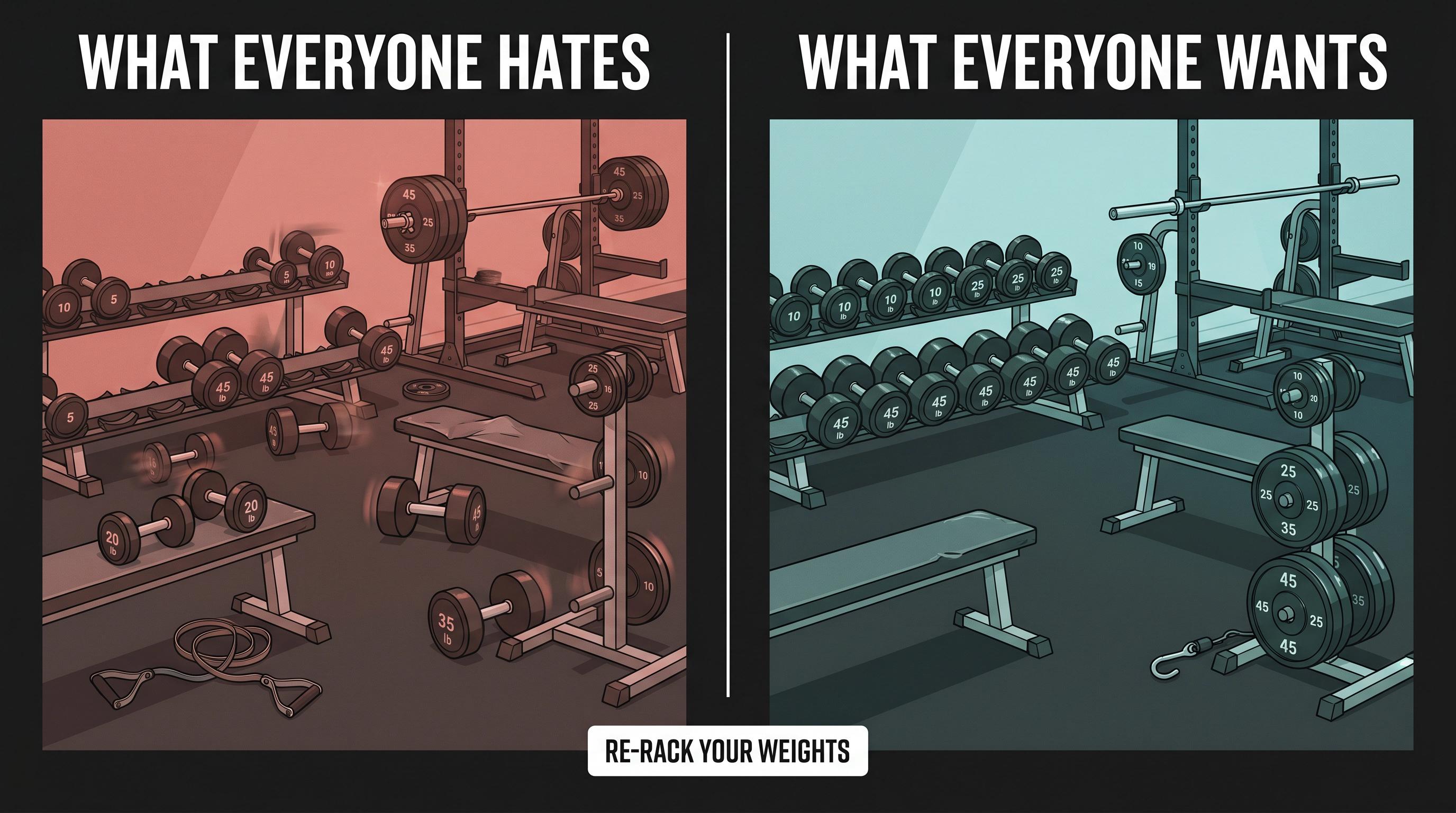
Do this every time:
- Put dumbbells back in the correct slots, not the closest open peg
- Return plates to the right rack positions
- Unload barbells completely when you're done
- Return cable attachments to the rack
- Put bands, mats, collars, boxes, and handles back where they belong
- Leave machines at a neutral setting when possible
PureGym lists this as an actual rule: members must put weights and equipment back in the correct place. (puregym.com)
The advanced version: bad re-racking is still bad etiquette. Don't put a 45 lb plate on the 10 lb peg because you were tired. Don't stack dumbbells randomly. Don't leave a 25 kg plate buried behind three 5 kg plates where nobody can get to it.
A clean weight area saves everyone time. It also makes the gym safer for smaller, newer, older, or injured lifters who shouldn't have to strip six plates from a machine just to begin their warm-up.
3. How to Wipe Down Gym Equipment the Right Way
If your skin, sweat, hair, or back touched it — wipe it.
That means benches, machine pads, cardio handles, cable handles, chest-supported rows, seated leg curls, hip thrust pads, mats, and anything else you left sweaty. This isn't just about looking polite. The American Academy of Dermatology says germs can thrive in warm, moist gym environments and recommends disinfecting equipment before and after use, using a towel barrier on shared surfaces, washing or sanitizing hands after training, and showering as soon as possible. (AAD)
The CDC's MRSA guidance for athletic facilities is direct: MRSA can spread in gyms and health clubs through shared equipment and skin-to-skin contact, and cleaning shared equipment after each use is recommended. (CDC)
The correct sequence is simple:
- Finish the exercise
- Wipe the surfaces you touched
- Let the cleaner sit briefly if the product requires contact time
- Return the equipment
- Move on
One note: don't spray disinfectant directly onto screens or electronics unless the gym's product is designed for that. The CDC's cleaning guidance recommends following manufacturer instructions and using products appropriate for the surface. (CDC)
4. How Long Is Too Long to Occupy Gym Equipment?
Resting is not the problem. Disappearing is the problem.
Serious strength training requires real rest. Heavy compound movements like squats, deadlifts, bench press, and overhead press are not supposed to be rushed. Our complete rest-period guide at Stronger recommends 3–5 minutes between heavy compound sets, 1.5–3 minutes for hypertrophy work, and shorter rests for endurance-style work. (Stronger)
So no, you don't have to jump off the bench every 45 seconds because someone is hovering. But you do need to stay aware.
Bad equipment camping looks like this:
- Sitting on the machine while scrolling through your phone for several minutes
- Taking a phone call while occupying a cable station
- Using a bench as a bag shelf between sets
- Staying on a piece of equipment while editing a video from last week
- Resting so long you forget how many sets you've done
- Refusing to let anyone work in during busy hours
Good etiquette looks like this:
- Know how many sets you have left before someone asks
- Use a rest timer
- Let people work in when it makes practical sense
- Step off the machine if you need a longer phone break
- Don't claim equipment you're not actively using
A good workout tracker helps here — if you use it properly. Stronger is built around fast set logging, smart defaults, automatic PR (personal record) detection, and a built-in rest timer. That means you can log the set, start the timer, and get back to training instead of drifting into a scroll hole between sets. (Stronger)
5. Why You Shouldn't Stand at the Dumbbell Rack
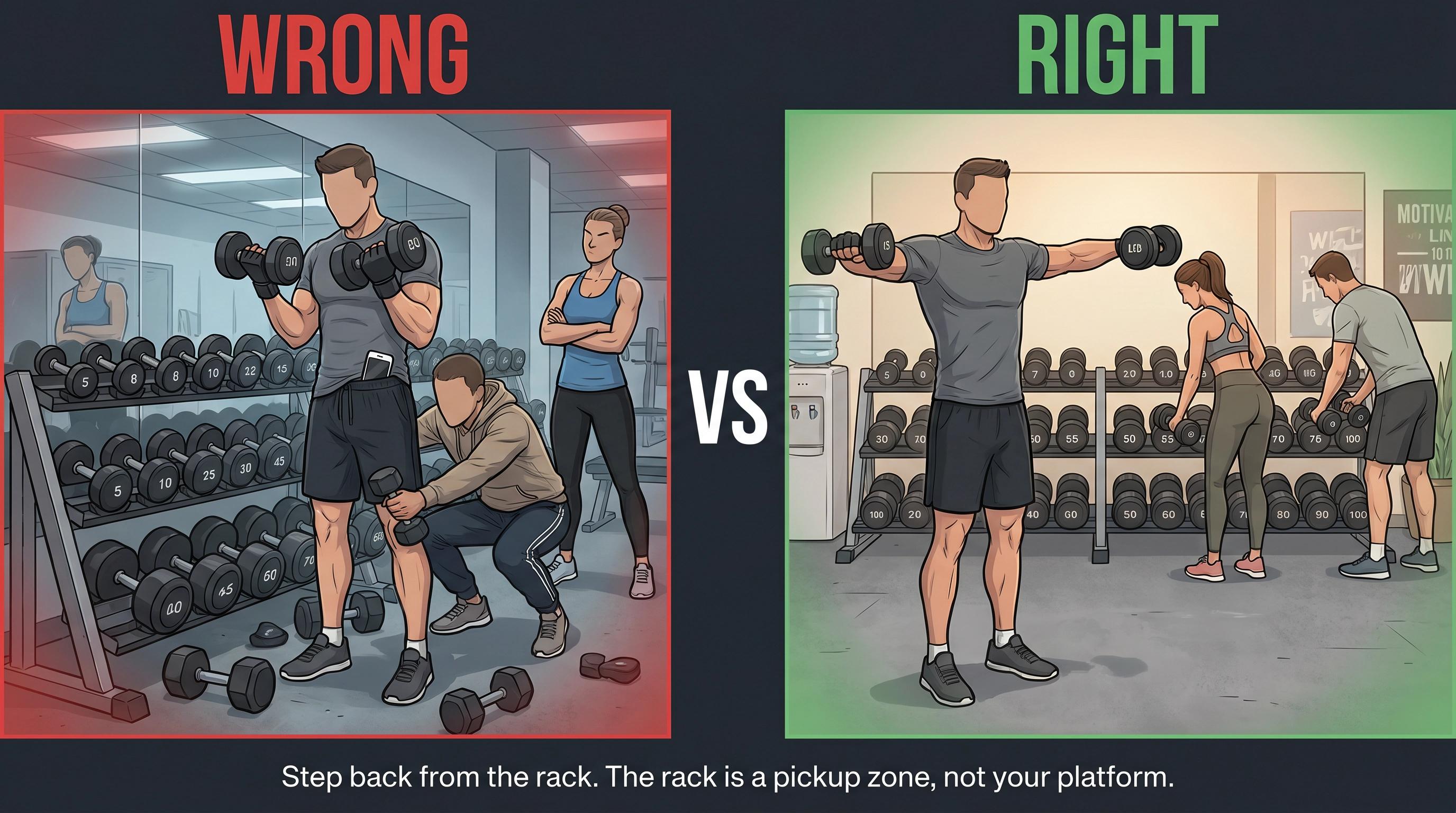
Don't stand directly in front of the dumbbell rack to curl, lateral raise, shrug, or film.
Grab the dumbbells, take several steps back, and give other people access to the rack. The dumbbell rack is a pickup zone — not your personal lifting platform.
Also:
- Don't hoard five pairs of dumbbells for a drop set circuit
- Don't leave dumbbells beside your bench after you're done
- Don't drop dumbbells from shoulder height unless the gym explicitly allows it
- Don't use dumbbells as improvised phone tripods
- Don't block the rack while checking messages between sets
- Return dumbbells to matching spots, not the closest available gap
A dumbbell area turns chaotic fast. The lifters who keep it moving are the lifters everyone is happy to train around.
6. What Are Squat Racks Actually For?
A squat rack is premium real estate in any gym. Treat it accordingly.
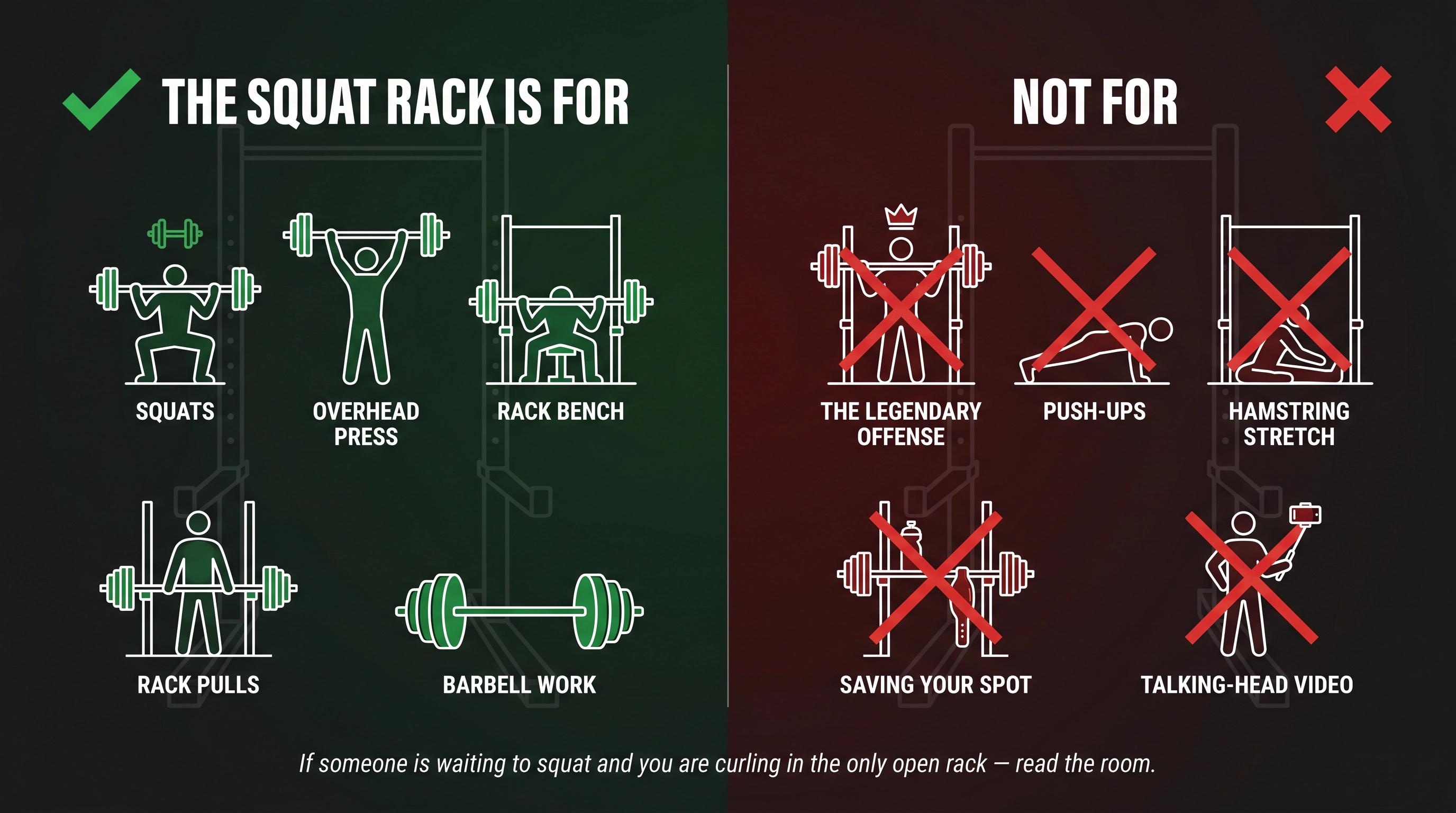
Use it for lifts that genuinely need safeties, uprights, or a barbell setup:
- Squats (all variations)
- Bench press variations if the rack is built for it
- Overhead press
- Rack pulls, pin presses, and other rack-dependent barbell work
- Heavy good mornings
- Barbell rows if no floor space exists
Avoid using the only squat rack for:
- Curls (the legendary offense)
- Push-ups
- Stretching
- Storing your water bottle and belt between supersets
- Filming a talking-head video
This isn't to say curls in the rack are morally evil. If the gym is empty at 6 a.m. and there are four open racks, nobody cares. But if someone is waiting to squat and you're curling in the only open rack — read the room, move the curl to the floor, and everyone goes home happy.
7. How to Safely Unload a Barbell After Your Set
When you're done with a barbell, unload it — but do it safely.
If a bar has significant weight on it, strip plates evenly from both sides. Don't remove every plate from one side while the other side is still loaded. A heavily unbalanced bar can tip, whip, or fall out of the rack, and that's a fast way to hurt someone or damage equipment.
Correct barbell cleanup:
- Remove clips or collars
- Take one plate from one side
- Take one plate from the other side
- Repeat until empty
- Return plates to the correct pegs
- Leave the empty bar where it belongs
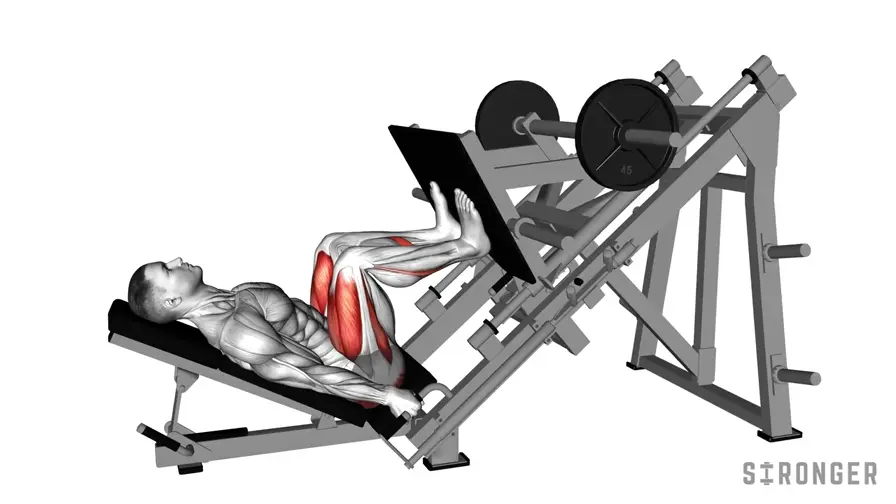
For machines like leg press or hack squat, unload everything unless your gym has a specific "leave one plate per side" norm. In most commercial gyms, the safest assumption is: empty it.
8. When Should You Use Collars on a Barbell?
Collars — the clips that lock plates onto a barbell — are not always mandatory, but they're often the right call.
Use collars when:
- Plates might slide due to an uneven floor or bar path
- The bar path is unstable (dumbbell press doesn't need them; uneven barbell movements might)
- You're lifting near failure on pressing movements
- You're doing Olympic lifts
- The gym requires them for all lifts
- You're using specialty bars
Some advanced lifters bench without collars so plates can slide off if they fail alone — but that's a specific technique for a specific context, not default advice. For most lifters, the safer rule is: use collars when plate movement would create any risk.
And if you're lifting alone, use safety pins, safety arms, or a proper rack setup. Always.
9. Proper Gym Machine Etiquette After Your Set
Machine etiquette is underrated and frequently ignored.
When you finish a machine:
- Remove your weight plates completely
- Wipe down the pads and handles
- Reset the pin to a light or neutral weight
- Return any attachments you used
- Move the seat or pad back to a standard position if you adjusted it dramatically
- Don't leave towels or bottles draped across the machine
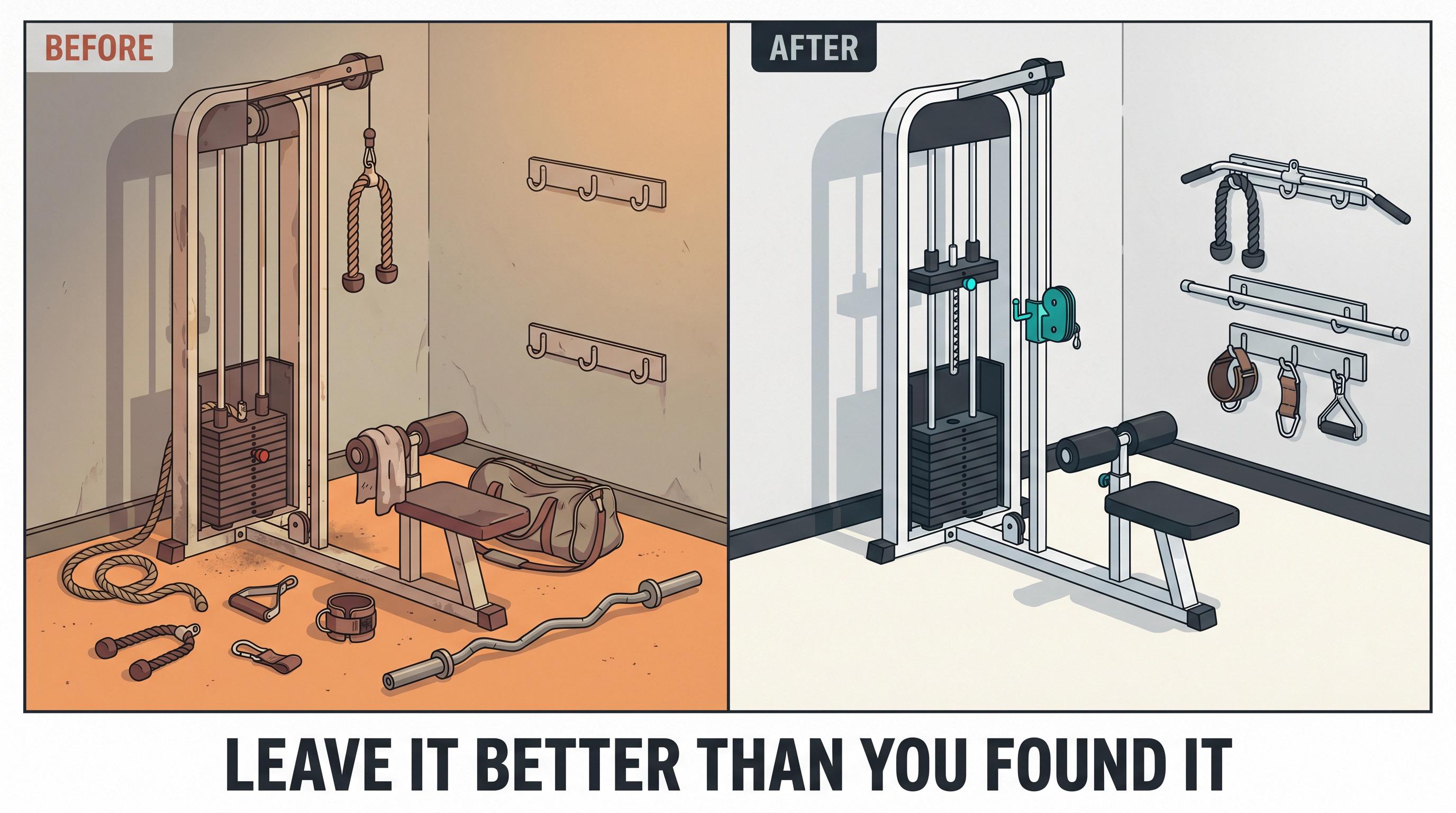
For plate-loaded machines, unload everything. For selectorized machines (the kind with a pin in a weight stack), don't leave the pin at the bottom of the stack to show how strong you are. Nobody cares, and the next person has to hunt for the pin.
Also: control the weight stack on the way down. Don't slam it. The machine lasts longer, your muscles probably get more out of the eccentric rep, and everyone nearby gets to keep their eardrums.
10. Cable Machine Etiquette: Return Attachments After Use
Cable stations get messy fast because people treat attachments like personal property.
When you're done with a cable exercise, return the attachment to its rack:
- Rope handles
- Straight bars and EZ bars
- Ankle cuffs and D-handles
- Lat pulldown bars
- Carabiners
Use the attachment, then return it.
Beyond the attachment: don't occupy both cable columns when the gym is busy and you only need one side. Don't set up a giant cable circuit during peak hour. Don't leave the cable at ankle height with a rope attached while you go to another station.
11. Is Dropping Weights at the Gym Rude?
Dropping weights isn't automatically rude. Dropping weights in the wrong place is rude.
Olympic lifting platforms, bumper plates, powerlifting deadlift zones, and CrossFit boxes are designed for controlled drops. Random commercial gym floors, dumbbell areas, and the area next to a machine are not.
PureGym's rules make this distinction directly: members must not drop weights on the floor unless they're in areas specifically designed for heavy lifting. (puregym.com)
The rule: if the floor, the plates, the bar, and the gym culture aren't designed for dropping, lower the weight under control.
There's also a difference between a heavy deadlift making noise on a platform and someone throwing dumbbells after a set of curls. One is training. The other is theatre.
12. Why Keeping Gym Walkways Clear Matters
Your bag, tripod, belt, water bottle, bands, plates, and mat should not block traffic.
This matters more than people think. Lifters carry dumbbells, walk backward out of racks, move plates, push sleds, and step away from failed reps. A cluttered walkway is a real safety hazard.
Planet Fitness explicitly states that bags and clothing are not allowed on the club floor because they create safety hazards. PureGym similarly prohibits bags or large items on the gym floor for safety reasons. (planetfitness.com)
Use lockers. Use cubbies if available. Keep your lifting area tight.
Gym Social Etiquette: How to Talk to People at the Gym
13. How to Ask "Are You Using This?" Without Being Awkward
Never assume abandoned-looking equipment is free.
A towel on a bench, plates on a bar, a water bottle beside a machine, a notebook near the rack — any of these usually means someone is actively using it. They might be grabbing water, doing a paired exercise, or resting nearby.
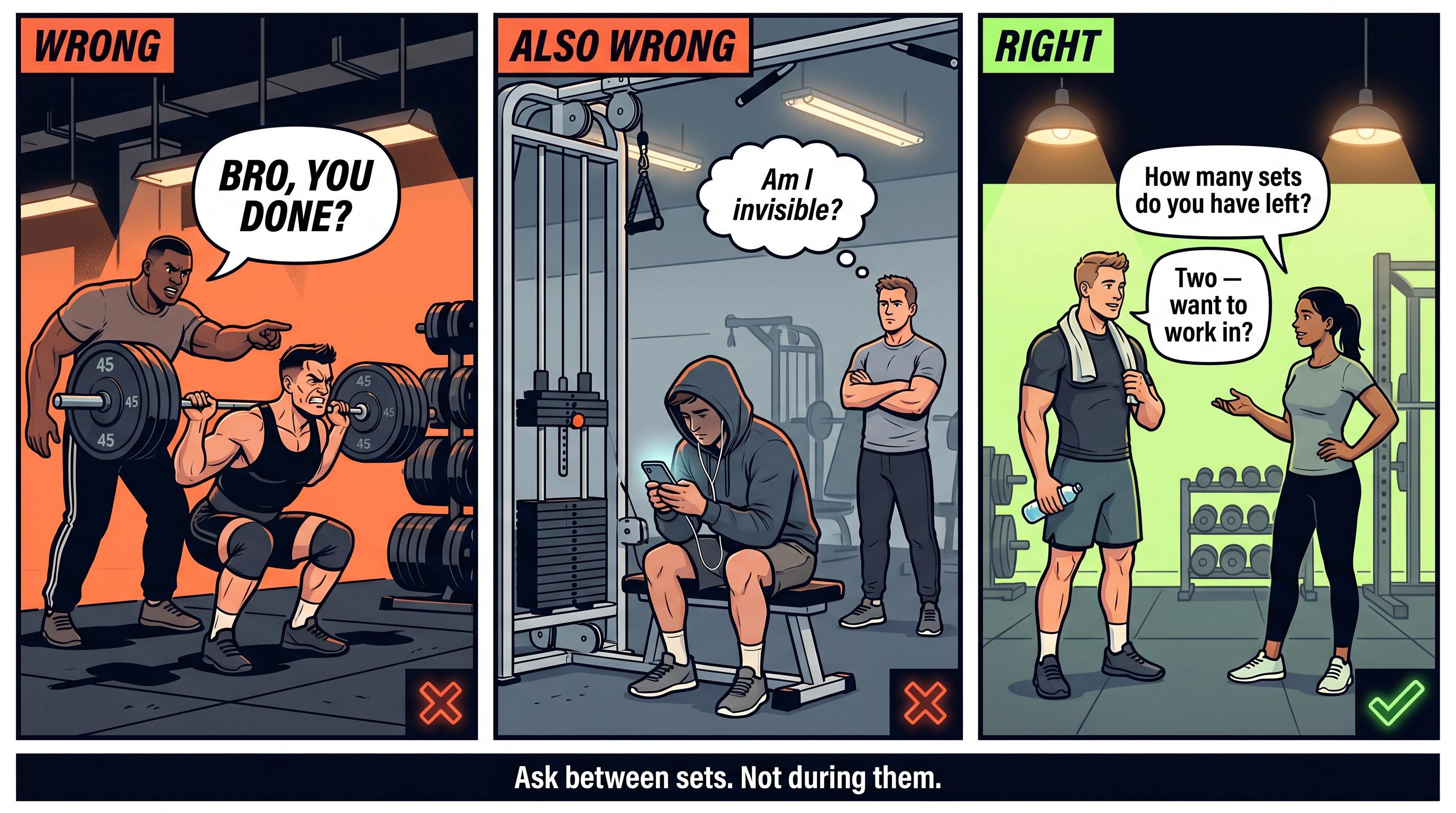
Always ask between sets, not during them:
"Are you using this?"
Or:
"Are you still on this?"
Not:
"Bro, you done?" while they're in the middle of unracking a squat.
If they say yes, follow up:
"How many sets do you have left?"
If they say one or two, it's usually easier to wait. If they say several, ask:
"Mind if I work in while you rest?"
That one phrase defuses half of all gym conflict.
14. How to Work In at the Gym Without Annoying Anyone
"Working in" means two or more people alternate sets on the same piece of equipment. It's one of the most effective tools for managing a busy gym — and one of the most mishandled.
Working in works well when:
- The gym is busy and equipment is limited
- The exercise setup is simple
- Weight changes are quick
- Both people are doing similar movements
- Rest periods are long enough to share
Working in doesn't work well when:
- The setup requires multiple band attachments, specialty bars, or specific safety positions
- One person is lifting very heavy and the other needs a completely different load
- Someone is attempting a max effort lift
- Hygiene reset would be annoying every set
- Someone is doing a timed circuit
Good working-in etiquette:
- Ask between sets: "Mind if I work in?"
- Change settings quickly once given permission
- Put the seat, pins, safeties, handles, and plates back exactly how you found them after every set
- Wipe the pad if you sweat on it
- Do your set efficiently
- Don't start coaching the other person
- Don't rush them — they were there first
When it's okay to say no: You're allowed to decline politely. Say:
"Sorry, I'm doing heavy singles and changing the setup would be rough. I've got two sets left."
Or:
"I'm almost done — just one more set."
The key is giving a clear answer, not acting like the other person committed a crime by asking.
15. Can You Take Plates Off Someone Else's Bar at the Gym?
Plates stored on a squat rack or machine often look available. They may not be.
Someone might need those plates for their next set, and if you take them without asking, you interrupt their workout and send them hunting for equipment they had already organized.
Ask first:
"Are you using this plate?"
Or:
"Mind if I grab a 10 from here?"
The Guardian's 2025 gym etiquette guide makes the same point: ask before taking plates from someone's machine, and don't ask while they're in the middle of a lift — wait until their set is over.
16. How to Ask for a Spot at the Gym (and How to Be a Good Spotter)
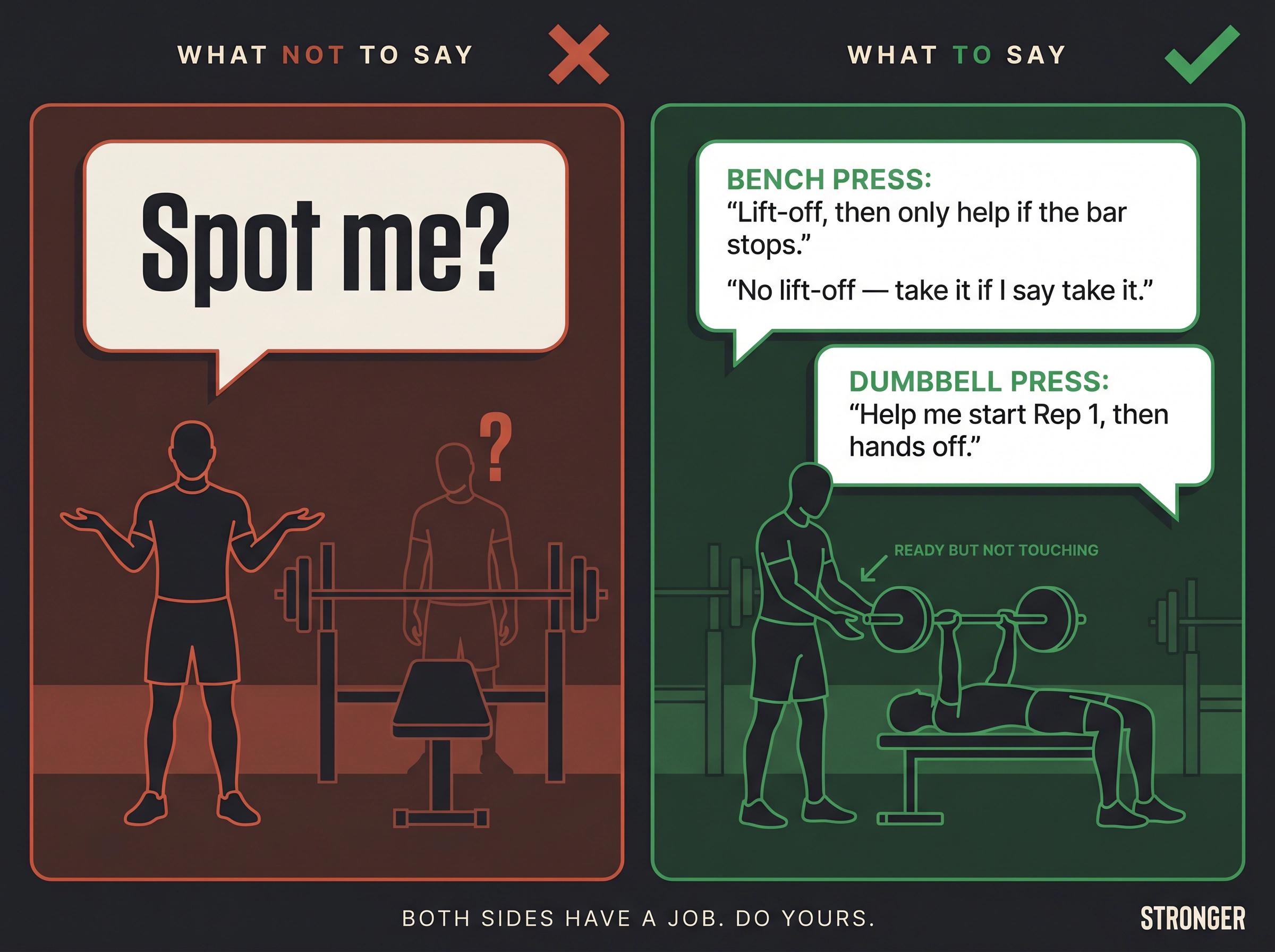
"Spot me?" is not enough information.
A spotter needs to know what you actually want from them before the lift begins.
For bench press:
"Can you give me a lift-off, then only help if the bar stops moving?"
Or:
"No lift-off, just stay close. If I say 'take it,' help me rack it."
For dumbbell press:
"Help me get the first rep started, then hands off unless I ask."
For squats: In most commercial gyms, safety arms or safeties set in a rack are better than asking one person to back-spot a heavy squat they may not know how to spot. Be honest with yourself about this.
Good spotting rules (for the person asking):
- Choose someone strong enough and attentive enough to actually help
- Ask between sets, not while they're lifting
- Explain the lift and exactly what kind of help you want
- Don't surprise someone with an unannounced max attempt
- Use safeties when possible
- Thank them after
Good spotting rules (for the spotter):
- Don't touch the bar early — let them work
- Don't upright row someone's bench rep unless it genuinely stalls
- Stay focused; don't check your phone mid-spot
- Follow their specific instructions
- Help rack safely
A bad spot can ruin a set. A good one makes genuinely hard training feel safer.
17. Should You Give Unsolicited Gym Advice to Strangers?
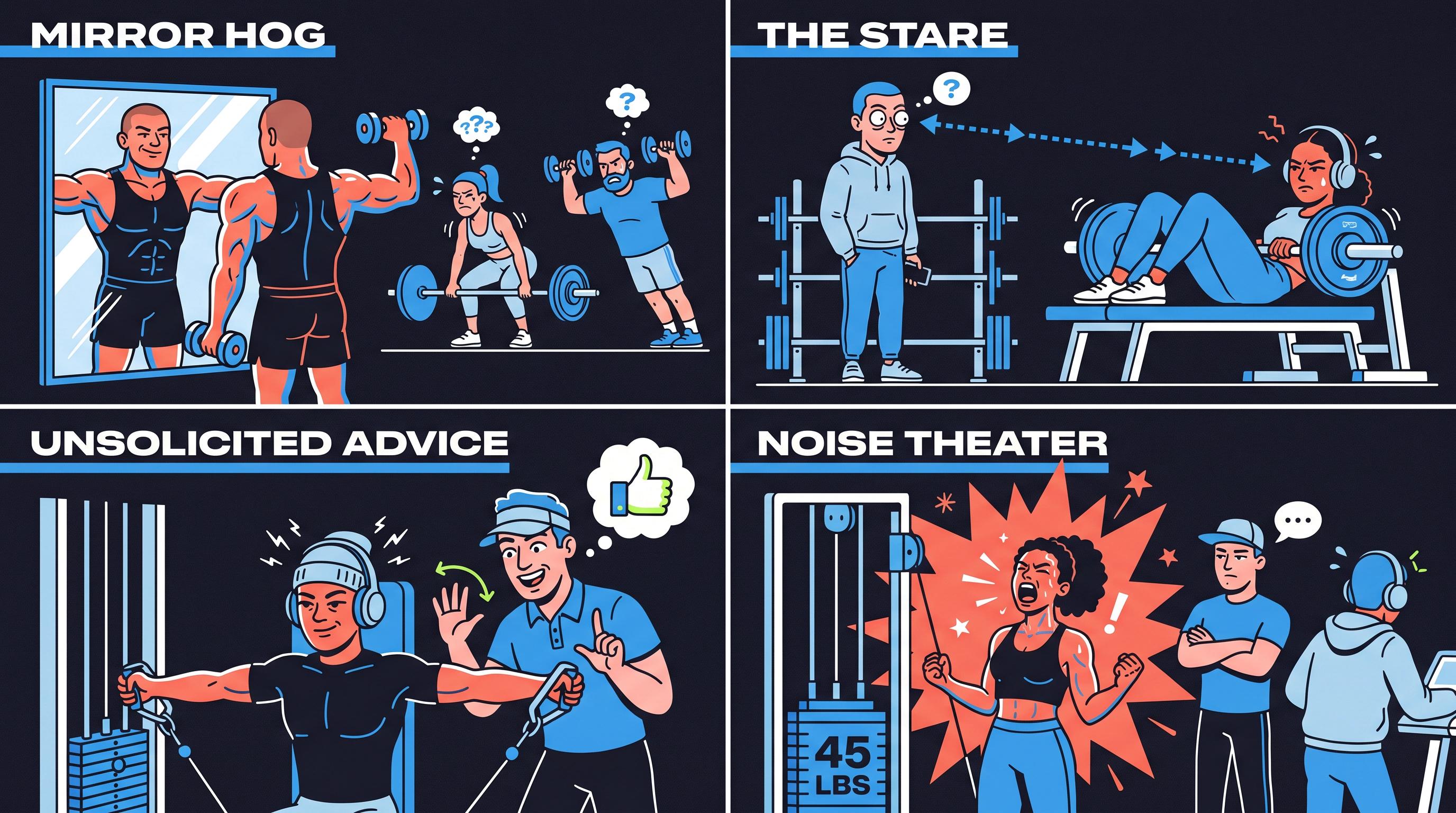
This is one of the biggest unwritten rules — and one of the most frequently broken.
Unless someone is in immediate danger, don't walk up and correct their form.
You might be right. You might be wrong. And even if you're right, most people don't want a stranger interrupting their workout to explain biomechanics. The Guardian's 2025 piece on gym etiquette included trainer insight that unsolicited form correction is almost always unwelcome unless someone is in immediate danger or serious risk of injury.
Don't say:
"You're doing that wrong."
If safety is genuinely urgent:
"Hey, sorry to interrupt — that rack pin looks loose and I don't want you to get hurt."
Best option most of the time: Say nothing.
If someone asks? Then help. Keep it short. Answer the question they actually asked. Don't turn a 10-second cue into a 12-minute lecture about your program.
18. Is It Okay to Ask for Help at the Gym?
The opposite of unsolicited advice is knowing when to ask.
Asking for help is completely normal gym behavior. Ask staff if you don't know how to use a machine. Ask a lifter for a spot before you attempt a heavy bench. Ask whether equipment is taken. Ask where a handle is kept.
Good gyms run on small, polite interactions.
Use simple scripts:
"Hey, do you know how to adjust this?"
"Could you spot me for one set?"
"Is this rack free?"
"Do you know where the ankle straps are kept?"
Most lifters aren't judging you. They're thinking about their own sets, their own music, and whether they loaded the bar correctly.
PureGym's rules specifically tell members to seek advice from staff if they're unsure how to use equipment. (puregym.com) Asking is the right move. Standing there guessing is how people get hurt.
19. Gym Mirror Etiquette: What the Rules Actually Are
Mirrors at the gym aren't just for selfies. Lifters use them to check squat depth, bar path, bracing position, symmetry, and lockout.
Don't walk between someone and their mirror during a set unless you have no other option. Don't set up directly in front of someone who's already using the mirror for form cues. Don't edge up to the dumbbell rack because you want a specific mirror angle, then stay there for six sets.
And a note for the other direction: don't stare at yourself so intensely that you lose awareness of everyone around you. The mirror helps you lift. It doesn't make the gym your stage.
20. Gym Staring: Why It's Rude and How to Avoid It
Glancing around is normal. Staring at someone is not.
People should be able to squat, hip thrust, deadlift, stretch, run, and train without feeling watched. This applies to everyone in the gym, regardless of what they're doing, what they're wearing, or what weight they're lifting.
Don't stare at:
- Someone's body
- Someone's weight selection (either direction)
- Someone's outfit
- Someone's disability or injury
- Someone who's new and confused
- Someone doing an exercise you personally think is useless
If you're waiting for equipment, don't stand two feet from the current user and stare them down. Ask how many sets they have left, then step back and give them space.
21. Is It Appropriate to Hit on Someone at the Gym?
The safest default is simple: don't hit on people mid-workout.
Friendly conversation happens at gyms. Gym friendships are real. But someone wearing headphones, training hard, avoiding eye contact, or moving deliberately through a program is not extending a social invitation.
Bad timing:
- During a set
- While they're stretching or loading plates
- While wearing headphones
- After they've already given short answers twice
- When you're using "form correction" as an excuse to approach
PureGym's rules specifically prohibit anti-social behavior including unwanted sexual advances, staring, catcalling, and continuing to engage after someone asks to be left alone. (puregym.com)
Talk like a normal person. Accept disinterest immediately. Never make someone's gym feel unsafe.
22. Why Mocking Other Gym Members Is a Serious Problem
Don't laugh at someone's form, body, weight selection, exercise choice, or effort. Don't post strangers online. Don't screenshot their session and send it to your group chat.
Everyone starts somewhere. The person who keeps showing up consistently — deadlifting 60 kg today and pulling 180 kg in two years — is doing something right. The person doing a "weird" machine exercise might be rehabbing an injury. The person lifting light might be warming up, deloading, learning a new movement, or just training for a goal you don't understand.
The gym works best when effort is respected.
23. How Much Noise Is Acceptable at the Gym?
Some noise is normal and fine.
Heavy lifting involves bracing, breathing, exertion, plates moving, and occasionally a genuine grunt. A max-effort deadlift will not sound like a library. A hard set of squats at your limit doesn't need to be silent.
But there's a clear line between effort and performance.
Fine:
- Controlled breathing
- Normal exertion sounds
- Plates touching during hard reps
- Heavy deadlifts on an appropriate platform
- A brief celebration after a genuine PR
Annoying:
- Screaming before every single set
- Throwing dumbbells after a set of curls
- Clapping chalk clouds everywhere it's not allowed
- Fake rage rituals performed primarily for the audience
- Celebrating every warm-up like you won a national title
The context also matters. A powerlifting gym will tolerate more noise than a hotel gym. A commercial gym at 7 a.m. may not appreciate death-metal screaming during cable flyes.
Train hard. Don't make the entire room revolve around you.
Gym Filming Rules: When Is It Okay to Record at the Gym?
24. Can You Film Yourself at the Gym? Rules You Need to Know
Modern gym etiquette has changed because phones changed the gym.
Filming can be genuinely useful. Lifters record sets to check depth, bar path, bracing, lockout, and technique. Online coaching often depends on video. Reviewing form footage is one of the best feedback tools available.
But filming becomes a problem when it captures strangers without consent, blocks equipment or walkways, creates trip hazards with tripods, or makes other people feel like unwanted background characters in your content.
Vox reported in April 2025 that gym filming creates real tension when people block equipment, tell others not to enter the shot, or treat public gym space like a private production set. (Vox)
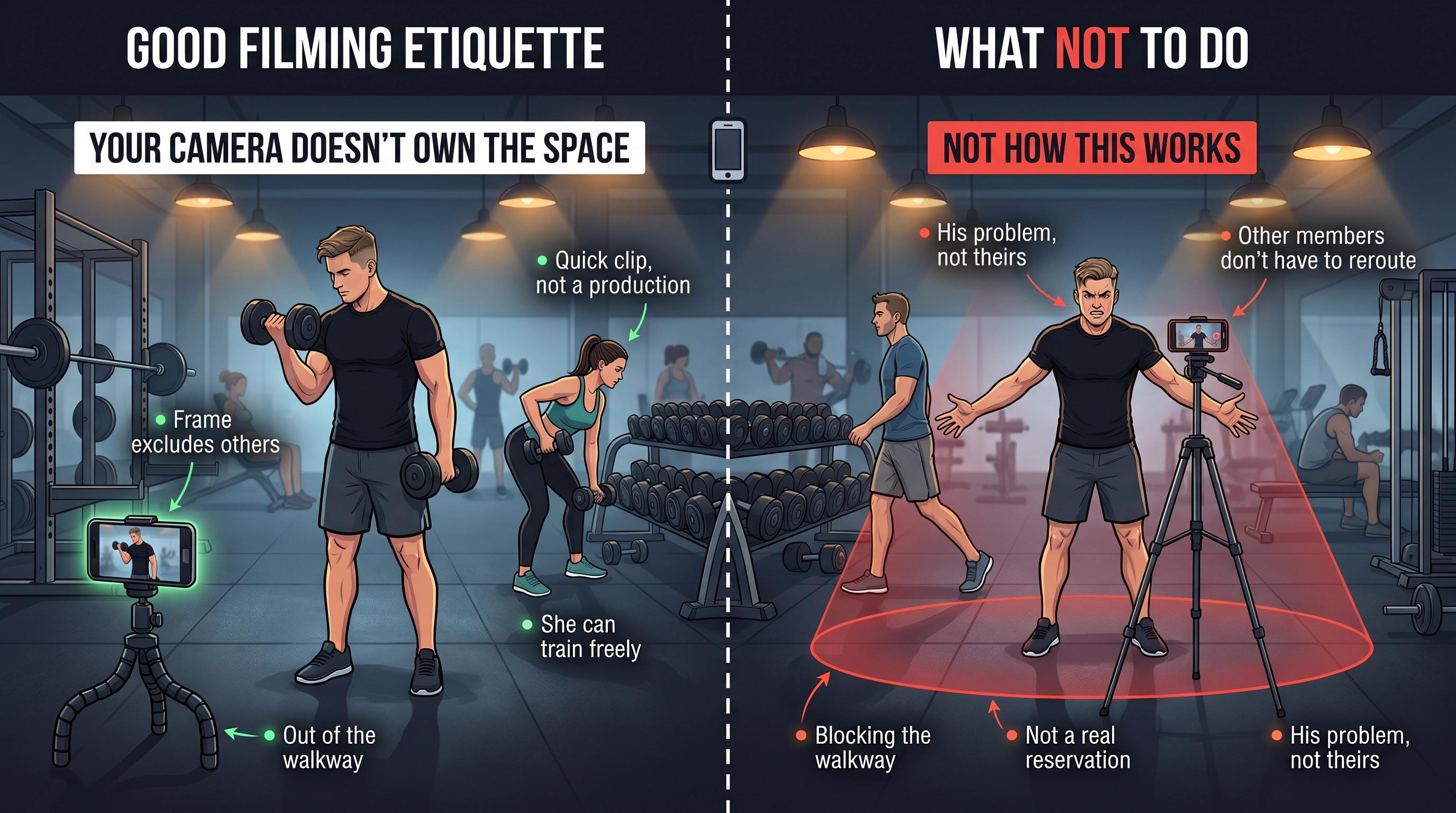
Good filming etiquette:
- Check the gym's policy before setting up
- Never film in locker rooms, bathrooms, saunas, or changing areas (more on this below)
- Keep people out of your frame
- Ask permission if someone might be visible
- Keep your phone or tripod out of walkways
- Don't block dumbbells, machines, benches, or cable stations
- Use short clips, not full production setups
- Avoid filming during peak hours if you can
- Delete footage if someone reasonably asks
- Never post a stranger to mock them
Planet Fitness permits gym-floor self-filming only in limited circumstances, and only when it doesn't create safety risk or capture others without permission. Equinox permits personal photography in some areas but prohibits it if it captures members, guests, or staff without consent; it also bans tripods and professional equipment. PureGym says members must not film, photograph, or livestream other members without permission, and must stop filming if staff or other members request it. (planetfitness.com)
If someone is nearby and you want to film your set:
"Hey, I'm going to record this for form. I'll angle it so you're not in the shot — is that okay?"
If they look uncomfortable, move. Don't debate it. Don't make it an issue. Just move.
25. Does Filming at the Gym Give You the Right to Reserve Space?
This one deserves its own rule because it still surprises people.
If you're filming, other members do not have to wait, reroute, or avoid equipment because your phone is recording. Your camera does not hold a reservation on the space around it.
The Guardian's 2025 etiquette feature put it directly: if someone needs equipment and you're in the way while filming, that's your problem, not theirs.
So if someone walks through your shot — that's a normal risk of filming in a shared public space.
Don't glare. Don't sigh loudly. Don't say "I was filming."
You can re-record the set. They can't train through your imaginary film set.
26. Why You Should Never Film in a Gym Locker Room
No photos. No videos. No mirror selfies. No FaceTime. No "but nobody was in the background."
Locker rooms are private spaces. People are changing, showering, weighing themselves, and expecting not to be recorded — regardless of what you're filming or why.
Planet Fitness strictly prohibits photos, videos, and voice/video calls in locker rooms and spa areas. Equinox prohibits recording in locker rooms, saunas, steam rooms, spa areas, pool areas, kids areas, and group fitness classes. (planetfitness.com)
This is one of the few etiquette rules with no nuance and no exceptions.
Don't film in the locker room.
27. Group Fitness Class Etiquette Rules You Need to Follow
Classes have their own etiquette layer on top of everything else.
Show up early enough to set up your equipment. Tell the instructor if you're new, injured, pregnant, returning from a long layoff, or unsure about specific movements. Don't walk in late and squeeze into the front row during the warm-up.
Good class etiquette:
- Arrive a few minutes before start time
- Bring only what you need
- Follow the instructor's setup
- Don't talk over demonstrations
- Scale movements appropriately and without ego
- Clean your station after class
- Return all equipment to its correct place
- Don't leave early unless you genuinely need to
Equinox explicitly prohibits recording during group fitness classes. (equinox.com)
If you need to leave early, let the instructor know beforehand and set up near the exit so you can leave without disrupting the rest of the class.
Ready to Get Stronger?
Join 2,000,000+ lifters tracking their workouts with Stronger. Available on iOS and Android.
Start tracking freePhone Etiquette at the Gym: Rules for Using Your Device
28. Why Headphones Are Required Gym Etiquette
Nobody wants your playlist, podcast, motivational speech, YouTube tutorial, TikTok, or voice note echoing across the weight floor.
Headphones are standard gym etiquette by any measure. Planet Fitness requires headphones or earbuds for mobile audio. Equinox says all audio and video content must be played through headphones at a volume inaudible to others. (planetfitness.com)
Beyond the official policies:
- No speakerphone on the gym floor
- No loud business calls beside the dumbbells
- No video calls near other lifters
- No scrolling TikTok at full volume between sets
- No playing music out loud "just for one set"
Your music might genuinely be elite. Keep it in your ears.
29. Is It Rude to Use Your Phone at the Gym?
You can use your phone in the gym. You should, actually — it's how most people log their workouts, run their rest timer, track their previous weights, and follow their program.
Valid reasons to use your phone at the gym:
- Your workout plan and exercise order
- Your training log
- Rest timer
- Music
- Form check videos
- Messages from a coach
- Checking previous weights and reps before loading
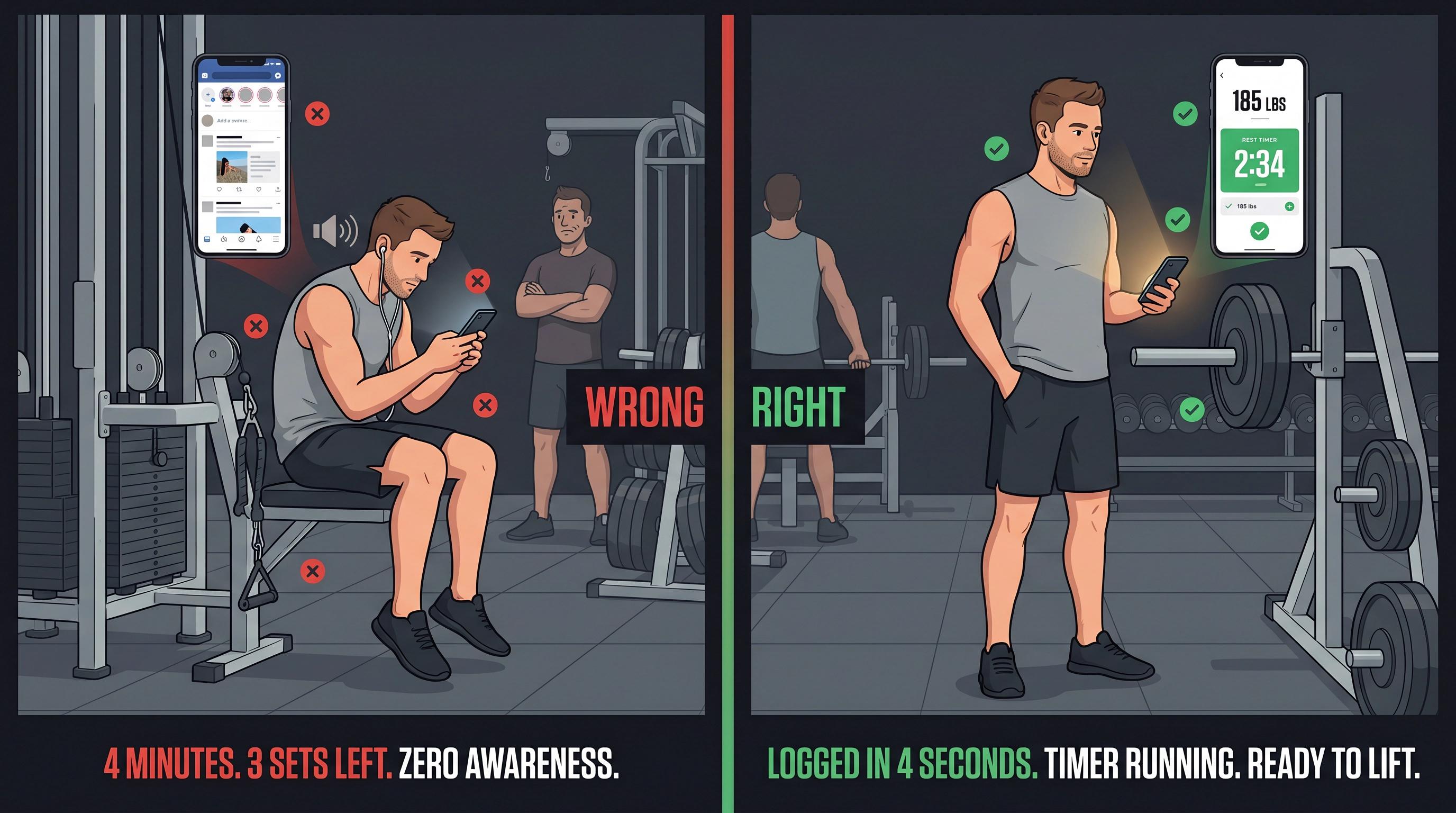
The issue isn't the phone. The issue is losing awareness of everything around you.
Good phone etiquette:
- Log your set quickly and efficiently
- Start your rest timer immediately
- Check your next exercise
- Move aside if you need to send a longer message
- Take actual phone calls in the lobby or outside
- Don't sit on equipment while scrolling social media
Stronger is built around fast gym-floor logging — quick set input, smart defaults, automatic PR detection, and a built-in rest timer. The goal is to get you logging in seconds, not minutes, so your phone time on the gym floor is productive rather than a distraction. (Stronger)
30. How to Use a Workout Tracker Without Being "That Phone Guy"
A workout tracker should make you a more focused gym citizen, not a less present one.
The wrong way to use a tracker:
- Sit on a machine for four minutes editing every single set note
- Film every angle of every warm-up set for content purposes
- Block equipment while checking notifications
- Use rest timer as an excuse to scroll social media between sets
- Forget you're even resting because you got pulled into your feed
The right way to use a tracker:
- Open your workout before you start, while you're still at the locker
- Log each set quickly right after completing it
- Use the rest timer and actually watch it
- Check last session's numbers before loading the bar
- Adjust load based on how you're feeling and the data in front of you
- Move when you're done
Stronger is built specifically for this — quick set logging, smart weight defaults based on previous sessions, a built-in rest timer, automatic personal record detection, your Strength Score, progress analytics, adaptive routines, and a library of 400+ exercises. (Stronger) The etiquette advantage is straightforward: when your plan, rest timer, and previous session numbers are organized, you spend less time guessing, less time on your phone, and more time training.
Gym Hygiene and Dress Code Rules Every Member Should Know
31. Gym Hygiene Etiquette: What Most Lifters Miss
Good gym hygiene is part of etiquette because your choices directly affect other people sharing the same space.
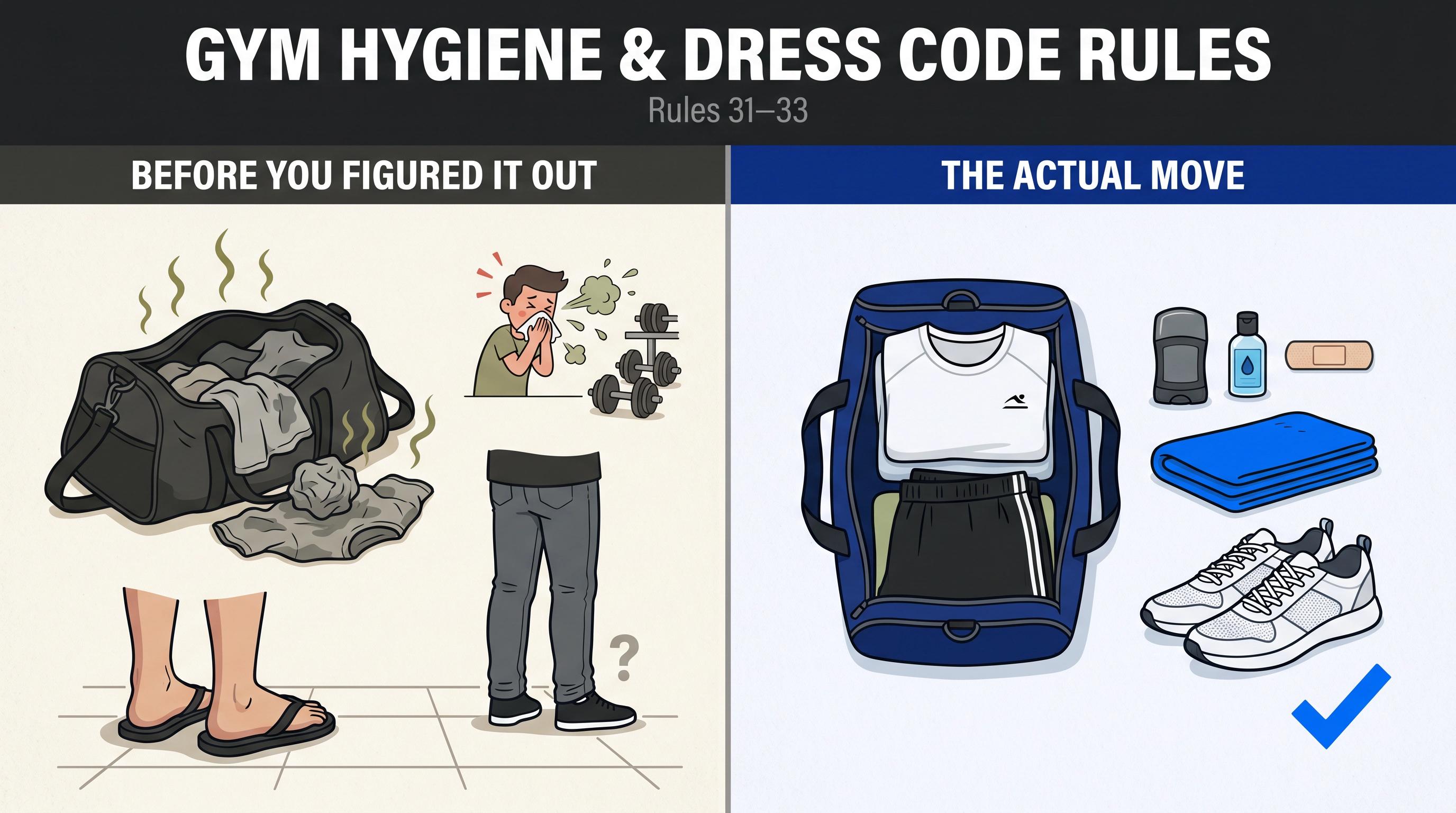
Do:
- Wear clean training clothes
- Wash gym clothes after every session
- Use deodorant
- Cover any cuts or open wounds
- Wash or sanitize hands after training
- Shower after workouts when possible
- Use your own towel
- Wear shoes in locker rooms and communal showers
The American Academy of Dermatology recommends moisture-wicking clothing, wearing shoes in locker rooms and showers, covering cuts, disinfecting equipment before and after use, washing hands after workouts, and showering soon after training. (AAD)
The Cleveland Clinic also recommends showering after workouts, changing into clean clothes, wiping down equipment, using a towel for sweat, and wearing breathable clothing. (Cleveland Clinic)
Nobody expects you to smell like a spa after heavy squats. But your clothes shouldn't smell like they've been living at the bottom of your gym bag since last Tuesday.
32. What Should You Wear to the Gym? Dress Code Rules Explained
Wear clothes and footwear that fit the gym environment and the actual workout you're doing.
Most gyms require athletic clothing and closed-toe shoes. Planet Fitness requires appropriate athletic footwear and bans open-toed shoes and sandals due to safety hazards. PureGym also requires appropriate clothing and footwear, and bans jeans, boots, flip-flops, sandals, slip-on shoes, and work clothing. (planetfitness.com)
Practical rules:
- Wear shoes unless your gym explicitly allows barefoot lifting
- Don't train barefoot in shared commercial gym spaces
- Avoid clothing with metal rivets that can damage pads
- Bring a clean shirt
- Follow the gym's dress code even if your previous gym had different standards
If you want to squat in flat shoes, bring flat lifting shoes. Don't assume barefoot is allowed.
33. Should You Go to the Gym When You're Sick?
This is both etiquette and common sense.
If you have a contagious illness, fever, vomiting, heavy coughing, or anything clearly infectious, don't go to the gym. You will not lose your gains from missing a session. You might make other people sick if you insist on training through it.
If you're recovering and unsure whether you're still contagious, choose a low-contact option: train at home, go for a walk outside, or wait another day.
The CDC notes that MRSA can spread through skin-to-skin contact and contaminated surfaces in athletic facilities, and recommends wound care, cleaning shared equipment, and keeping supplies like soap, bandages, and hand sanitizer available. (CDC)
Cover wounds. Stay home when sick. The training will be there.
Gym Etiquette for Special Situations: Coaching, Space, and Sharing
34. Gym Locker Room Rules for Privacy and Cleanliness
Locker rooms are spaces where people want privacy, speed, and basic cleanliness.
Do:
- Use a locker — not three benches
- Keep your belongings contained to your space
- Dry off before walking across the floor
- Wear shower shoes in communal showers
- Keep conversations normal and brief
- Clean up any grooming mess (hair in the sink, etc.)
- Take your towel and belongings with you when you leave
Don't:
- Film (covered above — but worth repeating)
- Make video calls or FaceTime conversations
- Leave wet towels everywhere
- Spray half a can of deodorant into the shared air
- Sit naked on shared benches longer than necessary
- Spread your entire bag across the walkway
And again: no filming. No exceptions. None.
35. Can You Bring Your Own Personal Trainer to a Gym?
Many gyms don't allow outside personal trainers on their floor.
That means you typically can't bring your own paid coach to train you inside a commercial gym unless the facility specifically permits it. You also shouldn't sell programs, solicit clients, film commercial content, or run your own group sessions on someone else's gym floor without permission.
PureGym's rules say members must not bring in a personal trainer unless that trainer is a PureGym PT or has written permission from the gym. Equinox prohibits photography and recording for commercial purposes, including promoting personal businesses or services. (puregym.com)
Training with a friend is completely fine. Running an unauthorized commercial operation on someone else's floor is a different category of thing entirely.
36. Why You Need to Give Lifters Space During Exercises
Gyms require more movement space than most environments because lifters move weights through arcs of motion.
Give people room during:
- Squats and lunges
- Deadlifts
- Kettlebell swings
- Olympic lifting movements
- Cable work and lateral raises
- Step-ups and sled pushes
- Battle ropes and medicine ball throws
Don't walk directly behind someone unracking a squat. Don't step over someone setting up for bench press. Don't squeeze between a lifter and the dumbbell rack during their rep.
If you need to pass someone mid-set, wait two seconds. That tiny pause is much cheaper than getting hit with a dumbbell.
37. What's the Difference Between Committed and Inconsiderate at the Gym?
There's a real difference between being committed to your training and being inconsiderate to everyone around you.
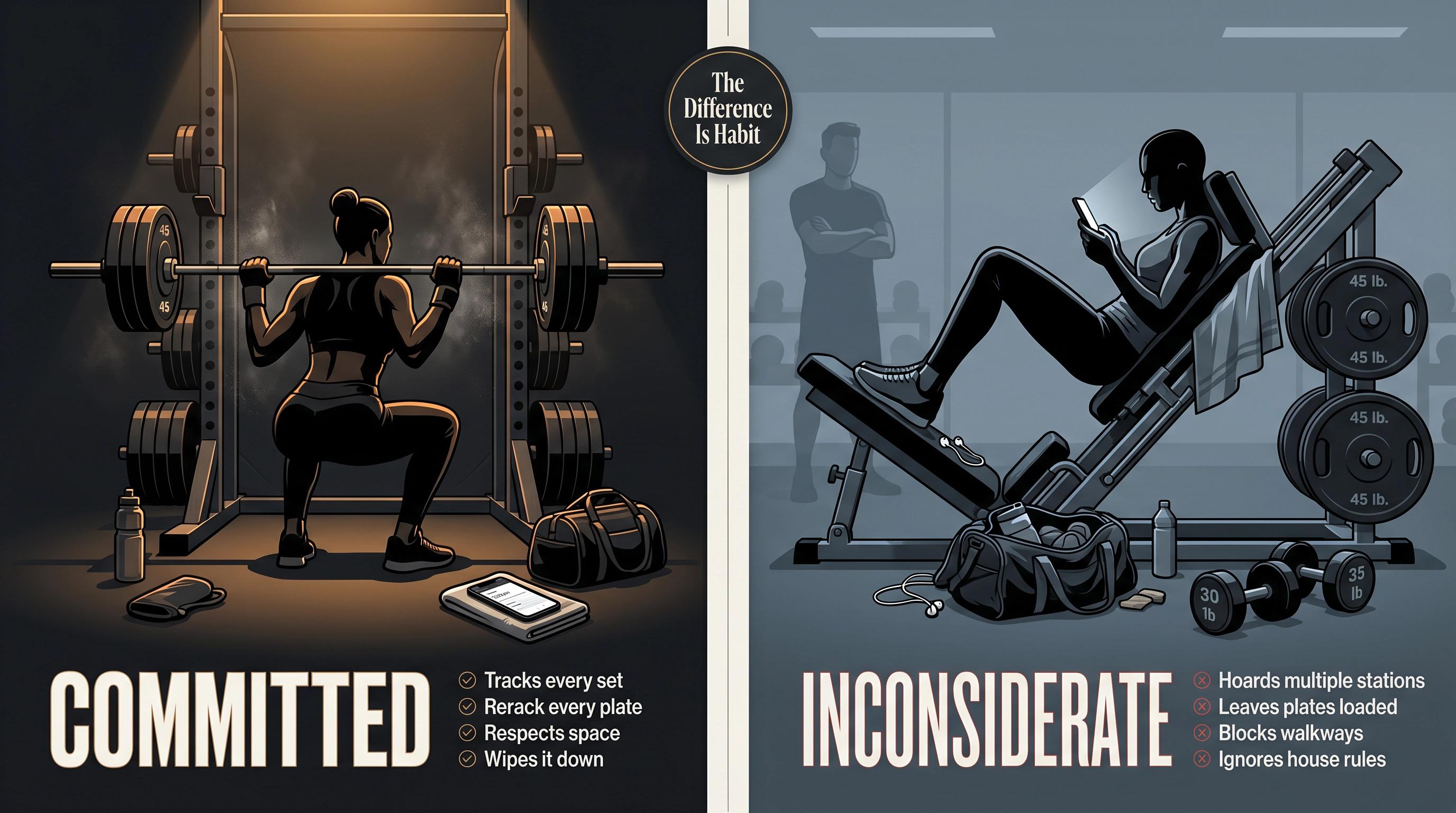
Committed looks like:
- Following a program and tracking your progress
- Resting the appropriate amount for the lift
- Training hard and with real effort
- Asking for a spot before you need one
- Filming form checks occasionally
- Working around busy equipment without drama
- Respecting other lifters' time and space
Inconsiderate looks like:
- Claiming multiple stations across the gym
- Leaving plates everywhere
- Filming strangers without consent
- Blocking walkways with equipment
- Sitting on machines while scrolling
- Ignoring posted house rules
- Giving random unsolicited advice
- Treating gym staff like personal cleaners
Strong training is built on repeatable habits. Our Stronger training guidance makes the same point in a programming context: progressive overload requires knowing what you lifted last time, doing more over time, and tracking your training systematically rather than guessing. (Stronger)
Gym etiquette works exactly the same way. It's not one heroic act of good behavior. It's the small repeatable habits: lift, log, wipe, reset, return, move. Done consistently, you become the kind of lifter everyone is glad to share a gym with.
Exact Phrases to Use in Every Awkward Gym Situation
Knowing the rules is step one. Knowing the exact words to use is what actually makes situations smooth.
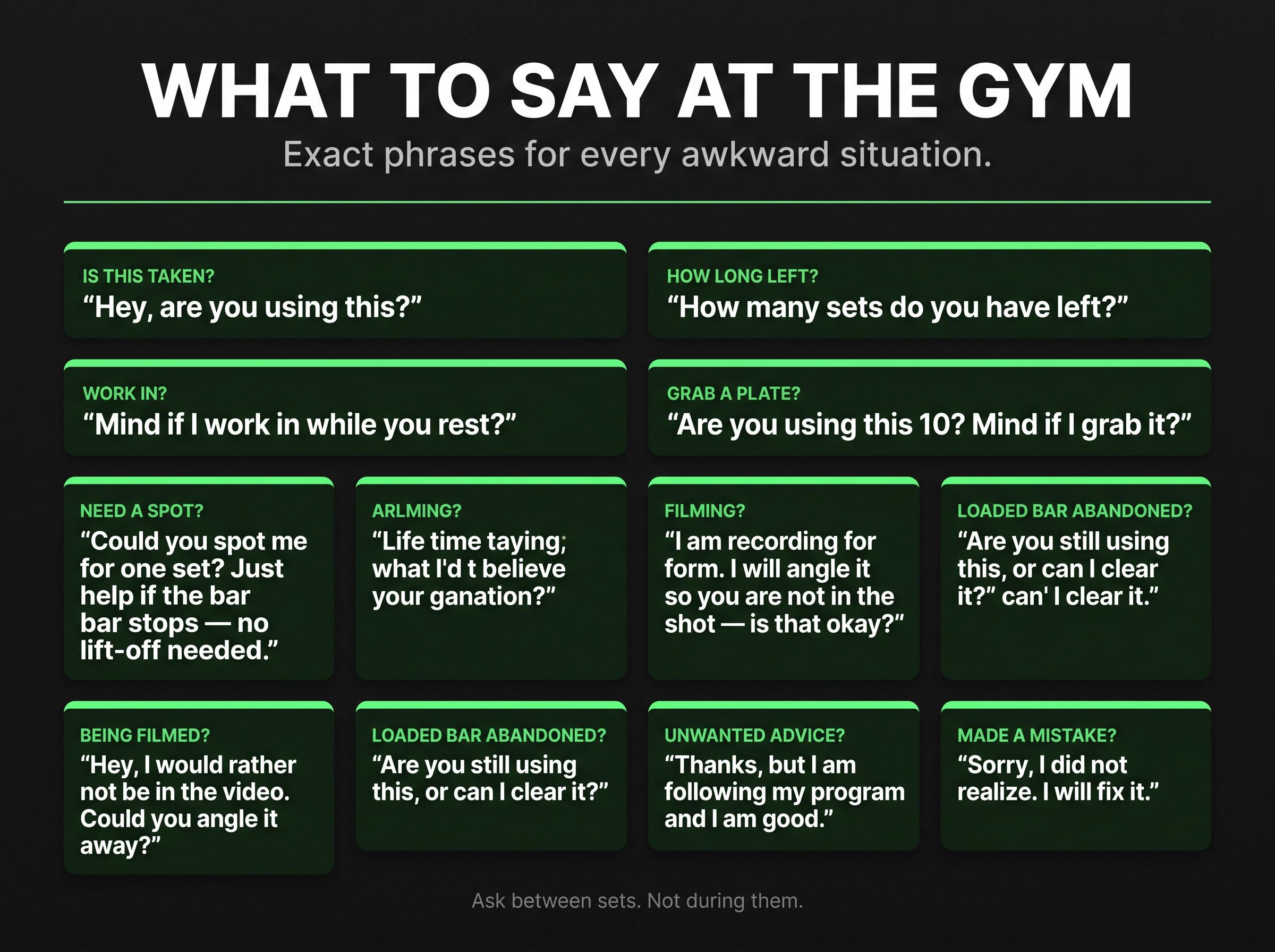
How to Ask "Is This Taken?" at the Gym
"Hey, are you using this?"
How to Ask How Long Someone Will Be on Equipment
"How many sets do you have left?"
How to Ask to Work In on Gym Equipment
"Mind if I work in while you rest?"
How to Ask to Take a Plate from Someone's Bar
"Are you using this 10? Mind if I grab it?"
How to Ask Someone to Spot You at the Gym
"Could you spot me for one set? I just need help if the bar stops moving — no lift-off needed."
How to Ask Permission to Film Your Set
"I'm recording this for form. I'll angle it so you're not in the shot — is that okay?"
What to Say When Someone Is Filming You at the Gym
"Hey, I'd rather not be in the video. Could you angle it away from me?"
What to Say When Someone Leaves Equipment Loaded
"Are you still using this, or can I clear it?"
How to Respond to Unwanted Gym Advice
"Thanks, but I'm following my program and I'm good."
What to Say When You Make a Gym Etiquette Mistake
"Sorry, I didn't realize. I'll fix it."
This last one is underrated. If you mess up — left a machine loaded, accidentally walked through someone's shot, took a plate without asking — fix it fast, say a simple sorry, and move on. The lifters who make mistakes and handle them briefly and directly are forgiven immediately. The ones who get defensive turn a five-second fix into a five-minute thing.
How to Handle Difficult Gym Situations Nobody Tells You About
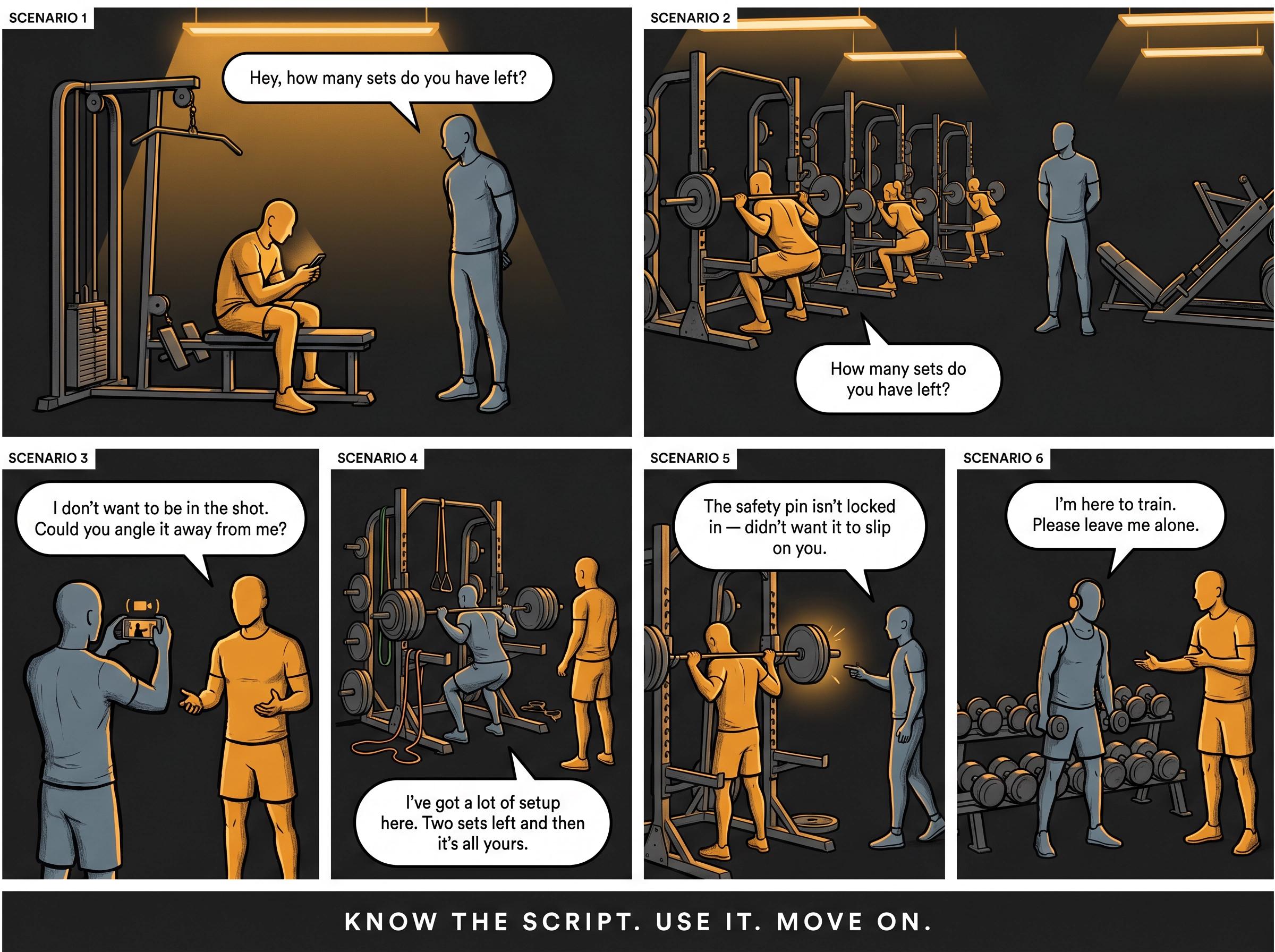
Scenario 1: What to Do When Someone Won't Get Off the Machine
Ask:
"Hey, how many sets do you have left?"
If they're resting:
"Cool — mind if I work in?"
If they're clearly not training and just occupying the machine, most people will move once asked politely. Don't open with aggression. Make it easy for them to do the right thing.
Scenario 2: What to Do When Every Squat Rack Is Taken
Don't hover inches away staring people down.
Ask each person between sets:
"How many sets do you have left?"
Then decide whether to wait, ask to work in, or choose a substitute movement.
You can usually substitute: front squat, hack squat, leg press, Bulgarian split squat, Smith machine squat, goblet squat, or a safety bar squat if one's available.
The lifters who adapt without drama are the ones who keep getting better. Turning a busy gym into a personal crisis is optional.
Scenario 3: What to Do When Someone Films You Without Permission
Say:
"Hey, I don't want to be in the shot. Could you angle it away from me?"
If they refuse, talk to staff. Don't escalate it yourself on the gym floor.
Scenario 4: How to Say No When Someone Asks to Work In
Say:
"Sorry — I've got a lot of setup going on here. I've got two sets left and then it's all yours."
Clear, honest, polite. Done.
Scenario 5: What to Do When Someone Is Doing Something Dangerous
Only step in if the risk is immediate.
Good:
"Sorry — I noticed the safety pin isn't locked in. I didn't want it to slip on you."
Not good:
"Your deadlift form is trash."
If it's not urgent, let them lift or mention it to staff. Your job isn't to coach strangers.
Scenario 6: What to Do When Someone Won't Leave You Alone at the Gym
Be direct:
"I'm here to train. Please leave me alone."
If they continue after that, report it to staff immediately. Gyms should handle harassment, stalking, filming complaints, and unwanted persistent attention as the serious issues they are.
Common Beginner Gym Etiquette Mistakes and How to Avoid Them
Mistake: Trying to look like you already know everything Better approach: Ask. Staff would rather show you how to adjust a machine than watch you figure it out wrong. There are no points for silent confusion.
Mistake: Doing your entire workout in one tiny corner Better approach: Use equipment, reset it, move on. You're allowed to use the gym.
Mistake: Copying advanced lifters without context Better approach: Follow a real program. Advanced lifters may be doing sport-specific work, post-injury rehabilitation, peaking, deloading, or accessory movements that make no sense out of context. Copying them blindly is a fast way to do something that isn't right for where you are.
Mistake: Being afraid to take up any space Better approach: Take the space your lift requires. No more, no less. You paid for the membership.
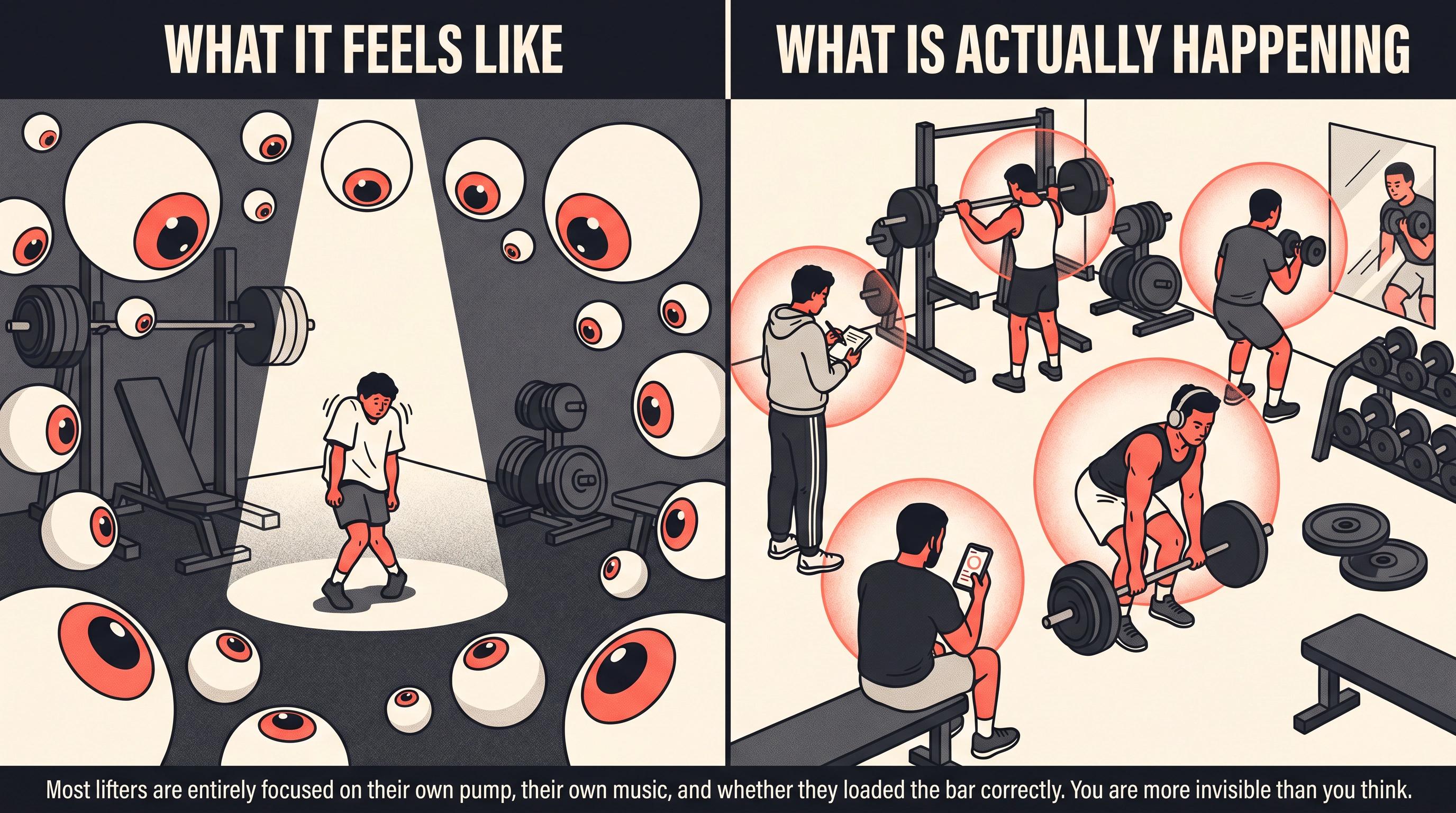
Mistake: Assuming everyone is watching you Better approach: Most people are entirely focused on their own workout, their own music, their own pump, and whether they loaded the bar correctly. You're more invisible than you think.
Gym Etiquette Mistakes Even Experienced Lifters Keep Making
Advanced lifters are not exempt from gym etiquette. If anything, experienced lifters set the tone for everyone else in the gym — and they're often the worst offenders.
Common advanced lifter mistakes:
- Treating beginners and casual gym-goers like obstacles or entertainment
- Leaving heavy machines fully loaded because they assume everyone else can unload it
- Occupying two or three stations during peak hour
- Making condescending remarks about commercial gym culture
- Giving unsolicited advice to people who clearly didn't ask
- Acting like lifting heavy automatically excuses bad manners
- Using chalk in gyms where it's explicitly banned
- Deadlifting loudly in areas not built for heavy drops
- Turning every training session into content production
- Refusing to adapt when the gym is busy
The strongest person in the gym should not be the hardest person to train around.
Ready to Get Stronger?
Join 2,000,000+ lifters tracking their workouts with Stronger. Available on iOS and Android.
Start tracking freeGym Etiquette by Area: Rules for Every Zone in the Gym
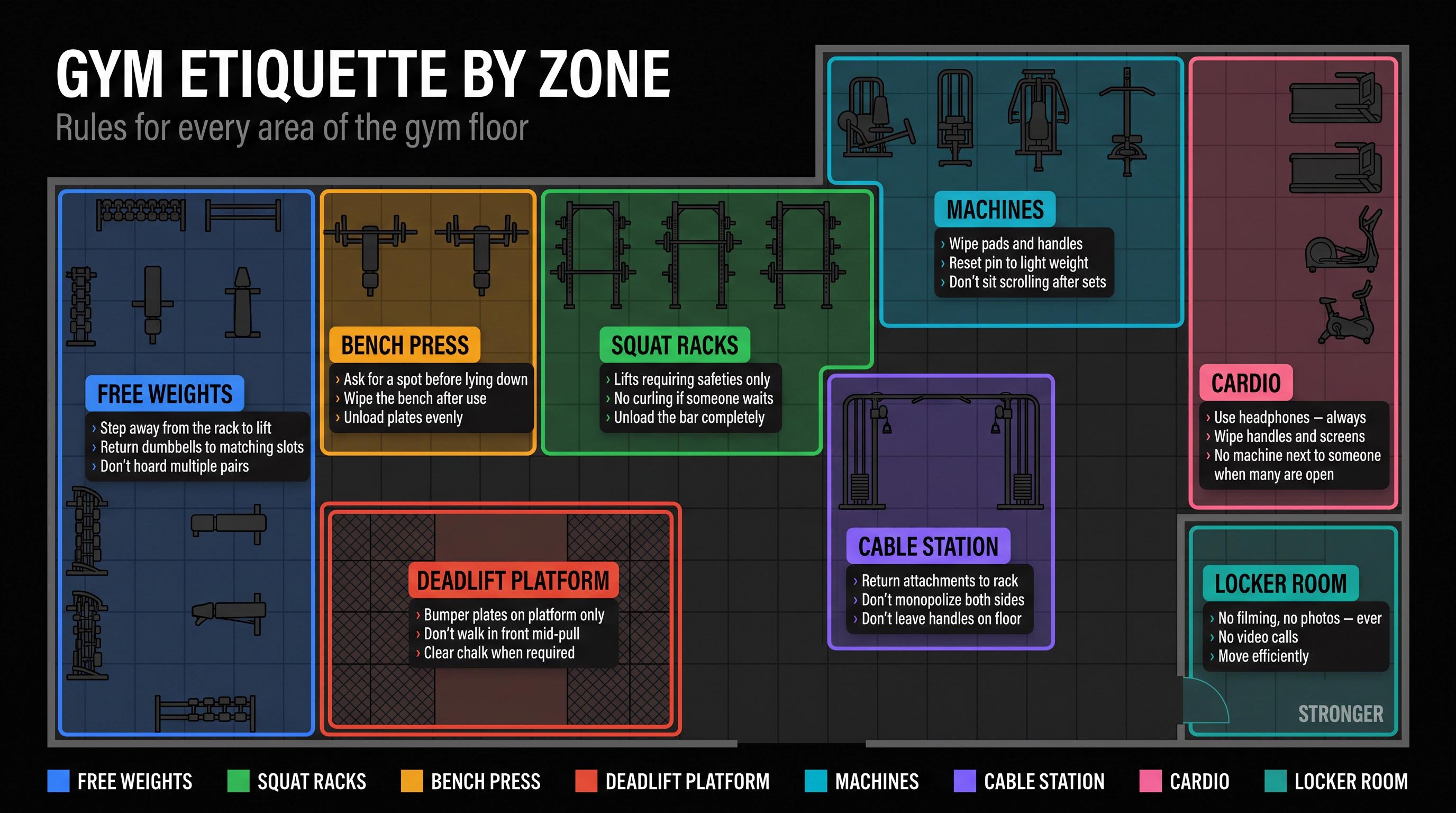
Free Weight Area Etiquette Rules
- Step away from the dumbbell rack to do your exercise
- Return dumbbells to matching slots when done
- Don't hoard multiple pairs for a circuit
- Don't drop dumbbells unnecessarily
- Keep benches clear when you're not actively using them
- Watch your walking path — other people are moving weights too
Squat Rack Etiquette Rules
- Use it for lifts that require safeties or a rack setup
- Set safeties properly before loading up
- Don't curl in the rack when someone is waiting to squat
- Unload the bar completely when you're done
- Don't take plates without asking
- Keep your bag, belt, and accessories out of the rack footprint
Bench Press Etiquette Rules
- Ask for a spot before you're under the bar, not while you're already stuck
- Don't hover directly over someone who's benching
- Wipe the bench when you're done
- Unload plates evenly from both sides
- Use collars when appropriate
- Move along after your set — don't sit there texting
Deadlift Platform Etiquette Rules
- Use the correct plate type for the platform (bumper plates on lifting platforms; iron plates aren't always appropriate)
- Keep the platform clear when you're not actively lifting
- Don't walk in front of someone mid-pull
- Control drops based on the gym's rules and the platform's design
- Clean chalk off the platform if required
- Unload the bar completely when done
Machine Etiquette Rules
- Wipe pads and handles after use
- Reset the pin to a light weight when done
- Unload plate-loaded machines entirely
- Let people work in when the setup is practical
- Don't sit there scrolling after your last set
Cable Station Etiquette Rules
- Return attachments to their rack or designated area after use
- Don't monopolize both cable sides during busy periods
- Keep your exercise path clear of other people's movement
- Don't leave handles stretched across the floor
- Ask before sharing if you want to work in
Cardio Area Etiquette Rules
- Use headphones — always
- Wipe handles and screens after use
- Respect posted time limits if they exist
- Don't choose the machine directly next to someone when many are open (the "middle urinal" rule applies here too)
- Take actual phone calls outside the cardio area
Locker Room Etiquette Rules
- No filming, no photos, no exceptions
- No video calls
- Use your assigned locker instead of three benches
- Keep your grooming mess contained
- Respect other people's privacy and space
- Move efficiently — you're not the only one who needs to get changed
Take Your Training Seriously With Stronger
Here's the thing about gym etiquette: the lifters who follow all these rules naturally tend to have something in common. They take their training seriously. They have a program. They know their numbers. They're not killing time between sets because they know exactly how long to rest and what they're lifting next.
That's what Stronger is built for.
We designed the app around the way serious lifters actually train:
Track every set in seconds. Quick Log lets you record sets without interrupting your training flow. Smart defaults pull up your previous weights and reps automatically, so you spend two seconds confirming rather than ten seconds searching.
Know exactly how long to rest. The built-in rest timer means you never accidentally occupy a machine for six minutes because you lost track of time. Start it after every set, and stay aware.
See how strong you actually are. Our proprietary Strength Score benchmarks you across 12 muscle groups against global standards — adjusted for your bodyweight and gender. It's a single number that tells you where you stand and shows you exactly how you're progressing over time.
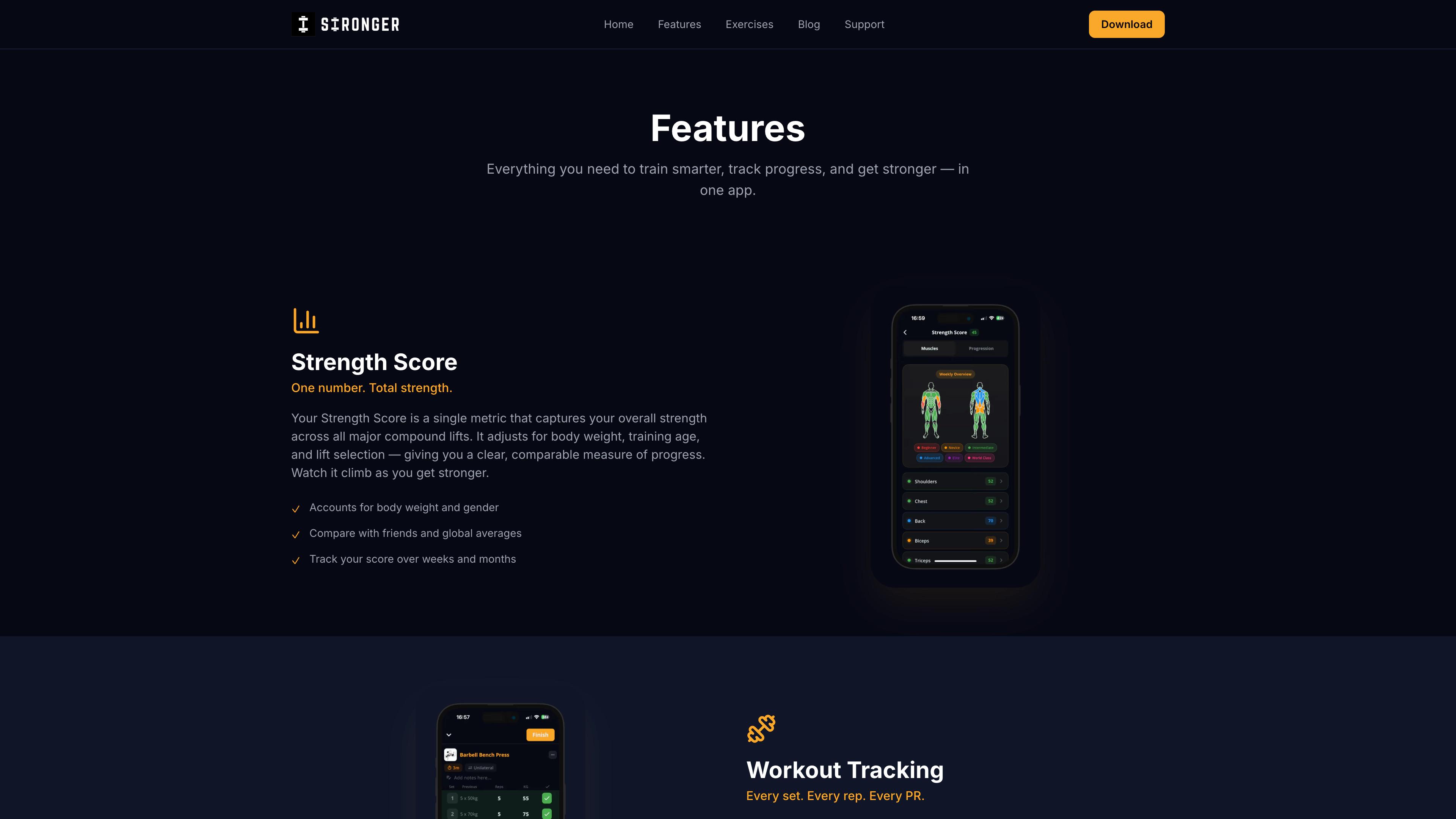
Follow a program that works. AI-generated routines personalize your training plan based on your goals, equipment, and experience level — then automatically adjust weights, sets, and reps as you get stronger. No guessing what to do next.
Train with people who push you. Friend challenges, leaderboards, and weekly competitions keep you accountable without needing to be in the same gym.
Over 2 million lifters use Stronger to train with purpose and track their real progress. The app is free to start — download Stronger on iOS or Android and start your 7-day Premium free trial.
The lifters who read a 37-rule gym etiquette guide are exactly the lifters Stronger was built for.
Frequently Asked Questions About Gym Etiquette
What is the most important gym etiquette rule?
Re-rack your weights, wipe down equipment, and don't make your workout someone else's problem. The underlying principle is simpler than any individual rule: leave the equipment, the space, and the people around you better than you found them.
Is it rude to ask someone how many sets they have left?
No — this is completely normal gym communication. Ask between their sets rather than during them, give them space, and don't hover or apply pressure. Most lifters appreciate the direct question over someone silently staring them down.
Is it rude to work in on someone's equipment?
Working in is completely acceptable if you ask politely and the setup makes it practical. It becomes annoying when you change the setup and don't reset it, rush the other person, or try to work in when someone is doing heavy singles or a complicated setup. Always ask first.
How long is too long to rest between sets?
It depends entirely on the lift and your goal. Heavy compound movements like squats, deadlifts, and bench press often benefit from 3–5 minutes of rest; hypertrophy-focused work usually needs less. Long rests become bad etiquette when you stop paying attention, scroll indefinitely, or refuse to share equipment during busy hours. (Stronger)
Is filming in the gym rude?
Not automatically. Filming form checks can be genuinely useful for identifying technique issues. It becomes rude when you film strangers without consent, block equipment or walkways with tripods, ignore gym filming policies, or treat other gym members as problems for interrupting your shot.
Can I film myself if other people might be in the background?
You should avoid it. Major gyms including Planet Fitness, Equinox, and PureGym have specific policies restricting recording that captures other members without their permission. (planetfitness.com) When in doubt, angle your camera away from others — or find a quieter spot or time.
Should I wipe equipment before or after use?
After use is the minimum standard. Before use is a smart habit if the previous person didn't clean it or if you're using a high-contact surface. The American Academy of Dermatology recommends disinfecting equipment before and after use to reduce the risk of skin infections. (AAD)
Is it okay to give someone form advice if they're clearly doing something wrong?
Usually, no. If they ask you for feedback, give it — briefly and helpfully. If they're in immediate safety danger, you can intervene quickly and respectfully. Otherwise, let them train. Most people do not want a stranger interrupting their workout to explain biomechanics.
Is it okay to drop weights?
Only where the equipment, the flooring, and the gym's rules explicitly allow it. Bumper plates on a dedicated lifting platform are built for this. Dumbbells being thrown onto a commercial gym floor after a set of curls is not the same thing.
Can I use two machines for supersets?
Yes — when the gym is quiet. During busy periods, avoid holding multiple stations simultaneously. If you do need to superset, stick to adjacent equipment and let people work in if they need one of the stations.
What should I do if someone breaks gym etiquette?
Start with a calm, direct question. "Are you still using this?" "Could you wipe that down?" "Could you angle the camera away from me?" Most etiquette issues resolve in one sentence when handled politely and directly. If the issue involves harassment, privacy violations, safety risks, or repeated conflict, report it to staff. That's what they're there for.
How to Be the Lifter Everyone Is Happy to Train Around
Gym etiquette isn't complicated. It really does come down to that one rule.
Train hard. Pay attention. Clean up after yourself. Share when you can. Ask before assuming. Keep your phone under control. Respect other people's privacy and space. Follow the posted rules. Don't turn your workout into someone else's inconvenience.
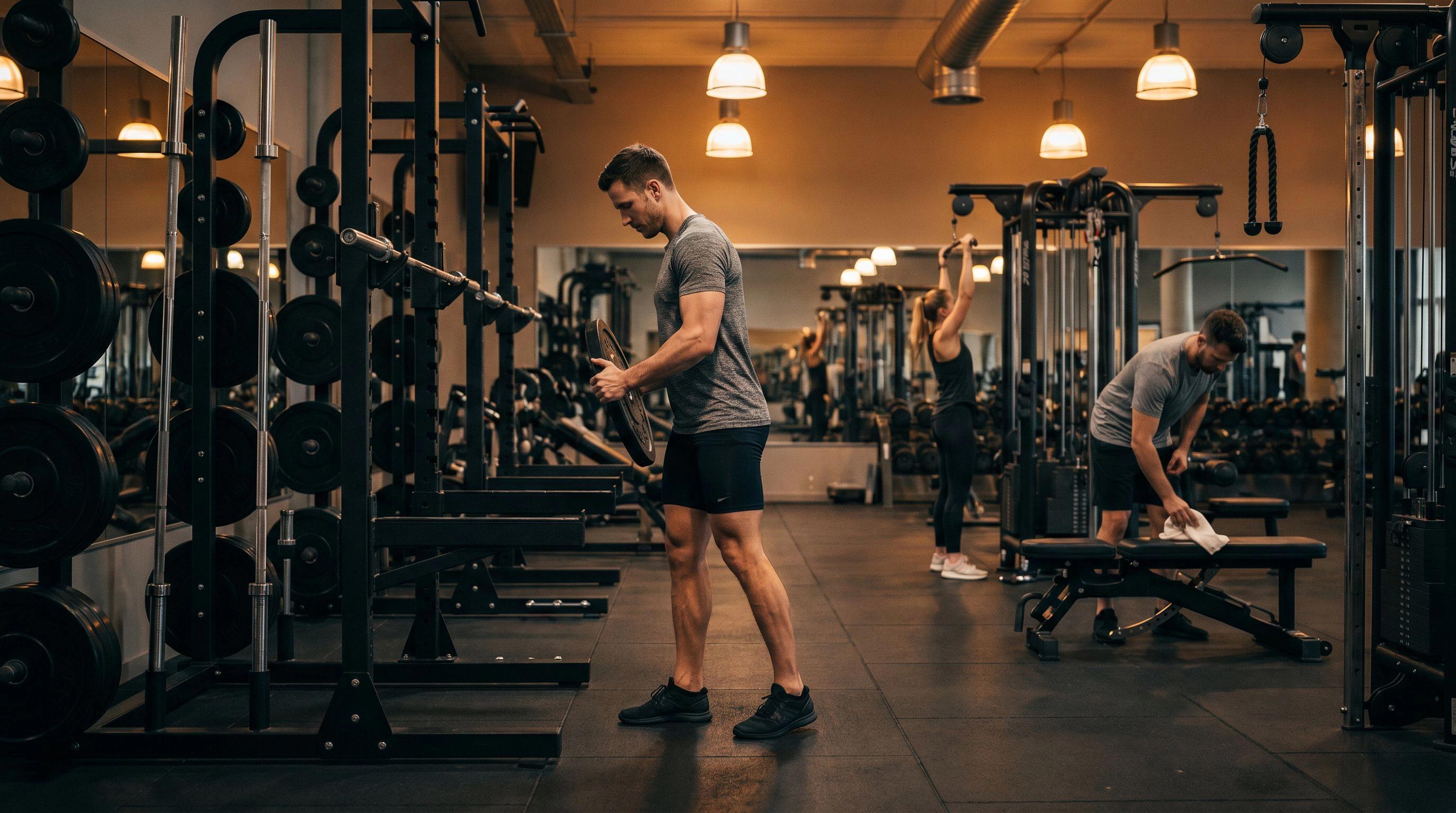
The best lifters in any gym aren't just strong — they're easy to train around. They move through the space competently, leave it better than they found it, and make the whole environment work better for everyone who shares it.
That matters, because a good gym is built by everyone who uses it.
Sources and Currency
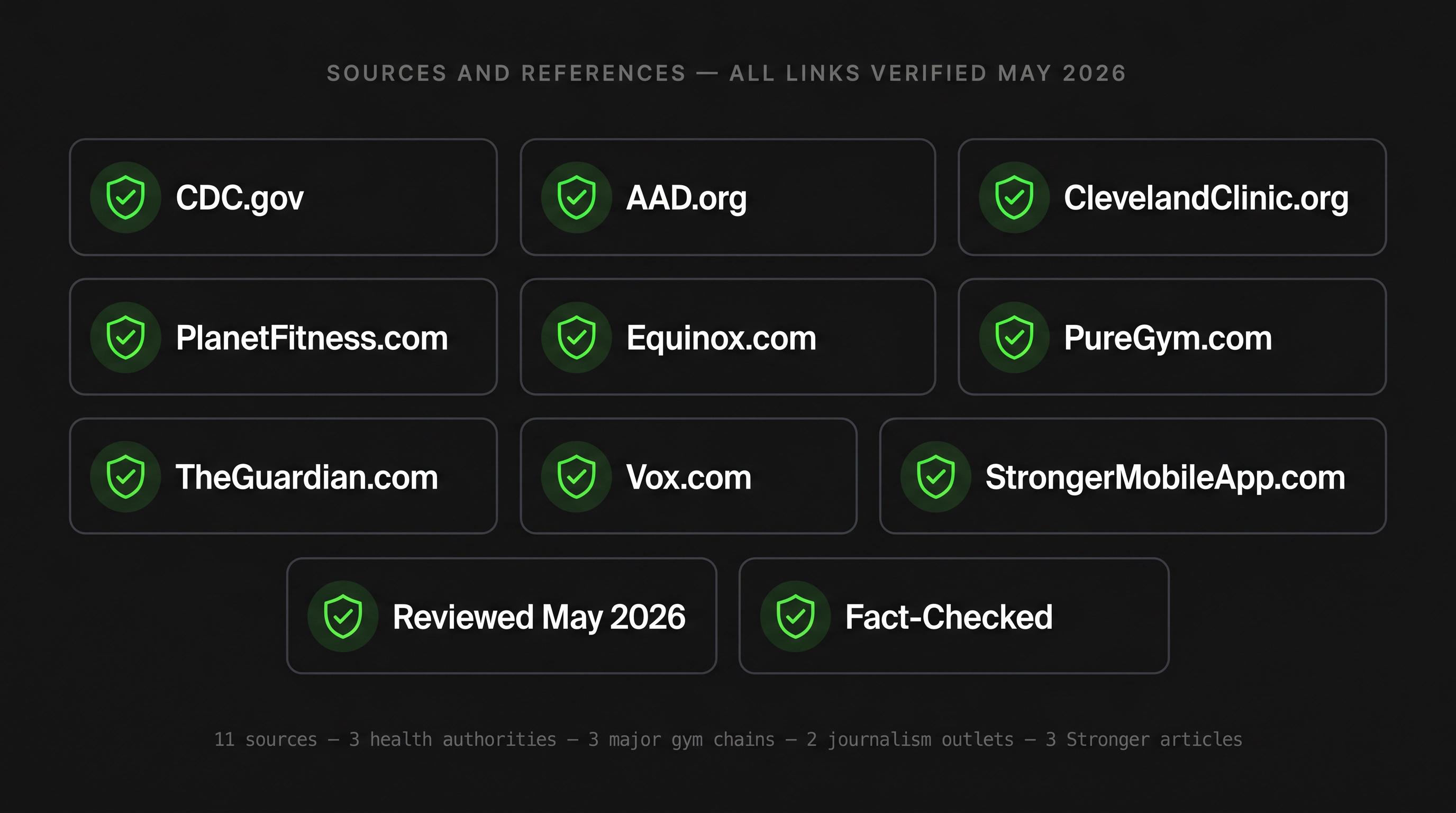
This article was last reviewed on May 6, 2026. Gym policies vary by country, franchise, and location — always check your own gym's posted rules.
- Planet Fitness Customer Service and FAQ, accessed May 6, 2026 — mobile device use, filming, calls, headphones, attire, bags, locker room privacy. (planetfitness.com)
- Equinox Member Policies, accessed May 6, 2026 — recording, photography, devices, tripods, locker rooms, group classes, calls, commercial recording. (equinox.com)
- PureGym Gym Rules, accessed May 6, 2026 — returning weights, equipment sharing, filming permission, dropping weights, clothing, bags, anti-social behavior. (puregym.com)
- CDC: Athletic Facilities — MRSA Prevention and Control, updated June 27, 2025 — shared equipment, gyms/health clubs, cleaning after use, hygiene, wound care. (CDC)
- CDC: When and How to Clean and Disinfect a Facility, updated April 16, 2024 — high-touch surfaces, cleaning and disinfecting principles, product instructions. (CDC)
- American Academy of Dermatology: How to Prevent Common Skin Infections at the Gym, accessed May 6, 2026 — disinfecting equipment, towel barriers, footwear, hand hygiene, showering, clean clothes. (AAD)
- Cleveland Clinic: How to Avoid Sweat Pimples Year-Round, published August 14, 2025 — showering after workouts, changing clothes, wiping equipment, breathable clothing. (Cleveland Clinic)
- Vox: No One's Happy About People Filming Themselves in Gyms, published April 15, 2025 — modern gym filming culture, tripods, equipment blocking, consent, backlash. (Vox)
- The Guardian: The New Rules of Gym Etiquette, published April 25, 2025 — filming, unsolicited advice, spotting, phone calls, sharing plates, hogging equipment, noise, dropping weights.
- Stronger Features Page, accessed May 6, 2026 — Strength Score, workout tracking, rest timers, adaptive routines, challenges, analytics, exercise library. (Stronger)
- Stronger: How Long to Rest Between Sets, published February 21, 2026 — rest periods for strength, hypertrophy, endurance, and using rest timers. (Stronger)
- Stronger: How to Get Stronger, accessed May 6, 2026 — progressive overload, tracking, programming principles. (Stronger)
Exercises in this guide
Stronger Editorial Team
Certified strength & conditioning specialists with 10+ years of coaching experience
The Stronger editorial team produces evidence-based training content for lifters of all levels.
Ready to Get Stronger?
Join 2,000,000+ lifters tracking their workouts with Stronger. Available on iOS and Android.
Start tracking free