
Does the Mind-Muscle Connection Actually Work?
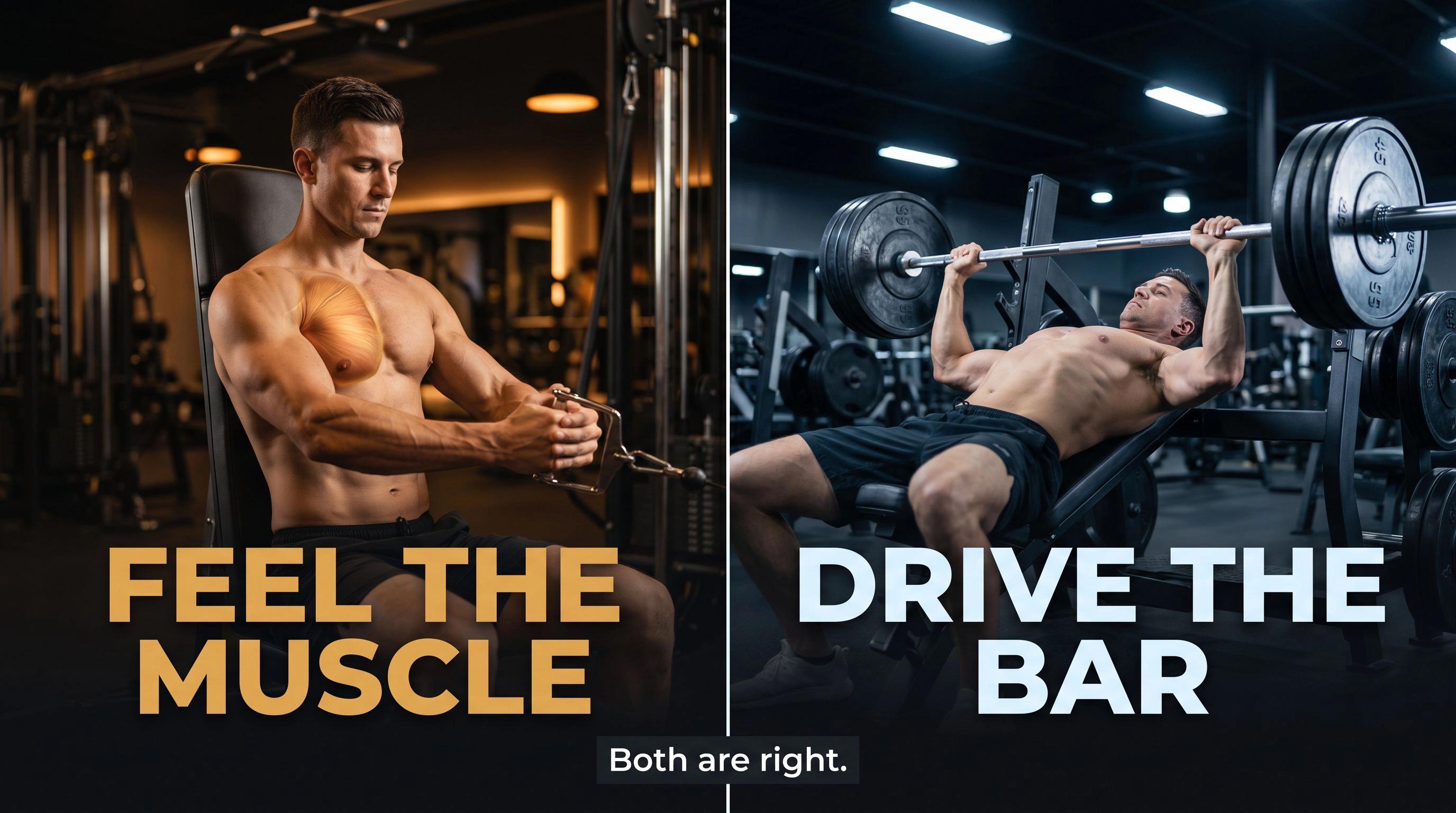
A bodybuilder says: "Stop just moving the weight. Feel the muscle."
A powerlifter says: "Stop thinking about your pecs. Drive the bar."
Both are right.
The mind-muscle connection is real, but it does not work the way most gym advice makes it sound. Focusing on a target muscle can increase that muscle's activity during certain exercises — especially when the load is moderate, the movement is controlled, and the goal is building muscle. But it is not magic. It does not replace progressive overload. It does not automatically produce more hypertrophy. And it is the wrong focus entirely when your goal is maximal strength or moving heavy weight efficiently.
The best one-sentence answer:
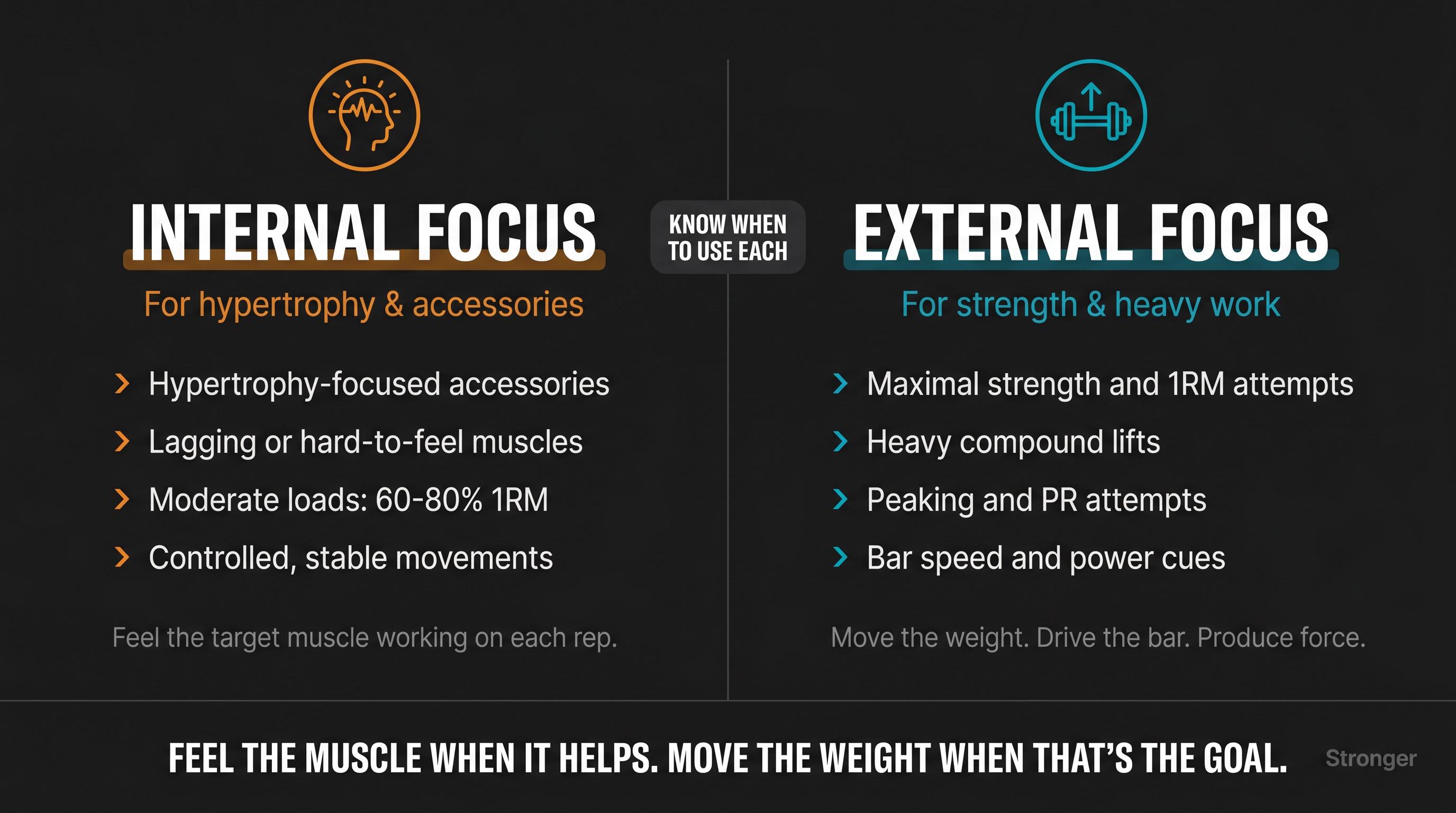
Use the mind-muscle connection for hypertrophy-focused work. Use performance-focused cues for heavy strength work. Track both.
That sentence solves most of the confusion. The rest of this guide explains the research behind it, when to apply it in practice, and how to build it systematically — including how to use Stronger to make sure your objective training numbers back up what you feel.
What is the mind-muscle connection?
The mind-muscle connection is the deliberate act of focusing attention on the target muscle while you perform an exercise.
In exercise science, this is called an internal focus of attention. You are directing attention toward a body part or muscle action:
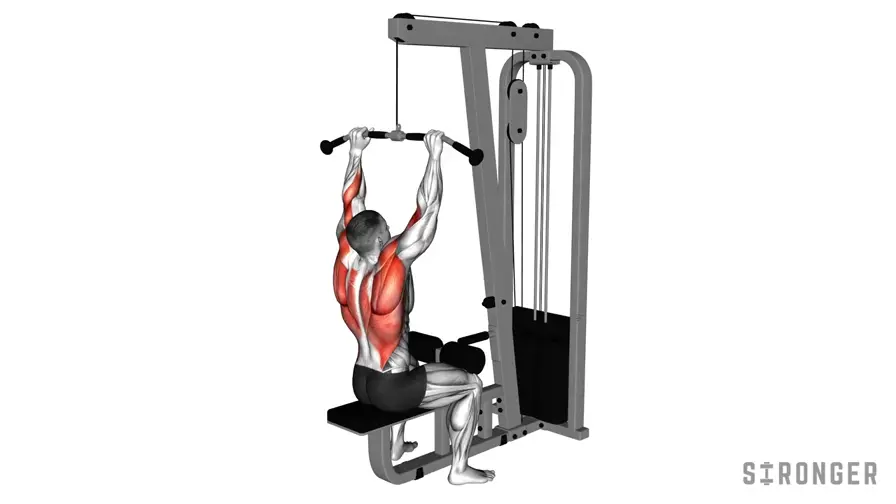
- During a lat pulldown, you think about pulling your elbows down and feeling your lats shorten — not about getting the bar to your chest.
- During a chest press, you think about bringing your upper arms together across your body — not about moving the handles forward.
- During a biceps curl, you focus on the biceps flexing — not on getting the dumbbell from A to B.
The opposite is an external focus of attention: directing attention toward the outcome of the movement or the object you are moving.
- "Drive the bar up."
- "Push the floor away."
- "Punch the ceiling."
- "Explode out of the bottom."
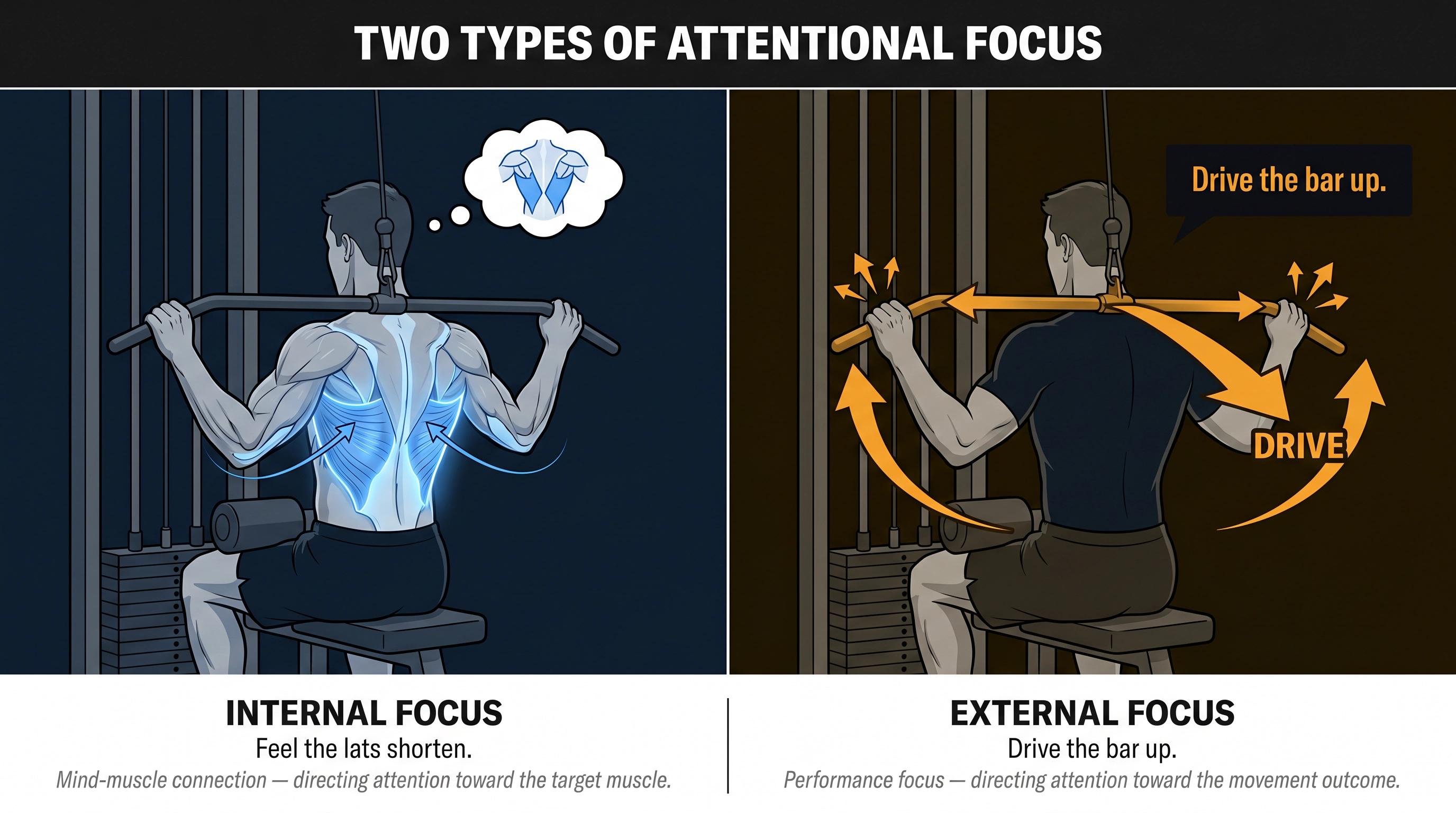
These two types of attentional focus are genuinely distinct — not just different ways of saying the same thing. Decades of motor learning research have established that internal and external focus tend to produce different effects on force output, speed, skill acquisition, and muscle activation. Understanding when each one serves you is more useful than asking "is the mind-muscle connection real?" — and it's at the heart of how hypertrophy and strength training differ as disciplines.
The research is more nuanced than the gym-floor version, and it's worth looking at what the studies actually found.
What does the research say about the mind-muscle connection?
Can focusing on a muscle increase its activation?
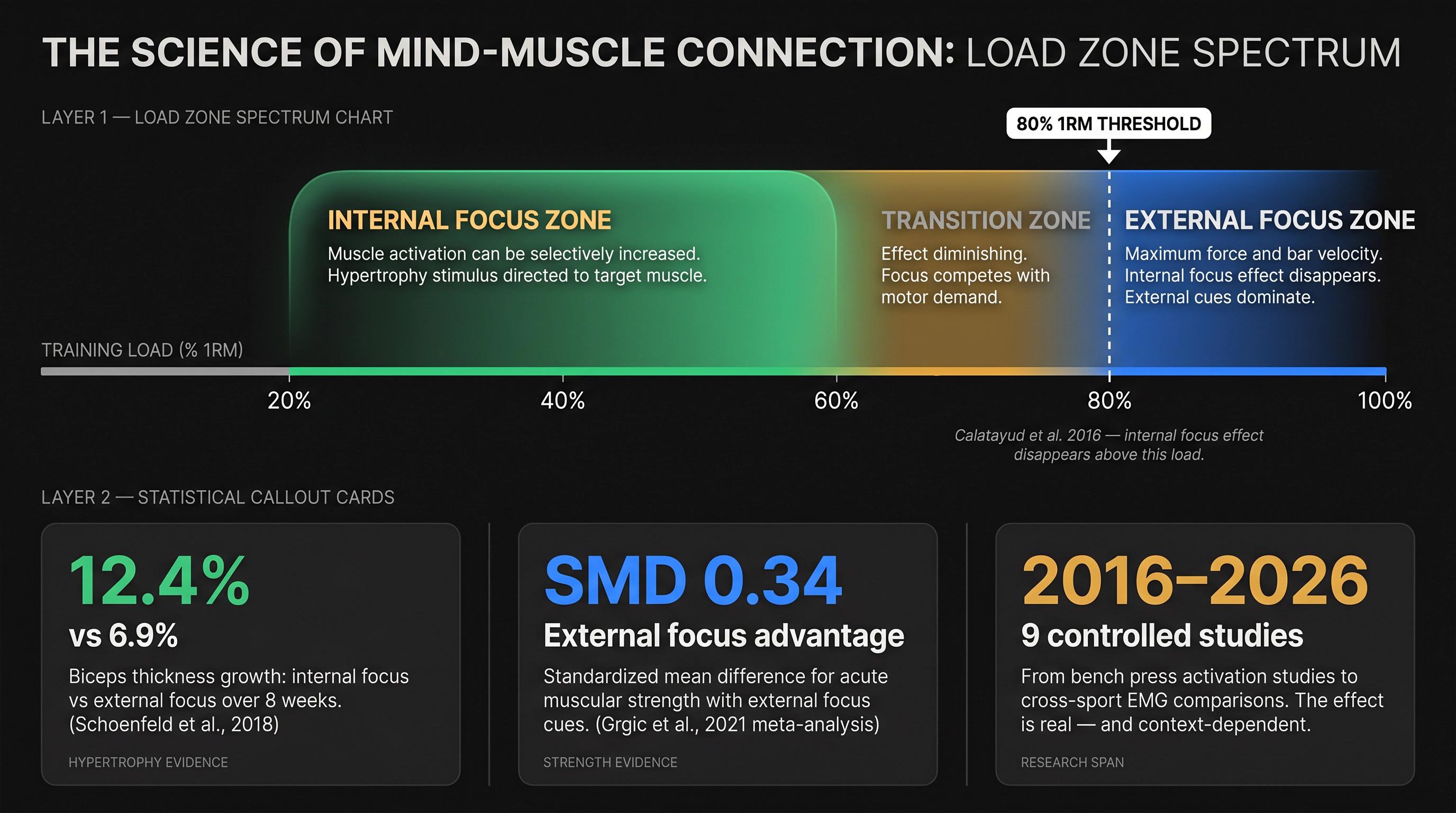
A foundational 2016 bench press study tested trained men at loads ranging from 20% to 80% of one-rep max. Participants were instructed to focus on different muscles during the lift. The researchers found that lifters could meaningfully increase pectoralis and triceps activity by focusing on those muscles — but only at loads of 20–60% 1RM. At 80%, the effect disappeared. (PubMed)
That is one of the most important findings in the whole debate. When the weight is heavy enough that completing the rep consumes all available attention and motor output, you cannot selectively bias toward one muscle. The load has taken over.
In plain English: you can "feel the muscle" better when you are not fighting for survival under the bar.
Is the mind-muscle connection a learnable skill?
A 2017 study using push-ups found that trained men could selectively increase pec activity by focusing on the pecs. The same study found that training experience was associated with the ability to selectively activate the triceps — suggesting that this is something you get better at with practice. (Springer)
This matters because "I can't feel this muscle" does not always mean the muscle is inactive. It may mean you haven't yet learned how to bias tension toward it. Bodybuilders talk about "learning" a muscle. It is not mystical. It is a motor skill.
Does internal focus build more muscle long-term?
The most-cited long-term study was published in 2018. Thirty untrained college-aged men trained for eight weeks using either an internal focus strategy or an external focus strategy. The internal-focus group saw greater elbow flexor thickness: 12.4% versus 6.9%. Quadriceps growth was similar between groups. (Sponet)
This is the strongest evidence that internal focus can help build muscle — and also the most honest signal of its limits. It worked for upper-body hypertrophy in untrained subjects. It didn't clearly work for the quads. Short study, one population, one set of muscles. Promising, not definitive.
Is external focus better for strength and speed?
For maximum force or bar velocity, external focus tends to win.
A 2021 meta-analysis found that external focus produced a positive acute effect on muscular strength, with a standardized mean difference of 0.34. The same review found that external focus appeared particularly beneficial for lower-body strength development. (ResearchGate)
A 2025 bench press study confirmed the direction: external focus cues produced greater bar velocities than internal focus cues. Even the wording of the cue mattered — "punch" produced greater velocities than "push." (ScienceDirect)
This is why "squeeze your chest" may help on a cable fly for hypertrophy, while "drive the bar up and back" is the right call when you are trying to hit a heavy bench PR.
Does the mind-muscle connection stop working as fatigue builds?
A 2020 seated row study found that back-focused verbal instructions increased lat activity during initial repetitions, but not during final repetitions. (Sage Journals) Fatigue reduces the effect.
And a 2025 bench press study across repeated training sessions found that internal focus did not produce meaningful changes in EMG or RPE at all. (PubMed) Not every internal focus cue works, and some that feel like they should work may produce no measurable effect.
Do bodybuilders and powerlifters use attentional focus differently?
A 2026 study compared bodybuilders, powerlifters, Paralympic powerlifters, and untrained controls on bench press at 60% 1RM. Attentional focus effects varied by sport, load, and muscle — with selective pectoralis activation appearing in bodybuilders but not necessarily in the other groups. (Springer)
This exactly matches real-world training cultures. Bodybuilders practice directing tension toward a target muscle. Powerlifters practice producing maximum system-level force. Different training history, different outcome.
Research summary
| Study | What was tested | Key finding |
|---|---|---|
| Calatayud et al., 2016 | Bench press, chest/triceps focus at 20–80% 1RM | Internal focus increased activation at 20–60% 1RM, not at 80% (PubMed) |
| Calatayud et al., 2017 | Push-up attentional focus in trained men | MMC is a learnable skill; experience matters (Springer) |
| Schoenfeld et al., 2018 | 8 weeks of internal vs external focus training | Greater biceps thickness with internal focus; similar quad growth (Sponet) |
| Paoli et al., 2019 | Bench press verbal instructions at 50% and 80% 1RM | Triceps activation increased; pec effect less consistent (ResearchGate) |
| Fujita et al., 2020 | Seated row with back-focused verbal cues | Lat activity increased in early reps, not final reps (Sage Journals) |
| Grgic et al., 2021 | Meta-analysis: attentional focus and strength | External focus improved acute strength (SMD 0.34) (ResearchGate) |
| Nascimento et al., 2025 | Bench press internal focus across repeated sessions | No change in EMG or RPE from internal focus cues (PubMed) |
| Finlay et al., 2025 | Internal vs external cues for bench press bar velocity | External focus increased bar velocity; "punch" > "push" (ScienceDirect) |
| Kosuge et al., 2026 | Bench press focus across bodybuilders, powerlifters, controls | Effects vary by sport, load, and muscle (Springer) |
The research does not say the mind-muscle connection is universally superior. It says: attentional focus is a variable, the right kind depends on your goal, and the effect has real limits. Understanding those limits is what turns MMC from gym mythology into a useful training tool.
Does higher muscle activation mean more muscle growth?
A lot of mind-muscle connection advice makes this leap:
More activation = more growth.
That is too simple.
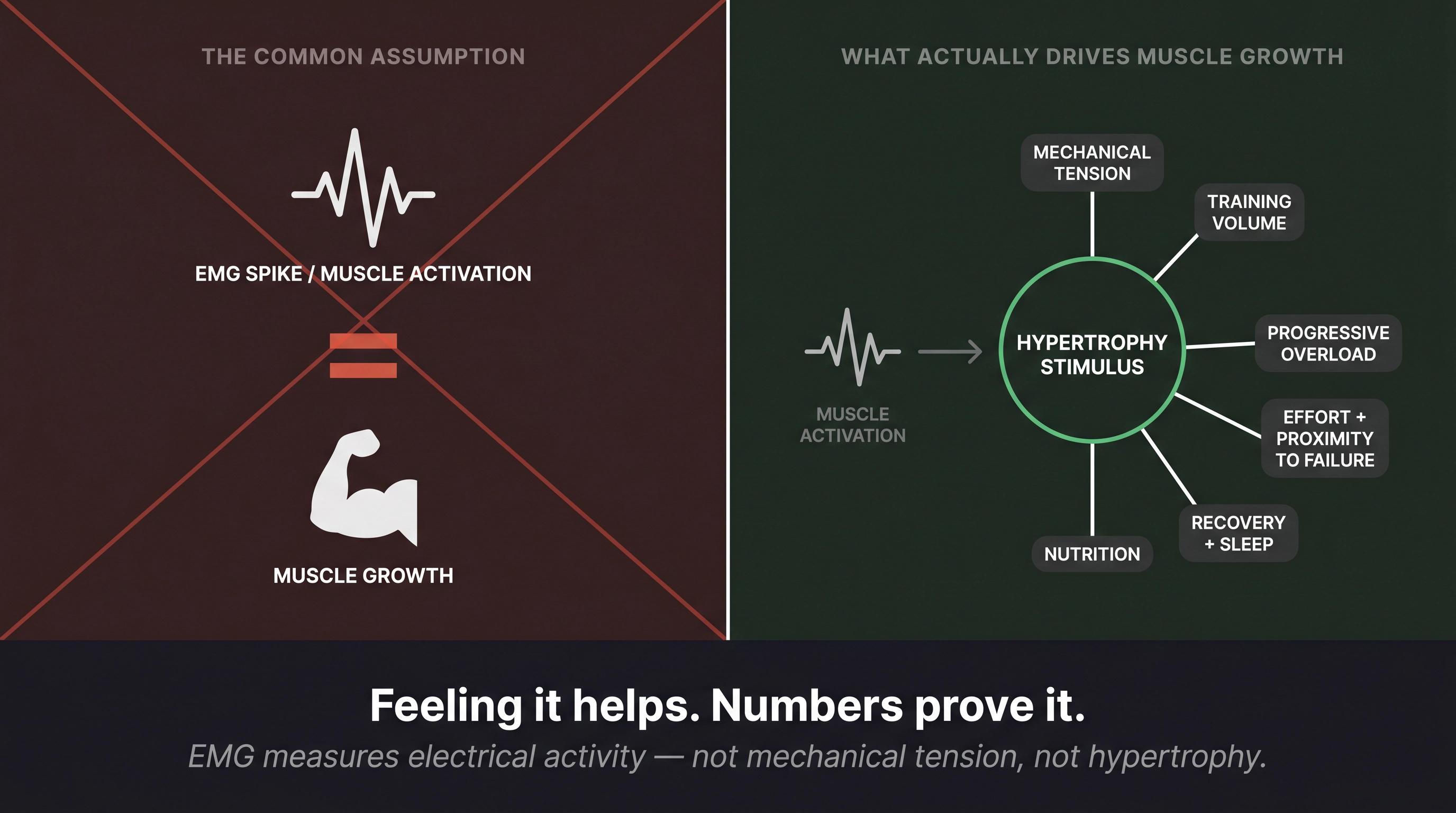
Most MMC studies measure muscle activity using surface electromyography (EMG). EMG can tell you something about electrical activity in a muscle, but it is not a direct measurement of hypertrophy stimulus. EMG amplitude has real interpretation limits and does not equal mechanical tension or future muscle growth. (ResearchGate) This is the same logic covered in the time under tension debate — where many lifters assume slower reps and more "feel" automatically equals more muscle growth, even though the evidence is more complicated.
Muscle growth is driven by the total training stimulus over time: mechanical tension, sufficient effort, adequate volume, good exercise selection, consistent progression, recovery, nutrition, and sleep. The mind-muscle connection can help you direct tension toward the muscle you want. But if using it makes you cut range of motion, lift significantly less weight, avoid hard sets, or stop progressing — it is actively working against you.
A well-executed hypertrophy set should usually have both things at once:
You feel the target muscle working, and your training numbers improve over time.
Feeling without progression is not a training program. It is not a substitute for a real progressive overload plan.
When should you use the mind-muscle connection?
Best exercises and situations for the mind-muscle connection
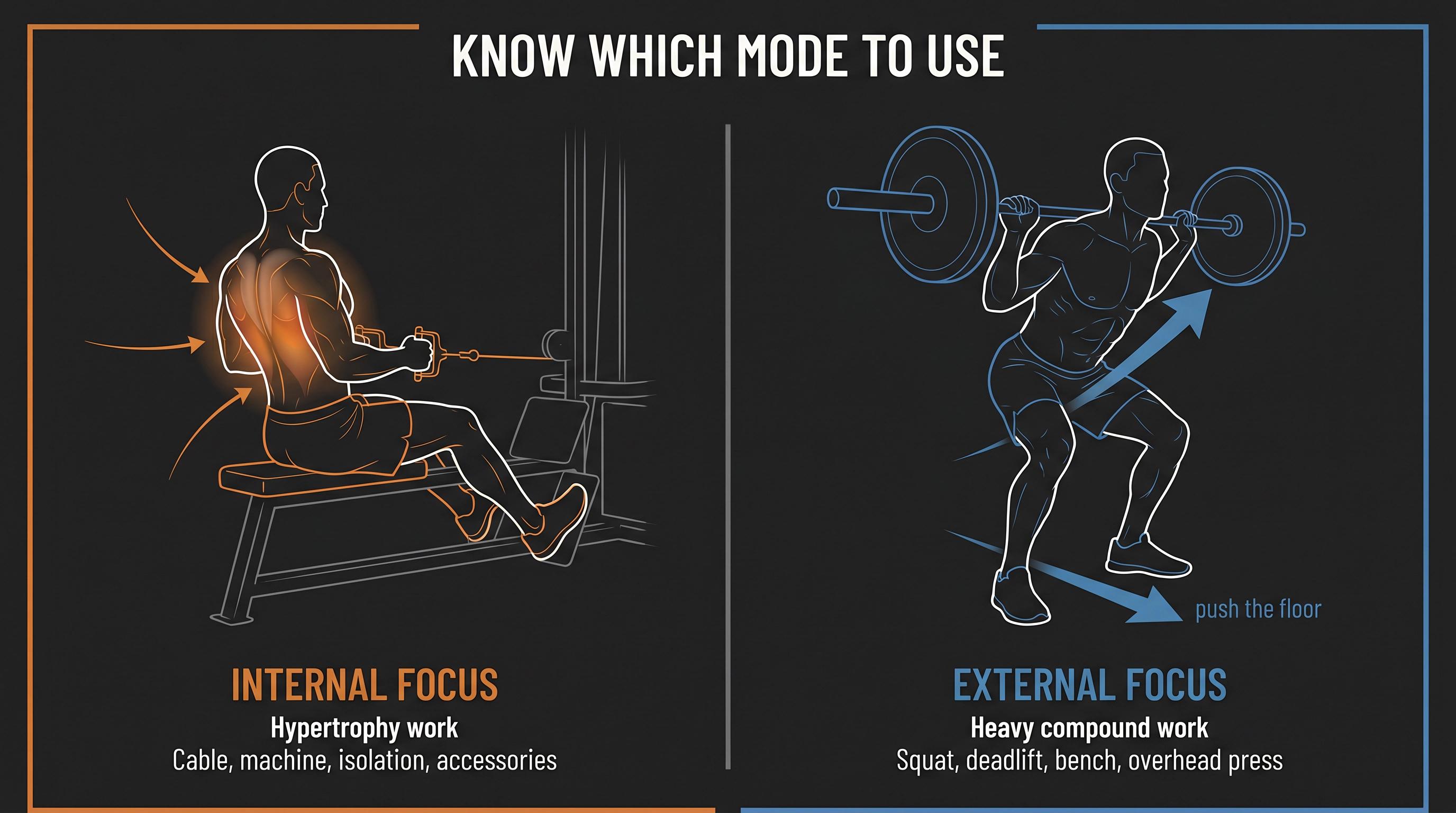
Hypertrophy-focused accessory work. This is the clearest use case. Machine work, cables, isolation movements, and stable compound variations where you can pay attention to the target muscle without sacrificing balance, bracing, or safety.
Good examples: lat pulldown, seated cable row, chest-supported row, cable fly, pec deck, leg extension, hamstring curl, hip thrust, lateral raise, rear delt fly, biceps curl, triceps pressdown.
Lagging muscles. If one muscle consistently refuses to grow despite training it, the issue may not be effort — it may be stimulus distribution. You bench, but your front delts and triceps dominate. You row, but your biceps take over. You do Romanian deadlifts, but your lower back fatigues before your hamstrings. Internal focus, combined with adjusted setup, load, and exercise selection, can help redirect the stimulus.
Warm-up and ramp-up sets. You do not need to obsess over every working rep. Use lighter warm-up sets to ask: Can I feel the target muscle stretch? Can I feel it contract? Is momentum hiding something? Once you have "found" the muscle, your working sets can be more automatic.
Moderate loads. The evidence is strongest around moderate loads — the 2016 bench press study showed the effect at 20–60% 1RM but not at 80%. (PubMed) In practice, that typically means controlled sets in the 8–20 rep range, one to three reps in reserve, stable body position, consistent tempo.
Beginners on simple exercises. Learn the movement pattern first on compound lifts. Once the technique is stable, practice feeling the target muscle on simple, stable exercises — pulldowns, cable rows, leg extensions, machine presses, curls, pressdowns. The skill transfers.
When not to use internal focus
One-rep max attempts. During a heavy squat, bench, deadlift, or overhead press, your job is to execute efficiently: brace, control the bar path, produce force. External cues consistently outperform internal cues for maximal force output on heavy compound lifts. (ResearchGate) "Squeeze my quads" during a heavy squat attempt may cost you the lift.
When it cuts range of motion. Some lifters "squeeze" so hard they shorten the movement — half-rep pulldowns, chest flyes with no real stretch, hip thrusts that are really just partial-range pulses. A strong contraction is useful. A loaded stretch is also useful. Both matter.
When it replaces actual progression. A set of cable flyes can produce a strong pump and a clear chest feel. That does not automatically mean it is sufficient volume, stimulus, or weekly load to drive growth. The mind-muscle connection improves rep quality. It is not a substitute for a real progression plan.
When you confuse soreness for success. Soreness can happen when a muscle receives a new or more intense stimulus. It fades as you adapt. Soreness is not evidence of growth, and chasing it is not a training strategy.
| Goal | Best focus type |
|---|---|
| Build a specific muscle (hypertrophy work) | Internal: feel and contract the target muscle |
| Lift the most weight possible | External: move the bar, push the floor |
| Improve speed or power output | External (usually) |
| Fix a lagging muscle | Internal + better exercise selection and setup |
| Train heavy compound lifts | External |
| Log and track real progress | Sets, reps, load, RPE, volume, consistency |
How to build a stronger mind-muscle connection
The mind-muscle connection is not something you either have or do not have. It improves with deliberate practice. Here is a four-step system.
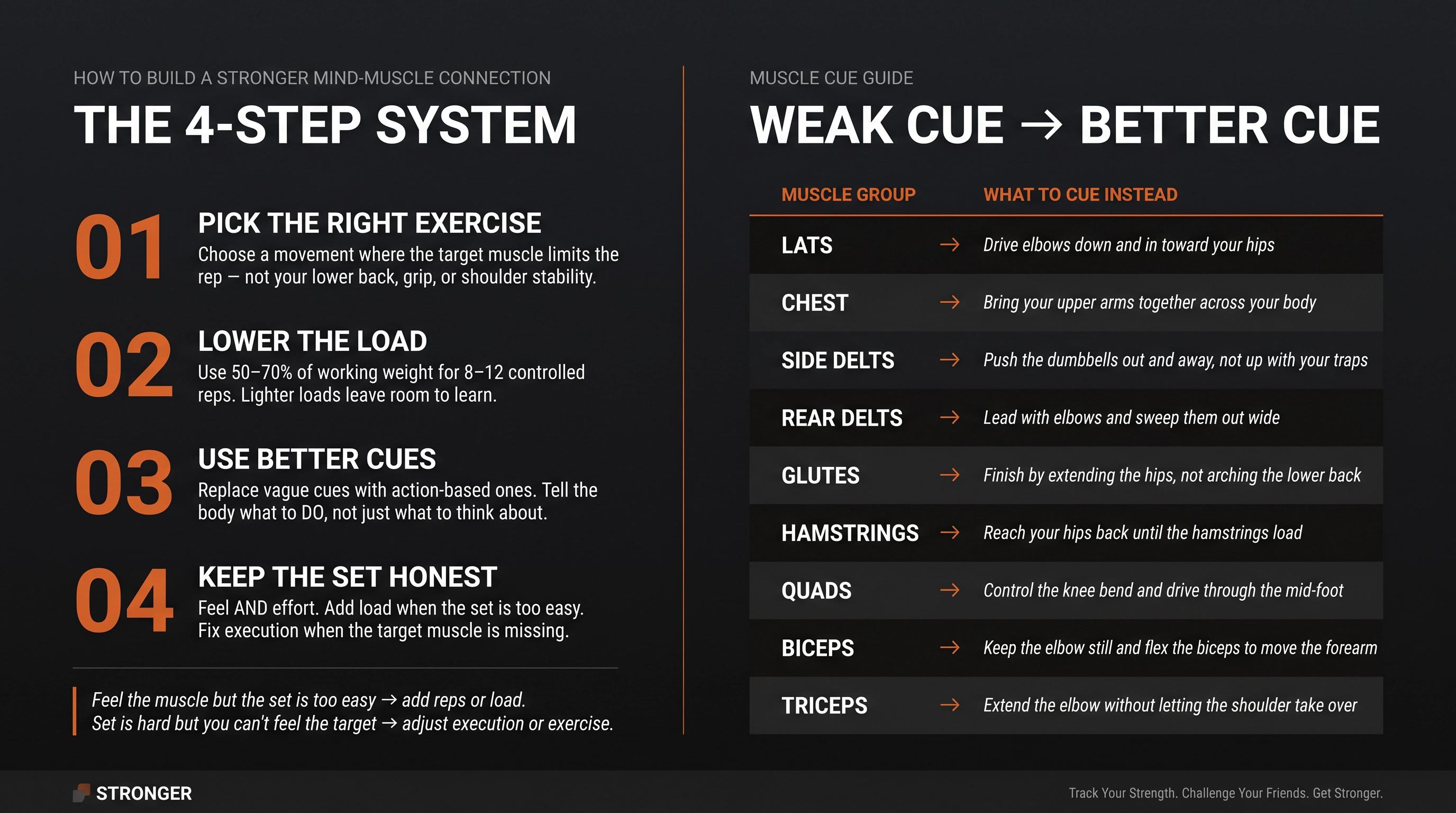
Step 1: Pick the right exercise for the target muscle
If you can't feel a target muscle, do not immediately blame your brain. The exercise may be a poor fit for your structure.
If barbell rows always become lower-back work, try a chest-supported row. If bench press never hits your chest, try a machine press, dumbbell press, or cable fly. If squats don't train your glutes well, try hip thrusts, Bulgarian split squats, or Romanian deadlifts.
A good target-muscle exercise has three traits:
- You can stabilize easily.
- You can train through a useful range of motion.
- The target muscle is the limiting factor before anything else fails.
Stronger's exercise library includes 400+ exercises with instructions, muscle targeting maps, and equipment filters — useful when you need to swap an exercise that looks good on paper for one that actually targets the muscle you want. (Stronger)
Step 2: Lower the load to learn the movement
If you cannot feel the target muscle, reduce the weight for one or two technique sets. Use 50–70% of your normal working weight. Perform 8–12 controlled reps. Pause briefly in the shortened position. Control the eccentric. Stop before fatigue makes form messy.
This is not because light weights build muscle better. It is because lighter loads leave room to learn. Once you can consistently feel the target muscle, add load back gradually. The goal is to earn the right to train heavier while keeping tension where you want it.
Step 3: Use cues that actually work
Most people fail at the mind-muscle connection because their cue is too vague.
"Feel your back" is not useful. "Drive your elbows down and in toward your hips" is useful.
"Use your glutes" is vague. "Tuck your pelvis slightly, keep your ribs down, and extend the hips to finish the rep" is actionable.
A good cue tells you what action to create, not just what muscle to think about.
| Muscle | Weak cue | Better cue |
|---|---|---|
| Lats | "Feel your back" | "Drive elbows down and in toward your hips" |
| Chest | "Squeeze your chest" | "Bring your upper arms together across your body" |
| Side delts | "Lift with shoulders" | "Push the dumbbells out and away, not up with your traps" |
| Rear delts | "Use rear delts" | "Lead with elbows and sweep them out wide" |
| Glutes | "Squeeze glutes" | "Finish by extending the hips, not arching the lower back" |
| Hamstrings | "Feel hamstrings" | "Reach your hips back until the hamstrings load" |
| Quads | "Use quads" | "Control the knee bend and drive through the mid-foot" |
| Biceps | "Curl hard" | "Keep the elbow still and flex the biceps to move the forearm" |
| Triceps | "Lock out" | "Extend the elbow without letting the shoulder take over" |
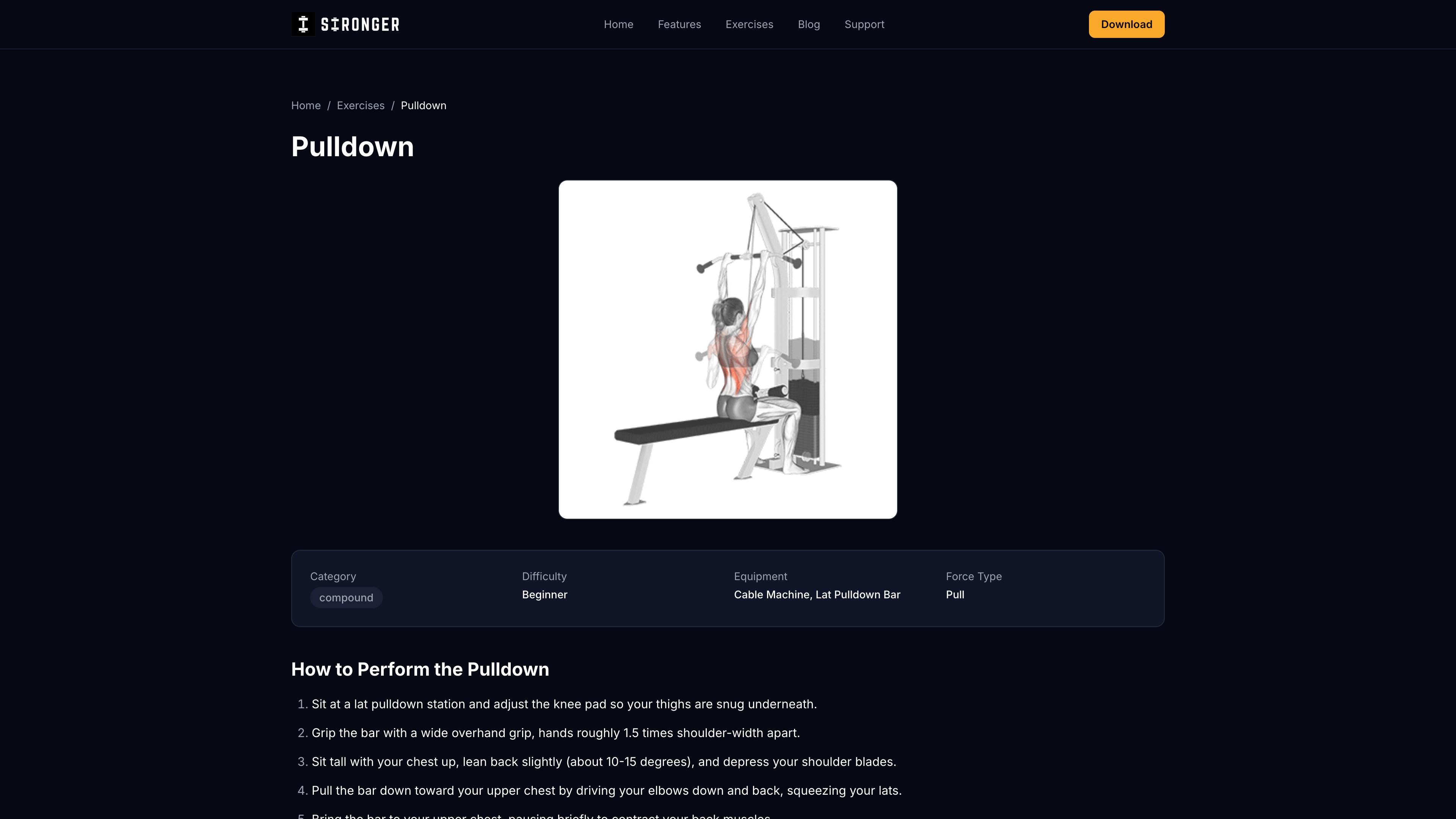
Stronger's pulldown guide uses the kind of cue that actually works for lats: drive the elbows down rather than curling the bar, with specific technique cues like pulling the elbows toward your back pockets and pausing briefly in the contracted position. (Stronger)
Step 4: Keep the hard set honest
The mind-muscle connection should improve your training, not make it easier.
A useful hypertrophy set should still be challenging. You should finish with a clear sense that you had only a few good reps left. Do not turn every set into a slow-motion meditation. You still need effort.
A useful check:
If you can feel the muscle but the set is not hard enough, add reps or load. If the set is hard but you cannot feel the target muscle, adjust execution or exercise selection.
The best hypertrophy work combines both.
Ready to Get Stronger?
Join 2,000,000+ lifters tracking their workouts with Stronger. Available on iOS and Android.


Exercise execution: how to fix common mind-muscle connection problems
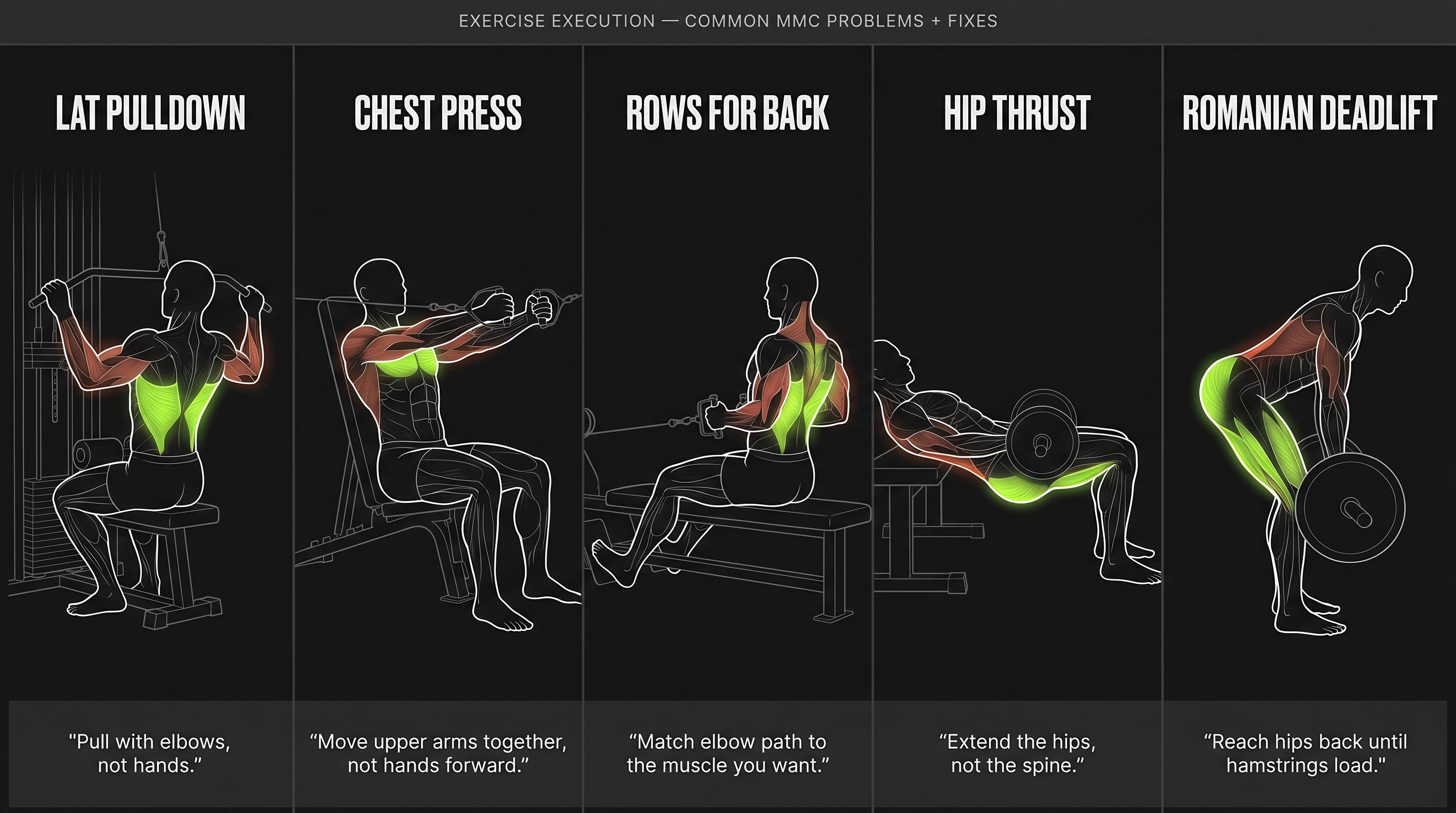
Lat pulldown: why you feel arms instead of lats
Problem: You feel biceps, forearms, or upper traps — not lats.
Fix:
- Let the shoulders rise slightly at the top so the lats can lengthen.
- Pull the elbows down toward your ribs or back pockets — not the bar toward your chest.
- Think of your hands as hooks; the elbows do the work.
- Control the upward phase.
Cue: "Pull with elbows, not hands."
Stronger's pulldown guide recommends keeping the chest tall, leaning back only slightly, and driving elbows down instead of curling the bar down. (Stronger)
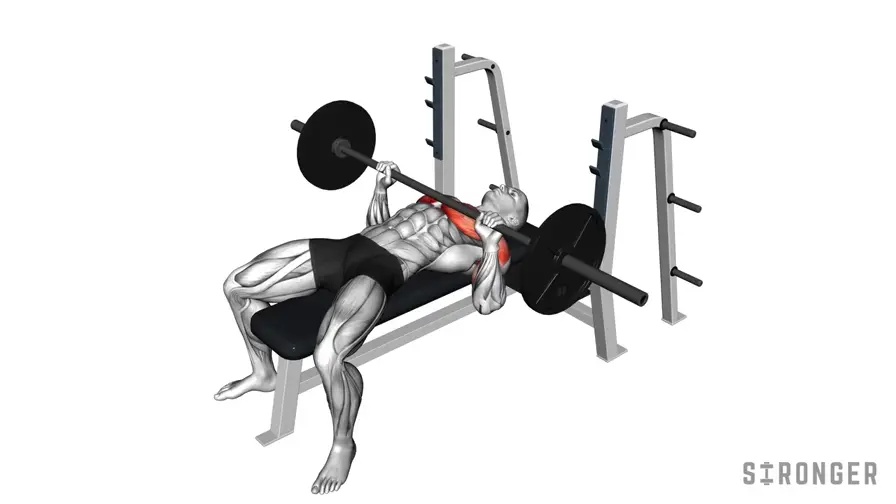
Chest press: why you feel front delts and triceps instead of chest
Problem: You feel front delts and triceps — not chest.
Fix:
- Set the handles around mid-chest height.
- Keep shoulder blades stable and down.
- Let the pecs stretch at the bottom — without losing control.
- Press by bringing your upper arms across your body, not just pushing your hands forward.
- Avoid shrugging at the top.
Cue: "Move your upper arms together, not just your hands forward."
Stronger's seated cable chest press guide recommends controlled reps, full range of motion, and a clear chest contraction at the end of each rep. (Stronger)
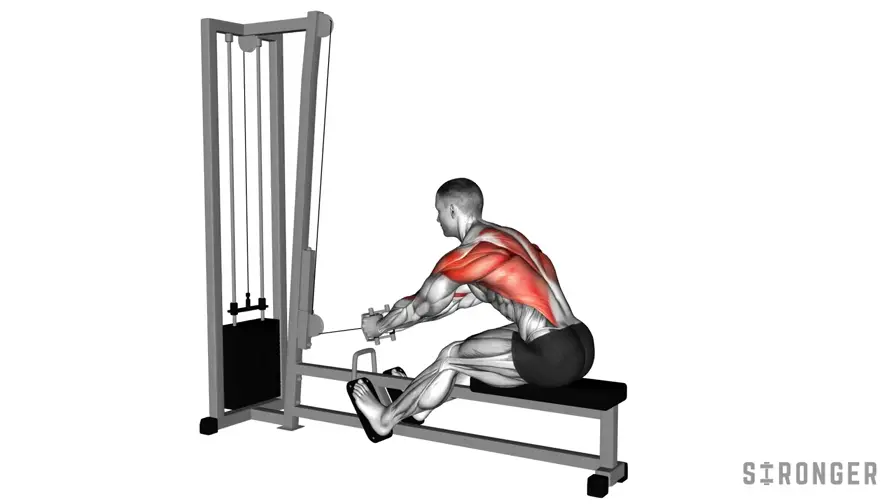
Rows for back: how to feel lats instead of arms and traps
Problem: Arms and traps dominate — not lats or mid-back.
Fix:
- For lats: keep elbows closer to the body, pull toward the hip, think "elbow to pocket." For a cable row targeting lats, a narrow, underhand grip with elbows tracking close to the ribcage tends to work well.
- For upper back: use a wider elbow path, pull toward the upper abdomen, let the shoulder blades protract and retract fully.
Cue: "Match the elbow path to the muscle you want to target."
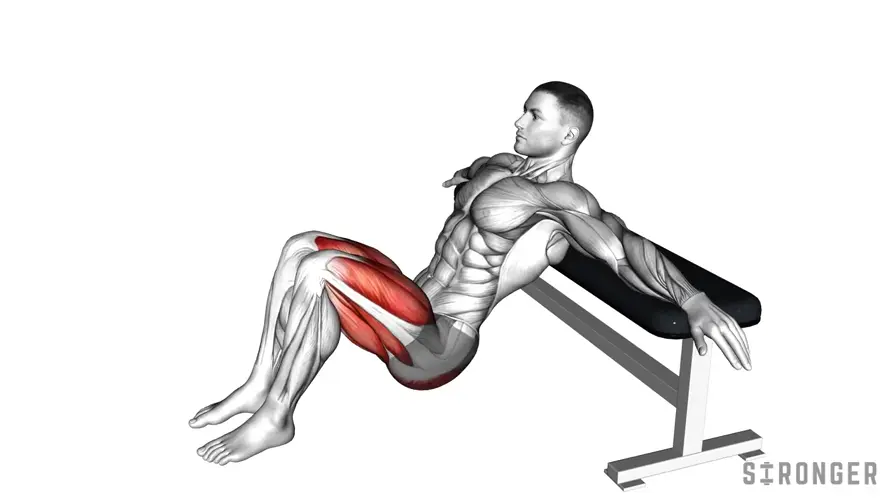
Hip thrust: how to feel glutes instead of your lower back
Problem: Lower back takes over — not glutes.
Fix:
- Place your upper back on the bench, feet so shins are roughly vertical at the top.
- Keep ribs down.
- Slightly tuck the pelvis at the top.
- Finish with hip extension — not spinal extension.
- Pause briefly at lockout.
Cue: "Extend the hips, not the spine."
See Stronger's hip thrust guide for a full breakdown of every variation and how to choose the right one for your structure.
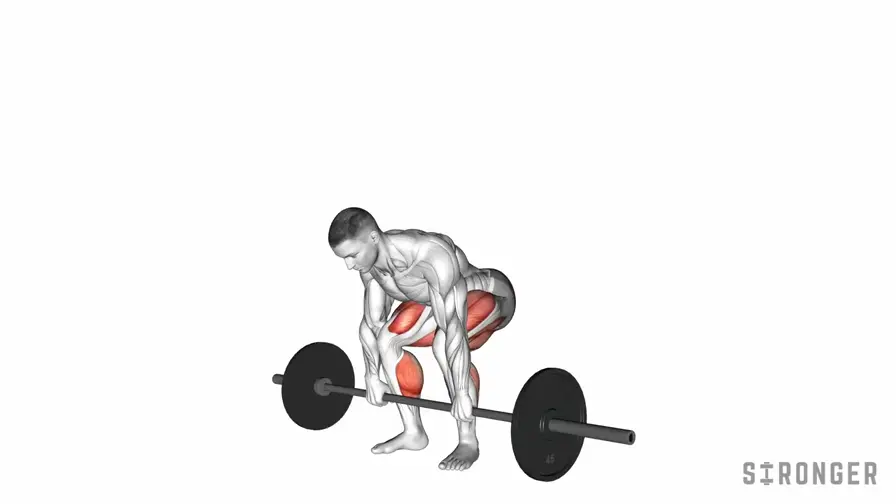
Romanian deadlift: how to feel hamstrings before your lower back fatigues
Problem: Lower back fatigues before hamstrings load.
Fix:
- Keep a soft knee bend throughout.
- Push the hips back — let the bar stay close to your legs.
- Stop when the hamstrings are deeply stretched, before your back position changes.
- Drive hips forward to stand.
Cue: "Reach your hips back until your hamstrings load."
The barbell RDL is one of the most reliable hamstring exercises when performed with this hip-back cue — the loaded stretch is what drives the stimulus.
Mind-muscle connection vs progressive overload: do you need both?
This is the most important section for long-term results.
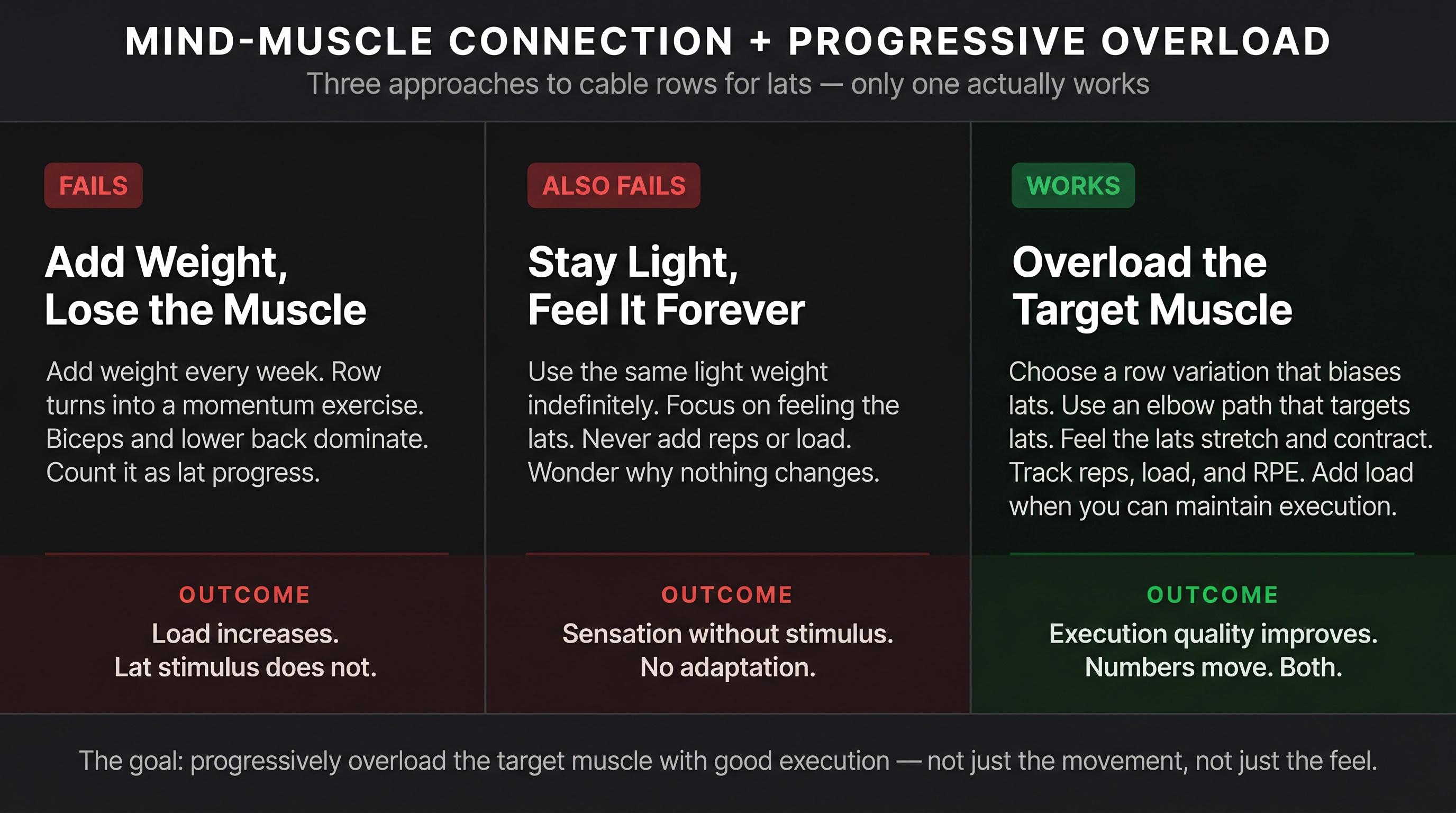
Many lifters treat these as opposites: "Just get stronger" versus "No, just feel the muscle." That is a false choice.
For hypertrophy, the answer is almost always: progressively overload the target muscle with good execution. Not just progressively overload the movement. Not just feel the muscle. Both.
Here is what that looks like with cable rows for lats:
The version that fails: add weight every week, turn the row into a momentum exercise, use more biceps and lower back, count it as lat progress.
Also fails: use the same light weight forever, feel the lats, never add reps or load, wonder why nothing changes.
The version that works: choose a row variation that biases lats, use an elbow path that targets lats, feel the lats stretch and contract, track the reps and load and RPE, add reps or load when you can maintain execution.
That is how the mind-muscle connection becomes productive instead of just contemplative.
Where the mind-muscle connection fits in your training hierarchy
Before the mind-muscle connection becomes useful, these fundamentals need to be in place:
- Consistency. The 2026 ACSM resistance training guidelines synthesized 137 systematic reviews and more than 30,000 participants. One of the clear practical conclusions was that consistency beats unnecessary complexity. (ACSM)
- Exercise selection. If an exercise is a poor match for your goal, no cue fully saves it.
- Technique and range of motion. Controlled, repeatable reps through a full range.
- Effort. The set needs to be hard enough to stimulate adaptation. Research on training proximity to failure suggests that getting close to failure matters — but that failure itself is not always superior to stopping short of it. (Springer) Tracking RPE per set is one of the most practical ways to quantify this.
- Progressive overload. Over time, the stimulus needs to increase — more load, more reps, more sets, better control, better range, or more work for the target muscle. We've written about how to structure this in our progressive overload guide. (Stronger)
Once those are in place, the mind-muscle connection becomes a meaningful refinement. It helps ensure the right muscle is receiving the stimulus you intended.
How to track mind-muscle connection in your workout log
The mind-muscle connection is subjective. Your training log is objective. You need both.
Here is a simple approach: add a brief MMC note to your log for exercises where targeting matters. Use a 1–3 rating.
| Rating | Meaning |
|---|---|
| 1 | Poor target feel; other muscles dominated |
| 2 | Adequate; target worked but was not clearly the limiter |
| 3 | Excellent; target muscle was clearly loaded and fatigued |
Example log entry:
- Lat pulldown: 70 kg × 10, 10, 9 — RPE 8 — MMC: 2
- Cue used: elbows to hips
- Note: biceps took over on the last set
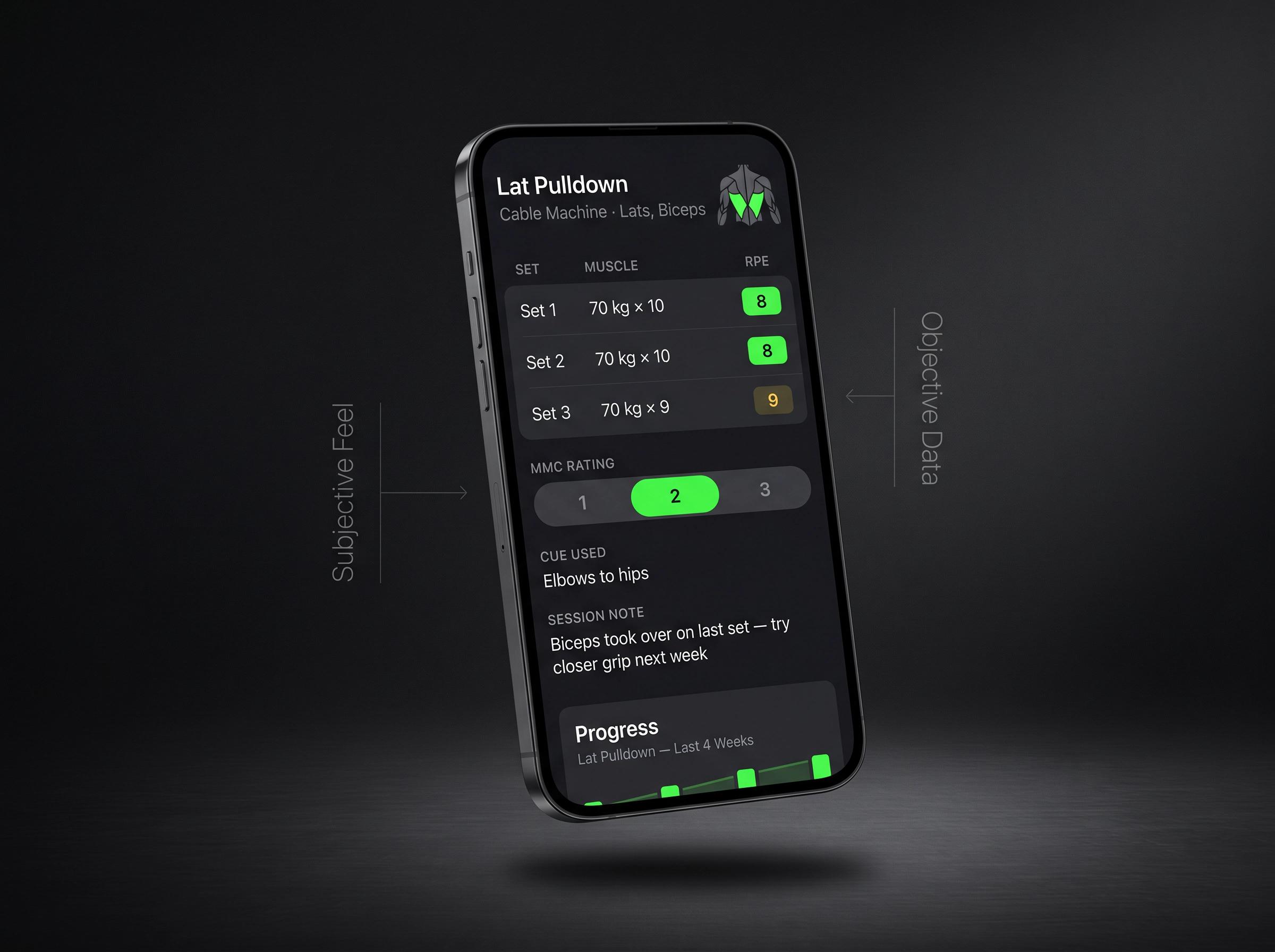
Your goal next week is not necessarily just "more weight." It might be: same load with cleaner lat tension, one additional clean rep before the biceps take over, or trying a slightly different grip. Over time, both numbers should move in the right direction — and both give you information.
How Stronger connects subjective feel to objective progress
The mind-muscle connection gives you information during the set. Stronger gives you the record of what actually happened across sessions.
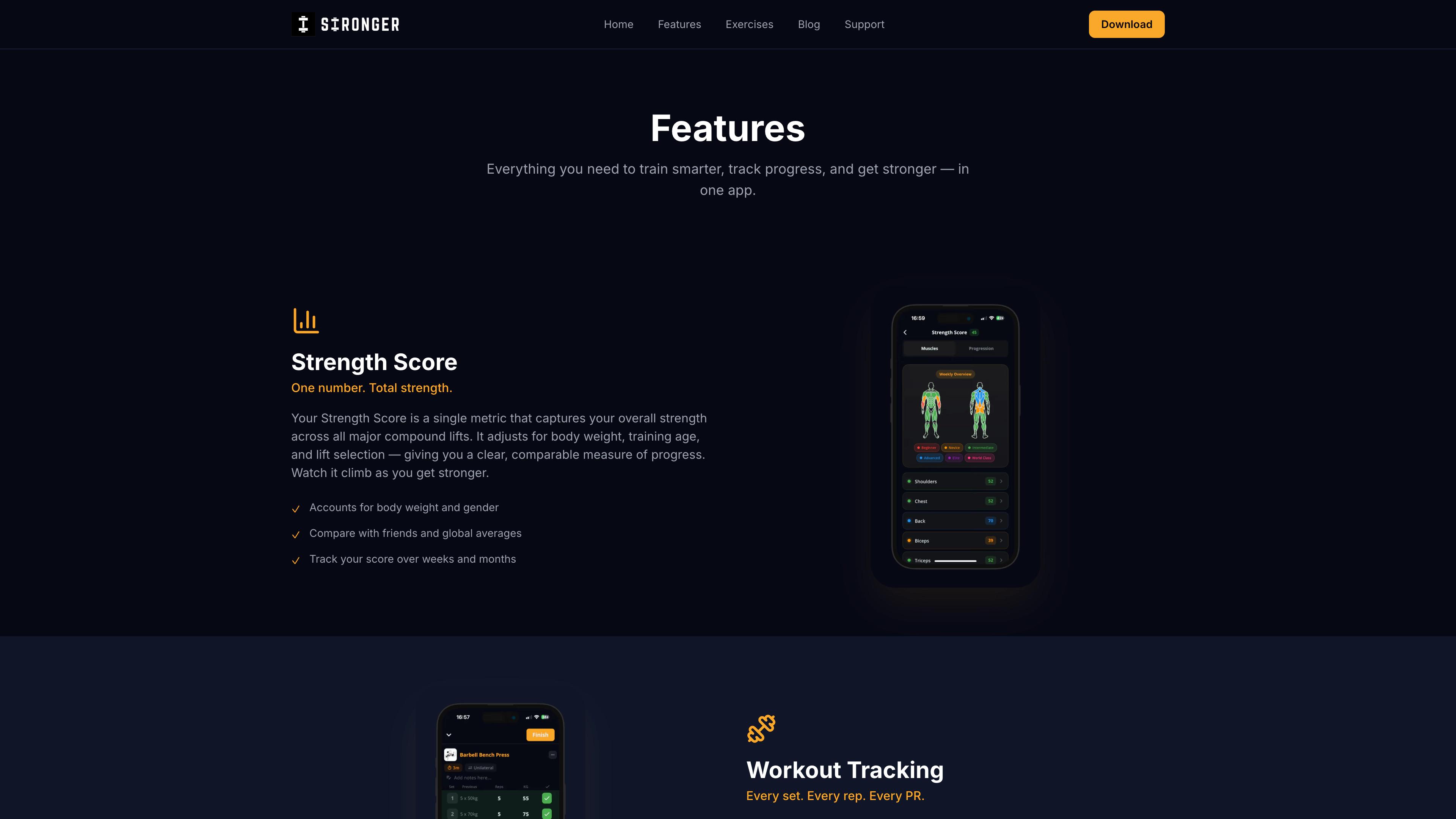
We built Stronger specifically for serious lifters who want more than a basic log — and the features that matter most for MMC work are built in:
Exercise library with muscle maps. Browse 400+ exercises filtered by muscle group, equipment, or goal — with instructions and targeting maps for each one. When an exercise isn't hitting the right muscle, finding a better variation takes seconds, not a Google session. (Stronger)
RPE logging. Track RPE per set so you can see whether "hard" is consistent week over week. An RPE 8 set at 70 kg for 10 reps means something different than an RPE 6 at the same numbers. This context is what turns a log into a training record.
Volume and frequency analytics. See how much total work each muscle group is getting per week. If your chest volume is high but your chest isn't growing, you have a targeting question, not a volume question.
Strength curves and progress charts. Track how individual exercises progress over time. If your lat pulldown weight has been stuck for three months, you know — without having to remember across dozens of sessions.
Strength Score. Our proprietary Strength Score benchmarks your overall strength across major lifts, adjusted for bodyweight, gender, and training age — calibrated against the strength standards that define progress from beginner to advanced. It is the signal that tells you whether your improvements in execution are translating to actual measurable strength progress.
Adaptive AI programming. If you are not sure how to structure your sessions around MMC work and progressive overload, our AI routines and adaptive programming can build a plan that does it for you — and adjusts as you improve.
Try Stronger free for 7 days — no commitment needed to see whether your training numbers match what you feel in the gym.
Common myths about the mind-muscle connection
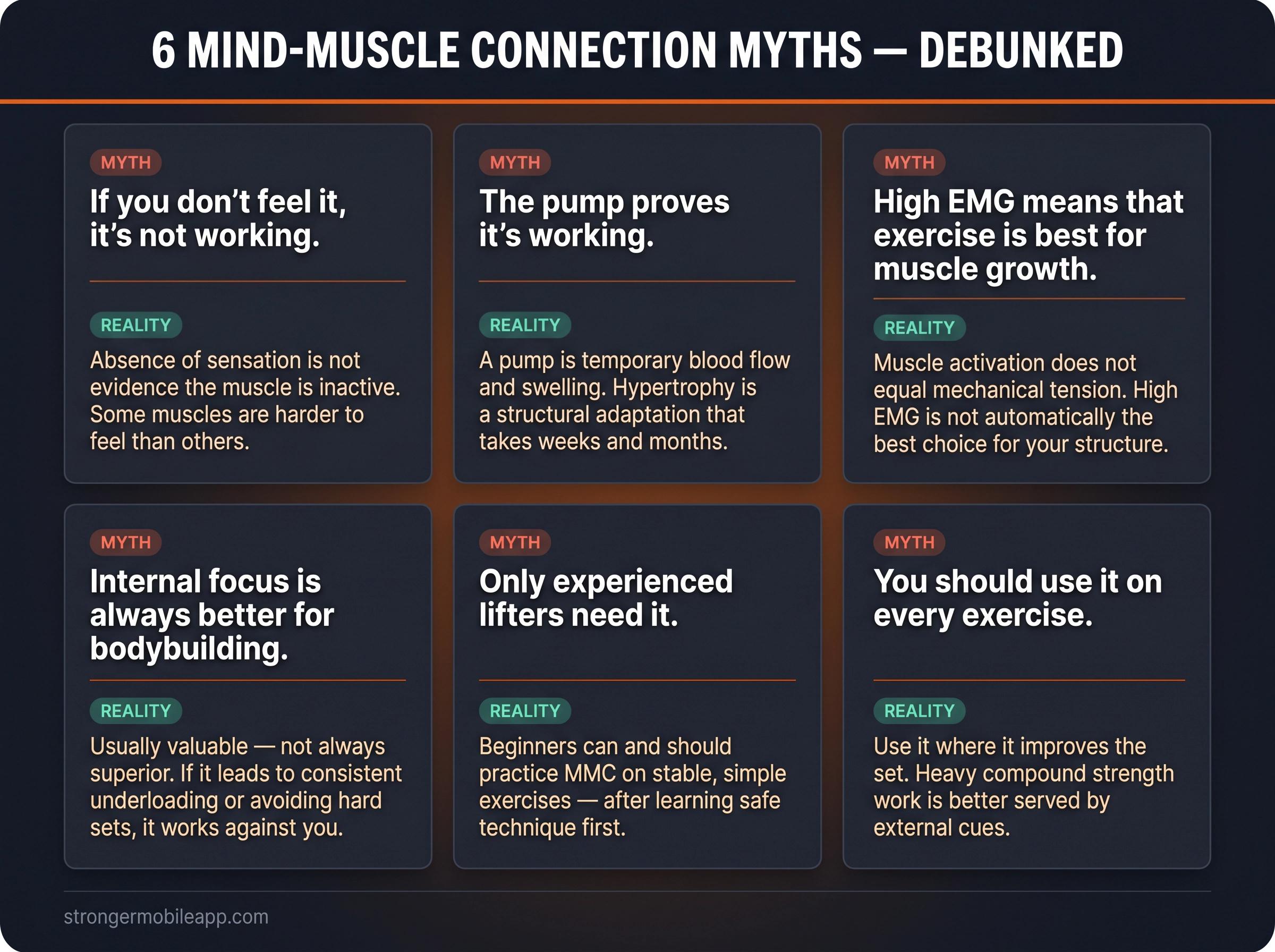
Myth 1: "If you don't feel it, it's not working."
Not always. Some muscles are harder to feel. Some exercises create more tension in the stretched position than the squeezed one. Some people get less pump or localized soreness than others. The absence of a strong sensation is not evidence that the muscle is inactive. But if another muscle consistently limits the set before the target muscle, that is worth addressing.
Myth 2: "The pump proves it's working."
A pump is a temporary increase in local blood flow and swelling during training. Hypertrophy is a chronic structural adaptation over weeks and months. You can get an enormous pump from a light band workout and minimal long-term growth. Enjoy the pump, but track progression.
Myth 3: "High EMG means that exercise is best for muscle growth."
Surface EMG has real interpretation limits. Muscle activation does not equal mechanical tension, and mechanical tension does not directly equal hypertrophic stimulus. (ResearchGate) An exercise with high EMG is not automatically the best choice for your structure, recovery, or training program.
Myth 4: "Internal focus is always better for bodybuilding."
Usually valuable, not always superior. Even bodybuilders need progressive load, adequate effort, sufficient volume, and stable execution. If internal focus leads you to underload consistently or avoid hard sets, it is working against you. The difference between training for hypertrophy and training for pure strength matters here: hypertrophy training tolerates more internal focus, but it still requires real mechanical stress.
Myth 5: "Only experienced lifters need it."
Beginners can and should practice feeling target muscles on stable, simple exercises. The rule for beginners is just: learn safe, repeatable technique first on compound movements, then practice MMC on the simpler exercises.
Myth 6: "You should use it on every exercise."
Use it where it improves the set. Do not force it where it reduces performance. Heavy compound strength work is better served by external cues.
Can't feel the target muscle? Work through this checklist
Work through this checklist if the target muscle keeps escaping you.
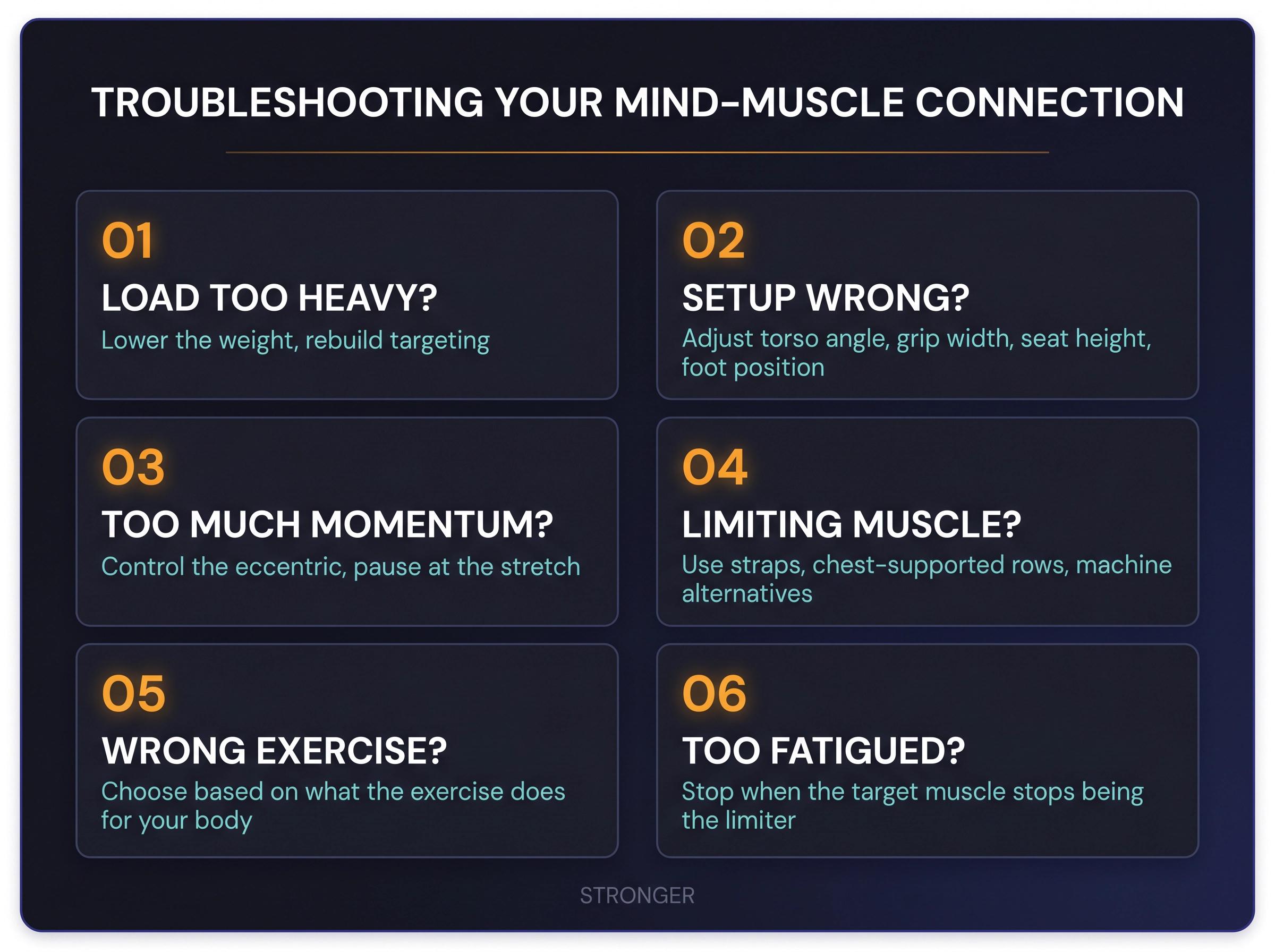
1. Is the load too heavy? The body will use whatever strategy completes the rep. Lower the load temporarily and rebuild targeting.
2. Is your setup wrong? Small changes matter enormously: torso angle on a pulldown, grip width on a row, seat height on a press, foot position on a hip thrust. Change one variable at a time.
3. Are you using too much momentum? Control the eccentric. Pause briefly at the stretch. Remove the bounce. Momentum hides poor targeting.
4. Is another muscle limiting you first? If grip fails before back, use straps. If lower back fails before lats, use a chest-supported variation. If shoulder stability fails before chest, try a machine or cable variation.
5. Is the exercise a poor match for you? A barbell bench press may be excellent for strength but a mediocre chest builder for someone with long arms and dominant triceps. A conventional deadlift may not be the best hamstring hypertrophy tool — the RDL typically wins for isolated hamstring loading because of its longer stretch window. A squat is essential for many programs but not the best glute builder for every structure — the hip thrust consistently outperforms the squat for glute hypertrophy in most structures. Choose exercises based on the job they do for your body.
6. Are you too fatigued? A 2020 seated row study found that back-focused verbal instructions increased lat activity during initial repetitions but not final repetitions. (Sage Journals) It is normal for targeting to deteriorate as the set gets hard. Stop a set when the target muscle is no longer the limiter, not five more reps later when everything is messy.
Ready to Get Stronger?
Join 2,000,000+ lifters tracking their workouts with Stronger. Available on iOS and Android.
The bottom line on the mind-muscle connection
The mind-muscle connection works — in the right context, applied the right way.
It is useful for: improving exercise execution, biasing tension toward a target muscle, training lagging muscles, getting more out of moderate-load accessory work, and teaching lifters how different muscles contribute to movement.
It is not useful for: replacing progressive overload, maximizing one-rep max strength, proving that an exercise is optimal, or justifying endless light sets.
The best approach is not complicated: use internal focus when you want to make a specific muscle do more work. Use external focus when you want to move the most weight possible. Track everything — both the subjective quality of each set and the objective progression of load, reps, volume, and strength over time.
For muscle growth: learn to feel the target muscle, then progressively overload it. For strength: focus on moving the weight efficiently, then use accessories to build the muscles that support the lift.
Feel the muscle when feeling it helps. Move the weight when moving it is the goal. Log both and let the numbers tell the real story.
If you want a structured way to apply this, Stronger has the exercise library to find movements that target the right muscles, the RPE and volume tracking to log what actually happened, and the analytics to tell you whether the execution is translating into real progress. Start your free trial and see what your training data says.
Frequently Asked Questions
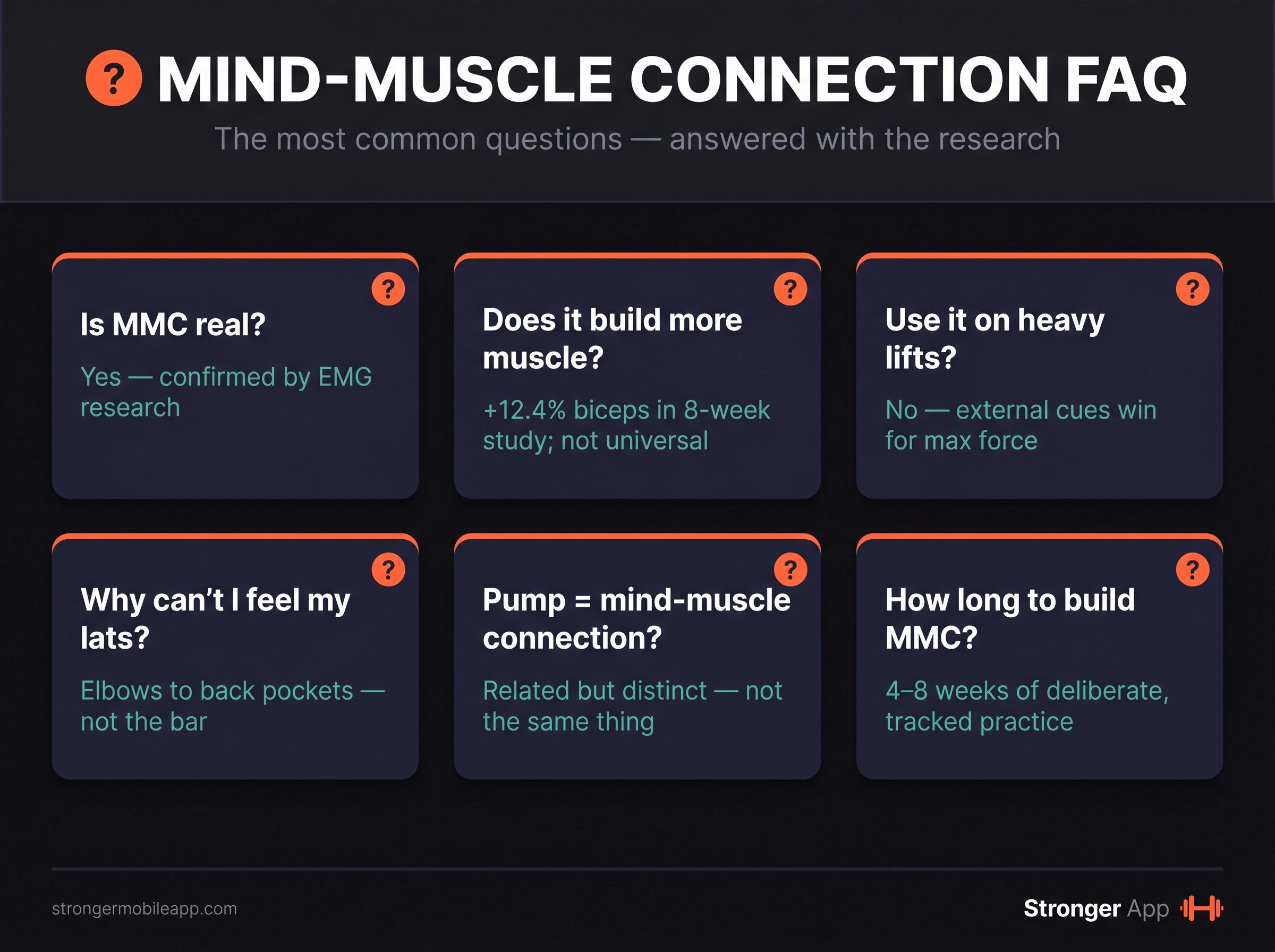
Is the mind-muscle connection real?
Yes. Research confirms that deliberately focusing on a target muscle can increase that muscle's electrical activity during certain exercises and loading conditions. The clearest evidence comes from lighter-to-moderate loads with controlled movements — not maximal lifting. (PubMed)
Does the mind-muscle connection build more muscle?
Possibly, in some contexts. An eight-week study found greater biceps thickness with internal focus (12.4%) versus external focus (6.9%), but quadriceps growth was similar between groups. The evidence is promising for upper-body hypertrophy but not conclusive as a universal rule. Progressive overload and sufficient effort remain the primary drivers of growth. (Sponet)
Should I use mind-muscle connection on heavy compound lifts?
Generally not as your primary cue. For heavy compound movements like squats, deadlifts, bench presses, and overhead presses, external cues tend to produce better force output and bar speed. Use internal focus more on warm-up sets, back-off sets, and accessories. (ResearchGate)
Why can't I feel my lats during pulldowns?
Common reasons: pulling with the arms rather than driving the elbows, using too much load, leaning back excessively, gripping too hard, or using an elbow path that doesn't target the lats. Reduce the load, think "elbows to back pockets," and control the stretch at the top of each rep. Stronger's pulldown guide gives a similar cue: drive the elbows down rather than curling the bar. (Stronger)
Is soreness a sign that the mind-muscle connection worked?
Not necessarily. Soreness happens when a muscle receives a new or more intense stimulus — it doesn't require the mind-muscle connection, and the mind-muscle connection doesn't require producing soreness. Better indicators of effective targeting are: the target muscle fatigueing before secondary muscles, cleaner reps over time, and consistent progression in load and volume.
Is a pump the same as the mind-muscle connection?
No. A pump is a temporary increase in local blood flow and swelling during exercise. The mind-muscle connection is your ability to direct attentional focus toward a target muscle. They often happen together — a localized pump usually suggests you have been targeting the right area — but they are not the same thing.
Can beginners use the mind-muscle connection?
Yes, but with the right priority order. First learn safe, repeatable technique on compound movements. Then practice feeling the target muscle on stable exercises: pulldowns, cable rows, leg extensions, hamstring curls, machine presses, curls, and pressdowns. Beginners who try to perfect MMC on every rep of a squat often become overly mechanical and slow.
Should I always feel the target muscle on every rep?
No. Sensation naturally changes as fatigue builds within a set. A 2020 seated row study found that verbal cues increased lat activity in initial repetitions but not in final repetitions. (Sage Journals) Targeting tends to degrade as the set gets harder — this is expected. Use it as a signal to stop the set rather than evidence that the method failed.
What if I keep feeling the wrong muscle?
Adjust one variable at a time: load, grip, stance, elbow path, tempo, range of motion, or exercise variation. If the wrong muscle always dominates regardless of adjustments, change the exercise entirely. Not every well-regarded exercise is the best choice for every body structure and goal. Stronger's full exercise library makes it easy to search by muscle group and find alternatives that might be a better match.
How should I track mind-muscle connection progress?
Use a simple 1–3 rating in your workout log alongside sets, reps, weight, and RPE. Note the cue that worked and whether the target muscle was the limiting factor. Stronger tracks all of the objective side — sets, reps, weight, RPE, volume, frequency, and progress charts — so you can see whether the subjective quality of your reps is translating into measurable progress over time. (Stronger)
Does the mind-muscle connection work for legs?
It does, but the evidence is less consistent than for upper body. The Schoenfeld 2018 study found internal focus improved biceps growth but produced similar quadriceps growth between groups. For legs, exercise selection and mechanical loading may matter more than attentional focus alone — though cues like "drive through the mid-foot" for quads or "reach the hips back" for hamstrings still serve a real function in directing execution.
How long does it take to build a stronger mind-muscle connection?
It varies by muscle and training experience, but significant improvement is typically noticeable within four to eight weeks of deliberate practice. The 2018 eight-week study showed measurable differences in that timeframe. Start with one lagging muscle, apply the four-step system consistently, and track both subjective feel and objective progression.
Related Stronger guides
- How to Get Stronger: The Science-Based Guide to Building Strength — progressive overload, compound lifts, rep ranges, frequency, protein, and recovery. (Stronger)
- Pulldown Exercise Guide — lat-focused cues for driving the elbows down and pulling to the back pockets. (Stronger)
- Seated Cable Chest Press Guide — technique for chest-focused pressing with a clear pec contraction. (Stronger)
- Stronger Features — exercise library, muscle-group analytics, RPE logging, Strength Score, and AI programming. (Stronger)
Exercises in this guide
Stronger Editorial Team
Certified strength & conditioning specialists with 10+ years of coaching experience
The Stronger editorial team produces evidence-based training content for lifters of all levels.
Ready to Get Stronger?
Join 2,000,000+ lifters tracking their workouts with Stronger. Available on iOS and Android.