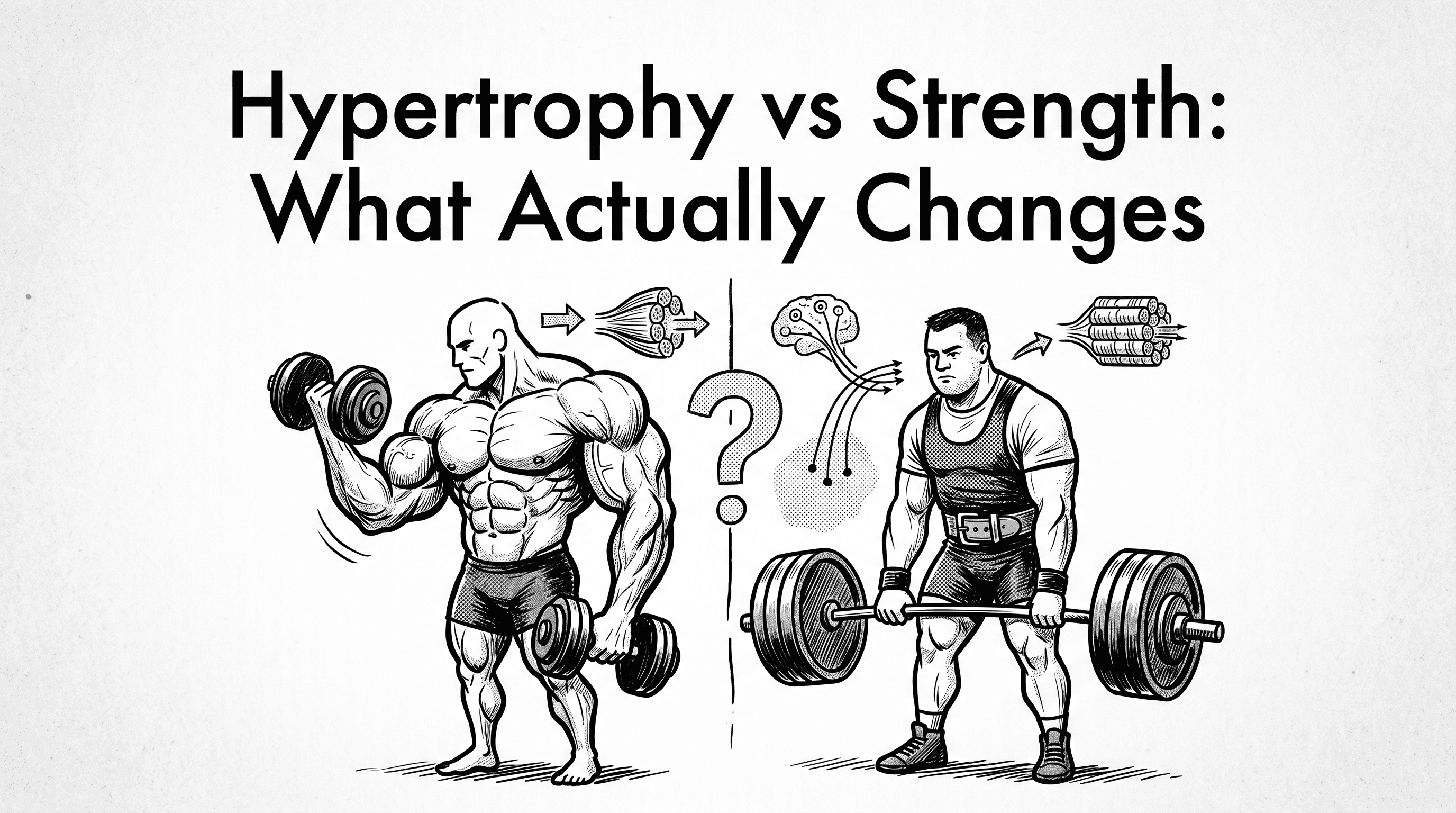

Sarcoplasmic vs Myofibrillar Hypertrophy Explained
Published: May 7, 2026 | Updated: May 7, 2026
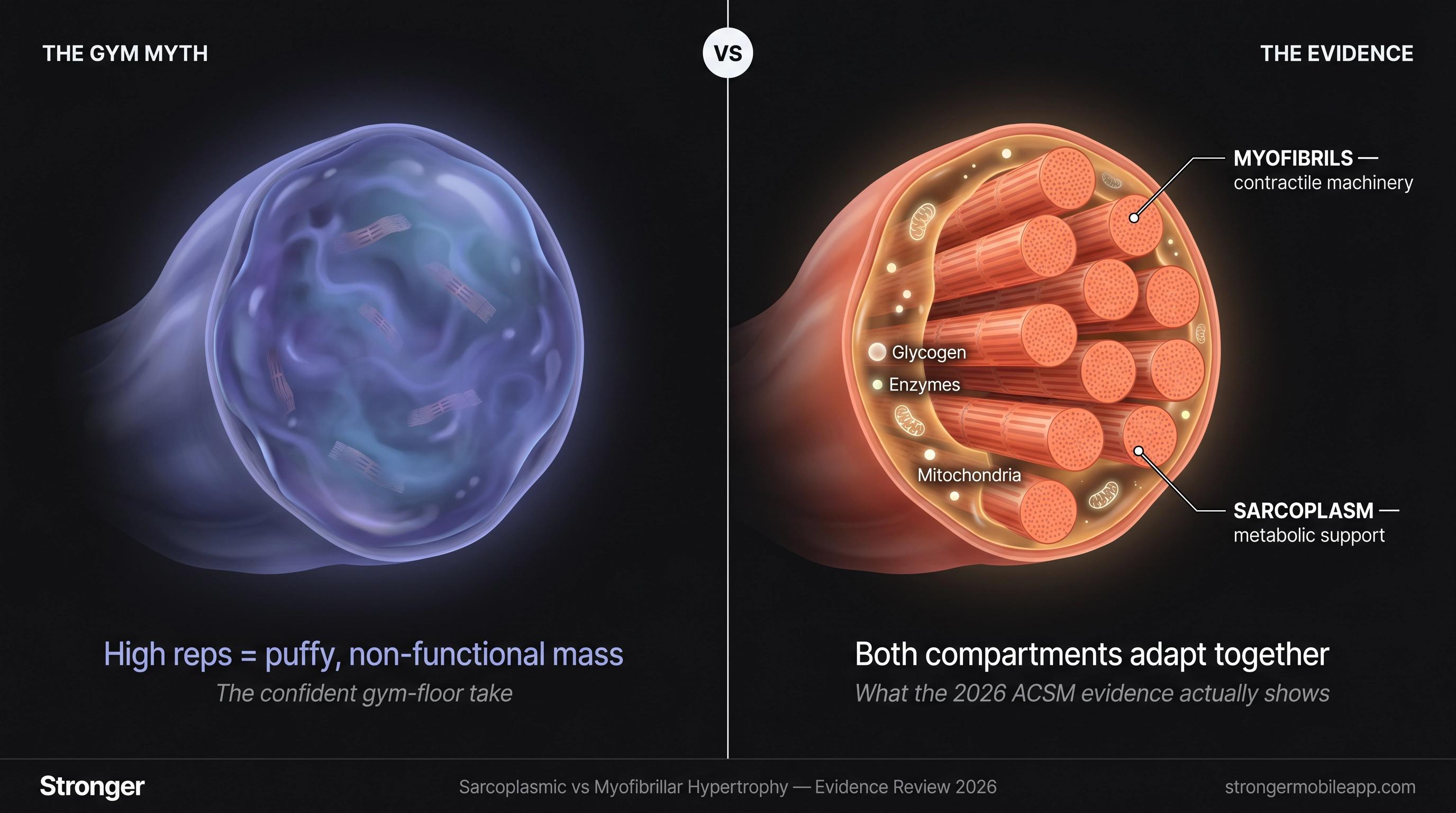
You've heard the confident take: low reps build dense, functional muscle. High reps build puffy, non-functional muscle. Therefore, if you train like a bodybuilder, you're accumulating size that doesn't really translate to strength — "sarcoplasmic hypertrophy," the gym world calls it. Real gainz come from heavy sets and myofibrillar density.
It's a clean story. It also oversimplifies the science to the point of being misleading.
At Stronger, we hear this debate constantly from serious lifters who want to know if their current training style is building the "right kind" of muscle. The honest answer — backed by the most current evidence, including the 2026 ACSM resistance-training guideline update — is more nuanced and ultimately more useful than the broscience version. Sarcoplasmic and myofibrillar hypertrophy are real biological concepts. They're poor training religions.
Here's what the science actually shows, where the evidence gets genuinely uncertain, and how to structure your training so that size, strength, and long-term progression all move in the right direction — regardless of what's happening at the microscopic level.
What is inside a muscle fiber?
Before the debate can make sense, you need a basic map of what's inside a muscle fiber.
Each muscle fiber contains many myofibrils — the rod-like contractile structures packed with proteins called actin and myosin. These are the structures that literally produce force when you lift. When myofibrils slide against each other, your muscle contracts.
The myofibrils sit inside the sarcoplasm — the gel-like internal environment of the muscle fiber. Think of it as the factory floor around the engine. The sarcoplasm contains enzymes, energy-handling machinery, glycogen stores, mitochondria, and other non-contractile material that supports the fiber's function.
A useful shorthand:
- Myofibrils = the engine parts that produce force
- Sarcoplasm = the factory floor — fuel systems, enzymes, fluid, support infrastructure around the engine
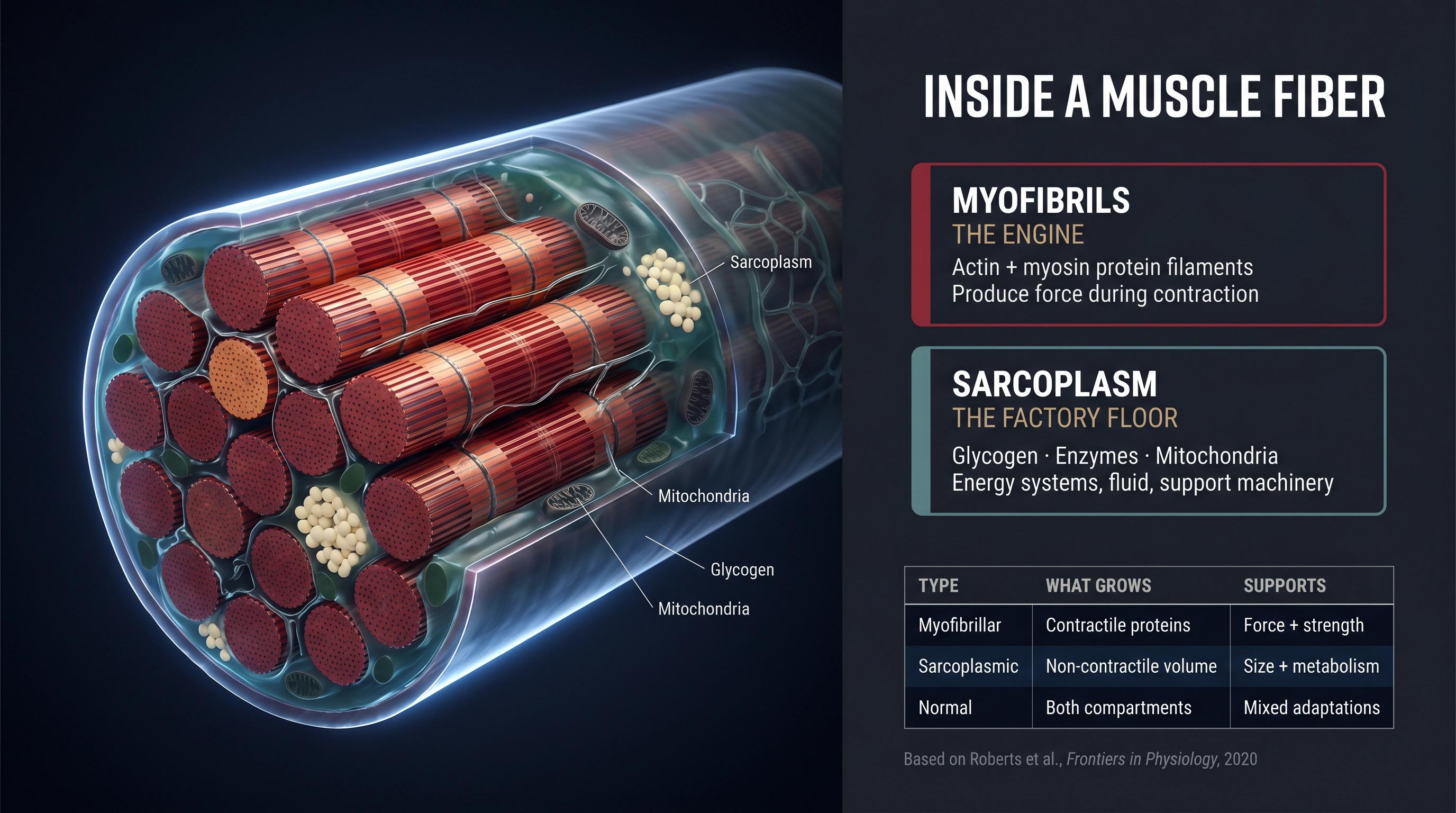
When a muscle grows, both compartments can change. Myofibrillar hypertrophy refers to more or denser myofibrillar structures — more contractile machinery. Understanding what each type of adaptation means for your training helps clarify why the debate matters in the first place. Sarcoplasmic hypertrophy refers to a disproportionate expansion of the sarcoplasmic content relative to myofibrillar protein accretion — the factory floor growing faster than the engine.
A 2020 review in Frontiers in Physiology by Roberts and colleagues formally defined sarcoplasmic hypertrophy this way, and noted that the usual model of muscle growth assumes these compartments grow more proportionally. (Frontiers)
| Type | Simple meaning | What changes inside the fiber | What it tends to support | Common misconception |
|---|---|---|---|---|
| Myofibrillar hypertrophy | More contractile machinery | More or denser myofibrils and contractile proteins | Force production, strength potential | It's not only caused by 1–5 reps |
| Sarcoplasmic hypertrophy | More non-contractile volume | More sarcoplasmic material relative to myofibrils | Possibly more size, metabolic support | It's not just "fake muscle" or water |
| Normal hypertrophy | Both systems adapting | Multiple compartments change simultaneously | Both size and strength potential | Most real training produces mixed adaptations |
Here's the thing: the biology does not hold the clean separation that the gym memes imply. The same training session can produce both types of changes. The same rep range can bias different outcomes depending on the lifter, the training age, and the total context.
So which compartment grows more when you lift? Usually both. Not always in equal proportion — and that's exactly where the debate gets interesting.
What does the research say about muscle hypertrophy?
Four findings form the current scientific picture on this topic. None of them are settled beyond question, but together they give you enough ground to make smarter training decisions.
Is sarcoplasmic hypertrophy real? What the evidence shows
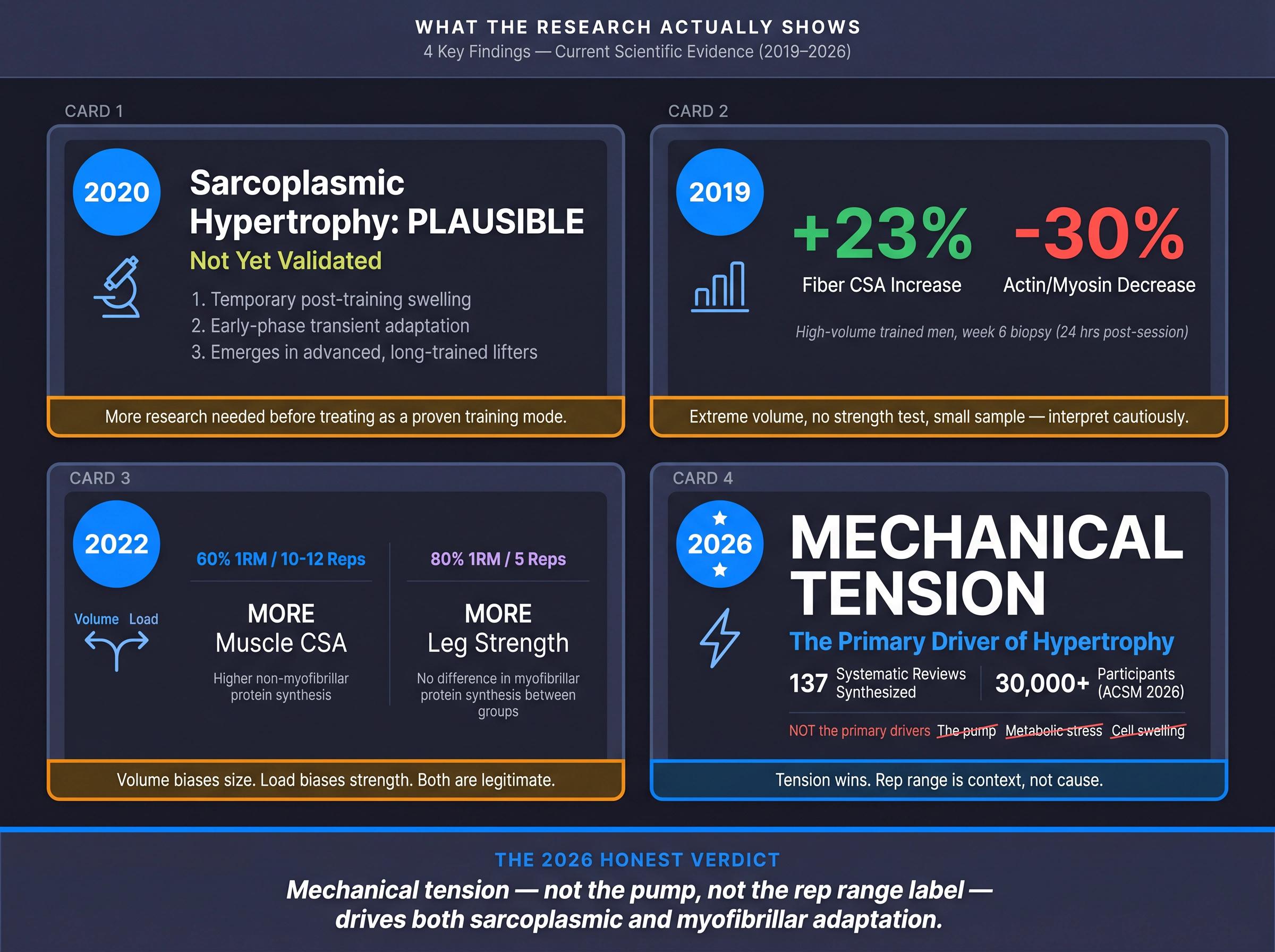
The most thorough and balanced review on sarcoplasmic hypertrophy is still Roberts et al. (2020) in Frontiers in Physiology. Their conclusion: some evidence supports disproportionate sarcoplasmic expansion, especially under higher-volume training conditions. But other studies don't show it clearly, and multiple alternative explanations exist. (Frontiers)
The review raised three possibilities for what "sarcoplasmic hypertrophy" might actually represent when it appears in data:
- Temporary swelling — an acute response to hard training, not a stable structural adaptation
- An early-phase adaptation — transient and self-limiting
- Something that emerges more clearly in very trained lifters, after years of myofibrillar growth has reached a certain point and the body seeks other ways to continue growing
That last point matters. A beginner who puts on muscle after eight weeks of training is probably not experiencing the same internal adaptation pattern as a competitive bodybuilder who has trained hard for ten years. Training age complicates everything in this space.
The honest bottom line: sarcoplasmic hypertrophy is plausible. It is not a validated, reliable, switchable training outcome with clearly identified mechanisms — a pattern shared with other training variables that sound important but don't drive hypertrophy the way the gym world assumes. The Roberts et al. review called for more careful research before treating it as a fully proven training mode.
Does high-volume training cause sarcoplasmic hypertrophy?
The most frequently cited study in this debate is Haun et al. (2019), published in PLOS ONE. The researchers put trained college-aged men through extremely high-volume protocols. In the highest responders, average muscle fiber cross-sectional area increased by roughly 23% by week 6 — but actin and myosin concentrations actually decreased by about 30%. The researchers also found increases in various sarcoplasmic proteins and glycolysis-related proteins. (PubMed) (PLOS)
On the surface, this looks like strong support for sarcoplasmic hypertrophy.
But the caveats matter:
- The training volume was extreme — not representative of typical programming
- The week-6 biopsy was taken only 24 hours after the final session, capturing acute swelling and recovery artifacts
- The sample was small and male-only
- The study included no strength testing — so we can't say whether the observed changes affected force production
The authors themselves treated the findings cautiously. This study does not prove that "high reps build non-functional muscle." It suggests that under certain high-volume conditions, trained lifters may show expansion of non-contractile components. That's interesting. It's not a magic rep-range rule.
High volume vs heavy load: which builds more muscle?
A 2022 Frontiers in Physiology study by Vann and colleagues compared higher-volume and higher-load lower-body training in trained men. The higher-volume condition used roughly 60–65% 1RM for 10–12 reps. The higher-load condition used roughly 85% 1RM for 5 reps. (Frontiers)
The results:
- The high-volume group increased vastus lateralis cross-sectional area more
- The high-load group improved leg-extensor strength more
- The high-volume condition also showed higher non-myofibrillar protein synthesis — including proteins involved in signal transduction, energy metabolism, and sarcoplasmic enzymes
- No clear difference in myofibrillar protein synthesis between conditions
This is a useful signal. But again: a small study in trained men should inform your thinking, not become your entire training philosophy.
The clearest practical takeaway: higher-volume training may be better for size-specific adaptations, while heavier training is better for strength-specific adaptations. That's not a revolutionary finding. It's what experienced coaches have observed for decades. The science is helping explain the mechanism.
Why mechanical tension is the primary driver of muscle growth
The most current comprehensive review on this topic — Van Every et al. in the Journal of Sport and Health Science (2025/2026) — is direct about one thing: mechanical tension is the essential primary driver of load-induced skeletal muscle hypertrophy. (ScienceDirect)
The same review also states that acute hormonal responses, metabolic stress, cell swelling, and "the pump" are not strongly supported as independent drivers of muscle growth.
This matters enormously for how you interpret the sarcoplasmic vs myofibrillar debate.
A popular (and wrong) chain of logic goes: pump = cell swelling = sarcoplasmic fluid = sarcoplasmic hypertrophy = muscle growth. But if the muscle isn't exposed to enough high-tension work, the pump alone isn't doing the job. A hard set of 12–15 reps can build muscle — but because the later reps create high fiber tension as fatigue forces more motor unit recruitment, not because the muscle simply filled up with fluid.
The 2026 ACSM resistance-training guideline update reinforces this: for strength-focused training, heavier loads around 80% 1RM are recommended. For hypertrophy, higher weekly volume — around 10 sets per muscle group per week — is the key lever. The update synthesized 137 systematic reviews representing more than 30,000 participants. (ACSM)
The key mechanism: consistent progressive overload — adding more weight, more reps, or more quality work over time — is what forces the muscle to keep adapting, regardless of which compartment does most of the growing.
The honest verdict for 2026: Sarcoplasmic hypertrophy is probably real in some contexts. It is not a reliable separate mode of training with its own clearly distinct protocol. Myofibrillar hypertrophy is central to long-term muscle growth and strength development. But it's not exclusive to low-rep strength work. Mechanical tension — not the pump, not metabolic stress, not the rep range label on a chart — is what drives both.
Rep range myths: what actually determines muscle growth
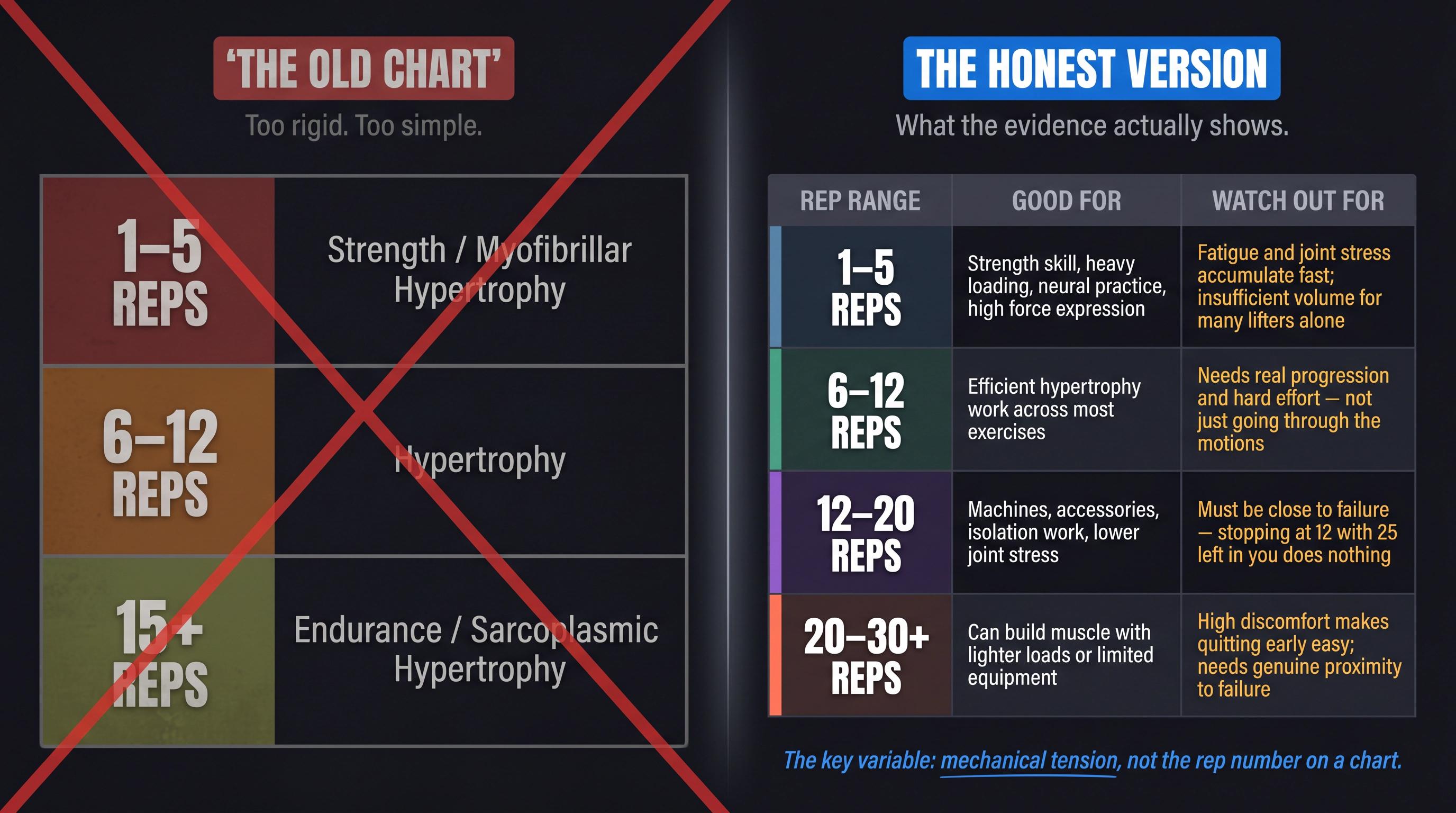
Old-school rep range charts look like this:
- 1–5 reps = strength / myofibrillar hypertrophy
- 6–12 reps = hypertrophy
- 15+ reps = endurance / sarcoplasmic hypertrophy
There's practical truth buried in there — heavier loads do bias more strength-specific adaptations, and higher volumes do bias more size-specific adaptations. But the chart is too rigid to be a programming rule.
Here's a more honest version:
| Rep range | What it's good for | What to watch |
|---|---|---|
| 1–5 reps | Strength skill, heavy loading, neural practice, high force expression | Fatigue and joint stress accumulate fast; insufficient volume for many lifters on its own |
| 6–12 reps | Efficient hypertrophy work across most exercises | Still needs real progression and hard effort — not just going through the motions |
| 12–20 reps | Great for machines, accessories, isolation work, lower joint stress | Must be close enough to failure — stopping at 12 when you had 25 in you does nothing |
| 20–30+ reps | Can build muscle, especially with lighter loads or limited equipment | High discomfort makes it easy to quit early; needs genuine proximity to failure |
For the complete rep range breakdown — including what the research actually shows about how each range drives adaptation — that's a full separate guide.
The key variable is not the rep number. It's whether enough muscle fibers experience enough mechanical tension for enough total work, accumulated over time. How much effort you're actually putting in — measured precisely through RPE and reps in reserve — matters far more than which bracket on a chart your set lands in.
A hard set of 20 reps — taken close to failure — can build muscle. A lazy set of 5 reps — stopped with plenty left in the tank — doesn't do much for either size or strength. The rep range sets the context; the effort and the load deliver the stimulus.
Ready to Get Stronger?
Join 2,000,000+ lifters tracking their workouts with Stronger. Available on iOS and Android.
Start tracking freeHow close to failure should you train for hypertrophy?
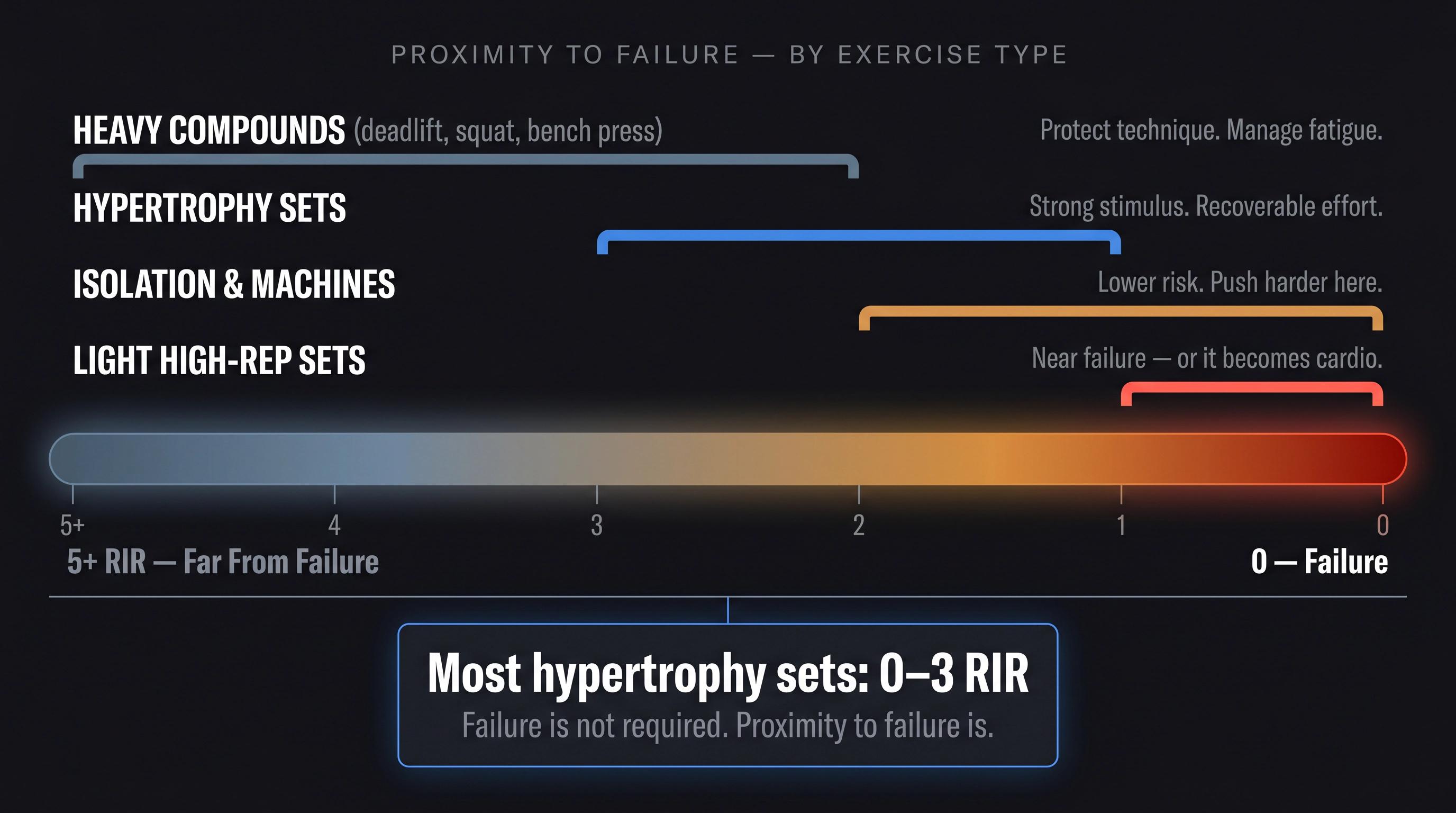
For hypertrophy, most working sets should land somewhere around 0–3 reps in reserve (RIR) on isolation lifts and 1–4 RIR on heavier compound lifts. "Reps in reserve" means how many reps you could have done before true muscular failure.
You don't need to fail every set.
A 2023 Sports Medicine systematic review found no clear evidence that training to momentary failure is superior to stopping short of failure for hypertrophy when total volume is matched. It also noted that low-load training likely needs to be taken closer to failure than heavy-load training. (Springer)
A 2024 Florida Atlantic University analysis of a meta-analysis supported a similar conclusion: proximity to failure appears more relevant for hypertrophy than for strength, with roughly 0–5 RIR being appropriate for muscle growth while strength work can often stay farther from failure with heavier loads. (Florida Atlantic University)
The practical rule, by exercise type:
- Heavy barbell compound sets (deadlift, squat, bench): stop with 2–4 RIR most of the time. Protecting technique and managing fatigue matter here.
- Standard hypertrophy sets: 1–3 RIR. Hard enough to produce a strong stimulus; not so hard that recovery tanks.
- Isolation and machine work: 0–2 RIR. Safer to push harder when the risk profile is lower.
- Light high-rep sets: get very close to failure, or they become cardio with dumbbells.
If your reps collapse from set 1 to set 2, you probably rested too little, overshot your effort, or took on too much volume at once. Rest longer, scale back, or recalibrate effort — don't grind through bad sets in the name of toughness.
Our guide to how long to rest between sets goes into detail on why rest period length affects your actual training stimulus — not just how hard the workout feels. The short version: for heavy strength work, 3–5 minutes is usually right; for standard hypertrophy sets, 1.5–3 minutes; for isolation pump work, 60–120 seconds. Cutting rest short to feel more tired is one of the most common ways to accidentally reduce the quality of your stimulus.
5 myths about sarcoplasmic and myofibrillar hypertrophy
A lot of gym misinformation travels under the cover of these two terms. Here are the five that do the most damage.
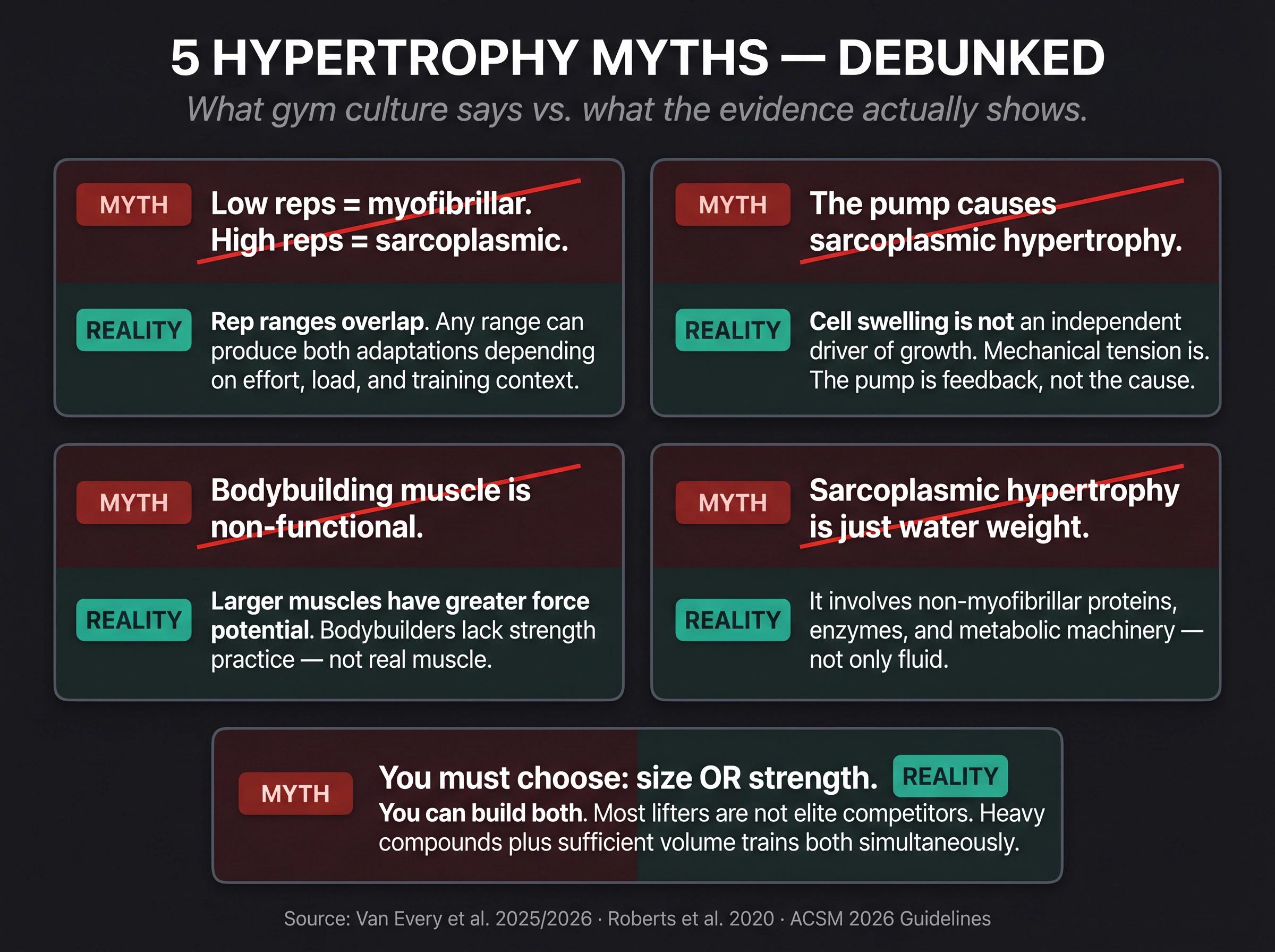
Myth 1: Do low reps build myofibrillar and high reps build sarcoplasmic hypertrophy?
Not exactly — and the "not exactly" matters.
Low reps are excellent for building strength skill and practicing heavy loading. Moderate reps are efficient for hypertrophy across most exercises. High reps can also build meaningful muscle when taken close enough to failure.
But you cannot guarantee that a given rep range produces a specific microscopic adaptation. Heavy sets of 3–5 reps can produce muscle growth. Sets of 15–20 reps can improve the strength of a trained muscle over time. The overlap is real, and the evidence for a clean separability is weak.
Train in the rep ranges that actually work for your goals. Don't treat the rep number as a dial that switches between biological programs.
Myth 2: Does the pump cause sarcoplasmic hypertrophy?
The pump is a useful training signal. It tells you that blood is reaching the target muscle and that you're accumulating meaningful work. It is not the primary mechanism of muscle growth.
The current review evidence is clear on this point: cell swelling and metabolite accumulation are not strongly supported as independent drivers of hypertrophy. (ScienceDirect) The pump can accompany productive training. It does not cause productive training. This follows the same logic as the evidence on time under tension — another variable that feels important but doesn't independently drive structural adaptation.
Use the pump as feedback that the muscle is working. Don't mistake it for the cause of the adaptation. Similarly, whether feeling the muscle actually drives growth follows a related research pattern — subjective sensations and actual adaptations aren't the same thing.
Myth 3: Is bodybuilding muscle non-functional?
This is a bad take that survives because it sounds sophisticated.
Larger muscles generally have greater force potential. The reason some highly muscular people don't lift as much as expected is usually skill, specificity, fatigue, leverages, or the simple fact that they haven't practiced heavy strength expression. A bodybuilder who never trains heavy singles will probably not perform like a powerlifter. But their muscle is not "fake" — they just haven't trained the skill of maximal force production.
A bigger engine still needs a trained driver. The bodybuilder has the engine. They may not have the driving hours.
Different sport, different output. Not different quality of muscle.
Myth 4: Is sarcoplasmic hypertrophy just water weight?
Too simple — in both directions.
Some short-term size changes absolutely can come from swelling, glycogen loading, inflammation, or fluid shifts. These are real and temporary. But the research discussion around sarcoplasmic hypertrophy also involves non-myofibrillar proteins, enzymes, and metabolic machinery — not just water. In the 2022 Vann et al. study, the non-myofibrillar proteins that increased in the high-volume group included proteins involved in signal transduction, energy synthesis and breakdown, and sarcoplasmic or mitochondrial enzymes. (Frontiers)
"Just water" undersells what might actually be happening. "Clearly permanent structural non-contractile muscle mass" overclaims what the evidence shows. The honest answer is somewhere in between, and we don't yet have the research resolution to be more specific than that.
Myth 5: Do you have to choose between size and strength?
You don't — especially if you're not an elite competitor with specific peaking demands.
Beginners can build both simultaneously without even trying. Intermediate and advanced lifters can still develop both, though it requires smarter programming. A program that includes heavy compound work, moderate-rep hypertrophy work, and sufficient accessory volume serves both goals well.
The athletes who seem to have "chosen" are usually sport-specific: powerlifters peak strength expression at the cost of some size accumulation; bodybuilders maximize visual size at the cost of practicing maximal force production. Most lifters reading this aren't competing in either sport. They can chase both. For a deeper look at how hypertrophy and strength training actually differ in their mechanisms and outcomes, that's exactly what the research shows about each goal's specific demands.
How to train for both size and strength
The good news: you don't need to pick a lane between sarcoplasmic and myofibrillar hypertrophy. You need to train in a way that creates enough mechanical tension, enough volume, and enough progressive overload over time to keep adapting.
Most lifters should structure their work with a rough emphasis split:
| Training goal | Weekly emphasis |
|---|---|
| Size | 60–80% of your work |
| Strength | 20–40% of your work |
This gives you enough heavy practice to get stronger and enough volume to grow — without sacrificing either. For a full program designed to build both strength and size simultaneously, a powerbuilding structure is the most direct expression of this philosophy.
What drives muscle growth — the six levers, in priority order:
- Mechanical tension (the primary driver) — hard contractions under load. Without this, nothing else matters much.
- Sufficient volume — enough hard sets per muscle per week. Around 10 weekly sets per muscle group is a practical hypertrophy starting point per the 2026 ACSM guidelines. (ACSM)
- Progressive overload — over time, you do more: more weight, more reps, better technique, longer range of motion. Our guide to how to get stronger breaks down how progressive overload works across different training phases.
- Proximity to failure — sets need to be hard enough to recruit the fibers you're trying to grow.
- Specificity — you get better at what you practice. Compound lifts improve when you train them.
- Recovery and nutrition — training creates the signal; recovery is where the adaptation happens.
Simple weekly training template for size and strength
Main lift / strength work:
- 3–5 sets
- 3–6 reps
- 75–88% of 1RM
- 2–4 reps in reserve
- 3–5 minutes rest
Hypertrophy work:
- 2–4 sets per exercise
- 6–15 reps
- 1–3 reps in reserve
- 1.5–3 minutes rest
Accessory / pump work:
- 2–4 sets
- 12–25 reps
- 0–2 reps in reserve
- 60–120 seconds rest
Sample 4-day workout program for size and strength
This isn't the only way to train — there are other 4-day structures worth exploring depending on your schedule and goals. It's a clean example of how to combine strength-biased and hypertrophy-biased work across a week.
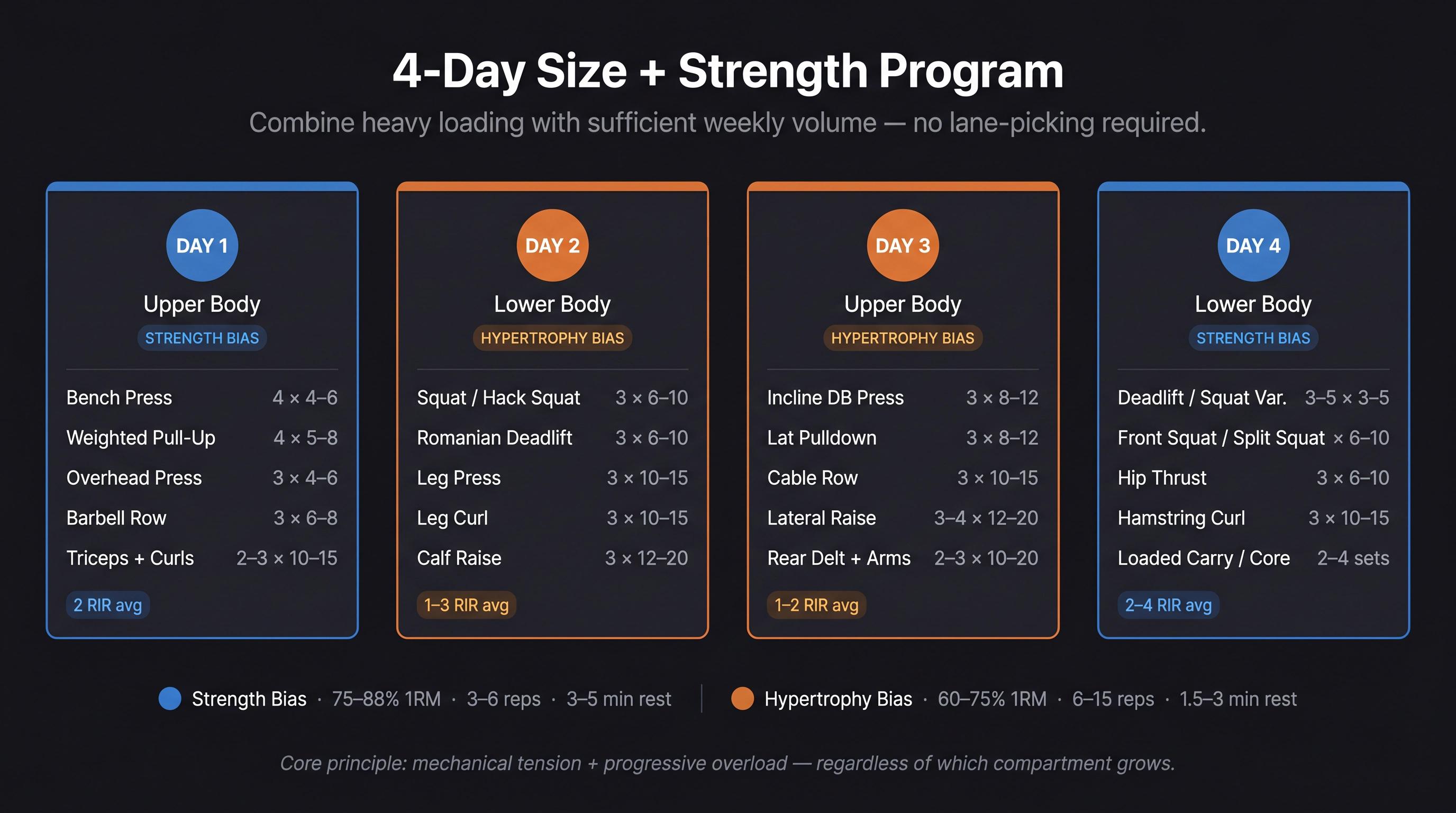
Day 1 — Upper Body, Strength Bias
| Exercise | Sets × Reps | Effort |
|---|---|---|
| Bench press | 4 × 4–6 | 2 RIR |
| Weighted pull-up or heavy lat pulldown | 4 × 5–8 | 1–2 RIR |
| Overhead press | 3 × 4–6 | 2 RIR |
| Barbell or chest-supported row | 3 × 6–8 | 1–2 RIR |
| Triceps pressdown | 2–3 × 10–15 | 0–2 RIR |
| Curl variation | 2–3 × 10–15 | 0–2 RIR |
Day 2 — Lower Body, Hypertrophy Bias
| Exercise | Sets × Reps | Effort |
|---|---|---|
| Squat or hack squat | 3 × 6–10 | 1–3 RIR |
| Romanian deadlift | 3 × 6–10 | 1–3 RIR |
| Leg press | 3 × 10–15 | 1–2 RIR |
| Leg curl | 3 × 10–15 | 0–2 RIR |
| Calf raise | 3 × 12–20 | 0–2 RIR |
Day 3 — Upper Body, Hypertrophy Bias
| Exercise | Sets × Reps | Effort |
|---|---|---|
| Incline dumbbell press | 3 × 8–12 | 1–2 RIR |
| Lat pulldown | 3 × 8–12 | 1–2 RIR |
| Cable row | 3 × 10–15 | 1–2 RIR |
| Lateral raise | 3–4 × 12–20 | 0–2 RIR |
| Rear delt fly | 2–3 × 12–20 | 0–2 RIR |
| Curl variation | 2–3 × 10–20 | 0–2 RIR |
| Triceps extension | 2–3 × 10–20 | 0–2 RIR |
Day 4 — Lower Body, Strength Bias
| Exercise | Sets × Reps | Effort |
|---|---|---|
| Deadlift or squat variation | 3–5 × 3–5 | 2–4 RIR |
| Front squat or split squat | 3 × 6–10 | 1–3 RIR |
| Hip thrust or good morning | 3 × 6–10 | 1–3 RIR |
| Hamstring curl | 3 × 10–15 | 0–2 RIR |
| Loaded carry or core work | 2–4 sets | Hard but clean |
This program isn't "half sarcoplasmic, half myofibrillar." It's better than that. It trains heavy force production, skill on big lifts, sufficient weekly volume, multiple rep ranges, high-effort accessory work, and recoverable progression. That's what most serious lifters actually need.
How to use double progression for consistent gains
Use double progression for your hypertrophy sets. Pick a rep range — say, 8–12.
Week 1, dumbbell incline press:
| Set | Weight | Reps |
|---|---|---|
| Set 1 | 30 kg | 10 |
| Set 2 | 30 kg | 9 |
| Set 3 | 30 kg | 8 |
Next session, try to add reps:
| Set | Weight | Reps |
|---|---|---|
| Set 1 | 30 kg | 11 |
| Set 2 | 30 kg | 10 |
| Set 3 | 30 kg | 9 |
When you hit the top of the range across all sets:
| Set | Weight | Reps |
|---|---|---|
| Set 1 | 30 kg | 12 |
| Set 2 | 30 kg | 12 |
| Set 3 | 30 kg | 12 |
Increase the weight next session. This method ties hypertrophy training to measurable performance. You're not chasing soreness or pump. You're proving your body is adapting — which is the core of progressive overload applied in practice.
How to know if your training is working
Don't judge your program by how destroyed you feel afterward. That's not a metric. Track these instead.
1. Performance
Are you adding reps or weight over time? Examples:
- Bench press: 80 kg × 8 becomes 80 kg × 10
- Squat: 120 kg × 5 becomes 125 kg × 5
- Lateral raise: 12 kg × 15 becomes 14 kg × 12
If numbers aren't moving across 4–6 weeks, something needs to change.
2. Volume
Are you getting enough hard sets per muscle per week? Around 10 hard sets per muscle group per week is a practical hypertrophy starting point, per the 2026 ACSM guidelines. (ACSM) Most intermediate lifters find they can handle and benefit from more over time — but 10 is a sensible baseline.
3. Effort
Are your sets actually hard? A set of 15 that you could have done for 30 isn't a hypertrophy set — it's a warm-up with ambition. Track your RIR honestly.
4. Body Measurements and Photos
Track bodyweight, waist, arms, chest, and thighs. Take progress photos at consistent intervals. Scale weight alone tells you almost nothing about muscle growth.
5. Strength Score and Strength Standards
If your main lifts are rising relative to your bodyweight, your strength is improving. This is where benchmark-based tracking becomes genuinely useful — not just as a motivational tool, but as a leading indicator of whether your hypertrophy work is translating to real performance. Check where your lifts stand against strength benchmarks by bodyweight and gender to see how your progress compares globally.
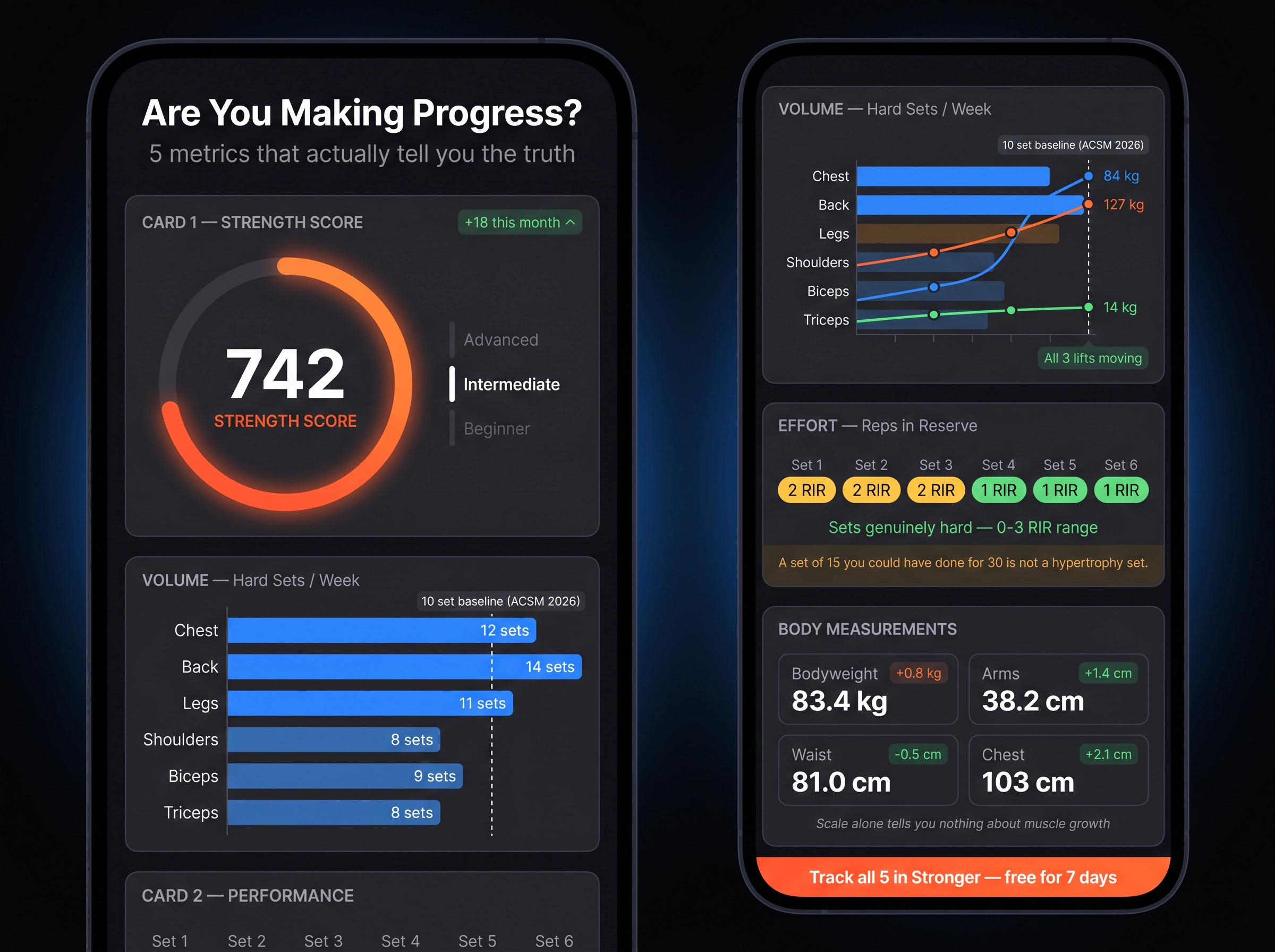
This is exactly what Stronger is built for.
Our app tracks sets, reps, weights, and RPE per set. It shows you strength curves over time, volume and frequency breakdowns by muscle group, body measurements, and your Strength Score — a proprietary metric that adjusts for bodyweight and gender to show you where you actually stand relative to global standards. When your hypertrophy work is producing real adaptation, your Strength Score moves. When it isn't, the data shows you before weeks of wasted effort pile up.
Hypertrophy is slow. Without tracking, you'll confuse noise for progress — a good week feels like a breakthrough, a hard week feels like failure, and neither tells you what's actually happening over the 6–12 week arc that actually matters.
Try Stronger free for 7 days — track performance, volume, body measurements, and strength standards in one place, without spreadsheets.
Training plateau troubleshooting: when progress stalls
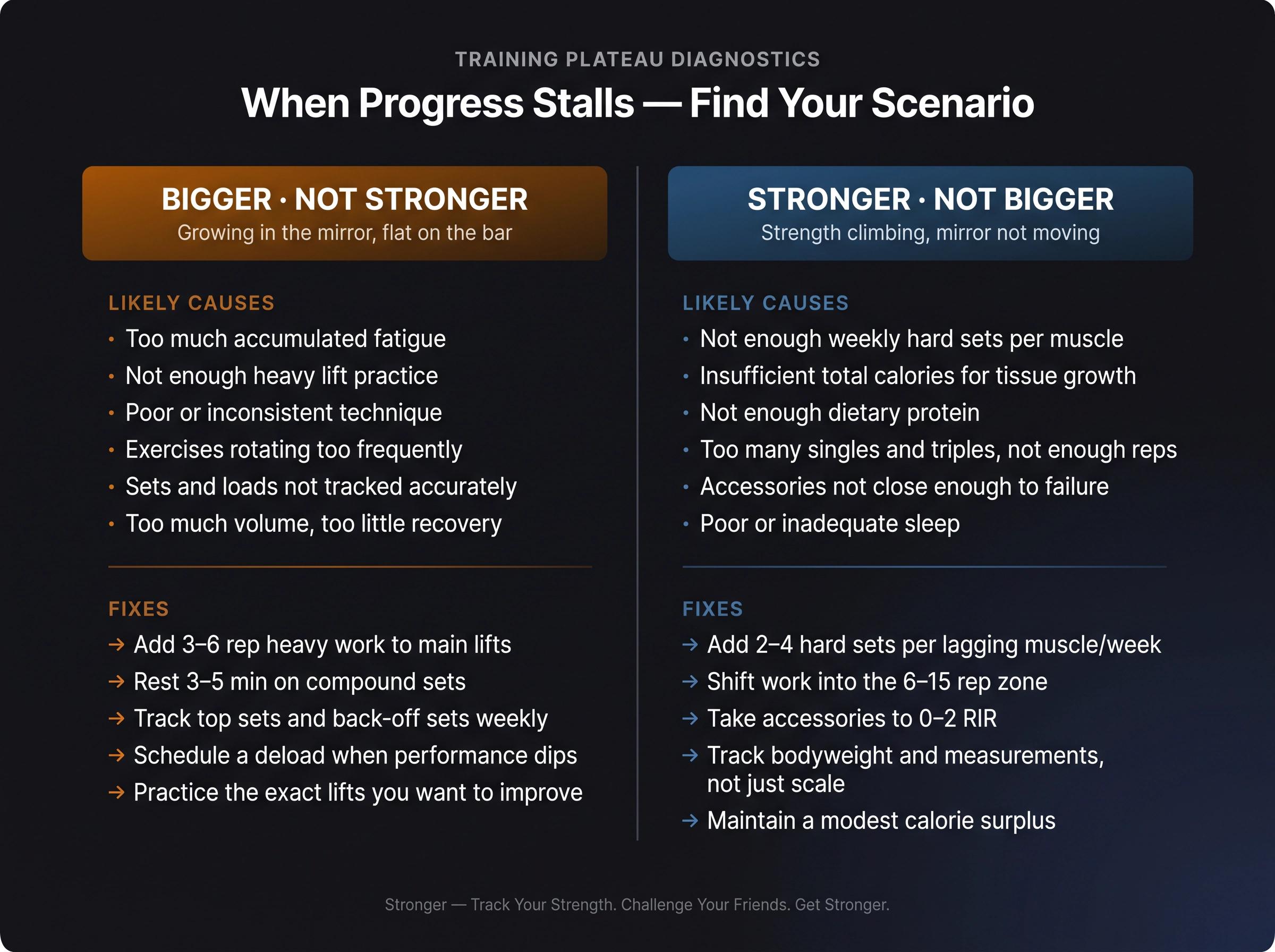
Getting bigger but not stronger?
First, define "stronger." If your bench press 1RM isn't moving, but your incline dumbbell press went from 30 kg × 8 to 34 kg × 12, you did get stronger — just not in the metric you're watching. Check multiple performance markers before concluding you're stalled.
But if muscles are visibly growing and every performance metric is genuinely flat, likely causes include:
- Too much fatigue — more isn't always more
- Not enough heavy practice on the lifts you care about
- Poor or inconsistent technique
- Changing exercises too frequently (technique skill isn't accumulating)
- Not tracking sets, reps, and loads accurately
- Too much volume without adequate recovery
- Always training to momentary failure on heavy compounds
Fixes:
- Keep some heavy work in the 3–6 rep range on main lifts
- Extend rest periods to 3–5 minutes on compound sets — our rest period guide covers why this matters more than most lifters realize
- Track top sets and back-off sets to see trends over time
- Plan a structured deload when performance feels suppressed for multiple sessions in a row
- Practice the specific lifts you want to improve
Getting stronger but not bigger?
This is extremely common early in a training career — strength can improve substantially through technique, coordination, bracing efficiency, and neural improvements, well before significant hypertrophy occurs.
But if size is genuinely not moving after 3–6+ months of consistent training, likely causes include:
- Not enough weekly hard sets per muscle group
- Not enough total calories to support tissue growth
- Not enough dietary protein
- Too much focus on singles and triples, not enough higher-rep volume
- Not enough proximity to failure on accessories
- Changing exercise selection too often
- Poor or inadequate sleep
Fixes:
- Add 2–4 hard sets per lagging muscle per week
- Shift more work into the rep ranges that favor size accumulation — primarily the 6–15 zone
- Take accessory work closer to failure (0–2 RIR)
- Track bodyweight and measurements consistently — progress photos often show change that the scale misses
- Maintain a modest calorie surplus if muscle gain is the primary goal
Ready to Get Stronger?
Join 2,000,000+ lifters tracking their workouts with Stronger. Available on iOS and Android.
Start tracking freeFrequently Asked Questions
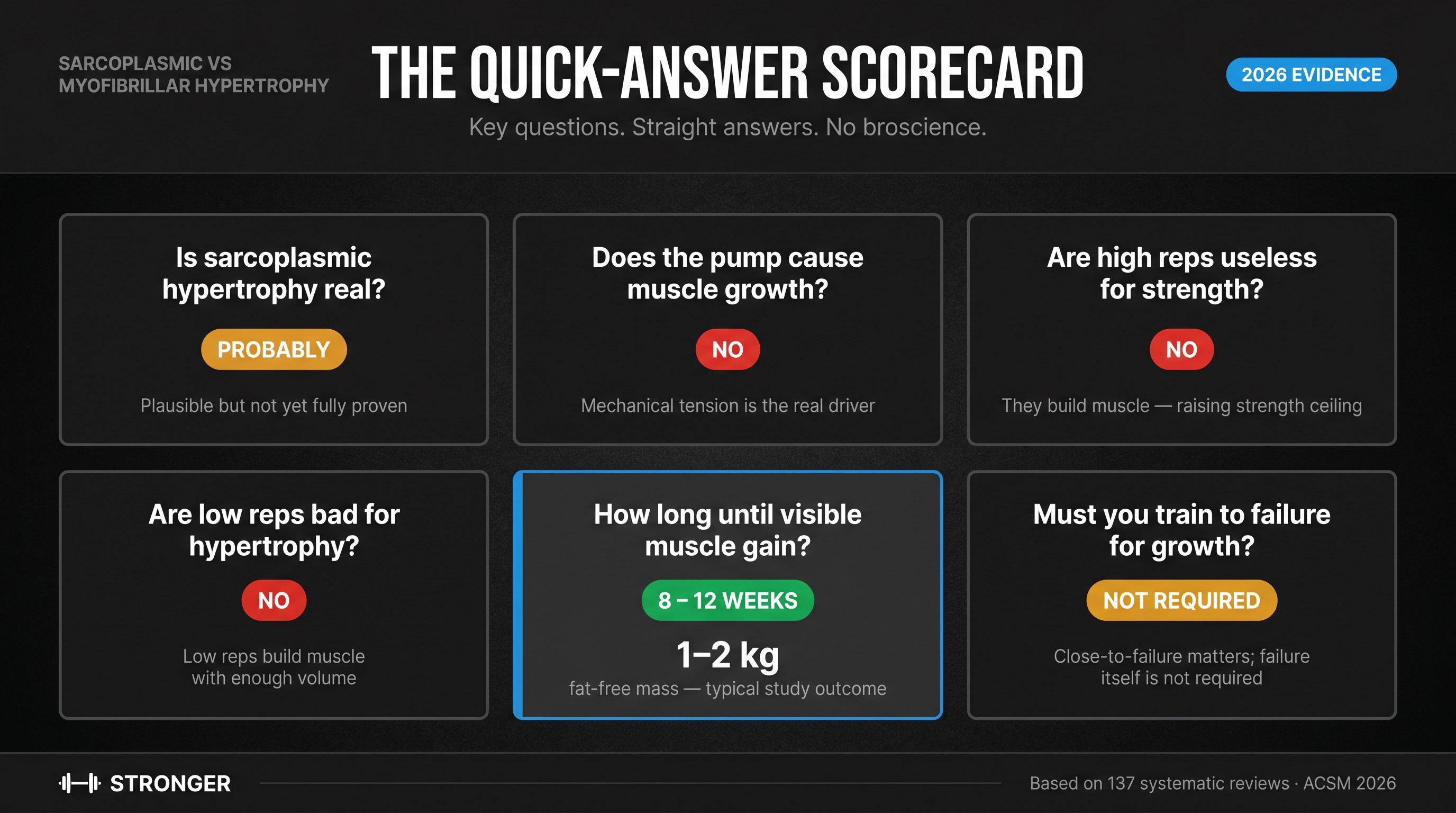
Is sarcoplasmic hypertrophy real?
Probably, in some contexts. The clearest honest answer is "plausible but not fully settled." Research shows evidence for disproportionate sarcoplasmic or non-myofibrillar expansion, especially under high-volume training conditions in trained lifters. But other studies don't show it clearly, and the mechanisms aren't established with precision. The 2020 Frontiers in Physiology review called for more careful research before treating it as a fully validated and reliable training outcome. (Frontiers)
Is myofibrillar hypertrophy better?
It depends on your goal. If maximal strength is the priority, contractile adaptations and strength-specific practice matter most. If the goal is visual size and bodybuilding, total muscle cross-sectional area matters too — and both myofibrillar and potentially sarcoplasmic growth contribute. For most lifters, the distinction is less important than consistent volume, tension, and progressive overload regardless of which compartment grows. How hypertrophy and strength training actually differ in their mechanisms is a more useful question than which type of hypertrophy to chase.
What rep range builds myofibrillar hypertrophy?
Heavier work — often in the 3–6 rep range — is more strength-specific and may bias contractile adaptations. But there's no clean equivalence where "5 reps = myofibrillar hypertrophy" and "12 reps = sarcoplasmic hypertrophy." The rep range sets context; the load and proximity to failure deliver the stimulus. The complete rep range breakdown covers what each range actually does and why.
What rep range builds sarcoplasmic hypertrophy?
Higher-volume training in the moderate-to-high rep range (roughly 10–20 reps) may bias more non-myofibrillar adaptation, particularly in trained lifters. But this isn't guaranteed, and it still requires hard effort and progressive overload to be effective.
Does the pump cause sarcoplasmic hypertrophy?
No. Cell swelling and metabolic stress are not strongly supported as independent drivers of muscle growth. (ScienceDirect) The pump can be useful feedback that you're hitting the target muscle — but it doesn't cause the adaptation. Mechanical tension is still the primary driver.
Should I train to failure for hypertrophy?
Not necessarily, and not on every set. Training close to failure matters for hypertrophy — but actual momentary failure isn't clearly superior to stopping 1–3 reps short when volume is matched. (Springer) For heavy compound lifts, staying 2–4 reps shy of failure protects technique and manages fatigue. For isolation and accessory work, pushing closer to failure (0–2 RIR) is reasonable and safer. The RPE and RIR system gives you a precise language for calibrating this across different exercises.
Are high reps useless for strength?
No. High reps can build muscle, and more muscle creates a higher strength ceiling. High-rep training is just less efficient for practicing maximal force production specifically. Use heavy work for strength skill and high-rep work for volume accumulation — both have a role.
Are low reps bad for hypertrophy?
No. Low-rep training can build muscle, especially when total hard-set volume is sufficient. Low reps are less time-efficient for accumulating hypertrophy volume and accumulate more joint stress and fatigue per set, which is why most hypertrophy-focused programs use higher reps for the majority of work.
How long does hypertrophy take to show up?
Visible muscle growth takes weeks to months of consistent work. A 2025/2026 review described 1–2 kg of fat-free mass gain after 8–12 weeks as a realistic outcome for many training studies — with progress slowing as training experience increases. (ScienceDirect) The early gains you feel in the first few weeks are largely neural and technical. Structural hypertrophy requires more time and consistent stimulus.
Can I build muscle without getting stronger?
For a period, possibly — particularly during early training when muscle tissue can grow while technique is still developing. But if your reps, loads, control, and volume never improve over months, muscle gain will eventually stall. Long-term hypertrophy and performance progression are strongly linked.
Can I get stronger without getting bigger?
Yes, especially through technique refinement and neural improvements, and especially early in a training career. Over the long run, adding muscle generally raises the ceiling for strength expression. Most advanced lifters find that maximizing strength requires meaningful muscle mass in the relevant structures.
What's the best app for tracking hypertrophy and strength progress?
Stronger is built exactly for this. It tracks sets, reps, weights, and RPE per set — giving you the performance data to confirm whether your hypertrophy work is translating to real strength gains. The Strength Score benchmarks your progress across major lifts relative to bodyweight and sex. Volume breakdowns show you how many hard sets each muscle group is actually receiving per week. And if you want a structured starting point, the AI routine builder generates programs based on your goals, experience, and available equipment. Start your free 7-day trial here.
Sarcoplasmic vs myofibrillar hypertrophy: the bottom line
Sarcoplasmic and myofibrillar hypertrophy are useful scientific concepts. They describe real biological categories. They are not reliable switches you flip with rep range selection, and they are poor foundations for building an entire training philosophy.
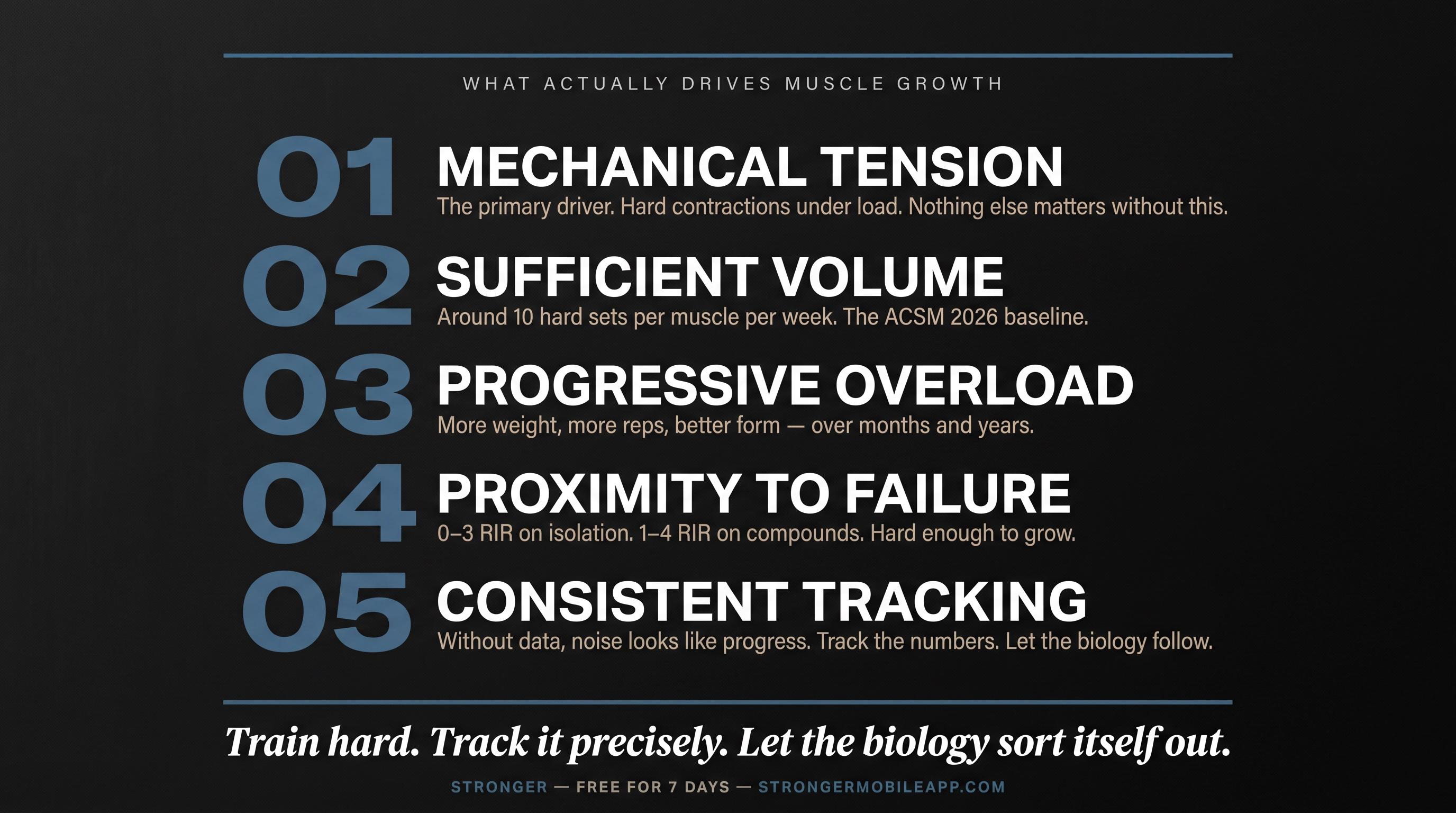
What actually drives muscle growth: mechanical tension, sufficient volume, smart proximity to failure, progressive overload, and consistent tracking over time. These principles apply whether the cellular adaptation is predominantly myofibrillar, sarcoplasmic, or — most likely — a mixture of both.
The best lifters we've seen don't win by picking the correct hypertrophy label. They win by showing up consistently, tracking what matters, recovering between sessions, and making the numbers move over months and years.
Train hard. Track it precisely. Let the biology sort itself out.
Start tracking with Stronger — free for 7 days.
Source Notes
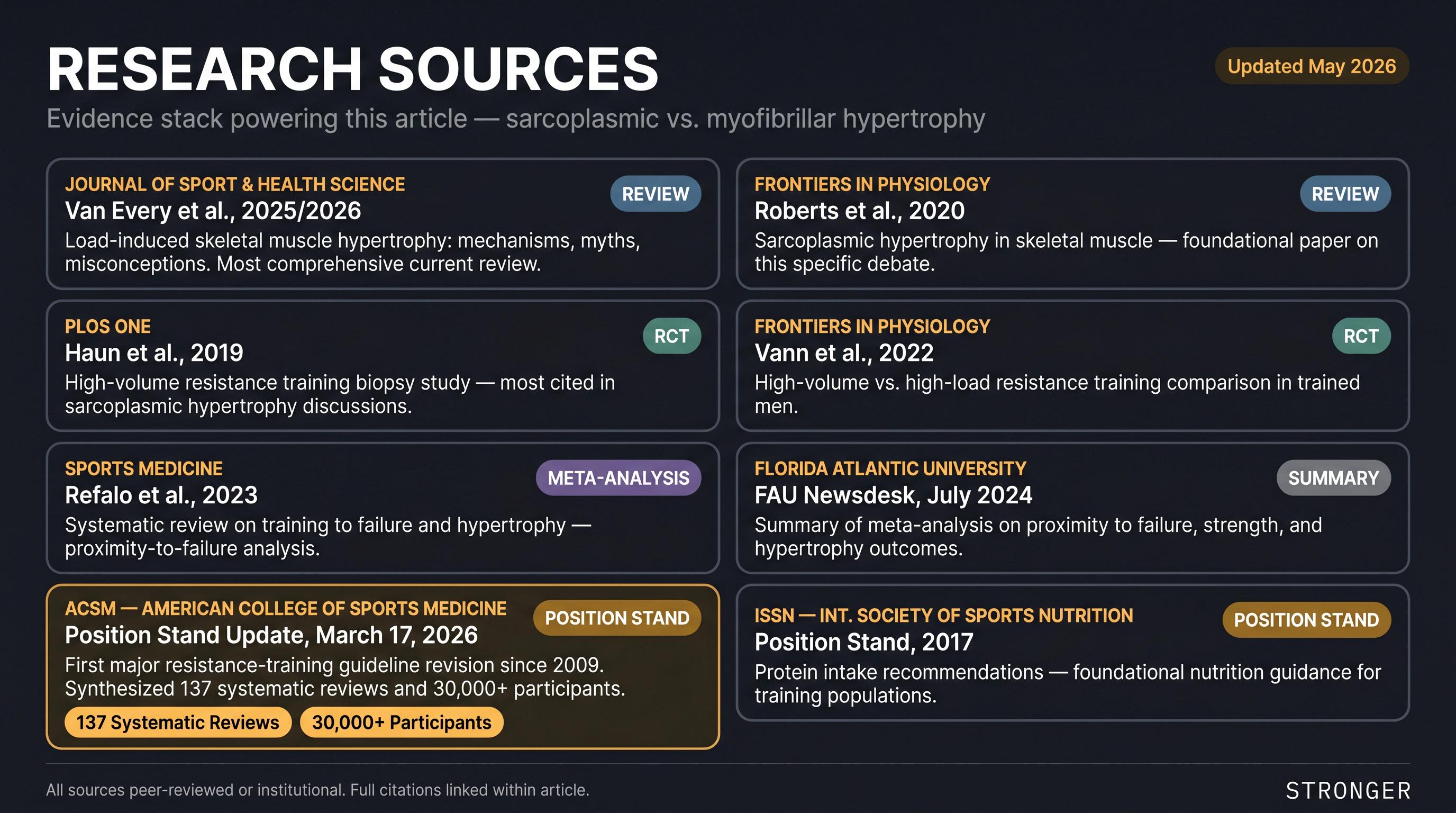
This article was updated on May 7, 2026. The most current training guideline source used here is the ACSM March 17, 2026 update — the first major ACSM resistance-training position stand revision since 2009, synthesizing 137 systematic reviews and more than 30,000 participants. (ACSM)
Key research sources:
- Van Every et al., Journal of Sport and Health Science, 2025/2026: Review on load-induced hypertrophy mechanisms, myths, and misconceptions — the most comprehensive current overview. (ScienceDirect)
- Roberts et al., Frontiers in Physiology, July 14, 2020: Detailed review of sarcoplasmic hypertrophy evidence and uncertainty — the foundational paper on this specific debate. (Frontiers)
- Haun et al., PLOS ONE, June 5, 2019: High-volume resistance-training biopsy study most cited in sarcoplasmic hypertrophy discussions. (PubMed) (PLOS)
- Vann et al., Frontiers in Physiology, March 11, 2022: High-volume vs high-load comparison in trained men. (Frontiers)
- ACSM, March 17, 2026: Updated resistance training recommendations. (ACSM)
- Refalo et al., Sports Medicine, 2023: Systematic review on training to failure and hypertrophy. (Springer)
- Florida Atlantic University, July 31, 2024: Summary of meta-analysis on proximity to failure, strength, and hypertrophy. (Florida Atlantic University)
- International Society of Sports Nutrition position stand, 2017: Protein intake recommendations. (ISSN)
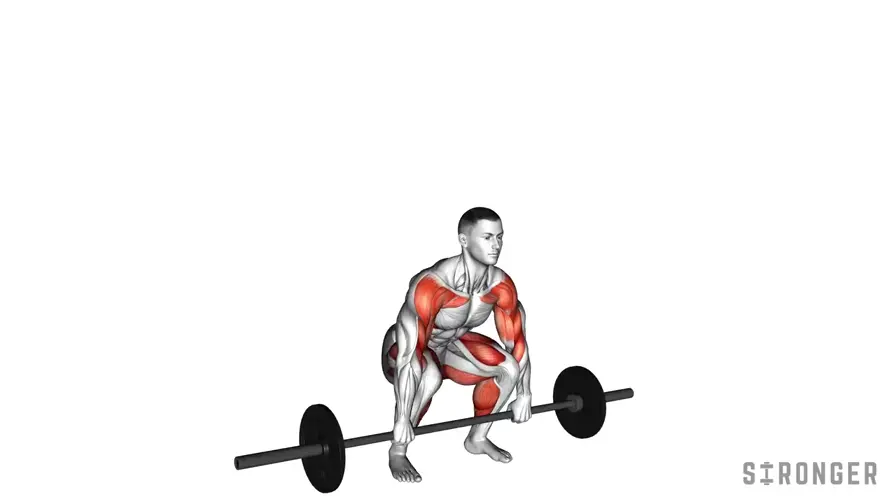
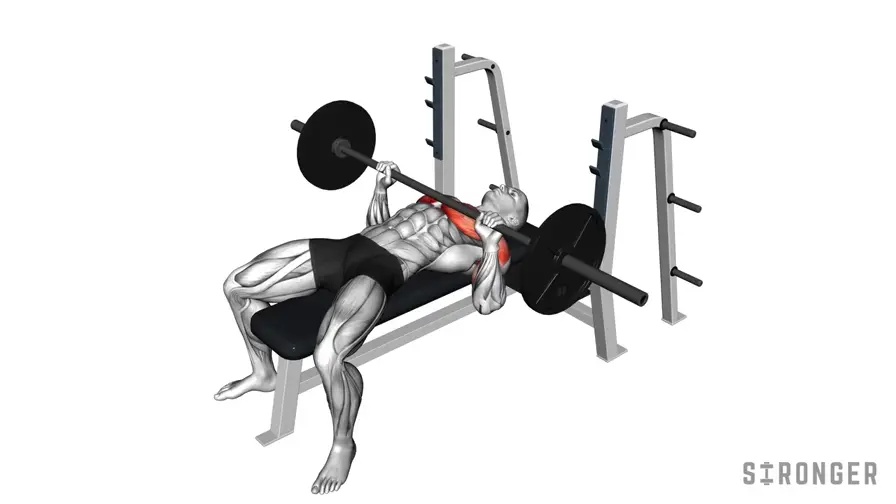
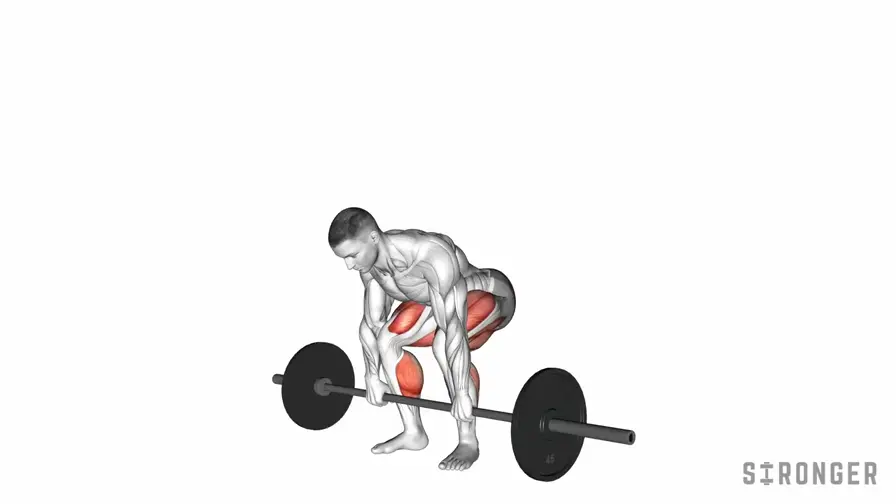
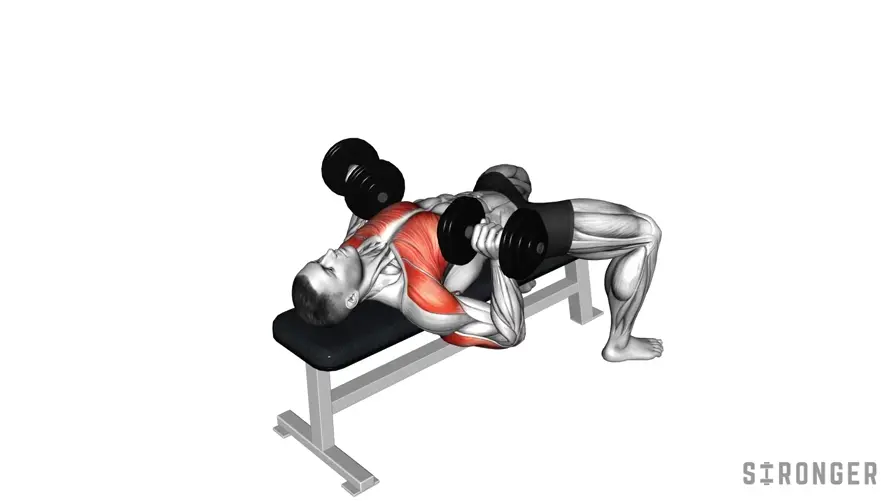
Exercises in this guide
Stronger Editorial Team
Certified strength & conditioning specialists with 10+ years of coaching experience
The Stronger editorial team produces evidence-based training content for lifters of all levels.
Ready to Get Stronger?
Join 2,000,000+ lifters tracking their workouts with Stronger. Available on iOS and Android.
Start tracking free