

German Volume Training: The 10×10 Program Guide
Most people who start German Volume Training fail on set three of day one. Not because the program is hard — it is, eventually — but because they loaded it wrong. They loaded it like a normal working set, the first few sets felt fine, and by set six they were grinding out six reps at a weight they planned to hit for ten. The program didn't fail them. They just misread the setup.
Here's what they also missed: the research on GVT has a counterintuitive finding that most articles skip entirely. The two most rigorous controlled studies comparing 10 sets to 5 sets found that 10-set GVT did not outperform 5 sets for hypertrophy or strength — and in some outcomes, the lower-volume group did better. That doesn't mean GVT is worthless. It means the results come from structured volume accumulation on a few key exercises, not from the number 10 specifically.
This guide gives you the honest evidence, the complete protocol, three split options, a full 6-week plan, and a tracking system that makes the details manageable. Tracking this kind of structured block — where rest periods, total reps, and progression decisions all compound over six weeks — is exactly what we built Stronger for. By the end, you'll know whether GVT is right for you and exactly how to run it.

What Is German Volume Training?
German Volume Training — often called GVT or the 10 sets method — is a hypertrophy protocol built around performing 10 sets of 10 reps on one main exercise per target muscle group, using the same load across all sets, with strict rest intervals and controlled technique.
Charles Poliquin popularized it in English-language strength circles. The method is often traced to Germany in the 1970s, attributed to weightlifting coach Rolf Feser. Poliquin's classic version emphasized 10 sets of a single exercise, roughly 60% of 1RM, controlled tempo, short rest, detailed logging, and adding weight only after completing all 10×10 with consistent rest.
Here's what the full protocol looks like at a glance:
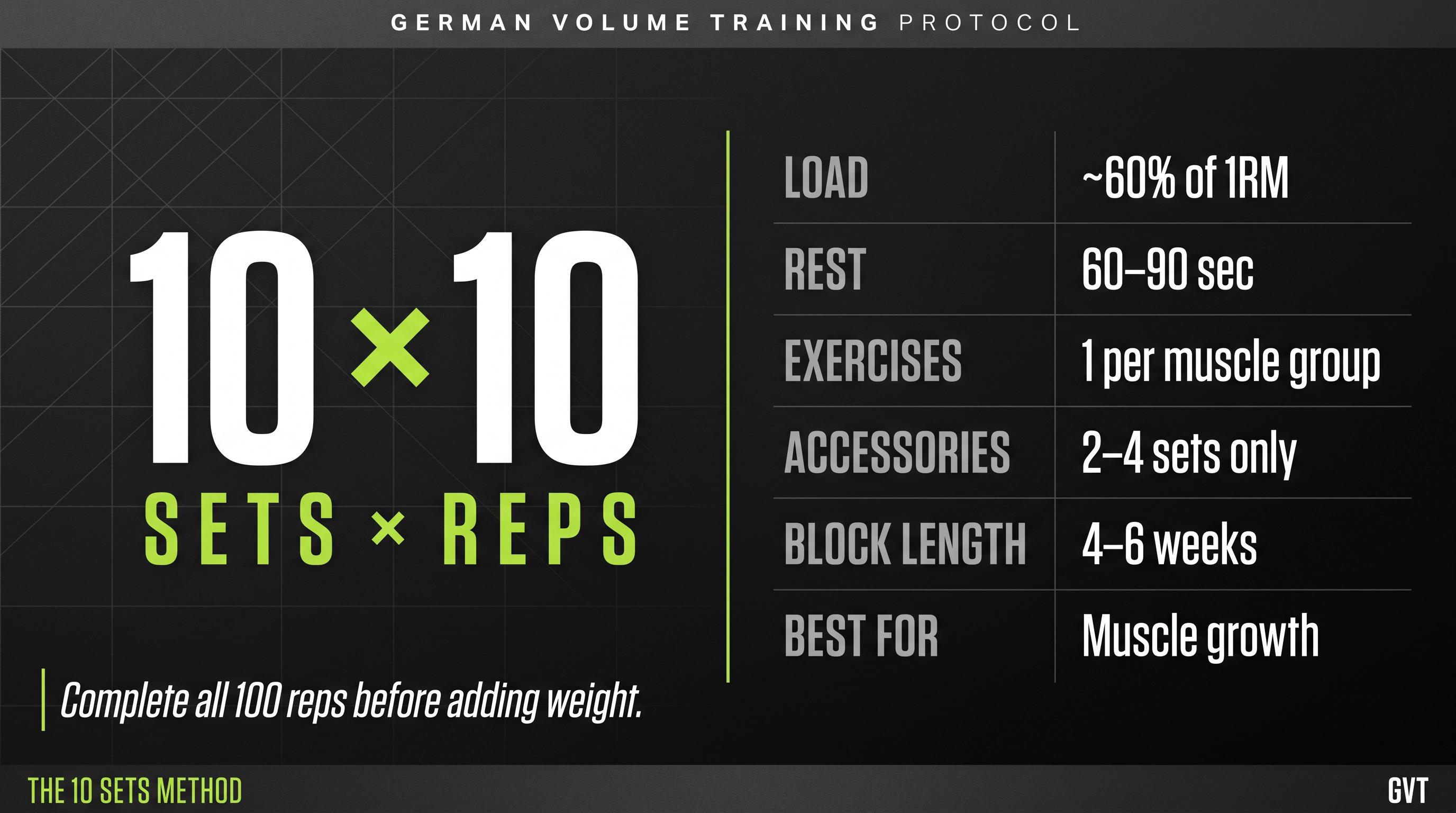
| Variable | Classic GVT Target |
|---|---|
| Main lift volume | 10 sets × 10 reps |
| Load | Around 60% of 1RM, or a weight you could lift for about 18–20 reps |
| Rest | 60–90 seconds for strict GVT; 90–120 seconds is more practical for compounds |
| Exercise choice | 1 main exercise per target muscle group |
| Accessories | 2–4 lighter accessory sets — not another full workout |
| Block length | 4–6 weeks, followed by a deload or lower-volume phase |
| Best goal | Muscle growth, work capacity, short-term specialization |
| Poor fit | Beginners, max-strength peaking, cutting aggressively, injury rehab |
The simplicity is the appeal and the trap. Because early sets feel manageable, most lifters start too heavy, stack too many exercises, and treat GVT as something to survive rather than something to execute precisely. What the evidence actually says about that approach is worth understanding before you build your first session.
Does German Volume Training Actually Work?
Short answer: yes. But not because 10 sets is better than fewer.
The 2017 Amirthalingam study assigned 19 trained men to either 10 sets or 5 sets of 10 reps for six weeks in a 3-day split. Both groups improved. The 10-set version was not more effective for hypertrophy or strength. The 5-set group had greater gains in some upper-body strength outcomes. The authors recommended 4–6 sets per exercise because gains may plateau beyond that in this style of training. (Amirthalingam et al., 2017)
The 2018 Hackett pilot study ran a 12-week comparison of 5 sets versus 10 sets of 10 reps at 60–80% 1RM in 12 trained men. Again, 10 sets did not produce greater hypertrophy or strength. Lean leg mass actually decreased in the 10-set group between weeks 6 and 12, suggesting that the second half of an extended 10-set block can work against you. (MDPI)
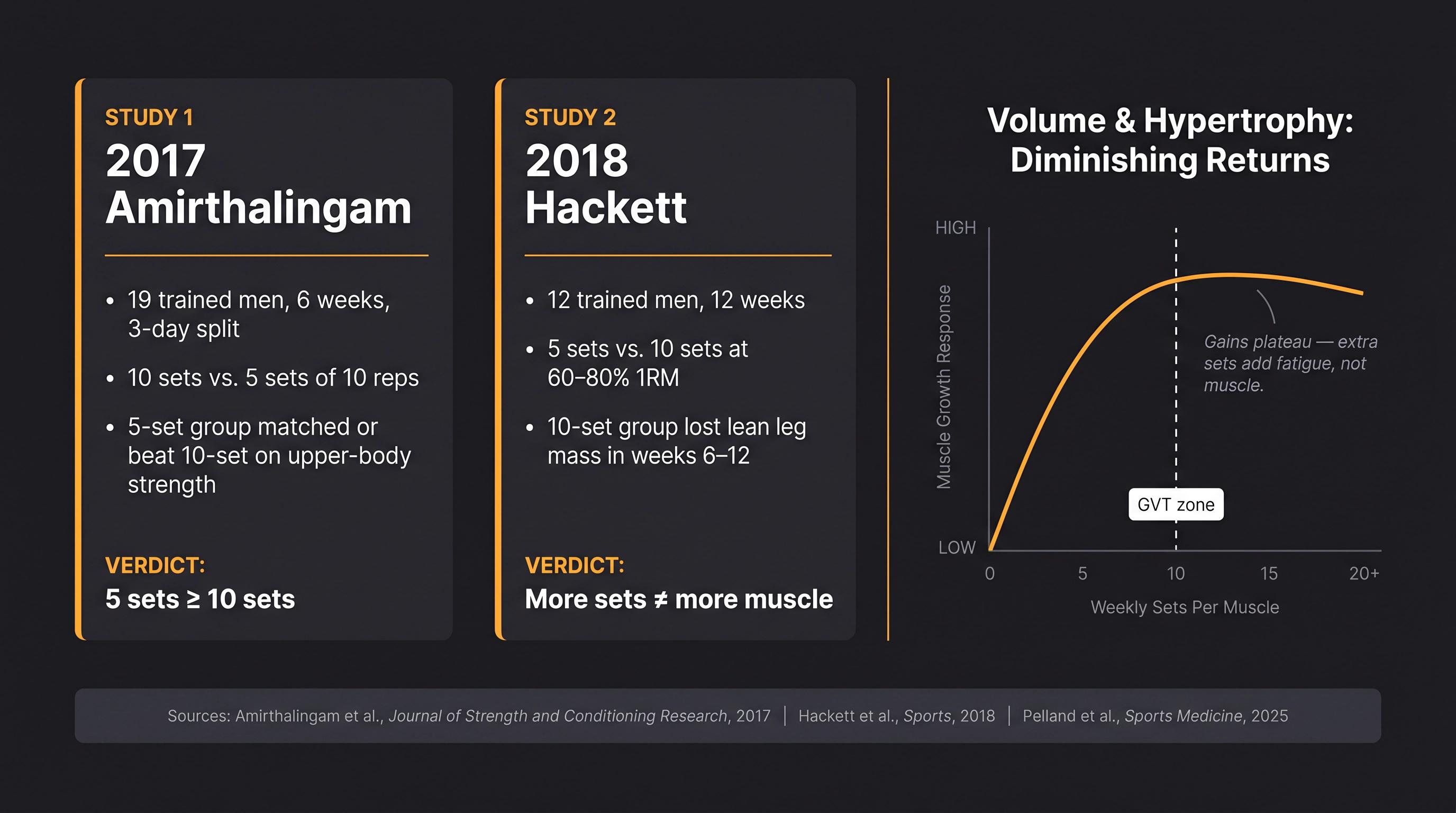
The bigger picture from 2024–2026 research confirms both the promise and the ceiling. A 2025 Sports Medicine meta-regression by Pelland and colleagues found a positive relationship between weekly set volume and muscle hypertrophy — but with clear diminishing returns and increasing uncertainty as volume climbs. (Pelland et al., 2025) ACSM's 2026 resistance-training update used roughly 10 sets per muscle group per week as a practical hypertrophy target for many adults. (ACSM)
One 10×10 exercise gives you 10 sets in one session. That's at or near the practical sweet spot for many lifters — but only if you're recovering between sessions, staying consistent, and progressing load deliberately. Add too many accessories, train the muscle too soon, or take every set to failure, and GVT stops being productive volume and becomes a fatigue management problem.
The honest takeaway: GVT works as a short-term overload block for intermediate lifters who can recover from it. It works because it forces structured volume accumulation on specific movements — not because 10 sets is a magic number. Here's the exact protocol structure that gets results.
German Volume Training Protocol: Step-by-Step
Best Exercises for German Volume Training
A proper GVT session is not 10 sets of everything. It's one primary 10×10 movement per target muscle group, sometimes paired with one opposing movement. The exercise you choose determines whether the set accumulation is productive or just exhausting.
Good GVT exercises share five traits:
- They're repeatable — you can set up identically on set 1 and set 10.
- They allow consistent technique under fatigue.
- They load the target muscle well throughout the range of motion.
- They don't require peak coordination (no Olympic lifts, no ballistic work).
- They don't punish a small secondary muscle before the primary muscle is trained.
Here's a practical guide by muscle group:
| Muscle / Goal | Best GVT Choices | Use Caution With |
|---|---|---|
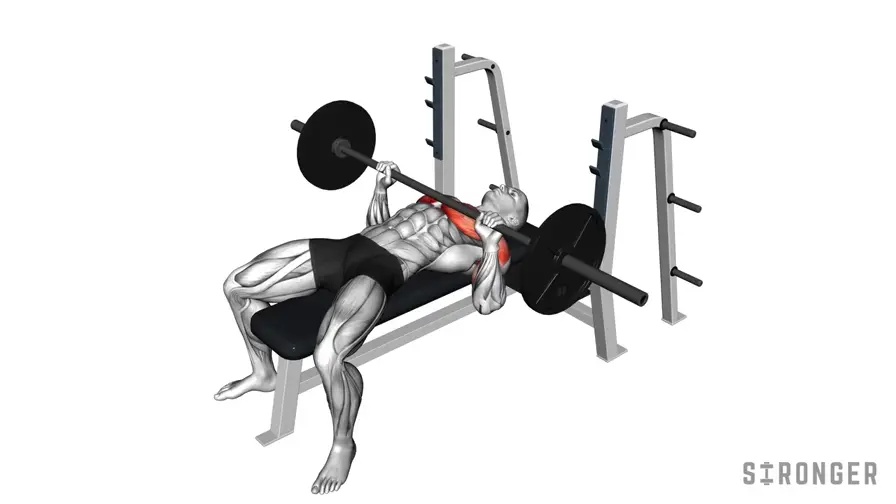
| Chest | Bench press, incline dumbbell press, machine chest press | Dips if shoulders are sensitive |
| Back width | Lat pulldown, assisted pull-up, neutral-grip pulldown | Strict pull-ups if 10×10 is unrealistic |
| Back thickness | Chest-supported row, seated cable row, machine row | Barbell row if lower back fatigues first |
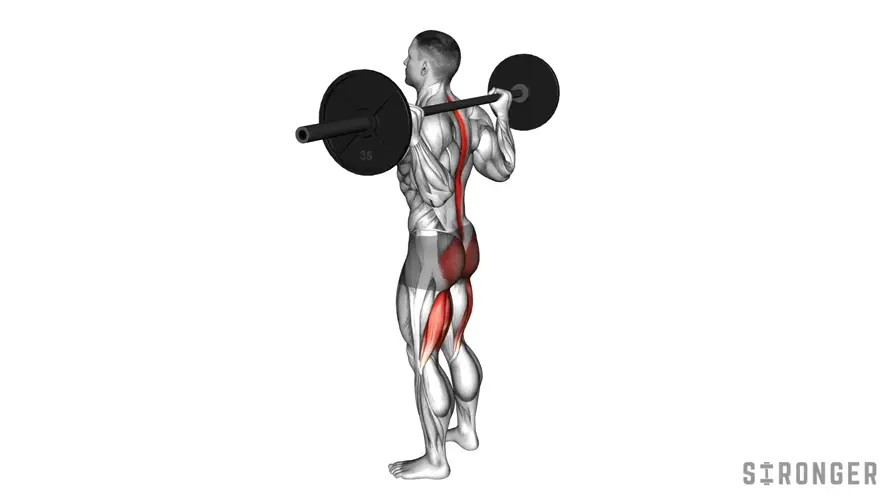
| Quads | Hack squat or leg press, high-bar squat, front squat | Low-bar squat if form breaks |
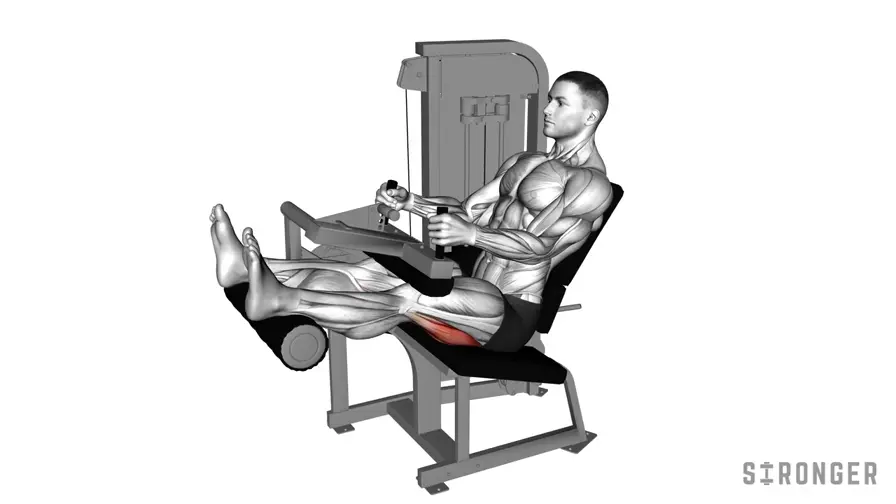
| Hamstrings | Seated leg curl, lying leg curl | Romanian deadlift at 10×10; use lower volume |
| Glutes | Hip thrust, leg press variation, split squat variation | Deadlift 10×10 |
| Shoulders | Machine shoulder press, seated dumbbell press | Standing press if bracing fails |
| Biceps | EZ-bar curl, cable curl, incline curl | Cheat curls |
| Triceps | Cable pressdown, close-grip bench, overhead cable extension | Skull crushers if elbows flare |
Avoid conventional deadlifts, Olympic lifts, heavy good mornings, and any technically demanding lift where fatigue makes form unpredictable. GVT should be hard because of volume, not because every rep becomes a gamble with your lower back.
For a deeper look at why repeatable compound lifts are the backbone of any measurable training block, read our guide to compound exercises and progressive overload.
What Weight to Use for German Volume Training
The traditional recommendation is 60% of your 1-rep max, or a weight you could lift for roughly 18–20 reps in one all-out set. Poliquin's original guideline used a load you could handle for about 20 reps, corresponding to roughly 60% 1RM for many lifters.
For your first GVT block, start slightly conservative:
| Exercise Type | Starting Load |
|---|---|
| Machine or stable isolation lift | 60% of 1RM, or 18–20RM |
| Bench press, row, pulldown, press | 55–60% of 1RM |
| Squat, hack squat, leg press | 50–60% of 1RM |
| New exercise variation | 50–55% of estimated 1RM |
| Anything that stresses the lower back heavily | Do not start with 10×10 |
If you don't know your 1RM, estimate it:
1RM Formula
Estimated 1RM = weight × (1 + reps ÷ 30)Example: You bench 185 lb for 8 reps 185 × (1 + 8 ÷ 30) = 185 × 1.267 = ~234 lb estimated 1RM
A conservative GVT starting load: 234 × 0.55–0.60 = 129–140 lb
Round down, not up. The first three sets are supposed to feel too easy. If they feel like a hard working set, you've already started too heavy.
Why GVT Uses the Same Weight for All 10 Sets
The classic GVT challenge isn't finding a heavy set of 10. It's this: Can you complete 100 clean reps with the same load, the same rest period, and the same technique?
The rules are simple:
- Do not pyramid up
- Do not reduce load when it gets uncomfortable
- Do not count ugly reps
- Stop each set at 10 even if you could do more in the early sets — those are part of the accumulated fatigue model
The goal isn't to be tired after set 1. The goal is that sets 9 and 10 are genuinely hard because of what came before.
How Long to Rest Between Sets in German Volume Training
Classic GVT uses 60–90 seconds between sets. That's part of what makes moderate loads challenging. The problem is that many lifters either watch a clock badly or let rest drift to three minutes because the sets start hurting.
A practical rest guide:
| Situation | Rest |
|---|---|
| Strict classic GVT | 60–90 seconds |
| Heavy compound lifts | 90–120 seconds |
| Squats, leg press, hack squat | 90–150 seconds if needed |
| Isolation lifts | 60–90 seconds |
| Reps collapsing before set 8 | Rest longer before reducing load |
A 2024 Bayesian meta-analysis on rest intervals found that hypertrophy can occur across many rest durations, but rest periods over 60 seconds may offer a small hypertrophy advantage — likely because longer rests preserve total volume load across the session. The same paper found no clear additional benefit from resting beyond 90 seconds, though the evidence remains uncertain. (Frontiers)
For a full breakdown of rest period science across different training goals, read our guide: How Long to Rest Between Sets.
The practical rule: don't sacrifice rep quality to obey a stopwatch. Rest periods are part of the prescription, which is why Stronger includes a built-in rest timer — once sets 7 through 10 start hurting, perceived time becomes unreliable. A timer you don't have to think about keeps the rest periods honest.
German Volume Training Tempo: How to Control Reps
Traditional GVT used a slow eccentric: 4-0-2 on large-range movements, 3-0-2 on smaller lifts. That can work, but you don't need to turn every rep into a 10-second grind.
A practical modern approach:
- Lower under control: 2–3 seconds
- Pause only if needed: 0–1 second at bottom
- Lift smoothly: strong but not sloppy
- Full range of motion: every rep should look the same
A controlled 2-second eccentric with full depth beats a performative 4-second eccentric with the spine flexing under load. Position always wins over tempo numbers.
How to Use RPE in German Volume Training
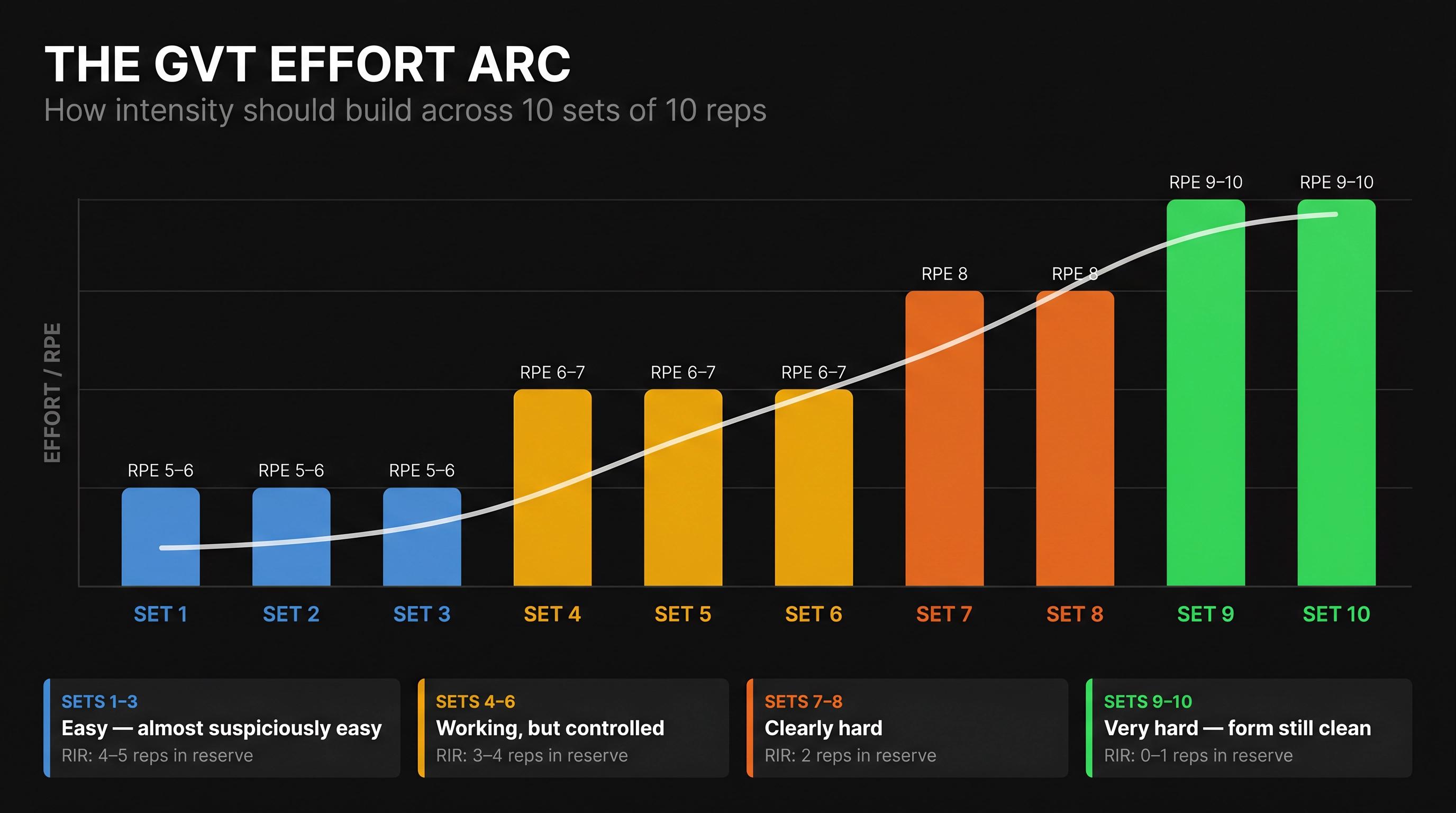
GVT should get hard gradually. If you're hitting RPE 9 on set 4, you started too heavy. If set 10 feels like RPE 6, you left progress on the table.
A well-loaded 10×10 effort curve looks like this:
| Sets | Target Feel | RPE | Reps in Reserve |
|---|---|---|---|
| 1–3 | Easy, almost suspiciously easy | 5–6 | 4–5 RIR |
| 4–6 | Working, but controlled | 6–7 | 3–4 RIR |
| 7–8 | Clearly hard | 8 | 2 RIR |
| 9–10 | Very hard, form still clean | 9–10 | 0–1 RIR |
Recent research on proximity to failure shows that hypertrophy tends to improve as sets are performed closer to failure, while strength gains can occur across a wider range of RIR. (PubMed) In GVT, total workload is already high, so failure should be rare — if it happens at all, it should be confined to the final set.
Logging RPE per set is one of the most useful practices in a GVT block, because it tells you early whether the load is right before performance starts to crater. Stronger includes per-set RPE logging — you can see whether your effort curve is trending as expected across the block, not just whether you hit all your reps.
German Volume Training Progression: When to Add Weight
GVT progression is simple, but it only works if you track accurately.
What Is the GVT 100-Rep Rule?
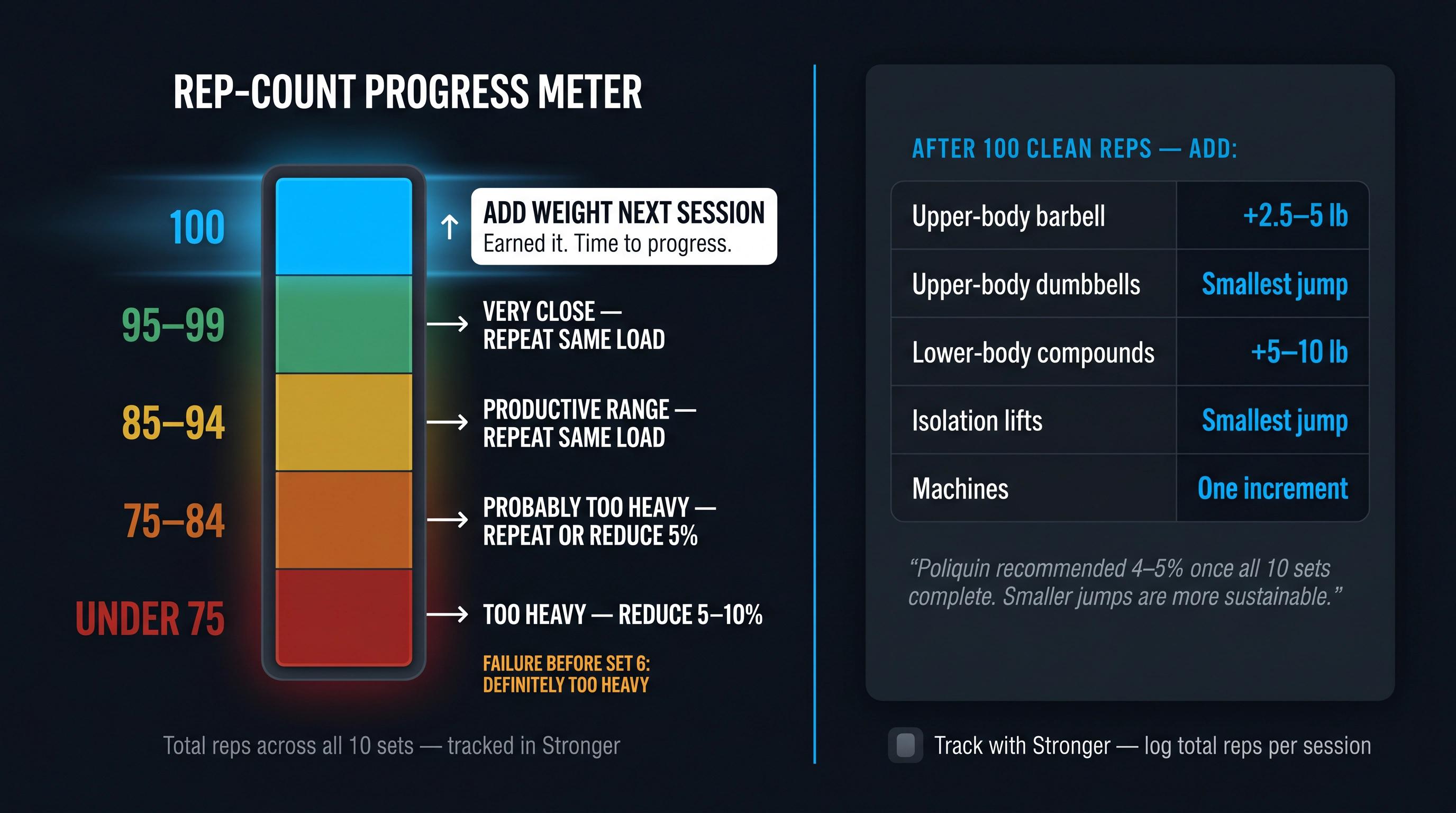
The Rule: Complete all 10 sets of 10 reps — clean form, same load, same rest, full range of motion — and increase the weight next session.
| Lift Type | Increase After 100 Clean Reps |
|---|---|
| Upper-body barbell lifts | 2.5–5 lb / 1–2.5 kg |
| Upper-body dumbbells | Smallest available jump |
| Lower-body compounds | 5–10 lb / 2.5–5 kg |
| Isolation lifts | Smallest possible jump |
| Machines | One plate increment only |
Poliquin's classic recommendation was a 4–5% increase once all 10 sets of 10 were completed with consistent rest. In practice, smaller jumps are more sustainable, especially for upper-body isolation work.
What to Do When You Miss Reps in GVT
Track total reps and use this guide:
| Total Reps Completed | What It Means | What to Do |
|---|---|---|
| 95–100 | Very close or perfect | Repeat same load (or add weight if 100) |
| 85–94 | Productive working range | Repeat same load |
| 75–84 | Probably too heavy or under-recovered | Repeat or reduce 5% |
| Under 75 | Too heavy for GVT | Reduce 5–10% |
| Failure before set 6 | Definitely too heavy | Reduce next time |
| 100 reps, easy final set | Too light | Add weight |
Example: You planned bench press 10×10 at 135 lb and got: 10, 10, 10, 10, 9, 9, 8, 8, 8, 7 = 89 reps. That's a valid GVT session. Keep 135 lb next time and aim to beat 89.
Progress is tracked as total reps per session, not just whether you hit 10 on each set. That distinction is what makes GVT trackable rather than just "try to survive."
Ready to Get Stronger?
Join 2,000,000+ lifters tracking their workouts with Stronger. Available on iOS and Android.
Start tracking freeThe Best German Volume Training Split for Your Goal
The right split depends on how much fatigue you can recover from. GVT compresses a large volume stimulus into very few movements, so the split needs to space muscle exposure enough for quality recovery between sessions. The evidence supports higher volume for hypertrophy, but with meaningful diminishing returns — so the split should help you recover, not just maximize punishment. (Pelland et al., 2025)
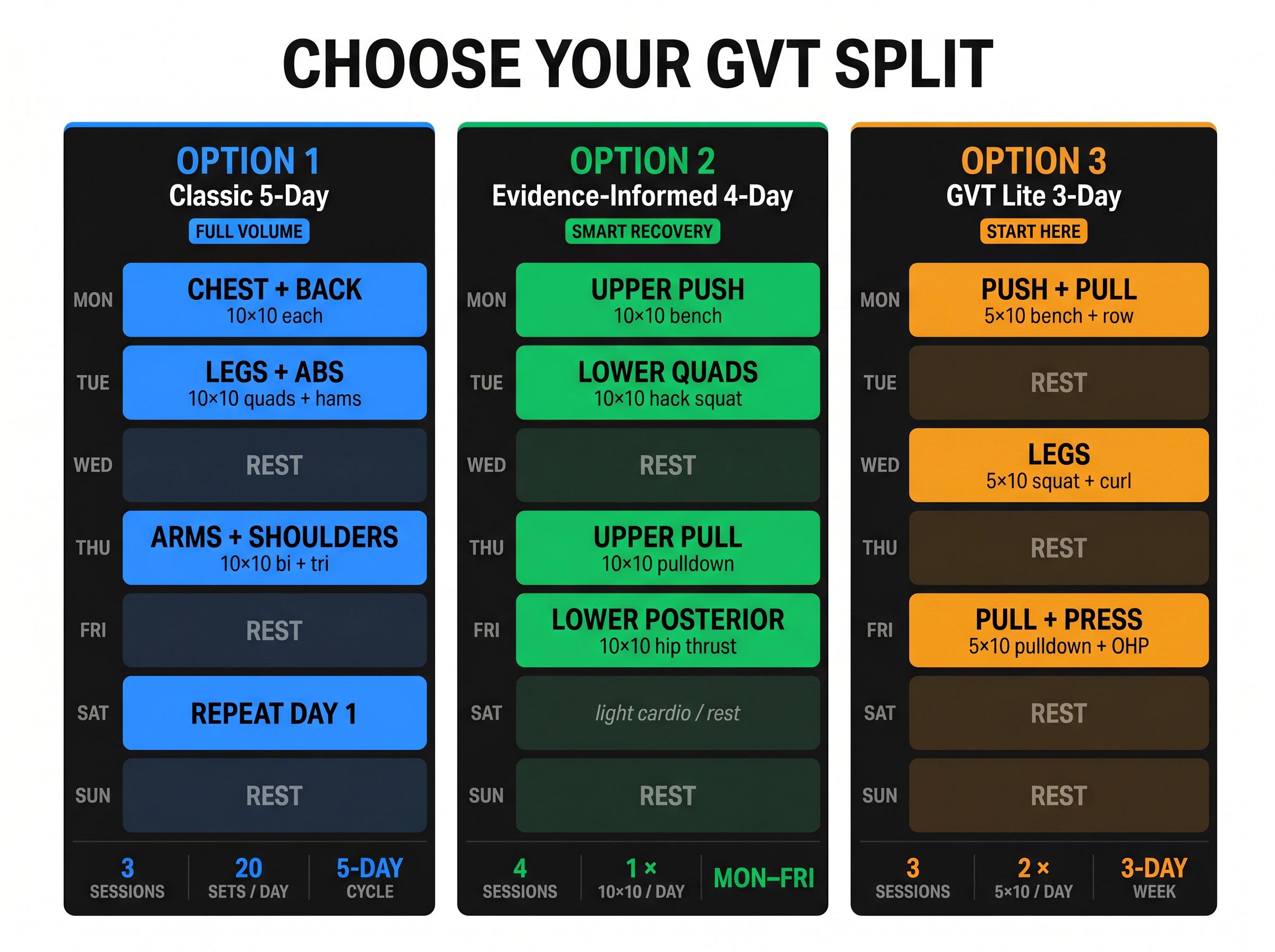
Classic 5-Day German Volume Training Split
The traditional approach: three workouts across a five-day training cycle, hitting each body part approximately once every five days.
| Day | Workout |
|---|---|
| Day 1 | Chest + Back |
| Day 2 | Legs + Abs |
| Day 3 | Rest |
| Day 4 | Arms + Shoulders |
| Day 5 | Rest |
| Day 6 | Repeat Day 1 |
Day 1: Chest + Back
| Exercise | Sets × Reps | Rest |
|---|---|---|
| Bench press or incline dumbbell press | 10×10 | 90 sec |
| Chest-supported row or lat pulldown | 10×10 | 90 sec |
| Cable fly or push-up | 2–3×10–15 | 60 sec |
| Face pull or rear delt fly | 2–3×12–20 | 60 sec |
Use chest-supported rows if your lower back limits barbell rowing.
Day 2: Legs + Abs
| Exercise | Sets × Reps | Rest |
|---|---|---|
| Hack squat, leg press, or high-bar squat | 10×10 | 90–150 sec |
| Lying or seated leg curl | 10×10 | 60–90 sec |
| Calf raise | 3×10–15 | 60 sec |
| Hanging knee raise or plank | 3 sets | 60 sec |
Hack squat or leg press is more sustainable than barbell squat for 10×10 in most cases — setup and bracing consistency are much easier to maintain under fatigue.
Day 4: Arms + Shoulders
| Exercise | Sets × Reps | Rest |
|---|---|---|
| EZ-bar curl or cable curl | 10×10 | 60–90 sec |
| Cable pressdown or close-grip bench | 10×10 | 60–90 sec |
| Lateral raise | 3×12–20 | 60 sec |
| Rear delt fly | 3×12–20 | 60 sec |
If elbows or shoulders are irritated, use cables exclusively. Skip skull crushers and heavy upright rows.
Best 4-Day German Volume Training Split
This version uses one 10×10 lift per session with moderate accessories. You still get the GVT stimulus, but you avoid stacking two full 100-rep exercises in one day — which is where most lifters' recovery systems break down.
| Day | Focus |
|---|---|
| Monday | Upper Push |
| Tuesday | Lower Quads |
| Wednesday | Rest |
| Thursday | Upper Pull |
| Friday | Lower Posterior / Glutes |
| Weekend | Rest or light cardio |
Monday: Upper Push
| Exercise | Sets × Reps |
|---|---|
| Bench press or incline dumbbell press | 10×10 |
| Chest-supported row | 4×8–12 |
| Lateral raise | 3×12–20 |
| Triceps pressdown | 2–3×10–15 |
Tuesday: Lower Quads
| Exercise | Sets × Reps |
|---|---|
| Hack squat, leg press, or high-bar squat | 10×10 |
| Seated or lying leg curl | 4×10–15 |
| Calf raise | 3×10–15 |
| Ab exercise | 3 sets |
Thursday: Upper Pull
| Exercise | Sets × Reps |
|---|---|
| Lat pulldown, assisted pull-up, or machine row | 10×10 |
| Incline dumbbell press | 4×8–12 |
| Rear delt fly or face pull | 3×12–20 |
| Dumbbell curl | 2–3×10–15 |
Friday: Lower Posterior / Glutes
| Exercise | Sets × Reps |
|---|---|
| Hip thrust or seated leg curl | 10×10 |
| Romanian deadlift | 3×8–10 |
| Split squat or leg extension | 2–3×10–12 |
| Calf raise or abs | 3 sets |
This 4-day structure works especially well if you want the hypertrophy stimulus of GVT without turning every session into a two-hour recovery crisis.
GVT Lite: The 5×10 Version for Better Recovery
Because the direct GVT studies found 5 sets to be as effective as — or more effective than — 10 sets in several outcomes, many lifters should start here before attempting full 10×10. (Amirthalingam et al., 2017)
Start with GVT Lite if:
- You're intermediate but new to very high training volume
- You train hard but have limited recovery (demanding job, poor sleep, active sport)
- You're currently below 10 direct sets per muscle per week
- You want hypertrophy without extreme soreness
- You want to test the structure before committing to 10 full sets
3-Day GVT Lite Workout Template
| Day | Main Work |
|---|---|
| Day 1 | Bench press 5×10, row 5×10, accessories |
| Day 2 | Squat or leg press 5×10, leg curl 5×10, accessories |
| Day 3 | Pulldown 5×10, overhead press 5×10, arms |
Run this 3-day format for 3–4 weeks. If recovery is good and performance is trending up, move one lift per session to 10×10. Progress to full GVT only when GVT Lite feels well-managed.
6-Week German Volume Training Plan and Schedule
This is the safest structure for your first full GVT block — or for returning to GVT after time away.
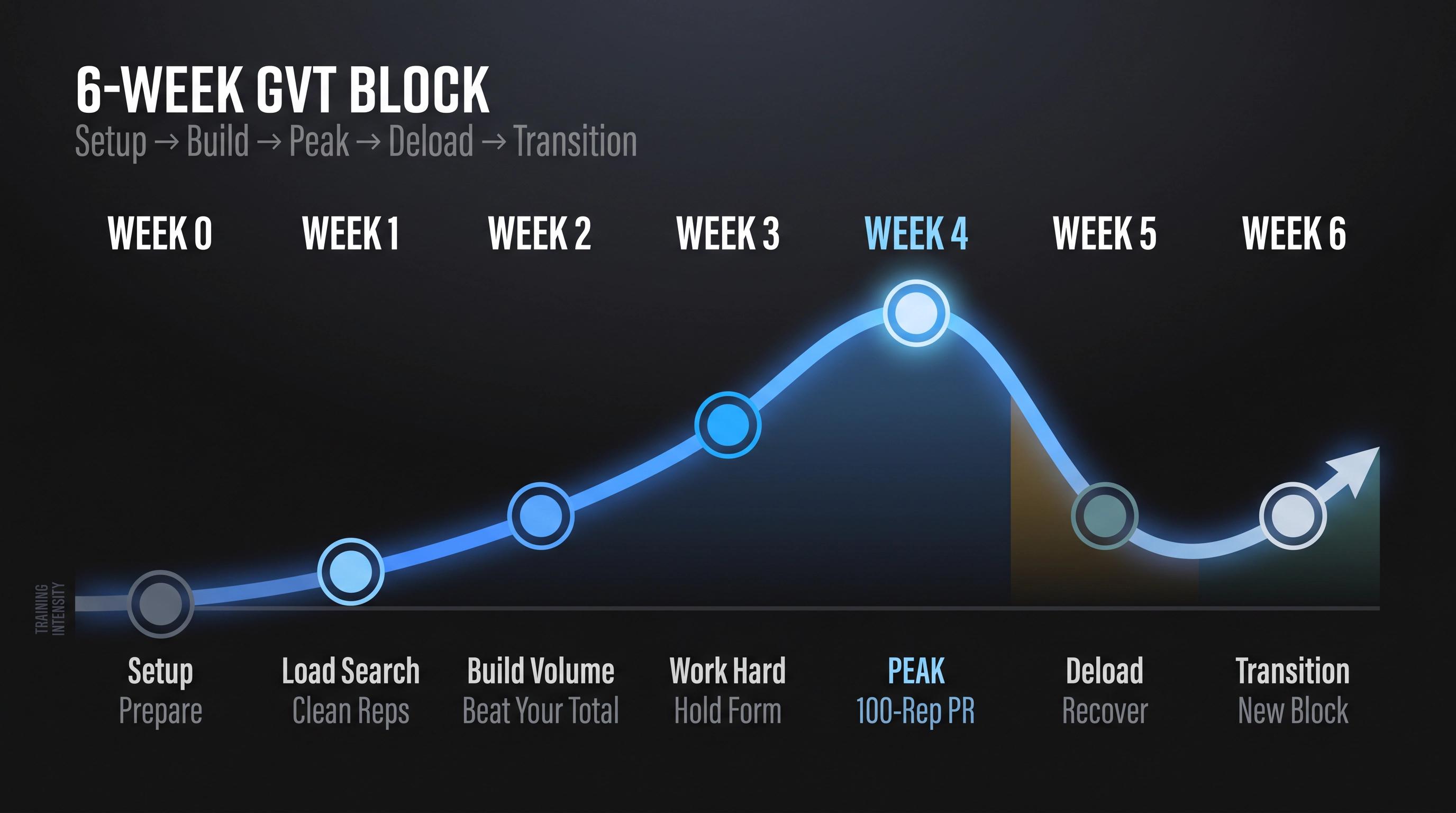
Week 0: How to Set Up Your GVT Block
Before the first session:
- Choose your exercises (use the table above)
- Estimate your 1RMs using the formula
- Set starting loads at 50–60% of estimated 1RM
- Decide rest periods and commit to them
- Remove unnecessary accessories before you start
- Take starting measurements if physique tracking is part of the goal
- Log your baseline lifts
Set up each GVT session in Stronger as saved routines before Week 1 begins. Add rest timers, mark which sets you'll log RPE on (at minimum the last 2–3 sets), and cap accessories in advance. The setup week isn't optional — it's where you remove the variables that derail the block in weeks 3 and 4.
Week 1: Finding the Right Load
Goal: finish each session with clean reps, not heroic failure.
Don't add weight mid-session. Don't add bonus sets because you feel good. Don't judge the program by how the first three sets feel — they're supposed to feel easy. Track total reps completed for each main lift. That number is your Week 2 benchmark.
Week 2: Beat Your Total Reps
Goal: improve total reps at the same weight, or complete 100 reps.
If you got 86 reps in Week 1, aim for 90+. If you completed 100 reps, add a small amount of weight. If soreness is still severe after 72 hours going into Week 2, reduce accessory volume — not the main 10×10 work.
Week 3: Push Hard Without Chasing Failure
Goal: make the final sets hard while preserving form.
This is where GVT starts to feel real. If your final sets reach RPE 9–10 with clean technique, the load is appropriate. If set 5 is already breaking down, reduce the load rather than grinding ugly reps. Volume at poor form accumulates injury risk, not muscle.
Week 4: Peak Your GVT Block
Goal: achieve your best GVT performance.
Try to complete 100 reps or set a total-rep PR at the same load. Keep accessory work minimal this week. The main 10×10 work is the priority.
Week 5: GVT Deload Week
Goal: recover and let adaptation consolidate.
Use 50–60% of your normal set volume. Don't train to failure. Keep the movement patterns but strip the fatigue. Focus on sleep, food, and mobility. Many lifters are surprised to feel stronger in Week 6 than they did at the peak — that's the adaptation you were building.
Week 6: What to Do After GVT
Don't immediately run another 10×10 block. Move into one of:
- A strength-focused program with heavier 3–6 rep work
- A moderate hypertrophy block using 3–5 sets per exercise
- A GVT Lite block if you liked the structure but need less fatigue
- A specialization block targeting a different muscle group
This is where most GVT blocks either pay off or fall apart. The lower-volume phase after GVT is where the gains often show up — lifters who jump straight into another brutal specialization phase cut that window short.
What Is German Volume Training Good For?
Is German Volume Training Good for Muscle Growth?
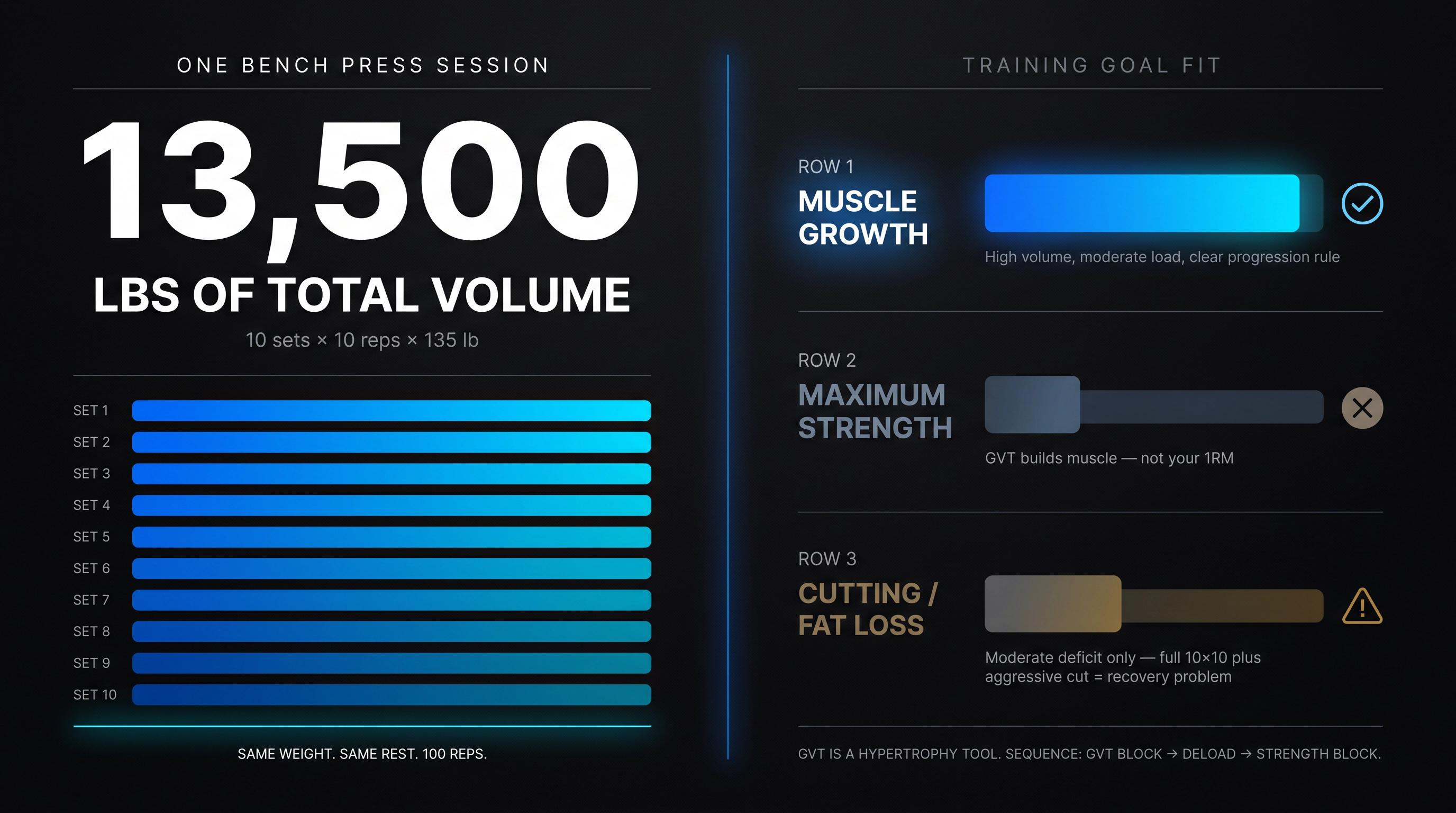
GVT can build significant muscle because it combines high weekly volume, moderate loads, repeated practice on the same movement, local muscular fatigue, a clear progression rule, and a simple enough structure to adhere to for six weeks.
But hard is not the same as optimal.
Current volume evidence shows more sets increase hypertrophy, but the benefit per additional set diminishes as total volume climbs. (Pelland et al., 2025) The direct GVT research suggests that once you're already doing substantial volume, pushing to 10 sets per exercise may not add measurable benefit and can reduce performance or impair recovery in later weeks. (Amirthalingam et al., 2017)
The honest hypertrophy case for GVT: it's a useful overload block when you need a new stimulus, especially if your previous volume was lower or inconsistent. It is not the permanently superior way to train every muscle group every year.
Is German Volume Training Good for Strength?
GVT can improve strength indirectly — by building muscle and practicing a movement pattern — but it's not an effective approach for maximizing your 1RM.
Maximal strength development depends heavily on specificity: heavier loads, longer rest, lower rep counts, and high-quality force expression per rep. GVT uses moderate loads and accumulated fatigue. The 2017 GVT study specifically concluded that GVT should not be the primary method when the goal is increasing muscular strength. (Amirthalingam et al., 2017)
The effective sequence: GVT block for hypertrophy → deload → strength block using 3–6 rep work. The new muscle and improved work capacity from GVT become the input for the heavier work.
Can You Do German Volume Training While Cutting?
GVT burns significant energy and feels metabolically demanding, but it's not a fat-loss protocol by itself. Fat loss comes from a caloric deficit, not from a specific set-rep scheme.
GVT during a diet can work under specific conditions:
- Deficit is moderate (not aggressive)
- Protein is high
- Sleep is consistent
- Accessory volume is reduced
- Final sets are not taken to failure
If you're in an aggressive cut, GVT Lite or standard moderate-volume hypertrophy training is a better fit. Full 10×10 with inadequate calories and poor sleep is a recovery problem waiting to happen.
German Volume Training Nutrition and Recovery Guide
Protein Requirements for German Volume Training
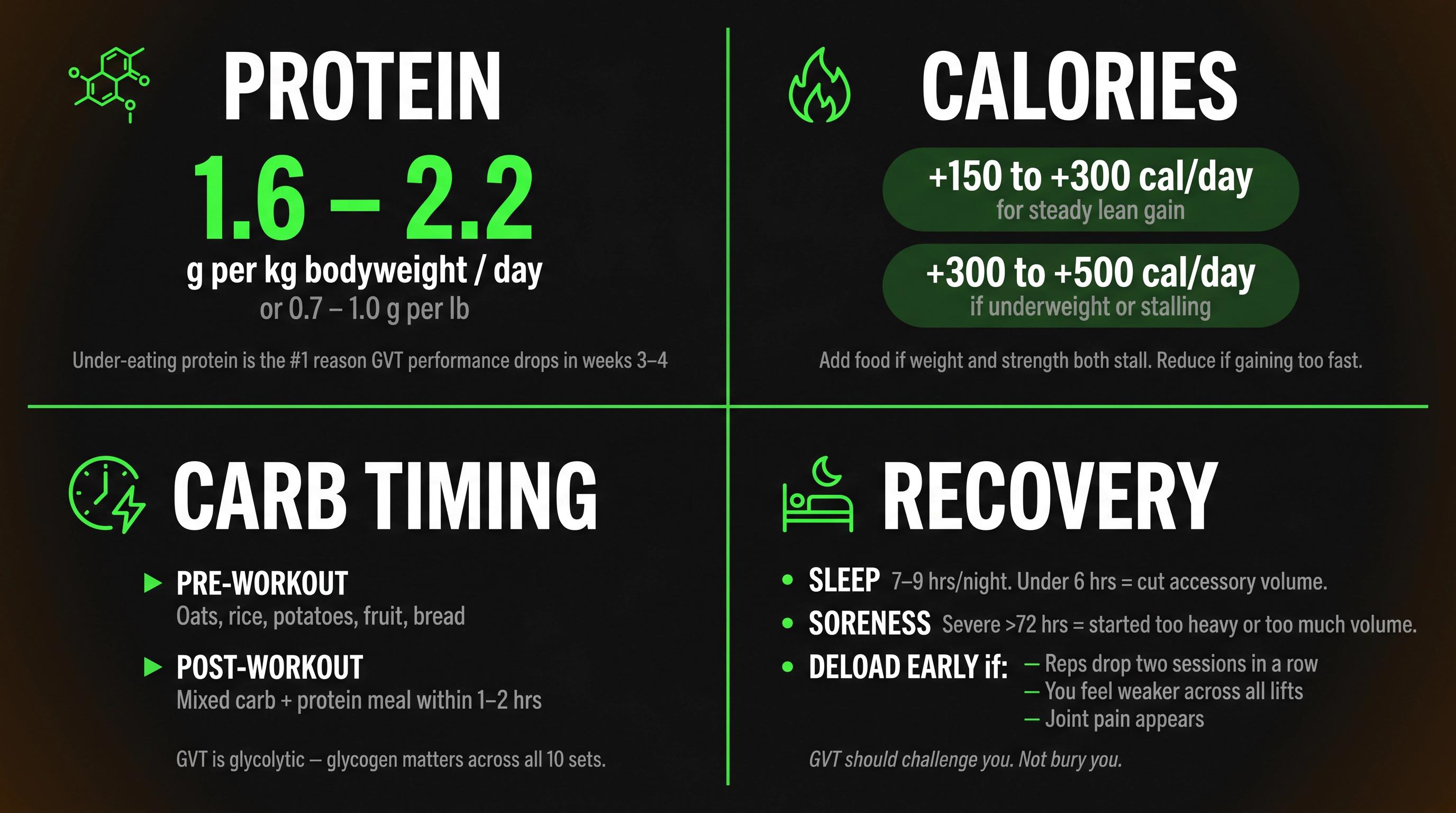
GVT creates a high recovery demand. Under-eating protein during a GVT block is one of the most common reasons performance drops in weeks 3–4.
A practical daily target:
1.6–2.2 g protein per kg bodyweight per day (or 0.7–1.0 g per lb)
The International Society of Sports Nutrition's protein position stand supports 1.4–2.0 g/kg/day for exercising individuals, with subsequent meta-analytic work commonly supporting ~1.6 g/kg as a strong resistance-training target. (PubMed)
How Many Calories to Eat During German Volume Training
For muscle gain while running GVT:
- +150 to +300 calories/day for slower, lean weight gain
- +300 to +500 calories/day if you're underweight or struggling to gain
If bodyweight is stalling and strength isn't progressing, add food. If weight is climbing too fast and performance is fine, reduce slightly.
Carbohydrate Timing for German Volume Training
GVT is glycolytic work — high-rep sets with short rest deplete muscle glycogen rapidly. Carbs help.
- Pre-workout: oats, rice, potatoes, fruit, bread, or a sports drink
- Post-workout: a mixed carb-and-protein meal within 1–2 hours
Daily carb intake should be high enough to keep training performance stable across 10 working sets.
How to Recover from German Volume Training
Sleep: Aim for 7–9 hours. If sleep drops below 6 hours consistently, reduce accessory volume.
Soreness: Some soreness after the first 1–2 sessions is expected. Severe soreness that limits movement for more than 72 hours is a sign you started too heavy or added too much volume.
Joint pain: Muscle burn is expected. Joint pain is not. If elbows, shoulders, knees, or lower back hurt:
- Switch to machines or cables
- Reduce range only if it eliminates pain completely
- Swap the exercise for a more stable variation
- Reduce to 5×10
- Extend rest periods
- Stop taking final sets to failure
Deload triggers — deload early if:
- Reps drop for two consecutive sessions
- You feel weaker on every lift
- Sleep quality declines alongside training
- Resting fatigue stays elevated for days
- Joint pain appears
- You dread sessions you normally enjoy
GVT should challenge you. It should not bury you.
The 7 Biggest German Volume Training Mistakes
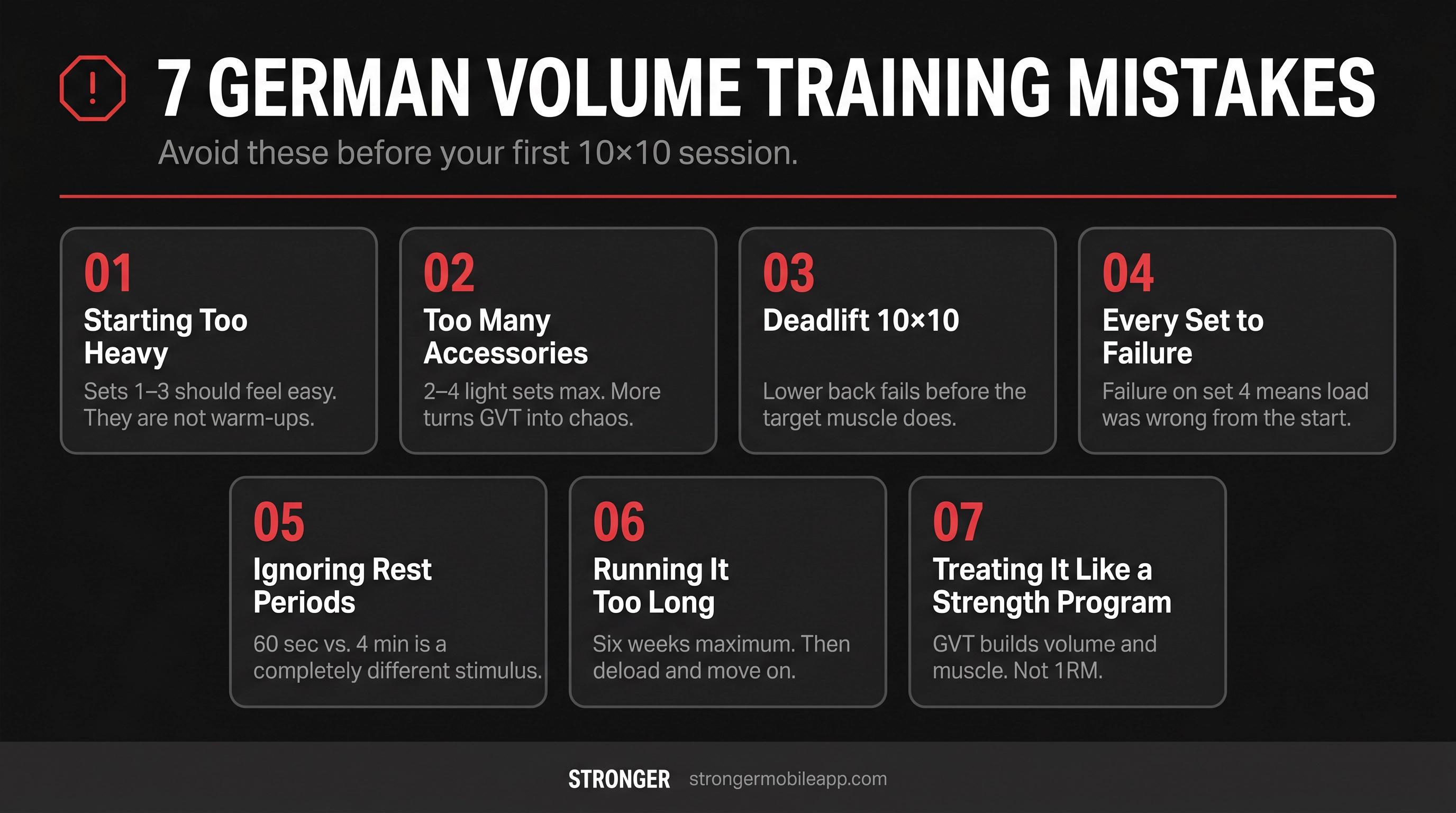
1. Starting Too Heavy
If the first set feels like a normal hard working set, the load is wrong. GVT sets 1–3 should feel too easy. That's correct. They're not warm-ups — they're the first installment in a 100-rep debt that compounds as the session progresses.
2. Adding Too Many Accessories
The 10×10 main lift is already substantial volume for that muscle group. Accessories should complement the session, not replicate it. Two to four sets of light, targeted accessory work is enough. Adding four more heavy exercises turns GVT into an hour-long fatigue accumulation experiment.
3. Choosing Conventional Deadlifts
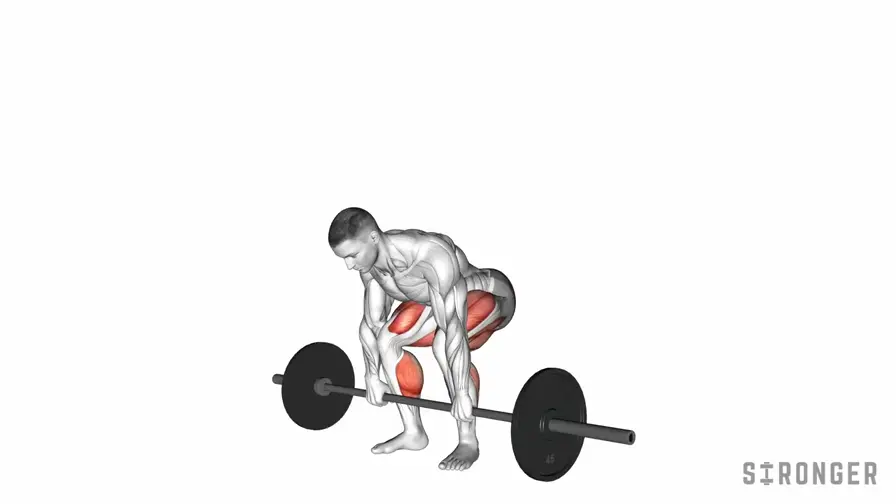
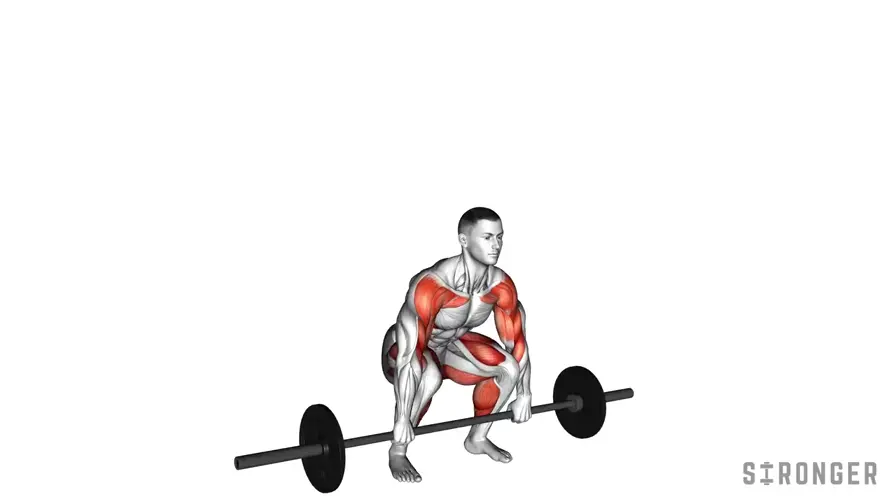
A conventional deadlift 10×10 is almost never the right call. Lower back, grip, and bracing fatigue degrade well before the target muscles are sufficiently challenged, and technique degradation on a heavy hinge pattern carries real injury risk. Use Romanian deadlifts at lower volume, or build posterior chain work around leg curls and hip thrusts.
4. Taking Every Set to Failure
Failure on the final set is acceptable. Failure on sets 3–6 means the load was misjudged — or the rest period was too short. Constant failure training in a 10-set block overwhelms recovery without adding proportionate stimulus.
5. Not Tracking Rest Periods
Ten reps after 60 seconds is a fundamentally different task than 10 reps after 4 minutes. Rest periods are part of the prescription, not an estimate. A rest timer matters here more than in almost any other style of training.
6. Running GVT for Months
GVT is a short-term specialization block. Six weeks maximum. Running the same 10×10 protocol indefinitely produces diminishing returns as recovery capacity starts losing ground to accumulated fatigue.
7. Comparing GVT to Strength Programs
GVT is not 5/3/1. It's not a powerlifting peaking block. It's not designed to maximize 1RM strength expression. Evaluating it as a strength program is evaluating the wrong thing. Its purpose is hypertrophy and work capacity. Used for that purpose, in a planned block, it's an effective tool.
Ready to Get Stronger?
Join 2,000,000+ lifters tracking their workouts with Stronger. Available on iOS and Android.
Start tracking freeHow to Track German Volume Training with Stronger
German Volume Training is simple on paper and surprisingly easy to mismanage in practice. The key variables — load, total reps, rest periods, and effort — all compound across sessions. Miss one and the next session's performance becomes harder to interpret.
Here's how we recommend setting up and tracking a full GVT block in Stronger.
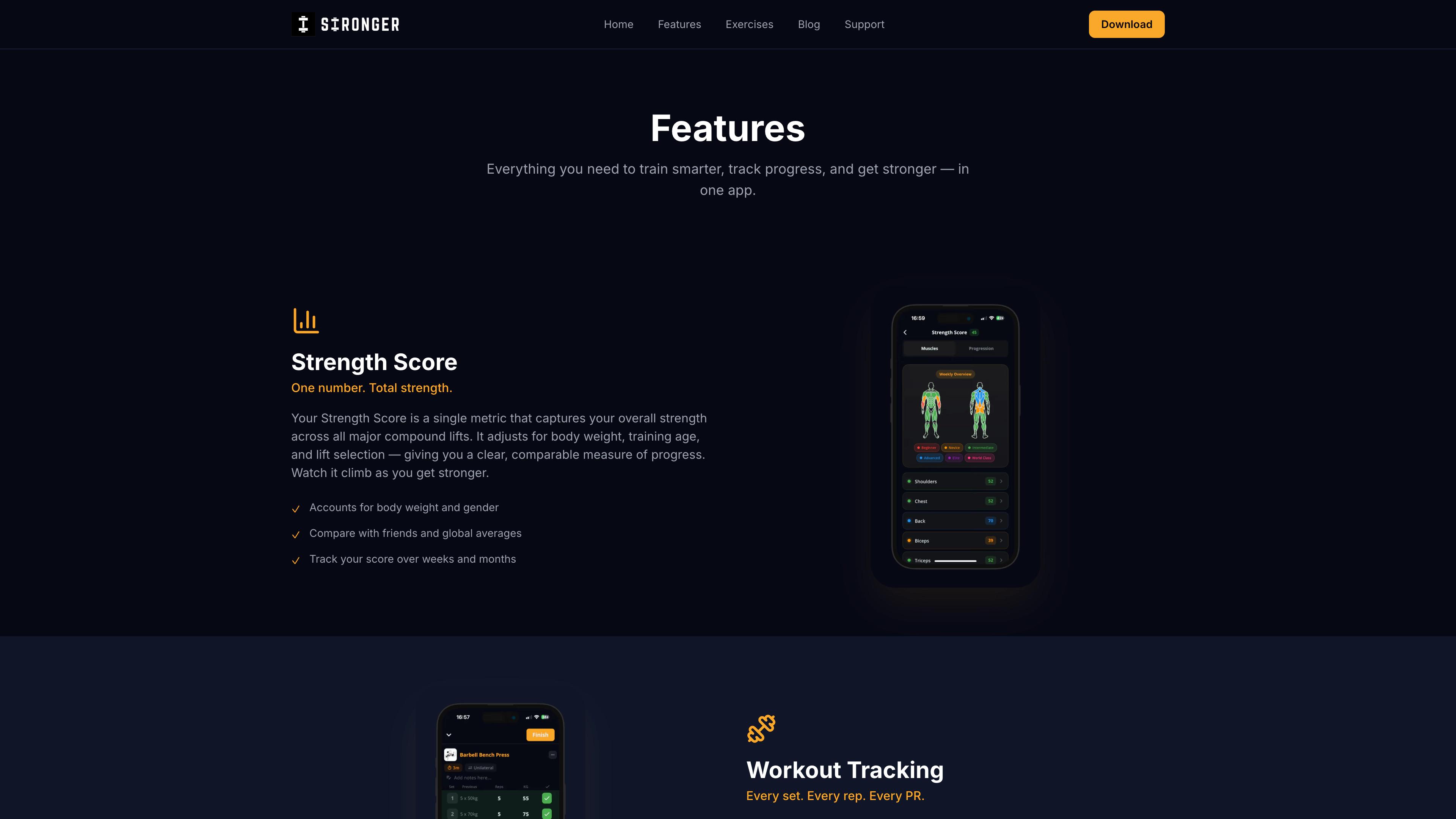
The Stronger features page shows the full toolkit: Strength Score tracking across compound lifts, built-in workout logging, and the analytics layer that turns 10×10 session data into a readable progression signal.
Setting Up Your GVT Routines in Stronger Before Week 1
In Stronger, create a saved routine for each GVT session — not just a blank workout log. Include:
- Your 10×10 main lift with your starting load entered
- A fixed rest timer matching your protocol (90 seconds for compounds is a sensible default)
- Your accessory exercises, capped at 2–4 sets each
- A note for soreness, pump, or joint feedback if anything feels off
Having the routine saved in advance means the session runs on structure, not decisions. When set 7 is hard, you don't want to be choosing what to do next.
What to Log During Each German Volume Training Session
For each GVT workout, track:
- Total reps completed for the main 10×10 lift (this is your progression metric)
- Whether you hit all 100 reps — if yes, you're adding weight next session
- RPE on the final 2–3 sets — this tells you whether fatigue is accumulating correctly
- Any missed reps — and which set they occurred on
- Whether rest periods stayed consistent
Stronger logs sets, reps, and weight by default. The built-in rest timer eliminates clock-watching. PR detection flags your best total rep count across sessions. The full training history means you can pull up last week's session while resting between sets to check exactly what you hit.
Key Signals to Watch During Your GVT Block
GVT's main risk is doing more volume than you can recover from — and not noticing until performance is already declining. Stronger's analytics give you the early warning signals:
- Volume load per exercise — 10 sets × 10 reps × 135 lb = 13,500 lb per session on bench alone. Watching this number across weeks tells you whether you're in productive overload or accumulating too much
- Per-exercise strength curves — are your main GVT lifts trending up across the block? Flat or declining curves from week 2 onward are a signal to check load, rest, or recovery
- Strength Score changes — broader performance indicator across compound lifts
- Weekly volume by muscle group — helps you confirm accessories aren't piling fatigue onto an already high main-lift load
By the time you reach Week 4 of a GVT block, the difference between "this is working" and "I'm running into recovery debt" can be invisible without the data. That's where Stronger's tracking pays off.
Download Stronger and set up your first GVT routine before Week 1. The 7-day free trial gives you full access to rest timers, RPE logging, training history, and analytics.

Is German Volume Training Worth It? Final Verdict
Use German Volume Training if you're an intermediate or advanced lifter who wants a structured hypertrophy block, can recover well, and is willing to track the variables that make it work.
Don't use it if you're a beginner, dealing with an injury, sleeping poorly, cutting calories aggressively, or trying to peak for a strength competition.
The smartest version of GVT isn't "destroy yourself with 100 reps no matter what." It's this:
- Choose the right lift — repeatable, stable, loads the target muscle well
- Start light enough that sets 1–3 feel easy
- Keep rest periods consistent — use a timer
- Track total reps, not just whether you finished
- Progress only when you've earned it (100 clean reps)
- Deload before fatigue starts winning
- Move into a lower-volume strength or hypertrophy phase afterward
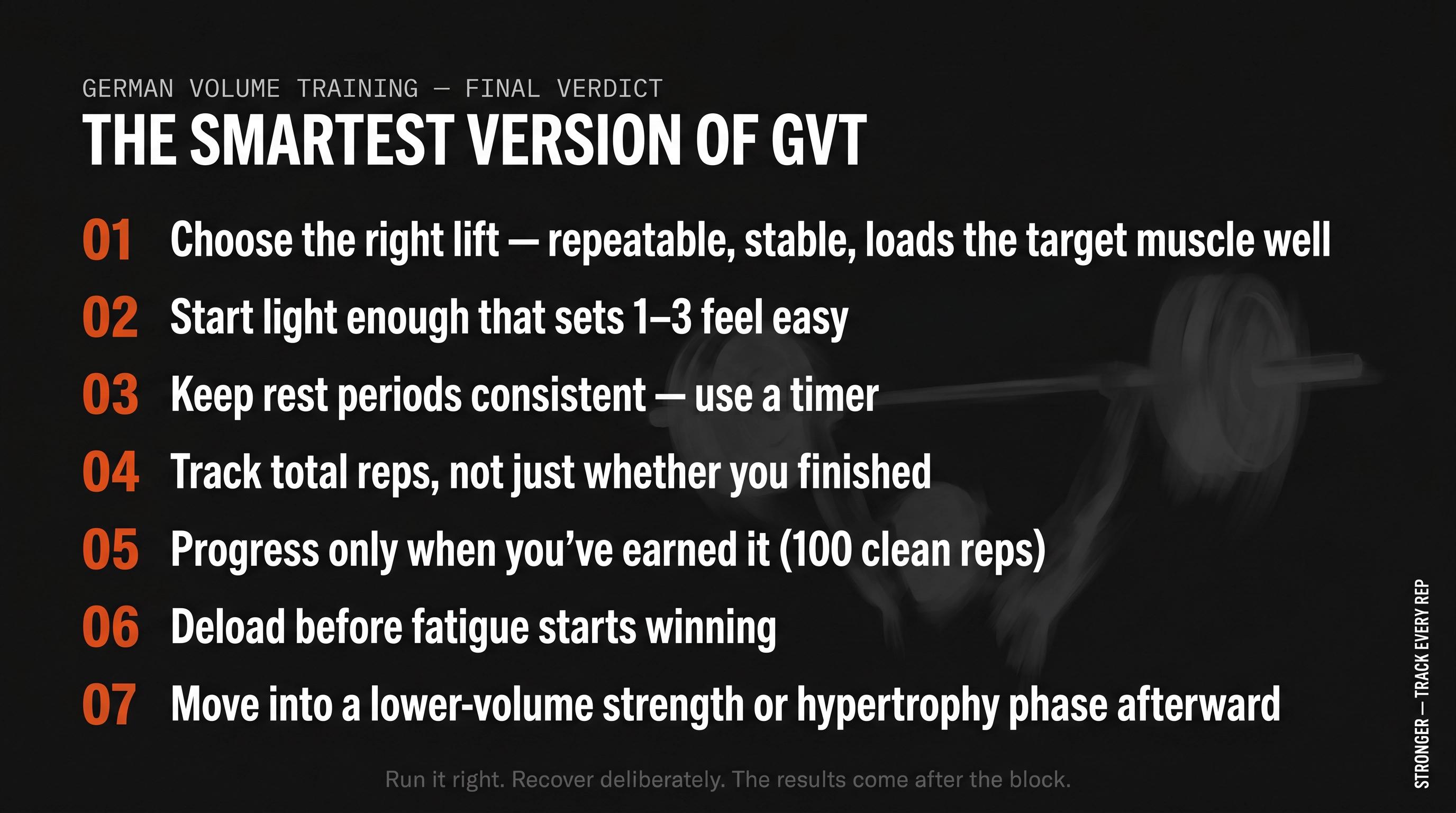
GVT works best when it's treated as a precise six-week tool — not a permanent identity, not a punishment ritual. Run it right, recover deliberately, and the block after GVT is often where you actually feel the results.
German Volume Training FAQ
Is German Volume Training good for beginners?
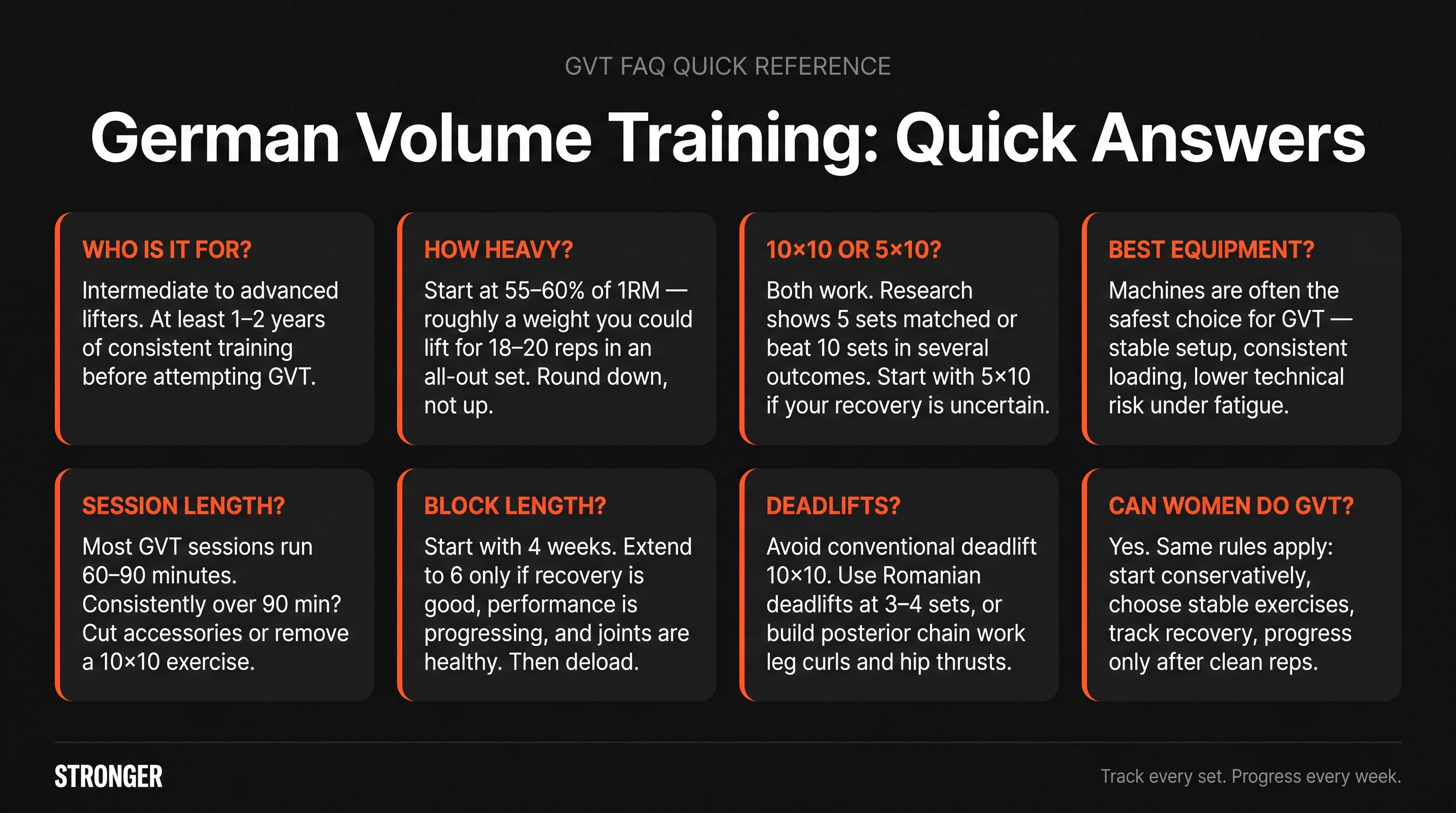
No. Beginners don't need 10 sets of 10 to grow — they need consistent technique, basic progressive overload, and enough recovery time to adapt. A full-body program or upper/lower split produces faster progress for beginners with far less injury and fatigue risk. Save GVT for when you've been training consistently for at least 1–2 years.
Is 10×10 better than 5×10?
Not necessarily. The two direct GVT studies found that 10 sets did not outperform 5 sets for hypertrophy or strength, and in some outcomes the 5-set group performed better. (Amirthalingam et al., 2017) If you're uncertain about your recovery capacity, start with 5×10 for 3–4 weeks before moving to full 10×10.
How heavy should German Volume Training be?
Start with roughly 55–60% of 1RM, or a weight you could handle for about 18–20 reps in an all-out set. Use 50–55% if the exercise is new to you, highly fatiguing, or involves a lot of lower-back loading.
Should I use barbells, dumbbells, or machines for GVT?
All three work. Machines are often the best choice for GVT because they eliminate setup demands and keep the target muscle loaded consistently as technique degrades under fatigue. Barbells are effective but require more technical discipline. Dumbbells work well for upper-body work, though large weight increments can complicate load progression.
Can I do GVT with squats?
Yes, but it's demanding. Squat 10×10 is one of the most systemically taxing things you can put in a program. Hack squats and leg presses typically deliver a comparable quad stimulus with significantly lower technical risk. If you squat for your GVT block, start conservatively, rest long enough to maintain depth and bracing on every rep, and watch your lower-back fatigue closely.
Can I do GVT with deadlifts?
Avoid conventional deadlift 10×10. Use Romanian deadlifts at lower volume (3–4 sets instead of 10), or build posterior-chain work around seated/lying leg curls and hip thrusts for high-rep GVT-style work.
Should I superset GVT exercises?
You can pair opposing movements — bench press and rows, for example — but don't rush the turnaround. The classic approach: one set of exercise A, full rest, one set of exercise B, full rest, repeat. If pairing movements causes rep quality to drop or form to break, train each exercise independently.
How long should a GVT workout take?
Most GVT sessions run 60–90 minutes. If workouts consistently run past 90 minutes, you've either added too many accessories or included too many 10×10 exercises. The program is designed to be demanding within a manageable time window — not to extend indefinitely.
How long should I run German Volume Training?
Run your first GVT block for 4 weeks. Extend to 6 weeks only if recovery is clearly good, performance is progressing, and joints are healthy. Then deload.
What should I do after GVT?
Move into a lower-volume phase. Good options: 3–5 sets per exercise at 6–8 reps for strength emphasis, or moderate hypertrophy work at 3–4 sets per exercise. Don't immediately jump into another high-volume specialization phase — that cuts off the window where your body actually consolidates the adaptation.
Can women do German Volume Training?
Yes. The protocol doesn't depend on sex. The same rules apply: start conservatively, choose stable exercises, track recovery carefully, and progress only after completing clean reps. The same evidence base and loading guidelines apply.
Does GVT build muscle faster than normal training?
It can create a strong short-term hypertrophy stimulus, especially if your previous training volume was lower or inconsistent. But the direct evidence doesn't show that 10×10 is inherently superior to well-designed moderate-volume training. GVT's biggest practical advantage is structure and adherence — a clearly defined protocol that forces consistent, progressive, high-volume work on a limited exercise selection.
Sources
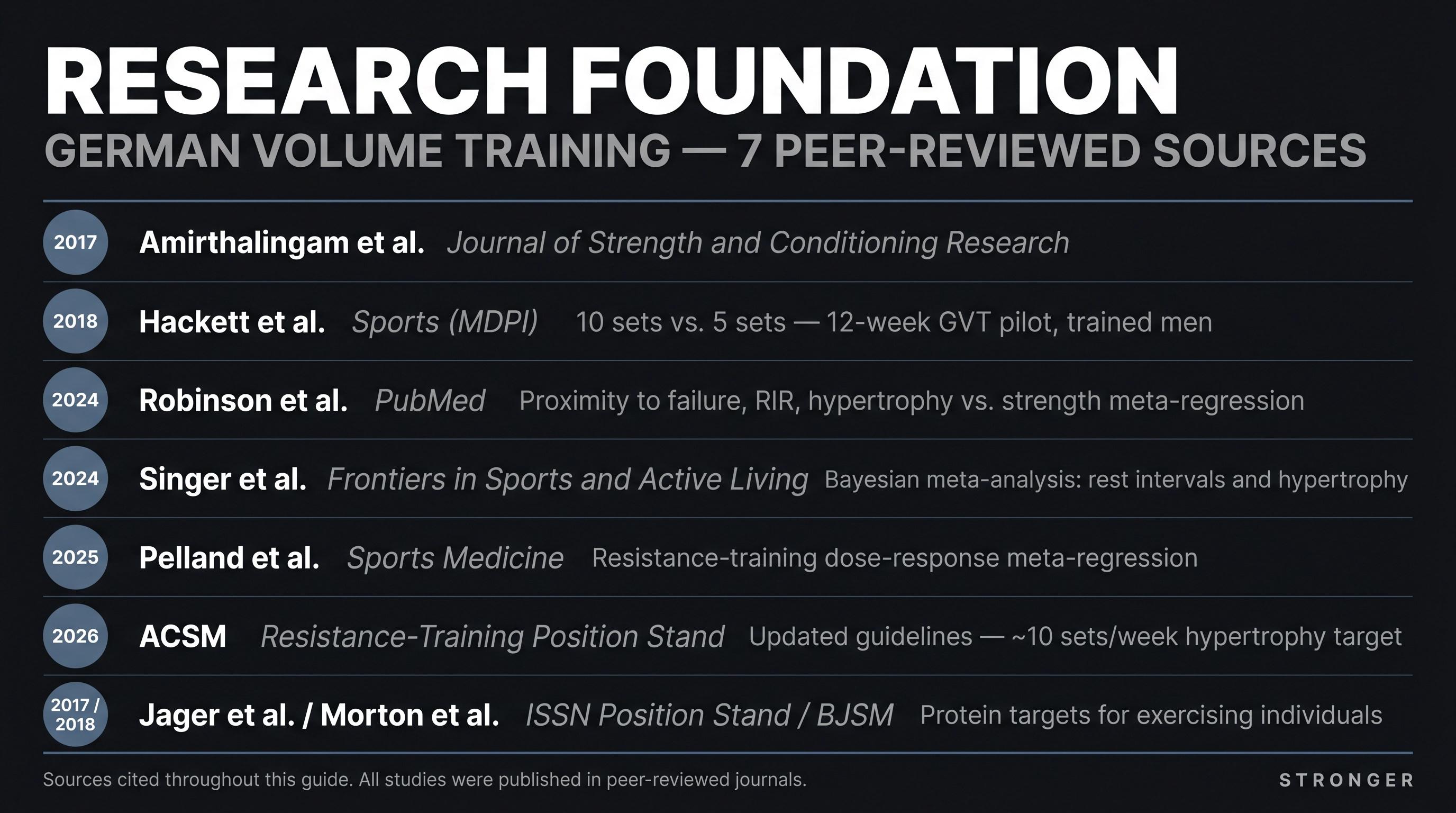
- Amirthalingam, T., Mavros, Y., Wilson, G. C., Clarke, J. L., Mitchell, L., & Hackett, D. A. (2017). Effects of a Modified German Volume Training Program on Muscular Hypertrophy and Strength. Journal of Strength and Conditioning Research, 31(11), 3109–3119. (PDF)
- Pelland et al., Sports Medicine, December 2025. Resistance-training dose-response meta-regression on volume, frequency, hypertrophy, and strength. (fisiologiadelejercicio.com)
- American College of Sports Medicine, March 2026. Updated resistance-training position stand. (ACSM)
- Hackett, D. A., Amirthalingam, T., Mitchell, L., Mavros, Y., Wilson, G. C., & Halaki, M. (2018). Effects of a 12-Week Modified German Volume Training Program on Muscle Strength and Hypertrophy: A Pilot Study. Sports, 6(1), 7. (MDPI)
- Singer, A., et al. (2024). Give it a rest: a systematic review with Bayesian meta-analysis on the effect of inter-set rest interval duration on muscle hypertrophy. Frontiers in Sports and Active Living, 6, 1429789. (Frontiers)
- Robinson, Z. P., et al. (2024). Exploring the Dose-Response Relationship Between Estimated Resistance Training Proximity to Failure, Strength Gain, and Muscle Hypertrophy: A Series of Meta-Regressions. Sports Medicine, 54(9), 2209–2231. (PubMed)
- Jäger et al., ISSN Position Stand, 2017; Morton et al., British Journal of Sports Medicine, 2018. Protein targets for exercising individuals. (PubMed)
Exercises in this guide
Stronger Editorial Team
Certified strength & conditioning specialists with 10+ years of coaching experience
The Stronger editorial team produces evidence-based training content for lifters of all levels.
Ready to Get Stronger?
Join 2,000,000+ lifters tracking their workouts with Stronger. Available on iOS and Android.
Start tracking free