

Starting Strength: Is It Worth It in 2026?
The short answer: is starting strength worth it?
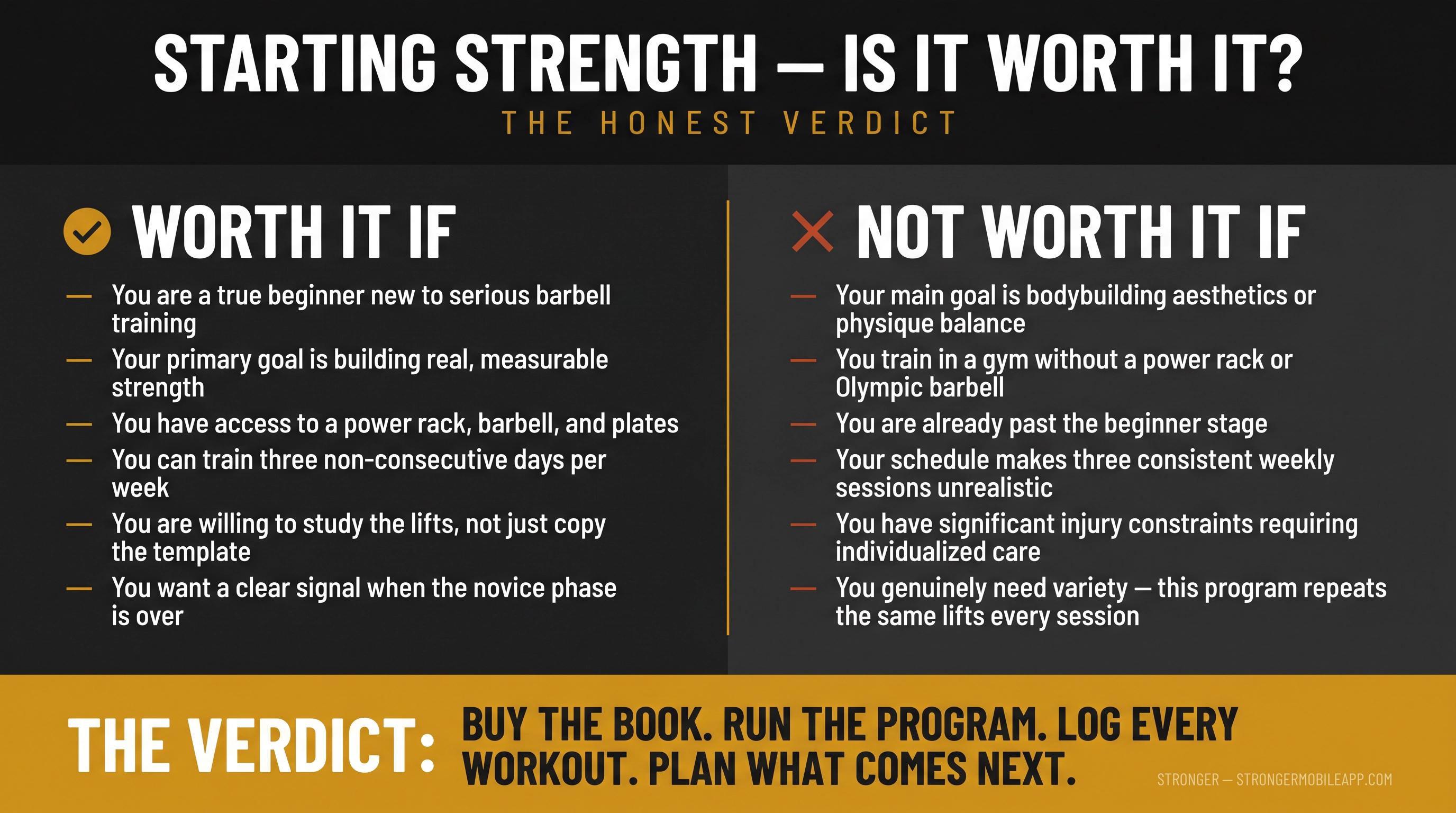
Starting Strength is worth it — if you are a true beginner whose main goal is building a barbell strength foundation as efficiently as possible.
It is not worth it if your goal is primarily bodybuilding aesthetics, you train in a limited-equipment gym, you are already past the beginner stage, or you want a program flexible enough to adapt to your schedule, injuries, or changing goals.
That is the honest answer, and it does not require a 5,000-word article to deliver. But the question "starting strength — is it worth it?" almost always contains a follow-up question hidden inside: worth it for what, at what cost, compared to what alternative? Those questions deserve real answers.
At Stronger, we work with thousands of lifters who are exactly where you are right now — doing research before committing to their first serious barbell program. This review covers what Starting Strength actually is, what it costs in 2026, who it genuinely works for, and how to run it well if you decide it's the right fit. We're also going to be honest about where it falls short, because a review that only tells you the good parts is just marketing.
Here's what you'll know by the end: whether Starting Strength is the right program for your situation, exactly what it costs, the most common mistakes that make it fail, and how to track it properly so you actually see the progress you're working for.
Starting strength program ratings at a glance
Before we go deep, here is a scorecard across the categories that actually matter for a beginner evaluating this program.
| Category | Rating | Honest take |
|---|---|---|
| Beginner strength | 9/10 | One of the best simple systems for learning progressive barbell training |
| Hypertrophy / bodybuilding | 6/10 | You'll build muscle, but it's not designed as a complete physique program |
| Technique education | 9/10 | The book is unusually detailed on barbell mechanics |
| Simplicity | 10/10 | Few lifts, clear progression, low decision fatigue |
| Flexibility | 5/10 | The program works best when run close to as written |
| Equipment accessibility | 5/10 | Requires proper barbell equipment |
| Long-term programming | 6/10 | Great starting point, but you need a plan after novice linear progression ends |
| Value for money | 8/10 | The book is inexpensive; coaching can be expensive but may be worth it for the right lifter |
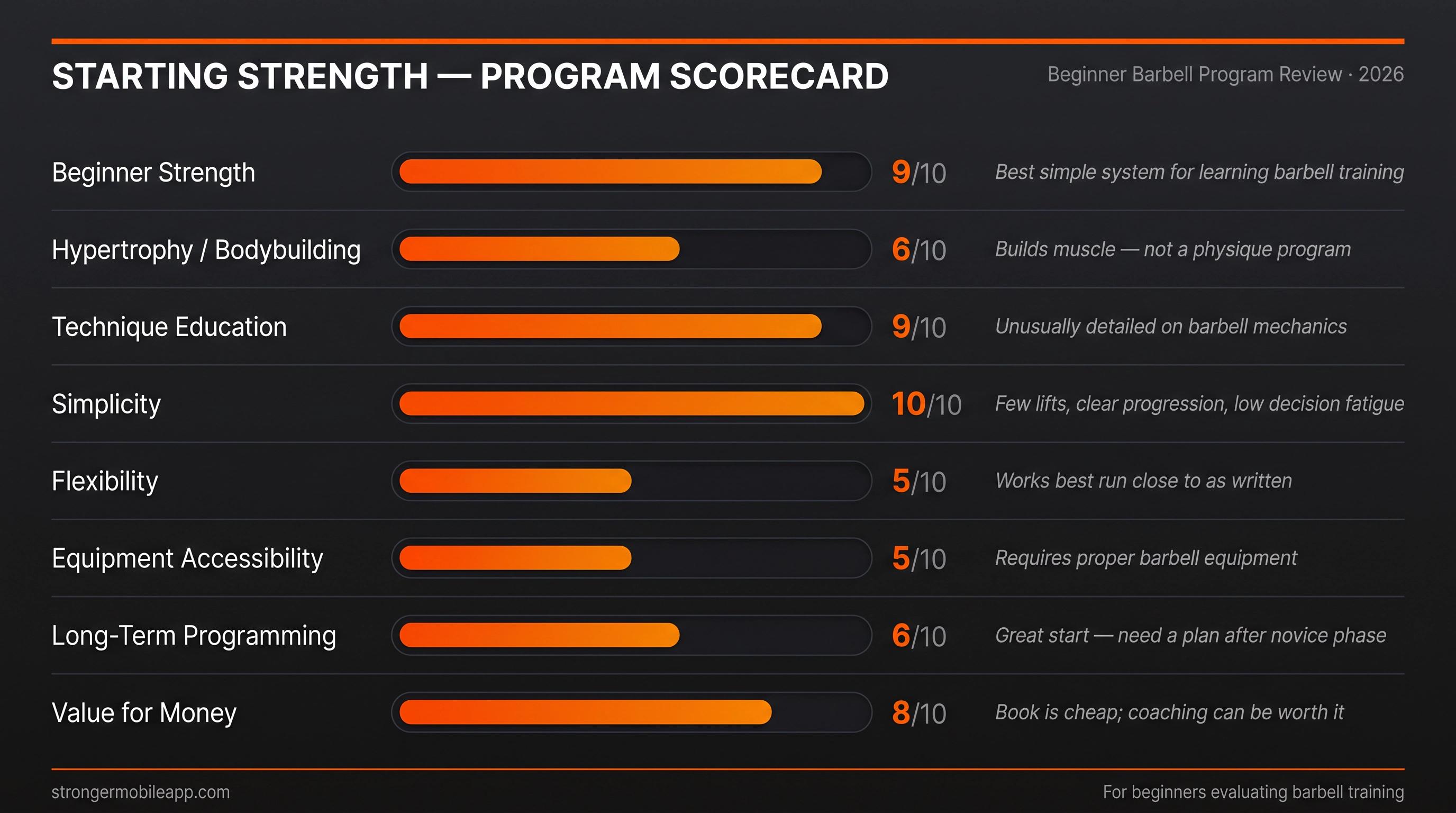
The rest of this review explains what those ratings mean in practice.
What is starting strength? (book, program, and ecosystem)
"Starting Strength" can mean three different things, and knowing which one you're evaluating changes everything.
- The book — Starting Strength: Basic Barbell Training by Mark Rippetoe. A 360-page technical manual on barbell lifts and beginner programming.
- The novice linear progression program — the actual beginner training template most people are referring to when they say they're "doing Starting Strength."
- The Starting Strength ecosystem — the official app, online coaching, affiliated gyms, seminars, forums, and coaching certification network.
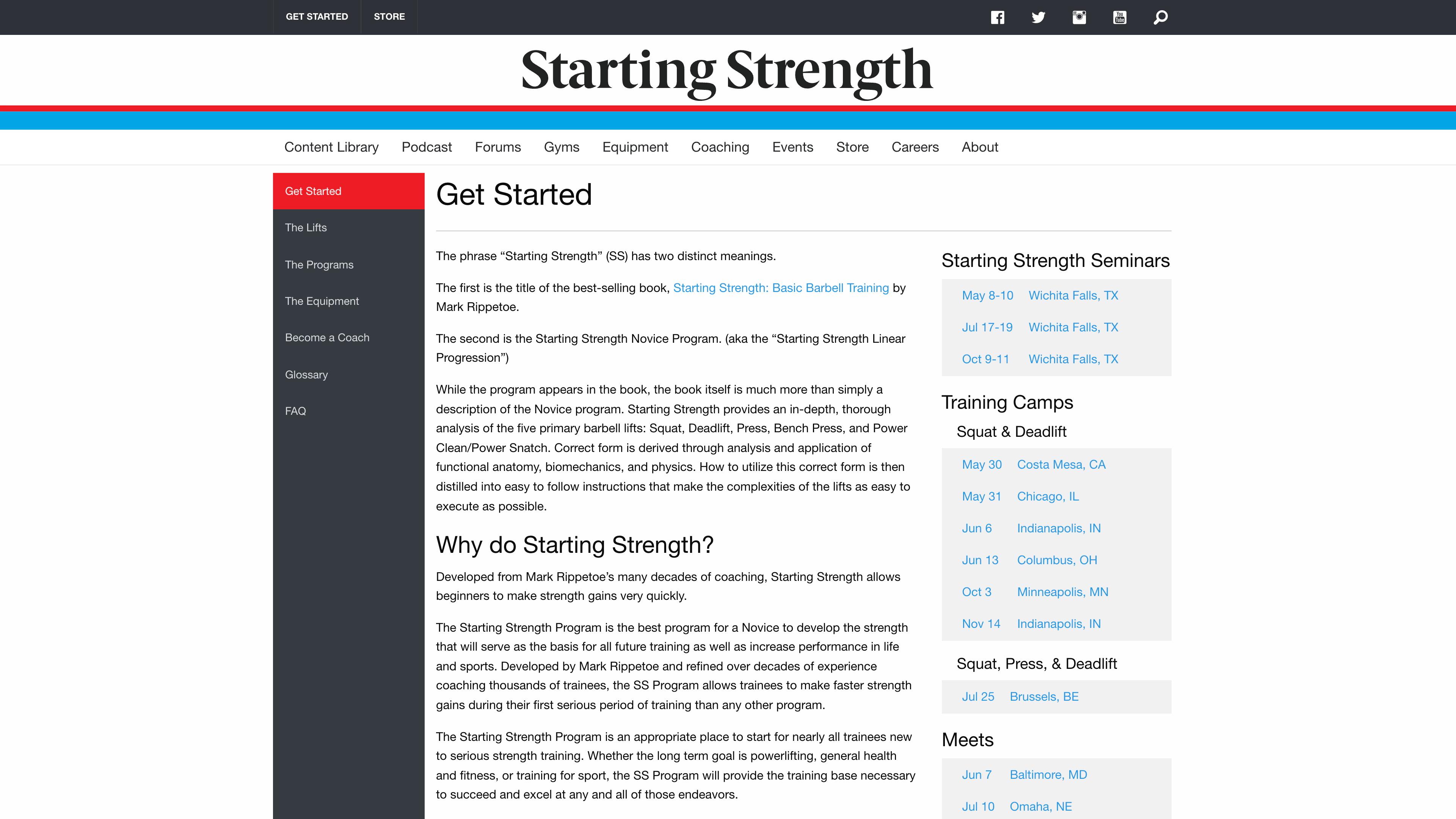
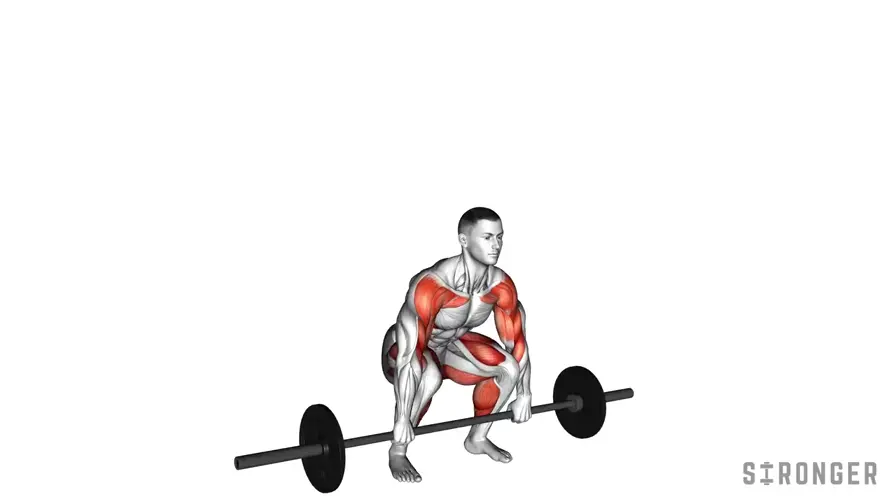
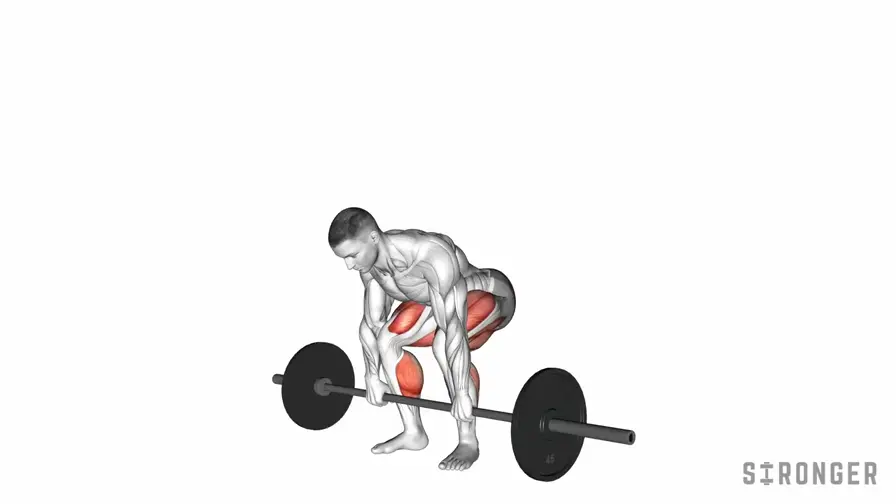
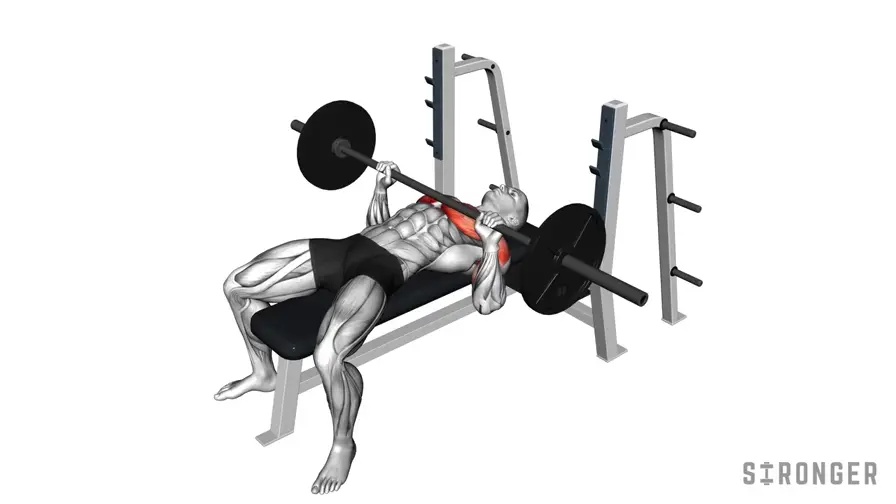
The official Starting Strength "Get Started" page describes the book as both a technical manual and a program built around five primary compound barbell lifts: the squat, deadlift, press, bench press, and power clean or power snatch. The novice program is specifically designed for people new to serious strength training and the principles of progressive overload — the core mechanism that makes systematic barbell training work. (Starting Strength)
That distinction matters for the rest of this review. The book is a technical reference. The program is a short-to-medium-term beginner progression. The ecosystem includes coaching and paid tools that may or may not be necessary depending on your budget and goals.
Most people asking "is Starting Strength worth it?" are asking about the program — and that's where we'll spend most of our time.
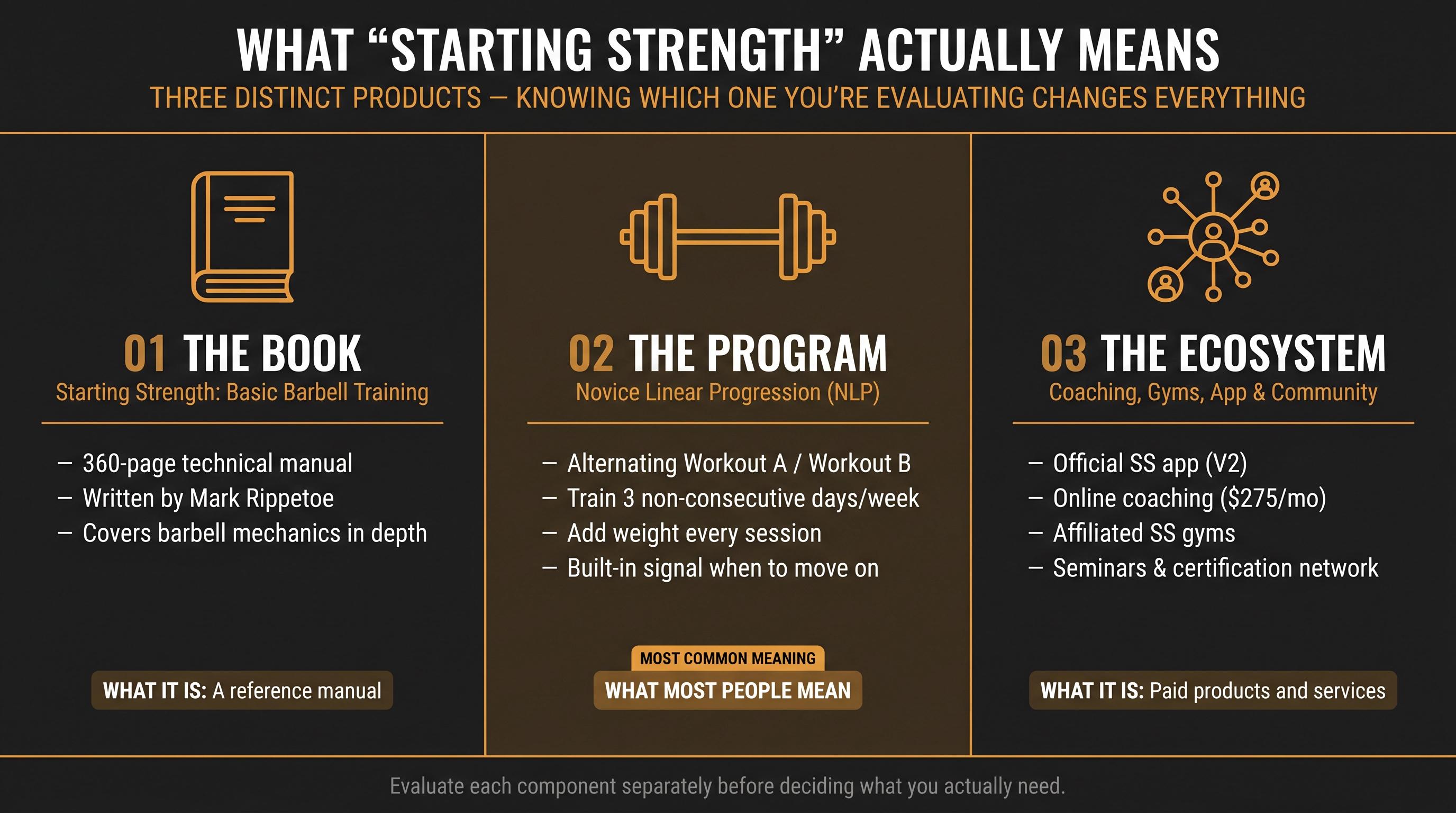
The official "Get Started" page at startingstrength.com is the clearest entry point for new trainees — it describes the book, the novice program structure, and the full ecosystem of coaching resources available.
How starting strength's novice linear progression works
The core idea is deliberately simple: do a few compound barbell lifts, train the whole body three times per week, and add weight whenever possible.
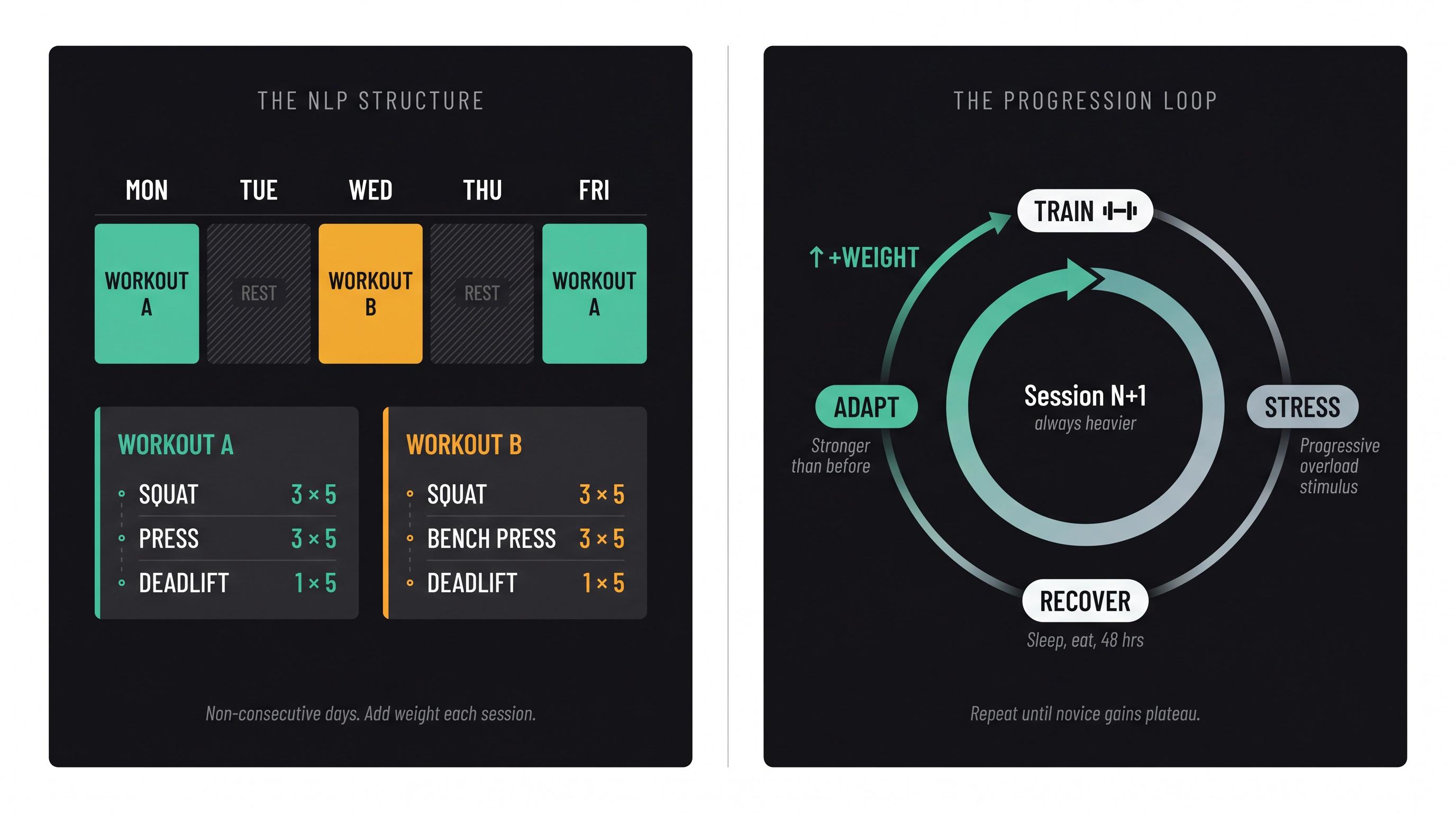
The novice program officially uses two alternating workouts. The trainee lifts on three non-consecutive days per week (e.g., Monday, Wednesday, Friday), and the goal is to add weight to each lift every session while still in the novice phase. (Starting Strength)
The early structure looks like this:
| Workout A | Workout B |
|---|---|
| Squat — 3 sets of 5 | Squat — 3 sets of 5 |
| Press or bench press — 3 sets of 5 | Bench press or press — 3 sets of 5 |
| Deadlift — 1 set of 5 | Deadlift — 1 set of 5 |
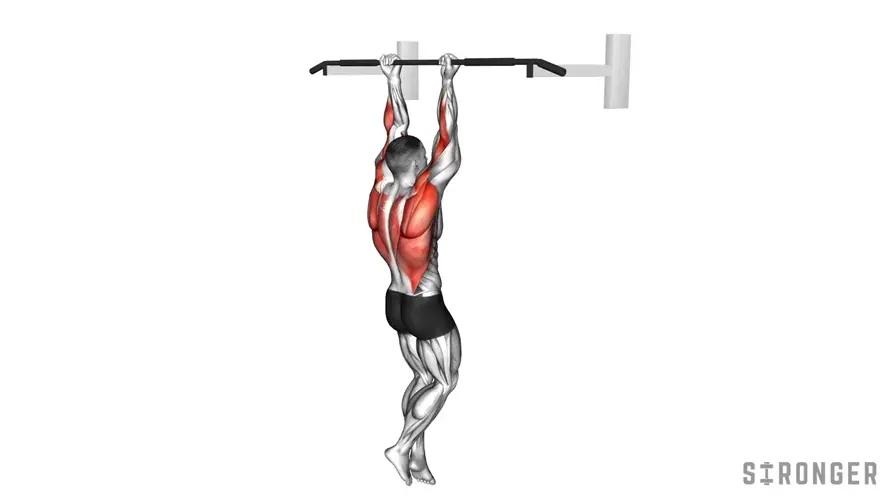
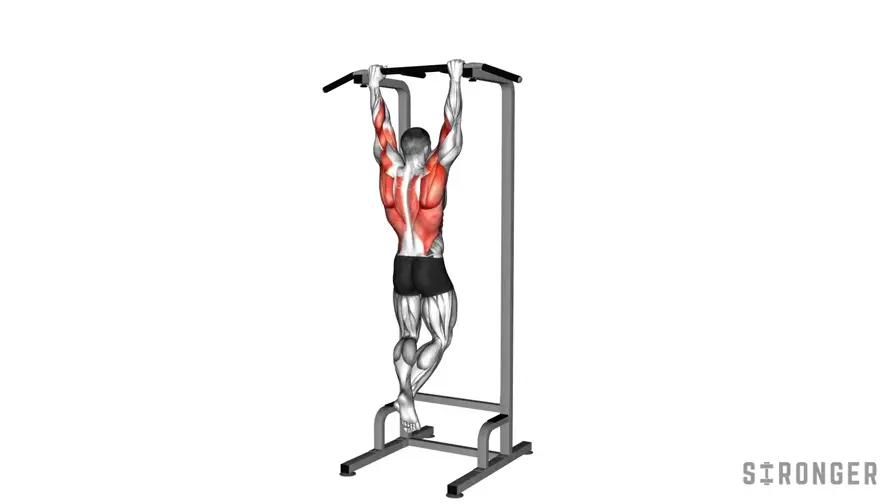
Later phases introduce the power clean, alternate deadlifts and power cleans, add chin-ups, and eventually include an "advanced novice" adjustment for trainees whose recovery can no longer support heavy squatting three times per week. (Starting Strength)
The progression rates the official program describes are aggressive by most standards. Healthy young men may initially add 10 pounds to the squat per session and 15–20 pounds to the deadlift in the first couple of sessions before moving to smaller jumps. Presses and bench presses usually need smaller increases sooner. Women and older lifters generally need smaller jumps throughout. (Starting Strength)
This is what makes Starting Strength's novice linear progression — often abbreviated NLP — more than just "3x5." It's a specific system: perform the lift, recover, add weight, repeat until that simple model stops working. The stopping point is built into the design. More on that shortly.
Does starting strength work? What the research says
Starting Strength's underlying logic — load the fundamental lifts, progress systematically, repeat — is well-supported by modern resistance training evidence.
Beginners benefit from what's often called the novice effect: new lifters can improve rapidly because they're simultaneously adapting neurologically, learning movement patterns, and driving early hypertrophy with minimal stimulus. That's why adding weight every single session is feasible in the novice phase in a way it simply isn't later.
The research backs this approach more broadly. A 2026 ACSM evidence update on resistance training emphasized that training should be individualized by goals, safety, enjoyment, and adherence, and that basic loading variables — particularly heavier loads around 80% of one-rep max performed for multiple sets — remain central for strength development. (ACSM)
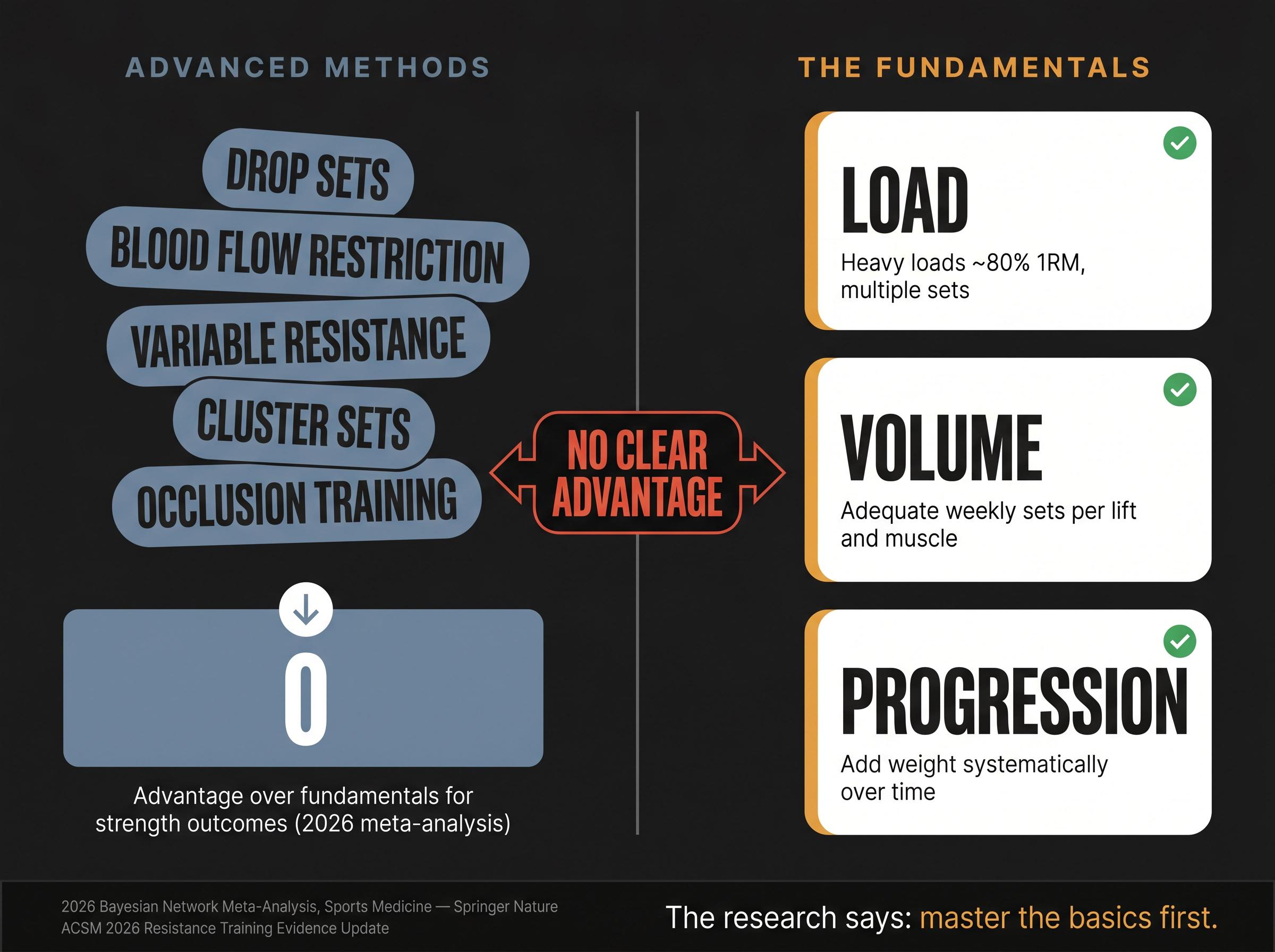
A 2026 systematic review and Bayesian network meta-analysis published in _Sports Medicine_ found no clear advantage of advanced resistance-training methods over traditional methods for strength and power outcomes in healthy adults. The authors concluded that practitioners should prioritize traditional methods and fundamentals such as load, volume, and progression. (Springer)
In other words: the research says that what Starting Strength does — emphasize load, volume, and progression on fundamental movements — is exactly what should take priority for strength development. The program is not outdated. It's aligned with where the evidence currently points.
That doesn't mean it's perfect. Evidence for an approach doesn't tell you it's the right tool for every goal. Which brings us to the honest part.
Ready to Get Stronger?
Join 2,000,000+ lifters tracking their workouts with Stronger. Available on iOS and Android.
Start tracking freeStarting strength pros: what the program gets right
1. It makes your progress measurable
Many beginners spend months going to the gym, sweating through random workouts, and wondering why they're not improving. Starting Strength solves this by making the goal completely concrete: add weight to the bar while maintaining technical quality.
That single constraint turns training into a feedback loop. You know what you lifted last session. You know what you're trying to lift today. You know whether you succeeded. For most beginners, this is the first time training feels genuinely objective. Tracking your performance against established strength standards for your bodyweight and experience level makes that objectivity even clearer — you're not just adding weight in isolation, you're mapping your progress against real benchmarks.
2. The exercise selection is highly efficient
The program is built around compound barbell lifts that recruit large amounts of muscle at once. You squat, press, bench, deadlift, and eventually power clean. These are high-skill movements, but they also give beginners an enormous return per unit of time and effort.
Instead of doing 12 exercises poorly, you do a few lifts repeatedly until you get better at them. That efficiency is the design principle, not an accident.
3. The book is still genuinely worth reading
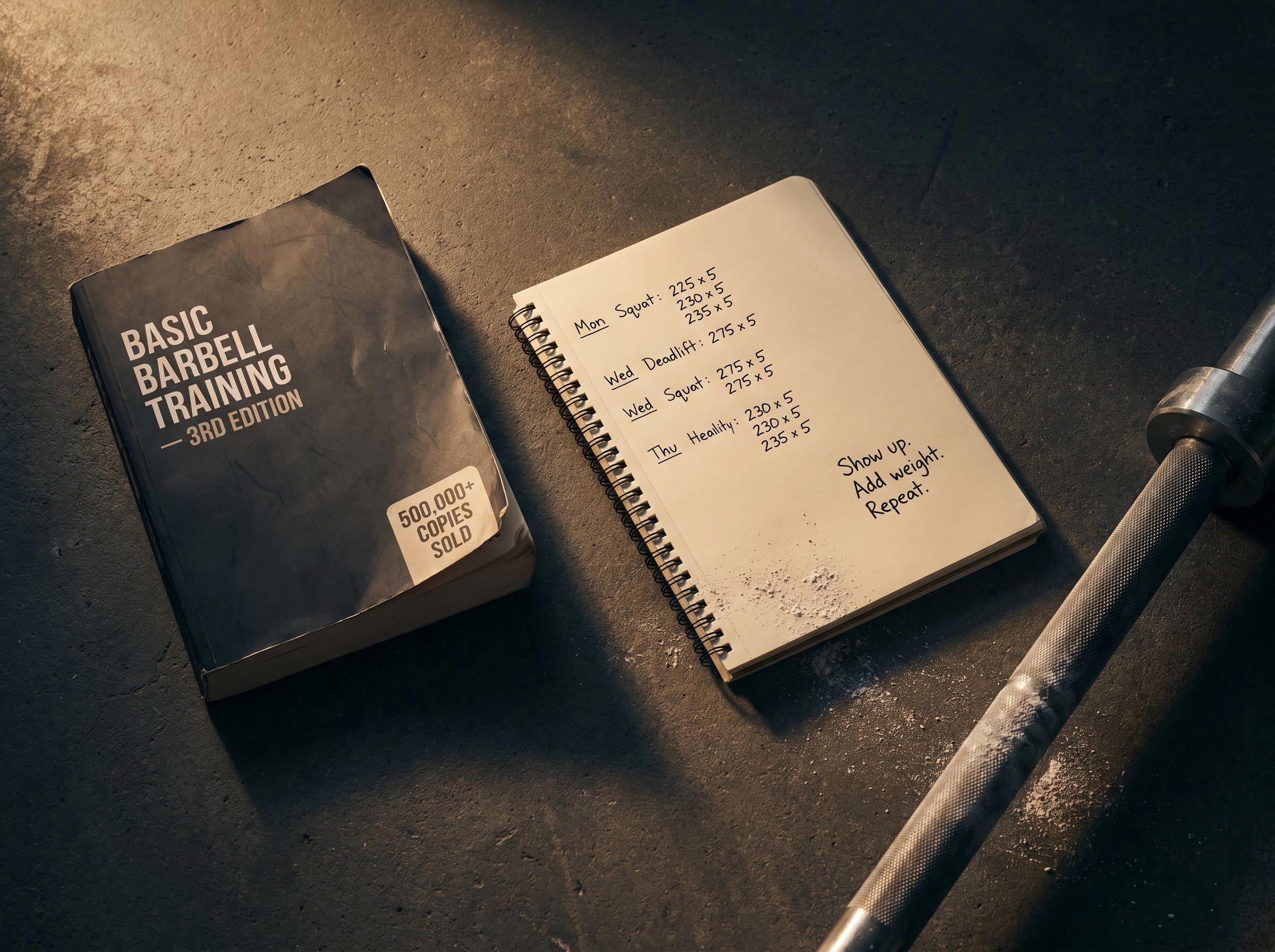
The third edition of Starting Strength: Basic Barbell Training is listed on the official Aasgaard store at $29.95, with the third revision published in June 2017 and over 500,000 copies sold. (Aasgaard Company)
Even if you don't agree with every coaching cue or programming opinion in the book, it is unusually detailed for a beginner training resource. It explains bar path, stance, grip, setup, and mechanics at a depth that most "best beginner workout" articles never approach.
The rule of thumb: if you're going to run the program seriously, the book is worth reading. If you only copy the template from the internet without studying the lifts, you're using half the product.
4. It builds real training discipline
Starting Strength is not designed to be entertaining. That's part of its strength.
You show up. You warm up. You squat, press or bench, and pull. You log the workout. You come back and do slightly more. The repeated exposure to this structure — same lifts, clear goal, consistent schedule — builds the kind of training discipline that carries you forward long after the novice phase ends.
For many beginners, the habit of showing up and progressing is more valuable than any specific programming choice.
5. It has a built-in signal to move on
A well-designed beginner program should eventually stop working — and Starting Strength's design makes that stopping point legible instead of ambiguous.
When you can no longer add weight workout to workout despite adequate sleep, food, technique, and sensible load jumps, the novice phase is over. You know when you're done. That clarity is rarer than it sounds: many programs pretend one template can work indefinitely, which leaves lifters grinding ineffective programs long past their expiration date.
Starting Strength avoids that trap by building the exit condition into the system.
Starting strength cons: where the program falls short
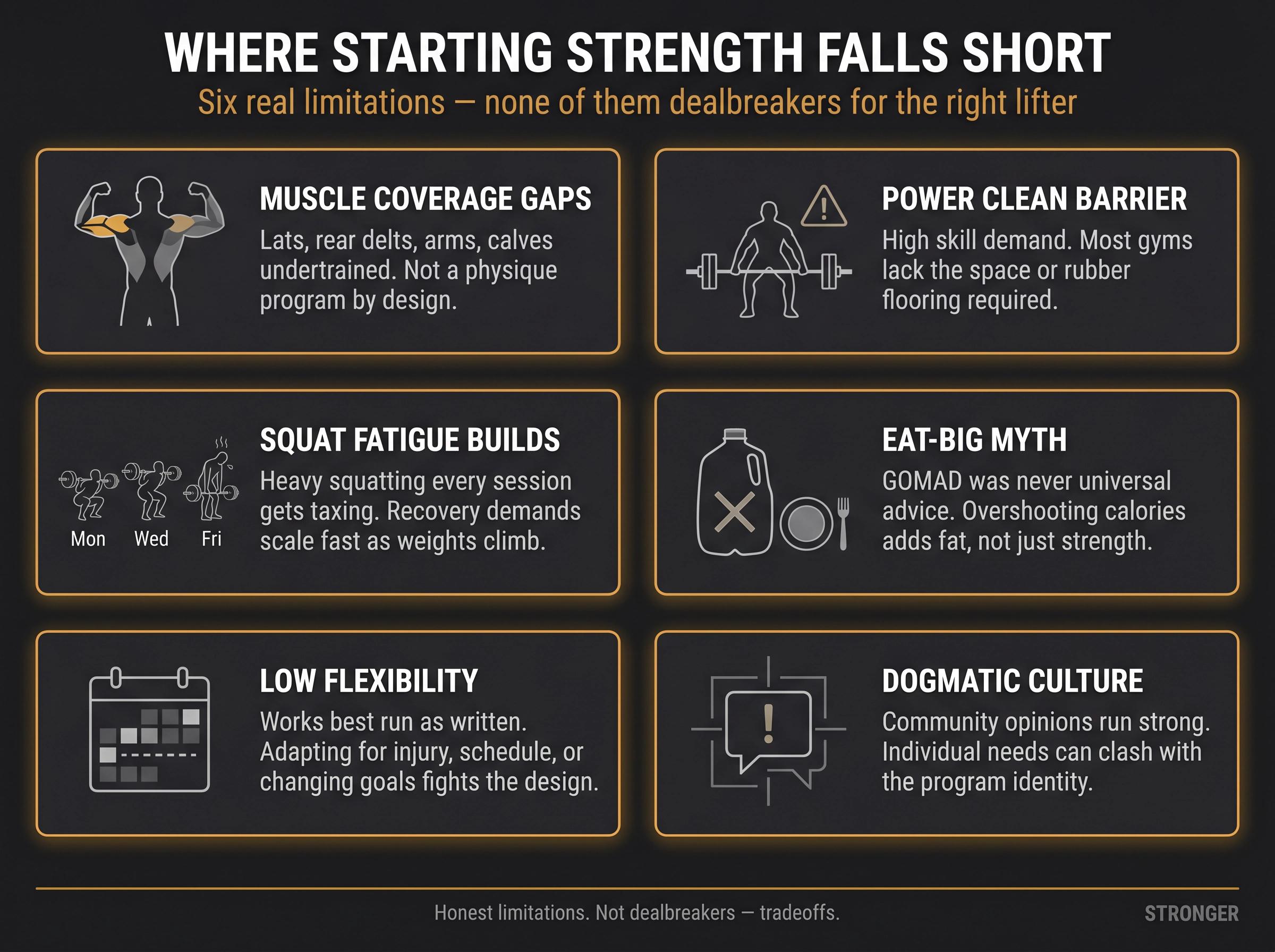
1. It's not a complete bodybuilding program
Starting Strength builds muscle — particularly in the legs, hips, back, chest, shoulders, and trunk. But it's not designed for physique balance or maximum hypertrophy. Understanding the actual differences between hypertrophy and strength training — in terms of volume, frequency, and exercise selection — helps clarify why.
The 2026 ACSM guidelines note that hypertrophy-focused training typically targets around 10 weekly sets per muscle group. (ACSM) Starting Strength's early phases are well below that threshold for several areas — lats, side delts, rear delts, arms, calves — and some muscle groups (like biceps directly, or rear delts) barely get trained at all. Chin-ups come later in the official progression, and the power clean is a strength skill, not a direct substitute for lat or upper-back hypertrophy work. (Starting Strength)
If your primary goal is to look bigger and more balanced, Starting Strength can be a useful foundation, but you'll want a hypertrophy-focused program sooner rather than later.
2. The power clean is a real barrier for many beginners
The power clean is valuable for power development and whole-body coordination, but it's also the most technically demanding movement in the program. Many commercial gyms don't have adequate space or rubber flooring for cleans. Many beginners don't have coaching available to learn it safely.
This is why alternative beginner programs often substitute rows, chin-ups, or Romanian deadlifts for the power clean. That doesn't make those programs universally better, but it does make them more accessible for the majority of lifters.
3. Heavy squatting 3x per week gets demanding
In the early weeks, full-body training three days a week often feels productive and motivating. Weeks in, heavy squatting every session can become physically and psychologically taxing.
The program itself acknowledges this. The official progression eventually introduces an advanced novice setup where the trainee squats heavy only twice per week with a lighter third session, allowing more recovery as weights get serious. (Starting Strength)
The mistake isn't doing the program. The mistake is refusing to acknowledge or accommodate the limits the program itself already anticipated.
4. The eat-big advice is frequently misapplied
Starting Strength has long been associated with aggressive eating — sometimes satirized as mandatory GOMAD (a gallon of milk a day). That association has helped some genuinely underweight beginners stop spinning their wheels. It has also led others to gain unnecessary body fat while making minimal strength progress.
The more nuanced official position is less extreme. A Starting Strength coach article from 2020 explicitly pushes back on the idea that every coach tells everyone to eat massive amounts, pointing out that people who are just starting don't necessarily need to eat more immediately. (Starting Strength) An older 2015 article acknowledges GOMAD as useful for young underweight males specifically, but "not recommended" for others. (Starting Strength)
The honest version: eat enough to recover and support performance. Track bodyweight and waist. If you're genuinely underweight and stalling, you probably need more food. If your waist is growing rapidly while your lifts are barely moving, you're probably overshooting.
5. It's less flexible than modern adaptive programs
Starting Strength works best when you run it close to as written. That's useful for beginners who need structure, but limiting for people with changing schedules, injury constraints, gym access variability, or goals that shift between strength, hypertrophy, sport performance, and general health.
A modern lifter may want exercise substitutions, RPE-based loading, volume tracking by muscle group, bodyweight analytics, estimated 1RM trends, and the ability to pivot when life changes. Starting Strength can be logged manually, but the original system is intentionally minimalist. If you need flexibility, you'll be working against the program's design.
6. The community culture can become dogmatic
This one is less about the written program and more about the community that surrounds it. Starting Strength has very strong opinions about technique, exercise selection, programming, and coaching. Strong opinions can be valuable. They can also become limiting when a lifter genuinely needs individualization or has goals that don't map neatly onto the program's philosophy.
The most useful relationship with Starting Strength is: take the valuable parts seriously, learn from them, and don't turn a training program into a fixed identity.
What does starting strength cost in 2026?
Here is the complete cost picture, from free to expensive.
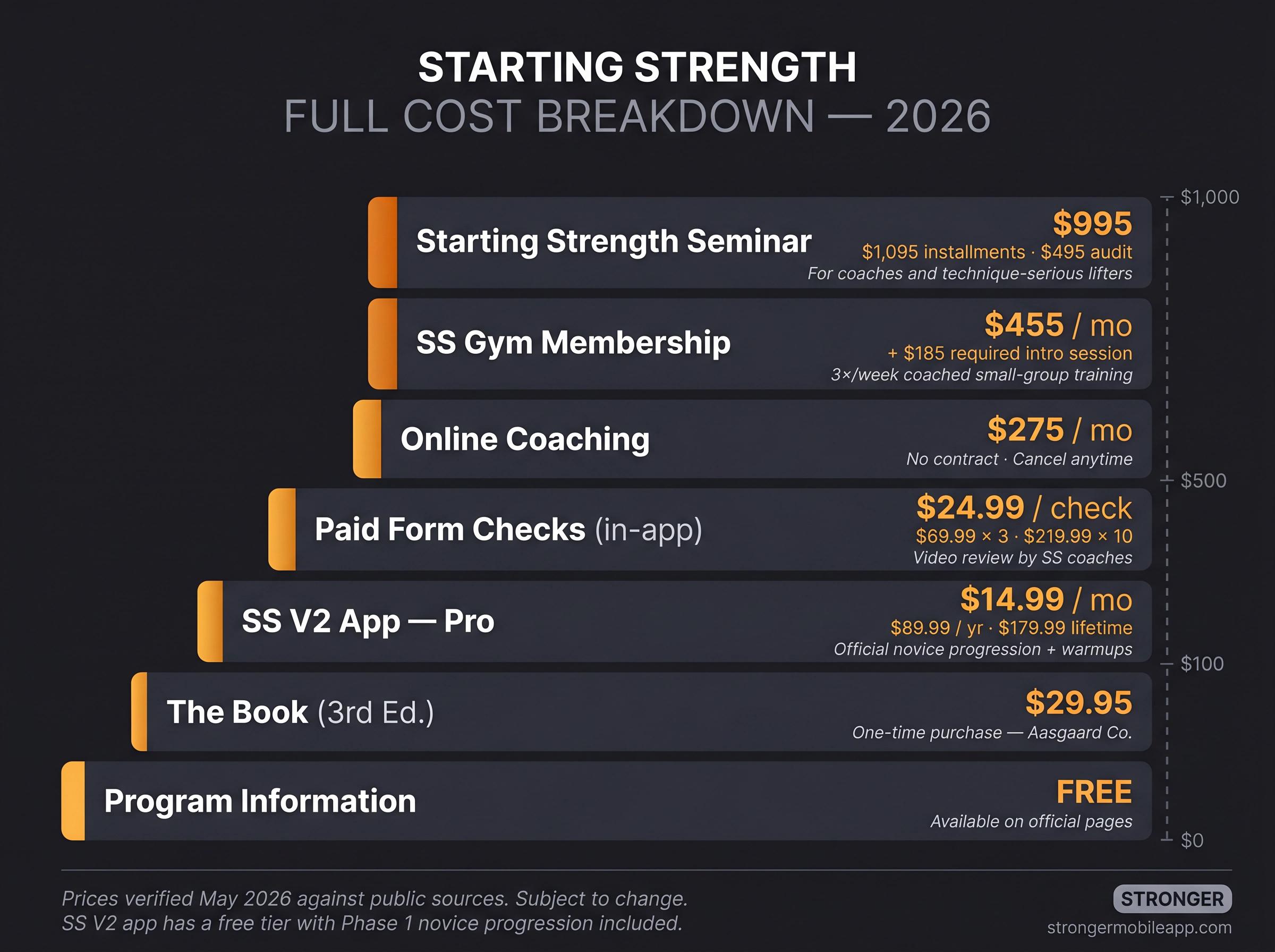
| Option | Current price | Is it worth it? |
|---|---|---|
| Starting Strength program information | Free on official pages | Yes — the basic novice framework is freely available |
| Starting Strength: Basic Barbell Training, 3rd ed. | $29.95 (Aasgaard Company) | Yes, if you plan to learn the lifts seriously |
| Starting Strength V2 app (Pro) | $14.99/month, $89.99/year, $179.99 lifetime (App Store) | Worth trying if you want SS-specific warmups, progression, and deload logic built in |
| Paid form checks (in official app) | $24.99 for one, $69.99 for three, $219.99 for ten (App Store) | Potentially worth it if you can film lifts well and have no in-person coaching |
| Legacy Starting Strength app | Older listings visible; one shows $14.99 (App Store) | Be careful — confirm you're buying V2, not the legacy version |
| Starting Strength Online Coaching | $275/month, no contract (Starting Strength Gyms) | Good middle ground: cheaper than in-person, more personalized than an app |
| Starting Strength Gym membership (example: Houston) | $455/month for 3x/week, required $185 intro session (Starting Strength Gyms) | Worth it if you value coached small-group training and can afford it |
| Starting Strength Seminar | $995 pay-in-full, $1,095 installments, $495 audit (July 2026 listing) (Aasgaard Company) | Valuable for coaches and technique-serious lifters; unnecessary for most beginners |
Note: Some official pages don't show a visible "last updated" date. Prices were checked against public sources in May 2026 and may change.
The most important practical takeaway: the program and book are inexpensive; coaching is where the costs get serious. That doesn't mean coaching is overpriced. Good technique instruction can save months of frustration and injury risk. But be clear about what you're actually paying for: information, app convenience, form feedback, or in-person coaching. Those are four different products at four different price points.
Is the Starting Strength book worth it?
Yes — if you're going to train the lifts seriously.
The book is not just a routine. It's a technical manual covering why barbells are used, the mechanics of the squat, press, deadlift, bench press, power clean, and power snatch, and the stress-recovery-adaptation model behind programming. (Aasgaard Company) Some beginners will find it dense. That density is also why it remains useful. A typical beginner article tells you to "keep your back straight." Starting Strength goes much deeper into bar path, stance, grip, and setup.
Buy the book if you want to actually learn the lifts, not just copy a template. Skip it if you want a simple app-only plan or you're not interested in barbell training.
Is the official Starting Strength V2 app worth it?
The new Starting Strength V2 app is worth trying if you want to run the program close to the official model.
Free features include Phase 1 of the novice linear progression, onboarding for the first workout, a custom training log, workout history, and basic progress tracking. Pro features add all programs, a custom workout builder, the mobile Blue Book, progress predictions, warmup calculations, stall and deload recommendations, technique guides, plate math, and cloud sync. (Aasgaard Company) The Google Play listing was updated April 30, 2026. (Google Play)
Use the official app if you want the most Starting-Strength-specific implementation. Use a general strength tracker instead if you want broader analytics, more exercise flexibility, bodyweight trends, and a log that will still serve you after you've graduated past the novice phase. That last point matters: Starting Strength is temporary for most lifters. Your training log should outlive the program.
Are Starting Strength Gyms worth it?
Starting Strength Gyms are not normal commercial gyms. The official pitch is coached training: "we program every workout and coach every rep." (Starting Strength Gyms) The Houston location lists a 3x/week plan at $455/month — described as an average of $35 per session — with a required $185 intro session for new members. A 2x/week plan runs $405/month. (Starting Strength Gyms)
That's substantially more expensive than a standard gym membership. It's also far more hands-on.
Consider a Starting Strength Gym if: you're nervous about learning barbell lifts alone, you've repeatedly stalled due to technique issues, you want accountability and a fixed schedule, or you're returning after a long layoff and want supervision. It's probably not worth it if you already have good technique, prefer independent training, have a tight budget, or want equipment variety beyond barbells.
Is Starting Strength Online Coaching worth it?
Official Starting Strength Online Coaching is listed at $275/month with individualized programming, video form reviews up to four times per week, nutrition advice, no contract, and cancel-anytime terms. (Starting Strength Gyms)
It's worth considering if you don't live near a Starting Strength gym, you want regular form review, and you're willing to record and upload your lifts consistently. It's not necessary if you're progressing smoothly, you have access to competent local coaching, or you only need a basic beginner template and a spreadsheet.
Online coaching is most valuable when the feedback actually changes your training decisions. If all you need is structure, it's overkill.
Who is starting strength actually for?
It's a strong fit if:
- You're a true beginner. If you're new to serious lifting and your primary goal is strength, Starting Strength is one of the clearest systems available.
- You want measurable, objective progress. Every workout has a target. The bar either moves or it doesn't. That simplicity is motivating for people who like tracking concrete improvement.
- You're barbell-focused. If you specifically want to build your squat, press, bench press, and deadlift, the program aligns perfectly with that goal.
- You need structure. Some beginners fail because they do too little random work; others fail because they do too much. Starting Strength solves both problems simultaneously.
- You might hire coaching. The program's biggest weakness — technically demanding lifts — becomes much less of an issue with access to competent coaching.
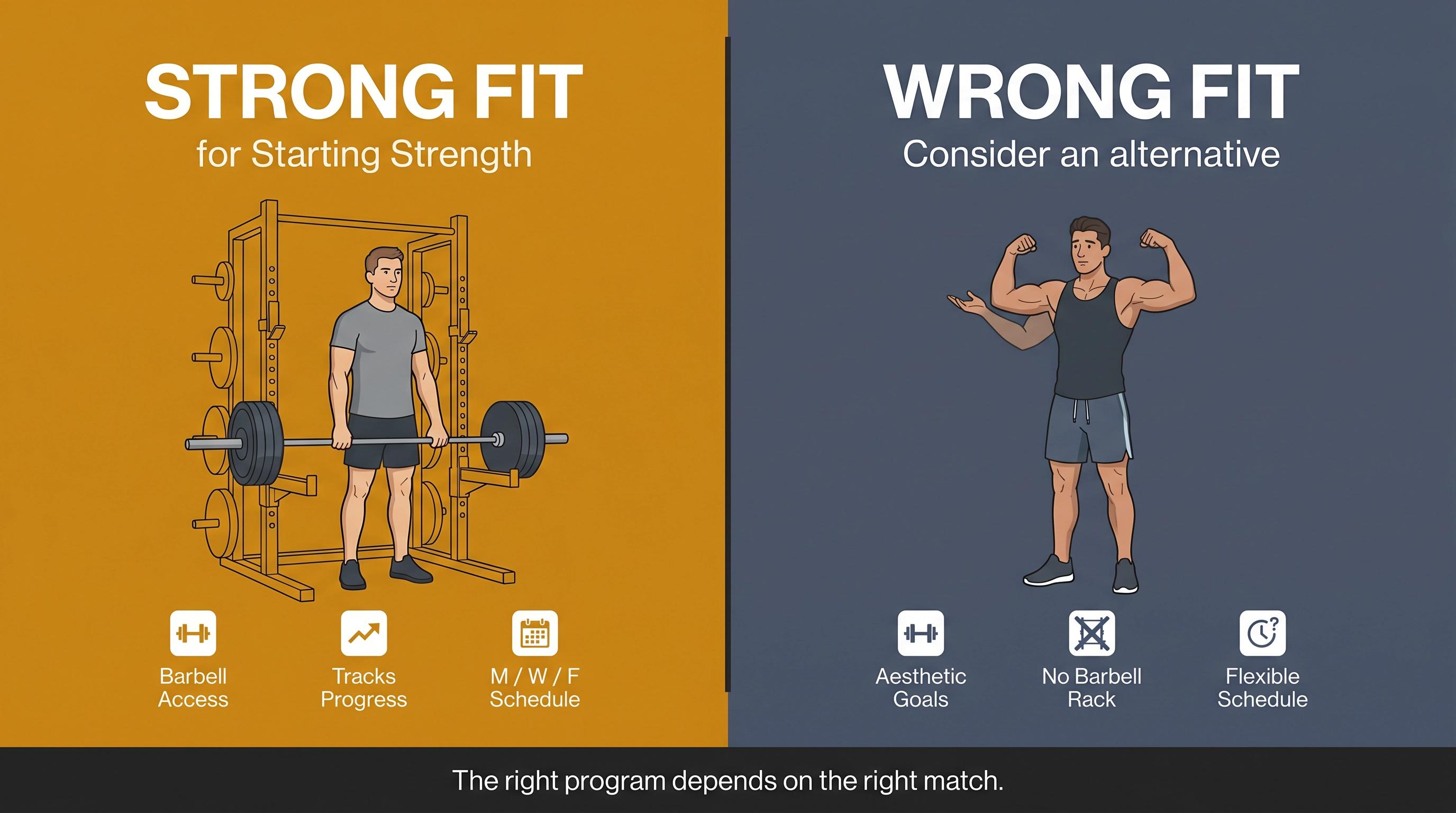
It's probably not the right fit if:
- Your main goal is bodybuilding aesthetics. Use a hypertrophy-focused beginner plan or transition quickly after building a strength base.
- You don't have barbell equipment. You need a power rack or squat stands, an Olympic barbell, a bench, and plates to run the program safely. Official equipment recommendations also include lifting shoes and a training log. (Starting Strength Gyms)
- Your schedule won't allow three non-consecutive days per week. The program is built around that rhythm. A more flexible plan will serve you better if your schedule is genuinely inconsistent.
- You have significant injury constraints. Barbell training can be modified — official SS materials confirm the method can be adjusted for different ages and limitations (Starting Strength Gyms) — but complex injury histories warrant individual qualified guidance, not a standard beginner template.
- You're already intermediate. If workout-to-workout progress is already unrealistic for you, the novice linear progression isn't the right tool.
- You genuinely hate low variety. The core lifts repeat every session, week after week. Some lifters love that. Others burn out. Adherence matters more than program design, so choose something you'll actually run.
What results can you expect from starting strength?
The most honest answer: fast early strength gains, then a clear and deliberate slowdown.
Beginners can often improve rapidly in the novice phase because they're simultaneously adapting neurologically, learning movements, and building early hypertrophy — all with relatively modest training stimulus. The official program is designed to capture that adaptation through systematic progression: add weight every workout while recovery allows. (Starting Strength)
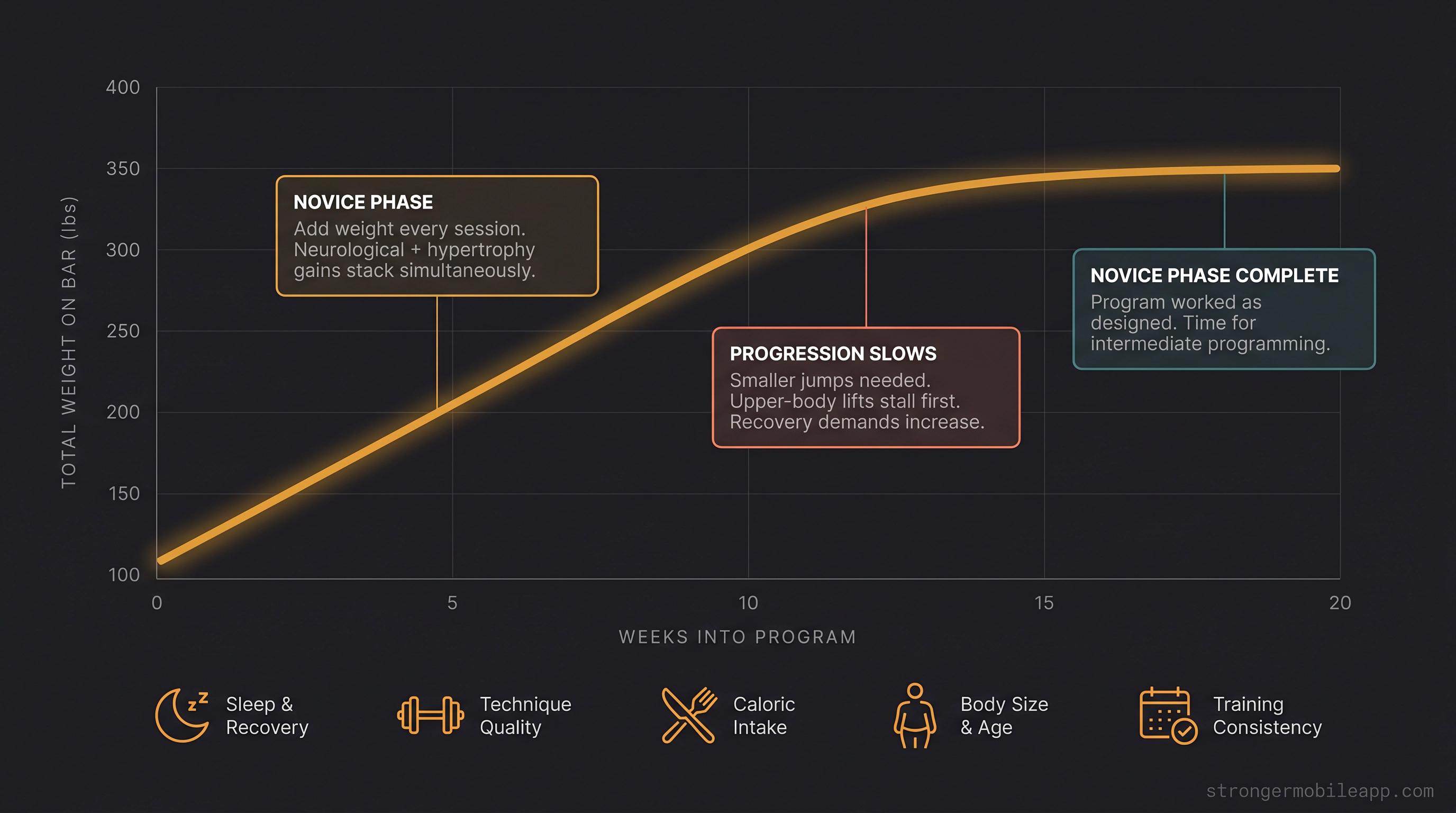
What you should not do is treat anyone else's training log as a promise for your own. Your results depend on:
- Starting strength and training history
- Body size, age, and sex
- Sleep and recovery quality
- Calorie and protein intake
- Technique quality and learning rate
- Equipment and training environment
- Rest between sets
- Life stress outside the gym
- Whether you started at appropriate weights
A more realistic set of expectations:
- You'll learn the main barbell lifts and genuinely improve at them
- Your squat and deadlift will usually progress fastest early on
- Your press will stall sooner than your lower-body lifts — this is normal and expected
- You'll eventually need smaller load jumps, more recovery between sessions, and then different programming entirely
- If you track bodyweight, waist measurements, and lift performance simultaneously, you'll know whether your recovery approach is working
Checking your lifts against established strength standards for your weight class gives you an objective reference point: you're not just adding arbitrary weight, you're working toward benchmarks that reflect real performance across thousands of lifters.
The official Starting Strength programming resources emphasize not abandoning novice linear progression too early, but they also acknowledge that programming changes become necessary once the novice phase genuinely runs its course. (Starting Strength) The goal is to exhaust the simplest tool before reaching for a more complex one — not to stay on a program that has stopped working out of loyalty.
7 tips to get better results from starting strength
If you've decided Starting Strength is the right program for you, here's how to actually run it well instead of just copying the template and hoping for the best.
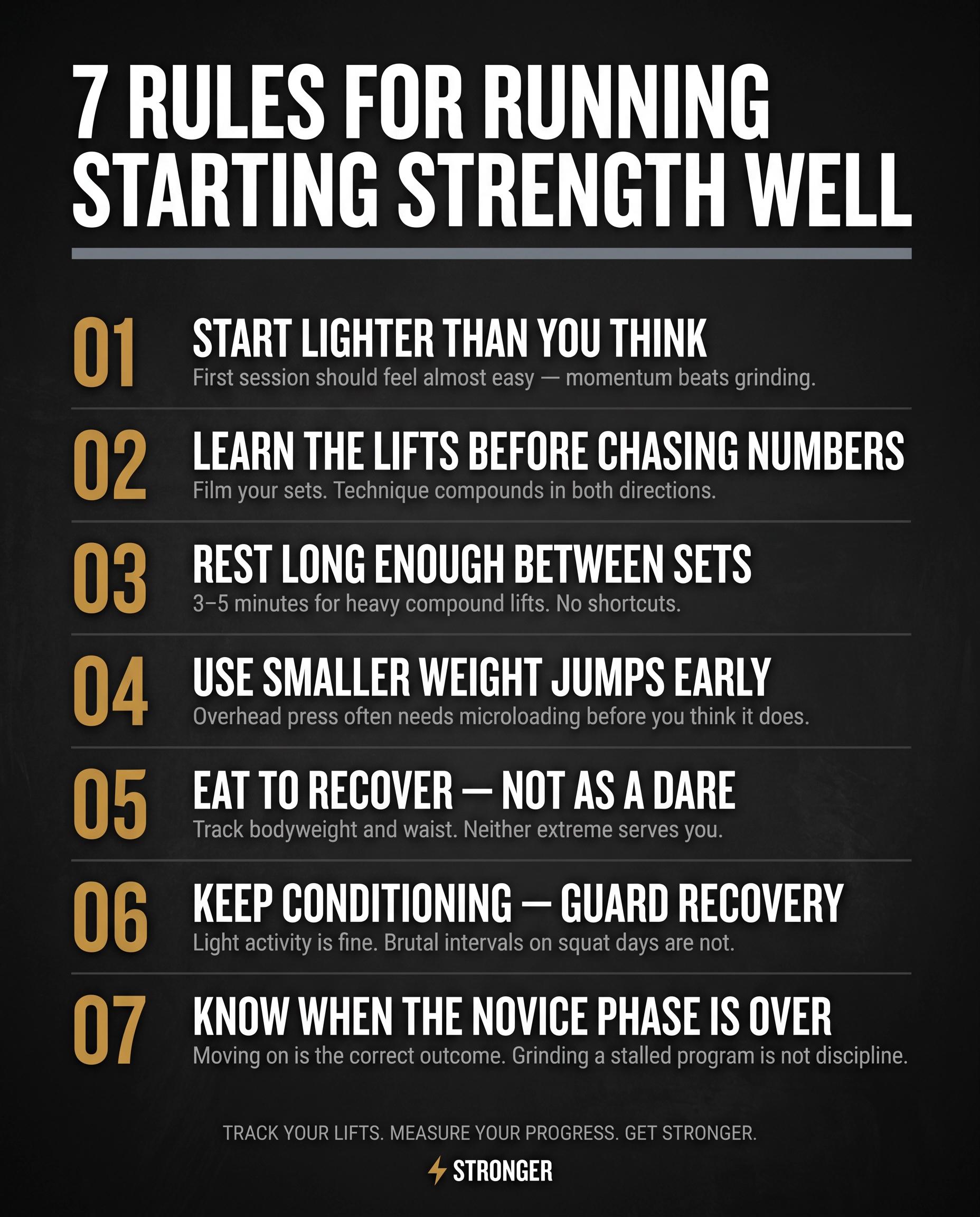
1. Start lighter than you think you need to
Most failed novice progressions begin too heavy. Your first session should feel almost easy — you should finish thinking "that was too light." That's not a problem. That's the setup. You'll add weight next session, and the session after that. Starting lighter means you build momentum instead of immediately grinding.
2. Learn the lifts before chasing numbers
Read the relevant book chapters, watch technique videos, and film your work sets. The goal is not to add weight for its own sake — it's to add weight to a movement pattern that you can keep improving. Technique problems compound over time in both directions: a good groove gets more efficient; a bad one gets harder to fix.
3. Rest long enough between sets
Heavy compound sets need real recovery between them. Our own rest-time guidance at Stronger recommends at least three minutes for heavy compound lifts, and often four to five minutes for demanding top sets. (Stronger) If your breathing and heart rate are limiting your next squat set more than your strength is, you're rushing.
4. Use smaller weight jumps before you need them
Upper-body lifts stall sooner than lower-body ones. The overhead press in particular often needs microloading — adding 1.25 or 2.5 lbs instead of 5 — earlier than most beginners expect. If your gym doesn't stock small plates, invest in fractional plates. If your tracking app lets you log planned future weights and shows trends, use that feature to plan realistic jumps before you're standing in the gym wondering what to put on the bar.
5. Eat to recover — don't turn it into a dare
Eat enough to recover and support your training. Get adequate protein. Track bodyweight and waist measurements. If you're genuinely underweight and your lifts are stalling, you probably need more food. If your waist is growing quickly while your performance is barely improving, you're probably eating beyond what recovery requires. Neither extreme serves you.
6. Keep conditioning but don't let it wreck recovery
Starting Strength is a strength program. It is not a complete health program. Light conditioning, walking, and general activity can support your health without wrecking your recovery from heavy squatting. What you want to avoid is suddenly adding brutal conditioning sessions — long runs, high-intensity intervals, extensive cycling — on top of a heavy novice squat progression. The recovery demands compete.
7. Know when the novice phase is over
Moving on from Starting Strength is not failure. It's the correct outcome.
Move to intermediate programming when you can no longer add weight despite: reasonable starting loads, solid technique, adequate rest, adequate food, smaller load jumps, sensible deloads, and consistent training. At that point, you've exhausted the simplest tool. The next step is a more complex one — Texas Method-style work, 5/3/1, upper/lower splits, hypertrophy programs, or adaptive programming based on your specific goals. Programs using RPE-based load selection often serve intermediate lifters better than fixed percentage jumps.
What you don't do is grind a stalled novice progression for another three months and call it discipline.
How Stronger helps you track starting strength
Starting Strength only works if you know exactly what you did last session. The program's central mechanic — add weight every workout — requires a reliable record of what you lifted, how many reps you completed, whether you missed any, how long you rested, and what your bodyweight looks like alongside your performance. Tracking is not optional. The program is built on it.
Here's what you need to log to run Starting Strength properly:
- Exercise and variation
- Sets, reps, and weight (including warm-up sets)
- Missed reps or technical failures
- Rest times between sets
- Bodyweight (at least weekly)
- Notes on form or recovery
- Sleep quality or major stressors
- Deloads and weight resets
A notebook works. A spreadsheet works. A dedicated strength app works better for most people — because it reduces friction, gives you visual trends, makes PR detection automatic, and keeps your full history organized when you eventually move to a different program.
This is where Stronger fits naturally into a Starting Strength practice. Stronger is not affiliated with Starting Strength, and it's not built specifically for the program. But it's exceptionally well-suited to tracking a novice linear progression because every feature the program actually demands is there out of the box.
Here's how the features map to what Starting Strength needs:
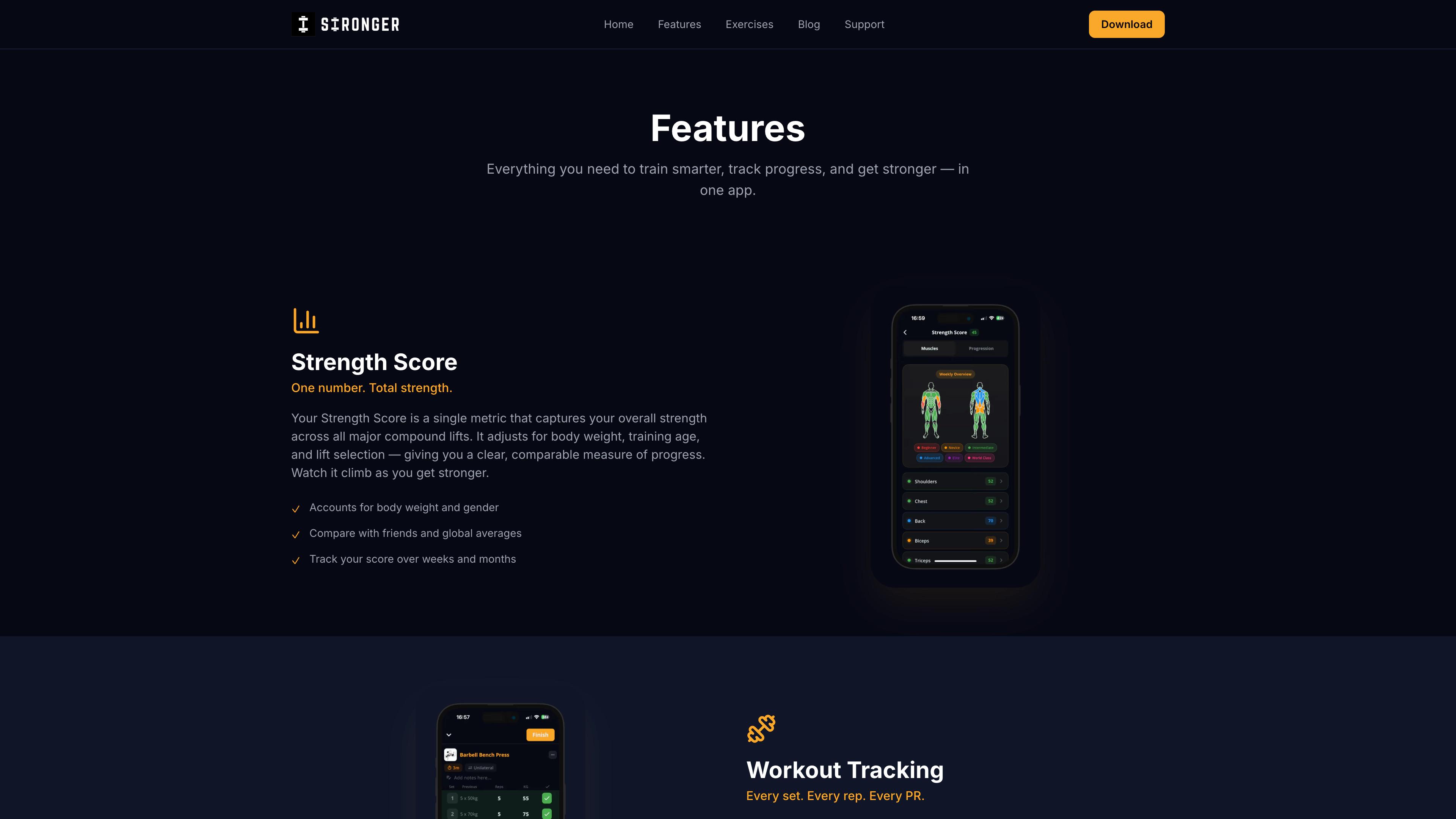
Workout templates. Create a Workout A and a Workout B template once. Log each session in seconds from the same structure every time. No rebuilding from scratch each session.
Rest timer. Built-in rest timer for every set. When you're squatting near your working maximum, having the timer automatically start after each set means you don't have to watch a clock — you get the rest the program demands without thinking about it.
PR detection. Stronger automatically flags personal records on every exercise, every rep range. When your squat hits a new lifetime best, you know it. For a program built around consistent progress, seeing that recognition in real-time is genuinely motivating.
Strength curves and estimated 1RM trends. One of the hardest things about running a novice progression is knowing whether you're still making meaningful progress or whether you've genuinely hit the wall. Stronger's strength curves and estimated 1RM tracking let you see your trajectory across weeks and months — not just session to session — so you can distinguish a bad week from a plateau.
Body measurements and bodyweight tracking. Starting Strength requires you to monitor bodyweight alongside lift performance, especially if you're adjusting nutrition. Stronger tracks both in one place, making it easy to see whether your strength gains and bodyweight changes are moving in the right direction together.
Volume and frequency tracking. Once you start wondering whether your weekly training load is appropriate — a question that becomes important as you approach the end of the novice phase — the volume analytics in Stronger give you the full picture.
The log outlives the program. This is the practical point that the official Starting Strength app can't match: when you're done with novice linear progression and ready for intermediate programming, all your Starting Strength history lives in the same app you'll use for whatever comes next. You don't lose your training record when you change programs. As we cover in our best workout tracker apps guide, one of the most underrated qualities of a good tracker is longevity — it should serve you for the beginner phase, the intermediate phase, and beyond. (Stronger)
A practical setup in Stronger for Starting Strength:
- Create "Workout A" and "Workout B" as named templates
- Log every work set with exact weight and reps
- Log warm-up sets separately (these matter for technique practice)
- Use the rest timer consistently — especially for squats and deadlifts
- Track bodyweight alongside each session's performance
- Review strength curves monthly to assess trajectory
If you're doing Starting Strength and haven't set up a proper tracking system yet, download Stronger and spend 10 minutes building those two templates. The first time you go to log a session and can see exactly what you did last time — with rest times, PR flags, and trend data — you'll understand why tracking isn't optional for this specific program.
Ready to Get Stronger?
Join 2,000,000+ lifters tracking their workouts with Stronger. Available on iOS and Android.
Start tracking freeWhy starting strength fails: 8 common mistakes
Most Starting Strength failures are not program failures. They're execution failures. Here are the ones we see most often.
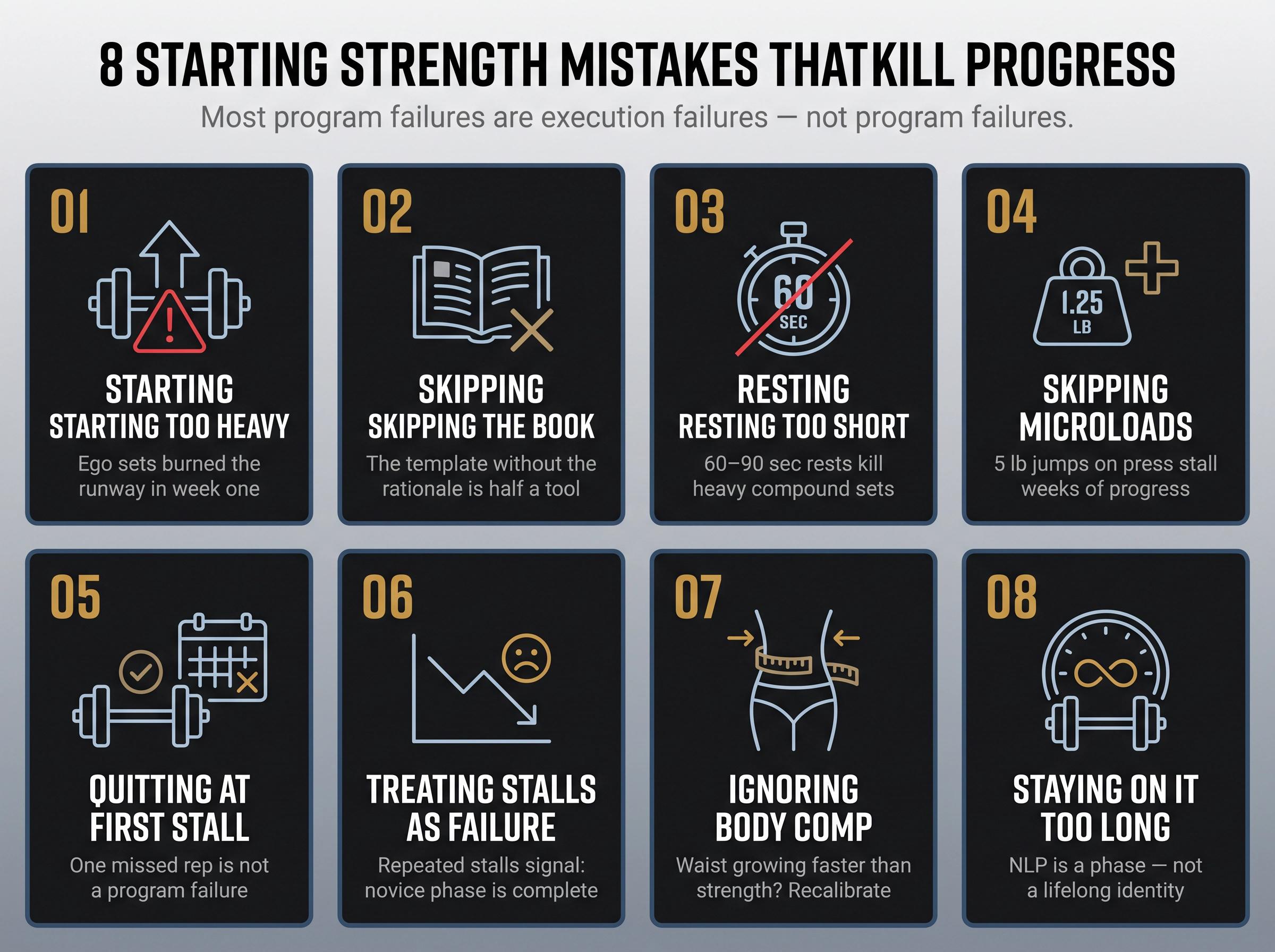
Mistake 1: Starting too heavy. If you're grinding from week one, you didn't find your starting weights — you tested your ego. Starting Strength requires weeks of comfortable progress to build momentum. Coming in too heavy burns through that runway immediately.
Mistake 2: Not reading the book. The template is not the whole product. The technical model — why the lifts are taught the way they are, what the cues mean, how the stress-recovery-adaptation model drives programming — is what makes the system coherent. Copying the workout structure without understanding the rationale is like following a recipe without understanding that heat changes proteins.
Mistake 3: Resting like it's a circuit. Sets of five on heavy squats and deadlifts are not metabolic conditioning work. They require real recovery. Resting 60-90 seconds between heavy barbell sets is one of the fastest ways to make the program "not work" while still technically doing it.
Mistake 4: Skipping microloading. A five-pound jump on the press can stall progress that could have continued another month or two with proper 2.5 or 1.25 lb increments. If your gym doesn't have small plates, buy a pair of 1.25s and keep them in your bag.
Mistake 5: Quitting the program at the first stall. Missed reps happen. A bad week of sleep, a stressful work period, a session where you were dehydrated — these cause single-session failures that are not program failures. Before abandoning the plan, check your sleep, food intake, rest between sets, and technique. Address those before changing the program.
Mistake 6: Treating repeated stalls as a moral failure. The flip side: if you've genuinely run the progression correctly and cannot add weight consistently despite addressing sleep, food, rest, and technique, you're done with the novice phase. Move on. That is not failure — that is the program working as intended.
Mistake 7: Ignoring body composition. Strength gain is good. Uncontrolled fat gain is not required. Track bodyweight and waist measurements throughout. If your waist is growing significantly faster than your strength, recalibrate your nutrition.
Mistake 8: Treating the early program as complete long-term programming. The early phases of Starting Strength have intentionally minimal pulling and upper-back work. That's by design for the novice phase. Your later training should include enough pulling volume, isolation work, and upper-back development to match your longer-term goals.
Is starting strength good for muscle growth?
Good for some muscle. Not ideal as a pure muscle-building program.
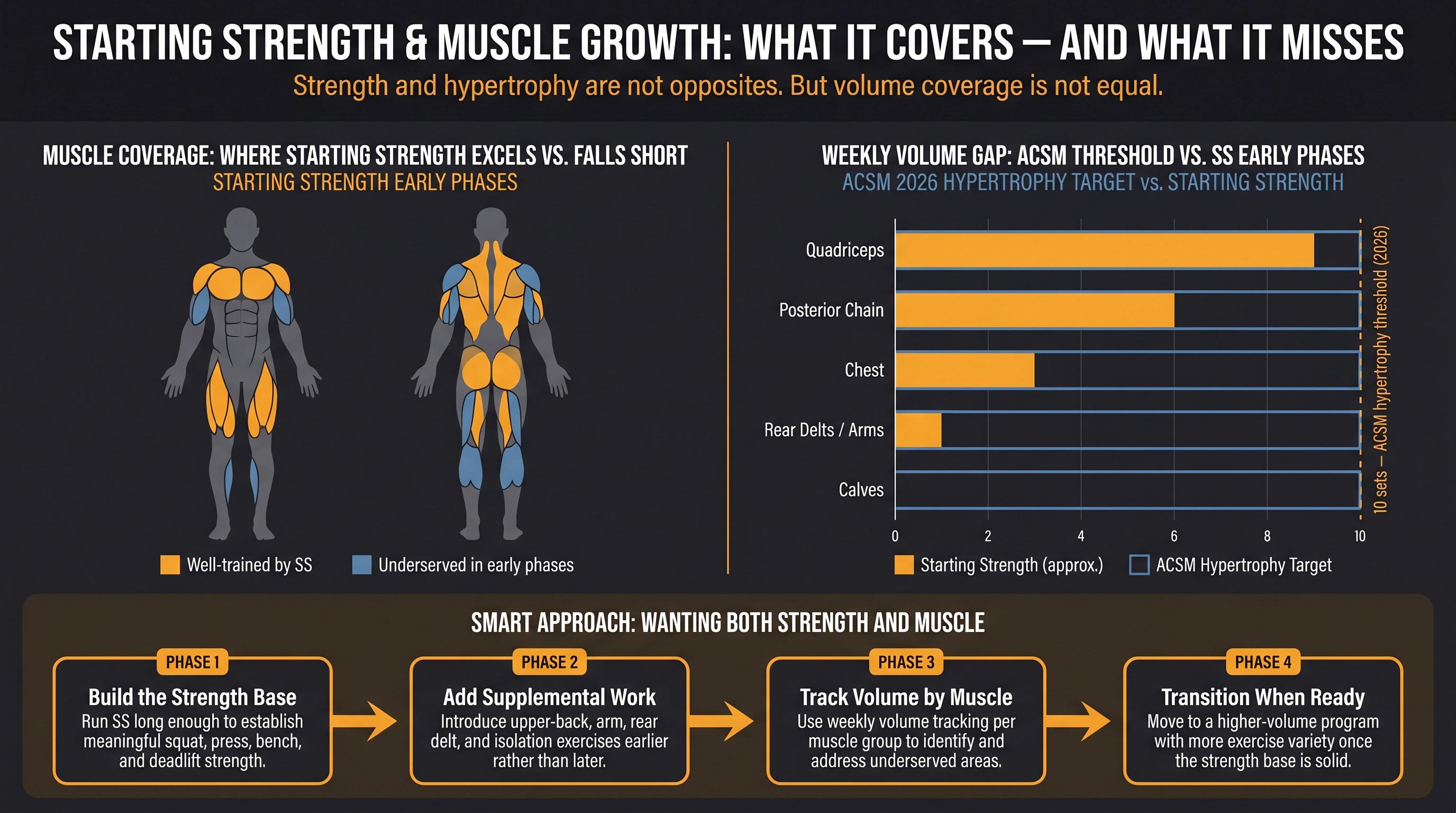
A beginner who gets significantly stronger at the squat, press, bench press, and deadlift will almost certainly gain muscle in the process. Strength and hypertrophy are not opposites. But hypertrophy training differs meaningfully from strength training in terms of the volume, rep ranges, and exercise selection required for maximum muscle development. Hypertrophy training benefits from adequate weekly volume per muscle group, exercise selection that covers all major muscles, and movements that allow target muscles to be trained close to failure safely.
Starting Strength's early phases are more strength-skill-focused than hypertrophy-focused. That's not a flaw if your goal is strength. It's a mismatch if your primary goal is a physique that's balanced and as developed as possible across all muscle groups.
The 2026 ACSM guidelines note that hypertrophy-focused training often targets around 10 weekly sets per muscle group. (ACSM) Starting Strength's early phases are well below that for several important areas, including arms, rear delts, and isolated hamstring or calf work.
A smart approach for lifters who want both strength and muscle:
- Run Starting Strength long enough to build a meaningful strength foundation
- Add supplemental upper-back, arm, delt, and isolation work earlier rather than later
- Track weekly volume by muscle group to see where you're underserving
- Keep the main lifts if you enjoy them, but consider transitioning to a higher-volume program with more exercise variety once you've built the strength base
Is starting strength safe?
No strength program is automatically safe. Safety in strength training depends on load selection, technique quality, fatigue management, equipment condition, and individual health status.
Starting Strength can be safe for many beginners because it progresses gradually and uses repeatable movement patterns that build technique over time. It can also carry risk if someone starts too heavy, ignores pain signals, uses poor equipment, or refuses to adjust when recovery is clearly compromised.
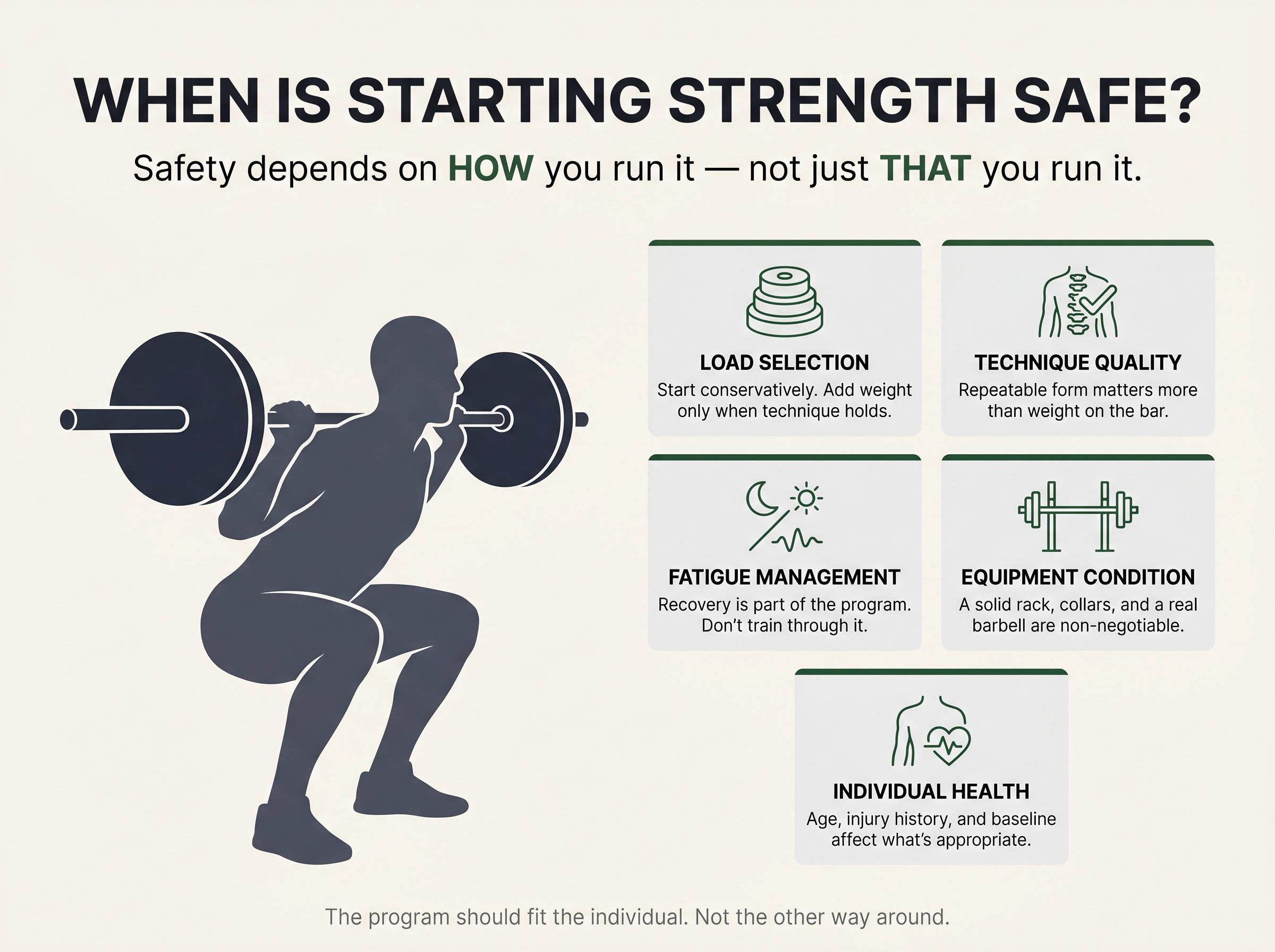
The official Starting Strength FAQ states that training can be modified for people with different ages, injuries, and baselines — including very conservative starting points when necessary. (Starting Strength Gyms) That's the right framework: the program should fit the individual, not the other way around.
If you have a medical condition, significant pain, or a complex injury history, get qualified medical or coaching guidance before loading aggressively. Starting Strength's fundamentals can often be adapted. The specific weights and progression rates should not be treated as mandatory regardless of your circumstances.
Final verdict: is starting strength worth it?
Starting Strength is worth it if you walk in with the right expectations.
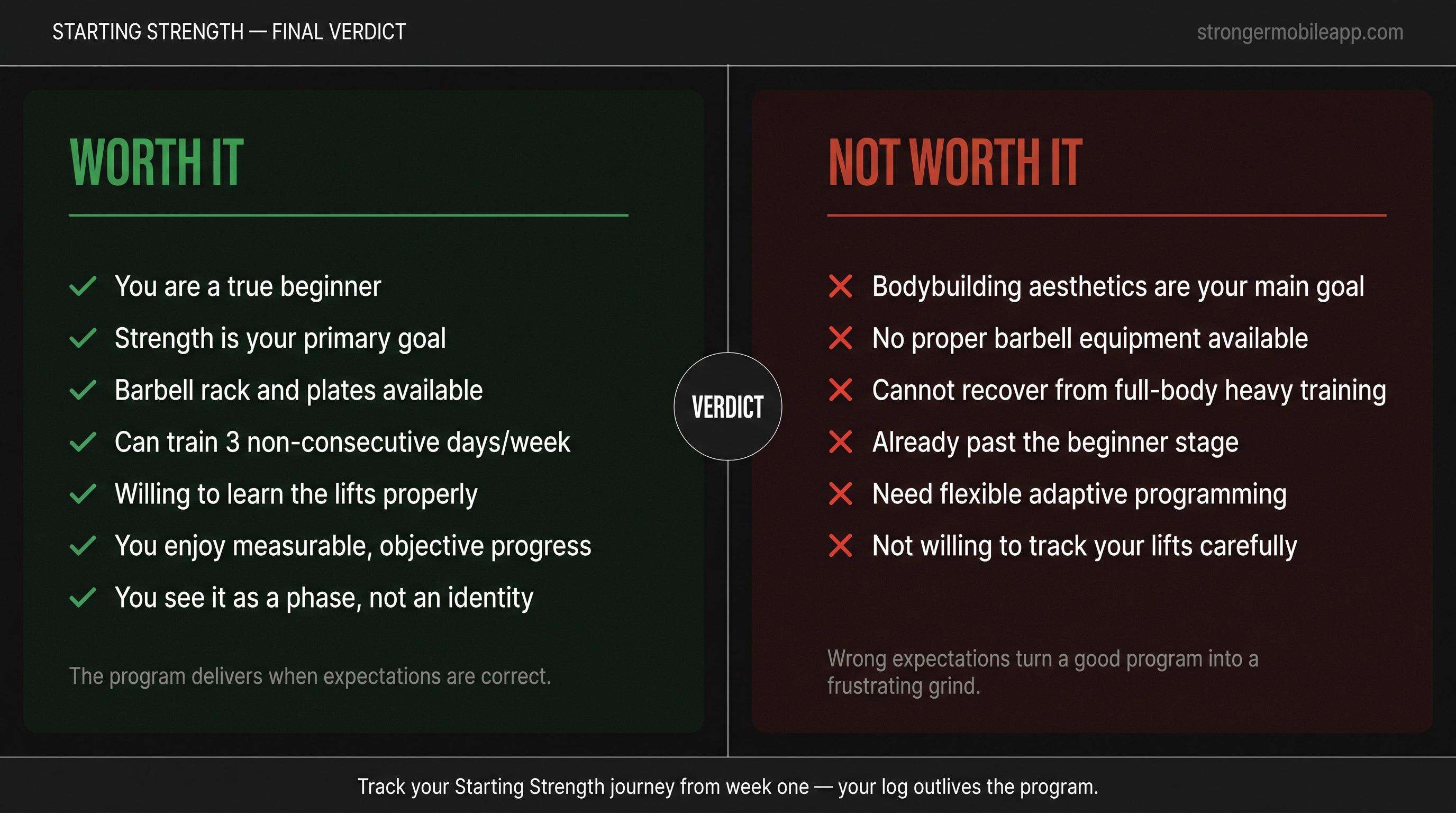
It's worth it if:
- You're a true beginner
- Strength is your primary goal, not aesthetics
- You have access to a barbell, rack, bench, and plates
- You can train three non-consecutive days per week
- You're willing to actually learn the lifts, not just load the bar
- You enjoy measurable, objective progress
- You understand it's a phase — not a lifelong identity
It's not worth it if:
- Bodybuilding aesthetics are your main goal
- You train in a gym without proper barbell equipment
- You cannot recover from heavy full-body training
- You're already intermediate
- You need flexible programming that adapts to your schedule and goals
- You're not willing to track your lifts carefully
Our recommendation: Buy the book. Run the novice progression intelligently. Log every workout. Plan your next program before you need it.
Starting Strength is not magic. It's not the only good beginner program. But for the right person — a true beginner who wants to build a barbell strength foundation as efficiently as possible — it remains one of the most effective ways to stop exercising randomly and start training seriously.
The program will do its job if you do yours: show up, track your numbers, add weight when you can, and know when the novice phase is over.
At Stronger, we work with lifters at every stage of that journey. If you're starting Starting Strength — or considering it — set up a proper tracking system before your first session. The progress you'll want to review in three months starts with the data you log in week one.
Frequently asked questions about starting strength
Is Starting Strength still worth it in 2026?
Yes, for true beginners whose main goal is barbell strength development. The scientific basis for the program's approach — emphasizing load, volume, and progression on fundamental compound movements — remains well-supported by current research, including 2026 updates from ACSM and a 2026 Bayesian meta-analysis in Sports Medicine. The program is less appropriate for bodybuilding-first trainees, people without barbell access, or lifters who are already intermediate.
How long should I run Starting Strength?
Run it until simple workout-to-workout progression stops despite good technique, adequate recovery, appropriate nutrition, and sensible load jumps. For many people that means three to six months, but the timeline varies considerably based on training history, age, sex, and starting point. The official phase model includes an advanced novice phase that extends the useful life of linear progression as recovery demands increase. (Starting Strength) The program itself tells you when you're done. At that point, it's worth exploring the training principles that carry you into intermediate programming.
Do I need to do power cleans on Starting Strength?
If you're running Starting Strength as written, the power clean is part of the program's progression. But if you have no coaching access, no appropriate training space, or simply no interest in learning the lift, a different beginner program that substitutes rows, chin-ups, or RDLs may serve you better. The power clean is valuable — but it's a barrier for many lifters, and there are other ways to address pulling and hip extension.
Is Starting Strength good for women?
It can be, though loading jumps and progression expectations need adjustment. The official program materials note that women typically need smaller increases than young men, particularly on upper-body lifts. (Starting Strength) The fundamental approach — compound barbell lifts, linear progression, consistent training — is just as relevant regardless of sex. For women who want to explore program options beyond the barbell-only structure, workout splits designed specifically for women's goals are worth considering alongside the barbell fundamentals.
Is Starting Strength good for older beginners?
It can be, especially with conservative loading and coaching. The official Starting Strength materials direct older or very deconditioned trainees toward modified approaches and related resources — including The Barbell Prescription, which applies the general SS methodology to older adults. (Starting Strength) The principle of progressive barbell training is sound for older lifters; the specific progression rates require more conservative calibration.
Do you need to drink a gallon of milk a day (GOMAD)?
No. GOMAD is not a universal requirement. The current and historical official position on this is more nuanced than the meme suggests. A 2020 Starting Strength coaching article explicitly pushes back on the idea that every coach mandates aggressive eating, pointing out that not everyone needs to increase caloric intake immediately. (Starting Strength) An older 2015 article discusses GOMAD as effective for young underweight males specifically, with "not recommended" status for others. (Starting Strength) Eat enough to support recovery and progress. That's the actual requirement.
Is Starting Strength better than StrongLifts 5x5?
It depends on your specific situation. Starting Strength is more technique-manual-driven, includes the power clean, and uses a 3x5 structure with a 1x5 deadlift. StrongLifts-style training is generally simpler from a template perspective, commonly substitutes rows for power cleans, and typically uses 5x5 across (more total volume). If your goal is classic barbell strength development and you're willing to study the lifts seriously, Starting Strength has a strong case. If you want a simpler template with more upper-back work built in from the start, a StrongLifts-style approach or similar novice LP may fit better.
Should I use the official Starting Strength app or a general tracker?
Use the official V2 app if you want the most SS-specific implementation — built-in warmup calculations, automatic progression, stall and deload recommendations, technique guides, and optional form checks. (Aasgaard Company)
Use a general strength tracker like Stronger if you want broader analytics (strength curves, estimated 1RM trends, volume and frequency tracking), more exercise flexibility, bodyweight and body composition tracking alongside lift data, and — critically — a training log that will still serve you after you've moved beyond the novice phase. Your Starting Strength training history shouldn't live in an app you'll abandon when the program ends.
Can I do Starting Strength at home?
Yes, if you have the right equipment. You need a power rack or squat stands with proper safety rails, an Olympic barbell, enough plate weight to progress, a bench, and adequate space to train safely. Without a rack with safeties, you cannot safely fail a squat or bench press. If you're missing any of those, choose a program better matched to your equipment.
What should I do after Starting Strength?
Move to intermediate programming that matches your goal. For continued strength development, common next steps include Texas Method-style training, 5/3/1, upper/lower splits, or powerbuilding programs. For hypertrophy, a dedicated PPL program with higher volume and more exercise variety. For general fitness, adaptive programming that balances strength, conditioning, and health. The important thing: stop expecting novice-pace progress when you're no longer a novice. The rate slows. The program needs to change with it. If you've been tracking in Stronger, your full history and strength benchmarks will carry forward into whatever comes next.
Is Starting Strength worth it for weight loss?
Starting Strength is primarily a strength program, not a weight-loss program. It can support body composition changes if paired with appropriate nutrition, but the program itself doesn't prescribe caloric deficits and isn't optimized for fat loss. Beginners can and often do recompose — gain strength and muscle while losing or maintaining body fat — but that depends heavily on nutrition, not just the program. If weight loss is your primary goal, work with a nutrition approach that supports it; the program can run alongside that, but it's not the driver.
Exercises in this guide
Stronger Editorial Team
Certified strength & conditioning specialists with 10+ years of coaching experience
The Stronger editorial team produces evidence-based training content for lifters of all levels.
Ready to Get Stronger?
Join 2,000,000+ lifters tracking their workouts with Stronger. Available on iOS and Android.
Start tracking free