

Building Muscle After 50: A Complete Guide
Medical note: This guide is educational, not medical advice. If you have chest pain, dizziness, unexplained shortness of breath, uncontrolled blood pressure, recent surgery, severe osteoporosis, kidney disease, major joint pain, or any condition that affects exercise safety, speak with a qualified healthcare professional before changing your training or supplement routine.
Here's the honest answer most people aren't getting: yes, you can build muscle after 50. Not "maintain a little if you try very hard." Actually build it.
The body changes. Recovery slows. Protein matters more. The margin for poor programming gets smaller. But the fundamental mechanism that drives muscle growth does not switch off when you turn 50. Your muscles still respond to progressive resistance training. The adaptation is slower, the approach needs to be smarter, and the recovery needs to be deliberate. But the door is open.
We've worked with thousands of lifters across a wide range of ages through Stronger, and the pattern we see consistently is this: the people who struggle after 50 are usually doing one of a small number of predictable things wrong. Not because they lack effort, but because the approach that worked at 25 needs a genuine rethink at 50.
This guide covers what actually changes in your body after 50, the principles that work given those changes, a full 12-week program you can start this week, what to eat, which supplements are worth it, and how to measure progress when the scale lies to you.
By the end, you won't just know that building muscle is possible after 50. You'll know exactly how to do it.
How your body changes after 50 and what it means for building muscle
Understanding the physiology isn't just academic. It's what separates intelligent training from stubborn repetition of old habits. Here's what's actually different, and what it means for how you train.
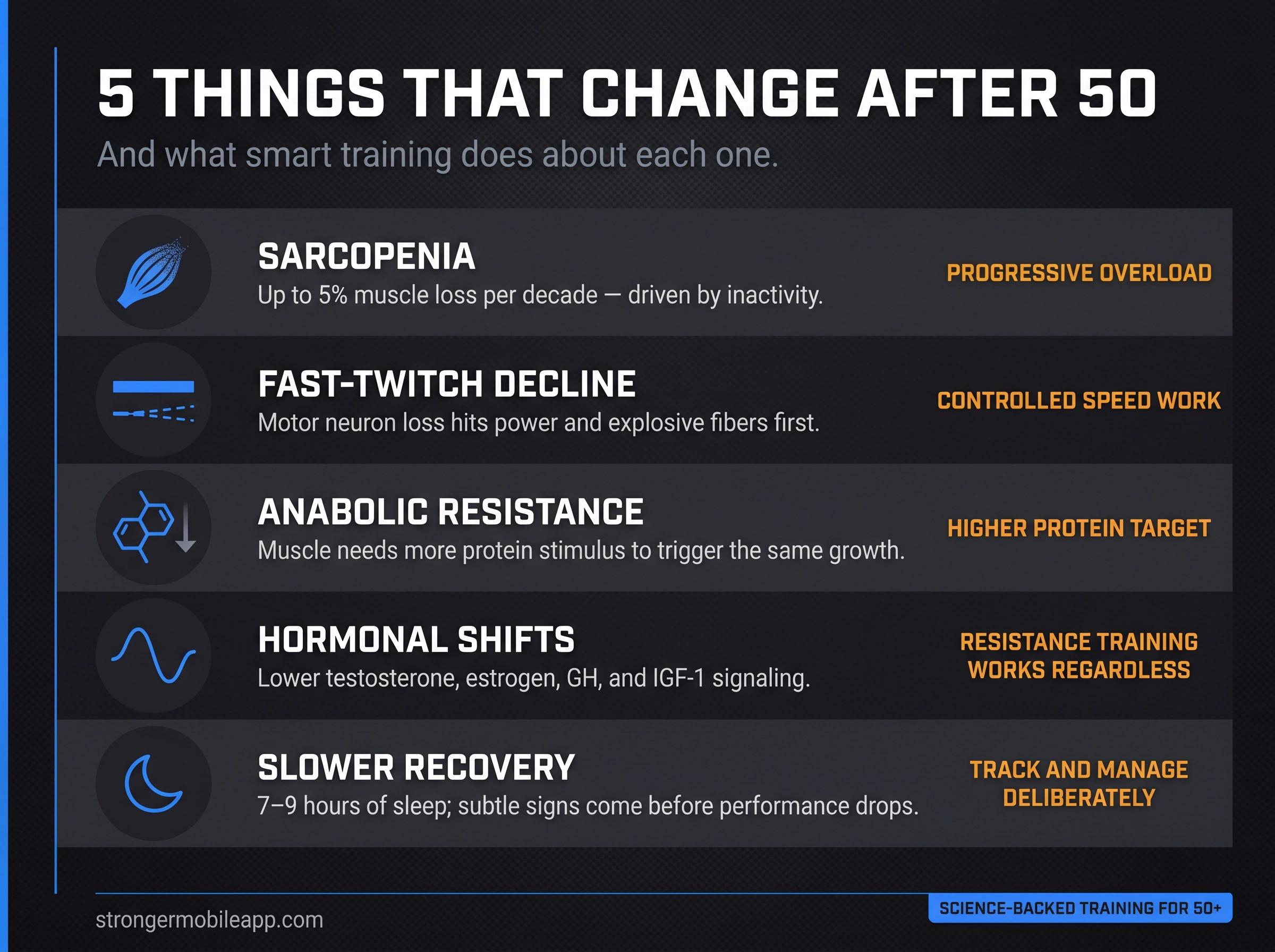
How muscle loss happens after 50 and why resistance training reverses it
Starting around age 30, adults naturally lose muscle at an estimated rate of about 3 to 5 percent per decade, and those changes often become more noticeable later in life. Sarcopenia, the clinical term for age-related loss of muscle mass and strength, can make everyday tasks like standing from a chair, walking, opening jars, and carrying groceries progressively harder. The NIH links sarcopenia to increased fall risk, mobility problems, hip fractures, and loss of independence when strength and walking speed decline. (NIH News in Health)
But here's the critical piece most people miss: the rate of muscle loss is largely driven by inactivity, not by aging alone. Poor nutrition, chronic illness, low protein intake, and periods of reduced movement all accelerate the process. If disuse is the primary driver of decline, progressive resistance training is the most direct counter-pressure available.
The goal isn't to "slow aging." The goal is to give your body a strong enough stimulus that it has reason to adapt, maintain, and grow.
Why fast-twitch muscle fibers decline faster after 50
After 50, the nervous system becomes a bigger piece of the story. A 2025 Frontiers in Aging review explains that aging muscle is affected by neurological, hormonal, nutritional, cellular, and mitochondrial changes. Motor neuron loss can begin around age 50, and this particularly affects fast-twitch muscle fibers, the fibers most responsible for strength, power, and explosive movement.
Fast-twitch fibers are the ones that activate when you sprint, jump, or lift something heavy quickly. Losing them doesn't show up as immediately on a tape measure as it does in functional performance: that slightly slower time getting out of a chair, the reduced confidence on stairs, the sense of being less "solid" even when body weight is unchanged.
This is why a smart program after 50 doesn't just chase muscle size. It also builds:
- Maximal strength
- Power under load
- Balance and coordination
- Confidence moving your own body
You don't need explosive or risky training to address this. Controlled movements with fast-but-clean lifting intent, step-ups, and carries all contribute. The point is to keep sending the signal.
What is anabolic resistance and why protein needs increase after 50
Anabolic resistance refers to the reduced ability of older muscle to respond to the normal growth signals that protein provides. To put it plainly: the same amount of protein that would trigger muscle repair and growth in a 25-year-old may not be enough in a 55-year-old. The threshold for stimulation goes up.
The practical takeaway: Protein intake needs to be higher than what many people in this age group are eating, and spreading it across the day produces better results than eating most of it at dinner. A 2025 Frontiers in Nutrition network meta-analysis found that protein supplementation combined with resistance training improved both muscle strength and mass in healthy older adults, and noted that older adults often need at least 1.2 g/kg/day when combined with training. (Frontiers)
How hormonal changes after 50 affect muscle growth
Menopause, lower estrogen, declining testosterone, reduced growth hormone, and lower IGF-1 signaling all influence muscle and bone. For women, the NIH notes that hormonal changes during menopause contribute to muscle loss, and the Office on Women's Health identifies sarcopenia as a major concern for aging women. (NIH News in Health) (Office on Women's Health)
These changes are real. But a 2026 systematic review and meta-analysis of older women with sarcopenia found that resistance training improved handgrip strength, gait speed, knee extension strength, Timed Up and Go performance, and 30-second chair-stand performance, even when muscle mass changes were harder to quantify. (Frontiers)
For men and women alike: hormone therapy decisions are medical conversations to have with your doctor. Resistance training is still the foundation, and it works regardless of hormonal status.
Why recovery matters more for muscle building after 50
After 50, the question isn't whether you can train hard. You can. The question is whether you're recovering from the training you do. Recovery that's managed well amplifies results; recovery that's neglected becomes the limiting factor.
Sleep is central. The CDC recommends 7 to 9 hours for adults ages 61 to 64 and 7 to 8 hours for adults 65 and older. (CDC) Poor recovery often doesn't show up as simple tiredness. It shows up as joint aches that linger, lower performance on workouts that should feel manageable, rising RPE on the same loads, irritability, and eventually stalled progress.
The signal that your recovery is failing is usually not dramatic. It's subtle. That's what makes it easy to miss and worth tracking deliberately.
Understanding these changes tells you why the approach after 50 looks different from what worked at 30. Here's what that approach actually is.
What actually works for building muscle after 50
The principles haven't changed. How you apply them has.
Why resistance training is essential for building muscle after 50
Walking, cycling, swimming, and mobility work are all valuable. But if the goal is building muscle, you need progressive resistance training. There is no substitute.
CDC guidance updated in December 2025 recommends that adults 65 and older do muscle-strengthening activity on at least two days per week, working muscles to the point where another repetition without help is difficult, with 8 to 12 repetitions per set and more benefit coming from two or three sets. (CDC) That's the public-health minimum. For actual muscle growth, the realistic target for most people over 50 is 2 to 4 dedicated lifting sessions per week.
How often to train each muscle group after 50
A once-per-week training split, where you do chest on Monday and legs on Friday and never revisit them until next week, isn't the best default for most people over 50. Muscle-building signals are relatively short-lived. Training a muscle once a week means six days of minimal stimulus between sessions.
A full-body routine 2 to 3 times per week, or an upper/lower split 4 times per week, gives each muscle more frequent growth signals while keeping each session manageable. The American College of Sports Medicine's 2026 resistance training update, which reviewed evidence from 137 systematic reviews representing more than 30,000 participants, specifically emphasizes training all major muscle groups at least twice weekly and notes that the biggest benefits come from moving from no resistance training to consistent resistance training. (ACSM)
How to start with the right training volume after 50
More is not always better, especially when you're returning to training after years away. A 2025 Sports Medicine systematic review and network meta-analysis of 151 randomized trials found that low resistance-training volume can substantially improve physical function and lean mass in healthy older adults, while higher volume may be needed for greater strength improvements. (search.pedro.org.au)
A practical progression for weekly hard sets per muscle group:
| Training level | Starting weekly hard sets per muscle | Later target |
|---|---|---|
| New or returning lifter | 4 to 6 | 6 to 10 |
| Consistent lifter | 6 to 10 | 8 to 12 |
| Advanced and recovering well | 10 to 12 | 12 to 16, if needed |
ACSM's 2026 guidance suggests roughly 10 sets per muscle group per week for hypertrophy as a useful benchmark, but the right number depends on your recovery capacity, goals, exercise selection, and training history. (ACSM)
How to use progressive overload for muscle growth after 50
Progressive overload, the gradual increase of training stress that gives your body a reason to keep adapting, is the engine behind muscle growth at any age. Stronger's progressive overload guide defines it as deliberately placing greater demands on your body over time: more reps, more weight, more sets, better technique, or better range of motion. (Stronger)
After 50, the most sustainable method is usually double progression:
- Pick a rep range, such as 8 to 12.
- Start with a weight you can lift cleanly for 8 reps.
- Add reps over weeks until you reach the top of the range.
- Increase the weight slightly.
- Drop back toward the bottom of the range and repeat.
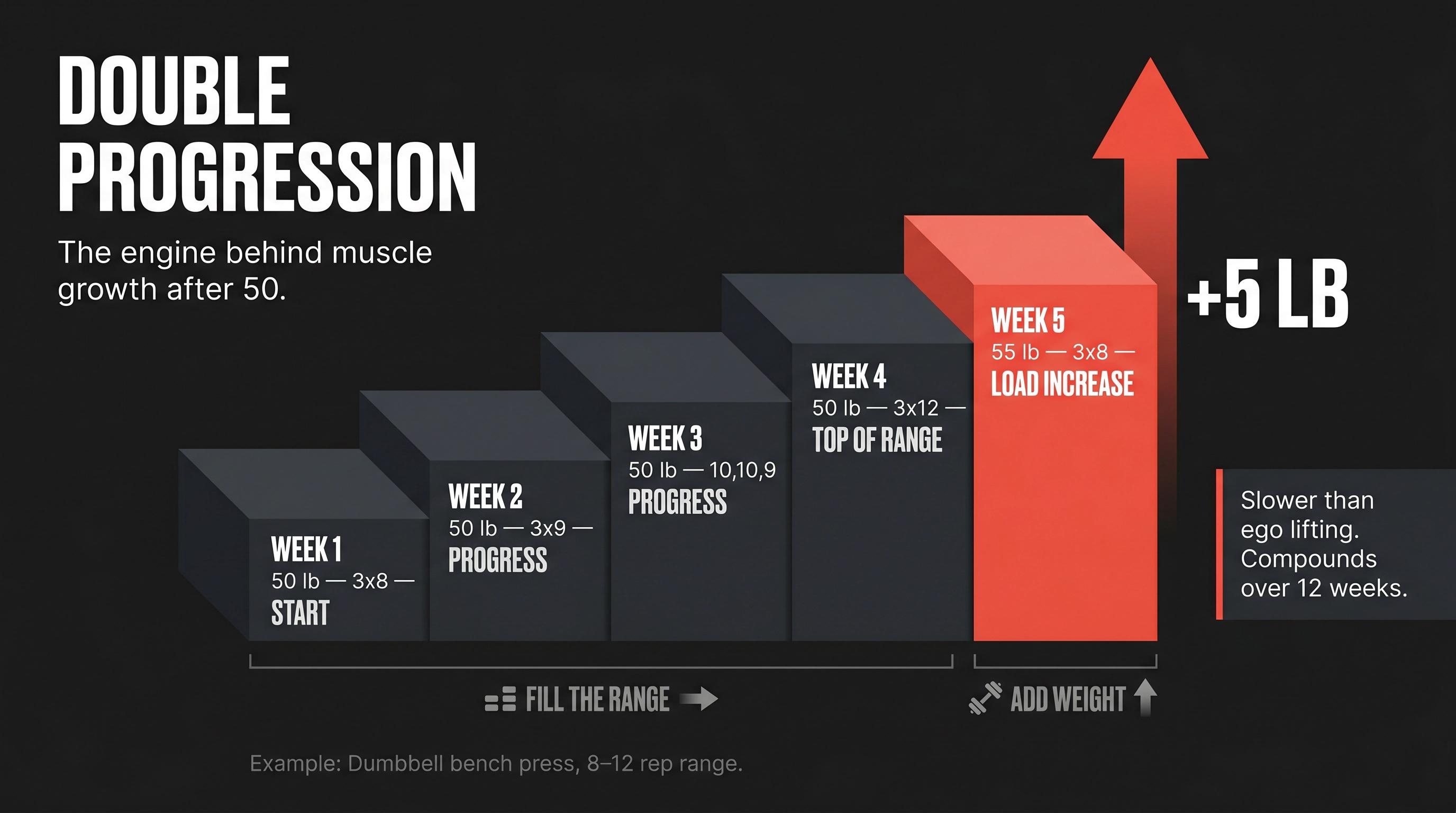
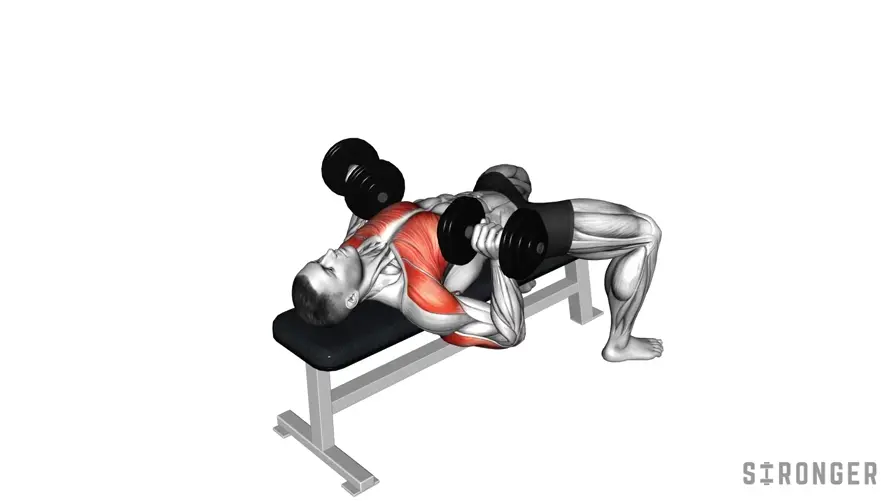
Here's what that looks like on dumbbell bench press:
| Week | Weight | Sets x Reps | Status |
|---|---|---|---|
| 1 | 50 lb | 3 x 8 | Starting point |
| 2 | 50 lb | 3 x 9 | Progress |
| 3 | 50 lb | 10, 10, 9 | Progress |
| 4 | 50 lb | 3 x 12 | Top of range |
| 5 | 55 lb | 3 x 8 | Load increase |
This is slower than ego lifting. It's also the method that actually compounds over 12 weeks without wrecking your joints or requiring five days of recovery.
Tracking this precisely is where Stronger pays for itself. The app logs every set, tracks your strength curves over time, and shows you exactly what your last session looked like before you walk into the gym. Without a system to track your numbers, double progression becomes guesswork.
Should you train to failure after 50?
Training hard matters. Training to failure on every set is unnecessary and often counterproductive for lifters over 50. ACSM's 2026 update found that training to momentary failure did not consistently determine outcomes for the average healthy adult. (ACSM)
A practical guide to effort:
- Most working sets: stop with 1 to 3 reps in reserve (RIR). This means you could do a couple more if you had to, but you stop before the form breaks down.
- Isolation exercises: occasionally going closer to failure is fine.
- Heavy compound lifts (squats, deadlifts, rows, presses): avoid sloppy failure. End the set clean.
- Painful reps: stop immediately. Pain is data, not progress.
Hard training should feel challenging, not chaotic.
Should you lift heavy weights after 50?
People over 50 don't need to avoid heavy weights forever. Strength is one of the most important physical qualities to preserve, and understanding how hypertrophy and strength training differ helps you program both intelligently. Heavier loads create bone stress that lighter loads don't. ACSM's 2026 update notes that strength outcomes are optimized with heavier loads above about 80 percent of 1RM for 2 to 3 sets per exercise. (ACSM)
The evidence for heavy training in older adults is genuinely compelling. A 2024 BMJ Open Sport & Exercise Medicine randomized trial follow-up found that one year of supervised heavy resistance training at retirement age preserved isometric leg strength four years later, while moderate-intensity and control groups declined. (Københavns Universitets Forskningsportal)
The key word in that sentence is supervised. If you're new, returning after injury, or unsure about form, build a movement foundation first. Heavy lifting earns its place after technique, joint tolerance, and consistent progressive overload are already established.
What equipment do you need to build muscle after 50?
You don't need a full commercial gym to build muscle after 50. ACSM's 2026 update explicitly notes that elastic bands, bodyweight exercises, and home-based routines can produce improvements in strength, hypertrophy, and physical function. (ACSM)
- Machines offer stable, joint-friendly loading that's excellent for beginners, people with joint issues, and anyone building a base.
- Dumbbells allow natural movement paths and are gentler on some joints than barbells.
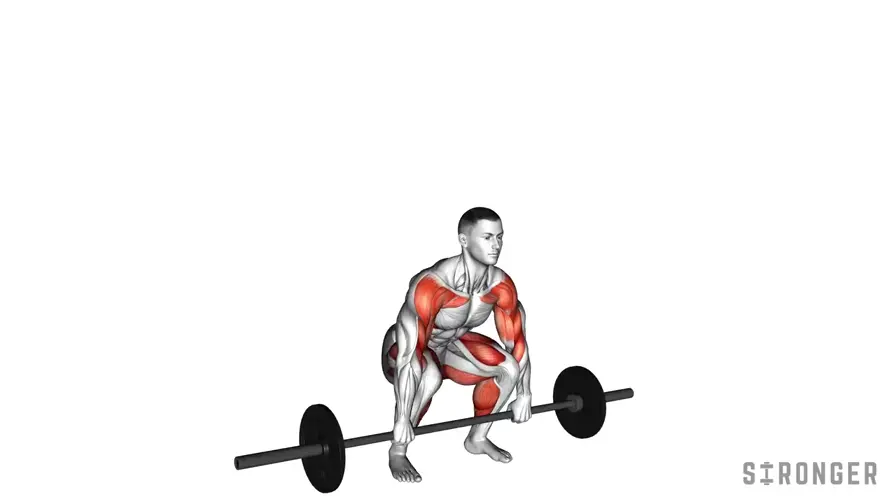
- Barbells are powerful tools when you can control them well.
- Bands and bodyweight work when consistency matters more than equipment.
If you're working without cables, lat pulldown alternatives can fill the vertical pull pattern effectively.
Use what lets you train the target muscle safely, progressively, and without pain.
Best exercises for building muscle after 50
You don't need a complex program with 30 exercises. You need enough movement patterns to train the entire body. Here's the framework:
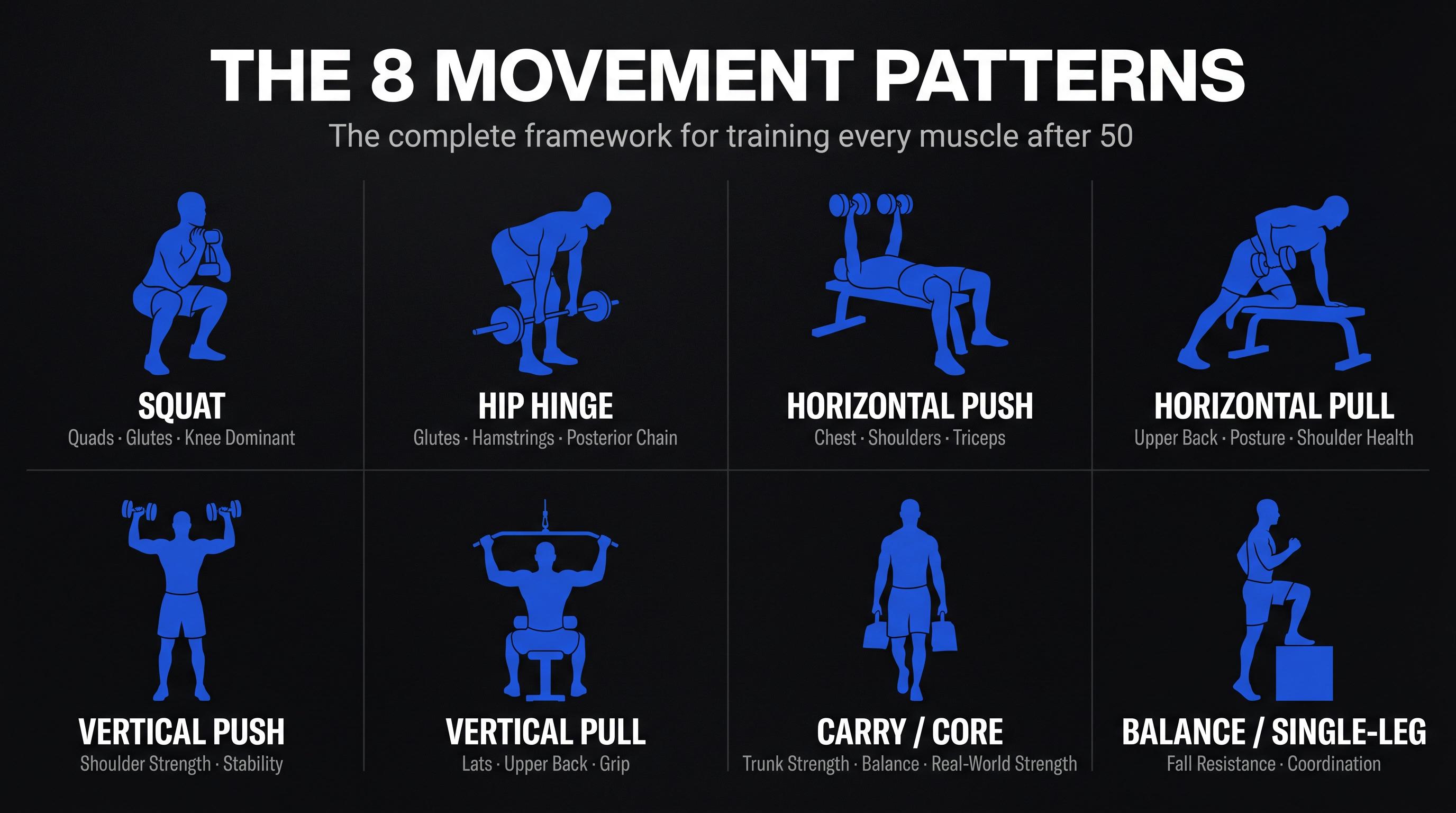
| Movement pattern | Examples | Why it matters |
|---|---|---|
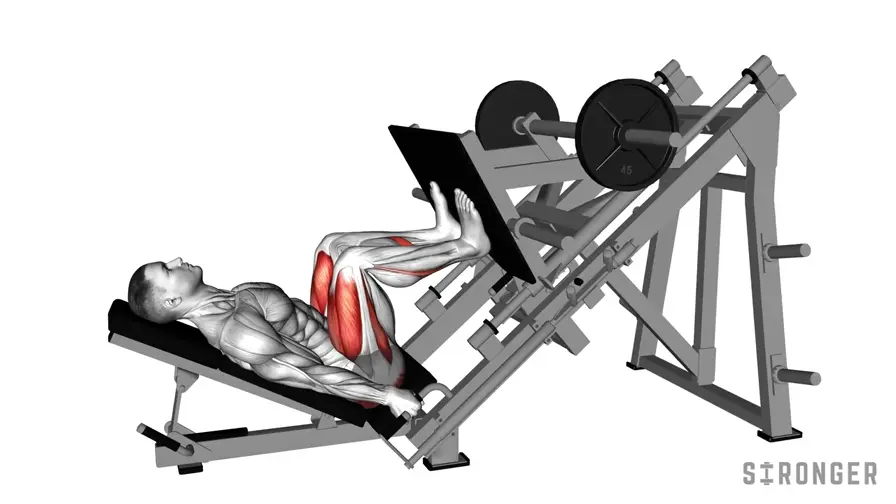
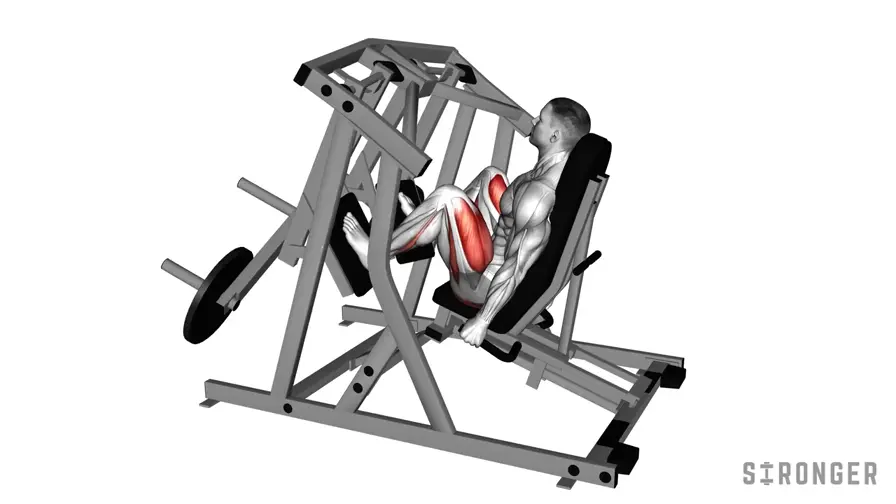
| Squat / knee-dominant | Goblet squat, leg press, split squat, step-up | Quads, glutes, getting up from chairs |
| Hip hinge | Romanian deadlift, hip thrust, trap-bar deadlift, back extension | Glutes, hamstrings, posterior chain |
| Horizontal push | Push-up, dumbbell bench, machine chest press | Chest, shoulders, triceps |
| Horizontal pull | Cable row, dumbbell row, chest-supported row | Upper back, posture, shoulder health |
| Vertical push | Dumbbell shoulder press, machine press, landmine press | Shoulder strength and stability |
| Vertical pull | Lat pulldown, assisted pull-up, band pulldown | Lats, upper back, grip |
| Carry / core | Farmer carry, suitcase carry, Pallof press, plank | Trunk strength, balance, real-world strength |
| Balance / single-leg | Step-up, split squat, single-leg RDL, heel-to-toe walk | Fall resistance, coordination |
For most people over 50, the highest-return exercises aren't the flashiest. They're the compound movements you can perform repeatedly with good form, progress over months, and recover from between sessions.
How to structure your sets, reps, and effort after 50
How many reps should you do to build muscle after 50?
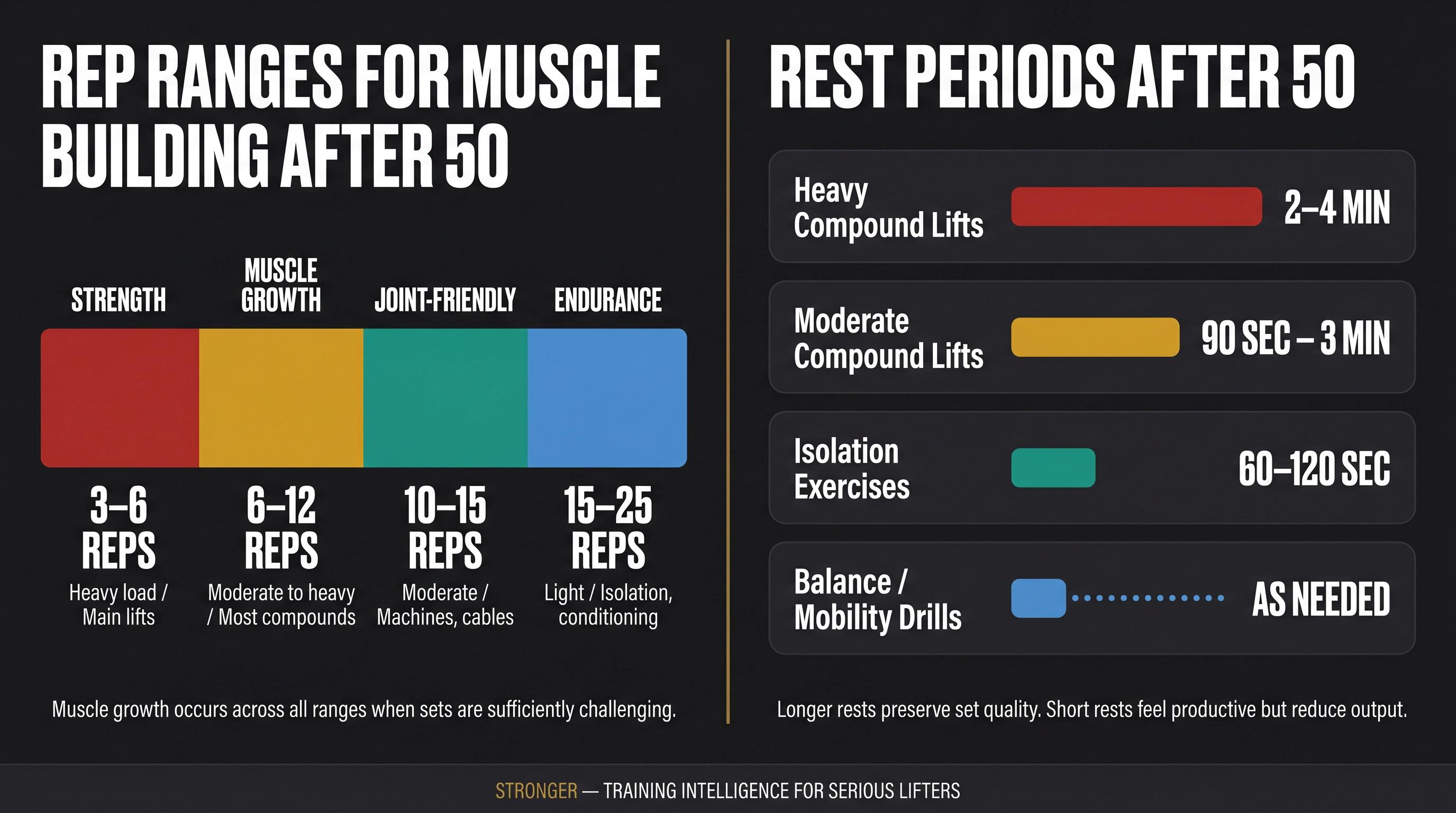
For muscle growth after 50, most of your training should live in the 6 to 15 rep range. Lower reps for strength practice, moderate reps for the bulk of your muscle-building work, higher reps for accessories and joint-friendly volume.
| Goal | Reps | Load | Best use |
|---|---|---|---|
| Strength | 3 to 6 | Heavy | Main lifts after technique is solid |
| Muscle growth | 6 to 12 | Moderate to heavy | Most compound and accessory work |
| Joint-friendly hypertrophy | 10 to 15 | Moderate | Machines, dumbbells, cables |
| Endurance / finishing | 15 to 25 | Light to moderate | Isolation work, conditioning |
Muscle growth can happen across multiple rep ranges when sets are sufficiently challenging. Moderate rep ranges tend to be the most efficient because they balance load, volume, and recovery. Stronger's rep ranges guide covers this in more depth if you want to understand the tradeoffs. (Stronger)
How long should you rest between sets after 50?
Rest long enough to perform the next set with full effort and clean technique.
| Exercise type | Rest |
|---|---|
| Heavy compound lifts | 2 to 4 minutes |
| Moderate compound lifts | 90 seconds to 3 minutes |
| Isolation exercises | 60 to 120 seconds |
| Balance or mobility drills | As needed |
Short rests feel productive but often reduce training quality. Stronger's rest-period guide explains that strength work benefits from longer rests, hypertrophy generally works well with 90 seconds to 3 minutes, and endurance work uses shorter intervals. (Stronger)
Ready to Get Stronger?
Join 2,000,000+ lifters tracking their workouts with Stronger. Available on iOS and Android.


Nutrition for building muscle after 50
Training provides the stimulus. Nutrition determines how much of that stimulus the body can actually use.
How much protein do you need to build muscle after 50?
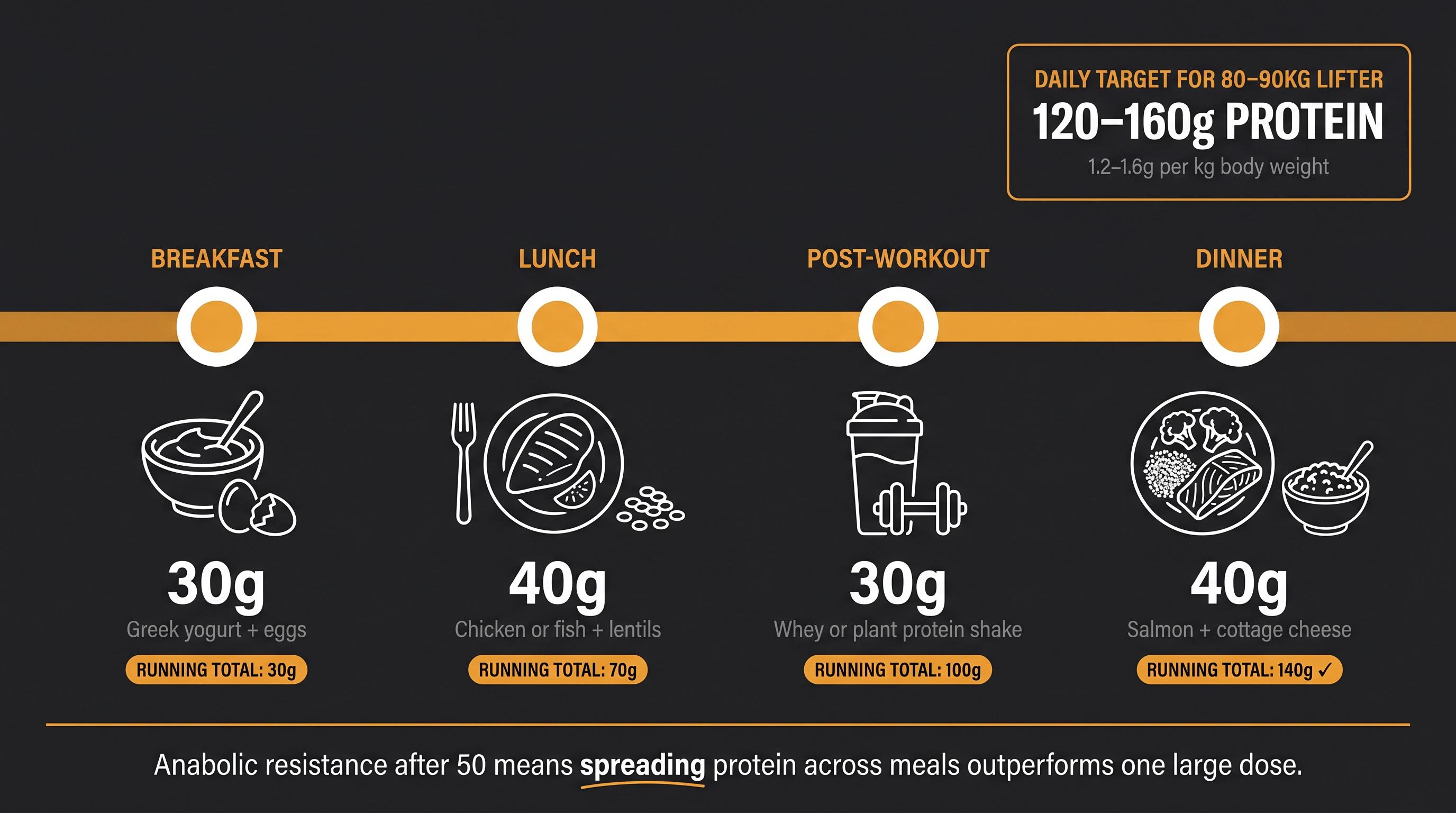
For most active adults over 50, the practical target is 1.2 to 1.6 grams of protein per kilogram of body weight per day. Here's what that looks like at different body weights:
| Body weight | Daily protein target |
|---|---|
| 60 kg / 132 lb | 72 to 96 g |
| 70 kg / 154 lb | 84 to 112 g |
| 80 kg / 176 lb | 96 to 128 g |
| 90 kg / 198 lb | 108 to 144 g |
| 100 kg / 220 lb | 120 to 160 g |
A March 2025 Journal of Nutrition network meta-analysis of 38 randomized controlled trials involving 2,610 participants found that combining protein supplementation with resistance training improved lean body mass, muscle mass, strength, and physical function in older adults. Resistance training alone improved strength and function compared with controls. (ScienceDirect)
If you have significant fat to lose, use goal body weight or lean body mass as the basis for your protein calculation. If you have kidney disease or have been told to limit protein, speak with your clinician before increasing intake significantly.
Why spreading protein throughout the day matters after 50
The older you are, the more important it is to distribute protein across multiple meals. Anabolic resistance means a single large protein dose is less effective than several well-spaced moderate ones.
Aim for 25 to 40 grams per meal, depending on body size and appetite:
| Food | Approximate protein |
|---|---|
| Greek yogurt, large serving | 20 to 30 g |
| Eggs plus egg whites | 20 to 35 g |
| Chicken, turkey, lean beef, or fish | 25 to 45 g |
| Tofu or tempeh | 20 to 35 g |
| Cottage cheese | 25 to 35 g |
| Lentils, beans, and grains combined | 15 to 30 g |
| Whey, casein, or plant protein powder | 20 to 30 g |
Cleveland Clinic's sarcopenia guidance lists resistance training and protein intake of roughly 20 to 35 grams per meal as part of sarcopenia prevention and treatment. (Cleveland Clinic)
How many calories should you eat to build muscle after 50?
You can build strength in a calorie deficit, especially if you're new to lifting or have significant body fat to lose. But aggressive dieting actively works against muscle growth and becomes a bigger problem after 50 than at younger ages.
A practical framework:
- If you're lean or losing weight unintentionally: eat at maintenance or a small calorie surplus.
- If you want fat loss alongside muscle-building: use a modest deficit, keep protein high, and keep lifting consistently.
- If performance drops for more than two consecutive weeks: increase food intake, reduce volume, or improve sleep before adding more training.
The older you are, the less you should gamble with rapid weight loss without a serious strength plan in place.
Do carbs and fats matter for muscle building after 50?
Protein repairs and builds tissue. Carbohydrates fuel training and support recovery. Fats support hormones, joint health, and overall cellular function. None of them is optional.
A simple plate model that works for most people:
- 1 to 2 palm-sized portions of protein
- 1 fist-sized portion of carbohydrates, more around training
- 1 to 2 fists of vegetables or fruit
- 1 thumb-sized portion of healthy fats
- Fluids and electrolytes as needed
The best muscle-building diet after 50 isn't the most sophisticated one. It's the one you can repeat consistently for months.
Supplements for muscle building after 50: what actually works
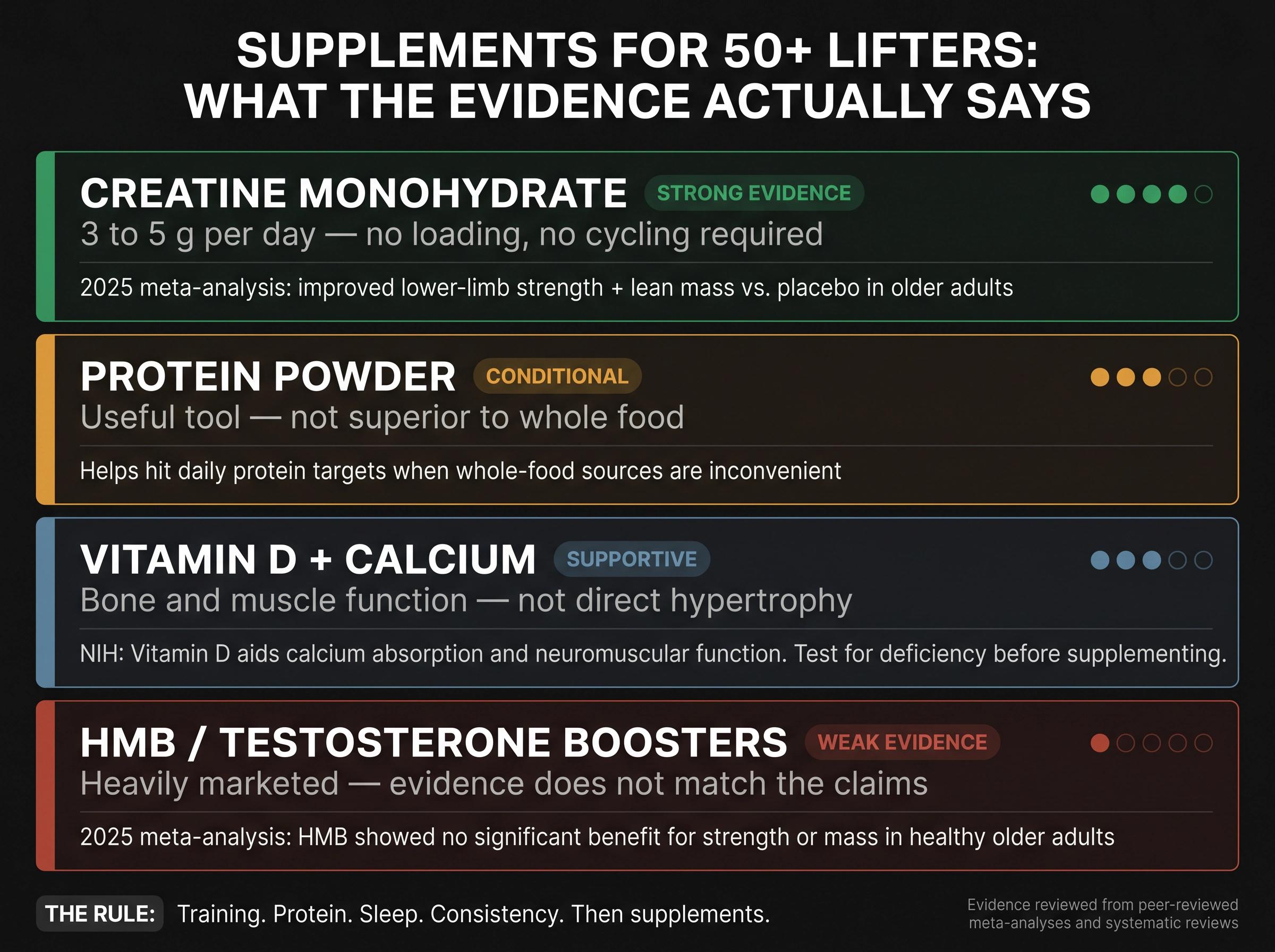
Supplements are the last variable, not the first. Training, protein, sleep, and consistency produce most of the results. Supplements contribute at the margin.
Does protein powder help with muscle growth after 50?
Protein powder is useful if it helps you hit your daily protein target. It isn't superior to food. It's just faster.
Use it when breakfast is low on protein, appetite is limited after training, or whole-food protein is difficult to prepare regularly. Any complete protein source (whey, casein, plant-based blends) works.
Is creatine effective for building muscle after 50?
Creatine is one of the few supplements with a meaningful evidence base for older lifters specifically.
A 2025 systematic review and meta-analysis in the European Review of Aging and Physical Activity found that creatine combined with resistance training improved lower-limb strength and lean tissue mass in older adults compared with placebo plus resistance training. (Springer) A practical dose is 3 to 5 grams of creatine monohydrate per day. You don't need to load it or cycle off it.
One important caveat: creatine can raise serum creatinine levels, which is a kidney function marker. A 2025 BMC Nephrology systematic review and meta-analysis found no significant change in actual glomerular filtration rate with creatine supplementation at standard doses, but noted that clinicians should interpret elevated creatinine carefully in people using creatine. (PMC) If you have kidney disease, take nephrotoxic medications, or are monitored for renal function, talk with your doctor before using creatine.
Do you need vitamin D and calcium supplements after 50?
These are more about bone and muscle function than direct muscle growth, but they matter for 50+ lifters. The NIH's Office of Dietary Supplements notes that vitamin D helps calcium absorption and has roles in neuromuscular function. Adult calcium recommendations generally range from 1,000 to 1,200 mg per day depending on age and sex. (Office of Dietary Supplements)
If you suspect deficiency, ask your doctor about testing rather than blindly supplementing.
Do HMB and testosterone boosters work for muscle growth after 50?
HMB is heavily marketed to older adults, but the evidence doesn't support the marketing. The 2025 Frontiers in Nutrition network meta-analysis found that HMB combined with resistance training did not show significant benefits for muscle strength or mass in healthy older adults, while protein and creatine showed stronger effects. (Frontiers)
Over-the-counter testosterone boosters are not a substitute for training, nutrition, sleep, or medical evaluation. They are not a shortcut.
12-week muscle-building program for people over 50
This plan is designed for someone who wants to build muscle safely, improve strength across all major movement patterns, and create a repeatable system they can run for years.
It uses three full-body workouts per week. For most people over 50, this is the best default: each muscle gets trained frequently, no session is so long it becomes unmanageable, and recovery days are built in.
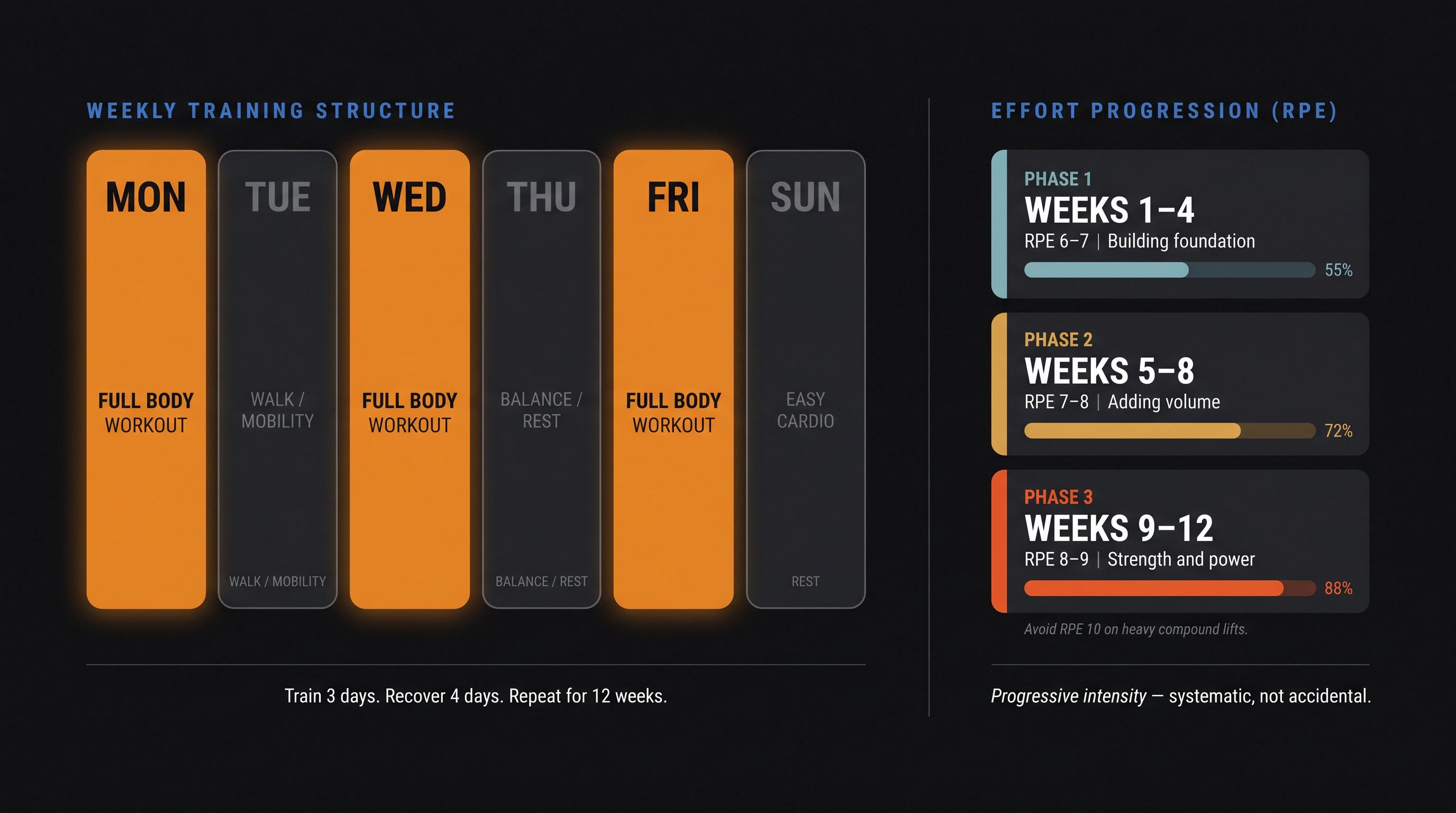
Weekly training schedule
| Day | Workout |
|---|---|
| Monday | Full Body A |
| Tuesday | Walk, mobility, or rest |
| Wednesday | Full Body B |
| Thursday | Walk, balance work, or rest |
| Friday | Full Body C |
| Saturday | Easy cardio, mobility, or light recreation |
| Sunday | Rest |
If two days per week fits your schedule better, rotate Full Body A and B one week, then C and A the next. The four-day upper/lower split later in this guide works well for experienced lifters who want more volume.
How to use RPE (effort scale) in your training
RPE, or Rate of Perceived Exertion, is a simple way to gauge how hard you're working. Our RPE chart gives you the full scale with load recommendations, but here's the quick reference for this program:
| RPE | Meaning |
|---|---|
| RPE 6 | You could do about 4 more reps |
| RPE 7 | You could do about 3 more reps |
| RPE 8 | You could do about 2 more reps |
| RPE 9 | You could do about 1 more rep |
| RPE 10 | Nothing left |
For this program:
- Weeks 1 to 4: mostly RPE 6 to 7
- Weeks 5 to 8: mostly RPE 7 to 8
- Weeks 9 to 12: mostly RPE 8, occasionally RPE 9 on safe accessory exercises
- Avoid RPE 10 on heavy compound lifts
How to warm up before lifting after 50
- 5 minutes of easy cardio or brisk walking
- 1 to 2 mobility drills targeting the joints you're training
- 2 to 3 ramp-up sets before the first heavy lower-body and upper-body exercise
Example for leg press:
- Empty or very light: 10 reps
- Moderate: 8 reps
- Working weight: 8 to 12 reps
The warm-up should prepare you, not exhaust you.
Weeks 1 to 4: Building your training foundation
Goal: Learn the movement patterns, build joint tolerance, establish consistency, and avoid the kind of soreness that ruins your next session.
Use 2 working sets per exercise unless noted.
Full Body A
| Exercise | Sets | Reps |
|---|---|---|
| Goblet squat or leg press | 2 | 8 to 12 |
| Dumbbell bench press or machine chest press | 2 | 8 to 12 |
| Seated cable row or chest-supported row | 2 | 8 to 12 |
| Romanian deadlift | 2 | 8 to 10 |
| Lat pulldown | 2 | 10 to 12 |
| Farmer carry | 2 | 30 to 45 sec |
| Side plank | 2 | 20 to 40 sec per side |
Full Body B
| Exercise | Sets | Reps |
|---|---|---|
| Step-up or split squat | 2 | 8 to 10 per side |
| Dumbbell shoulder press or machine press | 2 | 8 to 12 |
| Hip thrust or glute bridge | 2 | 10 to 15 |
| Assisted pull-up or lat pulldown | 2 | 8 to 12 |
| Hamstring curl | 2 | 10 to 15 |
| Calf raise | 2 | 10 to 15 |
| Pallof press | 2 | 10 to 12 per side |
Full Body C
| Exercise | Sets | Reps |
|---|---|---|
| Trap-bar deadlift, block pull, or hip hinge machine | 2 | 5 to 8 |
| Incline dumbbell press | 2 | 8 to 12 |
| One-arm dumbbell row | 2 | 8 to 12 per side |
| Leg extension or squat variation | 2 | 10 to 15 |
| Lateral raise | 2 | 12 to 15 |
| Biceps curl | 1 to 2 | 10 to 15 |
| Triceps pressdown | 1 to 2 | 10 to 15 |
Progression rule for weeks 1 to 4: Advance only when technique is clean, there's no joint pain, you've hit the top of the rep range, and RPE is 8 or lower. The goal is to finish each session feeling like you could have done a bit more, not like you need three days to recover.
Log every set in Stronger from day one. The value of the app compounds over weeks, not days. When you come back for week 5, you'll see exactly what you did in week 1, and progression stops being guesswork.
Weeks 5 to 8: Adding muscle-building volume
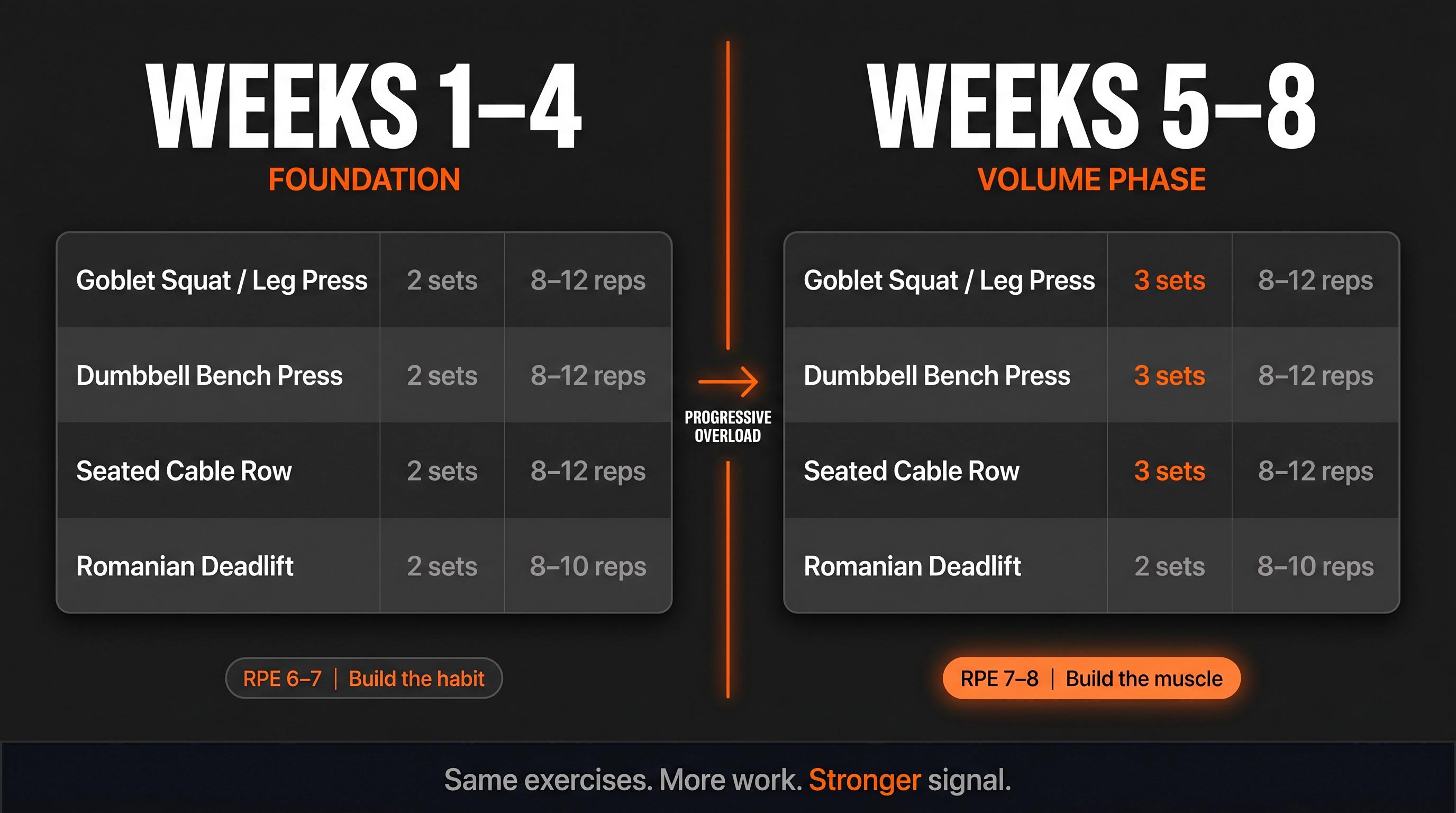
Goal: Same exercises, more work, stronger hypertrophy signal.
Changes from weeks 1 to 4:
- Main lower-body exercise: increase to 3 sets
- Main push and pull exercises: increase to 3 sets
- Keep accessories at 2 sets
- Train mostly at RPE 7 to 8
- Add weight only after you've cleanly hit the top of the rep range
Example: Full Body A becomes:
| Exercise | Sets | Reps |
|---|---|---|
| Goblet squat or leg press | 3 | 8 to 12 |
| Dumbbell bench press or machine chest press | 3 | 8 to 12 |
| Seated cable row or chest-supported row | 3 | 8 to 12 |
| Romanian deadlift | 2 | 8 to 10 |
| Lat pulldown | 2 | 10 to 12 |
| Farmer carry | 2 | 30 to 45 sec |
| Side plank | 2 | 20 to 40 sec per side |
By the end of week 8, most major muscles should be receiving 6 to 10 hard sets per week, depending on exercise overlap.
Optional deload after week 8: Take a deload week if joints are achier than usual, sleep quality has dropped, performance has declined for two sessions in a row, you're dreading workouts you normally enjoy, or RPE is climbing with the same weights. Reduce sets by 30 to 50 percent for one week while keeping technique sharp.
Weeks 9 to 12: Building strength and power safely
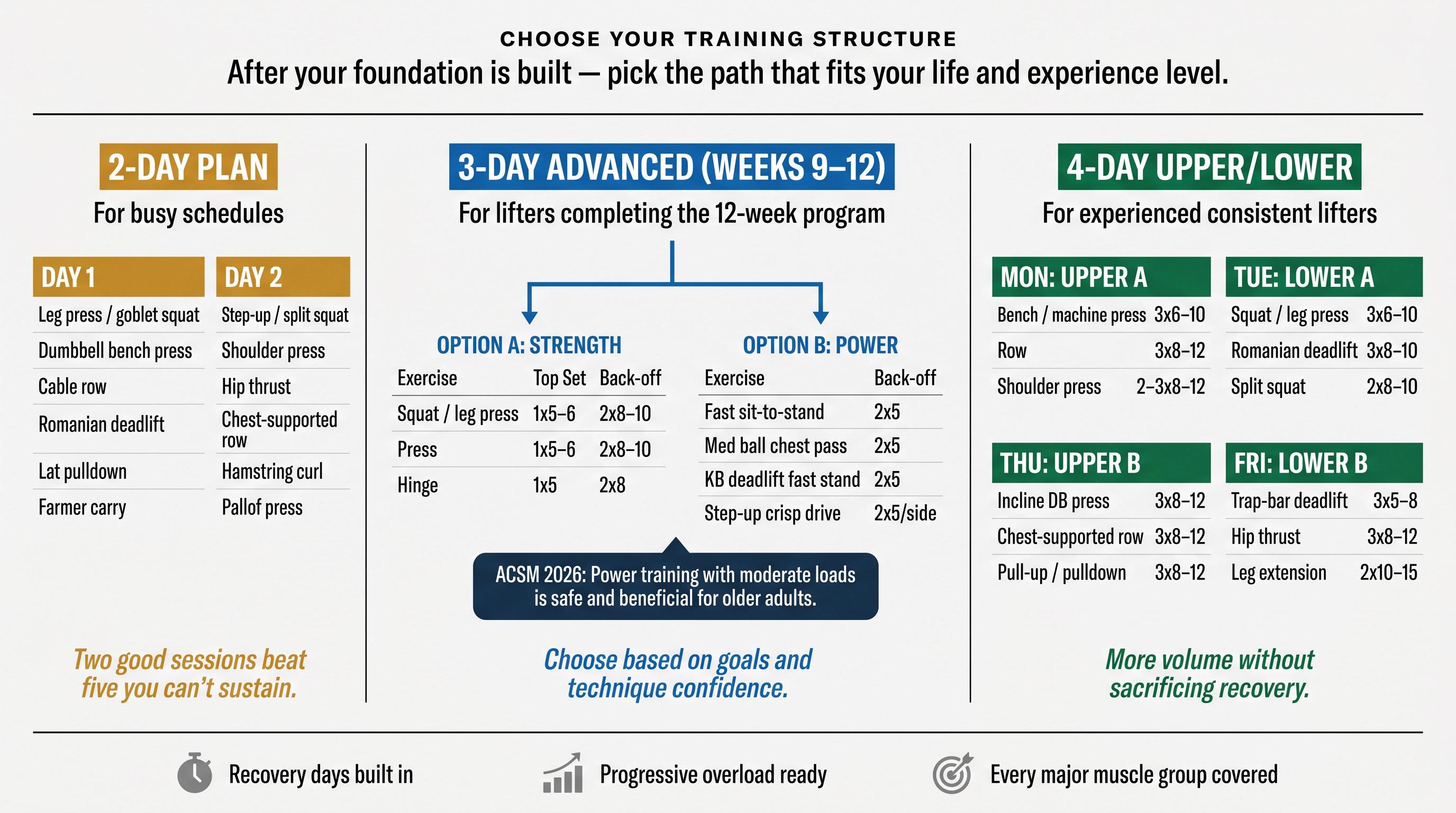
Goal: Build on the muscle-building base while adding heavier work or low-risk power elements.
Choose one option:
Option 1: Strength emphasis
For the first exercise of the day, add one heavier top set:
| Exercise | Top set | Back-off sets |
|---|---|---|
| Squat or leg press | 1 x 5 to 6 | 2 x 8 to 10 |
| Press | 1 x 5 to 6 | 2 x 8 to 10 |
| Hinge | 1 x 5 | 2 x 8 |
Use this option only if technique is consistent and pain-free. If you want to extend this into a dedicated powerbuilding approach combining size and strength work, our powerbuilding guide covers the full structure.
Option 2: Power emphasis
Before the first main lift, add one brief power drill:
| Drill | Sets | Reps |
|---|---|---|
| Fast sit-to-stand | 2 | 5 |
| Medicine ball chest pass | 2 | 5 |
| Light kettlebell deadlift with fast stand | 2 | 5 |
| Step-up with crisp drive | 2 | 5 per side |
Power drills should feel snappy, not exhausting. Stop if speed drops significantly. ACSM's 2026 guidance supports power training with moderate loads moved quickly, matched to ability and safety. (ACSM)
Two-day training plan for busy schedules after 50
If three days per week isn't sustainable, two is enough to start.
Day 1
| Exercise | Sets | Reps |
|---|---|---|
| Leg press or goblet squat | 3 | 8 to 12 |
| Dumbbell bench press | 3 | 8 to 12 |
| Cable row | 3 | 8 to 12 |
| Romanian deadlift | 2 | 8 to 10 |
| Lat pulldown | 2 | 10 to 12 |
| Farmer carry | 2 | 30 to 45 sec |
Day 2
| Exercise | Sets | Reps |
|---|---|---|
| Step-up or split squat | 3 | 8 to 10 per side |
| Shoulder press | 3 | 8 to 12 |
| Hip thrust | 3 | 10 to 15 |
| Chest-supported row | 2 | 8 to 12 |
| Hamstring curl | 2 | 10 to 15 |
| Pallof press | 2 | 10 to 12 per side |
Two good sessions per week beat five sessions you can't sustain.
Four-day training plan for experienced lifters over 50
If you're already training consistently, an upper/lower split gives you more volume without sacrificing recovery.
Monday: Upper A
| Exercise | Sets | Reps |
|---|---|---|
| Bench press or machine press | 3 | 6 to 10 |
| Row | 3 | 8 to 12 |
| Shoulder press | 2 to 3 | 8 to 12 |
| Pulldown | 2 to 3 | 10 to 12 |
| Lateral raise | 2 | 12 to 20 |
| Curl + triceps pressdown | 2 each | 10 to 15 |
Tuesday: Lower A
| Exercise | Sets | Reps |
|---|---|---|
| Squat or leg press | 3 | 6 to 10 |
| Romanian deadlift | 3 | 8 to 10 |
| Split squat | 2 | 8 to 10 per side |
| Calf raise | 2 | 10 to 15 |
| Core carry or Pallof press | 2 | 30 to 45 sec |
Thursday: Upper B
| Exercise | Sets | Reps |
|---|---|---|
| Incline dumbbell press | 3 | 8 to 12 |
| Chest-supported row | 3 | 8 to 12 |
| Assisted pull-up or pulldown | 3 | 8 to 12 |
| Push-up or cable press | 2 | 10 to 15 |
| Face pull | 2 | 12 to 20 |
| Arms | 2 each | 10 to 15 |
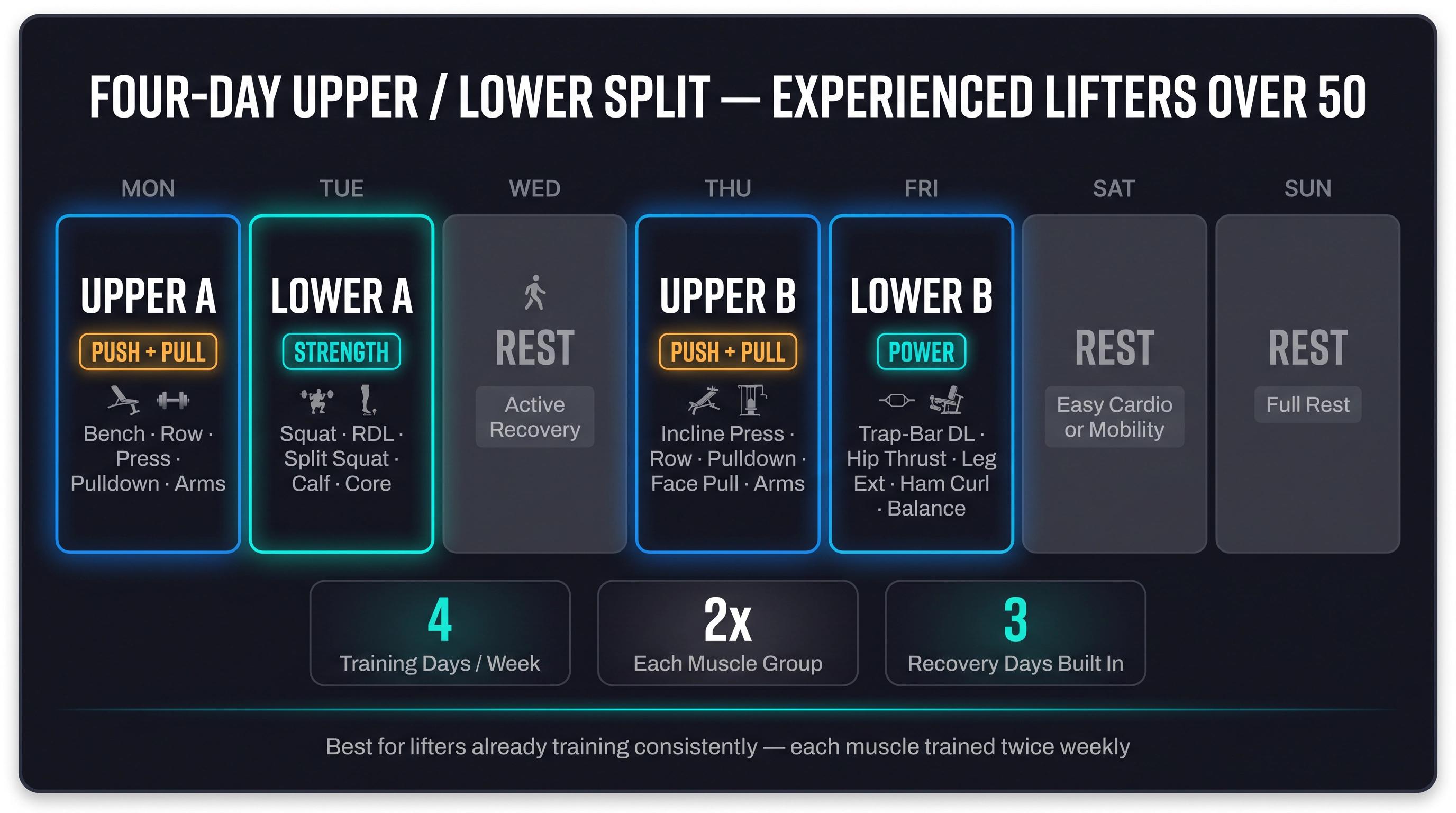
Friday: Lower B
| Exercise | Sets | Reps |
|---|---|---|
| Trap-bar deadlift or hinge | 3 | 5 to 8 |
| Hip thrust | 3 | 8 to 12 |
| Leg extension | 2 | 10 to 15 |
| Hamstring curl | 2 | 10 to 15 |
| Step-up or balance drill | 2 | 8 to 10 per side |
| Core | 2 | 10 to 15 |
How to train around common injuries and challenges after 50
If your knees hurt: exercises and modifications after 50
- Leg press instead of deep squats
- Box squats instead of free squats
- Step-ups to a lower box
- Split squats with support
- Slower eccentrics (the lowering phase)
- Shorter range of motion until tolerance improves
Don't force painful depth. Build tolerance gradually over weeks, not days.
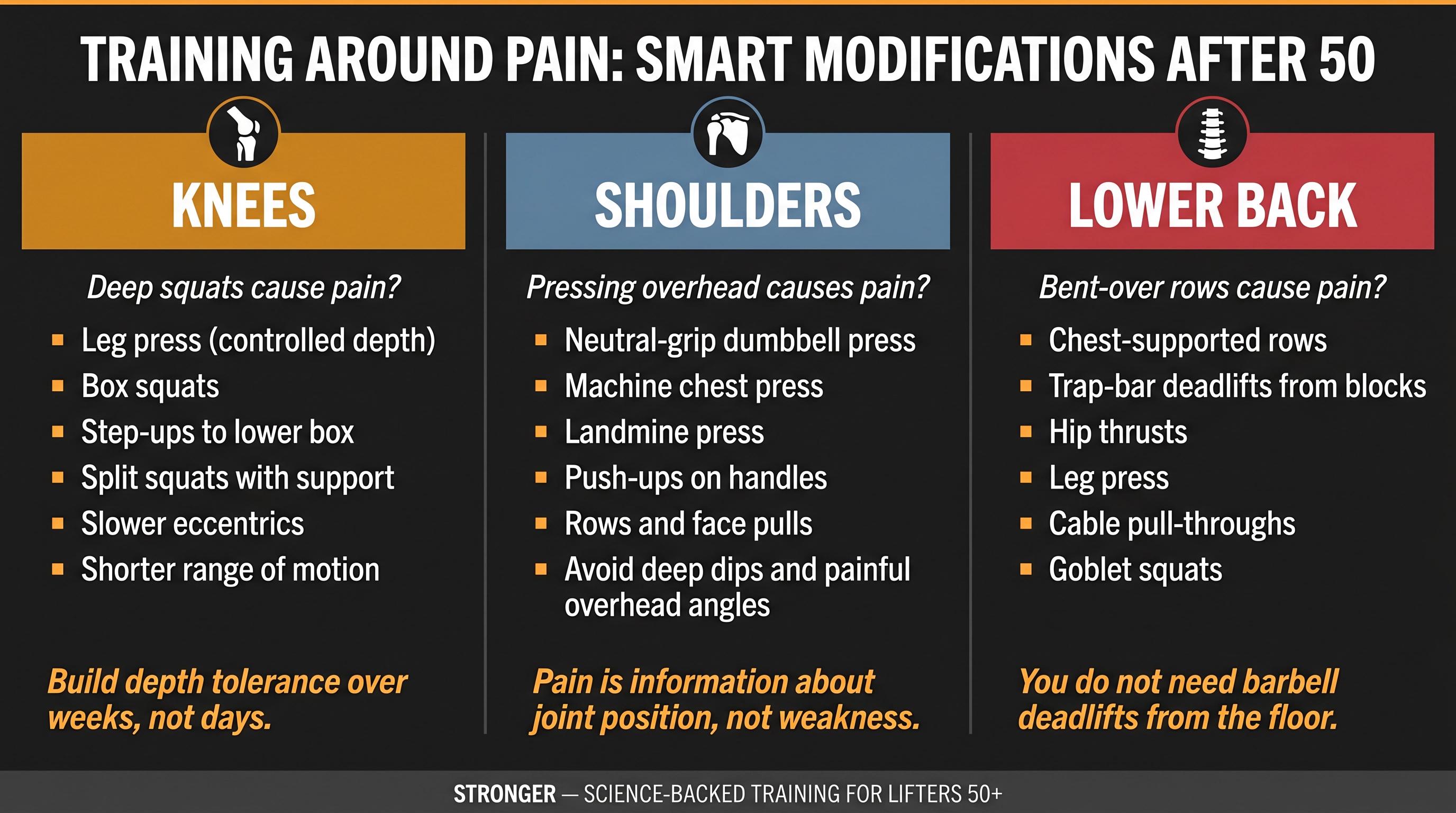
If your shoulders hurt: safe pressing alternatives after 50
- Neutral-grip dumbbell press
- Machine chest press
- Landmine press
- Push-ups on handles
- More rows and face pulls (often the missing piece in shoulder-achy lifters)
- Avoiding deep dips or overhead pressing positions that cause pain
Pain is information, not weakness. It's telling you something about joint position, load, or recovery.
If your lower back hurts: exercises to avoid strain after 50
- Chest-supported rows instead of bent-over rows
- Trap-bar deadlifts from blocks
- Hip thrusts
- Leg press
- Cable pull-throughs
- Goblet squats
- More deliberate core bracing practice
You don't need conventional barbell deadlifts from the floor to build a strong posterior chain.
Where to start if you're new to lifting after 50
Start with machines. A machine-based routine can build real muscle:
| Exercise | Sets | Reps |
|---|---|---|
| Leg press | 3 | 8 to 12 |
| Chest press | 3 | 8 to 12 |
| Seated row | 3 | 8 to 12 |
| Lat pulldown | 2 | 10 to 12 |
| Hamstring curl | 2 | 10 to 15 |
| Leg extension | 2 | 10 to 15 |
| Cable Pallof press | 2 | 10 to 12 per side |
Machines are not less serious. They're just different tools.
How to return to lifting after a long break over 50
For the first month, do less than you think you can. Muscles regain fitness faster than tendons, joints, and connective tissue do. Leave each session feeling better than when you walked in.
How to train if you're already strong and over 50
Keep lifting heavy, but manage fatigue carefully. More warm-up sets, fewer maximum attempts, more back-off work, joint-friendly accessories, planned deloads, and RPE-based progression rather than constantly chasing numbers. After 50, the goal isn't to prove strength every week. It's to build it across years.
How to track progress that actually matters after 50
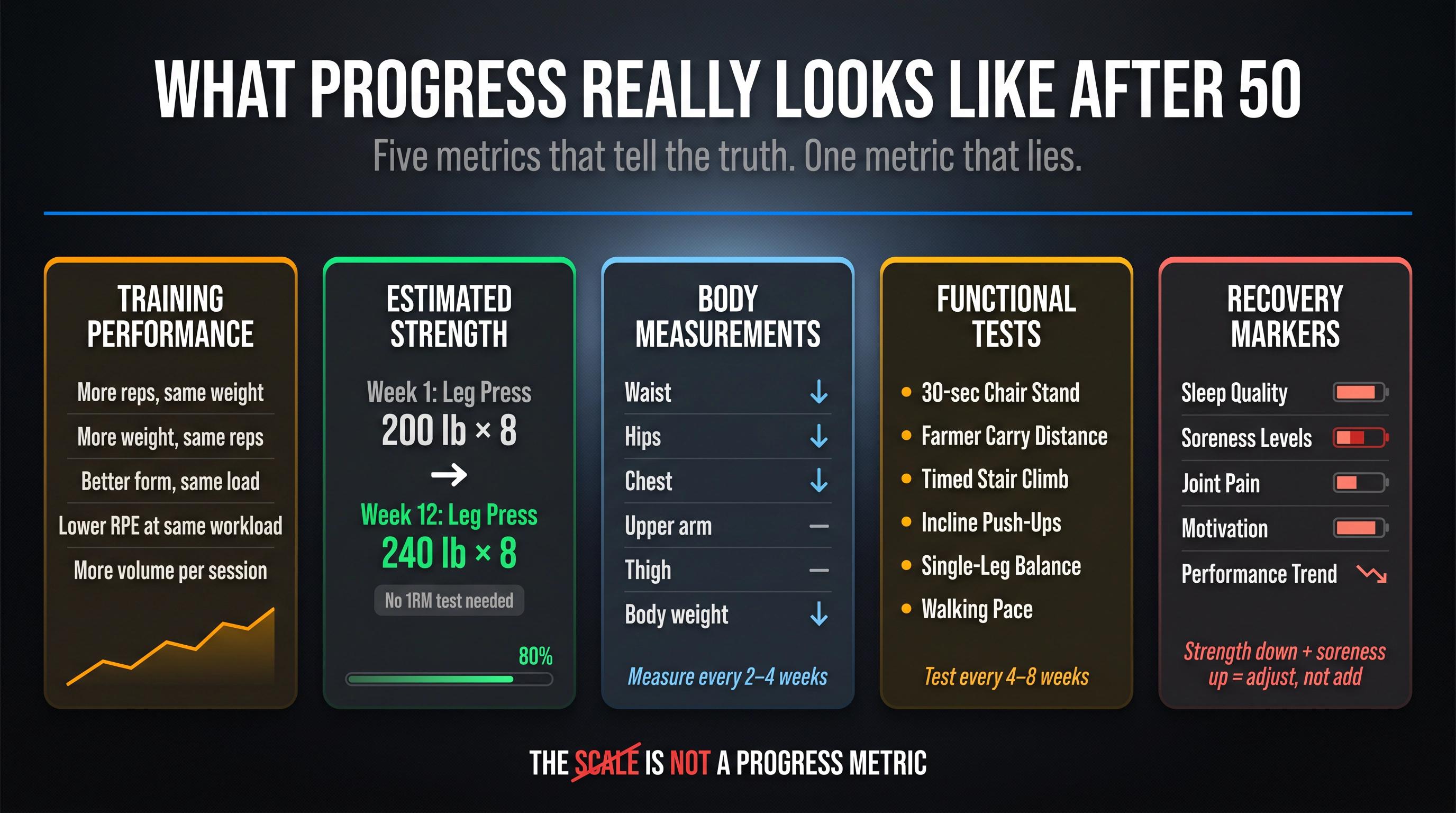
The scale is not enough. In older adults, muscle quality, strength, function, and independence often matter more than body weight, and scale weight can be deceptive as body composition shifts. The NIH's sarcopenia update notes that grip strength and walking speed were more strongly associated with outcomes like falls, hip fractures, and loss of independence than lean body mass alone. (NIH News in Health) You can see where your strength stands relative to global benchmarks to get a more complete picture of your progress over time.
Track these instead.
Training performance: More reps with the same weight. More weight for the same reps. Better form with the same load. Lower RPE at the same workload. More total volume over the same session. These are real signals.
Estimated strength: You don't need to max out to know you're stronger. If you leg press 200 lb for 8 reps in week 1 and 240 lb for 8 reps in week 12, that's meaningful strength improvement without a single risky 1RM test.
Body measurements: Measure every 2 to 4 weeks: waist, hips, chest, upper arm, thigh, and body weight. If waist is down and strength is up, you're improving body composition even when the scale hasn't moved.
Functional tests: Every 4 to 8 weeks, test yourself on practical benchmarks: 30-second chair stand, farmer carry distance, timed stair climb, push-ups from an incline, single-leg balance, and comfortable walking pace. These show whether strength is transferring to real life.
Recovery markers: Track sleep quality, soreness levels, joint pain, motivation, and performance trend. If strength is dropping and soreness is rising, the program isn't working. More training isn't the answer.
How Stronger helps you build muscle after 50
Building muscle after 50 depends on one thing above all: repeatable, progressive overload applied consistently over months. Guesswork is the enemy of that.
Stronger is built for exactly this. The app's core job is to make every training decision clearer: what you lifted last session, whether you're progressing, where your weak points are, and how your overall strength is trending over time. (Stronger)
Here's how each feature maps to what 50+ lifters actually need:
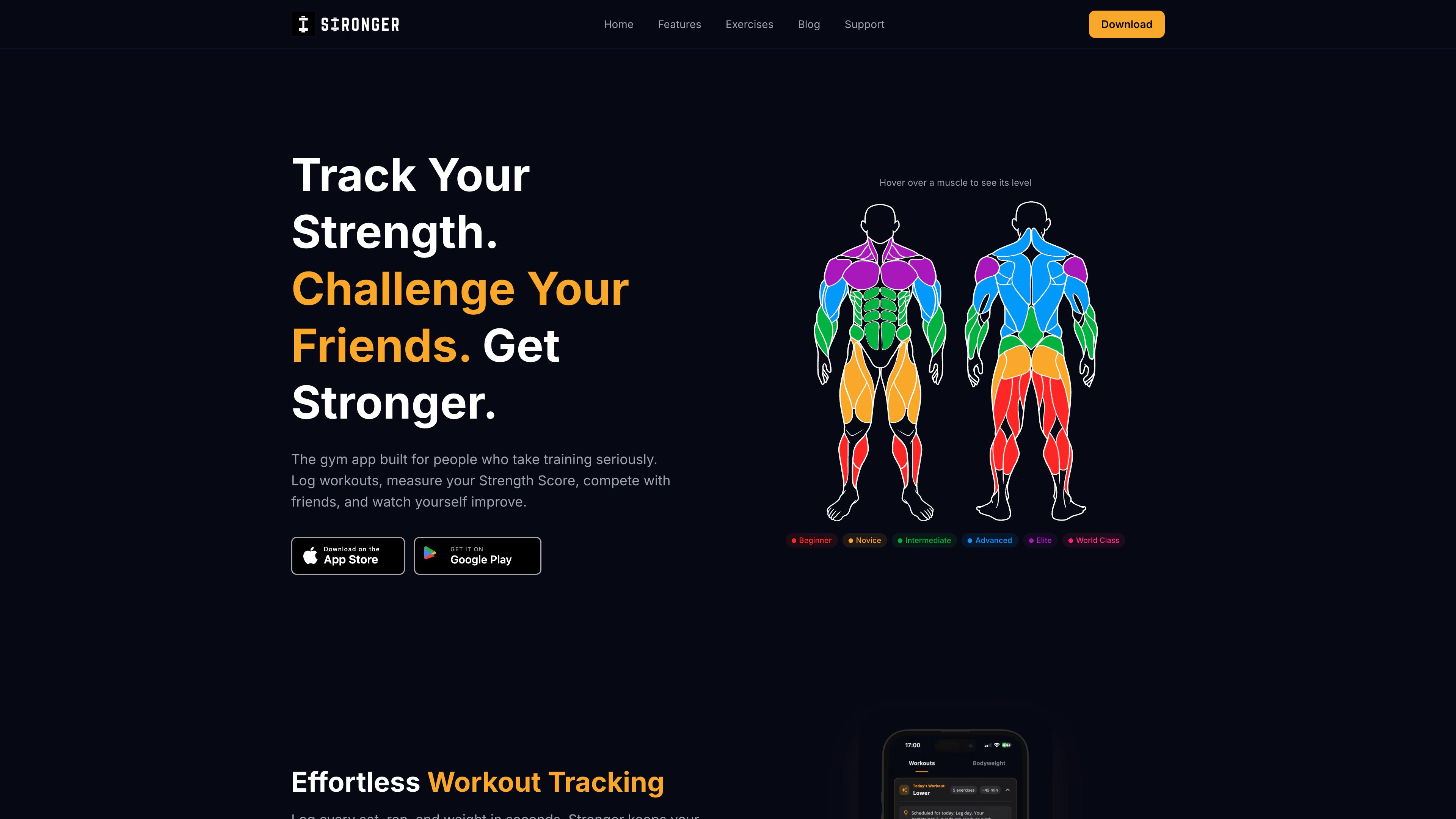
Workout logging with PR detection: Every set, rep, and weight is logged. The app automatically detects personal records so you can see real progress without relying on memory. When you come back to a lift after two weeks, you know exactly where you left off.
Strength Score: This is Stronger's proprietary benchmark. It aggregates your performance across major muscle groups, adjusts for bodyweight and gender, and gives you a single number that tracks over time. For lifters over 50, the Strength Score is particularly valuable because scale weight can be misleading during body recomposition. The score tells you whether you're actually getting stronger even when the mirror is slow to reflect it. (Stronger)
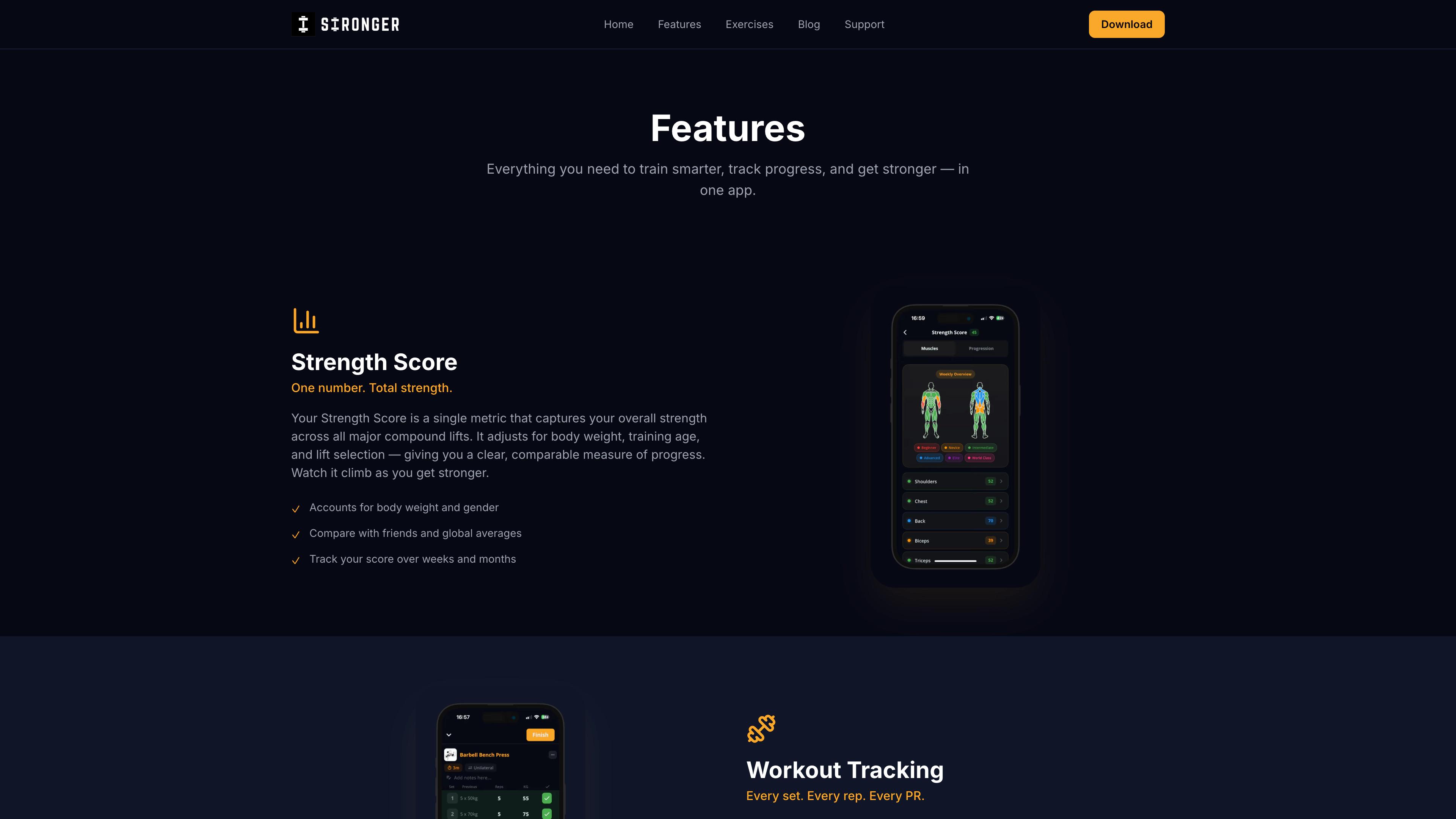
Strength curves: Track how a specific lift has changed over weeks and months. Useful for identifying which movement patterns are progressing and which have stalled.
Volume and frequency analytics: See how many sets per muscle group you're accumulating each week. This makes it easy to spot imbalances, ensure you're hitting the recommended frequency, and avoid accidentally skimping on muscles that don't scream for attention (posterior chain, we're looking at you).
Adaptive routines and AI-generated programs: Don't want to design your own program? Stronger builds one for you based on your goals, equipment, and experience level, and adjusts it as you progress. For the 50+ lifter who doesn't have a programming background, this removes a significant barrier.
RPE tracking: Since Stronger's December 2025 update, you can log RPE per set. Over time, this creates a record of how effort relates to load, which helps you catch fatigue accumulation before it becomes overtraining.
Deload suggestions: The app surfaces deload recommendations based on your data, so you don't have to guess when to back off.
Body measurement tracking: Log weight, body measurements, and track changes over time in the dedicated progress view.
Social accountability: Stronger's friend challenges and leaderboards add a layer of motivation that matters more than most people expect. Consistency over months is what builds muscle after 50. Accountability helps consistency.
The 12-week program in this guide is designed to run inside Stronger. Build the routine, log every session, watch your Strength Score trend upward, and let the analytics do the tracking work you'd otherwise have to do in a spreadsheet.
Start your free trial with Stronger today.
Ready to Get Stronger?
Join 2,000,000+ lifters tracking their workouts with Stronger. Available on iOS and Android.
7 mistakes that stall muscle-building progress after 50
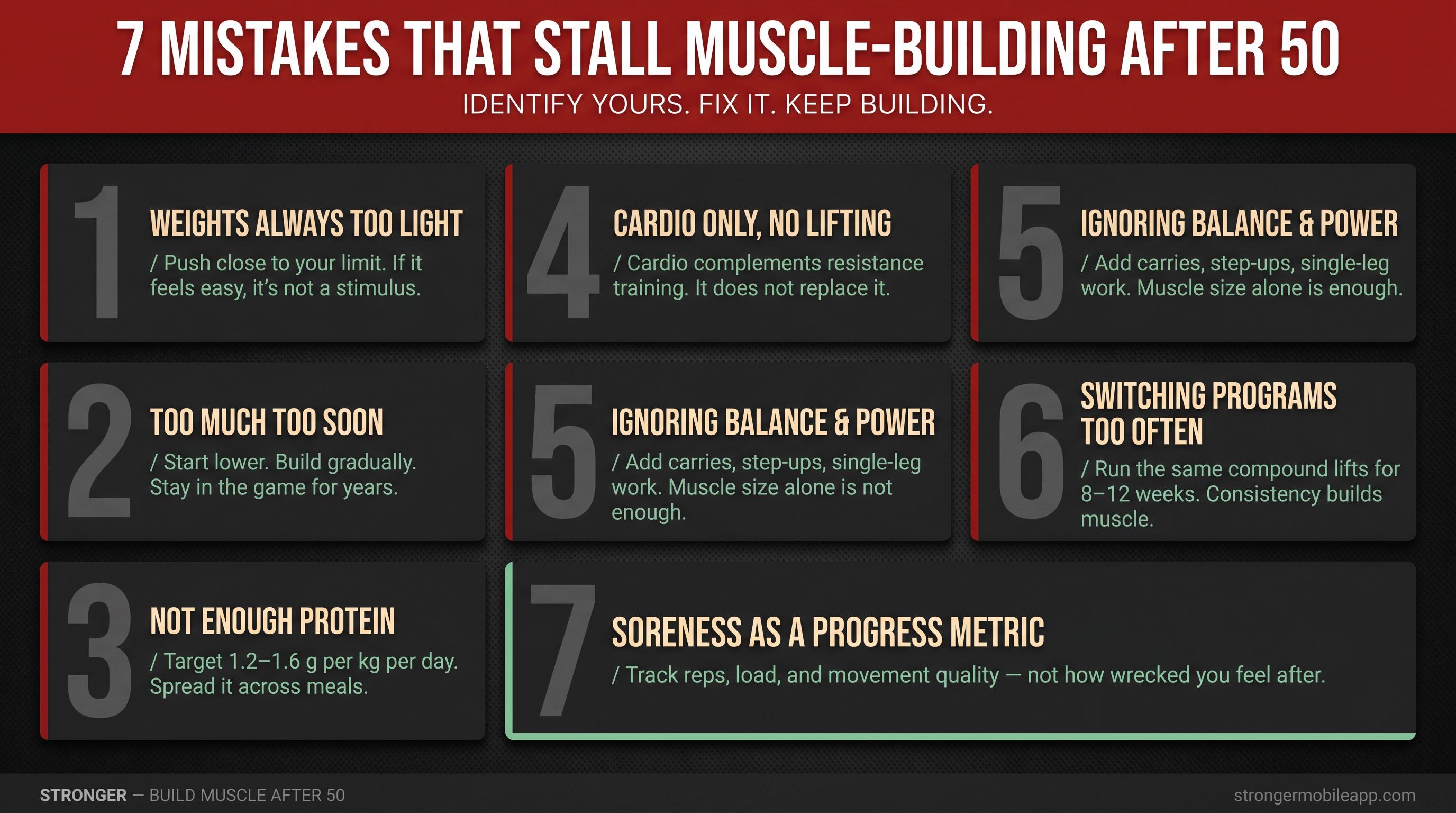
Mistake 1: Training with weights that are always too light
Light weights are appropriate at first. They're not sufficient long-term. If every set feels easy, your body has no reason to adapt. The stimulus needs to be challenging. Not maximal, but genuinely hard.
Mistake 2: Trying to do too much too soon
The opposite problem: trying to make up for lost time in the first three weeks. This usually produces excessive soreness, joint irritation, or an injury that forces a two-week break. Start lower. Build gradually. The people who win this game over years are the ones who stay in it.
Mistake 3: Not eating enough protein after 50
A low-protein diet makes muscle-building harder at any age. After 50, it becomes the most common limiting factor. Most older adults are eating significantly less than the 1.2 to 1.6 g/kg/day target. Protein isn't magic. It's required.
Mistake 4: Relying only on cardio and skipping resistance training
Cardiovascular exercise is excellent: it supports heart health, aerobic capacity, and recovery between lifting sessions. It does not, however, build or preserve muscle in the way resistance training does. CDC recommends older adults include aerobic, muscle-strengthening, AND balance activities each week, not just one category. (CDC) Cardio is a complement to resistance training, not a substitute.
Mistake 5: Ignoring balance and power training after 50
Muscle size is valuable. Fall prevention often comes down to power, coordination, and balance. Carries, step-ups, single-leg work, and eventually low-risk power drills address this in ways that pure hypertrophy work doesn't.
Mistake 6: Switching programs too often before seeing results
Muscle adaptation requires repeated exposure to the same stimuli over weeks. Switching exercises every session, or running a new program every month, prevents the body from getting good at anything. Run the same core compound lifts for at least 8 to 12 weeks. Change only when an exercise causes pain, stops progressing, or genuinely no longer fits your goals.
Mistake 7: Using muscle soreness as a measure of progress
Soreness is not a reliable signal of muscle growth. It's a signal of unfamiliar stress. The best signs of productive training are more reps, more load, better movement quality, stronger functional performance, and improved confidence. A workout that leaves you barely sore but progressively stronger every two weeks is far better than one that destroys you and sets back the next session.
Frequently asked questions about building muscle after 50
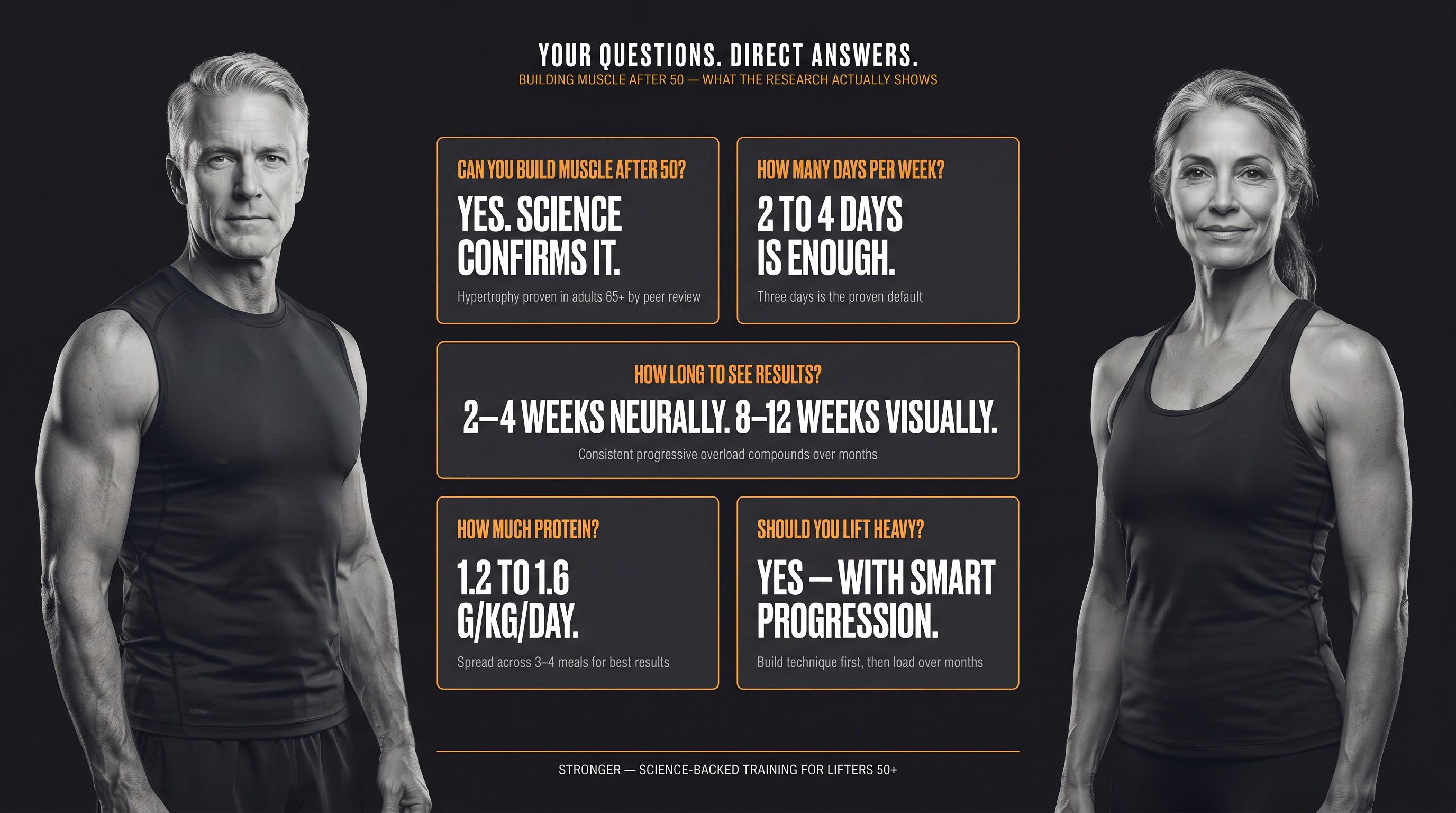
Can you really build muscle after 50?
Yes. Resistance training produces hypertrophy in older adults. A December 2024 systematic review and meta-analysis in Experimental Gerontology found that resistance training promoted muscle hypertrophy in adults 65 and older at both whole-muscle and muscle-fiber levels. (ScienceDirect)
Is it harder to build muscle after 50?
Generally, yes. Recovery tends to be slower, protein needs are higher, injury history may limit exercise selection, and neurological and hormonal changes affect strength and power output. Understanding the differences between training for hypertrophy and training for strength helps you target both intelligently. But harder doesn't mean impossible. It means the approach needs to be smarter: better nutrition, more deliberate recovery, more patient progression, and better tracking.
How many days per week should a 50-year-old lift weights?
Most people should lift 2 to 4 days per week. Two days is enough to start and enough to make meaningful progress. Three days is the best default for most people, see our guide to 3-day training splits for schedule options that fit different goals. Four days works well for experienced lifters who recover reliably.
Should you lift heavy after 50?
Yes, eventually, if you can do so safely. Heavy training is valuable for strength, bone loading, and long-term muscle maintenance. Build the technique and movement foundation first, then progress toward heavier loads over months, not weeks.
What's the best workout split after 50?
For most people, a 3-day full-body program is the best starting point. It trains each muscle group frequently, keeps sessions manageable, and provides built-in recovery days. A 4-day upper/lower split is a strong option for experienced lifters who want more weekly volume.
How much protein do you need after 50 to build muscle?
The practical target is 1.2 to 1.6 grams per kilogram of body weight per day. Active lifters may benefit from the higher end of that range. People with kidney disease or medical protein restrictions should speak with a clinician before making significant changes to protein intake.
Is creatine safe after 50?
Creatine monohydrate is generally well-studied and shows benefits for older adults when combined with resistance training. A 2025 kidney-function meta-analysis found no significant change in glomerular filtration rate with creatine at standard doses, though serum creatinine can rise modestly. (Springer) If you have kidney disease, speak with your doctor first.
Can women build muscle after menopause?
Yes. Menopause changes the hormonal environment but does not prevent muscle adaptation. A 2026 systematic review and meta-analysis found that resistance training improved strength, gait speed, and physical function in older women with sarcopenia, and that training remains one of the most effective tools for preserving muscle and independence after menopause. (Frontiers) For training structures designed specifically for women, our guide to workout splits for women covers options by goal and schedule.
How long does it take to see results after 50?
You may feel stronger and more coordinated within 2 to 4 weeks because of neural adaptations (the nervous system becomes more efficient at the new movements before the muscles grow). Visible muscle changes typically take 8 to 12 weeks or longer. Meaningful body recomposition takes months of consistent work.
Should you use machines or free weights after 50?
Both work. Machines offer stable, controlled loading that's excellent for building muscle with reduced joint stress. Free weights develop coordination and balance alongside strength. Bands and bodyweight can also produce real results when progressed appropriately. ACSM's 2026 update confirms that traditional gym equipment is not required to see meaningful benefits. (ACSM)
What if you have arthritis?
Many people with arthritis can and should strength train, but exercise selection matters. Use pain-free ranges of motion, controlled tempo, and joint-friendly tools: machines, cables, dumbbells, and supported movements. If pain is persistent or worsening with training, speak with a physical therapist before continuing.
Do you need a personal trainer after 50?
Not necessarily, but good coaching can be valuable if you're new to lifting, returning after a significant injury, or unsure about technique. Even a few sessions focused on movement quality can improve both safety and long-term progress. If in-person coaching isn't an option, apps like Stronger that provide AI-generated programs and exercise guidance can fill a meaningful part of that gap. You can also browse our full exercise library for step-by-step instructions on every movement.
The bottom line on building muscle after 50
Building muscle after 50 isn't about pretending the biology hasn't changed. It has. Recovery is slower. Protein matters more. The nervous system plays a bigger role in strength and power than it did at 30. The approach needs to be smarter.
But none of that means the process stops. The research is clear: resistance training produces real muscle growth in adults 65 and older. Heavy training at retirement age creates strength benefits that last four years. Protein combined with resistance training improves lean mass and function in older adults. Creatine helps. And the biggest benefits come not from perfecting the program, but from moving from no training to consistent training.
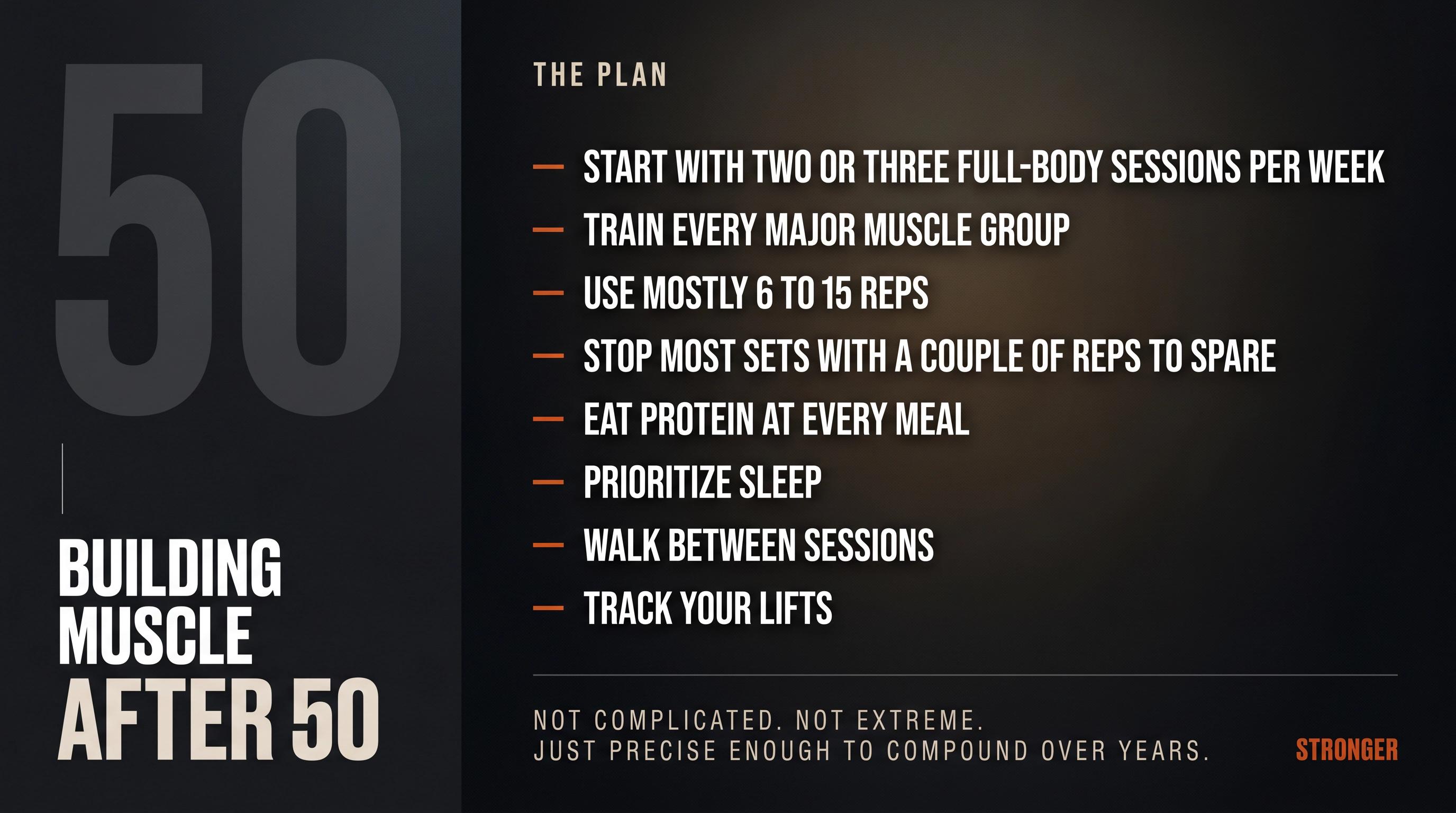
The plan:
- Start with two or three full-body sessions per week
- Train every major muscle group
- Use mostly 6 to 15 reps
- Stop most sets with a couple of reps to spare
- Eat protein at every meal
- Prioritize sleep
- Walk between sessions
- Track your lifts
That's it. Not complicated. Not extreme. Just precise enough to give your body a reason to adapt, repeated consistently enough to compound over months and years.
The people we see make the most progress after 50 aren't the ones with the perfect program. They're the ones who commit to the process, track what they do, and adjust based on what the data shows.
Stronger is built to support exactly that kind of long-term, data-driven training. Start your free trial and build the first week of your 12-week program today.
Sources
Exercises in this guide
Stronger Editorial Team
Certified strength & conditioning specialists with 10+ years of coaching experience
The Stronger editorial team produces evidence-based training content for lifters of all levels.
Ready to Get Stronger?
Join 2,000,000+ lifters tracking their workouts with Stronger. Available on iOS and Android.